
Selective Forgetting: A Graph-Based Memory Framework for Long-Term LLM Agents
Theo Rusu
Department of Computer Science
Toronto Metropolitan University
Toronto, Ontario, Canada[email protected]
Sourena Khanzadeh$^{*}$
The Creative School
Toronto Metropolitan University
Toronto, Ontario, Canada
Flybits, Creative AI Hub
Toronto, Ontario, Canada[email protected]
Manar Alalfi
Department of Computer Science
Toronto Metropolitan University
Toronto, Ontario, Canada[email protected]
$^{*}$ This work was conducted prior to the author's affiliations with Flybits and The Creative School. The author was previously affiliated with the Department of Computer Science at Toronto Metropolitan University.
Abstract
Knowledge graphs have been proposed as a structured alternative to flat retrieval-augmented generation for long-term agent memory, on the assumption that representing conversations as entities and relations improves recall. We evaluate that assumption directly. Our framework extracts each conversational turn into typed nodes and attributed edges, answers questions from a two-hop subgraph, and periodically prunes nodes that score low on a weighted combination of recency, access frequency, degree centrality, and age. On LongMemEval, the graph does not outperform a flat vector baseline at a matched candidate-generation budget of five retrieval roots: token F1 is $0.417$ against $0.468$, and a paired bootstrap over 500 questions gives $\Delta = -0.050$ (95% CI $[-0.085, -0.016]$). The gap is widest on questions that require recalling a specific prior assistant turn, where judged correctness falls from $0.911$ to $0.607$, suggesting that decomposing a turn into entities discards the surface form these questions depend on. The forgetting module is more successful. Applied once to a persistent 27,021-node graph, it removes 9.8% of nodes and 9.5% of stored bytes; token F1 is unchanged ($+0.001$, 95% CI $[-0.015, +0.016]$) and judged correctness falls by $1.6$ points, with the 95% interval bounding any loss at $3.8$ points ($[-0.038, +0.006]$). Because our extractor is a single small model evaluated on one benchmark, these results characterise this extraction-based pipeline rather than graph-structured memory in general.
Code: https://github.com/skhanzad/Selective-Amnesia
Executive Summary: This paper examines whether representing conversational history as a knowledge graph improves retrieval quality for long-term LLM agents compared with standard flat vector retrieval, and whether an explicit forgetting mechanism can keep such a graph from growing without harming performance. The work responds to the practical problem that agent memory stores expand rapidly over months of interaction, raising costs, noise, and retrieval degradation while current flat retrieval methods struggle with relational and multi-hop questions.
The authors built an extraction-based graph pipeline that turns each dialogue turn into typed nodes and attributed edges, retrieves a two-hop subgraph around the top-five matching entities, and periodically prunes nodes whose importance score—combining recency, access frequency, degree, and age—falls below a threshold. They evaluated the system on the 500-question LongMemEval benchmark, first by building a fresh graph per question and comparing it with a matched flat RAG baseline, then by ingesting all 500 conversations into one persistent graph and applying forgetting once.
The graph representation did not improve overall retrieval. Token F1 fell from 0.468 to 0.417 and LLM-judge correctness from 0.536 to 0.454 relative to the flat baseline; the largest gap appeared on questions that required recalling a specific prior assistant turn. The only category showing a small gain was temporal reasoning. In contrast, the forgetting module proved effective: applied to a 27,021-node persistent graph it removed 9.8 % of nodes and 9.5 % of storage while producing no statistically detectable change in any retrieval metric.
These results indicate that simply imposing graph structure does not solve the core limitations of long-term agent memory and can discard surface-form information that some questions depend on. At the same time, selective pruning offers a practical way to bound memory growth with bounded risk to answer quality. Systems that need both relational reasoning and precise recall will therefore require stronger update policies and hybrid retrieval mechanisms in addition to forgetting.
The findings rest on a single small extraction model and one benchmark, so they characterize this particular extraction-based pipeline rather than graph memory in general. Additional experiments with stronger extractors, alternative benchmarks, and matched random-pruning controls would be needed before the trade-offs can be generalized.
1. Introduction
Section Summary: Large language models are increasingly used as long-running personal AI assistants that must draw on past conversations to reason and respond effectively. Standard approaches store memories as simple vector embeddings for retrieval, but these methods often surface irrelevant or noisy information and struggle with complex, multi-step reasoning as data accumulates. The paper explores whether organizing memories into knowledge graphs, combined with mechanisms to selectively forget low-value details, can improve retrieval quality and keep systems efficient over extended interactions.
Large Language Models have rapidly evolved from standalone text generators into the foundation of complex, agentic systems that are able to reason, plan, and use external tools. These systems are increasingly being adopted as personal AI assistants that interact with users over prolonged periods of time. The quality of these interactions is reliant not only on the model's immediate reasoning ability, but also on the model's capacity to incorporate information from past exchanges. As such, memory becomes a critical component of these systems and is typically classified into two subcategories: short-term memory and long-term memory.
The current widely adopted long-term memory approach is retrieval-augmented generation [1], where dense vector stores are indexed and queried at inference time to retrieve relevant entries that augment the model's output. This method models memory as a flat, similarity-based retrieval system, which has been shown to be sensitive to noise, prone to retrieving irrelevant or redundant context, and is limited in its ability to support multi-hop reasoning or maintain coherent long-term knowledge [2].
To address these limitations, recent work has explored structured memory representations based on knowledge graphs, where information is organized as entities and their relationships rather than independent embeddings. In these systems, memories are encoded as nodes and edges, allowing more complex semantic and relational representations to be stored [3, 4].
However, existing graph-based approaches mainly focus on how information is added and maintained for consistency [5]. This does not address a fundamental challenge of long-term memory systems: unbounded growth. As interactions accumulate over time, memory stores become increasingly large, creating a range of downstream negative effects, including degraded retrieval quality, higher computational cost, and the retention of low-utility information.
As memory accumulates over prolonged interactions, the system must integrate new information and manage the relevance of existing knowledge. Prior work in continual learning and neural memory systems has shown that effective memory requires mechanisms for selective retention and forgetting, as retaining all information leads to performance degradation [6, 7].
In this work, we investigate whether structuring long-term conversational memory as a knowledge graph meaningfully improves retrieval and reasoning in LLM agents, and whether systems can remain efficient over extended interactions. We introduce a graph-based memory framework with an explicit forgetting module that controls the lifecycle of stored information. Rather than assuming structural representations are uniformly beneficial, our study empirically characterizes where graph-based memory helps and where it degrades performance. In addition, we show that selective forgetting based on recency, frequency, and structural importance can reduce memory size without materially affecting retrieval quality. These findings highlight that effective long-term memory requires structured representation and careful design of update and retention mechanisms.
2. Related Work
Section Summary: Previous research on memory for LLM-based agents has explored explicit external stores, retrieval-augmented generation that pulls in relevant passages via similarity search, and graph-structured representations that capture relationships between facts. These approaches improve how models retain and access information across sessions, yet most treat memory as a growing collection of entries that is rarely pruned, leading to noise, redundancy, and inefficiency over time. A smaller set of studies has begun incorporating forgetting mechanisms or evaluation benchmarks for long-term recall, providing the foundation for methods that actively manage memory growth while preserving useful structure.
2.1 Memory in LLM-based Agents
Equipping neural systems with explicit memory predates the current generation of language models. Early differentiable architectures such as Neural Turing Machines [8] and End-to-End Memory Networks [9] coupled a controller with an addressable external store, establishing the read/write abstraction that later memory systems inherit. As LLMs became the backbone of agentic systems, memory was repurposed to persist information between turns and sessions rather than within a single forward pass [10]. A common design is the memory stream of Generative Agents [11], which logs observations and retrieves them using a combination of recency, importance, and relevance, and periodically synthesizes higher-level reflections. Subsequent systems extend this idea along different axes: MemoryBank [12] introduces an updating scheme inspired by the Ebbinghaus forgetting curve [13]; MemGPT [14] treats memory as an operating-system-style hierarchy that pages information between a bounded context window and external storage; ReadAgent [15] compresses very long contexts into gist memories; and Think-in-Memory [16], Self-Controlled Memory [17], and MemLLM [18] give the model explicit control over what is stored and recalled. These approaches also enable long-term dialogue settings studied by [19]. Most of this line of work, however, organizes memory as a flat collection of entries and emphasizes writing and reading rather than principled removal.
2.2 Retrieval-Augmented Generation
The dominant strategy for grounding LLM outputs in external knowledge is retrieval-augmented generation [1], which retrieves relevant passages from a non-parametric store and conditions generation on them. Dense retrieval [20] and jointly pre-trained retrieval-reading models such as REALM [21] and RETRO [22] improved retrieval quality on scale, while retrieval has been shown to reduce hallucinations in dialogue [23]. More recent variants add self-reflective control over when and what to retrieve [24] and specialize models for conversational settings [25]. However, as surveyed by [2], RAG fundamentally models memory as a flat, similarity-based lookup over independent embeddings. This makes it sensitive to retrieval noise and redundancy and limits its capacity for multi-hop reasoning or maintaining coherent long-term knowledge, motivating more structured representations of memory.
2.3 Graph-Structured Memory
Knowledge graphs offer a structured alternative in which information is represented as entities and the relations between them [3, 4]. A growing body of work integrates such structure with LLMs [26], ranging from prompting with retrieved triples [27] to letting the model reason by traversing a graph [28]. For retrieval specifically, GraphRAG [29] constructs an entity graph and community summaries to support query-focused summarization, and HippoRAG [30] draws on hippocampal indexing theory to combine a knowledge graph with graph-based retrieval for long-term recall. In the agent-memory setting, systems such as Mem0 [5] adopt graph representations to store and consolidate user information across sessions. These methods demonstrate the benefits of relational structure for retrieval and reasoning, but they concentrate on how information is added and kept consistent and largely leave unbounded growth of the memory store unaddressed.
2.4 Forgetting and Memory Retention
The need to forget is well established outside of agent memory. In human cognition, retention decays predictably over time [13]. In neural networks, naive sequential learning induces catastrophic forgetting [31], prompting mechanisms that protect important parameters [6]; the broader phenomenon of forgetting in deep learning is surveyed by [32], and machine unlearning studies the deliberate removal of specific information [33]. A consistent finding across these areas is that effective memory requires selective retention rather than indefinite accumulation. This principle has only recently been applied to agent memory: FadeMem [7] introduces biologically inspired forgetting to keep agent memory efficient. Our work is closest in spirit to this direction, but couples forgetting with a graph-structured store: rather than treating retention as a post-hoc filter over flat entries, we integrate a forgetting module into the life cycle of nodes and edges, so that obsolete or low-utility memories are removed while relational structure is preserved.
2.5 Evaluating Long-Term Memory
Assessing memory over extended interactions requires dedicated benchmarks. LoCoMo [34] evaluates very long-term conversational memory, and LongMemEval [35] probes chat assistants on long-term interactive memory abilities such as multi-session reasoning and knowledge updates. We adopt LongMemEval to evaluate whether structured memory with forgetting sustains high-quality recall as interactions accumulate.
3. Methodology
Section Summary: The study introduces a graph-based memory system for conversations that represents ongoing interactions as an evolving knowledge graph of entities and their relationships, rather than isolated text embeddings. It processes each exchange through a three-stage pipeline that retrieves the most relevant subgraph to provide context for responses, extracts and adds new entities and links from the current turn, and periodically prunes less important nodes to keep the graph from growing indefinitely. Supporting steps include using an LLM to pull structured information according to a fixed ontology, embedding nodes for similarity searches, deduplicating repeated entities, and scoring nodes by factors such as recency and access frequency before deciding what to retain.
This study proposes a graph-based conversational memory framework that models interactions as a structured, evolving knowledge graph. Rather than storing past exchanges as independent embeddings, the system maintains entities and their relationships as nodes and edges, continuously updates this graph as new conversational turns arrive, and periodically prunes low-importance nodes to bound graph growth over long interactions.
3.1 Architecture
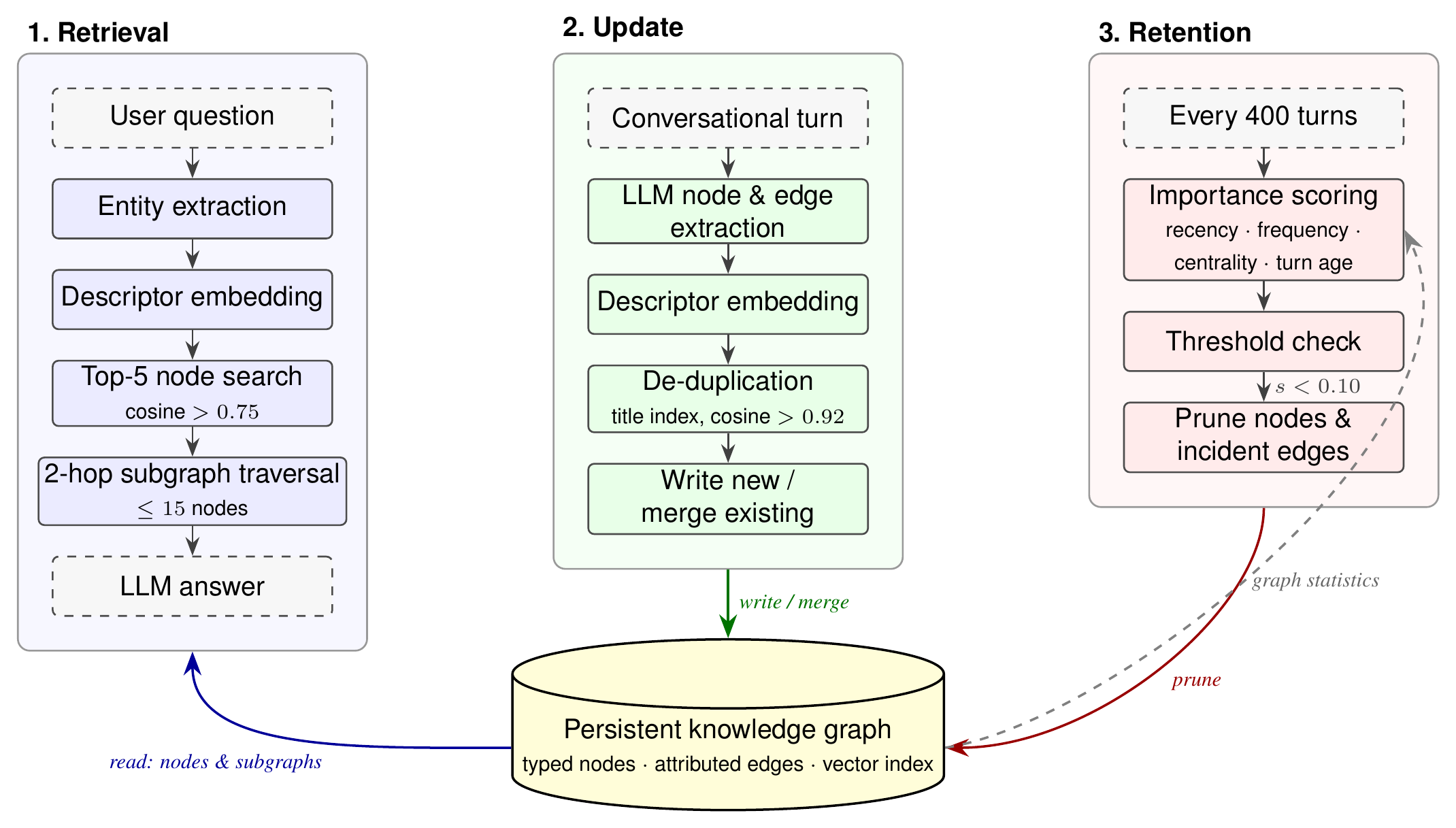
The framework is organized as a three-stage pipeline: retrieval, update, and retention. In the retrieval stage, the subgraph most relevant to the current question is selected and serialized as context for answer generation. In the update stage, an LLM extracts entities and relationships from the current conversational turn and integrates them into the knowledge graph. In the retention stage, a forgetting module scores every stored node and removes those whose importance falls below a threshold, bounding graph growth and discarding low-utility information. Figure 1 gives an overview of the full pipeline and how the three stages interact with the persistent knowledge graph.
3.2 Knowledge Graph Schema
The graph consists of typed nodes and edges with both types and attributes. Each node carries a label, a short title, a natural-language content description, a flat attributes dictionary, and system fields for temporal, access, and retention tracking (created_at, access_count, last_accessed_at, turns_at_creation, importance_score).
Nine node labels are defined in a fixed ontology: Person, Organization, Location, Event, Concept, Artifact, Preference, Goal, and Skill. Edges connect pairs of nodes via a typed relationship predicate and may carry their own attributes dictionary to capture relational properties such as duration, confidence, or quantity without introducing additional nodes.
3.3 Extraction Pipeline
Each conversational turn is processed by a single LLM extraction call (GPT-4o-mini) using a structured system prompt that defines the ontology, output schema, and extraction rules. Turns are prefixed with their speaker role ([Role: user] or [Role: assistant]) so the extractor handles each appropriately.
User and assistant turns are processed differently during extraction. For user turns, the system captures facts about the user, including their preferences, goals, skills, and relationships. Assistant turns are processed in two modes: (a) user-related facts that the assistant references or confirms, and (b) factual claims, recommendations, and named-entity information stated by the assistant, enabling the system to recall information provided in prior turns.
Turns that contain only superfluous or generic filler words produce empty output.
The extractor returns strict JSON conforming to the graph schema. A validation layer rejects any output that fails to parse, references undefined ontology types, or contains structurally invalid node-edge references.
3.4 Embedding and De-duplication
Node descriptors are constructed from each node's label, title, and content and embedded using nomic-embed-text served locally via Ollama. The resulting vectors are stored alongside each node in the graph's vector_index dictionary and persisted with the graph JSON file.
Before a new node is written to the graph, two de-duplication checks are applied in sequence. The first is title-based: if an existing node shares the same label and normalized title as the incoming node, it is identified as a match and the embedding check is skipped entirely. To enable the title-based check, the system maintains a title_index - a dictionary mapping each node's normalized title to its node ID — which is updated whenever a new node is created, allowing O(1) lookup without any vector computation. The second is embedding-based, applied only when the title check finds no match: the incoming node's vector is compared to all stored vectors via linear cosine scan; if the nearest existing node has a cosine similarity above 0.92, it is treated as the same entity. When either check identifies a match, the matched node's access_count and last_accessed_at fields are updated, providing a frequency signal to the importance scoring module before formal retrieval occurs.
3.5 Subgraph Retrieval
At inference time, a lightweight extraction call identifies the entities referenced by the current question and embeds their descriptors. An exhaustive cosine-similarity search is performed over all stored node embeddings. Nodes with a similarity score above 0.75 are retained and ranked by score. We use breadth-first search (BFS) starting from the top-5 retrieved nodes, expanding the graph up to two hops from these root nodes and stopping once a maximum of 15 nodes has been collected. Justifications for these parameter choices are provided in Appendix A.2.
The retrieved nodes and edges are serialized as a compact textual representation and included into the answer-generation prompt as contextual memory.
Visited nodes in a retrieved subgraph has its access_count incremented and last_accessed_at updated to the current session timestamp.
3.6 Importance Scoring and Forgetting
Each node is assigned an importance score that combines four components:
$ \begin{aligned} \text{Score} =\ & w_r \cdot \text{recency}(t) + w_f \cdot \text{frequency}(c) \ & + w_c \cdot \text{centrality}(d) + w_t \cdot \text{turns_decay}(k), \end{aligned} $
where recency is an exponential decay from the node's last access timestamp with a 90-day half-life; frequency is the log-normalized access count; centrality is the log-scaled edge degree; and turns_decay is an exponential decay from the node's creation turn with a 1,000-turn half-life. The weights are set to $w_r = 0.35$, $w_f = 0.25$, $w_c = 0.20$, $w_t = 0.20$.
The forgetting module is invoked every 400 conversational turns. All nodes whose importance score falls below 0.10 are pruned, together with every edge incident to those nodes. Additional details are provided in Appendix A.2.
4. Experiments
Section Summary: The section describes two experiments that test whether structuring conversational memory as a knowledge graph improves retrieval accuracy over a standard vector-based approach, and whether an added forgetting mechanism can shrink the graph’s size without hurting performance. Both experiments rely on the LongMemEval benchmark, which contains 500 questions drawn from multi-session dialogue histories spanning roughly three years. In the first experiment, fresh graphs and flat vector stores are built for each question’s conversation history and compared on precision, F1, and LLM-judged correctness; the second builds one persistent graph across all histories and measures how applying forgetting after ingestion affects storage and answer quality.
This section presents two experiments designed to evaluate (1) whether a knowledge graph retrieval mechanism improves answer accuracy over a flat vector baseline, and (2) whether the proposed forgetting module can reduce graph storage without degrading retrieval quality. In all experiments, the underlying language model is held constant and only the retrieval and memory mechanisms are varied.
4.1 Dataset
Both experiments use the LongMemEval benchmark [35], a dataset designed to evaluate long-term conversational memory in dialogue systems. The benchmark consists of 500 questions, each paired with a multi-session conversation history, referred to as the haystack, which contains the information required to answer the question. Haystack sessions span real historical dates covering approximately 33 months (June 2021 – February 2024), with each question drawing on between one and several sessions.
Questions are categorized into six types that probe distinct memory demands. Single-session (user) questions ask about facts the user stated directly, such as personal attributes or past events. Single-session (assistant) questions require recalling specific information the assistant provided in a prior turn, such as a recommendation or a factual explanation. Single-session (preference) questions target implicit or explicit user preferences expressed in conversation. Knowledge-update questions test whether the system correctly tracks values that changed across sessions, favoring the most recent statement over earlier ones. Multi-session questions require aggregating information spread across two or more separate sessions. Temporal-reasoning questions demand ordering events or computing time intervals from information embedded in the haystack.
4.2 Experiment 1: Retrieval Quality and Knowledge Retention
The goal of Experiment 1 is to determine whether structuring conversational memory as a knowledge graph improves retrieval quality over a flat vector baseline. For each of the 500 questions, a fresh knowledge graph is built from that question's haystack sessions alone, then used to answer the question. The baseline stores the same haystack turns as raw text chunks in a flat vector store and retrieves the top-5 most similar chunks at query time. Both systems use the same language model for answer generation, and neither has access to information outside the question's own haystack.
Performance is measured using token-level precision and F1-score, and an LLM-as-judge correctness score (binary, averaged across questions).
\begin{tabular}{lcccccccc}
\hline
  {} & \multicolumn{4}{c}{\textbf{Graph RAG (Ours)}} & \multicolumn{4}{c}{\textbf{Baseline RAG}} \\
\cmidrule(lr){2-5} \cmidrule(lr){6-9}
\textbf{Type} & \textbf{n} & \textbf{P} & \textbf{F1} & \textbf{J} & \textbf{n} & \textbf{P} & \textbf{F1} & \textbf{J} \\
\hline
Single (user) & 70 & 0.743 & 0.737 & 0.771 & 70 & 0.823 & 0.819 & 0.929 \\
Single (asst.) & 56 & 0.680 & 0.575 & 0.607 & 56 & 0.916 & 0.774 & 0.911 \\
Single (pref.) & 30 & \textbf{0.312} & 0.083 & 0.233 & 30 & 0.274 & 0.114 & 0.367 \\
Know.-update & 78 & 0.507 & 0.456 & 0.513 & 78 & 0.553 & 0.511 & 0.590 \\
Multi-session & 133 & \textbf{0.384} & 0.326 & 0.398 & 133 & 0.381 & 0.342 & 0.436 \\
Temporal & 133 & \textbf{0.468} & 0.328 & \textbf{0.293} & 133 & 0.416 & 0.334 & 0.278 \\
\hline
\textbf{Overall} & \textbf{500} & \textbf{0.505} & \textbf{0.417} & \textbf{0.454} & \textbf{500} & \textbf{0.532} & \textbf{0.468} & \textbf{0.536} \\
\hline
\end{tabular}
4.3 Experiment 2: Long-Term Memory Efficiency Under Forgetting
The goal of Experiment 2 is to determine whether the forgetting module can compress the knowledge graph without degrading its retrieval quality. A single persistent graph is built by ingesting the haystack sessions for all 500 questions in a sequence, simulating a long-running deployment in which a system accumulates memory across many independent interactions. Two variants are compared: a no-forgetting graph that retains every node, and a forgetting graph to which the forgetting module is applied once ingestion is complete. Both variants then answer all 500 benchmark questions, and their retrieval quality and storage footprints are compared.
::: {caption="Table 2: Experiment 2 results: storage and retrieval quality for the persistent graph with and without forgetting."}

:::
5. Discussion and Limitations
Section Summary: The experiments show that turning conversations into a knowledge graph does not consistently improve retrieval compared with a simple flat store of text, and can even hurt performance when precise wording or specific facts need to be recalled. Graphs help most with questions that involve time or relationships between events and people, but they lose detail by breaking statements into abstract nodes and links. A selective forgetting process can shrink the stored graph by about 9 percent with only a small drop in answer quality, suggesting that long-term memory systems will need a mix of structured links and ways to keep important raw details.
The experiments reveal two complementary findings about graph-based long-term memory. First, representing conversational memory as a knowledge graph does not uniformly improve retrieval over a flat vector store. Second, once memory is represented as a persistent graph, selective forgetting can substantially reduce its size while largely preserving retrieval quality.
In Experiment 1, the baseline RAG system outperforms Graph RAG overall, achieving a token F1 of 0.468 compared with 0.417 and an LLM-judge accuracy of 0.536 compared with 0.454. However, performance varies across question types, indicating that the usefulness of graph structure depends on the type of information being retrieved.
Graph RAG achieves its only improvement on the LLM-judge metric for temporal-reasoning questions (0.293 vs. 0.278). This task is naturally aligned with a graph representation: events can be represented as typed nodes with temporal attributes and connected to the entities that participate in them, allowing retrieval to preserve relational and temporal structure. In contrast, flat chunk retrieval does not explicitly represent event participants, ordering, or temporal relationships.
The largest performance deficit occurs for single-session (assistant) questions (judge: 0.607 vs. 0.911). These questions often require recalling a specific recommendation or factual statement from a previous assistant response. The flat baseline can retrieve the original assistant turn verbatim, whereas graph extraction decomposes the turn into entities and relationships. In doing so, it may lose information about which item or statement was specifically emphasized. This highlights an important limitation of extraction-based memory representations: structured abstraction can improve relational organization while simultaneously discarding information required for precise or verbatim recall.
Graph RAG also underperforms on knowledge-update questions (F1: 0.456 vs. 0.511). Inspection of failures indicates that the current conflict-resolution policy can retain an earlier attribute value instead of replacing it with a more recent value when no explicit confidence score is available. A last-write-wins policy for appropriate factual and numeric attributes could therefore improve performance on knowledge-update tasks. Smaller deficits on multi-session and single-session (user) questions appear to arise from related extraction and retrieval effects. Although graph structure can support cross-session entity linking, imperfect extraction and entity merging introduce retrieval noise, while concise facts that are directly preserved in raw text may be abstracted during graph construction.
Experiment 2 examines a different property of the memory system: whether accumulated graph memory can be reduced without substantially degrading retrieval. Applying the forgetting mechanism removes 2, 653 nodes (9.8%) and 2, 560 edges (5.5%), reducing the graph size from 440.6 MB to 398.6 MB, a 9.5% reduction. Token-level F1 remains nearly unchanged, increasing from 0.292 to 0.293, while LLM-judge accuracy decreases from 0.300 to 0.284.
Absolute retrieval performance in Experiment 2 is lower than in Experiment 1 because all 500 haystacks are merged into a single persistent graph, introducing cross-conversation retrieval interference. The purpose of this experiment is therefore not to maximize retrieval accuracy, but to compare the same persistent-memory setting with and without forgetting.
The nodes removed by the forgetting mechanism fall below the importance threshold after the simulated conversation period and are characterized by low re-reference frequency, limited structural connectivity, and reduced recency. Their removal has little effect on token-level F1, suggesting that the importance function preferentially removes peripheral information that contributes relatively little to retrieval. The reduction in LLM-judge accuracy, however, indicates that some pruned information can still contribute to correct answers, highlighting a trade-off between memory efficiency and information retention.
Taken together, these results suggest that graph structure alone is not sufficient to improve long-term conversational memory. Its benefits are strongest when relationships and temporal structure are important, whereas flat text retrieval remains advantageous for precise or verbatim recall. At the same time, explicit retention mechanisms provide a practical way to control the growth of persistent memory. Effective long-term memory systems may therefore benefit from combining structured representations with stronger update policies, selective retention, and mechanisms that preserve access to information for which verbatim context remains important.
6. Conclusion
Section Summary: This study shows that organizing conversation memory into a knowledge graph helps connect related ideas over time but can also cause loss of exact details needed for precise recall. Better performance requires more than just the graph structure itself, since success depends on how information is extracted, updated, and kept or discarded. A new forgetting module safely prunes low-value data to save space with no measurable drop in results, suggesting that effective long-term memory needs structured representations paired with strong update and retention methods.
This study demonstrates that structuring conversational memory as a knowledge graph introduces both benefits and limitations. While relational representations can support reasoning over temporally and semantically connected information, they also incur information loss that negatively impacts tasks requiring precise or verbatim recall. These results indicate that improvements in memory systems cannot be achieved through representation alone. Instead, performance depends critically on how information is extracted, updated, and retained over time.
The proposed forgetting module contributes a retention mechanism whose cost we can bound: pruning the low-importance tail of a 27,021-node store removed 9.8% of nodes and 9.5% of bytes, and a paired bootstrap over 500 questions detects no significant change in any of the four metrics (Table 7). Overall, the findings suggest that effective long-term memory systems should combine structured representations with stronger update mechanisms and selective retention strategies, rather than relying on a single approach in isolation.
Author Contributions
Section Summary: In this research project, Sourena Khanzadeh came up with the core idea and set the initial direction for the work. Theo Rusu carried out the main implementation tasks and conducted the experiments. Manar Alalfi provided overall supervision along with technical and academic guidance to the team.
Sourena Khanzadeh conceived the research idea and formulated the initial research direction. Theo Rusu was primarily responsible for the implementation and experimental execution. Manar Alalfi supervised the research and provided technical and academic guidance.
Appendix
Section Summary: The appendix explains that the study operated under tight compute and API limits on ordinary hardware, restricting experiments to just four complete runs of 500 questions each rather than broader testing, and therefore the results describe only this particular extraction-based graph system rather than graph memory approaches in general. It also notes that language models were used both as core components for building and evaluating the memory pipeline and as drafting aids for the paper itself, with all final technical decisions and responsibility remaining with the authors. The section further justifies each experimental parameter—such as retrieval thresholds, graph expansion depth, and forgetting rules—by showing whether it was tuned on small test data, dictated by cost, or chosen to match the baseline system for fair comparison.
A.1 Note to Reviewers on Experimental Scope and AI Use
Budget Constraints.
This work was carried out under a fixed compute and API budget on the consumer-grade workstation described above. We state the resulting scope limits explicitly so that our claims are read at the right granularity. Every configuration we evaluate requires re-ingesting the haystack sessions for all 500 LongMemEval questions, which costs one extraction call per conversational turn, plus one generation and one judge call per question. A single evaluated configuration is therefore expensive, and the budget admitted a small number of complete runs rather than a sweep. We chose to spend it on four full runs (Experiment 1 treatment and control, Experiment 2 treatment and control) at $n=500$ with temperature $=0$, and to report paired bootstrap intervals over those runs, rather than on a larger number of partially evaluated configurations.
Accordingly, our findings should be read as characterising this extraction-based graph memory pipeline at this model scale, not graph-structured memory in general. Given additional budget, our order of priority would be: a matched-compression control that prunes the same fraction of nodes at random, to isolate the contribution of the importance function; a second benchmark; and a stronger extraction model.
Use of Generative AI.
We distinguish two uses of language models in this work. First, as components of the method itself: GPT-4o-mini performs knowledge-graph extraction and answer generation, and serves as the LLM judge, as described in Sections 3.3 and 4.1. Second, as authoring tools. In the latter role, we used gpt5.6 sol to draft prose in the appendix and to assist with literature search, and Opus 4.8 to assist with implementing the experimental pipeline. The main technical content, including the experimental design, the analyses, and the interpretation of results, is the authors' own; model assistance on those sections was limited to grammar and formatting. All AI-assisted output was reviewed by the authors, all cited references were checked against their original sources, and the authors take full responsibility for the content of the paper.
A.2 Justification for parameter values chosen for the experiments and methodology.
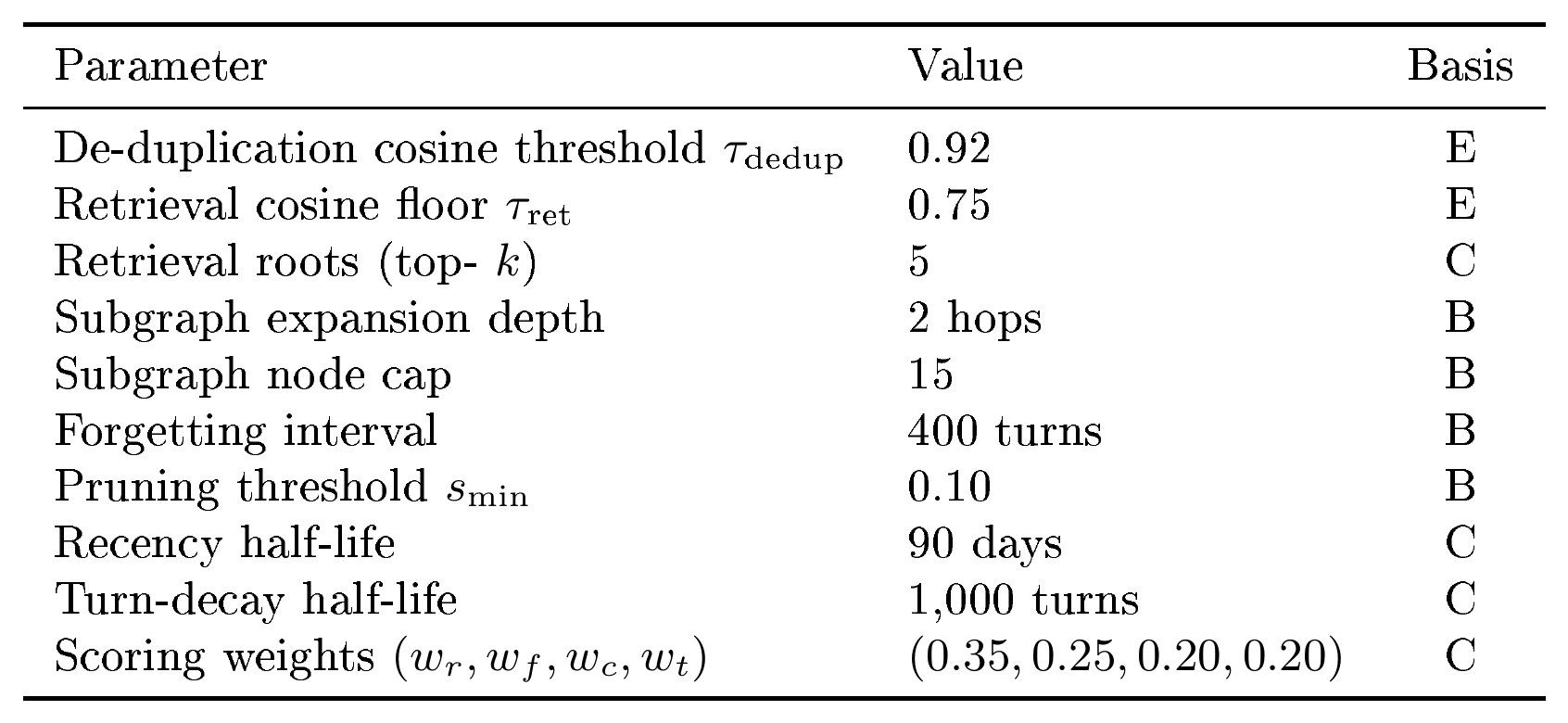
Table 3 lists every free parameter of the system together with its setting and the basis on which it was chosen. We distinguish three cases: values selected empirically on a small probe set (E), values fixed a priori from a budget or cost constraint (B), and values fixed by convention or by symmetry with the baseline (C). We did not perform a full sweep over the retention parameters; the consequences of this are discussed at the end of this section.
::: {caption="Table 3: Parameters, settings, and basis for selection. E = empirical probe, B = budget or cost constraint, C = convention or symmetry with the baseline."}
:::
De-duplication threshold. Selected by the probe procedure described in Appendix A.5. The value is deliberately conservative because the two error modes are not symmetric: a false merge collapses two distinct entities irreversibly and corrupts every edge incident to them, whereas a missed merge only leaves redundant nodes that later de-duplication passes or the retrieval stage can still surface. We therefore accepted a higher false-negative rate in exchange for a low false-merge rate.
Retrieval cosine floor. Descriptor embeddings produced by nomic-embed-text are anisotropic, so cosine similarity between unrelated short descriptors does not concentrate near zero. A floor of 0.75 admits paraphrases and partial mentions of the same entity while excluding nodes that are merely topically adjacent. This parameter is not load-bearing: because candidates are subsequently ranked and truncated to the top 5, the floor only affects queries for which fewer than five nodes clear it, in which case the system correctly retrieves a smaller context rather than padding it with unrelated nodes.
Number of retrieval roots. Set to 5 to match the number of chunks retrieved by the flat vector baseline (Section 4.2), so that the two systems are compared at an equal candidate-generation budget and any difference in performance is attributable to the representation rather than to the number of retrieval hits.
Expansion depth and node cap. One hop from a seed node returns only its immediate neighbours, which for most seeds is the set of attributes attached to a single entity and therefore adds little beyond the seed itself. Three or more hops expand super-linearly in a merged graph, and inspection showed that nodes at that distance are typically related to the seed through a hub entity rather than through any relation relevant to the query. Two hops is thus the smallest depth that supports the relational and multi-session cases the graph representation is intended to serve.
Forgetting interval and pruning threshold. Scoring is $O(N + M)$ in the size of the graph, so invoking it rarely amortizes its cost across many conversational turns; 400 turns is also long enough for the recency and turn-decay terms to separate nodes that are genuinely dormant from nodes that happen not to have been accessed recently. The threshold of 0.10 was set to be conservative, targeting only the tail of the score distribution rather than a fixed compression ratio. This choice determines the operating point reported in Experiment 2 and is the reason the reported reduction is approximately 10% rather than a larger figure.
Half-lives and scoring weights. The 90-day recency half-life is set relative to the temporal span of the LongMemEval haystacks, which cover roughly 33 months of real timestamps; a substantially shorter half-life would saturate the recency term for nearly all nodes, and a substantially longer one would flatten it. The 1,000-turn decay half-life plays the same role with respect to ingestion order. The weights were fixed a priori and were not tuned: they encode a prior, drawn from the memory-stream and forgetting-curve literature ([11, 12]), that access-driven signals (recency, frequency) should dominate structural and age-based ones.
Limitation. The retention parameters $(w_r, w_f, w_c, w_t)$, $s_{\min}$, and the forgetting interval were not swept, so Experiment 2 characterises a single point on the compression–quality trade-off rather than the curve. We also do not isolate the contribution of the individual scoring components; establishing that the four-term importance function outperforms a simpler retention rule at matched compression is left to future work.
Compute Environment.
All experiments were conducted on a local workstation equipped with an AMD Radeon RX 7800 XT GPU, 16 GB of system RAM, and an Intel Core i5-9400F CPU. This configuration was used for local execution of the memory pipeline, graph operations, embedding-related workloads and we utilized OpenAI model, mainly (gpt4o-mini) for API calls.
A.3 Role-Aware Extraction Prompt
This role-aware variant explicitly distinguishes user and assistant turns and specifies which assistant-provided facts should be retained.
Extract a knowledge graph from a conversation turn.
Return strict JSON only -- no markdown, no preamble.

Each turn is prefixed with its speaker role:
  [Role: user] -- the human speaking directly
  [Role: assistant] -- the AI assistant responding

ROLE HANDLING:
...
A.4 Sample Knowledge-Graph Extraction Prompt
The following example illustrates the structure of the extraction prompts used throughout our experiments.
You are a knowledge graph extraction engine. Given a single
conversational message, extract all relevant nodes, edges, and
attributes and return the result as strict JSON.

NODES:
Represent discrete entities mentioned or implied in the message,
such as people, organizations, locations, skills, goals, events,
preferences, and artifacts.

EDGES:
Represent directed relationships between nodes. Use precise,
domain-relevant relationship labels whenever possible.

ATTRIBUTES:
Represent additional properties associated with a node or edge,
including quantities, dates, durations, frequencies, or other
qualifying information.

REQUIREMENTS:
1. Extract every explicitly stated fact.
2. Do not introduce information that is not supported by the input.
3. Use only the predefined node labels.
4. Return valid JSON only.
5. Do not include explanations, markdown, or additional commentary.

OUTPUT FORMAT:
{
  "nodes": {
  "<node_id>": {
  "label": "<node_label>",
  "title": "<short_title>",
  "content": "<description>",
  "attributes":
  }
  },
  "edges": {
  "<edge_id>": {
  "source": "<source_node>",
  "target": "<target_node>",
  "relationship": "<relationship>",
  "attributes":
  }
  }
}

USER MESSAGE:
<conversation turn>
A.5 Algorithms
Algorithm 1 summarizes the memory ingestion pipeline. Given a conversational turn, the system first extracts a structured set of nodes and edges and embeds each extracted node. Candidate nodes are matched against existing memory using exact title matching followed by semantic similarity. Matches above the deduplication threshold $\tau_{\mathrm{dedup}}$ are mapped to existing nodes, while unmatched entities are assigned new identifiers. For standard operation, the same message is additionally converted into retrieval entities, which are used to identify and expand a relevant graph subgraph that is serialized as contextual memory. The extracted nodes and edges are then written to persistent memory, and an optional forgetting pass is triggered according to the configured memory-maintenance policy.
Require: User message $m$, memory graph $G$
Ensure: Updated graph $G$ and retrieved context $\mathcal{C}$
$E \gets \textsc{Extract}(m)$
// Extract nodes and relations
$Z \gets \textsc{Embed}(E.\text{nodes})$
// Embed extracted entities
for all $n \in E.\text{nodes}$ do
  $v \gets \textsc{Match}(n, Z_n, G)$
  if $v$ is sufficiently similar to $n$ then
    $\textsc{Merge}(n,v,G)$
  else
    $\textsc{AddNode}(n,G)$
  end if
end for
$\textsc{AddRelations}(E.\text{edges},G)$
$Q \gets \textsc{ExtractQueryEntities}(m)$
$R \gets \textsc{RetrieveRelevantNodes}(Q,G)$
$S \gets \textsc{ExpandSubgraph}(R,G)$
$\mathcal{C} \gets \textsc{Serialize}(S)$
if $ForgettingTriggered$ $(G)$ then
  $G \gets \textsc{Forget}(G)$
end if
return $(\mathcal{C},G)$
Deduplication Threshold Selection.
To identify an appropriate deduplication threshold, we constructed a sequence of prompts containing repeated references to the same underlying entities while varying the wording and contextual phrasing across prompts. This allowed us to evaluate how consistently semantically equivalent entities were merged as the similarity threshold changed. We then selected the threshold that provided the best trade-off between correctly merging duplicate entities and avoiding incorrect merges between distinct entities.
A.6 Computational Complexity
Let $N$ and $M$ be the number of nodes and edges in the memory graph, $d$ the embedding dimension, $k$ the number of entities extracted from an incoming message, $\ell$ the number of relations extracted with them, and $q$ the number of entities extracted from a query. Table 4 summarises the cost of each stage; we exclude the internal cost of the LLM and embedding calls, which depends on token lengths rather than on graph size.
\begin{tabular}{lll}
\toprule
Stage & Cost & Note \\
\midrule
Embed extracted entities & $O(kd)$ & \\
Title de-duplication & $O(1)$ per entity & hash index \\
Embedding de-duplication & $O(kNd)$ & linear scan \\
Graph write & $O(k+\ell)$ & indexed updates \\
Candidate retrieval & $O(qNd)$ & linear scan \\
Subgraph traversal & $O(N + M + |V_S| + |E_S|)$ & adjacency build \\
Forgetting & $O(N+M)$ every $T$ turns & amortized $O\!\left(\tfrac{N+M}{T}\right)$ \\
\bottomrule
\end{tabular}
Two exhaustive vector scans dominate, one at de-duplication and one at retrieval, giving a worst-case per-turn cost of
$ O\big((k+q)Nd + N + M\big) ;=; O(Nd + M), $
since $k$, $q$, and the subgraph size are bounded by construction (the traversal is capped at 15 nodes). The $N+M$ term arises only because the adjacency representation is rebuilt at query time and would vanish if it were persisted alongside the graph. Space complexity is $O(Nd + N + M)$, where $Nd$ accounts for stored embeddings and $N+M$ for graph structure and metadata.
The linear-scan terms are therefore the only components that grow with memory size, and both are incidental to the design: replacing the exhaustive search with an approximate nearest-neighbour index would reduce the $O(Nd)$ factor substantially, leaving the forgetting module as the mechanism that bounds $N$ itself.
A.7 Statistical Significance of Experimental Results
We report the statistical significance of the results underlying our main claim, namely that the forgetting module handles long-term memory growth efficiently: it substantially reduces graph storage (Table 2) without a statistically significant loss in answer quality. All intervals below are computed post-hoc over the per-question results produced by our benchmark runs (Section 4); no additional model calls were made to compute them.
Setup.
The factor of variability captured by every interval below is which questions were sampled from the fixed LongMemEval evaluation set, i.e. we resample over questions; answer generation used temperature $=0$, so there is no additional decoding-stochasticity component to capture. Rows corresponding to a crashed or errored run were dropped before aggregation. For each condition and metric we report the mean together with the standard error of the mean (SEM, a 1- $\sigma$ interval, stated explicitly as such) and a 95% confidence interval obtained from a nonparametric bootstrap (10, 000 resamples with replacement over questions, percentile method), which makes no Normality assumption on the underlying metric distribution. For the binary judge-correctness metric, whose sampling distribution is a proportion bounded in $[0, 1]$, we additionally report the 95% Wilson score interval, which by construction cannot extend outside $[0, 1]$; we prefer it over a symmetric interval for this metric to avoid the risk of implying out-of-range values.
Per-Condition Results.
Table 5 reports the mean $\pm$ SEM and the 95% bootstrap confidence interval for each of the four experimental conditions.
: Table 5: Mean ± SEM (1 $\sigma$) and 95% bootstrap CI for each condition, $n=500$ questions per condition.
| Condition | F1 | Precision | Recall | Judge acc. |
|---|---|---|---|---|
| Baseline RAG (per-question, Experiment 1 control) | 0.468 ± 0.019 | 0.532 ± 0.019 | 0.486 ± 0.020 | 0.536 ± 0.022 |
| Graph RAG (per-question, Experiment 1 treatment) | 0.417 ± 0.019 | 0.505 ± 0.020 | 0.412 ± 0.019 | 0.454 ± 0.022 |
| Persistent graph, no forgetting (Experiment 2 control) | 0.292 ± 0.017 | 0.363 ± 0.018 | 0.295 ± 0.018 | 0.300 ± 0.021 |
| Persistent graph, with forgetting (Experiment 2 treatment) | 0.293 ± 0.017 | 0.359 ± 0.018 | 0.294 ± 0.018 | 0.284 ± 0.020 |
: Table 6: 95% bootstrap confidence intervals corresponding to Table 5. For judge accuracy, the 95% Wilson score interval is shown alongside the bootstrap CI.
| Condition | F1 | Precision | Recall | Judge acc. |
|---|---|---|---|---|
| Baseline RAG (per-question, Experiment 1 control) | $[0.432, 0.505]$ | $[0.496, 0.571]$ | $[0.447, 0.525]$ | $[0.492, 0.580]$ (Wilson: $[0.492, 0.579]$) |
| Graph RAG (per-question, Experiment 1 treatment) | $[0.381, 0.454]$ | $[0.467, 0.544]$ | $[0.375, 0.451]$ | $[0.410, 0.496]$ (Wilson: $[0.411, 0.498]$) |
| Persistent graph, no forgetting (Experiment 2 control) | $[0.260, 0.325]$ | $[0.328, 0.399]$ | $[0.261, 0.330]$ | $[0.260, 0.342]$ (Wilson: $[0.262, 0.342]$) |
| Persistent graph, with forgetting (Experiment 2 treatment) | $[0.260, 0.326]$ | $[0.323, 0.395]$ | $[0.259, 0.329]$ | $[0.244, 0.324]$ (Wilson: $[0.246, 0.325]$) |
Paired Comparisons.
To assess whether the differences between paired conditions are statistically significant, we compute a paired nonparametric bootstrap over the per-question difference in each metric, matched by question ID between the two conditions being compared (10, 000 resamples). We report the mean difference, its 95% bootstrap CI, and a two-sided bootstrap $p$-value (twice the smaller tail fraction of resampled differences crossing zero, capped at 1). A comparison is marked significant at the $\alpha=0.05$ level when the 95% CI on the difference excludes zero. Results are shown in Table 7.
\begin{tabular}{lcccc}
\toprule
Comparison & F1 & Precision & Recall & Judge acc. \\
\midrule
Experiment 1: Graph RAG vs Baseline RAG & $-0.050$ $^{*}$ $[-0.085, -0.016]$ & $-0.028$ $[-0.067, +0.011]$ & $-0.073$ $^{*}$ $[-0.107, -0.039]$ & $-0.082$ $^{*}$ $[-0.128, -0.034]$ \\
Experiment 2: Forgetting vs No forgetting & $+0.001$ $[-0.015, +0.016]$ & $-0.004$ $[-0.023, +0.014]$ & $-0.001$ $[-0.017, +0.016]$ & $-0.016$ $[-0.038, +0.006]$ \\
\bottomrule
\end{tabular}
Interpretation.
None of the four metrics show a significant difference between the forgetting and no-forgetting conditions (Experiment 2), which is the key evidence for the no-quality-loss half of our main claim. The Graph RAG vs. Baseline RAG comparison (Experiment 1) is included for completeness but is not load-bearing for our main claim.
References
Section Summary: This section lists 35 academic papers and surveys that explore how large language models can be enhanced with external knowledge and long-term memory. The cited works cover retrieval-augmented generation techniques, knowledge graphs for structured information, mechanisms to handle forgetting in neural networks, and practical systems for building memory into AI agents. They also include foundational studies on human memory alongside recent benchmarks evaluating conversational recall over extended periods.
[1] Lewis et al. (2020). Retrieval-augmented generation for knowledge-intensive nlp tasks. pp. 9459–9474.
[2] Gao et al. (2023). Retrieval-augmented generation for large language models: A survey. arXiv preprint arXiv:2312.10997.
[3] Ji et al. (2021). A survey on knowledge graphs: Representation, acquisition, and applications. IEEE transactions on neural networks and learning systems. 33(2). pp. 494–514.
[4] Ciyuan Peng et al. (2023). Knowledge Graphs: Opportunities and Challenges. https://arxiv.org/abs/2303.13948. arXiv:2303.13948.
[5] Chhikara et al. (2025). Mem0: Building production-ready ai agents with scalable long-term memory. arXiv preprint arXiv:2504.19413.
[6] Kirkpatrick et al. (2017). Overcoming catastrophic forgetting in neural networks. Proceedings of the national academy of sciences. 114(13). pp. 3521–3526.
[7] Wei et al. (2026). Fademem: Biologically-inspired forgetting for efficient agent memory. pp. 4011–4015.
[8] Graves et al. (2014). Neural turing machines. arXiv preprint arXiv:1410.5401.
[9] Sukhbaatar et al. (2015). End-to-end memory networks.
[10] Zhang et al. (2025). A survey on the memory mechanism of large language model-based agents. ACM Transactions on Information Systems. 43(6). pp. 1–47.
[11] Park et al. (2023). Generative agents: Interactive simulacra of human behavior. In Proceedings of the 36th annual acm symposium on user interface software and technology. pp. 1–22.
[12] Zhong et al. (2024). Memorybank: Enhancing large language models with long-term memory. In Proceedings of the AAAI conference on artificial intelligence. pp. 19724–19731.
[13] Ebbinghaus, Hermann (1913). A contribution to experimental psychology.
[14] Packer et al. (2023). Memgpt: Towards llms as operating systems.
[15] Lee et al. (2024). A human-inspired reading agent with gist memory of very long contexts.
[16] Liu et al. (2023). Think-in-memory: Recalling and post-thinking enable llms with long-term memory. arXiv preprint arXiv:2311.08719.
[17] Wang et al. (2025). Scm: Enhancing large language model with self-controlled memory framework. pp. 188–203.
[18] Modarressi et al. (2024). Memllm: Finetuning llms to use an explicit read-write memory. arXiv preprint arXiv:2404.11672.
[19] Xu et al. (2022). Beyond goldfish memory: Long-term open-domain conversation. In Proceedings of the 60th annual meeting of the association for computational linguistics (volume 1: long papers). pp. 5180–5197.
[20] Karpukhin et al. (2020). Dense passage retrieval for open-domain question answering. In Proceedings of the 2020 conference on empirical methods in natural language processing (EMNLP). pp. 6769–6781.
[21] Guu et al. (2020). Retrieval augmented language model pre-training. In International conference on machine learning. pp. 3929–3938.
[22] Borgeaud et al. (2022). Improving language models by retrieving from trillions of tokens. In International conference on machine learning. pp. 2206–2240.
[23] Shuster et al. (2021). Retrieval augmentation reduces hallucination in conversation. In Findings of the Association for Computational Linguistics: EMNLP 2021. pp. 3784–3803.
[24] Asai et al. (2024). Self-rag: Learning to retrieve, generate, and critique through self-reflection. In International conference on learning representations. pp. 9112–9141.
[25] Liu et al. (2024). Chatqa: Surpassing gpt-4 on conversational qa and rag. Advances in Neural Information Processing Systems. 37. pp. 15416–15459.
[26] Pan et al. (2024). Unifying large language models and knowledge graphs: A roadmap. IEEE Transactions on Knowledge and Data Engineering. 36(7). pp. 3580–3599.
[27] Baek et al. (2023). Knowledge-augmented language model prompting for zero-shot knowledge graph question answering. In Proceedings of the 1st Workshop on Natural Language Reasoning and Structured Explanations (NLRSE). pp. 78–106.
[28] Sun et al. (2024). Think-on-graph: Deep and responsible reasoning of large language model on knowledge graph. In International Conference on Learning Representations. pp. 3868–3898.
[29] Edge et al. (2024). From local to global: A graph rag approach to query-focused summarization. arXiv preprint arXiv:2404.16130.
[30] Gutiérrez et al. (2024). Hipporag: Neurobiologically inspired long-term memory for large language models. pp. 59532–59569.
[31] McCloskey, Michael and Cohen, Neal J (1989). Catastrophic interference in connectionist networks: The sequential learning problem. 24. pp. 109–165.
[32] Wang et al. (2024). A comprehensive survey of forgetting in deep learning beyond continual learning. IEEE Transactions on Pattern Analysis and Machine Intelligence. 47(3). pp. 1464–1483.
[33] Lucas Bourtoule et al. (2020). Machine Unlearning. https://arxiv.org/abs/1912.03817. arXiv:1912.03817.
[34] Maharana et al. (2024). Evaluating very long-term conversational memory of llm agents. In Proceedings of the 62nd Annual Meeting of the Association for Computational Linguistics (Volume 1: Long Papers). pp. 13851–13870.
[35] Wu et al. (2024). Longmemeval: Benchmarking chat assistants on long-term interactive memory.