Fine-grained Image-text Matching by Cross-modal Hard Aligning Network
Zhengxin PanFangyu WuBailing Zhang
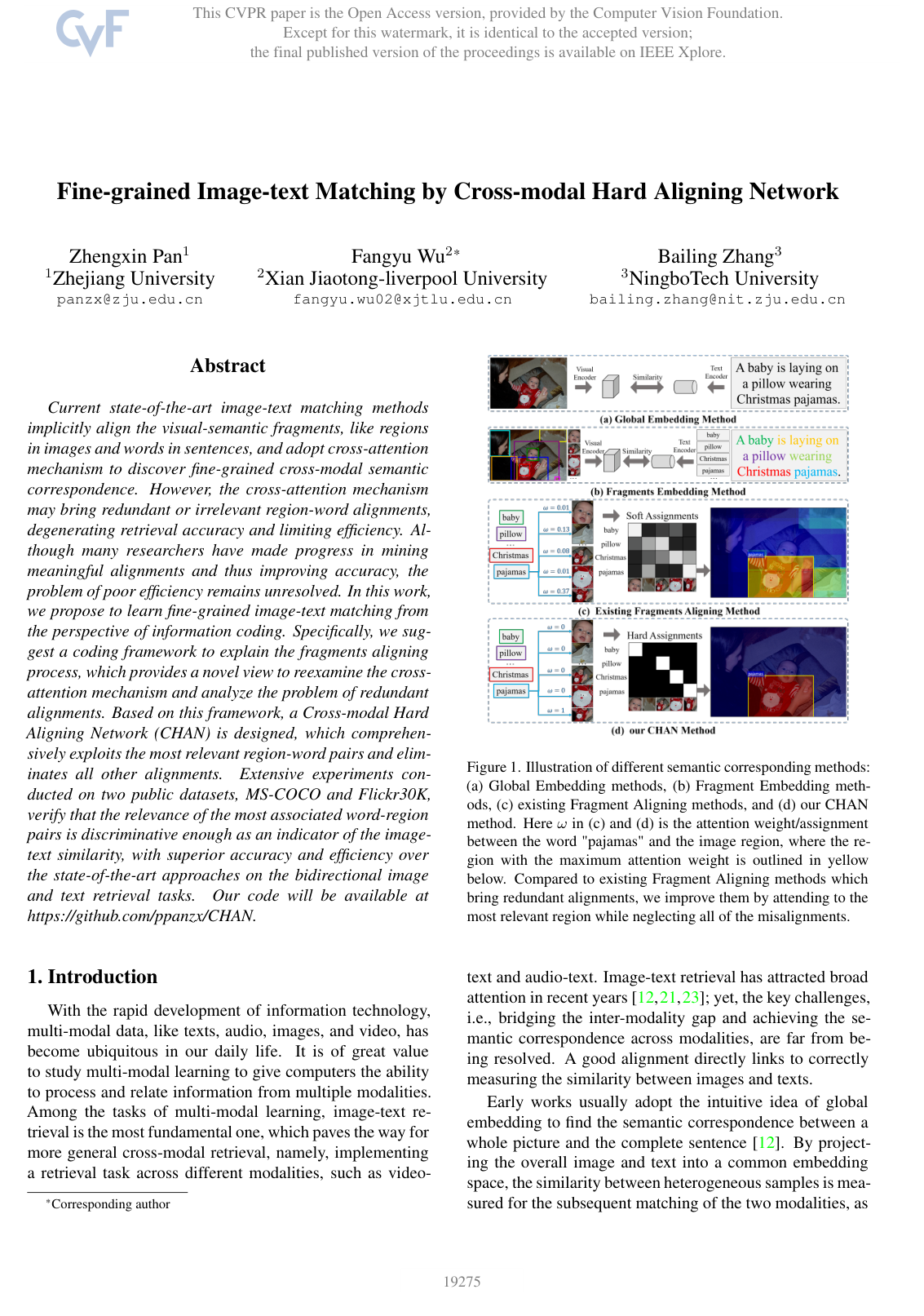
Proposes a cross-modal hard aligning network that reframes fine-grained image-text matching as a hard assignment coding problem, eliminating noisy region-word associations to improve retrieval accuracy while substantially cutting memory and computation costs compared to standard cross-attention methods.
Modern digital systems increasingly require automated tools to match visual content with descriptive text across massive multimedia collections. Existing fine-grained image-text retrieval methods typically rely on cross-attention mechanisms to align textual words with image regions. However, standard cross-attention introduces noisy, irrelevant alignments and requires calculating dense attention matrices, which creates severe computational bottlenecks, degrades retrieval accuracy, and leads to excessive memory and latency overhead in practical applications.
The article demonstrates that cross-modal fragment alignment can be reframed through an information coding perspective, evaluating whether hard assignment coding can replace soft cross-attention to deliver higher retrieval accuracy and substantially greater computational efficiency. To validate this concept, the authors developed the Cross-modal Hard Aligning Network (CHAN), which treats sentence words as queries and image regions as visual codewords, retaining only the single most relevant region-word alignment while discarding all redundant pairs. The approach was evaluated through extensive experimental benchmarks on the standard MS-COCO and Flickr30K datasets across both bidirectional image-to-text and text-to-image retrieval tasks.
The findings confirm three critical results. First, CHAN significantly outperforms previous state-of-the-art methods in retrieval accuracy on both benchmarks, achieving an RSUM of 518.5 on Flickr30K and 532.6 on MS-COCO 5-fold 1K using a standard language model backbone without requiring ensemble modeling. Second, CHAN provides over a tenfold speedup in total inference time compared to recent competing alignment architectures and is more than three times faster than standard baseline implementations. Third, ablation testing reveals that querying visual codebooks with text queries combined with LogSumExp pooling yields optimal alignment quality, and increasing the number of visual regions steadily improves accuracy without the degradation seen in older models.
These results demonstrate that dense soft alignments are largely redundant for cross-modal similarity matching. Retaining only the primary corresponding fragment reduces algorithmic memory complexity and eliminates the need for iterative batch processing during inference. Consequently, deployment of this hard aligning framework offers immediate performance gains, lower cloud infrastructure costs, and reduced latency for cross-modal search platforms. Organizations deploying visual-text search systems should consider transitioning from soft cross-attention architectures to hard assignment alignment mechanisms.
Future research should expand this coding framework toward information-theoretic objectives such as maximizing mutual information between modalities. While confidence in the reported experimental results is high across established benchmark datasets, real-world implementations should conduct domain-specific testing to confirm that visual object extractors capture sufficient region granularity when processing complex, cluttered, or out-of-domain imagery.
- Paper: Stacked Cross Attention for Image-Text Matching, Kuang-Huei Lee et al. (2018). Lee et al. established the standard stacked cross-attention paradigm for image-text matching, providing the baseline architecture and dense alignment problem that CHAN replaces with hard assignment coding.
- Paper: Negative-Aware Attention Framework for Image-Text Matching, Kun Zhang et al. (2022). Zhang et al. address the pitfalls of fine-grained cross-modal attention by introducing negative penalties for mismatched fragments, motivating CHAN's approach to eliminating redundant and noisy region-word pairs.
- Paper: Cross-Modal Discrete Representation Learning, Alexander H. Liu et al. (2022). Liu et al. formulate cross-modal matching through shared discrete codebooks and vector quantization, establishing the conceptual foundation for treating cross-modal fragment alignment as an information coding problem.
- Paper: Deep visual-semantic alignments for generating image descriptions, Andrej Karpathy et al. (2015). Karpathy and Fei-Fei introduced the foundational framework for learning fine-grained latent alignments between visual image regions and descriptive sentence fragments for cross-modal retrieval.
- Paper: Framing Image Description as a Ranking Task: Data, Models and Evaluation Metrics, Micah Hodosh et al. (2013). Hodosh et al. formalized cross-modal image description and retrieval as a ranking task evaluated on benchmark datasets like Flickr, creating the standard evaluation framework used in CHAN.
- Paper: SoftCLIP: Softer Cross-Modal Alignment Makes CLIP Stronger, Yuting Gao et al. (2024). Gao et al. explore the complementary perspective of softening rigid cross-modal contrastive targets via intra-modal similarity, offering a natural continuation to hard alignment frameworks.
- Paper: Alpha-CLIP: A CLIP Model Focusing on Wherever you Want, Zeyi Sun et al. (2024). Sun et al. extend the principle of focusing visual-language models on salient sub-regions by adding explicit regional alpha-channel guidance directly to the vision backbone.
- Paper: CLIP as RNN: Segment Countless Visual Concepts without Training Endeavor, Shuyang Sun et al. (2024). Sun et al. apply iterative query-region filtering to achieve fine-grained concept alignment in an inference-efficient, training-free manner for open-vocabulary segmentation.
- Paper: Text Is MASS: Modeling as Stochastic Embedding for Text-Video Retrieval, Jiamian Wang et al. (2024). Wang et al. advance cross-modal representation matching by modeling text queries as elastic semantic distributions to resolve granularity and information mismatches with complex visual inputs.