Implicit fairing of irregular meshes using diffusion and curvature flow
Mathieu DesbrunMark MeyerPeter SchröderAlan H. Barr
Introduces unconditionally stable implicit integration schemes and discrete curvature flow operators for irregular triangle meshes, enabling fast, distortion-free surface smoothing with volume preservation and geometric constraints.
Generating high-fidelity 3D digital models from real-world range scanning and photography often produces irregular, noisy surface meshes. Existing explicit smoothing techniques suffer from severe step-size limits, high computational overhead on large datasets, object shrinkage, and geometric distortions caused by irregular triangle spacing. The article develops and evaluates an efficient, unconditionally stable mathematical framework for irregular mesh fairing that removes unwanted noise while preserving intrinsic geometric features and volume.
The authors evaluated their approach by integrating backward Euler implicit numerical solvers with new geometric operators on standard irregular 3D meshes ranging from 12,000 to 290,000 faces. They compared this implicit approach against traditional explicit methods and evaluated both a scale-dependent Laplacian operator and an intrinsic curvature flow operator derived from discrete differential geometry.
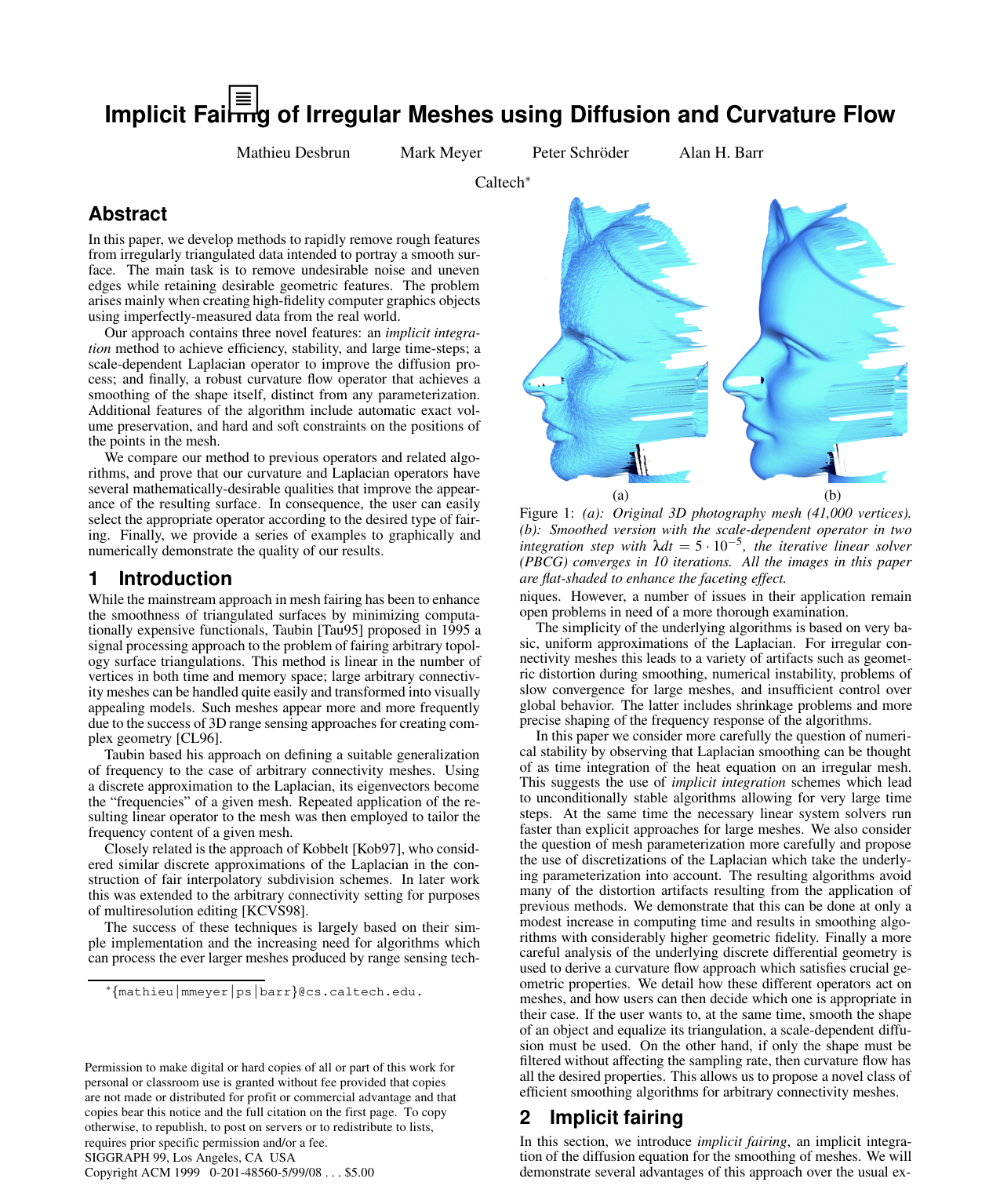
The analysis yielded four major findings. First, implicit integration achieves unconditional numerical stability, allowing substantially larger time steps and reducing computation time by roughly 60% compared to explicit integration on high-smoothing tasks. Second, the scale-dependent Laplacian accounts for varying edge lengths and eliminates artificial bumps and distortions that standard operators introduce on irregular meshes. Third, the curvature flow operator successfully drives smoothing based solely on local mean curvature, completely preventing vertices from sliding across flat areas or distorting spherical regions. Fourth, an automated post-step scaling step preserves exact 3D volume in linear time, eliminating object shrinkage without requiring manual parameter tuning.
These findings indicate that digital geometry pipelines can process large, scanned datasets significantly faster with substantially higher visual and geometric fidelity. Practitioners no longer need to compromise between numerical stability and processing speed or manually tune anti-shrinkage parameters. For deployment, teams should apply the scale-dependent Laplacian when the objective is to simultaneously smooth shapes and regularize triangle sizes, and deploy the curvature flow operator when only the underlying geometry should be filtered without altering mesh sampling.
The methods rely on local linearizations where edge lengths and angles are treated as constant during each solver iteration, which requires care when handling degenerate zero-area triangles. Overall confidence in the performance and stability gains is high across standard closed and open meshes, though full-scale production adoption could benefit from incorporating multigrid solvers to accelerate convergence on exceptionally massive meshes.
- Paper: A signal processing approach to fair surface design, Gabriel Taubin (1995). Introduces explicit low-pass geometric filtering and non-shrinking fairing on polyhedral surfaces, establishing the foundational discrete Laplacian formulation that this paper improves with implicit integration and curvature flow.
- Paper: Large steps in cloth simulation, D. Baraff et al. (1998). Pioneers the use of implicit numerical integration and large stable time-stepping for stiff differential equations on triangle meshes in computer graphics.
- Paper: Scale-Space Filtering, A. Witkin (1983). Formulates continuous diffusion and Gaussian scale-space filtering, providing the conceptual foundation for geometric multiscale smoothing and feature diffusion.
- Paper: Shape Modeling with Front Propagation: A Level Set Approach, R. Malladi et al. (1995). Introduces curvature flow and front-propagation techniques for shape evolution and smoothing, which directly motivate the intrinsic curvature-flow fairing operators used on meshes.
- Paper: Surface reconstruction from unorganized points, Hugues Hoppe et al. (1992). Details the construction of irregular triangle meshes from raw scan points, representing the exact type of noisy real-world geometry targeted by this fairing method.
- Paper: A volumetric method for building complex models from range images, B. Curless et al. (1996). Exemplifies volumetric reconstruction from range data, producing dense, noisy polygonal surfaces that require feature-preserving fairing and smoothing.
- Paper: Geometric Deep Learning: Going beyond Euclidean data, Michael M. Bronstein et al. (2016). Surveys geometric deep learning architectures that generalize discrete Laplacian operators, diffusion processes, and non-Euclidean manifold operations to neural network pipelines.
- Paper: Laplacian Eigenmaps and Spectral Techniques for Embedding and Clustering, Mikhail Belkin et al. (2001). Applies discrete graph Laplacians and heat diffusion operators to manifold learning, non-linear dimensionality reduction, and spectral data clustering.
- Paper: Poisson image editing, P. Pérez et al. (2003). Builds upon discrete differential operators and boundary-constrained elliptic PDE solvers to perform guided Poisson interpolation and seamless editing.
- Paper: Image inpainting, Marcelo Bertalmio et al. (2000). Extends continuous PDE-driven diffusion and curvature flow mechanisms to digital inpainting and geometric image structure propagation.
- Paper: Reconstruction and representation of 3D objects with radial basis functions, J. Carr et al. (2001). Provides a smooth implicit continuous surface representation for noisy point clouds that contrasts with and complements discrete irregular mesh fairing.