Single Image Haze Removal Using Dark Channel Prior
Kaiming HeJian SunX. Tang
Introduces the dark channel prior, a simple statistical discovery that enables accurate estimation of haze thickness to recover clear outdoor scenes and generate depth maps from a single degraded photograph.
Outdoor images frequently suffer from atmospheric haze, fog, and smoke, which scatter light, reduce contrast, and shift natural colors. This degradation impairs both human visual quality and downstream computer vision algorithms that assume clear scene radiance. Because haze density varies with unknown depth, restoring a clear image from a single picture has traditionally been an ill-posed problem requiring multiple exposures, polarization filters, or user-provided three-dimensional models.
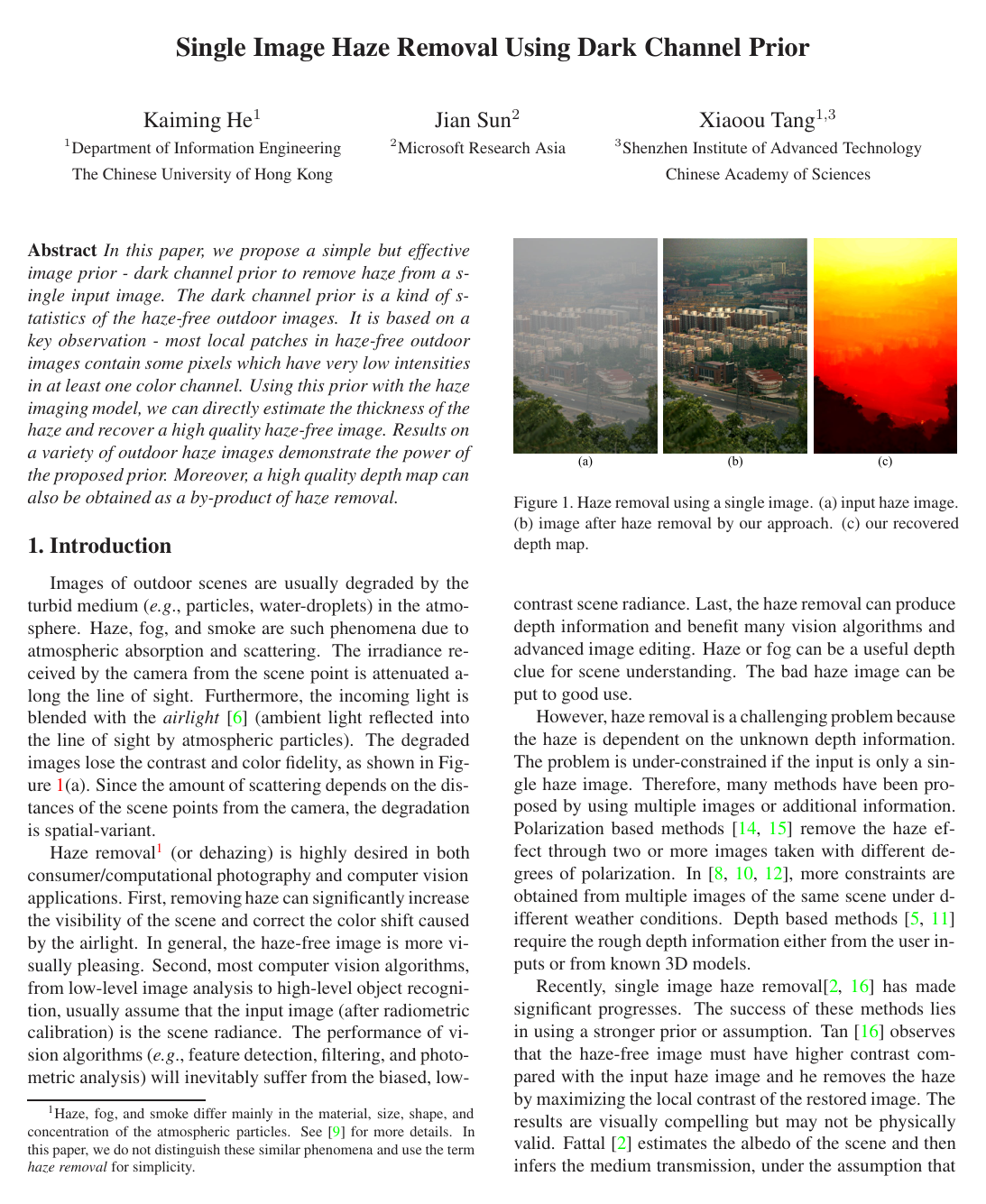
The article demonstrates a novel, physically grounded method for haze removal from a single image using a newly identified statistical property called the dark channel prior. The core objective is to directly estimate haze thickness and restore clear scene radiance and depth information without requiring supplementary hardware or external 3D data.
The approach relies on an empirical observation across natural outdoor scenes: in local non-sky patches, at least one color channel typically exhibits very low intensity due to shadows, colorful surfaces, or dark objects. The authors validated this statistical prior on a dataset of 5,000 haze-free outdoor landscape and cityscape images. By integrating this prior into standard atmospheric scattering models, the method calculates haze transmission, refines edge boundaries using soft matting, and estimates atmospheric light from the most haze-opaque regions of the image.
The key findings confirm the effectiveness and robustness of this method. First, statistical analysis verified that approximately 75% of dark channel pixels in haze-free images have zero intensity, and 90% have intensities below 25 out of 255. Second, the algorithm effectively restores vivid colors and sharp structures even in heavily hazy scenes where previous methods fail due to faint color variation. Third, the process simultaneously extracts an accurate relative depth map as a direct by-product of dehazing. Fourth, the method prevents over-saturation and significantly suppresses halo artifacts around depth discontinuities, matching or exceeding the performance of techniques that rely on pre-existing 3D terrain models.
These findings provide immediate practical value for computer vision systems, aerial imaging, and photography by enhancing visibility and depth perception without expensive multi-sensor setups. However, the dark channel prior becomes invalid when scene objects are inherently bright, uniform, and match the atmospheric light without casting shadows (such as white marble buildings), which can lead to localized underestimations of transmission. Future work should integrate more complex atmospheric scattering models to handle non-uniform atmospheric effects, such as direct sunlight and horizon-specific color shifts.
- Paper: Single image dehazing, Raanan Fattal (2008). It formulates the core single-image dehazing problem using atmospheric scattering and surface shading statistics, establishing foundational concepts that the dark channel prior directly refines and improves upon.
- Paper: A Closed-Form Solution to Natural Image Matting, Anat Levin et al. (2006). It introduces the matting Laplacian formulation used in the source paper for soft matting and refining coarse transmission maps.
- Paper: Guided Image Filtering, Kaiming He et al. (2010). It introduces the guided filter, an edge-preserving smoothing filter designed as a fast alternative to the matting Laplacian for refining transmission maps in single image dehazing.
- Paper: DehazeNet: An End-to-End System for Single Image Haze Removal, Bolun Cai et al. (2016). It advances single image dehazing from handcrafted heuristics like the dark channel prior to a learned, end-to-end convolutional neural network architecture for transmission map estimation.
- Paper: AOD-Net: All-in-One Dehazing Network, Boyi Li et al. (2017). It re-formulates the atmospheric scattering model to bypass separate transmission and atmospheric light estimation in favor of an end-to-end unified restoration network.
- Paper: Benchmarking Single-Image Dehazing and Beyond, Boyi Li et al. (2017). It builds a standardized, large-scale benchmark to systematically evaluate prior-based dehazing algorithms alongside deep learning alternatives across perceptual and task-driven criteria.
- Paper: FFA-Net: Feature Fusion Attention Network for Single Image Dehazing, Xu Qin et al. (2019). It proposes an attention-driven deep feature fusion network to handle spatially uneven haze distributions that challenge classical statistical priors.