AOD-Net: All-in-One Dehazing Network

Boyi LiXiulian PengZhangyang WangJizheng XuDan Feng

article2017ICCV2,146 citations

Proposes a lightweight convolutional network that directly generates clean images from hazy inputs by reformulating the atmospheric scattering model, preventing error accumulation and improving downstream object detection accuracy.

Listen

Outdoor computer vision systems frequently suffer from degraded visibility caused by haze, fog, and inclement weather. This degradation undermines performance in critical downstream applications such as autonomous navigation, surveillance, and automated object recognition. Traditional restoration methods and earlier deep learning models typically treat haze removal as a two-stage process: they separately estimate the medium transmission map and the global atmospheric light before calculating a clear image. This fragmented estimation causes errors from intermediate steps to accumulate and amplify, resulting in distorted colors, overexposure, and high computational costs that hinder real-time deployment.

To overcome these limitations, the article evaluates and demonstrates the All-in-One Dehazing Network (AOD-Net), a lightweight neural network designed to directly reconstruct haze-free images end-to-end without estimating intermediate physical parameters separately. By re-formulating the classical atmospheric scattering equation into a single unified parameter, the approach optimizes clean image generation in one step and enables seamless integration with high-level visual recognition pipelines.

The authors conducted comprehensive experimental evaluations across synthetic and natural datasets. The model was trained on more than 27,000 synthesized hazy indoor scenes derived from the NYU2 Depth Database and evaluated against multiple established dehazing algorithms using 3,170 indoor test images (TestSet A) and 800 synthetic outdoor images from the Middlebury stereo database (TestSet B). The authors also tested qualitative restoration on challenging real-world photos, white-scene images, and photos with light halation. Finally, they concatenated the dehazing network with a standard object detector, Faster R-CNN, across light, medium, and heavy haze conditions to measure improvements in detection accuracy.

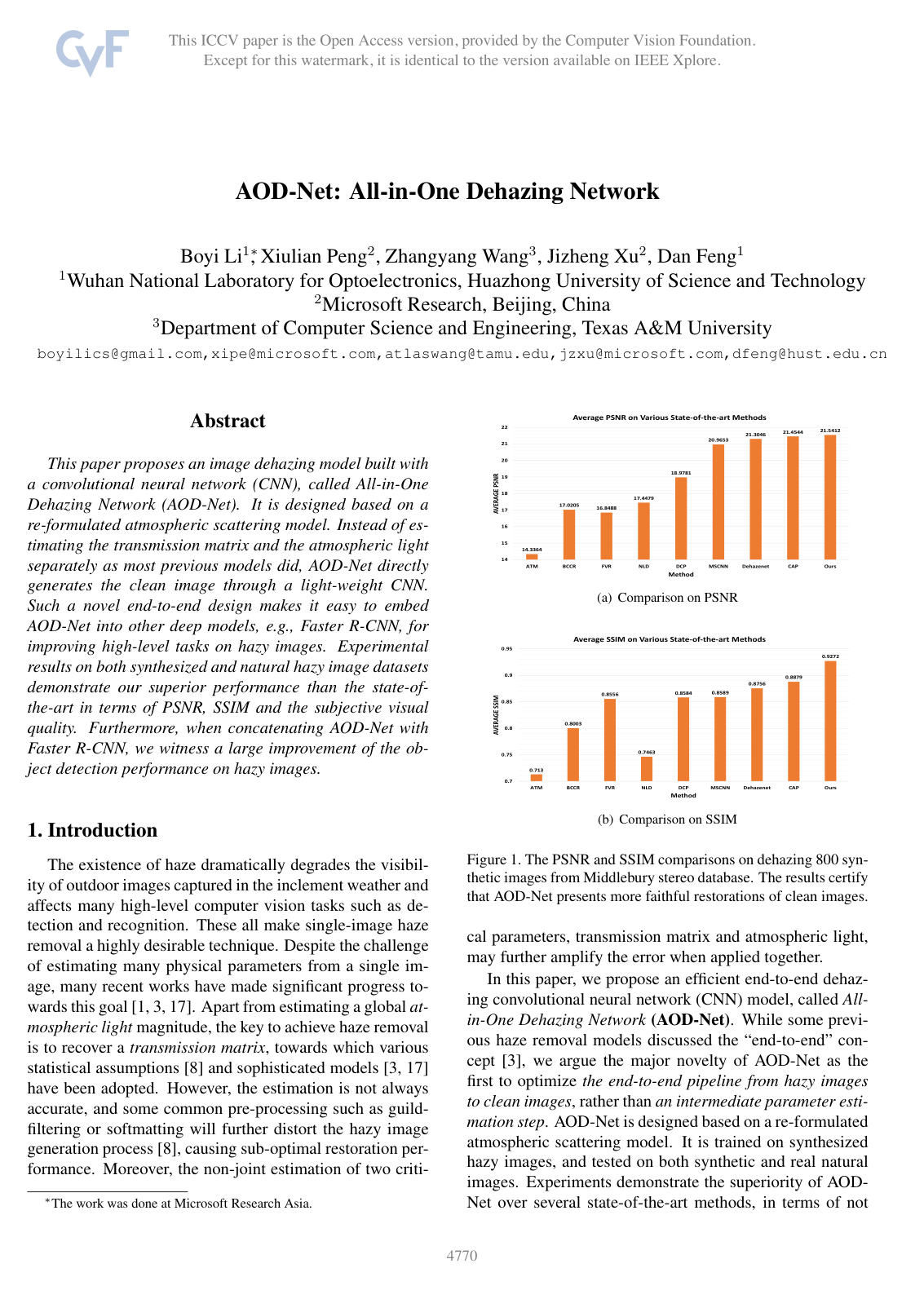
The findings confirm that AOD-Net consistently outperforms existing state-of-the-art dehazing methods across visual and quantitative benchmarks. On synthetic datasets, it achieved superior peak signal-to-noise ratio (PSNR) and structural similarity (SSIM) scores, notably reaching an SSIM of 0.9272 on TestSet B compared to 0.8584–0.8879 for competing algorithms. Analysis showed that joint parameter estimation significantly reduced errors in global illumination recovery, avoiding the artificial brightness and color distortions common in other models. Furthermore, the lightweight five-layer architecture processed images up to ten times faster than existing deep learning alternatives, requiring just 0.026 seconds on a single GPU (and 0.65 seconds on a CPU). Crucially, embedding and jointly tuning the network with an object detector in heavy haze conditions boosted object detection accuracy (mean Average Precision) from 0.5155 to 0.6819, recovering near-clear-weather performance.

These results demonstrate that single-step, end-to-end dehazing eliminates the error-propagation bottlenecks of traditional restoration techniques while offering substantial efficiency gains. For operational vision systems, this design significantly improves safety and recognition reliability in degraded environments without requiring expensive computational hardware. The unified framework also proves that low-level image enhancement and high-level analytical tasks can be jointly trained to optimize overall mission performance rather than relying on disjointed pre-processing steps.

Organizations developing computer vision systems for outdoor, unconstrained environments should adopt integrated end-to-end restoration architectures. When deploying vision models in hazy or low-visibility settings, engineering teams should jointly fine-tune the dehazing module alongside their primary detection or recognition networks rather than treating enhancement as an isolated step. While the network demonstrated robust generalization to natural photos and anti-halation tasks despite being trained purely on synthetic indoor data, future operational deployments should validate the framework across broader real-world outdoor conditions and diverse sensor types before full-scale implementation.

  • Paper: DehazeNet: An End-to-End System for Single Image Haze Removal, Bolun Cai et al. (2016). DehazeNet pioneered the use of convolutional neural networks to estimate the transmission map for single-image dehazing, establishing the two-stage baseline that AOD-Net directly simplifies into a unified end-to-end framework.
  • Paper: Single image dehazing, Raanan Fattal (2008). This foundational paper establishes the atmospheric scattering physics and statistical transmission formulation that AOD-Net seeks to reformulate and solve without intermediate hand-crafted priors.
  • Paper: Benchmarking Single-Image Dehazing and Beyond, Boyi Li et al. (2017). This comprehensive benchmarking study systematically evaluates state-of-the-art dehazing methods, including AOD-Net, across large-scale synthetic datasets, perceptual metrics, and downstream object detection tasks.
  • Paper: Multi-Stage Progressive Image Restoration, Syed Waqas Zamir et al. (2021). MPRNet advances end-to-end low-level vision beyond single-step architectures by demonstrating a multi-stage progressive network that balances contextual learning and high-resolution spatial restoration across diverse image degradation domains.
  • Paper: Restormer: Efficient Transformer for High-Resolution Image Restoration, Syed Waqas Zamir et al. (2022). Restormer extends modern restoration pipelines by applying efficient transformer attention across large-scale degraded images, achieving state-of-the-art restoration quality beyond classical lightweight CNN models.
Cover for AOD-Net: All-in-One Dehazing Network

Abstract

This paper proposes an image dehazing model built with a convolutional neural network (CNN), called All-in-One Dehazing Network (AOD-Net). It is designed based on a re-formulated atmospheric scattering model. Instead of estimating the transmission matrix and the atmospheric light separately as most previous models did, AOD-Net directly generates the clean image through a light-weight CNN. Such a novel end-to-end design makes it easy to embed AOD-Net into other deep models, e.g., Faster R-CNN, for improving high-level tasks on hazy images. Experimental results on both synthesized and natural hazy image datasets demonstrate our superior performance than the state-of-the-art in terms of PSNR, SSIM and the subjective visual quality. Furthermore, when concatenating AOD-Net with Faster R-CNN, we witness a large improvement of the object detection performance on hazy images.

Table of Contents

  • 1. Introduction
  • 2. Related Work
  • 3. Modeling and Extension
  • 3.1. Transformed Formula
  • 3.2. Network Design
  • 3.2.1 Necessity of K -estimation module
  • 3.3. Incorporation with High­Level Tasks
  • 4. Evaluations on Dehazing
  • 4.1. Datasets and Implementation
  • 4.2. Quantitative Results on Synthetic Images
  • 4.3. Qualitative Visual Results
  • 4.4. Running Time Comparison
  • 5. Improving High-level Tasks with Dehazing
  • 6. Conclusion
  • Acknowledgement
  • References

Knowls

  1. Knowl 1 — Reformulated Atmospheric Scattering Model for Direct Image Dehazing

    equation

    The classical atmospheric scattering model is expressed as:

    I(x)=J(x)t(x)+A(1−t(x))I(x) = J(x)t(x) + A(1 - t(x))

    where I(x)I(x) is the observed hazy image at pixel xx, J(x)J(x) is the scene radiance (the haze-free clean image), AA is the global atmospheric light vector, and t(x)=e−βd(x)t(x) = e^{-\beta d(x)} is the medium transmission map with atmospheric scattering coefficient eta and scene depth d(x)d(x). Inverting this formula yields:

    J(x)=1t(x)I(x)−A1t(x)+AJ(x) = \frac{1}{t(x)}I(x) - A\frac{1}{t(x)} + A

    Instead of estimating t(x)t(x) and AA in separate stages, the equation is unified into a single parameter map K(x)K(x):

    J(x)=K(x)I(x)−K(x)+bJ(x) = K(x) I(x) - K(x) + b

    where

    K(x)=1t(x)(I(x)−A)+(A−b)I(x)−1K(x) = \frac{\frac{1}{t(x)}(I(x) - A) + (A - b)}{I(x) - 1}

    and bb is a constant bias with a default value of 11. In this formulation, both 1t(x)\frac{1}{t(x)} and AA are integrated into the input-adaptive variable K(x)K(x). This formulation allows a convolutional neural network to predict K(x)K(x) directly from I(x)I(x) and optimize the reconstruction error of J(x)J(x) end-to-end in the image pixel domain, preventing the error accumulation and overexposure artifacts caused by separate estimations of t(x)t(x) and AA.

  2. Knowl 2 — All-in-One Dehazing Network (AOD-Net) Architecture

    model/method

    All-in-One Dehazing Network (AOD-Net) is a lightweight convolutional neural network designed to directly generate a clean image J(x)J(x) from a hazy input I(x)I(x). It consists of two sub-modules:

    1. KK-Estimation Module: A five-layer convolutional neural network estimating the input-adaptive parameter K(x)K(x):

      • Layer conv1: 33 filters of kernel size 1×11 \times 1 applied to the 3-channel input I(x)I(x).
      • Layer conv2: 33 filters of kernel size 3×33 \times 3 applied to conv1 features.
      • concat1: Concatenates the feature maps from conv1 and conv2 (66 channels).
      • Layer conv3: 33 filters of kernel size 5×55 \times 5 applied to concat1 features.
      • concat2: Concatenates the feature maps from conv2 and conv3 (66 channels).
      • Layer conv4: 33 filters of kernel size 7×77 \times 7 applied to concat2 features.
      • concat3: Concatenates the feature maps from conv1, conv2, conv3, and conv4 (1212 channels).
      • Layer conv5: 33 filters of kernel size 3×33 \times 3 applied to concat3 features, producing the 3-channel map K(x)K(x).

      Every convolutional layer uses Rectified Linear Unit (ReLU\text{ReLU}) activations and exactly 33 output filters, making the network lightweight.

    2. Clean Image Generation Module: Implements the reformulated scattering model via element-wise operations:

    J(x)=K(x)⊙I(x)−K(x)+bJ(x) = K(x) \odot I(x) - K(x) + b

    where ⊙\odot represents element-wise multiplication and b=1b=1 is a constant bias.

  3. Knowl 3 — Joint End-to-End Dehazing and High-Level Vision Pipeline

    model/method

    Because AOD-Net directly reconstructs the haze-free image J(x)J(x) using differentiable element-wise operations without requiring separate parameter estimation steps or non-differentiable post-processing (such as guided filtering), it can be concatenated directly with downstream deep neural networks for high-level computer vision tasks.

    In the jointly optimized pipeline (JAOD-Faster R-CNN), AOD-Net acts as a differentiable front-end to Faster R-CNN (with a VGG16 backbone). The entire network accepts a hazy image as input, implicitly performs haze removal via AOD-Net, and forwards the restored representation directly to the region proposal network and bounding-box classification and regression heads. The whole pipeline is optimized end-to-end using both low-level restoration and high-level object detection loss objectives simultaneously.

  4. Knowl 4 — Dehazing Performance on Synthetic Benchmark Datasets

    data/table

    The restoration fidelity of AOD-Net was evaluated against eight single-image dehazing methods on two synthetic datasets: TestSet A (3,1703{,}170 synthesized indoor images from the NYU2 Depth Database) and TestSet B (800800 synthesized images from the Middlebury stereo database). Performance was measured using Peak Signal-to-Noise Ratio (PSNR in dB) and the Structural Similarity Index Measure (SSIM).

    Dataset / Metric ATM BCCR FVR NLD DCP MSCNN DehazeNet CAP AOD-Net
    TestSet A
    PSNR (dB) 14.15 15.76 16.04 16.77 18.54 19.11 18.96 19.64 19.70
    SSIM 0.7141 0.7711 0.7452 0.7356 0.8337 0.8295 0.7753 0.8374 0.8478
    TestSet B
    PSNR (dB) 14.34 17.02 16.85 17.45 18.98 20.97 21.30 21.45 21.54
    SSIM 0.7130 0.8003 0.8556 0.7463 0.8584 0.8589 0.8756 0.8879 0.9272

    AOD-Net outperforms all prior physical-prior and deep learning methods in both metrics across both datasets, achieving the highest structural fidelity (SSIM of 0.92720.9272 on TestSet B).

  5. Knowl 5 — Object Detection Performance on Hazy PASCAL VOC 2007

    data/table

    The impact of haze and dehazing pre-processing on object detection was benchmarked on the PASCAL VOC 2007 test set using Faster R-CNN with a VGG16 backbone under three synthetic haze settings: Light Haze (A=1,β=0.04A = 1, \beta = 0.04), Medium Haze (A=1,β=0.06A = 1, \beta = 0.06), and Heavy Haze (A=1,β=0.10A = 1, \beta = 0.10). Monocular depth maps for synthesis were generated via deep convolutional neural fields. Performance is evaluated using mean Average Precision (mAP).

    Setting mAP
    Ground-truth Clean Images (Faster R-CNN) 0.6990
    Light Haze + Faster R-CNN 0.6410
    Light Haze + AOD-Net + Faster R-CNN (Cascaded, Un-tuned) 0.6701
    Medium Haze + Faster R-CNN 0.6046
    Medium Haze + AOD-Net + Faster R-CNN (Cascaded, Un-tuned) 0.6401
    Heavy Haze + Faster R-CNN 0.5155
    Heavy Haze + AOD-Net + Faster R-CNN (Cascaded, Un-tuned) 0.5794
    Heavy Haze + JAOD-Faster R-CNN (Jointly Tuned Pipeline) 0.6819

    Heavy haze causes an mAP drop of over 0.180.18 relative to clean ground-truth images. Cascading AOD-Net before Faster R-CNN without joint tuning improves mAP by +4.54%+4.54\% (light haze), +5.88%+5.88\% (medium haze), and +12.39%+12.39\% (heavy haze). Joint end-to-end fine-tuning of the combined pipeline (JAOD-Faster R-CNN) under heavy haze with a learning rate of 0.00010.0001 brings mAP to 0.68190.6819, recovering nearly all performance lost to degradation.

  6. Knowl 6 — Training Protocol and Implementation Details of AOD-Net

    experimental setup

    AOD-Net is trained and validated on synthetic datasets generated from indoor depth imagery:

    • Dataset Generation: 27,25627{,}256 images from the NYU2 Depth Database were used for training, and 3,1703{,}170 non-overlapping images formed TestSet A. Each synthetic hazy image was generated using I(x)=J(x)t(x)+A(1−t(x))I(x) = J(x)t(x) + A(1 - t(x)), with t(x)=e−βd(x)t(x) = e^{-\beta d(x)}. Atmospheric light AA was selected by drawing each color channel uniformly from [0.6,1.0][0.6, 1.0], and the scattering parameter was sampled from β∈{0.4,0.6,0.8,1.0,1.2,1.4,1.6}\beta \in \{0.4, 0.6, 0.8, 1.0, 1.2, 1.4, 1.6\}.
    • Objective Function: The network was trained directly on clean ground-truth images using Mean Squared Error (MSE) loss:

    L=1N∑x∥J(x)−JGT(x)∥2\mathcal{L} = \frac{1}{N} \sum_{x} \|J(x) - J_{\text{GT}}(x)\|^2

    • Optimization: Stochastic Gradient Descent with momentum of 0.90.9 and weight decay of 0.00010.0001. Model weights were initialized from Gaussian random variables. Gradients were clipped to constrain their norm within [−0.1,0.1][-0.1, 0.1] to stabilize training. The network converges in approximately 1010 epochs.
  7. Knowl 7 — Global Illumination Recovery Error Analysis via Mean-Image MSE

    empirical result

    To explain the large SSIM advantages achieved by AOD-Net, every restored image in TestSet B was decomposed into the sum of a mean image (a constant image of the average 3-channel color vector across the scene, reflecting global illumination AA) and a residual image (reflecting local structural variations and contrast). The total MSE equals the sum of the mean-image MSE and residual-image MSE.

    The average MSE between the mean images of dehazed outputs and ground-truth images on TestSet B is:

    • ATM: 4794.404794.40
    • NLD: 2130.602130.60
    • BCCR: 917.20917.20
    • FVR: 849.23849.23
    • DCP: 664.30664.30
    • DehazeNet: 424.90424.90
    • CAP: 356.68356.68
    • MSCNN: 329.97329.97
    • AOD-Net: 260.12260.12

    While AOD-Net produces residual MSE comparable to DehazeNet and CAP, its mean-image MSE is substantially lower. This shows that the end-to-end joint formulation of K(x)K(x) accurately recovers global illumination AA, avoiding the unnatural brightening and color distortions common in methods that estimate AA via separate heuristics.

  8. Knowl 8 — Runtime and Inference Efficiency of AOD-Net

    data/table

    The execution time of AOD-Net was compared against existing dehazing methods using 5050 test images of size 480×640480 \times 640 from TestSet A on an Intel Core i7-6700 CPU (3.40 GHz3.40\text{ GHz}, 16 GB16\text{ GB} RAM) without GPU acceleration.

    Method Platform Running Time (s)
    ATM Matlab 35.19
    DCP Matlab 18.38
    FVR Matlab 6.15
    NLD Matlab 6.09
    DehazeNet Pycaffe 5.09
    DehazeNet Matlab 1.81
    BCCR Matlab 1.77
    MSCNN Matlab 1.70
    CAP Matlab 0.81
    AOD-Net Pycaffe 0.65

    AOD-Net requires 0.65 s0.65\text{ s} per 480×640480 \times 640 image on CPU in Pycaffe, running roughly 8×8\times to 10×10\times faster than the Pycaffe implementation of DehazeNet (5.09 s5.09\text{ s}). On a single GPU, AOD-Net achieves an inference time of 0.026 s0.026\text{ s} per image.

  9. Knowl 9 — Ablation of Multi-Scale Concatenation in the K-Estimation Module

    empirical result

    The effectiveness of multi-scale feature concatenation in AOD-Net's KK-estimation module was tested by comparing the full network against a plain sequential baseline without skip or concatenation connections (conv1 →\to conv2 →\to conv3 →\to conv4 →\to conv5) on TestSet A.

    • Plain sequential baseline (no concatenation): Average PSNR = 19.0674 dB19.0674\text{ dB}, SSIM = 0.77070.7707.
    • Full AOD-Net (with concat1, concat2, concat3): Average PSNR = 19.6954 dB19.6954\text{ dB}, SSIM = 0.84780.8478.

    Removing the intermediate feature concatenations causes a substantial performance decline, particularly in SSIM (−0.0771-0.0771), demonstrating that fusing multi-scale receptive field filters (1×1,3×3,5×5,7×71\times1, 3\times3, 5\times5, 7\times7) and preserving low-level layer representations is necessary to accurately recover depth-dependent transmission and avoid information loss during convolution.

  10. Knowl 10 — Zero-Shot Generalization to Image Anti-Halation

    empirical result

    AOD-Net was tested without any re-training or parameter fine-tuning on the task of image anti-halation. Halation is an optical degradation where strong light spreads beyond proper boundaries, creating an unwanted foggy glow in bright photographic regions. Although halation differs physically from atmospheric particle scattering, AOD-Net's input-adaptive K(x)K(x) parameterization successfully suppresses halation glow and enhances contrast in bright regions without introducing color distortions.

Coverage note — Qualitative visual comparisons on specific challenging natural outdoor scenes and white-scenery images were omitted as their conclusions are fully reflected in the quantitative benchmark, error decomposition, and anti-halation knowls.

References

  1. 1.D. Berman, S. Avidan, et al. Non-local image dehazing. In Proceedings of the IEEE conference on computer vision and pattern recognition, pages 1674–1682, 2016.
  2. 2.D. Berman, T. Treibitz, and S. Avidan. Air-light estimation using haze-lines. In Computational Photography (ICCP), 2017 IEEE International Conference on, pages 1–9, 2017.
  3. 3.B. Cai, X. Xu, K. Jia, C. Qing, and D. Tao. Dehazenet: An end-to-end system for single image haze removal. IEEE Transactions on Image Processing, 25(11), 2016.
  4. 4.S. Diamond, V. Sitzmann, S. Boyd, G. Wetzstein, and F. Heide. Dirty pixels: Optimizing image classification architectures for raw sensor data. arXiv preprint arXiv:1701.06487, 2017.
  5. 5.M. Everingham, L. Van Gool, C. K. I. Williams, J. Winn, and A. Zisserman. The PASCAL Visual Object Classes Challenge 2007 (VOC2007) Results. http://www.pascalnetwork.org/challenges/VOC/voc2007/workshop/index.html.
  6. 6.R. Fattal. Single image dehazing. ACM transactions on graphics (TOG), 27(3):72, 2008.
  7. 7.R. Fattal. Dehazing using color-lines. ACM Transactions on Graphics (TOG), 34(1):13, 2014.
  8. 8.K. He, J. Sun, and X. Tang. Single image haze removal using dark channel prior. IEEE transactions on pattern analysis and machine intelligence, 33(12):2341–2353, 2011.
  9. 9.H. Hirschmuller and D. Scharstein. Evaluation of cost functions for stereo matching. In Computer Vision and Pattern Recognition, 2007. CVPR'07. IEEE Conference on, pages 1–8. IEEE, 2007.
  10. 10.F. Liu, C. Shen, G. Lin, and I. Reid. Learning depth from single monocular images using deep convolutional neural fields. IEEE transactions on pattern analysis and machine intelligence, 38(10):2024–2039, 2016.
  11. 11.E. J. McCartney. Optics of the atmosphere: scattering by molecules and particles. New York, John Wiley and Sons, Inc., 1976. 421 p., 1976.
  12. 12.G. Meng, Y. Wang, J. Duan, S. Xiang, and C. Pan. Efficient image dehazing with boundary constraint and contextual regularization. In Proceedings of the IEEE international conference on computer vision, pages 617–624, 2013.
  13. 13.S. G. Narasimhan and S. K. Nayar. Chromatic framework for vision in bad weather. In Computer Vision and Pattern Recognition, 2000. Proceedings. IEEE Conference on, volume 1, pages 598–605. IEEE, 2000.
  14. 14.S. G. Narasimhan and S. K. Nayar. Vision and the atmosphere. International Journal of Computer Vision, 48(3):233–254, 2002.
  15. 15.R. Pascanu, T. Mikolov, and Y. Bengio. On the difficulty of training recurrent neural networks. ICML, 2013.
  16. 16.S. Ren, K. He, R. Girshick, and J. Sun. Faster r-cnn: Towards real-time object detection with region proposal networks. In C. Cortes, N. D. Lawrence, D. D. Lee, M. Sugiyama, and R. Garnett, editors, Advances in Neural Information Processing Systems 28, pages 91–99. Curran Associates, Inc., 2015.
  17. 17.W. Ren, S. Liu, H. Zhang, J. Pan, X. Cao, and M.-H. Yang. Single image dehazing via multi-scale convolutional neural networks. In European Conference on Computer Vision, pages 154–169. Springer, 2016.
  18. 18.D. Scharstein and C. Pal. Learning conditional random fields for stereo. In Computer Vision and Pattern Recognition, 2007. CVPR'07. IEEE Conference on, pages 1–8. IEEE, 2007.
  19. 19.D. Scharstein and R. Szeliski. High-accuracy stereo depth maps using structured light. In Computer Vision and Pattern Recognition, 2003. Proceedings. 2003 IEEE Computer Society Conference on, volume 1, pages I–I. IEEE, 2003.
  20. 20.C. J. Schuler, M. Hirsch, S. Harmeling, and B. Schölkopf. Learning to deblur. IEEE transactions on pattern analysis and machine intelligence, 38(7):1439–1451, 2016.
  21. 21.N. Silberman, D. Hoiem, P. Kohli, and R. Fergus. Indoor segmentation and support inference from rgbd images. In European Conference on Computer Vision, pages 746–760. Springer, 2012.
  22. 22.M. Sulami, I. Glatzer, R. Fattal, and M. Werman. Automatic recovery of the atmospheric light in hazy images. In Computational Photography (ICCP), 2014 IEEE International Conference on, pages 1–11. IEEE, 2014.
  23. 23.R. T. Tan. Visibility in bad weather from a single image. In Computer Vision and Pattern Recognition, 2008. CVPR 2008. IEEE Conference on, pages 1–8. IEEE, 2008.
  24. 24.K. Tang, J. Yang, and J. Wang. Investigating haze-relevant features in a learning framework for image dehazing. In Proceedings of the IEEE Conference on Computer Vision and Pattern Recognition, pages 2995–3000, 2014.
  25. 25.J.-P. Tarel and N. Hautiere. Fast visibility restoration from a single color or gray level image. In Computer Vision, IEEE 12th International Conference on, pages 2201–2208, 2009.
  26. 26.Z. Wang, A. C. Bovik, H. R. Sheikh, and E. P. Simoncelli. Image quality assessment: from error visibility to structural similarity. IEEE transactions on image processing, 13(4):600–612, 2004.
  27. 27.Z. Wang, S. Chang, Y. Yang, D. Liu, and T. S. Huang. Studying very low resolution recognition using deep networks. In Proceedings of the IEEE Conference on Computer Vision and Pattern Recognition, pages 4792–4800, 2016.
  28. 28.Z. Wang, Y. Yang, Z. Wang, S. Chang, W. Han, J. Yang, and T. Huang. Self-tuned deep super resolution. In Proceedings of the IEEE Conference on Computer Vision and Pattern Recognition Workshops, pages 1–8, 2015.
  29. 29.J. Xie, L. Xu, and E. Chen. Image denoising and inpainting with deep neural networks. In Advances in Neural Information Processing Systems, pages 341–349, 2012.
  30. 30.J. Yu, Y. Jiang, Z. Wang, Z. Cao, and T. Huang. Unitbox: An advanced object detection network. In Proceedings of the 2016 ACM on Multimedia Conference, pages 516–520. ACM, 2016.
  31. 31.H. Zhang, J. Yang, Y. Zhang, N. M. Nasrabadi, and T. S. Huang. Close the loop: Joint blind image restoration and recognition with sparse representation prior. In Computer Vision (ICCV), 2011 IEEE International Conference on, pages 770–777. IEEE, 2011.
  32. 32.Q. Zhu, J. Mai, and L. Shao. A fast single image haze removal algorithm using color attenuation prior. IEEE Transactions on Image Processing, 24(11):3522–3533, 2015.

Citation

MLA
Li, B., et al. “An All-in-One Network for Dehazing and Beyond”. arXiv, 2017, http://arxiv.org/abs/1707.06543v1.
APA
Li, B., Peng, X., Wang, Z., Xu, J., & Feng, D. (2017). An All-in-One Network for Dehazing and Beyond. arXiv. http://arxiv.org/abs/1707.06543v1
Chicago
Li, B., X. Peng, Z. Wang, J. Xu, and D. Feng. 2017. “An All-in-One Network for Dehazing and Beyond”. arXiv. http://arxiv.org/abs/1707.06543v1.
Harvard
Li, B. et al. (2017) “An All-in-One Network for Dehazing and Beyond”, arXiv [Preprint]. Available at: http://arxiv.org/abs/1707.06543v1.
Vancouver
1. Li B, Peng X, Wang Z, Xu J, Feng D (2017) An All-in-One Network for Dehazing and Beyond. arXiv

BibTeX

@article{li2017all,
  title = {An All-in-One Network for Dehazing and Beyond},
  author = {Li, Boyi and Peng, Xiulian and Wang, Zhangyang and Xu, Jizheng and Feng, Dan},
  year = {2017},
  journal = {arXiv},
  url = {http://arxiv.org/abs/1707.06543v1},
  eprint = {1707.06543}
}
Metadata:arXiv

Access the Paper

This paper is available from its original source. Click below to access the PDF.

Open PDF