HierVL: Learning Hierarchical Video-Language Embeddings
Kumar AshutoshRohit GirdharLorenzo TorresaniKristen Grauman
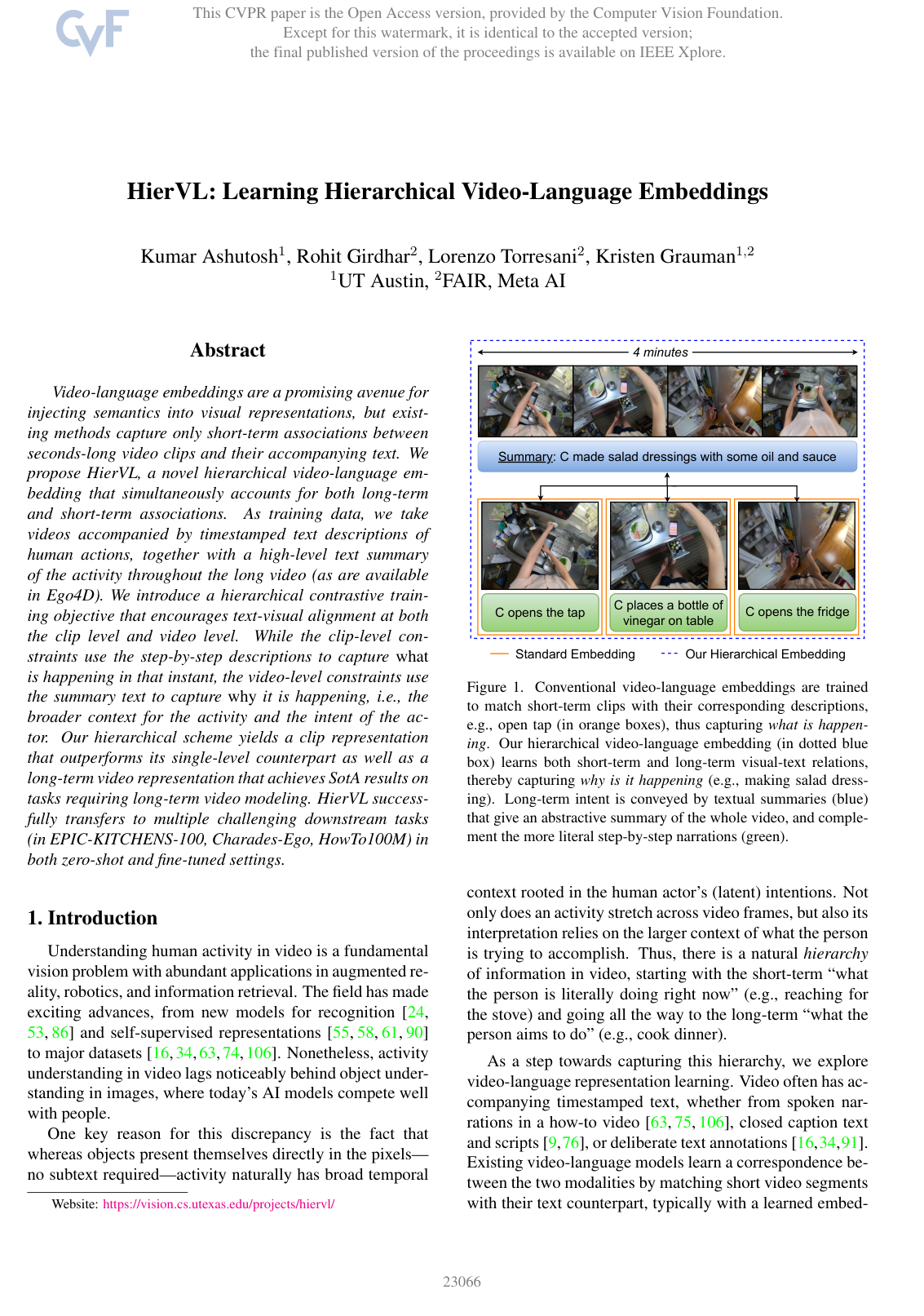
Proposes a hierarchical video-language framework that jointly aligns short-term action clips with step-by-step descriptions and aggregated video features with abstract summaries to capture both immediate actions and long-term actor intent.
Artificial intelligence models have achieved human-level performance in static image analysis, but interpreting human activity in video remains a significant hurdle. Standard video-language systems connect short, seconds-long clips directly to immediate descriptions (such as "opening a tap"), failing to capture the overarching context, sequential dependencies, and broader human intent (such as "preparing dinner"). This gap limits the effectiveness of automated video analysis in high-value domains like robotics, augmented reality, and large-scale media retrieval.
The article demonstrates a novel hierarchical video-language learning framework, named HierVL. The primary objective is to evaluate whether jointly training models on both granular, immediate actions and high-level abstract summaries creates visual representations that simultaneously capture short-term movements and long-term goals without incurring prohibitive computational costs.
To achieve this, the authors developed a dual-layer training framework using the Ego4D dataset, which contains 3,670 hours of daily-life wearable camera video annotated with 3.85 million step-by-step narrations and 120,000 video-level summaries. The approach matches individual video clips to step-by-step descriptions at the child level, while aggregating clip features across entire videos using self-attention mechanisms to match high-level summary texts at the parent level. This joint contrastive process circumvents memory bottlenecks associated with processing long raw videos and prevents catastrophic forgetting across different levels of abstraction.
The evaluation produced several decisive findings. First, HierVL-SA (using self-attention aggregation) achieved 95.4% accuracy on long-term summary matching and 26.8% on temporal sequence ordering tests, beating prior state-of-the-art baselines like EgoVLP by more than 6% and achieving a 34% relative improvement in temporal ordering where baseline models scored at chance levels (20%). Second, the framework established new state-of-the-art results across diverse external benchmarks, including the Ego4D Long-Term Anticipation challenge (predicting the next 20 actions), Charades-Ego action recognition (reaching 33.8% mean average precision when fine-tuned), and EPIC-KITCHENS-100 multi-instance retrieval. Third, linear probe tests on HowTo100M video classification demonstrated strong transferability, reaching 64.6% accuracy compared to 53.4% for existing methods, while resisting the transfer overfitting seen in standard models.
These findings indicate that incorporating abstract human intent fundamentally enriches foundational visual representations. For organizations developing video analytics, robotics, or interactive AI assistants, adopting hierarchical modeling directly improves long-horizon task planning and action forecasting while maintaining low-level precision. Importantly, downstream implementations do not require text summaries during deployment, making the learned representations immediately usable for standard video tasks without operational overhead.
Organizations advancing video-understanding pipelines should adopt hierarchical pretraining strategies and incorporate high-level summary metadata where available. Technical teams should prioritize self-attention aggregation over basic average pooling when temporal ordering is critical to the application. Future work should investigate scaling this approach to larger non-egocentric video corpora and exploring more granular intermediate hierarchy levels.
Confidence in these findings is high given rigorous benchmarking across multiple established datasets and explicit ablation studies confirming the necessity of both summary supervision and hierarchical structure. However, readers should note that training relies on datasets with dual-level text annotations, and variations in computing hardware configurations can slightly affect absolute baseline reproductions.
- Paper: HowTo100M: Learning a Text-Video Embedding by Watching Hundred Million Narrated Video Clips, Antoine Miech et al. (2019). Provides the foundational narrated video pretraining paradigm and the HowTo100M dataset used directly by HierVL for transferability and linear probe evaluations.
- Paper: Frozen in Time: A Joint Video and Image Encoder for End-to-End Retrieval, Max Bain et al. (2021). Introduces the end-to-end space-time dual-encoder framework for text-to-video retrieval that underpins modern video-language contrastive alignment architectures.
- Paper: VideoBERT: A Joint Model for Video and Language Representation Learning, Chen Sun et al. (2019). Pioneered joint video-and-language representation learning by aligning instructional video narrations with visual sequences using transformer pretraining.
- Paper: Is Space-Time Attention All You Need for Video Understanding?, Gedas Bertasius et al. (2021). Establishes pure space-time self-attention mechanisms for video transformers, which HierVL utilizes to aggregate clip-level representations across extended temporal sequences.
- Paper: HiCLIP: Contrastive Language-Image Pretraining with Hierarchy-aware Attention, Shijie Geng et al. (2023). Demonstrates how embedding hierarchical attention into vision-language architectures discovers multi-level semantic groupings and improves cross-modal alignment.
- Paper: Dense-Captioning Events in Videos, Ranjay Krishna et al. (2017). Introduces dense multi-event captioning and temporal event dependencies in untrimmed video, establishing the necessity of capturing both local actions and global narrative context.
- Paper: Video ReCap: Recursive Captioning of Hour-Long Videos, Md Mohaiminul Islam et al. (2024). Extends hierarchical multi-level video-language modeling into a recursive captioning framework capable of generating atomic, intermediate, and long-range narrative descriptions for hour-long untrimmed videos.
- Paper: Planning with Reasoning using Vision Language World Model, Delong Chen et al. (2025). Applies hierarchical temporal abstractions and multi-level video descriptions to build predictive vision-language world models for long-horizon agent planning.
- Paper: HourVideo: 1-Hour Video-Language Understanding, Keshigeyan Chandrasegaran et al. (2024). Provides a dedicated benchmark on long-form egocentric video to evaluate whether multimodal models can generalize hierarchical reasoning and summarization over hour-long horizons.
- Paper: TimeSuite: Improving MLLMs for Long Video Understanding via Grounded Tuning, Xiangyu Zeng 0004 et al. (2025). Continues the focus on long-form video comprehension by integrating explicit temporal grounding and timestamp supervision into multimodal large language models.
- Paper: Video-LaVIT: Unified Video-Language Pre-training with Decoupled Visual-Motional Tokenization, Yang Jin et al. (2024). Builds on efficient video-language tokenization by decoupling keyframe semantics from temporal motion tokens to scale multimodal models to long-duration video reasoning.