Dense-Captioning Events in Videos
Ranjay KrishnaKenji HataFrederic RenLi Fei-FeiJuan Carlos Niebles
Introduces the task and benchmark of dense video captioning alongside a context-aware model that simultaneously localizes and describes multiple temporal events across untrimmed videos in a single pass.
Modern automated video analysis systems frequently struggle with capturing the rich, multi-layered actions found in everyday, unconstrained videos. While traditional computer vision models assign broad, discrete action categories or describe short clips with a single sentence, natural videos typically contain multiple distinct, overlapping, and temporally interdependent events spanning seconds to several minutes. Without the capability to pinpoint exactly when events happen and describe them in detail, video-driven applications face significant limitations in automated search, content cataloging, and intelligent surveillance.
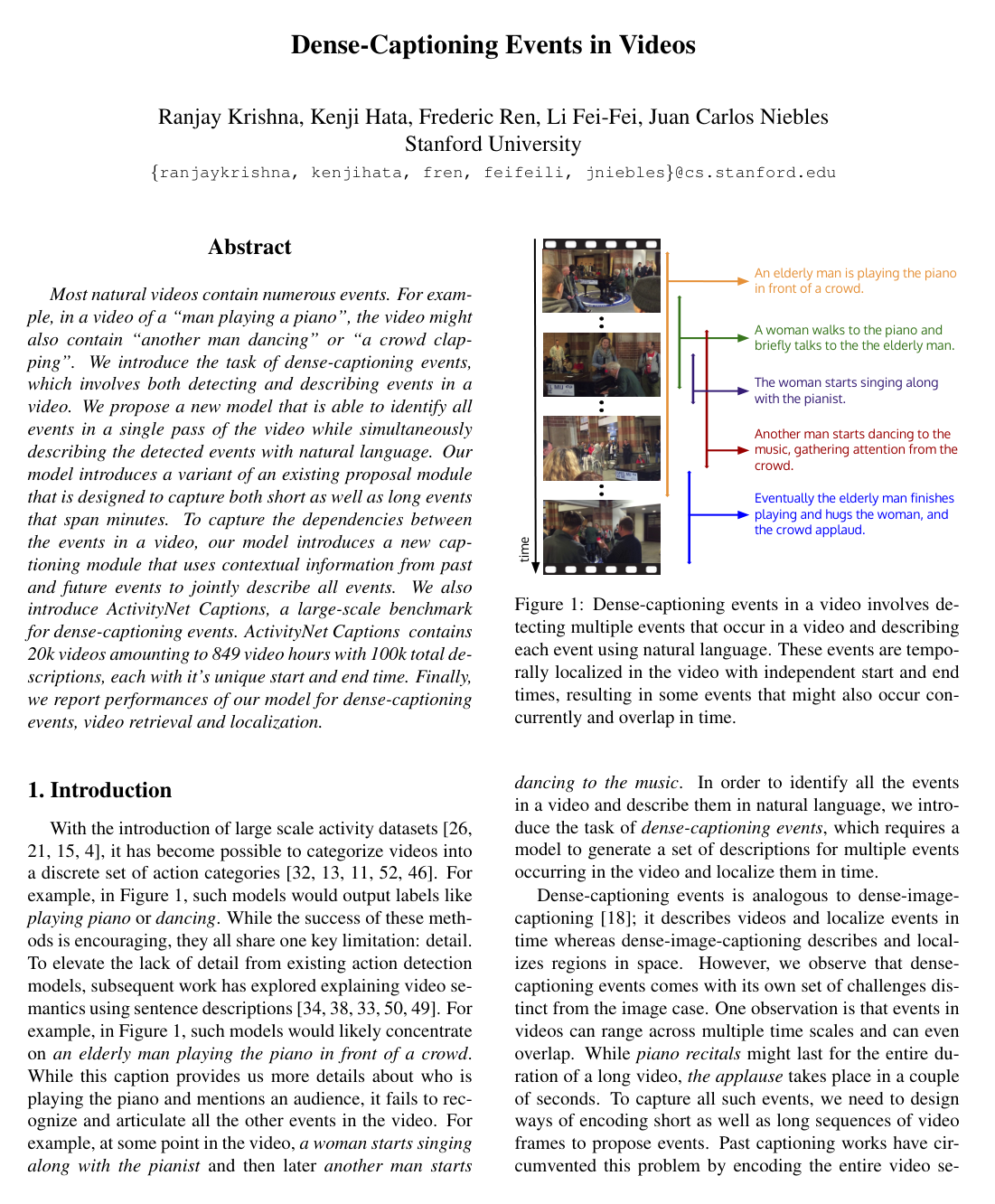
To address this limitation, the article introduces the unified task of dense-captioning events in videos, aiming to simultaneously detect when specific events occur and describe each event in natural language. The primary objective is to demonstrate an integrated computational architecture that performs event proposal and natural-language captioning across both short and long video sequences in a single processing pass, while incorporating contextual dependencies between past, concurrent, and future events.
To evaluate this framework, the authors created and deployed the ActivityNet Captions benchmark, comprising 20,000 untrimmed open-domain videos totaling 849 hours and annotated with 100,000 temporally localized descriptions. The technical approach couples a multi-scale temporal proposal module—sampling video frame features across multiple time strides—with a language generation module. This language network uses an attention mechanism to pool contextual hidden representations from preceding and succeeding events, enabling it to describe individual occurrences while maintaining narrative consistency across the entire video timeline.
The findings confirm that integrating temporal context substantially improves caption quality and event localization. When generating captions on predicted events, the full context-aware model achieved a CIDEr score of 17.29, representing an approximate 40% relative improvement over the baseline model lacking context (12.34). Incorporating multi-stride sampling resolved gradient decay issues in long video analysis and consistently outperformed single-stride event detection, particularly as the number of proposed events scaled. Furthermore, the architecture improved related tasks: in video retrieval benchmarks, adding context increased top-50 retrieval recall from 0.32 to 0.65 and cut the median retrieval rank by more than half, moving from rank 78 to 34.
These results indicate that automated video understanding benefits considerably from moving beyond isolated frame classification toward unified, context-aware sequence modeling. For organizations managing massive digital media archives, video surveillance feeds, or streaming platforms, dense-captioning frameworks offer a clear pathway to high-precision indexing and queryable video databases without requiring expensive human re-annotation. In addition, an online variant of the model that conditions solely on past events showed strong performance, demonstrating the technical feasibility of deploying dense captioning directly within real-time streaming pipelines.
Organizations developing automated video processing pipelines should prioritize architectures that capture temporal context and support streaming event detection. Future engineering work should concentrate on refining event boundary precision, as highly overlapping or redundant event proposals currently risk generating repetitive text descriptions. Confidence in the core findings remains strong given the extensive 20,000-video empirical benchmark, though performance may vary when applying the system to specialized, fine-grained activity domains that diverge from open-domain internet video datasets.
- Paper: ActivityNet: A large-scale video benchmark for human activity understanding, Fabian Caba Heilbron et al. (2015). ActivityNet establishes the foundational large-scale untrimmed video benchmark whose temporal annotations and videos are directly extended to create the ActivityNet Captions dataset introduced in the source.
- Paper: MSR-VTT: A Large Video Description Dataset for Bridging Video and Language, Jun Xu et al. (2016). MSR-VTT establishes the standard paradigm and baseline architectures for translating video content into natural language descriptions, providing essential context for video captioning models.
- Paper: Long-term Recurrent Convolutional Networks for Visual Recognition and Description, Jeff Donahue et al. (2015). This work introduces end-to-end recurrent convolutional network architectures that connect visual feature extraction with sequential language modeling for video description.
- Paper: Learning Spatiotemporal Features with 3D Convolutional Networks, Du Tran et al. (2015). C3D provides the fundamental 3D convolutional spatiotemporal feature representations used to encode video segments before generating temporal proposals and captions.
- Paper: Deep visual-semantic alignments for generating image descriptions, Andrej Karpathy et al. (2015). This foundational paper presents dense multimodal alignment between localized visual regions and natural language descriptions, which the source adapts to temporal video events.
- Paper: Show, Attend and Tell: Neural Image Caption Generation with Visual Attention, Kelvin Xu et al. (2015). It introduces neural attention mechanisms for caption generation that inspired subsequent contextual and attention-based modules for visual sequence description.
- Paper: Two-Stream Convolutional Networks for Action Recognition in Videos, Karen Simonyan et al. (2014). This paper establishes two-stream spatial and temporal convolutional representations for video action understanding that underlie video event encoding pipelines.
- Paper: Temporal Convolutional Networks for Action Segmentation and Detection, Colin Lea et al. (2016). It provides temporal modeling techniques for segmenting and detecting action boundaries across long video sequences.
- Paper: VideoBERT: A Joint Model for Video and Language Representation Learning, Chen Sun et al. (2019). VideoBERT extends video-and-language understanding by pretraining self-supervised multimodal transformers on large-scale untrimmed video and text, significantly advancing downstream video captioning.
- Paper: Frozen in Time: A Joint Video and Image Encoder for End-to-End Retrieval, Max Bain et al. (2021). Frozen in Time generalizes multimodal video-text representations through unified space-time transformer encoders evaluated on retrieval tasks over video datasets.
- Paper: ViViT: A Video Vision Transformer, Anurag Arnab et al. (2021). ViViT advances spatiotemporal feature modeling beyond convolutional proposal architectures by introducing pure vision transformers factorized across space and time.
- Paper: Is Space-Time Attention All You Need for Video Understanding?, Gedas Bertasius et al. (2021). TimeSformer develops divided space-time self-attention architectures that replace convolutional backbones for video event and action modeling.
- Paper: Video-MME: The First-Ever Comprehensive Evaluation Benchmark of Multi-modal LLMs in Video Analysis, Chaoyou Fu et al. (2025). Video-MME advances comprehensive evaluation of modern multimodal LLMs on long video comprehension, perception, and temporal reasoning over complex events.