Learning to Solve PDE-constrained Inverse Problems with Graph Networks
Qingqing ZhaoDavid B. LindellGordon Wetzstein
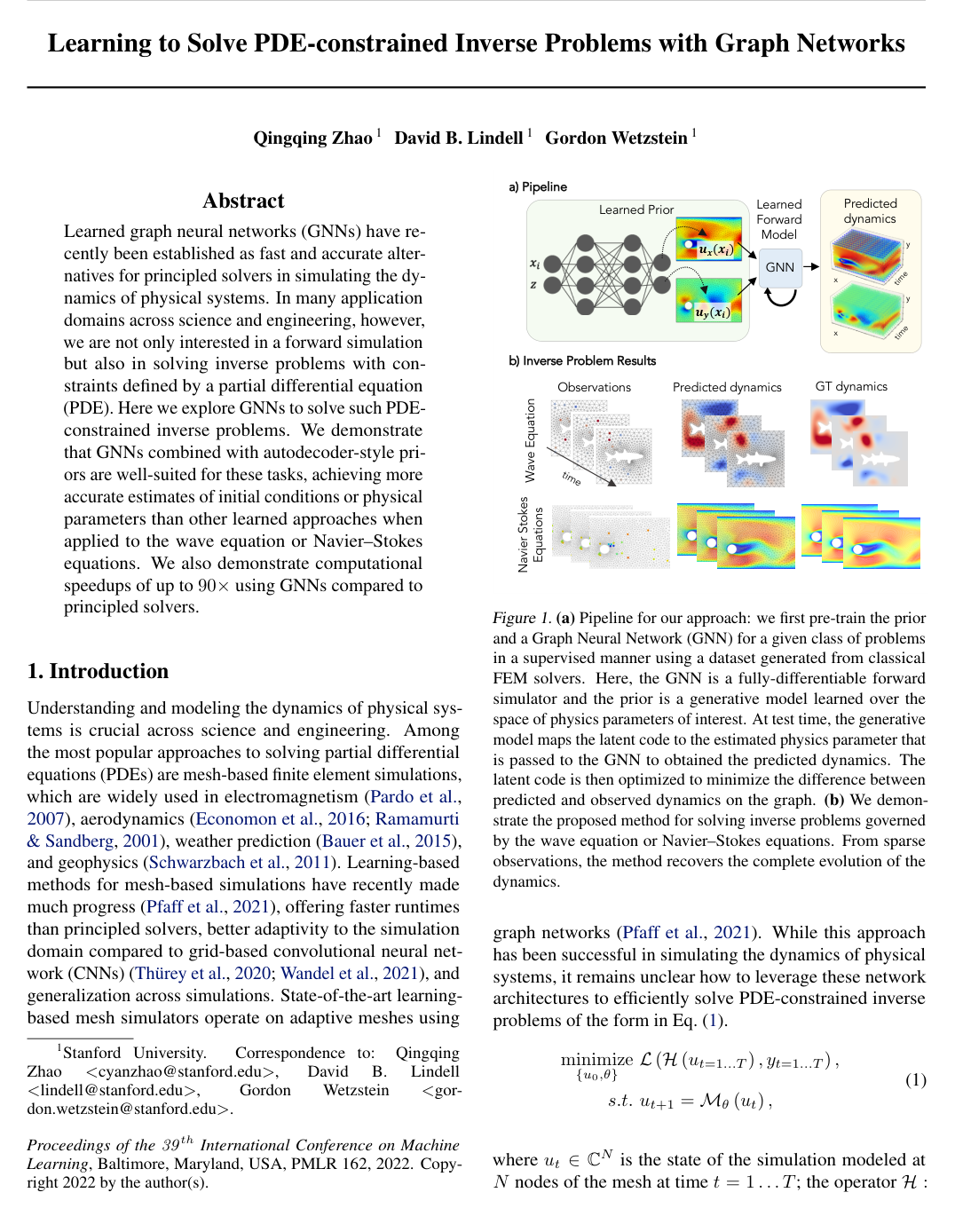
Combines differentiable graph neural network forward simulators with autodecoder coordinate priors to accurately recover initial conditions and physical parameters in PDE-constrained inverse problems at up to 90 times the speed of traditional solvers.
Simulating and inferring physical dynamics, such as fluid flows and wave propagation, is central to engineering design, geophysics, and atmospheric forecasting. While principled numerical solvers provide high accuracy, estimating unknown initial conditions or physical properties from sparse sensor measurements remains computationally intensive and mathematically ill-posed. The article introduces and evaluates a machine learning framework that pairs graph neural networks with continuous coordinate-based learned priors to rapidly solve inverse problems on irregular, adaptive meshes.
The framework combines a differentiable graph neural network forward simulator with an autodecoder-style prior implemented via a coordinate network. In the evaluation, the models were trained and tested on two core physical benchmarks: the two-dimensional scalar wave equation and the two-dimensional incompressible Navier–Stokes equations. The approach was systematically benchmarked against classical finite element method solvers and regular grid-based convolutional neural networks across multiple test trajectories and unseen irregular domain geometries.
The findings show substantial speed and accuracy benefits. First, the graph network framework achieved computational speedups between roughly 8 times and 90 times compared to traditional finite element solvers during iterative optimization. Second, operating on irregular meshes enabled the graph model to match or outperform convolutional networks that required 5 to 7 times more grid nodes. Third, integrating the learned coordinate prior proved critical; without it, all tested solvers failed due to severe ill-posedness, whereas with the prior, the model accurately reconstructed initial wavefields, velocity distributions, and fluid flows from sparse sensor observations.
These results demonstrate that graph neural networks combined with coordinate priors can drastically reduce the computational overhead and turnaround times for complex physics simulations and inverse estimation tasks. By supporting irregular geometries with adaptive resolution, the framework lowers processing requirements without sacrificing structural fidelity, making real-time or near-real-time monitoring feasible for physics-constrained systems.
Organizations handling simulation-heavy inverse workflows should consider exploring graph network pipelines to accelerate optimization cycles, particularly where sensor data is sparse. However, leaders should note current operational boundaries: the framework currently requires retraining from scratch when fundamental equations or boundary conditions shift, and GPU memory constraints currently restrict the number of unrolled time steps. Further development, including gradient checkpointing and validation across three-dimensional physical domains, is recommended before full deployment.
- Paper: Learning Mesh-Based Simulation with Graph Networks, Tobias Pfaff et al. (2020). Its mesh-based graph simulator provides the direct architectural foundation for understanding how this work adapts graph networks to PDE-constrained inference on irregular meshes.
- Paper: Learning to Simulate Complex Physics with Graph Networks, Alvaro Sanchez-Gonzalez et al. (2020). Its message-passing simulator establishes the learned physical-dynamics framework that the source extends from forward prediction to inverse estimation.
- Paper: Neural Inverse Operators for Solving PDE Inverse Problems, Roberto Molinaro et al. (2023). It advances PDE inverse solving from iterative, graph-based reconstruction to learned neural inverse operators that map measurements directly to hidden physical fields.