
topic
boundary value problems (boundary value problem)
Boundary value problems are differential equations that must be solved subject to a set of constraints, known as boundary conditions, specified at the boundaries or extreme points of the problem domain. Unlike initial value problems where all conditions are provided at a single starting point, a boundary value problem requires information at multiple distinct points, such as the spatial endpoints of an interval or the perimeter of a geometric region. These problems arise extensively in computational science and engineering to model equilibrium and steady-state physical systems, including heat conduction, wave propagation, structural mechanics, and electrostatics. Because exact analytical solutions are often unavailable for complex systems, computational approaches utilize numerical approximation techniques, such as finite element methods, finite difference methods, shooting methods, and collocation methods, to determine solutions across the defined domain.
2 items
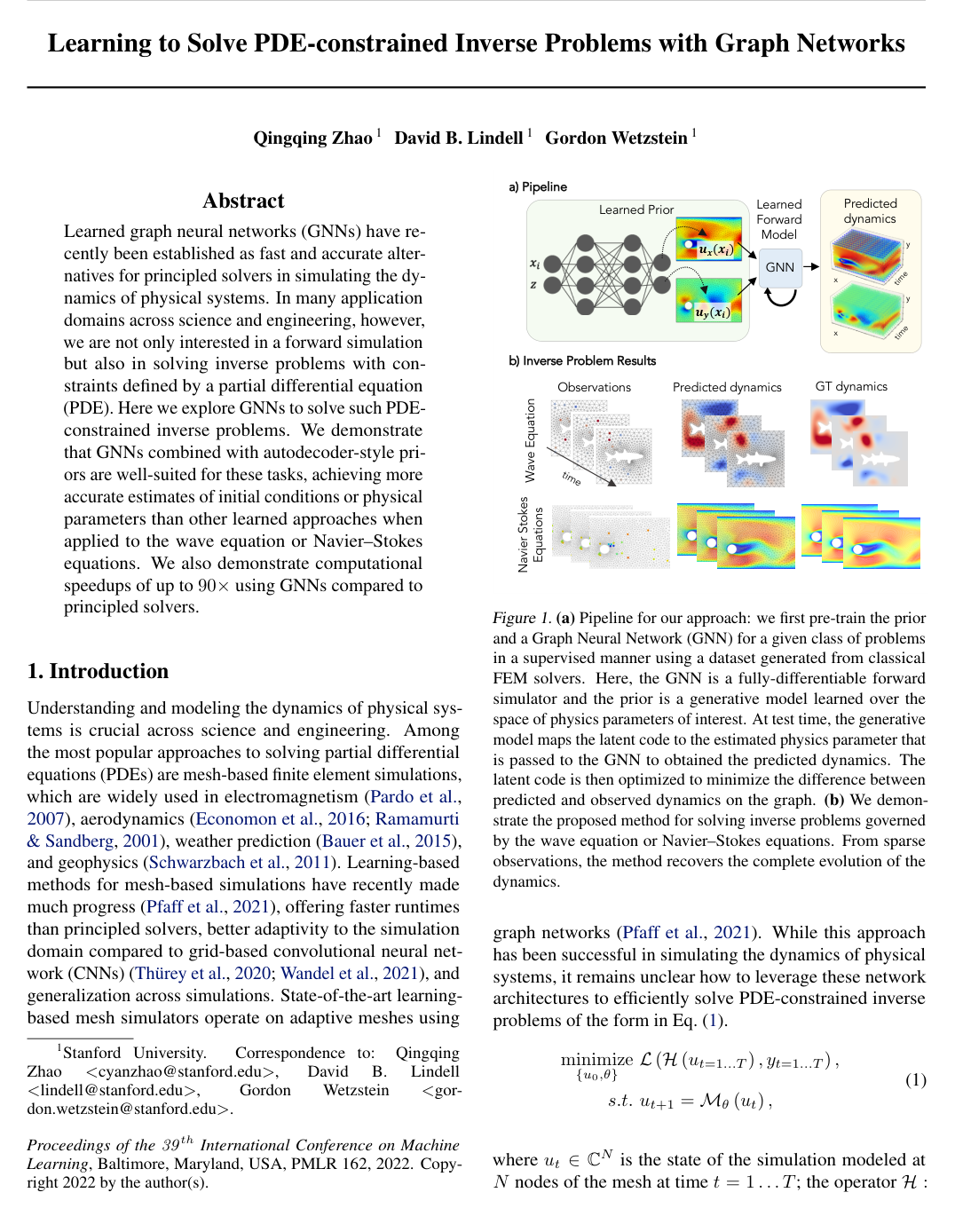
Learning to Solve PDE-constrained Inverse Problems with Graph Networks
Qingqing Zhao, David B. Lindell, Gordon Wetzstein
Why you should read this
Combines differentiable graph neural network forward simulators with autodecoder coordinate priors to accurately recover initial conditions and physical parameters in PDE-constrained inverse problems at up to 90 times the speed of traditional solvers.
Learned graph neural networks (GNNs) have recently been established as fast and accurate alternatives for principled solvers in simulating the dynamics of physical systems. In many application domains across science and engineering, however, we are not only interested in a forward simulation but also in solving inverse problems with constraints defined by a partial differential equation (PDE). Here we explore GNNs to solve such PDE-constrained inverse problems. We demonstrate that GNNs combined with autodecoder-style priors are well-suited for these tasks, achieving more accurate estimates of initial conditions or physical parameters than other learned approaches when applied to the wave equation or Navier–Stokes equations. We also demonstrate computational speedups of up to 90× using GNNs compared to principled solvers.
Added
2026-10-03
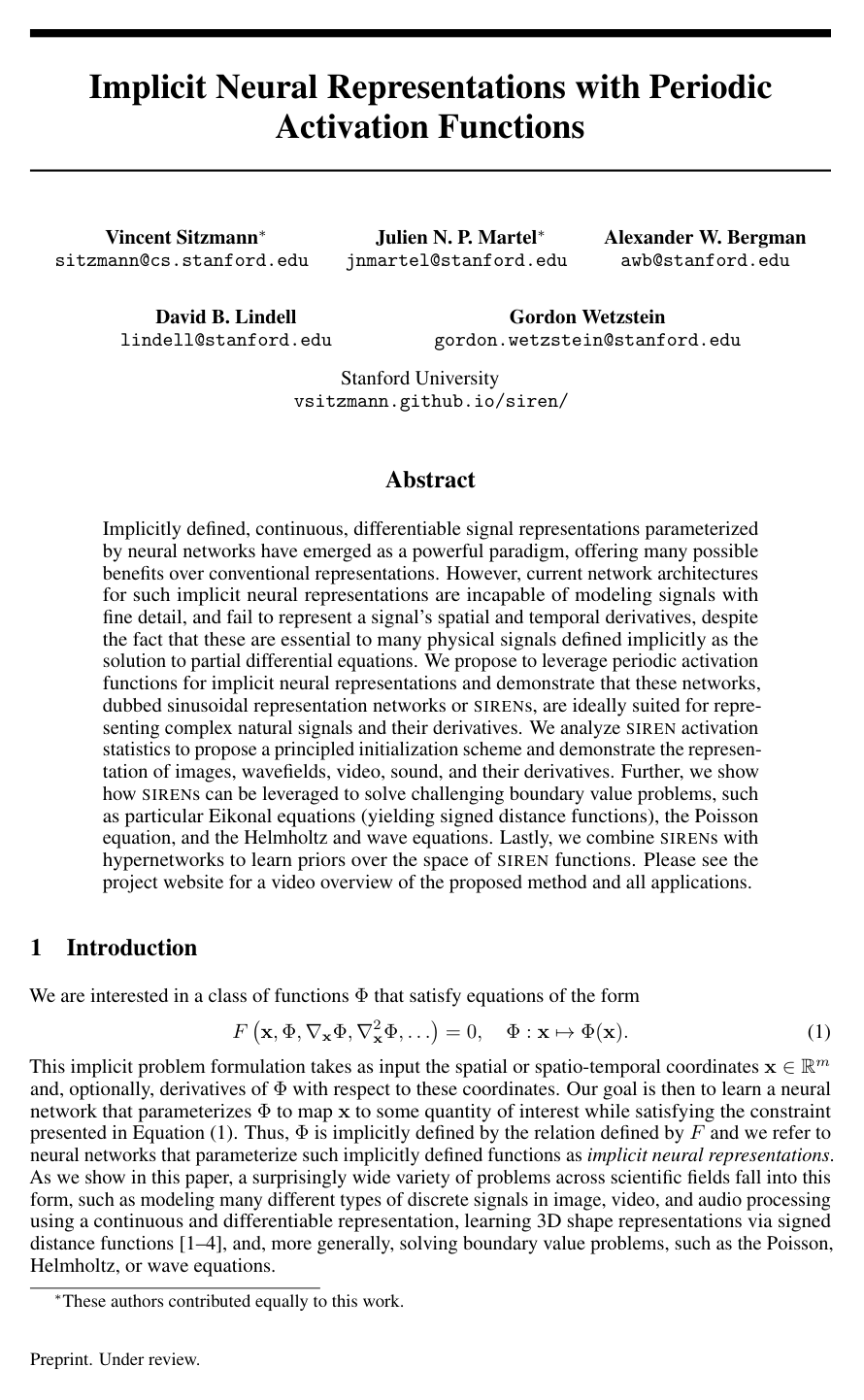
Implicit Neural Representations with Periodic Activation Functions
Vincent Sitzmann, Julien N. P. Martel, Alexander W. Bergman, David B. Lindell, Gordon Wetzstein
Why you should read this
Introduces sinusoidal representation networks with periodic activation functions to model complex continuous signals and their derivatives, enabling high-fidelity representation of audio, video, and 3D shapes as well as direct solutions to partial differential equations.
Implicitly defined, continuous, differentiable signal representations parameterized by neural networks have emerged as a powerful paradigm, offering many possible benefits over conventional representations. However, current network architectures for such implicit neural representations are incapable of modeling signals with fine detail, and fail to represent a signal's spatial and temporal derivatives, despite the fact that these are essential to many physical signals defined implicitly as the solution to partial differential equations. We propose to leverage periodic activation functions for implicit neural representations and demonstrate that these networks, dubbed sinusoidal representation networks or Sirens, are ideally suited for representing complex natural signals and their derivatives. We analyze Siren activation statistics to propose a principled initialization scheme and demonstrate the representation of images, wavefields, video, sound, and their derivatives. Further, we show how Sirens can be leveraged to solve challenging boundary value problems, such as particular Eikonal equations (yielding signed distance functions), the Poisson equation, and the Helmholtz and wave equations. Lastly, we combine Sirens with hypernetworks to learn priors over the space of Siren functions.
Added
2026-09-16
License
Published with permission