Objaverse: A Universe of Annotated 3D Objects
Matt DeitkeDustin SchwenkJordi SalvadorLuca WeihsOscar MichelEli VanderBiltLudwig SchmidtKiana EhsaniAniruddha KembhaviAli Farhadi
Introduces Objaverse, a massive open dataset of over 800,000 annotated 3D models that addresses the critical shortage of 3D data and enables substantial progress across 3D generative modeling, embodied AI, and visual recognition.
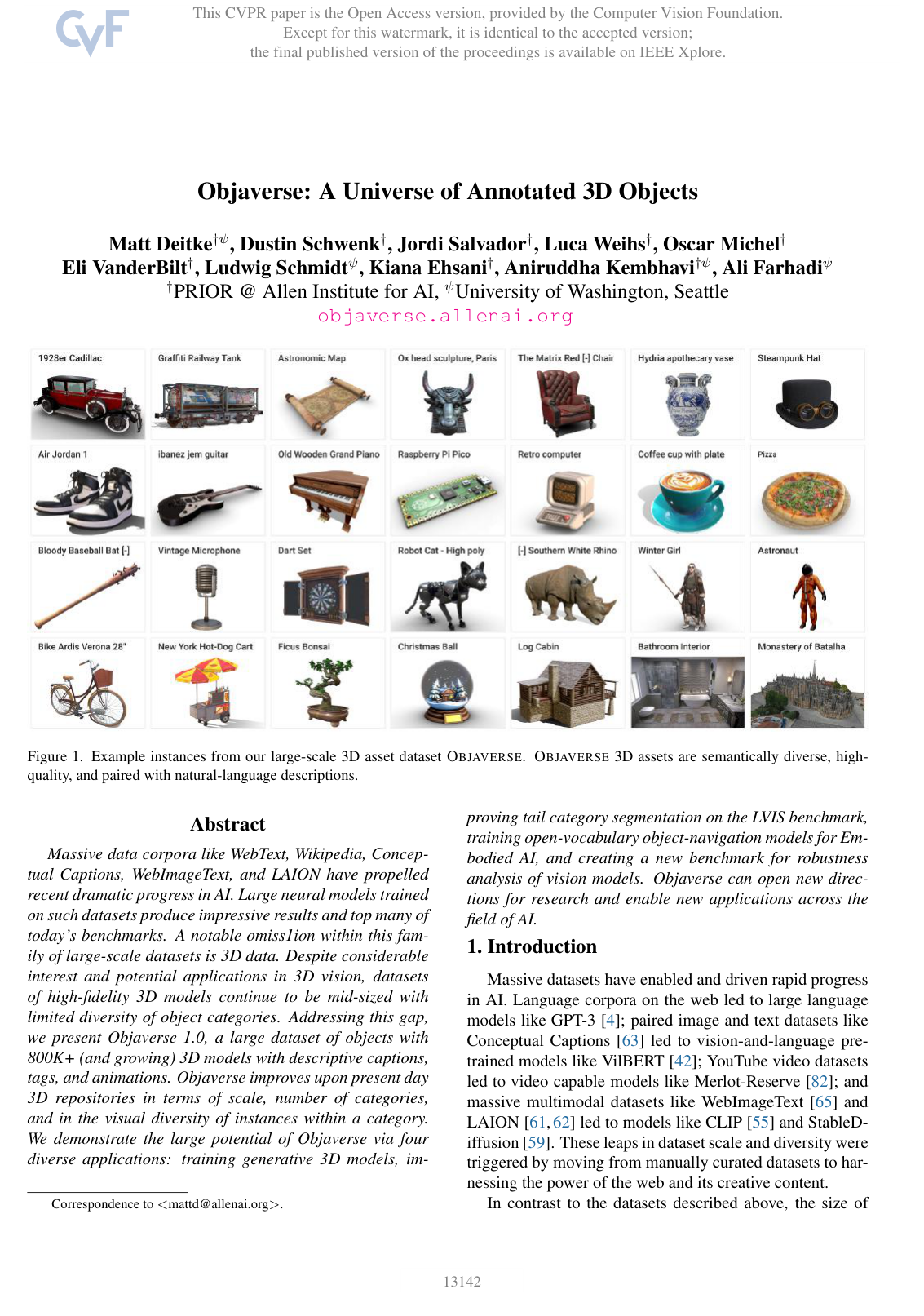
Recent dramatic advances in artificial intelligence have been driven by massive web-scale datasets for text and 2D images. In contrast, 3D computer vision and embodied AI have remained constrained by small, mid-sized repositories that lack visual diversity and category breadth. This article introduces Objaverse 1.0, an open-access repository containing over 800,000 richly annotated 3D objects created by more than 150,000 artists, to demonstrate how scaling 3D data enables new capabilities across generative modeling, 2D recognition, robotic simulation, and model evaluation.
The authors curated the dataset from the online platform Sketchfab under Creative Commons licenses, organizing foundational metadata such as descriptions, tags, animations, and articulable parts. To support specific vision benchmarks, they constructed Objaverse-LVIS, a curated subset of 47,000 objects mapped across 1,156 granular semantic categories using automated text-image filtering and crowdsourced human verification. The researchers evaluated the utility of this resource across four distinct application domains: training 3D generative meshes, augmenting long-tailed 2D instance segmentation, building open-vocabulary robotic navigation environments, and benchmarking model robustness against non-standard viewing angles.
The evaluations yielded four primary findings. First, in 3D generative modeling, human evaluators judged objects produced by models trained on Objaverse to be more visually diverse than those trained on previous datasets in 91% of comparisons. Second, using rendered 3D objects as synthetic data augmentations improved 2D instance segmentation performance across rare, common, and frequent object categories. Third, integrating Objaverse into simulated home environments scaled the variety of unique objects from around 2,000 to 36,000 across 1,100 categories, enabling autonomous agents to successfully navigate to open-vocabulary target descriptions with a 19.9% success rate compared to 5.1% for random baselines. Fourth, evaluating leading vision-language models on objects viewed from random orientations exposed major vulnerabilities, as accuracy dropped by roughly 18 to 23 percentage points when moving from canonical views to arbitrary camera angles.
These findings indicate that large-scale 3D data provides a cost-effective path to improving both 2D and 3D computer vision systems. By substituting expensive manual annotations with synthetic renderings, organizations can enhance recognition performance on rare real-world categories and safely test safety-critical models against perspective shifts before physical deployment. Furthermore, the findings show that existing standard vision models overfit heavily to canonical forward-facing viewpoints, highlighting an unaddressed operational risk for autonomous systems operating in unpredictable physical environments.
Organizations developing computer vision and autonomous systems should integrate diverse 3D asset pipelines to augment low-sample training data and establish mandatory multi-angle robustness evaluations. Teams should also utilize scaled 3D environments to expand the vocabulary and generalizability of embodied AI agents. Future work should expand fine-grained category annotations across the remaining uncurated assets, address unnatural scaling or noise in web-scraped metadata, and develop targeted training interventions to close the substantial performance gaps identified in non-canonical viewpoint recognition.
- Paper: LVIS: A Dataset for Large Vocabulary Instance Segmentation, Agrim Gupta et al. (2019). LVIS provides the large-vocabulary long-tailed instance segmentation benchmark directly used in Objaverse to demonstrate improvements on tail category segmentation.
- Paper: 3D ShapeNets: A deep representation for volumetric shapes, Zhirong Wu et al. (2014). This seminal work introduced volumetric deep shape representations and CAD benchmarks like ModelNet, establishing the foundational paradigm for 3D generative and recognition tasks that Objaverse scales up.
- Paper: LAION-400M: Open Dataset of CLIP-Filtered 400 Million Image-Text Pairs, Christoph Schuhmann et al. (2021). LAION-400M represents the paradigm of massive open web-scale multimodal datasets that inspired Objaverse to bridge the dataset scale gap in 3D AI.
- Paper: Vision-and-Language Navigation: Interpreting Visually-Grounded Navigation Instructions in Real Environments, Peter Anderson et al. (2017). This paper establishes the vision-and-language embodied navigation benchmark and task formulation that Objaverse targets for training open-vocabulary embodied AI agents.
- Paper: Matterport3D: Learning from RGB-D Data in Indoor Environments, Angel Chang et al. (2017). Matterport3D serves as a key prior 3D indoor scene dataset whose scope and category limitations highlight the need for massive object-level repositories like Objaverse.
- Paper: Microsoft COCO: Common Objects in Context, Tsung-Yi Lin et al. (2014). Microsoft COCO set the standard for dense multi-task visual annotations, providing the conceptual and baseline framework for dataset design that Objaverse brings to the 3D domain.
- Paper: Zero-1-to-3: Zero-shot One Image to 3D Object, Ruoshi Liu et al. (2023). Zero-1-to-3 directly utilizes massive rendering views synthesized from Objaverse's 3D object models to fine-tune diffusion models for zero-shot single-image 3D novel view synthesis.
- Paper: SyncDreamer: Generating Multiview-consistent Images from a Single-view Image, Yuan Liu et al. (2024). SyncDreamer builds upon models trained on the Objaverse repository to generate multiview-consistent images and reconstruct complete 3D meshes from single images.