LVIS: A Dataset for Large Vocabulary Instance Segmentation
Agrim GuptaPiotr DollárRoss B. Girshick
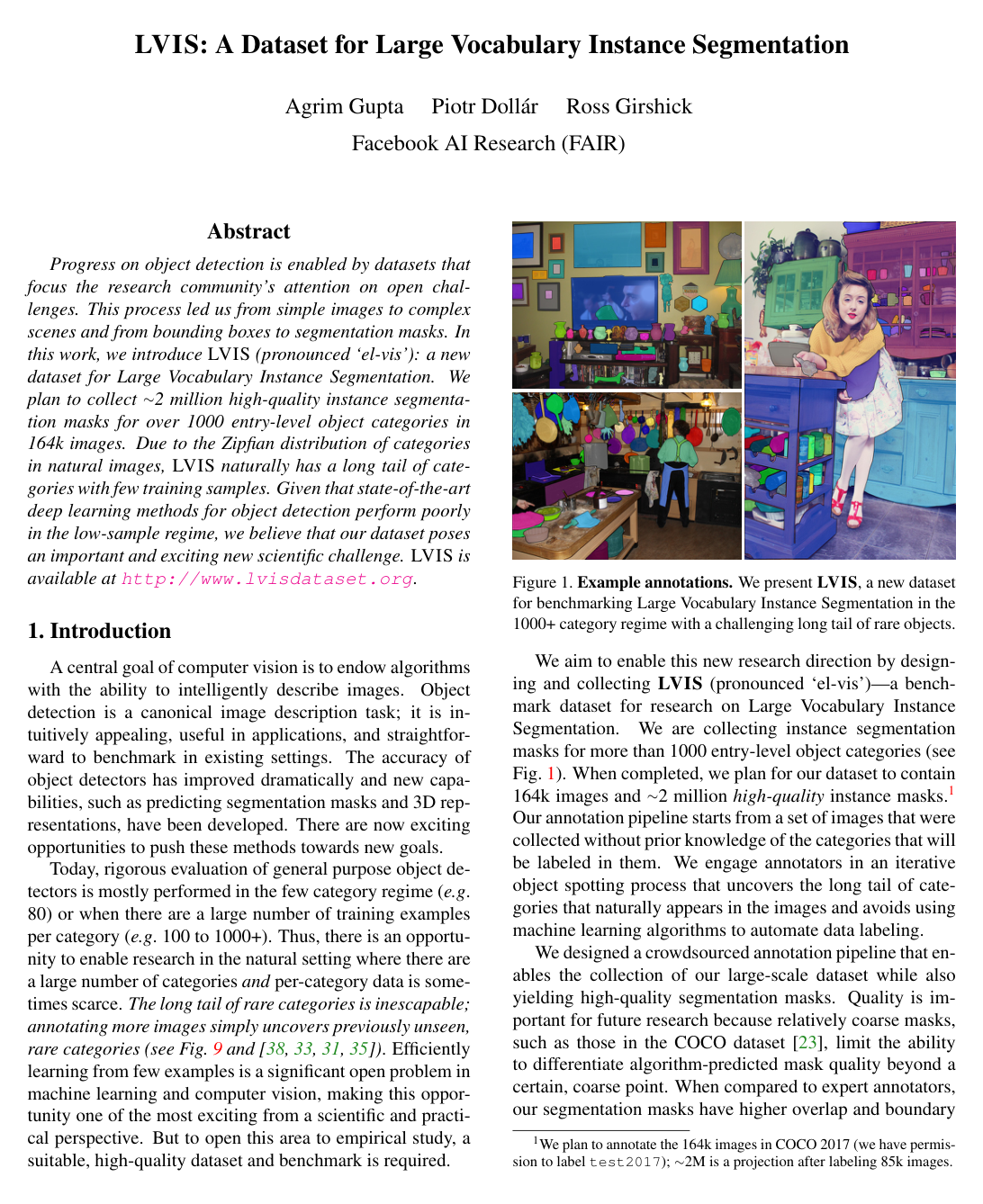
Introduces the LVIS benchmark spanning over 1,000 object categories and two million segmentation masks, exposing how poorly current deep learning models perform on long-tailed visual recognition with rare categories.
Modern computer vision algorithms perform exceptionally well when identifying a small set of common objects supported by thousands of examples. However, real-world visual environments naturally contain an extensive, long-tailed distribution of object categories, where many rare items appear infrequently. Existing benchmarks do not adequately measure how well systems recognize this vast variety of objects in low-sample settings, limiting the deployment of reliable image-understanding systems in complex environments.
The article introduces and evaluates LVIS, a large-scale instance segmentation benchmark designed to test whether machine learning algorithms can accurately delineate and categorize over 1,000 object classes, particularly in rare, low-data scenarios.
To make this evaluation feasible and fair, the authors designed a federated dataset structure and an iterative six-stage crowdsourcing pipeline across 164,000 images from the standard COCO collection. Instead of forcing every image to be exhaustively labeled for all 1,000+ categories—an impractical and ambiguous task—each category possesses a verified positive set (where every occurrence is masked) and a negative set (where the object does not appear). The dataset establishes high mask accuracy using human verification and WordNet synonym mapping rather than relying on automated labeling algorithms.
The investigation produced several key findings. First, existing top-tier architectures experience severe performance drops in rare-object regimes; for instance, standard models trained on reduced samples suffered an overall mask accuracy decline from 36.4% to 9.8%, with rare-category accuracy near zero (0.8%). Second, the proposed crowdsourced pipeline generated masks with higher boundary precision and overlap consistency relative to expert annotators than existing standards such as COCO and ADE20K. Third, simple algorithmic interventions yield immediate gains: adjusting inference detection thresholds and introducing a repeat factor sampling technique to oversample rare categories boosted rare-category average precision from 3.2% to 13.4% and overall precision to 27.1% when paired with larger backbones. Finally, empirical and simulation analyses revealed that evaluation set size inherently biases accuracy metrics downward on larger test sets due to the increased prevalence of rare categories.
These results demonstrate that extreme category imbalance and low-shot learning represent major bottlenecks for general-purpose visual recognition. Deploying current vision models in unconstrained environments introduces significant operational risk of missing uncommon objects. Furthermore, researchers must account for evaluation set size and category frequency shifts when measuring model performance and translating validation results to real-world test settings.
Organizations developing vision systems should integrate data resampling strategies, recalibrate inference-scoring thresholds, and benchmark models on large-vocabulary, long-tailed datasets before field deployment. For future research, the authors recommend participating in open benchmark challenges and refining architectures specifically to handle scarce training data.
The findings are bounded by the mid-stage release (v0.5), which represents approximately half of the projected two million masks and contains 1,230 categories across 82,000 images. Despite potential metric variance across differing evaluation set sizes, high experimental consistency across repeated runs and model ranks provides strong confidence in the benchmark's reliability.
- Paper: Microsoft COCO: Common Objects in Context, Tsung-Yi Lin et al. (2014). Microsoft COCO provides the foundational benchmark and image base upon which LVIS is constructed to scale instance segmentation to a massive, long-tailed vocabulary.
- Paper: Mask R-CNN, Kaiming He et al. (2017). Mask R-CNN establishes the primary baseline framework for instance segmentation that LVIS evaluates and benchmarks across high-cardinality, low-sample categories.
- Paper: Semantic Understanding of Scenes Through the ADE20K Dataset, Bolei Zhou et al. (2016). ADE20K pioneered dense, large-vocabulary scene parsing and instance labeling, establishing essential precedents for open-vocabulary and multi-class visual recognition.
- Paper: ImageNet Large Scale Visual Recognition Challenge, Olga Russakovsky et al. (2014). ImageNet introduced the 1,000-class scale to visual recognition that LVIS seeks to bring to pixel-level instance segmentation.
- Paper: Visual Genome: Connecting Language and Vision Using Crowdsourced Dense Image Annotations, Ranjay Krishna et al. (2016). Visual Genome explores dense crowdsourced annotations and semantic relationship grounding across diverse object classes on COCO imagery.
- Paper: DeViSE: A Deep Visual-Semantic Embedding Model, Andrea Frome et al. (2013). DeViSE introduces visual-semantic embedding methods that motivate zero-shot and open-vocabulary strategies needed to address LVIS's long-tailed object distributions.
- Paper: Grounded Language-Image Pre-training, Liunian Harold Li et al. (2022). GLIP directly utilizes the LVIS benchmark to evaluate zero-shot and few-shot phrase grounding and large-vocabulary object detection.
- Paper: Per-Pixel Classification is Not All You Need for Semantic Segmentation, Bowen Cheng et al. (2021). MaskFormer introduces a unified mask-classification framework specifically designed to scale efficiently to the large-vocabulary segmentation challenges highlighted by datasets like LVIS.
- Paper: Segment Anything, Alexander M. Kirillov et al. (2023). Segment Anything builds on the need for exhaustive, high-quality segmentation across diverse vocabularies by introducing promptable foundation models trained at massive scale.
- Paper: Intern VL: Scaling up Vision Foundation Models and Aligning for Generic Visual-Linguistic Tasks, Zhe Chen et al. (2024). InternVL scales vision foundation models and leverages large-vocabulary benchmarks to assess transferability across complex visual-linguistic tasks.