Magentic-UI: Towards Human-in-the-loop Agentic Systems
Hussein MozannarGagan BansalCheng TanAdam FourneyVictor DibiaJingya ChenJack GerritsTyler PayneMatheus Kunzler MaldanerMadeleine Grunde-McLaughlin
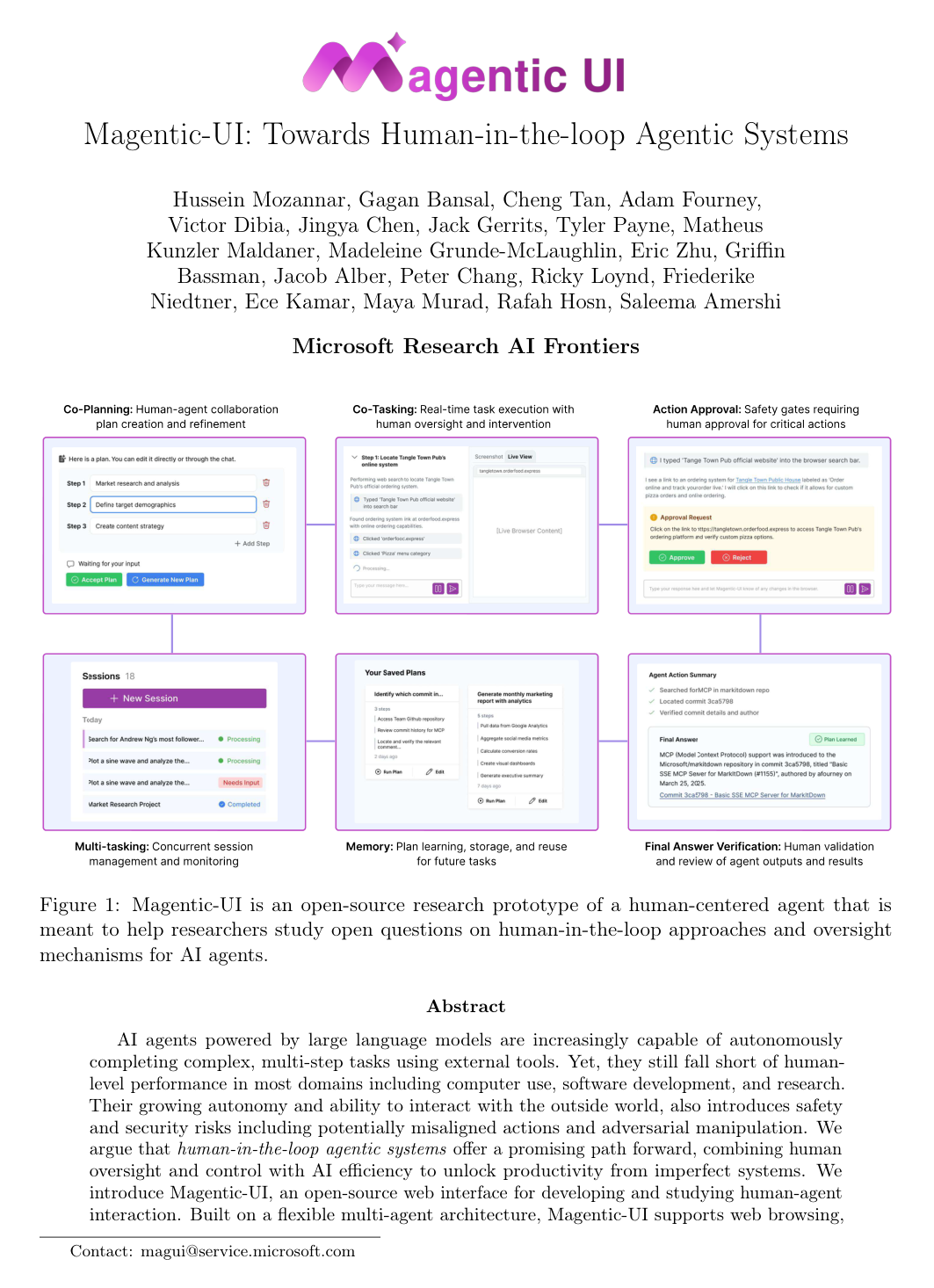
Presents Magentic-UI, an open-source research platform that implements six core interaction mechanisms—such as co-planning, live intervention, and action approvals—to enable safe, cost-effective human oversight of multi-agent LLM systems performing complex web and coding tasks.
Autonomous artificial intelligence agents powered by large language models are increasingly capable of executing multi-step tasks across the web, code repositories, and local file systems. However, current agents still fail to reach human-level reliability and present substantial safety risks, such as falling victim to adversarial prompt injections, leaking confidential data, or executing irreversible real-world actions. The article evaluates Magentic-UI, an open-source, user-facing research prototype designed to address these shortcomings by embedding human oversight directly into agent workflows. Its primary objective is to demonstrate how human-in-the-loop interaction mechanisms can bridge the performance gap between imperfect artificial intelligence systems and full human proficiency while maintaining safety and operational control.
To assess this system, the article employs a comprehensive, multi-method approach. The authors evaluated Magentic-UI across standard autonomous agent benchmarks—including GAIA, AssistantBench, WebVoyager, and WebGames—using state-of-the-art models such as GPT-4o and o4-mini. They conducted simulated user experiments on the GAIA benchmark to model the impact of human guidance, carried out qualitative user studies with 12 participants performing multi-task workflows, and executed targeted security red-teaming across 24 adversarial attack scenarios that featured direct exploitation, social engineering, and prompt injections.
Key findings show that human intervention significantly boosts agent capabilities at low human effort. In simulated user testing on the GAIA benchmark, pairing the agent with lightweight human guidance increased task completion accuracy by 71% (improving from 30.3% to 51.9%), even though the system requested human assistance on only 10% of tasks and averaged just 1.1 help requests per difficult task. In autonomous benchmark testing, Magentic-UI achieved strong task success rates, reaching 82.2% on WebVoyager and 45.5% on WebGames with o4-mini. User study participants gave the interface a solid usability rating (a System Usability Scale score of 74.58), finding co-planning and background multi-tasking valuable, though they highlighted friction around system latency, verbose progress logs, and rigid approval prompts. In safety assessments, default security mechanisms—specifically Docker container sandboxing, separate browser instances, and two-stage action guards—successfully thwarted 100% of the 24 adversarial attack scenarios.
These results demonstrate that organizations do not need to wait for fully autonomous artificial intelligence to realize productivity benefits from agentic workflows. By incorporating low-cost human oversight mechanisms such as up-front co-planning, real-time interruption, and action approval guards, imperfect systems can be deployed safely without exposing critical infrastructure or private data to prompt injection vulnerabilities. However, the study also shows that when security mitigations were intentionally disabled, agents consistently succumbed to prompt injections that exfiltrated access keys and certificates, underscoring that architectural isolation and human oversight are strictly necessary safeguards.
For practical adoption, organizations should implement layered defense architectures that isolate agent execution environments within sandboxed containers and enforce human approval on high-risk, irreversible operations. Agent interfaces should be tuned to avoid excessive interruption by batching clarifying questions and offering visual summarization tools rather than raw text logs. Further work is required to conduct long-term, randomized controlled trials that quantify net productivity gains and evaluate more expressive planning structures, such as hierarchical or branching workflows.
The findings are bounded by certain limitations. The evaluations relied on simulated user behaviors and short qualitative sessions rather than long-term workplace deployments, meaning true organizational productivity impact remains unmeasured. Furthermore, testing was limited to English-language tasks, and agent performance remains lower on highly complex coding and broad computer-control problems. Nevertheless, the evidence strongly supports human-in-the-loop architecture as a practical and secure paradigm for current agent deployment.
- Paper: AutoGen: Enabling Next-Gen LLM Applications via Multi-Agent Conversation, Qingyun Wu et al. (2023). It introduces the foundational multi-agent conversational framework and human-in-the-loop interaction paradigm upon which Magentic-UI's architecture is constructed.
- Paper: WebArena: A Realistic Web Environment for Building Autonomous Agents, Shuyan Zhou et al. (2023). It provides the foundational simulation benchmark and evaluation methodology for autonomous web-browsing agents that Magentic-UI seeks to support and improve through human oversight.
- Paper: Human-Centered Artificial Intelligence: Reliable, Safe & Trustworthy, Ben Shneiderman (2020). It establishes the core conceptual framework arguing that high automation and high human control must coexist to ensure safe and trustworthy AI systems.
- Paper: SWE-agent: Agent-Computer Interfaces Enable Automated Software Engineering, John Yang et al. (2024). It demonstrates how designing dedicated interface abstractions between agents and computer environments improves reliability in interactive execution tasks.
- Paper: Mind2Web: Towards a Generalist Agent for the Web, Xiang Deng et al. (2023). It defines the challenges and interaction paradigms of generalist agents navigating real-world web interfaces.
- Paper: ReAct: Synergizing Reasoning and Acting in Language Models, Shunyu Yao et al. (2023). It establishes the foundational interleaved reasoning and acting framework utilized by modern autonomous tool-using agents.
- Paper: Human-in-the-loop or AI-in-the-loop? Automate or Collaborate?, Sriraam Natarajan et al. (2025). It conceptually formalizes the operational distinction between human-in-the-loop and AI-in-the-loop collaborative frameworks demonstrated by systems like Magentic-UI.
- Paper: Dive into Claude Code: The Design Space of Today's and Future AI Agent Systems, Jiacheng Liu et al. (2026). It investigates the concrete architectural design space, permission layers, and user-control harnesses required for production-grade human-in-the-loop agentic systems.
- Paper: SafeArena: Evaluating the Safety of Autonomous Web Agents, Ada Defne Tur et al. (2025). It directly evaluates the safety risks and adversarial vulnerabilities of autonomous web agents that human-in-the-loop interfaces aim to mitigate.
- Paper: Auto-Eval Judge: Towards a General Agentic Framework for Task Completion Evaluation, Abubakarr Jaye et al. (2025). It develops automated evaluation frameworks specifically tested on Magentic agent workflows to assess task completion across intermediate execution steps.
- Paper: AgentDoG: A Diagnostic Guardrail Framework for AI Agent Safety and Security, Dongrui Liu et al. (2026). It introduces advanced diagnostic guardrails to identify unsafe tool actions and execution risks across multi-step agent trajectories.
- Paper: Intelligent AI Delegation, Nenad Tomašev et al. (2026). It extends human-agent interaction by developing a formal theoretical framework for dynamic authority transfer, intent clarity, and continuous oversight.