AutoGen: Enabling Next-Gen LLM Applications via Multi-Agent Conversation

Qingyun WuGagan BansalJieyu ZhangYiran WuBeibin LiErkang ZhuLi JiangXiaoyun ZhangShaokun ZhangJiale Liu

article2023COLM2,594 citationsBest Paper, LLM Agents Workshop ICLR'24

Introduces AutoGen, an open-source framework that enables developers to build advanced applications by orchestrating customizable, conversable agents that combine large language models, human input, and computational tools.

Listen

The article introduces AutoGen, an open-source framework designed to build applications that use large language models through multi-agent conversations. Developers face growing challenges in scaling LLM capabilities for complex, multi-domain tasks, and prior single-agent systems often lack flexibility for collaboration, human input, or dynamic workflows. The work addresses this by creating a system that lets agents with varied roles converse to solve problems, combining LLM reasoning with tools and optional human oversight.

The authors developed two core concepts: conversable agents that can be customized with LLMs, humans, or tools, and a conversation programming approach that defines interactions through natural language or code. They implemented built-in agents and tested the framework on six applications across mathematics, code generation, question answering, decision-making in simulated environments, optimization, and interactive games. Evaluations used standard benchmarks such as the MATH dataset, Natural Questions, ALFWorld, and OptiGuide tasks, comparing results against baselines including GPT-4, ReAct, and commercial tools.

Key findings show that AutoGen systems achieved higher success rates than alternatives, such as 69.5 percent accuracy on the full MATH test set versus 55.2 percent for GPT-4 alone, and a 15 percent gain on ALFWorld tasks when adding a grounding agent. Multi-agent designs improved safety checks in coding tasks and reduced development code by roughly 75 percent in one case while cutting user interactions by three to five times. Dynamic group chats and human-in-the-loop modes enabled new interaction patterns without added complexity.

These results indicate that multi-agent conversation can improve task performance, lower development effort, and support modular, reusable components across diverse applications. The approach allows organizations to integrate LLMs more effectively into workflows that require collaboration, validation, or external tool use, potentially accelerating deployment while maintaining oversight.

Further work is needed to identify optimal agent configurations for specific tasks, integrate existing agent libraries, and develop safeguards against unintended behaviors as autonomy increases. Developers should begin with simple two-agent setups and built-in components, then add complexity only as required, while monitoring for bias, privacy, and accountability issues.

Cover for AutoGen: Enabling Next-Gen LLM Applications via Multi-Agent Conversation

Abstract

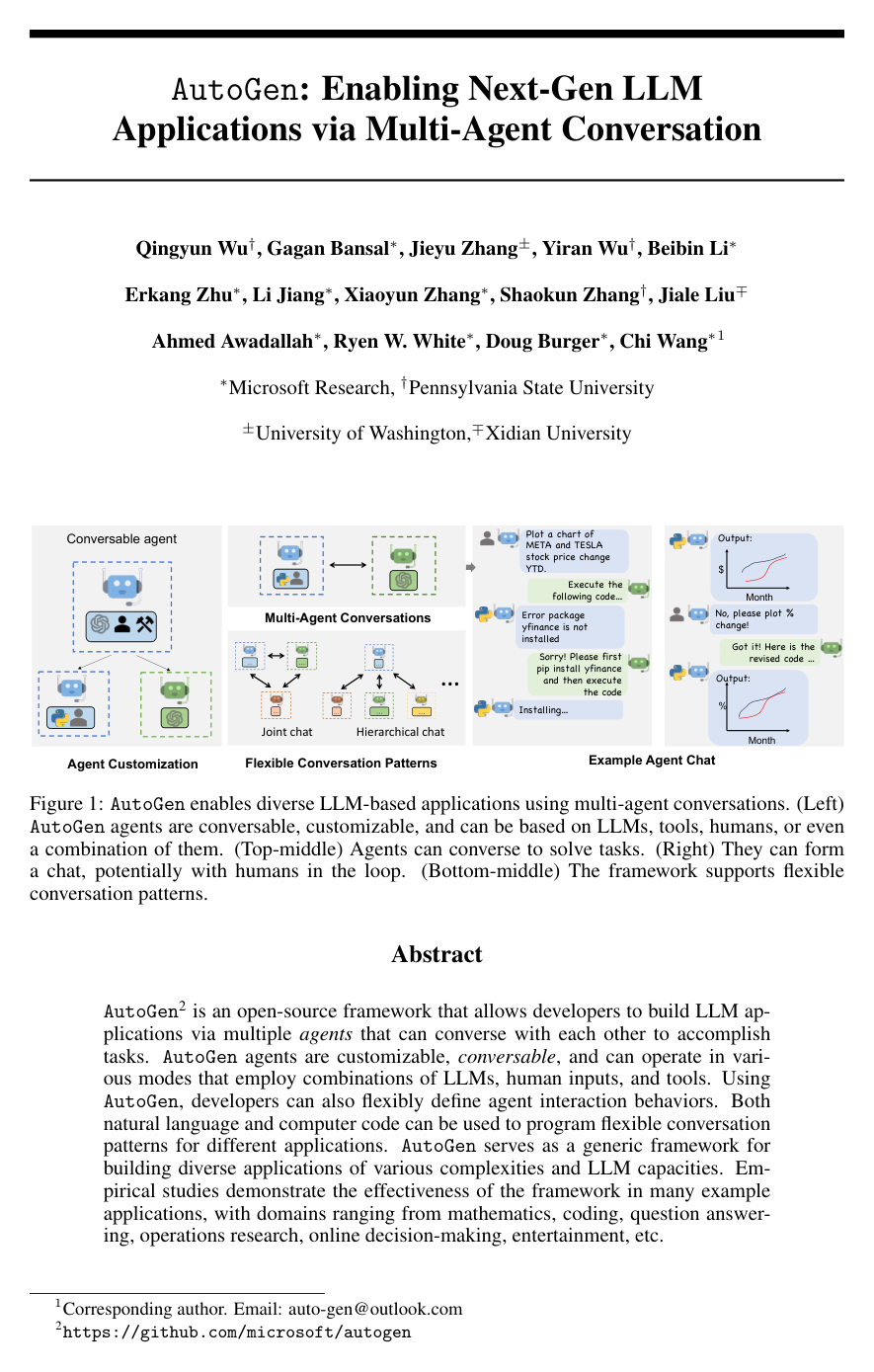
AutoGen is an open-source framework that allows developers to build LLM applications via multiple agents that can converse with each other to accomplish tasks. AutoGen agents are customizable, conversable, and can operate in various modes that employ combinations of LLMs, human inputs, and tools. Using AutoGen, developers can also flexibly define agent interaction behaviors. Both natural language and computer code can be used to program flexible conversation patterns for different applications. AutoGen serves as a generic infrastructure to build diverse applications of various complexities and LLM capacities. Empirical studies demonstrate the effectiveness of the framework in many example applications, with domains ranging from mathematics, coding, question answering, operations research, online decision-making, entertainment, etc.

Table of Contents

  • 1 Introduction
  • 2 The AutoGen Framework
  • 2.1 Conversable Agents
  • 2.2 Conversation Programming
  • 3 Applications of AutoGen
  • 4 Discussion
  • References
  • A Related Work
  • B Expanded Discussion
  • B.1 General Guidelines for Using AutoGen
  • B.2 Future Work
  • C Default System Message for Assistant Agent
  • D Application Details
  • E Example outputs from applications

Knowls

  1. Knowl 1 — Conversable Agent Architecture in AutoGen

    model/method

    In the AutoGen framework, a multi-agent workflow is constructed from conversable agents. A conversable agent is an autonomous entity associated with a defined role that communicates by passing messages via unified interfaces (send, receive, and generate_reply). Each agent maintains its own internal conversational context and can be configured with a composable mix of backends:

    1. LLM backend: Leverages large language models for reasoning, state tracking, role-playing, code generation, and critique conditioning.
    2. Human backend: Incorporates human oversight directly into the loop with configurable interaction modes (ALWAYS, NEVER, or conditional intervention).
    3. Tool backend: Enables execution of code blocks (e.g., Python or shell scripts) or external API/function calls.

    AutoGen defines a base class ConversableAgent and two primary built-in subclasses:

    • AssistantAgent: A pre-configured AI assistant backed by an LLM designed for multi-step problem solving and code generation.
    • UserProxyAgent: An agent acting as a proxy for humans and/or execution environments, capable of executing LLM-suggested code/function calls and soliciting human inputs when configured.
  2. Knowl 2 — Conversation Programming and Decentralized Auto-Reply Mechanism

    model/method

    AutoGen structures LLM application workflows using conversation programming, which decomposes tasks into conversation-centric computation (actions taken by agents to compute replies) and conversation-driven control flow (the sequence and conditions under which messages are exchanged).

    Control flow is executed via a decentralized auto-reply mechanism: upon receiving a message from another agent, a conversable agent automatically executes its registered generate_reply pipeline and sends the response back to the sender unless a specified termination condition is met. Reply functions can be based on default LLM inference, human feedback solicitation, tool/code execution, or custom registered reply handlers (registered via register_reply). This eliminates the requirement for a centralized orchestrator or global control plane.

  3. Knowl 3 — Fusion of Natural and Programming Language Control Flow

    model/method

    AutoGen supports hybrid control of agent workflows by fusing natural language instructions with programmatic logic:

    1. Natural-language control: Conversation flows and agent boundaries are directed via natural language system prompts (e.g., instructing an assistant agent to examine execution errors in context, revise code, or emit specific termination keywords such as "TERMINATE" when a task is completed).
    2. Programming-language control: Flow constraints, maximum number of auto-replies, human input triggers, and code execution policies are configured programmatically in Python.
    3. Bidirectional control transitions: Systems transition from code to natural language by triggering LLM inference inside custom reply hooks, or from natural language to code execution via LLM-driven function calling.
  4. Knowl 4 — Dynamic Group Chat via GroupChatManager

    model/method

    For multi-agent workflows without a fixed communication order, AutoGen provides a dynamic group chat pattern managed by GroupChatManager. In this pattern, all participating agents share a single collective context. The GroupChatManager operates in a continuous three-step loop:

    1. Speaker selection: Dynamically select the next speaking agent based on the conversation history and a role-play prompt that evaluates role alignment for the current context.
    2. Response generation: Prompt the selected agent to generate its response.
    3. Broadcasting: Broadcast the generated message to all other participating agents in the group chat.

    Using a role-play prompt for speaker selection improves role alignment and task completion rate over a purely task-based prompt.

  5. Knowl 5 — Performance of AutoGen Multi-Agent Problem Solving on the MATH Benchmark

    data/table

    When evaluated on the MATH benchmark using GPT-4 as the base model, an out-of-the-box AutoGen two-agent setup (AssistantAgent paired with a code-executing UserProxyAgent) achieved higher problem-solving accuracy than single-agent GPT-4, commercial ChatGPT configurations, and other multi-agent frameworks.

    Method 120 Level-5 Problems (%) Whole Dataset (%)
    AutoGen 52.50 69.48
    ChatGPT + Code Interpreter 48.33
    ChatGPT + Wolfram Alpha Plugin 45.00
    Vanilla GPT-4 30.00 55.18
    Multi-Agent Debate 26.67
    LangChain ReAct 23.33

    The AutoGen setup outperforms vanilla GPT-4 by 14.30 percentage points on the entire 5000-problem test set by iteratively writing, executing, and correcting symbolic mathematics code (e.g., via sympy).

  6. Knowl 6 — Interactive Retrieval-Augmented Generation Architecture

    model/method

    AutoGen implements Retrieval-Augmented Generation (RAG) through two conversable agents: a Retrieval-augmented User Proxy (which splits, embeds, and stores documents in a vector database like Chroma using SentenceTransformers) and a Retrieval-augmented Assistant.

    Instead of a standard one-shot retrieval pipeline, the system uses interactive retrieval: if the retrieved document context sent by the user proxy is insufficient to answer the query, the assistant agent responds with the signal "Sorry, I cannot find any information about... UPDATE CONTEXT.". Receiving this message triggers the user proxy to retrieve the next most relevant set of document chunks from the vector database and continue the dialogue until a satisfactory answer is found or context is exhausted.

  7. Knowl 7 — Empirical Evaluation of Interactive Retrieval Augmentation on Natural Questions

    empirical result

    On the Natural Questions benchmark (evaluated over 6,775 queries and 5,332 context documents using GPT-3.5-turbo and all-MiniLM-L6-v2 embeddings), AutoGen's interactive retrieval mechanism demonstrated significant gains over both standard one-shot retrieval and Dense Passage Retrieval (DPR):

    • AutoGen (with interactive retrieval): F1=25.88%F_1 = 25.88\%, Recall=66.65%\text{Recall} = 66.65\%
    • AutoGen without interactive retrieval (ablation): F1=22.79%F_1 = 22.79\%, Recall=62.59%\text{Recall} = 62.59\%
    • DPR baseline: F1=15.12%F_1 = 15.12\%, Recall=58.56%\text{Recall} = 58.56\%

    Approximately 19.4%19.4\% of the evaluated questions triggered an "UPDATE CONTEXT" action, yielding the observed improvements in answer recall and accuracy.

  8. Knowl 8 — Grounding Agent Performance in Text-World Environments (ALFWorld)

    data/table

    On 134 unseen decision-making tasks across 6 categories in the synthetic household benchmark ALFWorld, a three-agent AutoGen architecture (AssistantAgent, ExecutorAgent, and GroundingAgent) was evaluated against a standard two-agent setup and the ReAct baseline using GPT-3.5-turbo. The GroundingAgent supplies physical commonsense rules whenever the assistant repeats an identical action three times consecutively, preventing execution loops.

    Method Pick Clean Heat Cool Look Pick 2 All (%)
    ReAct (avg) 63 52 48 71 61 24 54
    ALFChat (2 agents, avg) 61 58 57 67 50 19 54
    ALFChat (3 agents, avg) 79 64 70 76 78 41 69
    ReAct (best of 3) 75 62 61 81 78 35 66
    ALFChat (2 agents, best of 3) 71 61 65 76 67 35 63
    ALFChat (3 agents, best of 3) 92 74 78 86 83 41 77

    Introducing the grounding agent yields a 15 percentage point gain on average (from 54% to 69%) and an 11 to 14 percentage point improvement on best-of-3 evaluation over the 2-agent and ReAct baselines.

  9. Knowl 9 — Multi-Agent Safeguarded Code Generation in OptiGuide

    empirical result

    In the OptiGuide supply-chain optimization code-generation task, AutoGen coordinates three agents: a Commander (user proxy and executor), a Writer (code authoring and output interpreter), and a Safeguard (adversarial code safety screener). Across 100 safe and unsafe coding tasks, separating safety validation into a dedicated Safeguard agent improved F1F_1 scores for detecting unsafe code relative to a single-agent baseline:

    • GPT-4: F1=96.00%F_1 = 96.00\% (Multi-Agent) vs. 88.00%88.00\% (Single-Agent) — an 8%8\% absolute increase; Recall: 98.00%98.00\% vs. 78.00%78.00\%.
    • GPT-3.5-turbo: F1=83.00%F_1 = 83.00\% (Multi-Agent) vs. 48.00%48.00\% (Single-Agent) — a 35%35\% absolute increase; Recall: 72.00%72.00\% vs. 32.00%32.00\%.

    Re-implementing OptiGuide with AutoGen reduced core workflow code from >430>430 lines to 100 lines and reduced required user interaction prompts by 3.03×3.03\times to 4.88×4.88\times across five benchmark domains (netflow: 3.14×3.14\times, facility: 3.14×3.14\times, tsp: 4.88×4.88\times, coffee: 3.38×3.38\times, diet: 3.03×3.03\times).

  10. Knowl 10 — Dynamic Group Chat Performance on Multi-Step Tasks

    data/table

    A pilot study evaluated a 4-agent dynamic group chat system (User Proxy, Engineer, Critic, Executor) against a Two-Agent setup and a Group Chat with a task-based speaker selection policy across 12 complex multi-step tasks.

    Model Two-Agent Group Chat (Role-Play) Group Chat (Task-Based)
    Successes out of 12 (higher is better)
    GPT-3.5-turbo 8 9 7
    GPT-4 9 11 8
    Avg # LLM Calls, Termination Failures (lower is better)
    GPT-3.5-turbo 9.9, 9 5.3, 0 4.0, 0
    GPT-4 6.8, 3 4.5, 0 4.0, 0

    Role-play prompt speaker selection achieved the highest overall success rates (11/12 with GPT-4) while completely eliminating termination failures and reducing the required number of LLM inference calls relative to the two-agent setup.

Coverage note — Qualitative dialogue examples (e.g., Conversational Chess and MiniWoB++ web-interaction transcripts) were omitted as standalone knowls in favor of the foundational architectural mechanisms and quantitative benchmark results.

References

  1. 1.Vaibhav Adlakha, Parishad BehnamGhader, Xing Han Lu, Nicholas Meade, and Siva Reddy. Evaluating correctness and faithfulness of instruction-following models for question answering. arXiv preprint arXiv:2307.16877, 2023.
  2. 2.Saleema Amershi, Dan Weld, Mihaela Vorvoreanu, Adam Fourney, Besmira Nushi, Penny Collisson, Jina Suh, Shamsi Iqbal, Paul N Bennett, Kori Inkpen, et al. Guidelines for human-ai interaction. In Proceedings of the 2019 chi conference on human factors in computing systems, 2019.
  3. 3.Dario Amodei, Chris Olah, Jacob Steinhardt, Paul Christiano, John Schulman, and Dan Mane. Concrete problems in ai safety, 2016.
  4. 4.AutoGPT. Documentation — auto-gpt. https://docs.agpt.co/, 2023.
  5. 5.BabyAGI. Github — babyagi. https://github.com/yoheinakajima/babyagi, 2023.
  6. 6.Carrie J. Cai, Samantha Winter, David F. Steiner, Lauren Wilcox, and Michael Terry. "hello ai": Uncovering the onboarding needs of medical practitioners for human-ai collaborative decisionmaking. Proceedings of the ACM on Human-Computer Interaction, 2019.
  7. 7.Tianle Cai, Xuezhi Wang, Tengyu Ma, Xinyun Chen, and Denny Zhou. Large language models as tool makers. arXiv preprint arXiv:2305.17126, 2023.
  8. 8.Chroma. Chromadb. https://github.com/chroma-core/chroma, 2023.
  9. 9.Victor Dibia. LIDA: A tool for automatic generation of grammar-agnostic visualizations and infographics using large language models. In Proceedings of the 61st Annual Meeting of the Association for Computational Linguistics (Volume 3: System Demonstrations), Toronto, Canada, July 2023. Association for Computational Linguistics.
  10. 10.Yihong Dong, Xue Jiang, Zhi Jin, and Ge Li. Self-collaboration code generation via chatgpt. arXiv preprint arXiv:2304.07590, 2023.
  11. 11.Yilun Du, Shuang Li, Antonio Torralba, Joshua B Tenenbaum, and Igor Mordatch. Improving factuality and reasoning in language models through multiagent debate. arXiv preprint arXiv:2305.14325, 2023.
  12. 12.Atty Eleti, Jeff Harris, and Logan Kilpatrick. Function calling and other api updates. https://openai.com/blog/function-calling-and-other-api-updates, 2023.
  13. 13.Guidance. Guidance. https://github.com/guidance-ai/guidance, 2023.
  14. 14.Dan Hendrycks, Collin Burns, Saurav Kadavath, Akul Arora, Steven Basart, Eric Tang, Dawn Song, and Jacob Steinhardt. Measuring mathematical problem solving with the math dataset. arXiv preprint arXiv:2103.03874, 2021.
  15. 15.Sirui Hong, Xiawu Zheng, Jonathan Chen, Yuheng Cheng, Ceyao Zhang, Zili Wang, Steven Ka Shing Yau, Zijuan Lin, Liyang Zhou, Chenyu Ran, et al. Metagpt: Meta programming for multi-agent collaborative framework. arXiv preprint arXiv:2308.00352, 2023.
  16. 16.Eric Horvitz. Principles of mixed-initiative user interfaces. In Proceedings of the SIGCHI conference on Human Factors in Computing Systems, 1999.
  17. 17.HuggingFace. Transformers agent. https://huggingface.co/docs/transformers/transformers_agents, 2023.
  18. 18.Geunwoo Kim, Pierre Baldi, and Stephen McAleer. Language models can solve computer tasks. arXiv preprint arXiv:2303.17491, 2023.
  19. 19.Tom Kwiatkowski, Jennimaria Palomaki, Olivia Redfield, Michael Collins, Ankur Parikh, Chris Alberti, Danielle Epstein, Illia Polosukhin, Jacob Devlin, Kenton Lee, et al. Natural questions: a benchmark for question answering research. Transactions of the Association for Computational Linguistics, 2019.
  20. 20.LangChain. Introduction — langchain. https://python.langchain.com/en/latest/index.html, 2023.
  21. 21.Mike Lewis, Denis Yarats, Yann N Dauphin, Devi Parikh, and Dhruv Batra. Deal or no deal? end-to-end learning for negotiation dialogues. arXiv preprint arXiv:1706.05125, 2017.
  22. 22.Patrick Lewis, Ethan Perez, Aleksandra Piktus, Fabio Petroni, Vladimir Karpukhin, Naman Goyal, Heinrich Kuttler, Mike Lewis, Wen-tau Yih, Tim Rockt aschel, et al. Retrieval-augmented generation for knowledge-intensive nlp tasks. Advances in Neural Information Processing Systems, 2020.
  23. 23.Beibin Li, Konstantina Mellou, Bo Zhang, Jeevan Pathuri, and Ishai Menache. Large language models for supply chain optimization. arXiv preprint arXiv:2307.03875, 2023a.
  24. 24.Guohao Li, Hasan Abed Al Kader Hammoud, Hani Itani, Dmitrii Khizbullin, and Bernard Ghanem. Camel: Communicative agents for "mind" exploration of large scale language model society, 2023b.
  25. 25.Tian Liang, Zhiwei He, Wenxiang Jiao, Xing Wang, Yan Wang, Rui Wang, Yujiu Yang, Zhaopeng Tu, and Shuming Shi. Encouraging divergent thinking in large language models through multiagent debate, 2023.
  26. 26.Evan Zheran Liu, Kelvin Guu, Panupong Pasupat, Tianlin Shi, and Percy Liang. Reinforcement learning on web interfaces using workflow-guided exploration. arXiv preprint arXiv:1802.08802, 2018.
  27. 27.Jerry Liu. LlamaIndex, November 2022. URL https://github.com/jerryjliu/llama_index.
  28. 28.Volodymyr Mnih, Koray Kavukcuoglu, David Silver, Alex Graves, Ioannis Antonoglou, Daan Wierstra, and Martin Riedmiller. Playing atari with deep reinforcement learning. arXiv preprint arXiv:1312.5602, 2013.
  29. 29.Roberto Navigli, Simone Conia, and Bjorn Ross. Biases in large language models: Origins, inventory and discussion. ACM Journal of Data and Information Quality, 2023.
  30. 30.OpenAI. ChatGPT plugins. https://openai.com/blog/chatgpt-plugins, 2023.
  31. 31.Joon Sung Park, Joseph C O'Brien, Carrie J Cai, Meredith Ringel Morris, Percy Liang, and Michael S Bernstein. Generative agents: Interactive simulacra of human behavior. arXiv preprint arXiv:2304.03442, 2023.
  32. 32.Md Rizwan Parvez, Wasi Uddin Ahmad, Saikat Chakraborty, Baishakhi Ray, and Kai-Wei Chang. Retrieval augmented code generation and summarization. arXiv preprint arXiv:2108.11601, 2021.
  33. 33.Shishir G. Patil, Tianjun Zhang, Xin Wang, and Joseph E. Gonzalez. Gorilla: Large language model connected with massive apis. arXiv preprint arXiv:2305.15334, 2023.
  34. 34.Nils Reimers and Iryna Gurevych. Sentence-bert: Sentence embeddings using siamese bertnetworks. In Proceedings of the 2019 Conference on Empirical Methods in Natural Language Processing. Association for Computational Linguistics, 11 2019. URL https://arxiv.org/abs/1908.10084.
  35. 35.Semantic-Kernel. Semantic kernel. https://github.com/microsoft/semantic-kernel, 2023.
  36. 36.Bokui Shen, Fei Xia, Chengshu Li, Roberto Martın-Martın, Linxi Fan, Guanzhi Wang, Claudia Perez-D'Arpino, Shyamal Buch, Sanjana Srivastava, Lyne Tchapmi, et al. igibson 1.0: A simulation environment for interactive tasks in large realistic scenes. In 2021 IEEE/RSJ International Conference on Intelligent Robots and Systems (IROS). IEEE, 2021.
  37. 37.Tianlin Shi, Andrej Karpathy, Linxi Fan, Jonathan Hernandez, and Percy Liang. World of bits: An open-domain platform for web-based agents. In International Conference on Machine Learning. PMLR, 2017.
  38. 38.Mohit Shridhar, Xingdi Yuan, Marc-Alexandre Cot e, Yonatan Bisk, Adam Trischler, and Matthew Hausknecht. ALFWorld: Aligning Text and Embodied Environments for Interactive Learning. In Proceedings of the International Conference on Learning Representations (ICLR), 2021. URL https://arxiv.org/abs/2010.03768.
  39. 39.Oriol Vinyals, Timo Ewalds, Sergey Bartunov, Petko Georgiev, Alexander Sasha Vezhnevets, Michelle Yeo, Alireza Makhzani, Heinrich Kuttler, John Agapiou, Julian Schrittwieser, et al. Starcraft ii: A new challenge for reinforcement learning. arXiv preprint arXiv:1708.04782, 2017.
  40. 40.Chi Wang, Qingyun Wu, Markus Weimer, and Erkang Zhu. Flaml: A fast and lightweight automl library. Proceedings of Machine Learning and Systems, 2021.
  41. 41.Guanzhi Wang, Yuqi Xie, Yunfan Jiang, Ajay Mandlekar, Chaowei Xiao, Yuke Zhu, Linxi Fan, and Anima Anandkumar. Voyager: An open-ended embodied agent with large language models. arXiv preprint arXiv:2305.16291, 2023a.
  42. 42.Lei Wang, Chen Ma, Xueyang Feng, Zeyu Zhang, Hao Yang, Jingsen Zhang, Zhiyuan Chen, Jiakai Tang, Xu Chen, Yankai Lin, et al. A survey on large language model based autonomous agents. arXiv preprint arXiv:2308.11432, 2023b.
  43. 43.Daniel S. Weld and Oren Etzioni. The first law of robotics (a call to arms). In AAAI Conference on Artificial Intelligence, 1994.
  44. 44.Max Woolf. Langchain problem. https://minimaxir.com/2023/07/langchain-problem/, 2023.
  45. 45.Yiran Wu, Feiran Jia, Shaokun Zhang, Qingyun Wu, Hangyu Li, Erkang Zhu, Yue Wang, Yin Tat Lee, Richard Peng, and Chi Wang. An empirical study on challenging math problem solving with gpt-4. arXiv preprint arXiv:2306.01337, 2023.
  46. 46.Zhiheng Xi, Wenxiang Chen, Xin Guo, Wei He, Yiwen Ding, Boyang Hong, Ming Zhang, Junzhe Wang, Senjie Jin, Enyu Zhou, et al. The rise and potential of large language model based agents: A survey. arXiv preprint arXiv:2309.07864, 2023.
  47. 47.Shunyu Yao, Jeffrey Zhao, Dian Yu, Nan Du, Izhak Shafran, Karthik Narasimhan, and Yuan Cao. React: Synergizing reasoning and acting in language models. arXiv preprint arXiv:2210.03629, 2022.

Citation

MLA
Wu, Q., et al. “AutoGen: Enabling Next-Gen LLM Applications via Multi-Agent Conversation”. arXiv, 2023, http://arxiv.org/abs/2308.08155v2.
APA
Wu, Q., Bansal, G., Zhang, J., Wu, Y., Li, B., Zhu, E., Jiang, L., Zhang, X., Zhang, S., Liu, J., Awadallah, A. H., White, R. W., Burger, D., & Wang, C. (2023). AutoGen: Enabling Next-Gen LLM Applications via Multi-Agent Conversation. arXiv. http://arxiv.org/abs/2308.08155v2
Chicago
Wu, Q., G. Bansal, J. Zhang, et al. 2023. “AutoGen: Enabling Next-Gen LLM Applications via Multi-Agent Conversation”. arXiv. http://arxiv.org/abs/2308.08155v2.
Harvard
Wu, Q. et al. (2023) “AutoGen: Enabling Next-Gen LLM Applications via Multi-Agent Conversation”, arXiv [Preprint]. Available at: http://arxiv.org/abs/2308.08155v2.
Vancouver
1. Wu Q, Bansal G, Zhang J, et al (2023) AutoGen: Enabling Next-Gen LLM Applications via Multi-Agent Conversation. arXiv

BibTeX

@article{wu2023autogen,
  title = {AutoGen: Enabling Next-Gen LLM Applications via Multi-Agent Conversation},
  author = {Wu, Qingyun and Bansal, Gagan and Zhang, Jieyu and Wu, Yiran and Li, Beibin and Zhu, Erkang and Jiang, Li and Zhang, Xiaoyun and Zhang, Shaokun and Liu, Jiale and Awadallah, Ahmed Hassan and White, Ryen W and Burger, Doug and Wang, Chi},
  year = {2023},
  journal = {arXiv},
  url = {http://arxiv.org/abs/2308.08155v2},
  eprint = {2308.08155}
}
Metadata:arXiv

Source Code

This paper has an official code repository available. Click below to access the source code.

View Repository

Access the Paper

This paper is available from its original source. Click below to access the PDF.

Open PDF

License: https://creativecommons.org/licenses/by/4.0/