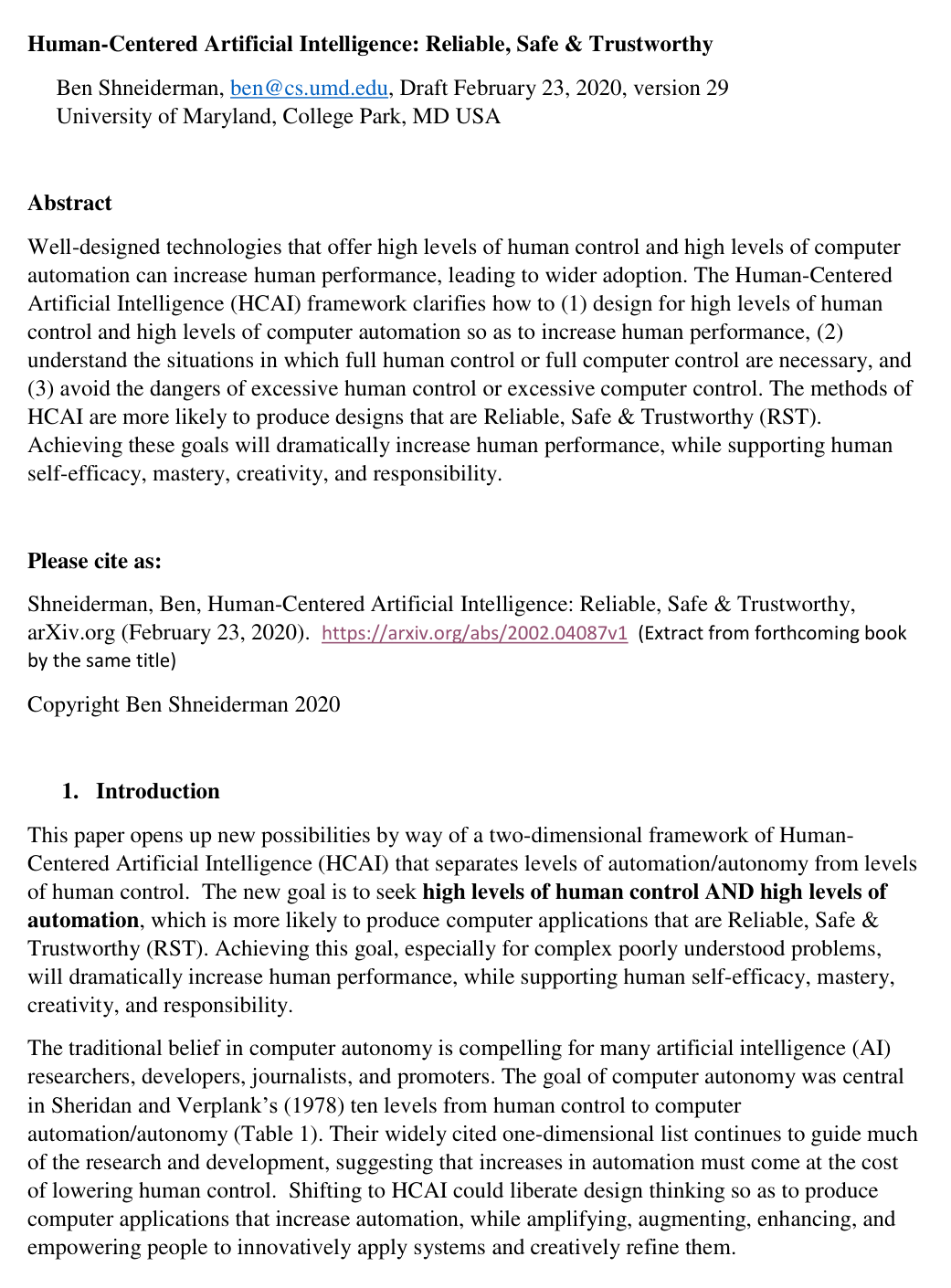
Human-Centered Artificial Intelligence: Reliable, Safe & Trustworthy

Ben Shneiderman

article2020International journal of human computer interactions1,471 citations

Presents a framework for pairing high automation with high human control, guiding designers to build reliable, safe, and trustworthy AI systems that preserve human responsibility and agency.

Listen

Artificial intelligence development has long operated on the assumption that increasing machine autonomy requires reducing human control. This traditional view has led to system designs that obscure operations from users, fail in unexpected environments, and cause fatal accidents in safety-critical domains such as aviation and transportation.

The article establishes a two-dimensional Human-Centered Artificial Intelligence framework to demonstrate that high levels of automation and high levels of human control are not mutually exclusive, but rather complementary goals for creating reliable, safe, and trustworthy systems.

The author uses a conceptual and comparative approach, synthesizing historical models of automation, human factors literature, and real-world case studies across consumer, medical, and industrial systems to challenge prevailing design assumptions.

First, the article finds that treating automation and human control as a zero-sum trade-off is flawed; well-designed systems can maximize both dimensions simultaneously to significantly improve human performance. Second, extreme design choices introduce severe hazards: excessive computer automation produces catastrophic blind spots (as seen in recent commercial aviation crashes), while excessive human control allows preventable operator mistakes that software interlocks could easily stop. Third, specific system quadrants require distinct balances, such as fully automated rapid responses for airbags and pacemakers versus high human mastery for creative tasks. Fourth, achieving reliable, safe, and trustworthy systems requires combining sound technical practices, an open organizational safety culture, and independent external oversight.

These findings suggest that framing artificial intelligence as a human collaborator or autonomous agent leads to flawed engineering and misallocated operational risk. Instead, viewing systems as powerful instruments that augment human agency protects safety, maintains human accountability for critical decisions, and prevents expensive public failures.

To apply this approach, engineering and product leaders should adopt interaction design principles that provide continuous visual state displays, rapid and reversible actions, and transparent feedback. Organizations must also implement audit trails, establish internal failure review boards, and prepare for external compliance standards.

The framework represents a high-level qualitative paradigm rather than a mathematical model, and the author notes that standardized, objective metrics for measuring levels of control and autonomy across diverse domains still require further development.

arXiv: 2002.04087
Cover for Human-Centered Artificial Intelligence: Reliable, Safe & Trustworthy

Abstract

Well-designed technologies that offer high levels of human control and high levels of computer automation can increase human performance, leading to wider adoption. The Human-Centered Artificial Intelligence (HCAI) framework clarifies how to (1) design for high levels of human control and high levels of computer automation so as to increase human performance, (2) understand the situations in which full human control or full computer control are necessary, and (3) avoid the dangers of excessive human control or excessive computer control. The methods of HCAI are more likely to produce designs that are Reliable, Safe & Trustworthy (RST). Achieving these goals will dramatically increase human performance, while supporting human self-efficacy, mastery, creativity, and responsibility.

Table of Contents

  • 1. Introduction
  • 2. Reliable, Safe & Trustworthy Systems
  • 3. The Human-Centered Artificial Intelligence for RST Systems
  • 4. Prometheus Principles and Examples
  • 5. Summary, limitations, and conclusions
  • References

Knowls

  1. Knowl 1 — Two-Dimensional HCAI Framework

    model/method

    The Human-Centered Artificial Intelligence (HCAI) framework decouples levels of computer automation from levels of human control, organizing them into a two-dimensional design space rather than a one-dimensional spectrum. Traditional one-dimensional models (such as the Sheridan-Verplank levels of automation) presume that increasing machine autonomy inherently reduces human control in a zero-sum trade-off.

    In the two-dimensional HCAI framework:

    • The horizontal axis defines the level of computer automation (from low to high).
    • The vertical axis defines the level of human control (from low / computer control to high / human mastery).

    The framework establishes that high levels of computer automation and high levels of human control can be designed simultaneously. Achieving high values on both dimensions enables systems to amplify, augment, enhance, and empower human capabilities while maintaining human responsibility, mastery, self-efficacy, and creativity.

  2. Knowl 2 — Four Quadrants of the HCAI Design Space

    definition

    The two-dimensional HCAI framework divides system designs into four operational quadrants based on combinations of automation and human control:

    • High Human Control, High Computer Automation (Reliable, Safe & Trustworthy / RST): The primary target for complex, poorly understood tasks and dynamic environments. Systems leverage sophisticated machine algorithms and sensors to automate routine actions while providing rich displays and fine-grained controls so human operators steer decisions, exercise creativity, and handle unexpected conditions (e.g., modern digital cameras, commercial elevators, surgical robots).
    • High Human Control, Low Computer Automation (Human Mastery): Systems where personal skill development, engagement, physical execution, and mastery are primary values (e.g., playing a musical instrument, riding a bicycle, cooking, creative drawing).
    • Low Human Control, High Computer Automation (Computer Control / Rapid Action): Systems requiring automated, sub-second responses where human intervention is impossible or too slow to prevent harm, requiring extensive testing and fail-safe design (e.g., airbag deployment, anti-lock braking systems, implantable pacemakers, automated defensive weapons).
    • Low Human Control, Low Computer Automation: Simple or passive devices requiring minimal computation and minimal active steering (e.g., mechanical clocks, mousetraps, standard passive gravity-drip medication bags).
  3. Knowl 3 — Danger Zones of Excessive Automation and Excessive Human Control

    model/method

    The HCAI framework identifies two critical failure zones along the extreme margins of the design space:

    • Excessive Automation (Right Margin Danger Zone): Characterized by fully autonomous systems that hide internal machine state, lack manual override options, or operate under the mistaken belief of being foolproof ("algorithmic hubris"). These designs lead to single-point failure vulnerability, mode confusion, degraded user vigilance, and catastrophic accidents (such as flight control overrides unknown to pilots or overreliance on driver-assist systems).
    • Excessive Human Control (Top Margin Danger Zone): Characterized by systems lacking safety constraints, interlocks, or range checks, leaving operations vulnerable to fatal human errors caused by intoxication, distraction, exhaustion, or misjudgment (such as operating vehicles without alcohol interlocks or exceeding structural track speeds in trains).
  4. Knowl 4 — Three Governance Pillars for Reliable, Safe, and Trustworthy (RST) Systems

    model/method

    To achieve high performance and public acceptance, human-centered artificial intelligence systems require support from three interdependent structural pillars:

    1. Technical Practices for Reliability: Engineering methods that ensure algorithmic soundness, including comprehensive audit trails ("flight data recorders") to review anomalies and near misses, standardized benchmark tests for verification and validation, continuous data-quality monitoring and bias testing across changing deployment contexts, and explainability mechanisms.
    2. Management Strategies for Cultures of Safety: Internal organizational governance that encourages continuous learning, including explicit leadership commitment to safety, open reporting mechanisms for operational problems and near misses, reviews by internal oversight boards, and public reporting of failures.
    3. Independent Oversight Structures for Trustworthiness: External societal checks that certify design, operation, and maintenance, including independent accounting/auditing firms, professional standards bodies (e.g., IEEE, ISO), regulatory agencies (e.g., FAA, FDA, NHTSA), third-party consumer testing organizations, and insurance underwriting frameworks that compensate for system failures.
  5. Knowl 5 — Prometheus Principles of User Interface Design

    model/method

    The Prometheus Principles are six user interface design rules formulated to ensure systems remain comprehensible, predictable, and controllable while delivering high levels of computer automation:

    1. Consistent interfaces: Provide standardized interaction structures to allow users to easily formulate, express, and revise their intent.
    2. Continuous visual display: Maintain a persistent visual overview of objects, data, and operational states of interest.
    3. Rapid, incremental, and reversible actions: Enable users to perform fine-grained exploratory actions that can be immediately undone without penalty.
    4. Informative feedback: Acknowledge each user action promptly with explicit machine-state indications.
    5. Progress indicators: Display continuous status updates and remaining effort or time during ongoing automated operations.
    6. Completion reports: Issue clear, unambiguous confirmation and performance summaries when tasks finish successfully.
  6. Knowl 6 — System Categorization by Impact: Recommender, Consequential, and Life-Critical

    definition

    The HCAI framework categorizes intelligent applications into three distinct operational tiers based on decision stakes, time constraints, and consequence severity:

    • Recommender and Consumer Systems: High-volume, low-risk platforms (e.g., search autocompletion, media recommendations, advertising tools). Individual errors have minor consequences, though systemic manipulation and bias require user-controlled preferences and transparent suggestions.
    • Consequential Applications: Medium-risk professional decision-support domains (e.g., clinical diagnosis, legal advice, financial portfolio management, disease surveillance). System recommendations carry significant economic or health impacts, but decision makers typically have sufficient time to reflect, inspect audit logs, review explanations, and consult peers before committing to actions.
    • Life-Critical Systems: High-stakes physical and cyber-physical domains (e.g., autonomous transportation, surgical robotics, pacemakers, aviation, intensive care units). Actions involve strict real-time constraints and irreversible consequences, requiring rapid automated execution coupled with robust human supervisory controls, redundant fail-safes, and continuous logging.
  7. Knowl 7 — HCAI Quadrant Mapping for Patient-Controlled Analgesia (PCA)

    model/method

    The design of Patient-Controlled Analgesia (PCA) devices demonstrates how functionality varies across the four quadrants of the HCAI framework:

    • Low Control, Low Automation: A static intravenous drip bag delivering a fixed, unvarying dose of medication.
    • Low Control, High Automation (Automated Dispenser): An autonomous pump dispensing algorithmically determined doses based solely on physiological sensor readings without direct patient input or pain-perception accounting.
    • High Control, Low Automation (Patient-Controlled): A manual button-press device allowing patients to trigger doses on demand, constrained by safety interlocks such as fixed lockout periods (e.g., 6–10 minutes) and cumulative dose limits over 1–4 hour intervals to prevent overdose.
    • High Control, High Automation (RST Design): A patient-guided, clinician-monitored system where patients trigger boluses to signal perceived pain, while machine learning algorithms analyze historical patient trends, vital signs, and pharmacokinetics to tailor dose sizes safely. The interface provides explanations of dosage limits, while a centralized clinical monitoring center tracks device fleets, detects anomalies, reviews audit trails, and coordinates maintenance.
  8. Knowl 8 — Automotive Evolution in the HCAI Framework

    model/method

    The two-dimensional HCAI framework maps the historical evolution and future target of automotive control systems across automation and control axes:

    • 1980 Automobiles: Located in the high human control, low automation quadrant, relying primarily on direct mechanical manipulation with basic automations (e.g., automatic transmission, power steering).
    • 2020 Autonomous Concepts: Attempted high automation with low human control, aiming for full machine driving authority. This positioning risks driver disengagement, loss of situational awareness, and failure during edge cases or sensor misinterpretations.
    • 2040 RST Envisioned Vehicles: Located in the high human control, high automation quadrant. Vehicles execute automated lower-level safety actions (e.g., automated emergency braking, collision avoidance, lane centering, skid management), while human drivers and regional monitoring centers maintain high-level intent control, routing oversight, and supervisory intervention via robust interfaces, V2V communication, and audit logging.
  9. Knowl 9 — Interlocks, Physical Guards, and Software Constraints for Error Mitigation

    model/method

    To prevent disasters caused by excessive human control without sacrificing overall human agency, human-centered systems implement multi-layered physical, electrical, and software constraints:

    • Physical and Hardware Interlocks: Hardware mechanisms that physically block dangerous actions until safe conditions are met (e.g., thrust reversers engaging only when landing gear sensors confirm ground contact; self-cleaning oven doors remaining locked when internal temperatures exceed 600°F; vehicle ignition locks requiring zero-alcohol breath samples).
    • Software Range Checking and Input Guards: Programmatic constraints that validate parameters, verify input boundaries, and sanitize commands, ensuring that algorithms accept only valid inputs and produce safe, allowable outputs.
    • Supervisory and Regional Monitoring Centers: High-level human-in-the-loop oversight systems (modeled after air traffic control) that monitor fleets of semi-automated agents, track frequent near misses, dynamically regulate operational limits based on environmental conditions, and manage complex exceptions.
  10. Knowl 10 — Open Research Challenges and Limitations in HCAI

    limitation

    Implementing the HCAI framework presents several open research and engineering challenges:

    • Lack of Standardized Objective Metrics: There is a lack of rigorous, task-specific quantitative metrics to evaluate and compare precise levels of human control and computer autonomy across diverse domains.
    • Human De-skilling: High levels of automation over long periods risk eroding manual operator proficiency, leaving human users unable to take effective control when automation fails.
    • Vigilance Degradation: Operators struggle to maintain active cognitive vigilance and situational awareness when system events and required interventions become rare.
    • Operationalizing Ethics into Engineering Specifications: Bridging high-level ethical guidelines (e.g., fairness, responsibility, explainability) into concrete, actionable software architectures and interface requirements remains an ongoing challenge.

Coverage note — Specific historical summaries of earlier one-dimensional taxonomies (e.g., the 10 Sheridan-Verplank levels and SAE levels 0-5) and secondary consumer illustrations (e.g., home dishwashers and simple thermostats) were omitted as their core concepts are subsumed by the 2D framework, the Prometheus principles, and the main case studies.

References

  1. 1.Amershi, S., Weld, D., Vorvoreanu, M., Fourney, A., Nushi, B., Collisson, P., ... & Horvitz, E. (2019). Guidelines for human-AI interaction. Proceedings of the 2019 CHI Conference on Human Factors in Computing Systems (Paper 3, 1-13). ACM.
  2. 2.Apple Computer, Inc., Human Interface Guidelines, Apple, Cupertino, CA (2019). Available at https://developer.apple.com/design/human-interface-guidelines/ios/overview/themes/
  3. 3.Bainbridge, L. (1983). Ironies of automation, Automatica, 19, 6, 775-779, Pergamon.
  4. 4.Bennett, K. B. & Hoffman, R. R. (2015). Principles for interaction design, Part 3: Spanning the creativity gap. IEEE Intelligent Systems, 30 (6), 82-91.
  5. 5.Berry, J. C., Davis, J. T., Bartman, T., Hafer, C. C., Lieb, L. M., Khan, N. & Brilli, R. J. (2016). Improved safety culture and teamwork climate are associated with decreases in patient harm and hospital mortality across a hospital system. Journal of Patient Safety (Jan 7 2016). http://www.ncbi.nlm.nih.gov/pubmed/26741790
  6. 6.Blackhurst, J. L., Gresham, J. S., & Stone, M. O. (2011). The autonomy paradox. Armed Forces Journal, 20-40.
  7. 7.Bradshaw, Jeffrey M., Robert R. Hoffman, David D. Woods & Matthew Johnson (2013). The seven deadly myths of autonomous systems. IEEE Intelligent Systems 28, 3, 54-61.
  8. 8.Brooks, R. (2017). The big problem with self-driving cars is people. IEEE Spectrum: Technology, Engineering, and Science News (27 July 2017).
  9. 9.Calvo RA, Peters D., Vold V, Ryan, RM (2020). Supporting human autonomy in AI systems: A framework for ethical enquiry. In Burr, C. & Floridi, L. (Eds.) Ethics of Digital Well-Being: A Multidisciplinary Approach. Springer Open.
  10. 10.Canadian Government (2019). Responsible use of artificial intelligence (AI), https://www.canada.ca/en/government/system/digital-government/modern-emerging-technologies/responsible-use-ai.html
  11. 11.Candy, L. (2020). Creating with the Digital: Tool, Medium, Mediator, Partner, In Brooks, A. L. (editor) Interactivity, Game Creation, Design, Learning, and Innovation. Springer (to appear). http://lindacandy.com/wp-content/uploads/2019/12/ArtsIT-LCandy.pdf
  12. 12.de Visser, E. J., Pak, R. & Shaw, T. H. (2018). From ‘automation’ to ‘autonomy’: the importance of trust repair in human–machine interaction. Ergonomics, 61(10), 1409-1427.
  13. 13.Defense Science Board (2016). “Summer Study on Autonomy.” Office of the Undersecretary for Defense for Acquisition, Technology and Logistics, Department of Defense, Washington, DC.
  14. 14.Du, M., Liu, N., & Hu, X. (2020). Techniques for interpretable machine learning. Communications of the ACM, 63 (1), 68-77.
  15. 15.Dudley, J. J., & Kristensson, P. O. (2018). A review of user interface design for interactive machine learning. ACM Transactions on Interactive Intelligent Systems (TiiS), 8(2), 8.
  16. 16.Edmonds, E. A. (2020). Computation for Creativity. In J. S. Gero and M. L Maher (Editors), Computational and Cognitive Models of Creative Design, Springer, London, (to appear).
  17. 17.Edmonds, E. A. and Candy, L. (2002). Creativity, Art Practice and Knowledge, Communications of the ACM Special Section on Creativity and Interface, 45(10), 91-95.
  18. 18.Endsley, M. R. (2017). From here to autonomy: lessons learned from human–automation research, Human Factors, 59 (1), 5-27.
  19. 19.Endsley, Mica R. (2018). Level of Automation Forms a Key Aspect of Autonomy Design, Journal of Cognitive Engineering and Decision Making 12, 1 (March 2018), 29-34, DOI: 10.1177/1555343417723432
  20. 20.Fischer, G. (2018). Design Trade-Offs for Quality of Life. ACM Interactions XXV, 1, 26-33.
  21. 21.Fukuyama, F. (1995). Trust: The Social Virtues and the Creation of Prosperity. Free Press, New York.
  22. 22.Giuliani, M., Lenz, C., Müller, T., Rickert, M., & Knoll, A. (2010). Design principles for safety in human-robot interaction. International Journal of Social Robotics, 2 (3), 253-274.
  23. 23.Guldenmund, F. W. (2000). The nature of safety culture: a review of theory and research. Safety Science, 34 (1-3), 215-257.
  24. 24.Hancock, P. A. (2017). Imposing limits on autonomous systems. Ergonomics, 60 (2), 284-291.
  25. 25.Heer, Jeffrey (2019) Agency plus automation: Designing artificial intelligence into interactive systems, Proc. National Academy of Sciences, https://www.pnas.org/content/116/6/1844
  26. 26.Hoffman, R. R., Cullen, T. M. & Hawley, J. K. (2016). The myths and costs of autonomous weapon systems. Bulletin of the Atomic Scientists, 72 (4), 247-255.
  27. 27.Hoffman, R. R. & Johnson, M. (2019). The quest for alternatives to "Levels of Automation" and "Task Allocation." In M. Mouloua & P.A. Hancock (Eds.), Human Performance in Automated and Autonomous Systems. Boca Raton, FL: CRC Press, 43-68.
  28. 28.Horvitz, E. (1999). Principles of mixed-initiative user interfaces. Proceedings of the SIGCHI Conference on Human Factors in Computing Systems. ACM, 159-166.
  29. 29.IEEE Global Initiative on Ethics of Autonomous and Intelligent Systems (2019). Ethically Aligned Design: A Vision for Prioritizing Human Well-being with Autonomous and Intelligent Systems, First Edition. IEEE. https://standards.ieee.org/content/ieee-standards/en/industry-connections/ec/autonomous-systems.html
  30. 30.Johnson, M., Bradshaw, J. M., & Feltovich, P. J. (2018). Tomorrow’s human–machine design tools: From levels of automation to interdependencies. Journal of Cognitive Engineering and Decision Making, 12(1), 77-82.
  31. 31.Johnson, M., Bradshaw, J. M., Feltovich, P. J., Jonker, C. M., Van Riemsdijk, M. B., & Sierhuis, M. (2014). Coactive design: Designing support for interdependence in joint activity. Journal of Human-Robot Interaction, 3(1), 43-69.
  32. 32.Jordan M. I. (2018). Artificial intelligence - The revolution hasn’t happened yet. https://medium.com/@mijordan3/artificial-intelligence-the-revolution-hasnt-happened-yet-5e1d5812e1e7
  33. 33.Kaber, D. B. (2018). Issues in human–automation interaction modeling: Presumptive aspects of frameworks of types and levels of automation, Journal of Cognitive Engineering and Decision Making, 12 (1), 7-24.
  34. 34.Klein, G., Woods, D.D., Bradshaw, J.M., Hoffman, R.R. & Feltovich, P.J. (2004). Ten challenges for making automation a “team player” in joint human-agent activity. IEEE Intelligent Systems 6, 91–95.
  35. 35.Konstan, J. A., & Riedl, J. (2012). Recommender systems: from algorithms tommen reco user experience. User Modeling and User-Adapted Interaction, 22 (1-2), 101-123.
  36. 36.Lazer, D., Kennedy, R., King, G. & Vespignani, A. (2014). The parable of Google Flu: Traps in the big data analysis, Science 343 (March 14, 2014), 1203-1205.
  37. 37.Li, F.-F. (2018). How to make A.I. that’s good for people. The New York Times (March 7, 2018). https://www.nytimes.com/2018/03/07/opinion/artificial-intelligence-human.html
  38. 38.Macintyre, P. E. (2001). Safety and ef®cacy of patient-controlled analgesia, British Journal of Anaesthesia 87, 1, 36-46.
  39. 39.Markoff, J. (2016). Machines of Loving Grace: The Quest for Common Ground between Humans and Robots, HarperCollins Publishers.
  40. 40.Mindell, D. (2015). Our Robots, Ourselves: Robotics and the Myths of Autonomy, Viking Press.
  41. 41.Modarres, M., Kaminskiy, M. P., & Krivtsov, V. (2016). Reliability Engineering and Risk Analysis: A Practical Guide. CRC press.
  42. 42.Murphy, R. and Shields, J. (2012). The Role of Autonomy in DoD Systems, Defense Science Board Task Force Report (July 2012), Washington, DC.
  43. 43.Nicas, J., Kitroeff, N., Gelles, D., & Glanz, J. (2019). Boeing Built Deadly Assumptions into 737 Max, Blind to a Late Design Change. The New York Times (June 6, 2019). https://www.nytimes.com/2019/06/01/business/boeing-737-max-crash.html
  44. 44.O’Neil, C. (2016). Weapons of Math Destruction: How Big Data Increases Inequality and Threatens Democracy, Crown Publishers, New York.
  45. 45.Parasuraman, R., Sheridan, T. B., & Wickens, C. D. (2000). A model for types and levels of human interaction with automation. IEEE Transactions on Systems, Man and Cybernetics-Part A: Systems and Humans, 30: 286–297.
  46. 46.Sheridan, T. B. (1992). Telerobotics, Automation, and Human Supervisory Control. MIT Press.
  47. 47.Sheridan, T. B. (2000). Function allocation: algorithm, alchemy or apostasy? International Journal of Human-Computer Studies, 52 (2), 203-216.
  48. 48.Sheridan, T. B., & Verplank, W. L. (1978). Human and computer control of undersea teleoperators. Massachusetts Institute of Technology Cambridge Man-Machine Systems Lab.
  49. 49.Shneiderman, B. (1983). Direct Manipulation: A Step Beyond Programming Languages. IEEE Computer 8, 57-69.
  50. 50.Shneiderman, B. (1987). Designing the User Interface: Strategies for Effective Human-Computer Interaction, Addison-Wesley Publ. Co., Reading, MA.
  51. 51.Shneiderman, B. (2000). Designing trust into online experiences. Communications of the ACM, 43 (12), 57-59.
  52. 52.Shneiderman, B. (2016). Opinion: The dangers of faulty, biased, or malicious algorithms requires independent oversight. Proceedings of the National Academy of Sciences, 113 (48), 13538-13540.
  53. 53.Shneiderman, B., Plaisant, C., Cohen, M., Jacobs, S. & Elmqvist, N. (May 2016). Designing the User Interface: Strategies for Effective Human-Computer Interaction: Sixth Edition, Pearson.
  54. 54.Society of Automotive Engineers (2014). Taxonomy and Definitions for Terms Related to On-Road Motor Vehicle Automated Driving Systems. SAE Report J3016. https://www.sae.org/standards/content/j3016_201401/
  55. 55.Strauch, B. (2017). Ironies of automation: Still unresolved after all these years. IEEE Transactions on Human-Machine Systems, 48 (5), 419-433.
  56. 56.Thimbleby, H. (2020). Fix IT: Stories from Healthcare IT, Oxford University Press.
  57. 57.U.S. National Transportation Safety Board (2017). Collision Between a Car Operating With Automated Vehicle Control Systems and a Tractor-Semitrailer Truck Near Williston, Florida May 7, 2016, Report HAR1702.
  58. 58.Woods, D. D. (2017). Essential characteristics of resilience. In Hollnagel, E., Woods, D. W., and Leveson, N. (editors), Resilience Engineering: Concepts and Precepts, Ashgate Publishing, 21-34.
  59. 59.Woods, D. D., Tittle, J., Feil, M., & Roesler, A. (2004). Envisioning human-robot coordination in future operations. IEEE Transactions on Systems, Man, and Cybernetics, Part C (Applications and Reviews), 34 (2), 210-218.

Citation

MLA
Shneiderman, B. “Human-Centered Artificial Intelligence: Reliable, Safe & Trustworthy”. arXiv, 2020, http://arxiv.org/abs/2002.04087v2.
APA
Shneiderman, B. (2020). Human-Centered Artificial Intelligence: Reliable, Safe & Trustworthy. arXiv. http://arxiv.org/abs/2002.04087v2
Chicago
Shneiderman, B. 2020. “Human-Centered Artificial Intelligence: Reliable, Safe & Trustworthy”. arXiv. http://arxiv.org/abs/2002.04087v2.
Harvard
Shneiderman, B. (2020) “Human-Centered Artificial Intelligence: Reliable, Safe & Trustworthy”, arXiv [Preprint]. Available at: http://arxiv.org/abs/2002.04087v2.
Vancouver
1. Shneiderman B (2020) Human-Centered Artificial Intelligence: Reliable, Safe & Trustworthy. arXiv

BibTeX

@article{shneiderman2020human,
  title = {Human-Centered Artificial Intelligence: Reliable, Safe & Trustworthy},
  author = {Shneiderman, Ben},
  year = {2020},
  journal = {arXiv},
  url = {http://arxiv.org/abs/2002.04087v2},
  eprint = {2002.04087}
}
Metadata:arXiv

Access the Paper

This paper is available from its original source. Click below to access the PDF.

Open PDF