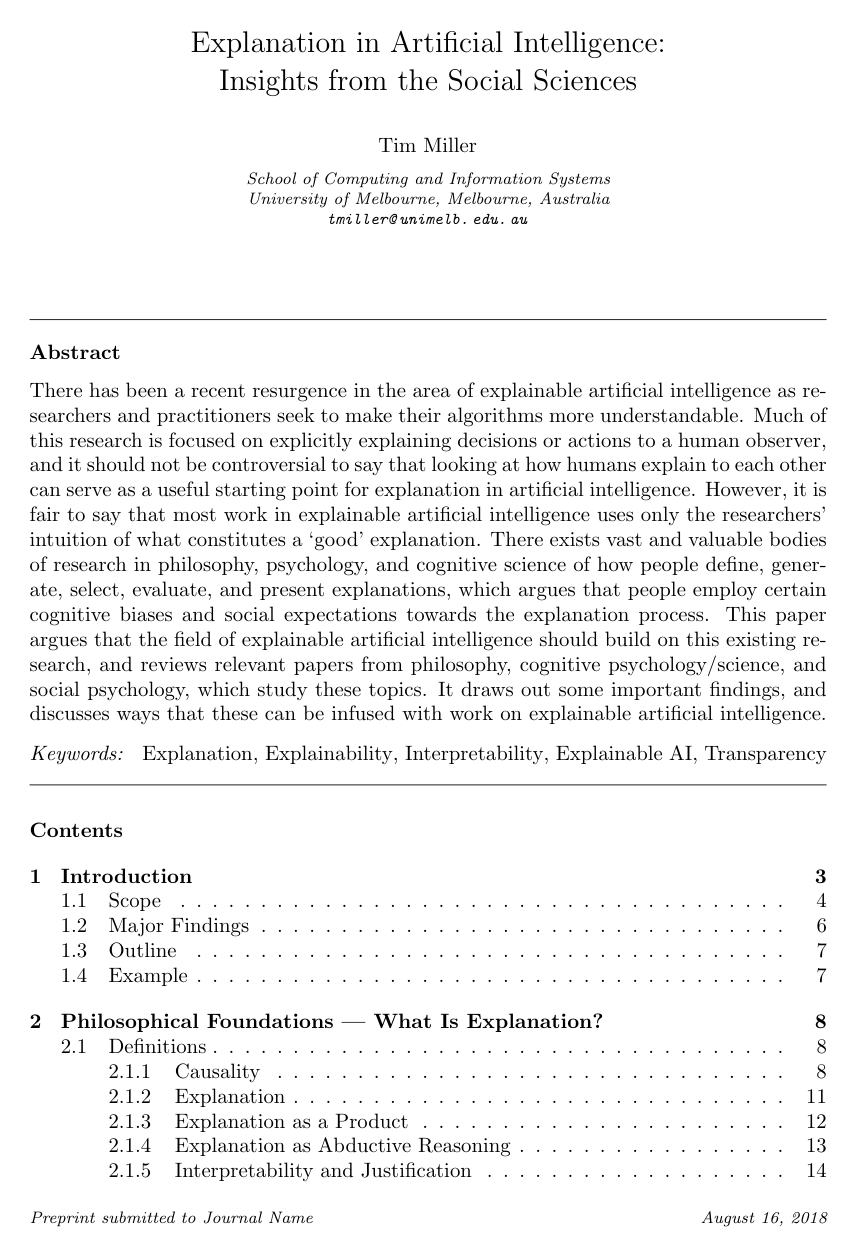
Explanation in Artificial Intelligence: Insights from the Social Sciences

Tim Miller

article2019Artificial Intelligence5,632 citations

Synthesizes decades of findings from philosophy, cognitive science, and social psychology to define how explainable artificial intelligence should align with human cognitive biases and social expectations rather than developer intuition.

Listen

The paper reviews extensive research from philosophy, psychology, and cognitive science to improve how artificial intelligence systems generate explanations for their decisions. The resurgence of interest in explainable AI stems from evidence that many systems see limited adoption due to user distrust and ethical concerns, yet most current work relies on developers’ intuitions about what makes a good explanation rather than established findings on how people actually produce, select, and evaluate explanations.

The review surveyed more than 250 publications across social science fields, selecting key works for their relevance to everyday explanations of specific events rather than general scientific theories. It maps these findings onto the challenges of building explanatory agents that can justify decisions in applications such as autonomous systems, medical decision support, and machine learning models.

Four findings stand out. First, explanations are contrastive: people seek reasons why one outcome occurred rather than another expected outcome, and they judge explanations by how well they distinguish the two cases. Second, people select only a small subset of causes as the explanation, guided by cognitive biases such as abnormality, intentionality, and relevance to the contrast case. Third, while truth and likelihood matter, citing probabilities or statistical associations alone rarely satisfies users; causal accounts are preferred. Fourth, explanation is a social process shaped by the explainer’s beliefs about the recipient’s knowledge and goals, often occurring within a conversational exchange.

These results imply that many existing XAI techniques, which focus on surfacing full causal chains or feature importance scores, may fail to build genuine trust because they ignore how humans process and value explanations. Systems that present complete or probabilistic information risk overwhelming users or appearing unhelpful, while contrastive and selective explanations could reduce cognitive load and improve perceived relevance.

Designers of explanatory agents should therefore incorporate mechanisms to infer or elicit a user’s contrast case, prioritize abnormal or intentional causes, emphasize causal stories over statistics, and model the interaction as a dialogue that tracks shared knowledge. Further empirical studies are needed to test these principles in deployed AI systems and to develop practical methods for inferring contrast cases when they are not stated explicitly. The review itself is limited to existing social-science evidence and does not include new experiments with AI users, so its recommendations remain provisional until validated in technical settings.

Cover for Explanation in Artificial Intelligence: Insights from the Social Sciences

Abstract

There has been a recent resurgence in the area of explainable artificial intelligence as researchers and practitioners seek to make their algorithms more understandable. Much of this research is focused on explicitly explaining decisions or actions to a human observer, and it should not be controversial to say that looking at how humans explain to each other can serve as a useful starting point for explanation in artificial intelligence. However, it is fair to say that most work in explainable artificial intelligence uses only the researchers' intuition of what constitutes a `good' explanation. There exists vast and valuable bodies of research in philosophy, psychology, and cognitive science of how people define, generate, select, evaluate, and present explanations, which argues that people employ certain cognitive biases and social expectations towards the explanation process. This paper argues that the field of explainable artificial intelligence should build on this existing research, and reviews relevant papers from philosophy, cognitive psychology/science, and social psychology, which study these topics. It draws out some important findings, and discusses ways that these can be infused with work on explainable artificial intelligence.

Table of Contents

  • 1. Introduction
  • 1.1. Scope
  • 1.2. Major Findings
  • 1.3. Outline
  • 1.4. Example
  • 2. Philosophical Foundations — What Is Explanation?
  • 2.1. Definitions
  • 2.1.1. Causality
  • 2.1.2. Explanation
  • 2.1.3. Explanation as a Product
  • 2.1.4. Explanation as Abductive Reasoning
  • 2.1.5. Interpretability and Justification
  • 2.2. Why People Ask for Explanations
  • 2.3. Contrastive Explanation
  • 2.4. Types and Levels of Explanation
  • 2.5. Structure of Explanation
  • 2.6. Explanation and XAI
  • 2.6.1. Causal Attribution is Not Causal Explanation
  • 2.6.2. Contrastive Explanation
  • 2.6.3. Explanatory Tasks and Levels of Explanation
  • 2.6.4. Explanatory Model of Self
  • 2.6.5. Structure of Explanation
  • 3. Social Attribution — How Do People Explain Behaviour?
  • 3.1. Definitions
  • 3.2. Intentionality and Explanation
  • 3.3. Beliefs, Desires, Intentions, and Traits
  • 3.3.1. Malle's Conceptual Model for Social Attribution
  • 3.4. Individual vs. Group Behaviour
  • 3.5. Norms and Morals
  • 3.6. Social Attribution and XAI
  • 3.6.1. Folk Psychology
  • 3.6.2. Malle's Models
  • 3.6.3. Collective Intelligence
  • 3.6.4. Norms and Morals
  • 4. Cognitive Processes — How Do People Select and Evaluate Explanations?
  • 4.2. Causal Connection: Abductive Reasoning
  • 4.2.1. Abductive Reasoning and Causal Types
  • 4.2.2. Background and Discounting
  • 4.2.3. Explanatory Modes
  • 4.2.4. Inherent and Extrinsic Features
  • 4.3. Causal Connection: Counterfactuals and Mutability
  • 4.3.1. Abnormality
  • 4.3.2. Temporality
  • 4.3.3. Controllability and Intent
  • 4.3.4. Social Norms
  • 4.4. Explanation Selection
  • 4.4.2. Abnormality
  • 4.4.3. *Intentionality and Functionality*
  • 4.4.4. *Necessity, Sufficiency and Robustness*
  • 4.4.5. Responsibility
  • 4.4.6. Preconditions, Failure, and Intentions
  • 4.5. Explanation Evaluation
  • 4.5.1. Coherence, Simplicity, and Generality
  • 4.5.2. Truth and Probability
  • 4.5.3. Goals and Explanatory Mode
  • 4.6. Cognitive Processes and XAI
  • *4.6.1. Abductive Reasoning*
  • *4.6.2. Mutability and Computation*
  • 4.6.3. Abnormality
  • 4.6.4. Intentionality and Functionality
  • 4.6.5. Perspectives and Controllability
  • 4.6.6. *Evaluation of Explanations*
  • 5. Social Explanation — How Do People Communicate Explanations?
  • 5.1. Explanation as Conversation
  • 5.1.1. Logic and Conversation
  • 5.1.2. *Relation & Relevance in Explanation Selection*
  • 5.1.3. Argumentation and Explanation
  • 5.1.4. Linguistic structure
  • 5.2. Explanatory Dialogue
  • 5.3. *Social Explanation and XAI*
  • 5.3.1. *Conversational Model*
  • 5.3.2. *Dialogue*
  • 5.3.3. Theory of Mind
  • 5.3.4. Implicature
  • 5.3.5. Dilution
  • 5.3.6. *Social and Interactive Explanation*
  • 6. Conclusions
  • *Acknowledgements*

Knowls

  1. Knowl 1 — Four Core Tenets of Human Explanation for Explainable AI

    theoretical result

    Synthesizing findings across philosophy, cognitive psychology, and social sciences reveals that human explanation for artificial intelligence systems is governed by four fundamental tenets:

    1. Explanations are contrastive: Explanations are predominantly sought not for an isolated fact PP, but as a contrastive question of why event PP occurred instead of a counterfactual contrast case or foil QQ (PP rather than QQ).
    2. Explanations are selected: Human explainers do not expect or present complete causal chains. Instead, they select a minimal subset (typically one or two causes) using cognitive heuristics and biases such as abnormality, intentionality, necessity, and responsibility.
    3. Causal mechanism dominates statistical probability: Statistical correlations and probabilities alone do not satisfy human explainees; valid explanations require identifying the underlying causal mechanisms that produced the specific instance.
    4. Explanations are social and interactive: Explanation is an act of communicative knowledge transfer between an explainer and explainee, structured as a conversation governed by conversational maxims, the explainee's epistemic state (Theory of Mind), and dialectical argumentation.
  2. Knowl 2 — Contrastive Explanation and the Difference Condition

    model/method

    Contrastive explanation models why-questions as inquiries about why a fact PP occurred rather than a foil QQ (where PP is the observed event and QQ is a counterfactual alternative).

    Under Lipton's Difference Condition, explaining why PP occurred rather than QQ requires citing a causal difference between the causal history of PP and the hypothetical history of egQ eg Q—that is, a cause present in the history of PP but absent in the history of QQ.

    Key implications for explanatory systems include:

    • Explaining contrastive events is computationally more tractable than full causal attribution, as the agent only needs to identify the differences between the histories of PP and QQ rather than all antecedents of PP.
    • When an explainee provides an explicit foil QQ, they indicate the precise boundary of their misunderstanding.
    • When a foil is implicit (e.g., in a plain query "Why PP?"), systems can infer default foils using normative baselines (i.e., "Why PP rather than the normal outcome QQ?").
  3. Knowl 3 — Distinction Between Causal Attribution and Causal Explanation

    definition

    Causal attribution and causal explanation represent distinct stages and concepts:

    • Causal Attribution (Causal Inference): The process of determining the underlying causal history, dependencies, or full causal graph responsible for an outcome or decision.
    • Causal Explanation: A complete socio-cognitive process comprising:
      1. Causal Connection: Inferring candidate causes of an event (the explanandum) via abductive reasoning or counterfactual simulation.
      2. Explanation Selection: Applying cognitive selection criteria to select a small, relevant subset of causes (the explanans) relative to a contrast foil.
      3. Social Presentation: Conveying the selected explanans through an interactive dialogue adapted to the explainee's prior knowledge.

    Providing an uncurated computational trace, raw feature importance list, or complete dependency chain constitutes causal attribution, not an explanation.

  4. Knowl 4 — Malle's Conceptual Framework for Behavior and Social Attribution

    model/method

    In explaining agent behavior, actions are categorized by intentionality, which dictates the appropriate explanatory mode:

    • Unintentional Behavior: Explained using physical, mechanistic, or situational causes.
    • Intentional Behavior: Actions performed when an agent possesses a desire for an outcome, a belief that the action leads to that outcome, an intention, and the skill and awareness to execute it. Intentional actions are explained through three modes:
      1. Reason Explanations: Explanations citing the agent's subjective desires, beliefs, and values that rationally grounded the intention and subsequent action.
      2. Causal History of Reasons (CHR): Explanations citing background, context, or distal factors (such as personality traits, culture, previous environment, or fixed optimization metrics like minimizing cost) that gave rise to the agent's reasons without being reasons themselves.
      3. Enabling Factor (EF) Explanations: Explanations that do not explain the intention itself, but rather explain how the action succeeded by detailing enabling conditions, capacities, or environmental preconditions.
  5. Knowl 5 — Cognitive Criteria for Explanation Selection

    model/method

    When selecting a concise explanans from an extensive causal network, human cognition relies on several specific criteria:

    • Abnormality: Explanations prioritize abnormal, unexpected, or non-normative events over normal background conditions. Standard background states (e.g., the presence of oxygen in a fire) are presupposed and discarded.
    • Intentionality and Causal Tracing: Deliberate, intentional human actions take priority over unintentional actions and physical events. In causal opportunity chains, causes are traced back through proximal abnormal events to distal intentional actions.
    • Necessity and Sufficiency: Necessary causes are preferred over non-necessary sufficient causes. Uniquely sufficient causes and robust causes (causes that produce the outcome across a wide variety of background conditions) are selected over fragile, context-dependent causes.
    • Temporality: Later (more proximal) events are generally considered more mutable and are preferred over distal events, unless superseded by intentional actions.
  6. Knowl 6 — Structural Model Measure of Causal Responsibility

    equation

    In structural causal models, the degree of causal responsibility Resp(C,E)\text{Resp}(C, E) of an event CC for an outcome EE measures the minimal distance to a counterfactual state where EE depends on CC.

    Let NN denote the minimal number of variable assignments that must be altered in the actual situation to make the occurrence of EE counterfactually dependent on CC. The responsibility is defined as: Resp(C,E)=1N+1\text{Resp}(C, E) = \frac{1}{N + 1}

    • If N=0N = 0, CC is an immediate counterfactual cause of EE in the actual situation, yielding full responsibility Resp(C,E)=1\text{Resp}(C, E) = 1.
    • If N>0N > 0, the degree of responsibility decreases as more changes are required to expose the causal dependence, falling in the range (0,1)(0, 1).
    • If CC is not an actual cause under any valid contingency, Resp(C,E)=0\text{Resp}(C, E) = 0.
  7. Knowl 7 — Cognitive Evaluation Criteria for Explanation Quality

    model/method

    Explainees evaluate the quality and believability of explanations using distinct cognitive criteria rather than mathematical probability alone:

    • Simplicity: Consistent with explanatory coherence theory, explanations invoking fewer causes are systematically preferred over complex, conjunctive explanations, even when joint base-rate probabilities favor conjunctive causes.
    • Generality: Explanations that account for multiple observations or symptoms simultaneously (broad explanations) are judged superior to narrow explanations that only account for individual observations.
    • Coherence: Explanations must cohere with the explainee's prior beliefs and mental models of the domain.
    • Inherence Bias: Explanations citing inherent, principled properties (kk-properties, reflecting how an entity is fundamentally constituted) are preferred over extrinsic, historical, or purely statistical properties (tt-properties).
  8. Knowl 8 — Conversational and Epistemic Model of Explanation

    model/method

    Social explanation functions as a cooperative conversation structured around Gricean maxims and the explainee's epistemic state:

    • Quality: The explainer must provide explanations supported by evidence and believed to be true.
    • Quantity and Epistemic Relevance: The explainer provides only the information needed to resolve the explainee's knowledge gap. Causes already assumed or known in the explainee's epistemic state must be omitted.
    • Relation and the Dilution Effect: Statements must be strictly relevant to the contrastive question. Providing non-diagnostic, irrelevant causal information triggers the dilution effect, weakening the impact of true diagnostic evidence and leading to less accurate judgments by the explainee.
    • Manner: The explanation must be presented concisely, unambiguously, and in an orderly structure.
  9. Knowl 9 — Dialectical and Argumentative Explanation Dialogue Framework

    model/method

    Explanatory interaction between an explainer and an explainee is modeled as a formal, multi-stage dialogue system:

    1. Dialogue Stages:
      • Opening Stage: The explainee poses a contrastive why-question identifying an explicit or implicit foil.
      • Exploration Stage: The explainer provides explanatory locutions updating the shared commitment and understanding stores.
      • Closing / Examination Stage: The explainer tests whether the explainee has genuinely understood and can infer/generalize from the explanation, preventing infinite failure loops.
    2. Dialectical Shifts: When an explainee questions or rejects an asserted cause, the dialogue temporarily shifts from an explanation dialogue to an argumentation dialogue. The explainer provides claim-backings to justify that the cause held. Once the claim is justified or conceded, the dialogue shifts back to complete the explanation.
  10. Knowl 10 — Three-Level Explanatory Architecture for Intelligent Agents

    model/method

    To deliver human-centric explanations, an artificial intelligence agent requires an architecture consisting of three interrelated components:

    1. Explanatory Model of Self: A dedicated, often symbolic meta-model that sits alongside the agent's primary decision-making algorithms (e.g., neural networks or complex planners) to represent and reason about its internal choices, states, and learning provenance in human-understandable terms.
    2. Theory of Mind (User Model): An epistemic model representing the explainee's background knowledge, current beliefs, goals, expertise level, and misconceptions, allowing the agent to tailor explanations to the user's specific context.
    3. Dialogue and Discourse Manager: An interaction engine that manages the multi-turn exchange, interprets implicit or explicit foils, adheres to communication maxims, prevents informational dilution, and handles dialectical shifts to argumentation when claims are challenged.

Coverage note — No substantial contributed material was omitted; the paper's comprehensive survey and synthesis across philosophy, cognitive psychology, social attribution, and dialogue systems have been captured in the ten extracted knowls.

References

  1. 1.D. Allemang, M. C. Tanner, T. Bylander, J. R. Josephson, Computational Complexity of Hypothesis Assembly, in: IJCAI, vol. 87, 1112–1117, 1987.
  2. 2.J. Angwin, J. Larson, S. Mattu, L. Kirchner, Machine bias, ProPublica, May 23.
  3. 3.C. Antaki, I. Leudar, Explaining in conversation: Towards an argument model, European Journal of Social Psychology 22 (2) (1992) 181–194.
  4. 4.A. Arioua, M. Croitoru, Formalizing explanatory dialogues, in: International Conference on Scalable Uncertainty Management, Springer, 282–297, 2015.
  5. 5.J. L. Aronson, On the grammar of ‘cause’, Synthese 22 (3) (1971) 414–430.
  6. 6.D. Baehrens, T. Schroeter, S. Harmeling, M. Kawanabe, K. Hansen, K.-R. MAˇzller, How to ˜ explain individual classification decisions, Journal of Machine Learning Research 11 (Jun) (2010) 1803–1831.
  7. 7.E. Bekele, W. E. Lawson, Z. Horne, S. Khemlani, Human-level explanatory biases for person re-identification .
  8. 8.P. Besnard, A. Hunter, Elements of argumentation, vol. 47, MIT press Cambridge, 2008.
  9. 9.O. Biran, C. Cotton, Explanation and justification in machine learning: A survey, in: IJCAI 2017 Workshop on Explainable Artificial Intelligence (XAI), 8–13, 2017.
  10. 10.A. Boonzaier, J. McClure, R. M. Sutton, Distinguishing the effects of beliefs and preconditions: The folk psychology of goals and actions, European Journal of Social Psychology 35 (6) (2005) 725–740.
  11. 11.R. I. Brafman, C. Domshlak, From One to Many: Planning for Loosely Coupled Multi-Agent Systems., in: International Conference on Automated Planning and Scheduling, 28–35, 2008.
  12. 12.J. Broekens, M. Harbers, K. Hindriks, K. Van Den Bosch, C. Jonker, J.-J. Meyer, Do you get it? User-evaluated explainable BDI agents, in: German Conference on Multiagent System Technologies, Springer, 28–39, 2010.
  13. 13.S. Bromberger, Why–questions, in: R. G. Colodny (Ed.), Mind and Cosmos: Essays in Contemporary Science and Philosophy, Pittsburgh University Press, Pittsburgh, 68–111, 1966.
  14. 14.B. Buchanan, E. Shortliffe, Rule-based expert systems: the MYCIN experiments of the Stanford Heuristic Programming Project, Addison-Wesley, 1984.
  15. 15.A. Burguet, D. Hilton, Effets de contexte sur l’explication causale, in: M. B. et A. Trognon (Ed.), Psychologie Sociale et Communication, Paris: Dunod, 219–228, 2004.
  16. 16.R. M. Byrne, The Construction of Explanations, in: AI and Cognitive Science’90, Springer, 337–351, 1991.
  17. 17.A. Cawsey, Generating Interactive Explanations., in: AAAI, 86–91, 1991.
  18. 18.A. Cawsey, Explanation and interaction: the computer generation of explanatory dialogues, MIT press, 1992.
  19. 19.A. Cawsey, Planning interactive explanations, International Journal of Man-Machine Studies 38 (2) (1993) 169–199.
  20. 20.A. Cawsey, User modelling in interactive explanations, User Modeling and User-Adapted Interaction 3 (1993) 221–247.
  21. 21.T. Chakraborti, S. Sreedharan, Y. Zhang, S. Kambhampati, Plan explanations as model reconciliation: Moving beyond explanation as soliloquy, in: Proceedings of IJCAI, URL https://www.ijcai.org/proceedings/2017/0023.pdf, 2017.
  22. 22.K. Chan, T.-W. Lee, P. A. Sample, M. H. Goldbaum, R. N. Weinreb, T. J. Sejnowski, Comparison of machine learning and traditional classifiers in glaucoma diagnosis, IEEE Transactions on Biomedical Engineering 49 (9) (2002) 963–974.
  23. 23.B. Chandrasekaran, M. C. Tanner, J. R. Josephson, Explaining control strategies in problem solving, IEEE Expert 4 (1) (1989) 9–15.
  24. 24.E. Charniak, R. Goldman, A probabilistic model of plan recognition, in: Proceedings of the ninth National conference on Artificial intelligence-Volume 1, AAAI Press, 160–165, 1991.
  25. 25.J. Y. Chen, K. Procci, M. Boyce, J. Wright, A. Garcia, M. Barnes, Situation awareness-based agent transparency, Tech. Rep. ARL-TR-6905, U.S. Army Research Laboratory, 2014.
  26. 26.Y. Chevaleyre, U. Endriss, J. Lang, N. Maudet, A short introduction to computational social choice, in: International Conference on Current Trends in Theory and Practice of Computer Science, Springer, 51–69, 2007.
  27. 27.S. Chin-Parker, A. Bradner, Background shifts affect explanatory style: how a pragmatic theory of explanation accounts for background effects in the generation of explanations, Cognitive Processing 11 (3) (2010) 227–249.
  28. 28.S. Chin-Parker, J. Cantelon, Contrastive Constraints Guide Explanation-Based Category Learning, Cognitive science 41 (6) (2017) 1645–1655.
  29. 29.H. Chockler, J. Y. Halpern, Responsibility and blame: A structural-model approach, Journal of Artificial Intelligence Research 22 (2004) 93–115.
  30. 30.A. Cimpian, E. Salomon, The inherence heuristic: An intuitive means of making sense of the world, and a potential precursor to psychological essentialism, Behavioral and Brain Sciences 37 (5) (2014) 461–480.
  31. 31.A. Cooper, The inmates are running the asylum: Why high-tech products drive us crazy and how to restore the sanity, Sams Indianapolis, IN, USA, 2004.
  32. 32.DARPA, Explainable Artificial Intelligence (XAI) Program, http://www.darpa.mil/program/explainable-artificial-intelligence, full solicitation at http://www.darpa.mil/attachments/DARPA-BAA-16-53.pdf, 2016.
  33. 33.G. C. Davey, Characteristics of individuals with fear of spiders, Anxiety Research 4 (4) (1991) 299–314.
  34. 34.M. M. de Graaf, B. F. Malle, How People Explain Action (and Autonomous Intelligent Systems Should Too), in: AAAI Fall Symposium on Artificial Intelligence for Human-Robot Interaction, 2017.
  35. 35.D. C. Dennett, The intentional stance, MIT press, 1989.
  36. 36.D. C. Dennett, From bacteria to Bach and back: The evolution of minds, WW Norton & Company, 2017.
  37. 37.F. Dignum, R. Prada, G. J. Hofstede, From autistic to social agents, in: Proceedings of the 2014 international conference on Autonomous agents and multi-agent systems, IFAAMAS, 1161–1164, 2014.
  38. 38.D. H. Dodd, J. M. Bradshaw, Leading questions and memory: Pragmatic constraints, Journal of Memory and Language 19 (6) (1980) 695.
  39. 39.P. Dowe, Wesley Salmon’s process theory of causality and the conserved quantity theory, Philosophy of Science 59 (2) (1992) 195–216.
  40. 40.T. Eiter, T. Lukasiewicz, Complexity results for structure-based causality, Artificial Intelligence 142 (1) (2002) 53–89.
  41. 41.T. Eiter, T. Lukasiewicz, Causes and explanations in the structural-model approach: Tractable cases, Artificial Intelligence 170 (6-7) (2006) 542–580.
  42. 42.R. Fagin, J. Halpern, Y. Moses, M. Vardi, Reasoning about knowledge, vol. 4, MIT press Cambridge, 1995.
  43. 43.D. Fair, Causation and the Flow of Energy, Erkenntnis 14 (3) (1979) 219–250.
  44. 44.G. Fischer, User modeling in human–computer interaction, User modeling and user-adapted interaction 11 (1-2) (2001) 65–86.
  45. 45.J. Fox, D. Glasspool, D. Grecu, S. Modgil, M. South, V. Patkar, Argumentation-based inference and decision making–A medical perspective, IEEE intelligent systems 22 (6).
  46. 46.M. Fox, D. Long, D. Magazzeni, Explainable Planning, in: IJCAI 2017 Workshop on Explainable Artificial Intelligence (XAI), URL https://arxiv.org/pdf/1709.10256, 2017.
  47. 47.N. Frosst, G. Hinton, Distilling a Neural Network Into a Soft Decision Tree, arXiv e-prints 1711.09784, URL https://arxiv.org/abs/1711.09784.
  48. 48.T. Gerstenberg, D. A. Lagnado, Spreading the blame: The allocation of responsibility amongst multiple agents, Cognition 115 (1) (2010) 166–171.
  49. 49.T. Gerstenberg, M. F. Peterson, N. D. Goodman, D. A. Lagnado, J. B. Tenenbaum, Eye-tracking causality, Psychological science 28 (12) (2017) 1731–1744.
  50. 50.M. Ghallab, D. Nau, P. Traverso, Automated Planning: theory and practice, Elsevier, 2004.
  51. 51.D. T. Gilbert, P. S. Malone, The correspondence bias, Psychological bulletin 117 (1) (1995) 21.
  52. 52.C. Ginet, In defense of a non-causal account of reasons explanations, The Journal of Ethics 12 (3-4) (2008) 229–237.
  53. 53.L. Giordano, C. Schwind, Conditional logic of actions and causation, Artificial Intelligence 157 (1-2) (2004) 239–279.
  54. 54.V. Girotto, P. Legrenzi, A. Rizzo, Event controllability in counterfactual thinking, Acta Psychologica 78 (1) (1991) 111–133.
  55. 55.M. Greaves, H. Holmback, J. Bradshaw, What is a conversation policy?, in: Issues in Agent Communication, Springer, 118–131, 2000.
  56. 56.H. P. Grice, Logic and conversation, in: Syntax and semantics 3: Speech arts, New York: Academic Press, 41–58, 1975.
  57. 57.J. Y. Halpern, Axiomatizing causal reasoning, Journal of Artificial Intelligence Research 12 (2000) 317–337.
  58. 58.J. Y. Halpern, J. Pearl, Causes and explanations: A structural-model approach. Part I: Causes, The British Journal for the Philosophy of Science 56 (4) (2005) 843–887.
  59. 59.J. Y. Halpern, J. Pearl, Causes and explanations: A structural-model approach. Part II: Explanations, The British Journal for the Philosophy of Science 56 (4) (2005) 889–911.
  60. 60.R. J. Hankinson, Cause and explanation in ancient Greek thought, Oxford University Press, 2001.
  61. 61.N. R. Hanson, Patterns of discovery: An inquiry into the conceptual foundations of science, CUP Archive, 1965.
  62. 62.G. H. Harman, The inference to the best explanation, The philosophical review 74 (1) (1965) 88–95.
  63. 63.M. Harradon, J. Druce, B. Ruttenberg, Causal Learning and Explanation of Deep Neural Networks via Autoencoded Activations, arXiv e-prints 1802.00541, URL https://arxiv.org/abs/1802.00541.
  64. 64.H. L. A. Hart, T. Honor´e, Causation in the Law, OUP Oxford, 1985.
  65. 65.B. Hayes, J. A. Shah, Improving Robot Controller Transparency Through Autonomous Policy Explanation, in: Proceedings of the 12th ACM/IEEE International Conference on Human-Robot Interaction (HRI 2017), 2017.
  66. 66.F. Heider, The psychology of interpersonal relations, New York: Wiley, 1958.
  67. 67.F. Heider, M. Simmel, An experimental study of apparent behavior, The American Journal of Psychology 57 (2) (1944) 243–259.
  68. 68.C. G. Hempel, P. Oppenheim, Studies in the Logic of Explanation, Philosophy of Science 15 (2) (1948) 135–175.
  69. 69.G. Hesslow, The problem of causal selection, Contemporary science and natural explanation: Commonsense conceptions of causality (1988) 11–32.
  70. 70.D. Hilton, Social Attribution and Explanation, in: Oxford Handbook of Causal Reasoning, Oxford University Press, 645–676, 2017.
  71. 71.D. J. Hilton, Logic and causal attribution, in: Contemporary science and natural explanation: Commonsense conceptions of causality, New York University Press, 33–65, 1988.
  72. 72.D. J. Hilton, Conversational processes and causal explanation, Psychological Bulletin 107 (1) (1990) 65–81.
  73. 73.D. J. Hilton, Mental models and causal explanation: Judgements of probable cause and explanatory relevance, Thinking & Reasoning 2 (4) (1996) 273–308.
  74. 74.D. J. Hilton, J. McClure, B. Slugoski, Counterfactuals, conditionals and causality: A social psychological perspective, in: D. R. Mande, D. J. Hilton, P. Catellani (Eds.), The psychology of counterfactual thinking, London: Routledge, 44–60, 2005.
  75. 75.D. J. Hilton, J. McClure, R. M. Sutton, Selecting explanations from causal chains: Do statistical principles explain preferences for voluntary causes?, European Journal of Social Psychology 40 (3) (2010) 383–400.
  76. 76.D. J. Hilton, J. L. McClure, R. Slugoski, Ben, The Course of Events: Counterfactuals, Causal Sequences and Explanation, in: D. R. Mandel, D. J. Hilton, P. Catellani (Eds.), The Psychology of Counterfactual Thinking, Routledge, 2005.
  77. 77.D. J. Hilton, B. R. Slugoski, Knowledge-based causal attribution: The abnormal conditions focus model, Psychological review 93 (1) (1986) 75.
  78. 78.R. R. Hoffman, G. Klein, Explaining explanation, part 1: theoretical foundations, IEEE Intelligent Systems 32 (3) (2017) 68–73.
  79. 79.D. Hume, An enquiry concerning human understanding: A critical edition, vol. 3, Oxford University Press, 2000.
  80. 80.J. M. Jaspars, D. J. Hilton, Mental models of causal reasoning, in: The social psychology of knowledge, Cambridge University Press, 335–358, 1988.
  81. 81.J. R. Josephson, S. G. Josephson, Abductive inference: Computation, philosophy, technology, Cambridge University Press, 1996.
  82. 82.D. Kahneman, Thinking, fast and slow, Macmillan, 2011.
  83. 83.D. Kahneman, A. Tversky, The simulation heuristic, in: P. S. D. Kahneman, A. Tversky (Eds.), Judgment under Uncertainty: Heuristics and Biases, New York: Cambridge University Press, 1982.
  84. 84.Y. Kashima, A. McKintyre, P. Clifford, The category of the mind: Folk psychology of belief, desire, and intention, Asian Journal of Social Psychology 1 (3) (1998) 289–313.
  85. 85.A. Kass, D. Leake, Types of Explanations, Tech. Rep. ADA183253, DTIC Document, 1987.
  86. 86.H. H. Kelley, Attribution theory in social psychology, in: Nebraska symposium on motivation, University of Nebraska Press, 192–238, 1967.
  87. 87.H. H. Kelley, Causal schemata and the attribution process, General Learning Press, Morristown, NJ, 1972.
  88. 88.J. Knobe, Intentional action and side effects in ordinary language, Analysis 63 (279) (2003) 190–194.
  89. 89.T. Kulesza, M. Burnett, W.-K. Wong, S. Stumpf, Principles of explanatory debugging to personalize interactive machine learning, in: Proceedings of the 20th International Conference on Intelligent User Interfaces, ACM, 126–137, 2015.
  90. 90.T. Kulesza, S. Stumpf, M. Burnett, S. Yang, I. Kwan, W.-K. Wong, Too much, too little, or just right? Ways explanations impact end users’ mental models, in: Visual Languages and Human-Centric Computing (VL/HCC), 2013 IEEE Symposium on, IEEE, 3–10, 2013.
  91. 91.T. Kulesza, S. Stumpf, W.-K. Wong, M. M. Burnett, S. Perona, A. Ko, I. Oberst, Why-oriented end-user debugging of naive Bayes text classification, ACM Transactions on Interactive Intelligent Systems (TiiS) 1 (1) (2011) 2.
  92. 92.D. A. Lagnado, S. Channon, Judgments of cause and blame: The effects of intentionality and foreseeability, Cognition 108 (3) (2008) 754–770.
  93. 93.P. Langley, B. Meadows, M. Sridharan, D. Choi, Explainable Agency for Intelligent Autonomous Systems, in: Proceedings of the Twenty-Ninth Annual Conference on Innovative Applications of Artificial Intelligence, AAAI Press, 2017.
  94. 94.D. B. Leake, Goal-Based Explanation Evaluation, Cognitive Science 15 (4) (1991) 509–545.
  95. 95.D. B. Leake, Abduction, experience, and goals: A model of everyday abductive explanation, Journal of Experimental & Theoretical Artificial Intelligence 7 (4) (1995) 407–428.
  96. 96.J. Leddo, R. P. Abelson, P. H. Gross, Conjunctive explanations: When two reasons are better than one, Journal of Personality and Social Psychology 47 (5) (1984) 933.
  97. 97.H. J. Levesque, A knowledge-level account of abduction, in: IJCAI, 1061–1067, 1989.
  98. 98.D. Lewis, Causation, The Journal of Philosophy 70 (17) (1974) 556–567.
  99. 99.D. Lewis, Causal explanation, Philosophical Papers 2 (1986) 214–240.
  100. 100.B. Y. Lim, A. K. Dey, Assessing demand for intelligibility in context-aware applications, in: Proceedings of the 11th international conference on Ubiquitous computing, ACM, 195–204, 2009.
  101. 101.M. P. Linegang, H. A. Stoner, M. J. Patterson, B. D. Seppelt, J. D. Hoffman, Z. B. Crittendon, J. D. Lee, Human-automation collaboration in dynamic mission planning: A challenge requiring an ecological approach, Proceedings of the Human Factors and Ergonomics Society Annual Meeting 50 (23) (2006) 2482–2486.
  102. 102.P. Lipton, Contrastive explanation, Royal Institute of Philosophy Supplement 27 (1990) 247–266.
  103. 103.Z. C. Lipton, The mythos of model interpretability, arXiv preprint arXiv:1606.03490 .
  104. 104.T. Lombrozo, The structure and function of explanations, Trends in Cognitive Sciences 10 (10) (2006) 464–470.
  105. 105.T. Lombrozo, Simplicity and probability in causal explanation, Cognitive psychology 55 (3) (2007) 232–257.
  106. 106.T. Lombrozo, Explanation and categorization: How “why?” informs “what?”, Cognition 110 (2) (2009) 248–253.
  107. 107.T. Lombrozo, Causal–explanatory pluralism: How intentions, functions, and mechanisms influence causal ascriptions, Cognitive Psychology 61 (4) (2010) 303–332.
  108. 108.T. Lombrozo, Explanation and abductive inference, Oxford handbook of thinking and reasoning (2012) 260–276.
  109. 109.T. Lombrozo, N. Z. Gwynne, Explanation and inference: mechanistic and functional explanations guide property generalization, Frontiers in human neuroscience 8 (2014) 700.
  110. 110.J. L. Mackie, The cement of the universe, Oxford, 1980.
  111. 111.B. F. Malle, How people explain behavior: A new theoretical framework, Personality and Social Psychology Review 3 (1) (1999) 23–48.
  112. 112.B. F. Malle, How the mind explains behavior: Folk explanations, meaning, and social interaction, MIT Press, 2004.
  113. 113.B. F. Malle, Attribution theories: How people make sense of behavior, Theories in Social Psychology (2011) 72–95.
  114. 114.B. F. Malle, Time to Give Up the Dogmas of Attribution: An Alternative Theory of Behavior Explanation, Advances in Experimental Social Psychology 44 (1) (2011) 297–311.
  115. 115.B. F. Malle, J. Knobe, The folk concept of intentionality, Journal of Experimental Social Psychology 33 (2) (1997) 101–121.
  116. 116.B. F. Malle, J. Knobe, M. J. O’Laughlin, G. E. Pearce, S. E. Nelson, Conceptual structure and social functions of behavior explanations: Beyond person–situation attributions, Journal of Personality and Social Psychology 79 (3) (2000) 309.
  117. 117.B. F. Malle, J. M. Knobe, S. E. Nelson, Actor-observer asymmetries in explanations of behavior: new answers to an old question, Journal of Personality and Social Psychology 93 (4) (2007) 491.
  118. 118.B. F. Malle, G. E. Pearce, Attention to behavioral events during interaction: Two actor-observer gaps and three attempts to close them, Journal of Personality and Social Psychology 81 (2) (2001) 278–294.
  119. 119.D. Marr, Vision: A computational investigation into the human representation and processing of visual information, Inc., New York, NY, 1982.
  120. 120.D. Marr, T. Poggio, From understanding computation to understanding neural circuitry, AI Memos AIM-357, MIT, 1976.
  121. 121.R. McCloy, R. M. Byrne, Counterfactual thinking about controllable events, Memory & Cognition 28 (6) (2000) 1071–1078.
  122. 122.J. McClure, Goal-based explanations of actions and outcomes, European Review of Social Psychology 12 (1) (2002) 201–235.
  123. 123.J. McClure, D. Hilton, For you can’t always get what you want: When preconditions are better explanations than goals, British Journal of Social Psychology 36 (2) (1997) 223–240.
  124. 124.J. McClure, D. Hilton, J. Cowan, L. Ishida, M. Wilson, When rich or poor people buy expensive objects: Is the question how or why?, Journal of Language and Social Psychology 20 (2001) 229–257.
  125. 125.J. McClure, D. J. Hilton, Are goals or preconditions better explanations? It depends on the question, European Journal of Social Psychology 28 (6) (1998) 897–911.
  126. 126.J. L. McClure, R. M. Sutton, D. J. Hilton, The Role of Goal-Based Explanations, in: Social judgments: Implicit and explicit processes, vol. 5, Cambridge University Press, 306, 2003.
  127. 127.A. L. McGill, J. G. Klein, Contrastive and counterfactual reasoning in causal judgment, Journal of Personality and Social Psychology 64 (6) (1993) 897.
  128. 128.P. Menzies, H. Price, Causation as a secondary quality, The British Journal for the Philosophy of Science 44 (2) (1993) 187–203.
  129. 129.J. E. Mercado, M. A. Rupp, J. Y. Chen, M. J. Barnes, D. Barber, K. Procci, Intelligent agent transparency in human–agent teaming for Multi-UxV management, Human Factors 58 (3) (2016) 401–415.
  130. 130.J. S. Mill, A system of logic: The collected works of John Stuart Mill, vol. III, 1973.
  131. 131.D. T. Miller, S. Gunasegaram, Temporal order and the perceived mutability of events: Implications for blame assignment, Journal of personality and social psychology 59 (6) (1990) 1111.
  132. 132.T. Miller, P. Howe, L. Sonenberg, Explainable AI: Beware of Inmates Running the Asylum, in: IJCAI 2017 Workshop on Explainable Artificial Intelligence (XAI), 36–42, URL http://people.eng.unimelb.edu.au/tmiller/pubs/explanation-inmates.pdf, 2017.
  133. 133.T. M. Mitchell, R. M. Keller, S. T. Kedar-Cabelli, Explanation-based generalization: A unifying view, Machine learning 1 (1) (1986) 47–80.
  134. 134.J. D. Moore, C. L. Paris, Planning text for advisory dialogues: Capturing intentional and rhetorical information, Computational linguistics 19 (4) (1993) 651–694.
  135. 135.C. Muise, V. Belle, P. Felli, S. McIlraith, T. Miller, A. R. Pearce, L. Sonenberg, Planning Over Multi-Agent Epistemic States: A Classical Planning Approach, in: B. Bonet, S. Koenig (Eds.), Proceedings of AAAI 2015, 1–8, 2015.
  136. 136.G. Nott, ‘Explainable Artificial Intelligence’: Cracking open the black box of AI, Computer World https://www.computerworld.com.au/article/617359/.
  137. 137.M. J. O’Laughlin, B. F. Malle, How people explain actions performed by groups and individuals, Journal of Personality and Social Psychology 82 (1) (2002) 33.
  138. 138.J. Overton, Scientific Explanation and Computation, in: D. B. L. Thomas Roth-Berghofer, Nava Tintarev (Ed.), Proceedings of the 6th International Explanation-Aware Computing (ExaCt) workshop, 41–50, 2011.
  139. 139.J. A. Overton, Explanation in Science, Ph.D. thesis, The University of Western Ontario, 2012.
  140. 140.J. A. Overton, “Explain” in scientific discourse, Synthese 190 (8) (2013) 1383–1405.
  141. 141.J. Pearl, D. Mackenzie, The Book of Why: The New Science of Cause and Effect, Hachette UK, 2018.
  142. 142.C. S. Peirce, Harvard lectures on pragmatism, Collected Papers v. 5, 1903.
  143. 143.R. Petrick, M. E. Foster, Using General-Purpose Planning for Action Selection in Human-Robot Interaction, in: AAAI 2016 Fall Symposium on Artificial Intelligence for Human-Robot Interaction, 2016.
  144. 144.D. Poole, Normality and Faults in logic-based diagnosis., in: IJCAI, vol. 89, 1304–1310, 1989.
  145. 145.H. E. Pople, On the mechanization of abductive logic, in: IJCAI, vol. 73, 147–152, 1973.
  146. 146.K. Popper, The logic of scientific discovery, Routledge, 2005.
  147. 147.H. Prakken, Formal systems for persuasion dialogue, The Knowledge Engineering Review 21 (02) (2006) 163–188.
  148. 148.S. Prasada, The scope of formal explanation, Psychonomic Bulletin & Review (2017) 1–10.
  149. 149.S. Prasada, E. M. Dillingham, Principled and statistical connections in common sense conception, Cognition 99 (1) (2006) 73–112.
  150. 150.J. Preston, N. Epley, Explanations versus applications: The explanatory power of valuable beliefs, Psychological Science 16 (10) (2005) 826–832.
  151. 151.M. Ranney, P. Thagard, Explanatory coherence and belief revision in naive physics, in: Proceedings of the Tenth Annual Conference of the Cognitive Science Society, 426–432, 1988.
  152. 152.A. S. Rao, M. P. Georgeff, BDI agents: From theory to practice., in: ICMAS, vol. 95, 312–319, 1995.
  153. 153.S. J. Read, A. Marcus-Newhall, Explanatory coherence in social explanations: A parallel distributed processing account, Journal of Personality and Social Psychology 65 (3) (1993) 429.
  154. 154.B. Rehder, A causal-model theory of conceptual representation and categorization, Journal of Experimental Psychology: Learning, Memory, and Cognition 29 (6) (2003) 1141.
  155. 155.B. Rehder, When similarity and causality compete in category-based property generalization, Memory & Cognition 34 (1) (2006) 3–16.
  156. 156.R. Reiter, A theory of diagnosis from first principles, Artificial intelligence 32 (1) (1987) 57–95.
  157. 157.M. T. Ribeiro, S. Singh, C. Guestrin, Why Should I Trust You?: Explaining the Predictions of Any Classifier, in: Proceedings of the 22nd ACM SIGKDD International Conference on Knowledge Discovery and Data Mining, ACM, 1135–1144, 2016.
  158. 158.M. Robnik-Sikonja, I. Kononenko, Explaining classifications for individual instances, IEEE Transactions on Knowledge and Data Engineering 20 (5) (2008) 589–600.
  159. 159.W. C. Salmon, Four decades of scientific explanation, University of Pittsburgh press, 2006.
  160. 160.J. Samland, M. Josephs, M. R. Waldmann, H. Rakoczy, The role of prescriptive norms and knowledge in children’s and adults’ causal selection, Journal of Experimental Psychology: General 145 (2) (2016) 125.
  161. 161.J. Samland, M. R. Waldmann, Do Social Norms Influence Causal Inferences?, in: P. Bello, M. Guarini, M. McShane, B. Scassellati (Eds.), Proceedings of the 36th Annual Conference of the Cognitive Science Society, Cognitive Science Society, 1359–1364, 2014.
  162. 162.M. Scriven, The concept of comprehension: From semantics to software, in: J. B. Carroll, R. O. Freedle (Eds.), Language comprehension and the acquisition of knowledge, Washington: W. H. Winston & Sons, 31–39, 1972.
  163. 163.Z. Shams, M. de Vos, N. Oren, J. Padget, Normative Practical Reasoning via Argumentation and Dialogue, in: Proceedings of the 25th International Joint Conference on Artificial Intelligence (IJCAI-16), AAAI Press, 2016.
  164. 164.R. Singh, T. Miller, J. Newn, L. Sonenberg, E. Velloso, F. Vetere, Combining Planning with Gaze for Online Human Intention Recognition, in: Proceedings of the 17th International Conference on Autonomous Agents and Multiagent Systems, 2018.
  165. 165.B. R. Slugoski, M. Lalljee, R. Lamb, G. P. Ginsburg, Attribution in conversational context: Effect of mutual knowledge on explanation-giving, European Journal of Social Psychology 23 (3) (1993) 219–238.
  166. 166.K. Stubbs, P. Hinds, D. Wettergreen, Autonomy and common ground in human-robot interaction: A field study, IEEE Intelligent Systems 22 (2) (2007) 42–50.
  167. 167.J. Susskind, K. Maurer, V. Thakkar, D. L. Hamilton, J. W. Sherman, Perceiving individuals and groups: expectancies, dispositional inferences, and causal attributions, Journal of Personality and Social Psychology 76 (2) (1999) 181.
  168. 168.W. R. Swartout, J. D. Moore, Explanation in second generation expert systems, in: Second Generation Expert Systems, Springer, 543–585, 1993.
  169. 169.P. E. Tetlock, R. Boettger, Accountability: a social magnifier of the dilution effect, Journal of Personality and Social Psychology 57 (3) (1989) 388.
  170. 170.P. E. Tetlock, J. S. Learner, R. Boettger, The dilution effect: judgemental bias, conversational convention, or a bit of both?, European Journal of Social Psychology 26 (1996) 915–934.
  171. 171.P. Thagard, Explanatory coherence, Behavioral and Brain Sciences 12 (03) (1989) 435–467.
  172. 172.T. Trabasso, J. Bartolone, Story understanding and counterfactual reasoning, Journal of Experimental Psychology: Learning, Memory, and Cognition 29 (5) (2003) 904.
  173. 173.A. Tversky, D. Kahneman, Extensional versus intuitive reasoning: The conjunction fallacy in probability judgment, Psychological Review 90 (4) (1983) 293.
  174. 174.K. Uttich, T. Lombrozo, Norms inform mental state ascriptions: A rational explanation for the side-effect effect, Cognition 116 (1) (2010) 87–100.
  175. 175.J. Van Bouwel, E. Weber, Remote causes, bad explanations?, Journal for the Theory of Social Behaviour 32 (4) (2002) 437–449.
  176. 176.B. C. Van Fraassen, The pragmatics of explanation, American Philosophical Quarterly 14 (2) (1977) 143–150.
  177. 177.N. Vasilyeva, D. A. Wilkenfeld, T. Lombrozo, Goals Affect the Perceived Quality of Explanations., in: D. C. Noelle, R. Dale, A. S. Warlaumont, J. Yoshimi, T. Matlock, C. D. Jennings, P. P. Maglio (Eds.), Proceedings of the 37th Annual Conference of the Cognitive Science Society, Cognitive Science Society, 2469–2474, 2015.
  178. 178.F. B. von der Osten, M. Kirley, T. Miller, The minds of many: opponent modelling in a stochastic game, in: Proceedings of the 25th International Joint Conference on Artificial Intelligence (IJCAI), AAAI Press, 3845–3851, 2017.
  179. 179.G. H. Von Wright, Explanation and understanding, Cornell University Press, 1971.
  180. 180.D. Walton, A new dialectical theory of explanation, Philosophical Explorations 7 (1) (2004) 71–89.
  181. 181.D. Walton, Examination dialogue: An argumentation framework for critically questioning an expert opinion, Journal of Pragmatics 38 (5) (2006) 745–777.
  182. 182.D. Walton, Dialogical Models of Explanation, in: Proceedings of the International Explanation-Aware Computing (ExaCt) workshop, 1–9, 2007.
  183. 183.D. Walton, A dialogue system specification for explanation, Synthese 182 (3) (2011) 349–374.
  184. 184.D. N. Walton, Logical Dialogue — Games and Fallacies, University Press of America, Lanham, Maryland, 1984.
  185. 185.J. Weiner, BLAH, a system which explains its reasoning, Artificial intelligence 15 (1-2) (1980) 19–48.
  186. 186.D. S. Weld, G. Bansal, Intelligible Artificial Intelligence, arXiv e-prints 1803.04263, URL https://arxiv.org/pdf/1803.04263.pdf.
  187. 187.A. Wendt, On constitution and causation in international relations, Review of International Studies 24 (05) (1998) 101–118.
  188. 188.D. A. Wilkenfeld, T. Lombrozo, Inference to the best explanation (IBE) versus explaining for the best inference (EBI), Science & Education 24 (9-10) (2015) 1059–1077.
  189. 189.J. J. Williams, T. Lombrozo, B. Rehder, The hazards of explanation: Overgeneralization in the face of exceptions, Journal of Experimental Psychology: General 142 (4) (2013) 1006.
  190. 190.M. Winikoff, Debugging Agent Programs with Why?: Questions, in: Proceedings of the 16th Conference on Autonomous Agents and MultiAgent Systems, AAMAS ’17, IFAAMAS, 251–259, 2017.
  191. 191.J. Woodward, Making things happen: A theory of causal explanation, Oxford University Press, 2005.
  192. 192.J. Woodward, Sensitive and insensitive causation, The Philosophical Review 115 (1) (2006) 1–50.

Citation

MLA
Miller, T. “Explanation in Artificial Intelligence: Insights from the Social Sciences”. Artificial Intelligence, vol. 267, 2019, pp. 1–8, https://doi.org/10.1016/J.ARTINT.2018.07.007.
APA
Miller, T. (2019). Explanation in artificial intelligence: Insights from the social sciences. Artificial Intelligence, 267, 1–38. https://doi.org/10.1016/J.ARTINT.2018.07.007
Chicago
Miller, T. 2019. “Explanation in Artificial Intelligence: Insights from the Social Sciences”. Artificial Intelligence 267: 1–38. https://doi.org/10.1016/J.ARTINT.2018.07.007.
Harvard
Miller, T. (2019) “Explanation in artificial intelligence: Insights from the social sciences”, Artificial Intelligence, 267, pp. 1–38. Available at: https://doi.org/10.1016/J.ARTINT.2018.07.007.
Vancouver
1. Miller T (2019) Explanation in artificial intelligence: Insights from the social sciences. Artificial Intelligence 267:1–38

BibTeX

@article{Miller_2019, title={Explanation in artificial intelligence: Insights from the social sciences}, volume={267}, ISSN={0004-3702}, url={http://dx.doi.org/10.1016/J.ARTINT.2018.07.007}, DOI={10.1016/j.artint.2018.07.007}, journal={Artificial Intelligence}, publisher={Elsevier BV}, author={Miller, Tim}, year={2019}, month=Feb, pages={1–38} }
Metadata:Crossref

Access the Paper

This paper is available from its original source. Click below to access the PDF.

Open PDF