RoboCodeX: Multimodal Code Generation for Robotic Behavior Synthesis
Yao MuJunting ChenQinglong ZhangShoufa ChenQiaojun YuChongjian GeRunjian ChenZhixuan LiangMengkang HuChaofan Tao
Presents RoboCodeX, a multimodal vision-language framework that decomposes complex instructions into tree-structured, object-centric manipulation units to generate executable control code with physical and safety constraints across different robot platforms.
Deploying intelligent robots to handle complex, everyday household and workplace tasks remains a fundamental challenge in artificial intelligence. While recent vision-language models excel at high-level reasoning and scene understanding, they struggle to convert abstract goals into the precise physical control commands required for hardware execution. Conversely, traditional robotic control frameworks lack the adaptability to generalize across diverse objects, physical mechanisms, and different robot hardware designs. Bridging this gap between high-level conceptual understanding and low-level physical manipulation is essential for creating adaptable, cross-platform robotic systems.
The article introduces and evaluates RoboCodeX, a multimodal vision-language framework designed to synthesize robotic behaviors by generating executable Python code. The primary objective is to demonstrate that grounding code generation in visual perception and physical constraints enables robots to generalize across complex manipulation tasks, novel object geometries, and distinct hardware platforms.
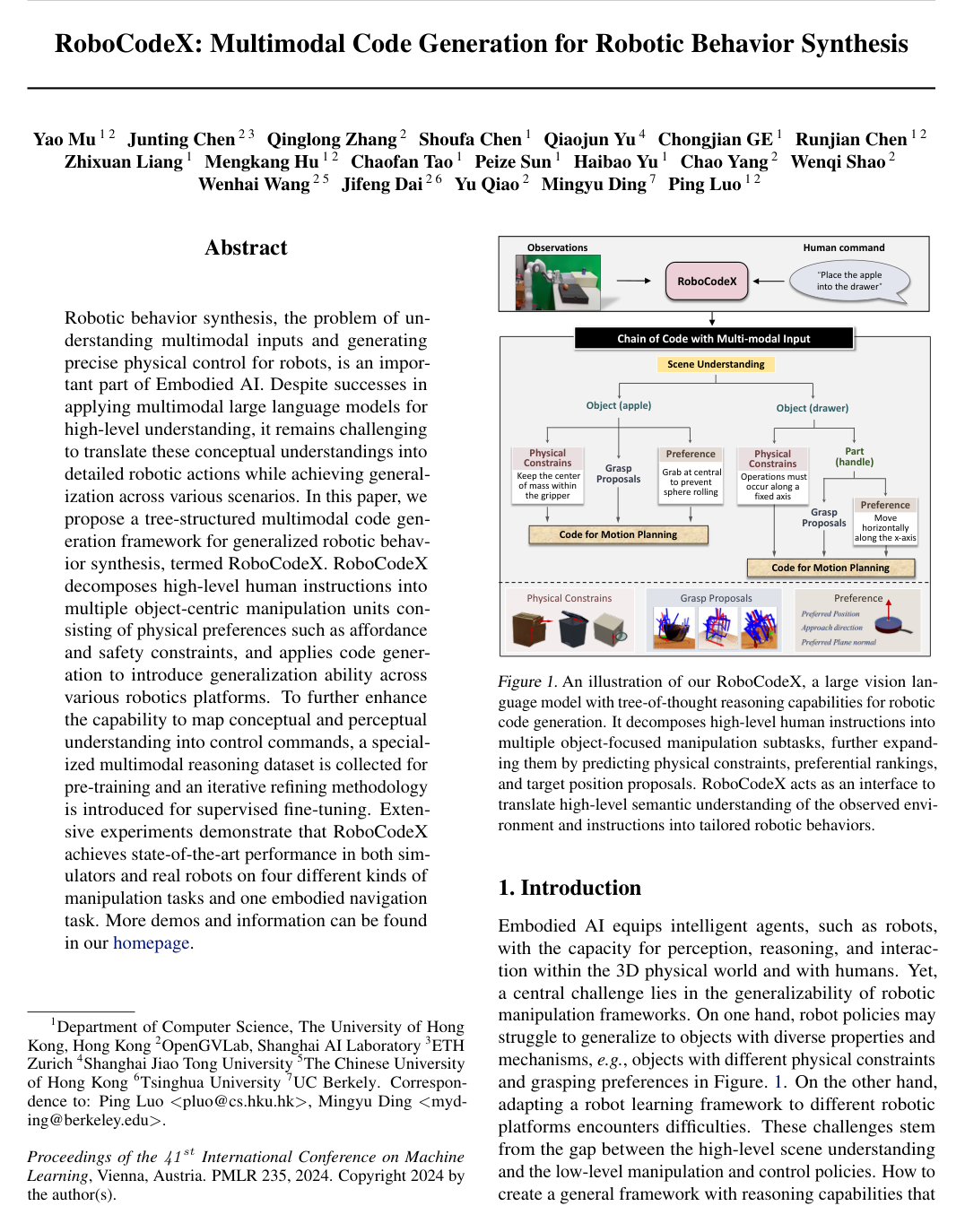
To achieve this, the approach employs a tree-of-thought structure that decomposes high-level human instructions into sequential, object-centric manipulation subtasks. For each subtask, the model analyzes multi-view depth camera observations to infer physical constraints, grasping preferences, and target positions before calling specialized robotics programming interfaces to generate motion trajectories. To train this framework, the authors generated a simulation pretraining dataset of 147,303 multimodal interaction samples and a fine-tuning dataset of 49,320 high-quality samples refined iteratively to guarantee execution viability. The architecture couples a vision transformer, a feature adapter, and a 13-billion-parameter language model, which was validated through simulated benchmarks and real-world robot trials.
Empirical evaluations show that RoboCodeX significantly outperforms leading models across multiple robotic domains. In manipulation benchmarks, it achieved an 80% success rate on open-vocabulary pick-and-place tasks—a 17% absolute improvement over GPT-4V (63%)—and reached success rates of 84% on drawer manipulation and 74% on door opening. On embodied navigation benchmarks across simulated environments, it attained a 40.0% to 40.3% success rate, matching or outperforming foundation model baselines. In zero-shot real-world experiments using two distinct robotic arms (Franka Emika Panda and UR5), RoboCodeX completed varied tasks with success rates between 80% and 100% simply by updating the robot configuration file, requiring no hardware-specific model fine-tuning. Ablation studies confirmed that inferring grasping preferences and retaining general vision-question-answering data during training were essential to prevent performance drops and overfitting.
These findings indicate that using executable code as a bridge between multimodal perception and physical control provides a scalable, cost-effective way to achieve cross-platform robot deployment. Rather than retraining specialized models for each robot type or object shape, organizations can deploy a unified vision-language policy that interfaces directly with existing robotic motion planners. This reduces integration timelines, improves operational safety by respecting physical joint constraints, and lowers software development overhead.
Organizations developing autonomous systems should consider adopting modular, code-generating vision-language architectures to control heterogeneous robot fleets. When training these systems, practitioners should retain general vision-language datasets alongside domain-specific code to prevent model overfitting. However, deployment should proceed with caution: the current framework faces limitations in force-sensitive assembly tasks, such as fastening nuts and bolts, and unstructured contact operations like wiping or sweeping. Future development should focus on integrating dynamic force sensing and refining closed-loop feedback before deploying this architecture into high-precision industrial manufacturing.
- Paper: Code as Policies: Language Model Programs for Embodied Control, Jacky Liang et al. (2022). Read this foundational demonstration of language models generating executable robot-control programs first; RoboCodeX develops the same code-as-policy bridge with multimodal grounding and broader cross-platform evaluation.
- Paper: A Few Words Go a Long Way: Language Guided Robot Policy Synthesis, Daphne Chen et al. (2026). After RoboCodeX’s one-shot code synthesis, ARCHITECT extends the approach with execution-trace diagnosis, human corrections, and reusable skills for iterative policy improvement.
- Paper: CaP-X: A Framework for Benchmarking and Improving Coding Agents for Robot Manipulation, Max Fu et al. (2026). CaP-X carries code-generating robot manipulation toward systematic benchmarking and training-free or reinforcement-learning improvements, building on the executable-policy paradigm RoboCodeX exemplifies.
- Paper: Code as Agent Harness, Xuying Ning et al. (2026). This later survey generalizes executable code from a control interface into an agent harness for planning, memory, verification, and feedback, extending the perspective RoboCodeX applies to robotics.