
topic
behavioral synthesis
Behavioral synthesis is an automated electronic design automation process that converts an abstract, algorithmic description of digital circuit behavior into a structural register-transfer level implementation. Rather than requiring engineers to manually specify cycle-by-cycle hardware interactions, behavioral synthesis takes high-level functional code—often written in languages such as C, C++, or SystemC—and automates core compilation tasks including operation scheduling, resource allocation, and binding. Through these steps, the process assigns computational operations to specific clock cycles and maps them to hardware units, registers, and interconnects while optimizing for design constraints such as timing, silicon area, and power consumption.
2 items
RoboCodeX: Multimodal Code Generation for Robotic Behavior Synthesis
Yao Mu, Junting Chen, Qinglong Zhang, Shoufa Chen, Qiaojun Yu, Chongjian Ge, Runjian Chen, Zhixuan Liang, Mengkang Hu, Chaofan Tao, Peize Sun, Haibao Yu, Chao Yang, Wenqi Shao, Wenhai Wang, Jifeng Dai, Yu Qiao, Mingyu Ding, Ping Luo
Why you should read this
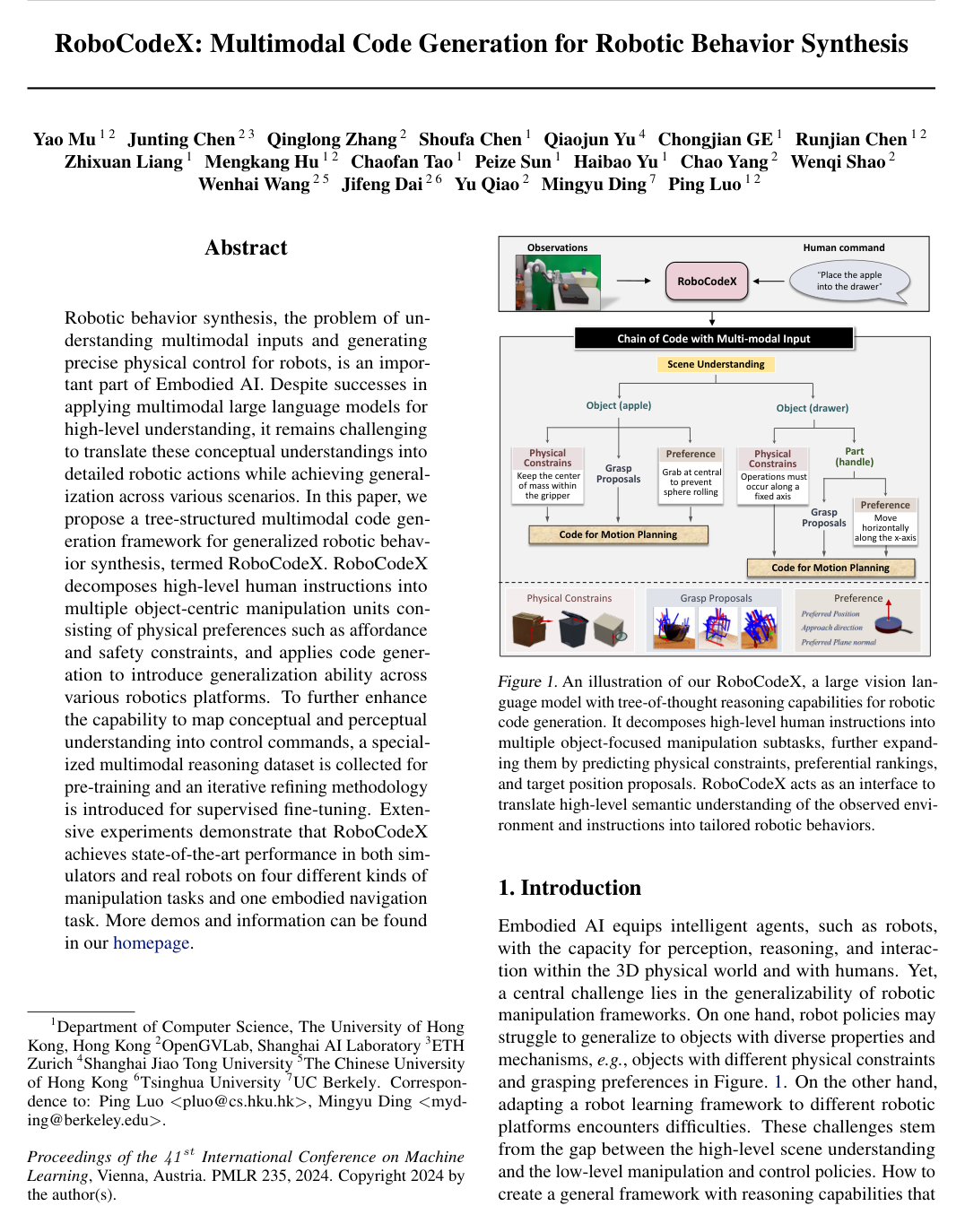
Presents RoboCodeX, a multimodal vision-language framework that decomposes complex instructions into tree-structured, object-centric manipulation units to generate executable control code with physical and safety constraints across different robot platforms.
Robotic behavior synthesis, the problem of understanding multimodal inputs and generating precise physical control for robots, is an important part of Embodied AI. Despite successes in applying multimodal large language models for high-level understanding, it remains challenging to translate these conceptual understandings into detailed robotic actions while achieving generalization across various scenarios. In this paper, we propose a tree-structured multimodal code generation framework for generalized robotic behavior synthesis, termed RoboCodeX. RoboCodeX decomposes high-level human instructions into multiple object-centric manipulation units consisting of physical preferences such as affordance and safety constraints, and applies code generation to introduce generalization ability across various robotics platforms. To further enhance the capability to map conceptual and perceptual understanding into control commands, a specialized multimodal reasoning dataset is collected for pre-training and an iterative refining methodology is introduced for supervised fine-tuning. Extensive experiments demonstrate that RoboCodeX achieves state-of-the-art performance in both simulators and real robots on four different kinds of manipulation tasks and one embodied navigation task. More demos and information can be found in our homepage.
Added
2026-10-03
Planning with Diffusion for Flexible Behavior Synthesis
Michael Janner, Yilun Du, Joshua B. Tenenbaum, Sergey Levine
Why you should read this
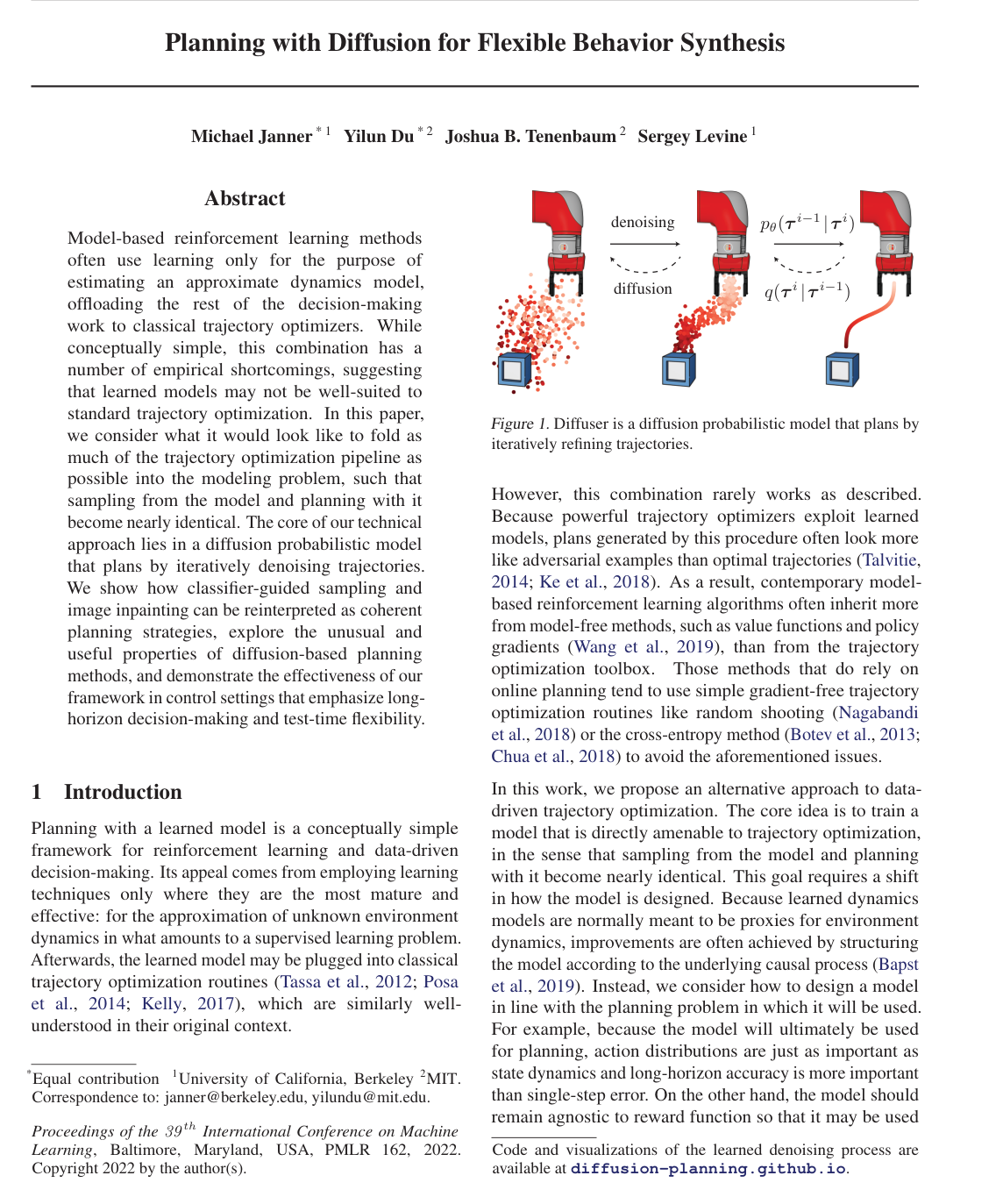
Proposes a trajectory-level diffusion model that unifies dynamics modeling and planning into an iterative denoising process, enabling flexible goal conditioning and effective long-horizon control via classifier-guided sampling.
Model-based reinforcement learning methods often use learning only for the purpose of estimating an approximate dynamics model, offloading the rest of the decision-making work to classical trajectory optimizers. While conceptually simple, this combination has a number of empirical shortcomings, suggesting that learned models may not be well-suited to standard trajectory optimization. In this paper, we consider what it would look like to fold as much of the trajectory optimization pipeline as possible into the modeling problem, such that sampling from the model and planning with it become nearly identical. The core of our technical approach lies in a diffusion probabilistic model that plans by iteratively denoising trajectories. We show how classifier-guided sampling and image inpainting can be reinterpreted as coherent planning strategies, explore the unusual and useful properties of diffusion-based planning methods, and demonstrate the effectiveness of our framework in control settings that emphasize long-horizon decision-making and test-time flexibility.
Added
2026-09-25