Knowledge Base Question Answering by Case-based Reasoning over Subgraphs
Rajarshi DasAmeya GodboleAnkita NaikElliot TowerManzil ZaheerHannaneh HajishirziRobin JiaAndrew McCallum
Presents a semiparametric case-based reasoning framework that scales knowledge base question answering to billion-fact graphs by retrieving similar training queries and transferring their subgraph reasoning patterns to target questions without requiring annotated logical forms.
Organizations increasingly rely on large knowledge bases to store vast amounts of structured facts. However, querying these repositories using natural language remains difficult because answering diverse questions requires complex, joint reasoning across multiple connections in the graph rather than simple path-following. Manually labeling these intricate reasoning patterns is labor-intensive and impossible to scale. At the same time, standard machine learning models struggle to memorize rare query patterns, generalize poorly to newly added entities, and generate overly large subgraphs from massive databases that exceed hardware compute limits.
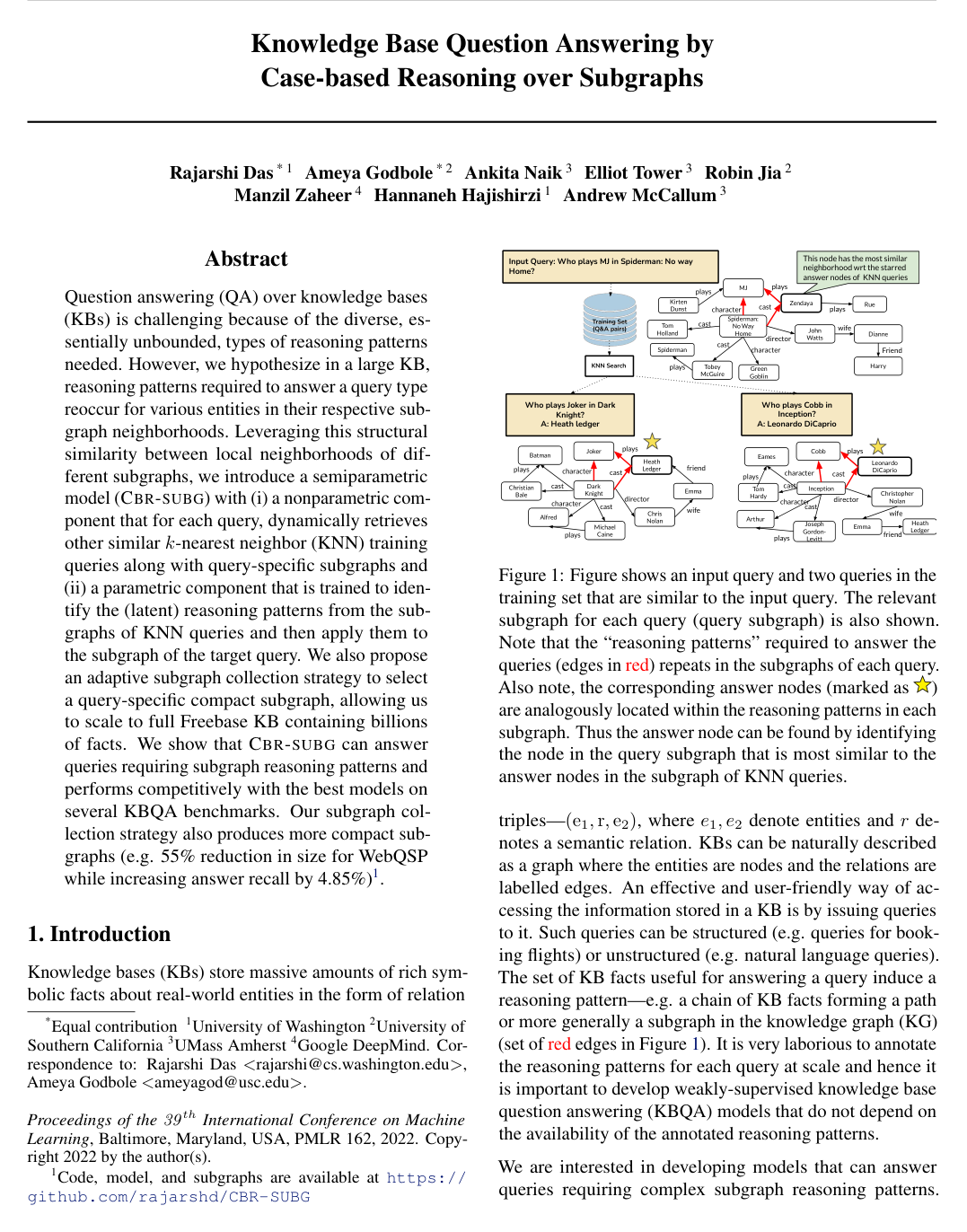
To resolve these challenges, the article evaluates a case-based reasoning framework called CBR-SUBG. The model is designed to demonstrate that complex reasoning patterns can be resolved without labeled training paths by retrieving dynamically similar past questions and applying structural similarities across local subgraphs. The framework combines a nonparametric retrieval module—which finds similar training queries and adaptively extracts compact, query-specific subgraphs—with a parametric graph neural network trained via contrastive learning to match the structural neighborhood of target answer nodes to those in retrieved cases.
The authors tested CBR-SUBG on synthetic controlled environments featuring unseen entities and on real-world benchmarks, including FreebaseQA, WebQuestionsSP, and MetaQA, scaling up to the full Freebase knowledge graph containing over 45 million entities and 3 billion facts. The evaluation produced four key findings. First, CBR-SUBG effectively identified complex, unannotated graph structures, achieving an 85.68% average strict accuracy across diverse pattern shapes and outperforming standard parametric baseline models by approximately 13 percentage points. Second, the adaptive subgraph collection method reduced subgraph sizes by 55.07% on WebQuestionsSP and 92.07% on MetaQA while increasing answer coverage recall by 4.85% and 0.91%, respectively. Third, CBR-SUBG delivered superior performance on standard benchmarks, notably scoring 52.07% on FreebaseQA to outperform the strongest pure knowledge base baseline by 14.45 percentage points and achieving 99.3% on MetaQA 3-hop questions. Fourth, the model demonstrated an ability to improve performance as more nearest-neighbor evidence was provided at inference time, provided the training case base was sufficiently large.
These findings indicate that semiparametric case-based reasoning offers a practical and computationally efficient path for enterprise knowledge base question answering. By employing sparse entity representations based on outgoing relation types rather than fixed entity embeddings, the system readily incorporates newly added entities and evolving facts without requiring full model retraining. Furthermore, generating smaller, highly focused subgraphs directly reduces hardware memory requirements and compute costs while simultaneously improving answer precision and recall.
Organizations developing automated reasoning and question-answering systems over large-scale knowledge graphs should consider adopting semiparametric, case-based architectures. The article recommends deploying dynamic case retrieval and adaptive subgraph pruning rather than naive neighborhood extraction. Prior to production rollout, teams must evaluate the depth and quality of their historical case repositories, as the system relies on retrieving truly relevant cases to prevent performance degradation caused by noisy context. Future developmental initiatives should explore incorporating large language models into the parametric reasoning component and establishing continuous learning pipelines that automatically ingest newly discovered facts.
- Paper: Case-Based Reasoning, J. Kolodner (1988). This paper establishes the foundational principles and four-step reasoning cycle of case-based reasoning that CBR-SUBG adapts for knowledge base question answering.
- Paper: Modeling Relational Data with Graph Convolutional Networks, Michael Schlichtkrull et al. (2018). It introduces relational graph convolutional networks for multi-relational graphs, providing essential background for neural representation and structural matching over graph neighborhoods.
- Paper: A Review of Relational Machine Learning for Knowledge Graphs, Maximilian Nickel et al. (2015). This survey outlines statistical relational learning and graph feature models for large-scale knowledge bases like Freebase, foundational to the knowledge graph reasoning tasks addressed in the source.
- Paper: Semantic Parsing on Freebase from Question-Answer Pairs, Jonathan Berant et al. (2013). It establishes question answering and semantic parsing benchmarks over Freebase without full logical form supervision, directly preceding the unannotated knowledge base QA paradigm used in the source.
- Paper: Retrieval-Augmented Generation for Knowledge-Intensive NLP Tasks, Patrick Lewis et al. (2020). This work introduces modern retrieval-augmented generation paradigms that combine nonparametric retrieval with parametric neural reasoning.
- Paper: Representation Learning on Graphs: Methods and Applications, William L. Hamilton et al. (2017). It provides a comprehensive conceptual framework for node and subgraph representation learning using graph neural network encoders.
- Paper: Memory Networks, Jason Weston et al. (2014). It introduces memory networks for knowledge base question answering, formalizing how external memory stores can be queried during neural reasoning.
- Paper: NodePiece: Compositional and Parameter-Efficient Representations of Large Knowledge Graphs, Mikhail Galkin et al. (2022). It proposes an inductive, anchor-and-relation-based tokenization method for scaling knowledge graph representations to millions of entities without storing individual entity embeddings.
- Paper: Plan-on-Graph: Self-Correcting Adaptive Planning of Large Language Model on Knowledge Graphs, Liyi Chen et al. (2024). This paper extends graph reasoning on Freebase by integrating adaptive planning and dynamic path exploration directly into large language models.
- Paper: StructGPT: A General Framework for Large Language Model to Reason over Structured Data, Jinhao Jiang et al. (2023). It generalizes multi-hop question answering over knowledge graphs to an iterative reading-then-reasoning framework for large language models.
- Paper: Unifying Large Language Models and Knowledge Graphs: A Roadmap, Shirui Pan et al. (2023). This roadmap provides a broader perspective on unifying structured knowledge graphs with neural language models for bidirectional reasoning.
- Paper: Improving Time Sensitivity for Question Answering over Temporal Knowledge Graphs, Chao Shang et al. (2022). It extends subgraph-based question answering strategies to temporal knowledge graphs requiring chronological constraints and time estimation.
- Paper: From Local to Global: A Graph RAG Approach to Query-Focused Summarization, Darren Edge et al. (2024). It scales graph-based retrieval-augmented reasoning from local subgraphs to hierarchical, query-focused community summarization.
- Paper: Mitigating Large Language Model Hallucinations via Autonomous Knowledge Graph-Based Retrofitting, Xinyan Guan et al. (2024). It applies local knowledge graph subgraph retrieval to autonomously detect and retrofit intermediate reasoning hallucinations in language models.