
keyword
knowledge base question answering
Knowledge base question answering is a natural language processing task that aims to automatically answer natural language questions by retrieving and reasoning over structured facts stored in a knowledge base or knowledge graph. In this task, systems interpret user queries and link natural language phrases to specific entities, relations, and schemas within a structured database. To produce an answer, systems typically employ semantic parsing to translate the question into an executable logical query, or use graph-based reasoning to traverse and extract paths from relevant subgraphs. This framework allows automated systems to perform precise factual retrieval, multi-hop reasoning, and structured data aggregation to provide accurate answers derived directly from interconnected factual repositories.
2 items
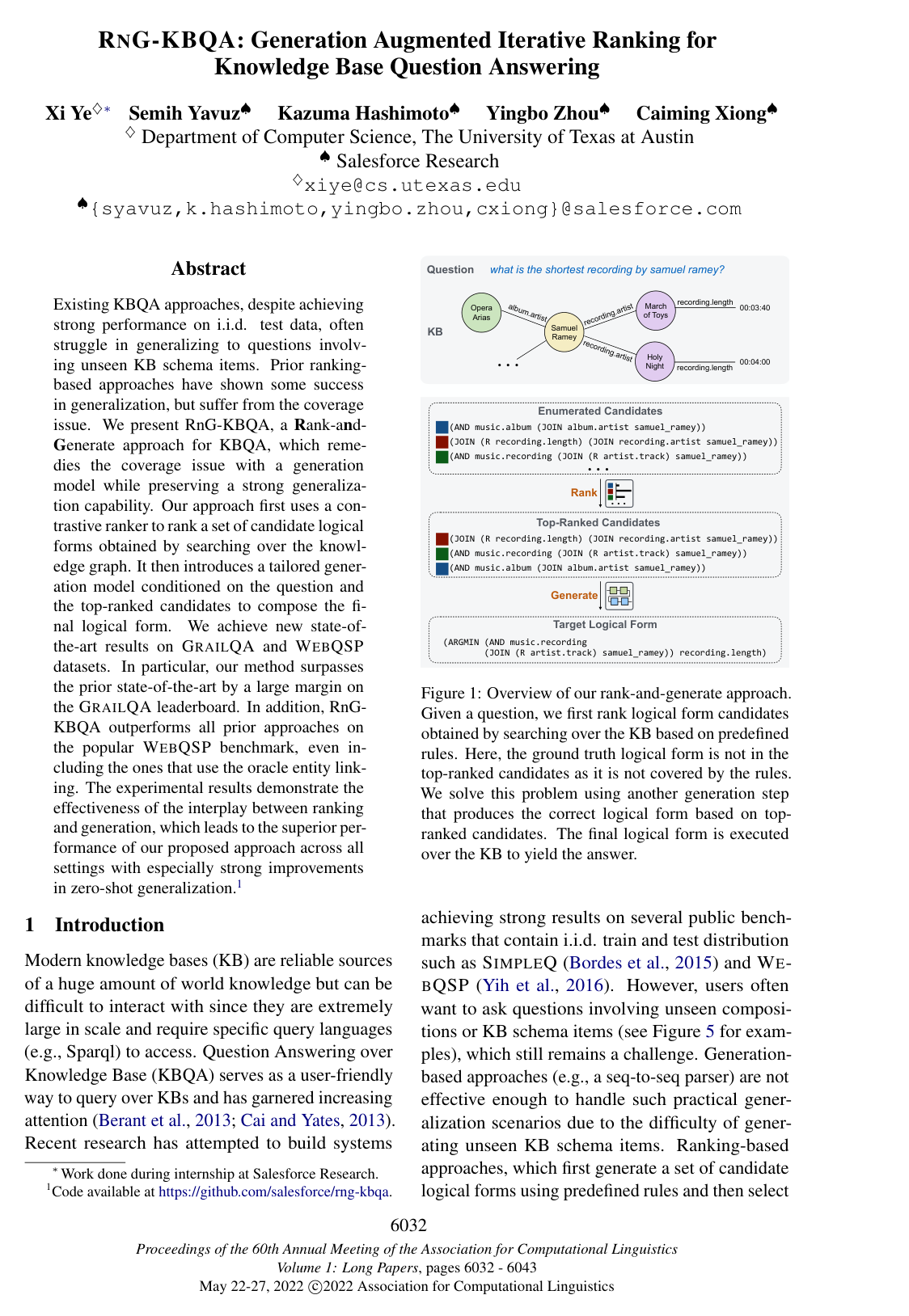
RNG-KBQA: Generation Augmented Iterative Ranking for Knowledge Base Question Answering
Xi Ye, Semih Yavuz, Kazuma Hashimoto, Yingbo Zhou, Caiming Xiong
Existing KBQA approaches, despite achieving strong performance on i.i.d. test data, often struggle with generalizing to questions involving unseen KB schema items. Prior ranking-based approaches have shown some success in generalization, but suffer from the coverage issue. We present RnG-KBQA, a Rank-and-Generate approach for KBQA, which remedies the coverage issue with a generation model while preserving a strong generalization capability. Our approach first uses a contrastive ranker to rank a set of candidate logical forms obtained by searching over the knowledge graph. It then introduces a tailored generation model conditioned on the question and the top-ranked candidates to compose the final logical form. We achieve new state-of-the-art results on GRAILQA and WEBQSP datasets. In particular, our method surpasses the prior state-of-the-art by a large margin on the GRAILQA leaderboard. In addition, RnG-KBQA outperforms all prior approaches on the popular WEBQSP benchmark, even including the ones that use the oracle entity linking. The experimental results demonstrate the effectiveness of the interplay between ranking and generation, which leads to the superior performance of our proposed approach across all settings with especially strong improvements in zero-shot generalization.
Added
2026-09-28
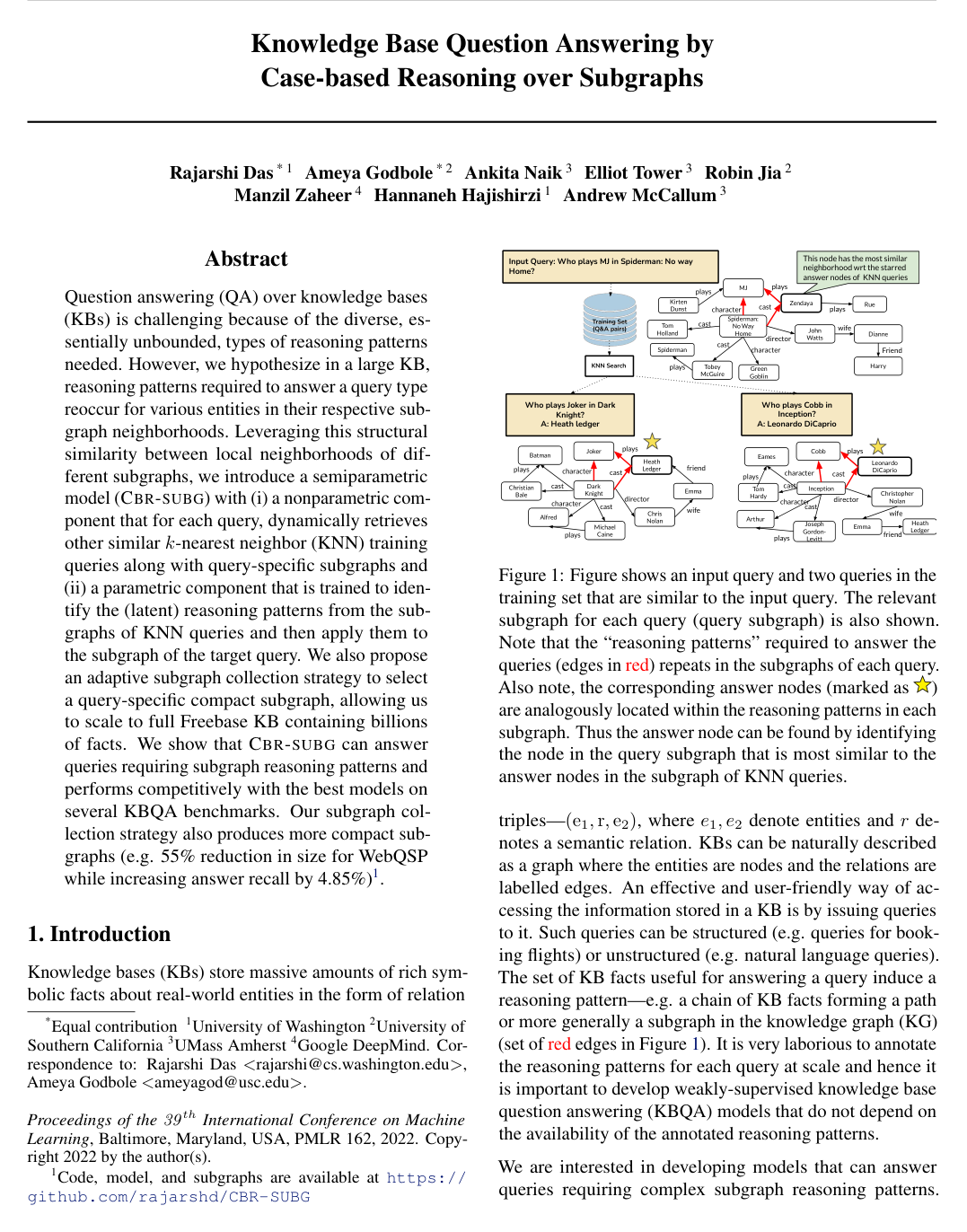
Knowledge Base Question Answering by Case-based Reasoning over Subgraphs
Rajarshi Das, Ameya Godbole, Ankita Naik, Elliot Tower, Manzil Zaheer, Hannaneh Hajishirzi, Robin Jia, Andrew McCallum
Why you should read this
Presents a semiparametric case-based reasoning framework that scales knowledge base question answering to billion-fact graphs by retrieving similar training queries and transferring their subgraph reasoning patterns to target questions without requiring annotated logical forms.
Question answering (QA) over knowledge bases (KBs) is challenging because of the diverse, essentially unbounded, types of reasoning patterns needed. However, we hypothesize in a large KB, reasoning patterns required to answer a query type reoccur for various entities in their respective subgraph neighborhoods. Leveraging this structural similarity between local neighborhoods of different subgraphs, we introduce a semiparametric model (CBR-SUBG) with (i) a nonparametric component that for each query, dynamically retrieves other similar k-nearest neighbor (KNN) training queries along with query-specific subgraphs and (ii) a parametric component that is trained to identify the (latent) reasoning patterns from the subgraphs of KNN queries and then apply them to the subgraph of the target query. We also propose an adaptive subgraph collection strategy to select a query-specific compact subgraph, allowing us to scale to full Freebase KB containing billions of facts. We show that CBR-SUBG can answer queries requiring subgraph reasoning patterns and performs competitively with the best models on several KBQA benchmarks. Our subgraph collection strategy also produces more compact subgraphs (e.g. 55% reduction in size for WebQSP while increasing answer recall by 4.85%)1.
Added
2026-09-26