Hierarchical Spatio-temporal Decoupling for Text-to- Video Generation
Zhiwu QingShiwei ZhangJiayu WangXiang WangYujie WeiYingya ZhangChangxin GaoNong Sang
Proposes HiGen, a diffusion-based framework that decouples spatial reasoning from temporal dynamics at both the structural and content levels to generate realistic, temporally stable videos from text prompts.
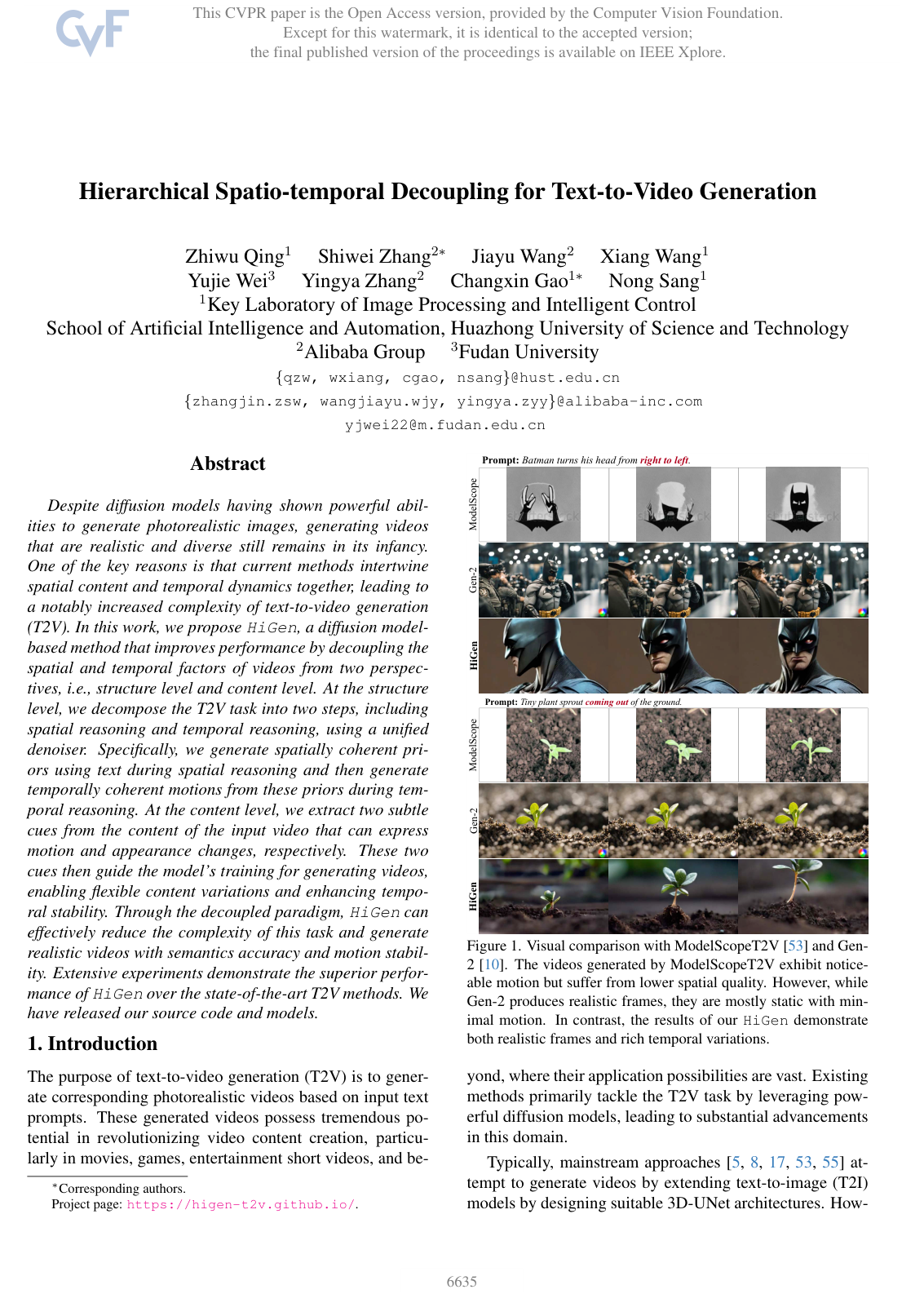
Generating realistic and dynamic videos from text prompts holds substantial value for digital media, gaming, and entertainment. However, current automated systems struggle to produce video clips that simultaneously offer sharp image quality and lively, coherent movement. Existing approaches generally try to generate spatial imagery and temporal dynamics all at once, which introduces excessive mathematical complexity. Consequently, current models tend to generate either high-quality images with almost no movement or dynamic scenes with severe visual degradation and instability.
The article introduces and evaluates "HiGen," an artificial intelligence method designed to resolve this trade-off by decoupling video generation into separate spatial and temporal steps across two distinct levels: structural architecture and content guidance.
The researchers developed a hierarchical framework utilizing an established image synthesis model as its base. Structurally, the system performs spatial reasoning first to establish a high-quality visual anchor, followed by temporal reasoning to generate movement across frames. At the content level, the method calculates explicit motion cues from adjacent pixel differences and appearance cues using a semantic vision model, allowing independent control over movement speed and scene variations. The system was trained using an image-video joint strategy on 17 million video-text pairs and roughly 60 million image-text pairs, and its performance was evaluated against benchmark datasets and existing tools.
The evaluation revealed several key findings. First, the hierarchical decoupling strategy significantly outperformed existing models on benchmark tests, achieving a substantial reduction in video distortion metrics (a Fréchet Video Distance score of 406 compared to 550 for the baseline). Second, human evaluations showed strong preference for the new approach, most notably in temporal movement quality, where it scored 74.0%—surpassing the nearest open-source alternative by 18.8 percentage points. Third, structural decoupling without content-level guidance severely degraded frame-to-frame consistency, confirming that both decoupling layers are necessary for stable video output. Finally, explicit motion and appearance factors proved highly effective for manual control during video generation, whereas standard playback frame-rate adjustments had minimal impact on temporal dynamics.
These findings demonstrate that separating visual content from time-based motion reduces computational complexity and makes automated video synthesis more practical and controllable. By enabling users to independently tune motion speed and appearance shifts, this approach provides a viable foundation for reliable commercial video production tools. Importantly, the analysis shows that prioritizing extreme frame-to-frame consistency often results in static, unengaging videos, indicating that controlled variability is essential for natural motion.
Organizations developing or deploying automated video generation systems should adopt decoupled architectures to improve output quality and operational control. Future development should focus on addressing remaining technical boundaries. Specifically, the system's ability to render fine object details still lags behind dedicated single-image generators, and synthesizing complex human or animal movements that adhere strictly to common-sense physical actions remains challenging during large motions. Addressing these issues will require further research into training data curation and specialized model architectures.
- Paper: Align Your Latents: High-Resolution Video Synthesis with Latent Diffusion Models, Andreas Blattmann et al. (2023). This foundational work introduces latent diffusion models adapted for video synthesis by adding temporal layers to pretrained image generators, which serves as the direct baseline paradigm that HiGen decouples.
- Paper: Video Diffusion Models, Jonathan Ho et al. (2022). It establishes the core video diffusion framework and joint image-video training principles upon which subsequent spatio-temporal video generation architectures rely.
- Paper: Make-A-Video: Text-to-Video Generation without Text-Video Data, Uriel Singer et al. (2023). It introduces spatial-temporal factorized diffusion layers on top of text-to-image models, providing the standard coupled architecture that HiGen aims to hierarchically decouple.
- Paper: Imagen Video: High Definition Video Generation with Diffusion Models, Jonathan Ho et al. (2022). It details cascaded high-definition video generation with diffusion architectures, highlighting the challenge of intertwined spatial content and temporal dynamics addressed by HiGen.
- Paper: Stable Video Diffusion: Scaling Latent Video Diffusion Models to Large Datasets, Andreas Blattmann et al. (2023). It outlines modern scaling, curation, and multi-stage training protocols for latent video diffusion models that form the state of the art in text-to-video synthesis.
- Paper: MoCoGAN: Decomposing Motion and Content for Video Generation, Sergey Tulyakov et al. (2018). It introduces the fundamental conceptual framework of explicitly decomposing video generation into separate content and motion representations.
- Paper: Denoising Diffusion Probabilistic Models, Jonathan Ho et al. (2020). It introduces the core denoising diffusion probabilistic formulation and U-Net architecture underpinning all modern diffusion-based generation models.
- Paper: MotionClone: Training-Free Motion Cloning for Controllable Video Generation, Pengyang Ling et al. (2025). Building on spatial-temporal attention mechanisms in video diffusion, it introduces a training-free strategy to isolate and clone temporal attention cues for controllable generation.
- Paper: CogVideoX: Text-to-Video Diffusion Models with An Expert Transformer, Zhuoyi Yang et al. (2025). It advances diffusion-based text-to-video generation by replacing conventional U-Nets with expert diffusion transformers and 3D causal VAEs to scale coherent spatio-temporal modeling.
- Paper: Emu Video: Factorizing Text-to-Video Generation by Explicit Image Conditioning, Rohit Girdhar et al. (2024). It offers an alternative factorization strategy for text-to-video generation by explicitly conditioning video diffusion on intermediate generated keyframe images.
- Paper: AnimateDiff: Animate Your Personalized Text-to-Image Diffusion Models without Specific Tuning, Yuwei Guo et al. (2024). It explores modular motion modeling by training plug-and-play temporal modules that can animate arbitrary personalized text-to-image base models without modifying spatial weights.
- Paper: Video-LaVIT: Unified Video-Language Pre-training with Decoupled Visual-Motional Tokenization, Yang Jin et al. (2024). It extends decoupled visual-motion representations to a unified multimodal language modeling paradigm by tokenizing static keyframes and temporal motion vectors separately.