SVFormer: Semi-supervised Video Transformer for Action Recognition
Zhen XingQi DaiHan HuJingjing ChenZuxuan WuYu-Gang Jiang
Presents SVFormer, a semi-supervised video transformer framework combining an exponential moving average teacher with specialized tube-level token mixing and temporal warping augmentations to substantially improve action recognition performance under extremely limited supervision.
Online video content continues to expand rapidly, creating substantial demand for accurate automated video understanding. However, training conventional video recognition models requires vast amounts of manually annotated video, which is labor-intensive and costly. Semi-supervised learning addresses this bottleneck by using a small fraction of labeled videos alongside large volumes of unlabeled footage. While vision transformer models have recently outperformed traditional convolutional neural networks in fully supervised settings, their application to semi-supervised video recognition has remained largely unexplored due to challenges in training transformers with limited supervision and the inadequacy of image-based data augmentation techniques for temporal video.
The article introduces and evaluates SVFormer, a transformer-based semi-supervised action recognition framework designed to train video models effectively using minimal labeled data.
The authors develop a framework incorporating a stable teacher-student model architecture to generate reliable pseudo-labels for unlabeled video clips. To tailor semi-supervised learning to video transformers, the approach introduces two specialized data augmentation techniques: Tube TokenMix, which blends video clips at the transformer token level using temporally consistent spatial masks, and Temporal Warping Augmentation, which randomly stretches and pads frame durations to simulate complex motion variations. The method was evaluated through extensive benchmark experiments on three standard datasets (Kinetics-400, UCF-101, and HMDB-51) under constrained labeling conditions, comparing performance against existing convolutional and transformer baselines.
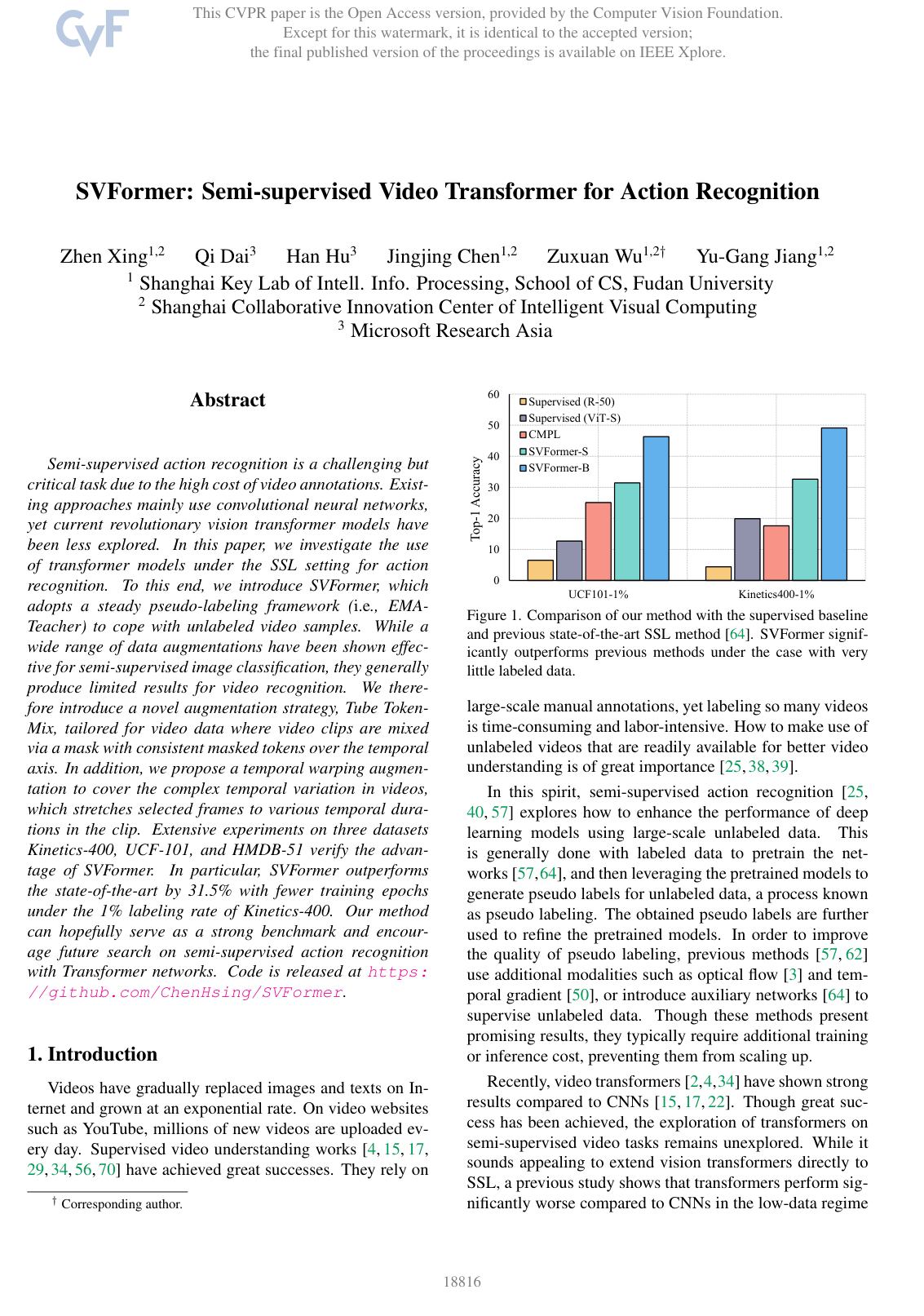
The evaluation yielded several critical findings. First, SVFormer establishes a new state of the art in semi-supervised video recognition, outperforming prior methods on the Kinetics-400 benchmark with only 1% of data labeled by an absolute 15.0% top-1 accuracy margin for the small model (SVFormer-S) and 31.5% for the base model (SVFormer-B). Second, the framework reaches this higher accuracy significantly faster, requiring only 30 training epochs compared to 180 to 600 epochs for previous convolutional approaches. Third, initializing the video transformer with standard image-pretrained weights resolves the common low-data training failures typically seen in transformer models. Finally, ablation studies confirmed that combining token-level tube masking with temporal warping yields clear performance gains over standard image mixing techniques and isolated spatial augmentations.
These findings demonstrate that organizations can deploy high-performing video recognition systems while reducing data labeling costs and computational training budgets. By relying solely on standard video input without requiring complex auxiliary networks or secondary data streams (such as optical flow), SVFormer streamlines the training pipeline and reduces both operational complexity and carbon footprint. For decision-makers, this shifts the paradigm for video analytics from costly full annotation to lightweight semi-supervised transformer training.
Organizations developing video recognition systems should adopt transformer-based semi-supervised workflows and incorporate token-aligned, temporally aware augmentations rather than legacy image-based mixing methods. Teams seeking to deploy this approach should leverage pretrained image representations as model initializers to stabilize training. Future work should evaluate this framework across longer video sequences, specialized industry-specific domains, and real-time operational environments.
The findings are supported by consistent results across three standard benchmarks and thorough component ablations. Limitations include reliance on short video clips and standard classification settings; performance may vary when transitioning to untrimmed, complex real-world footage or when domain shifts occur between labeled and unlabeled samples.
- Paper: ViViT: A Video Vision Transformer, Anurag Arnab et al. (2021). It introduces foundational spatio-temporal tokenization and factorized attention architectures for video vision transformers upon which SVFormer builds.
- Paper: Is Space-Time Attention All You Need for Video Understanding?, Gedas Bertasius et al. (2021). It establishes pure space-time attention mechanisms and image-to-video weight adaptation for video transformers, providing essential architectural context for SVFormer.
- Paper: Multiscale Vision Transformers, Haoqi Fan et al. (2021). It establishes multiscale pooling attention for video vision transformers, demonstrating core principles of efficient spatiotemporal transformer design.
- Paper: VideoMAE: Masked Autoencoders are Data-Efficient Learners for Self-Supervised Video Pre-Training, Zhan Tong et al. (2022). It establishes video tubelet masking in vision transformers, directly informing the design of SVFormer's Tube TokenMix data augmentation strategy.
- Paper: Emerging Properties in Self-Supervised Vision Transformers, Mathilde Caron et al. (2021). It introduces teacher-student self-distillation frameworks for vision transformers, forming the conceptual foundation for SVFormer's semi-supervised pseudo-labeling.
- Paper: Training data-efficient image transformers & distillation through attention, Hugo Touvron et al. (2021). It provides crucial techniques for stabilizing and data-efficient training of vision transformers via distillation and specialized token strategies.
- Paper: ST-Adapter: Parameter-Efficient Image-to-Video Transfer Learning, Junting Pan et al. (2022). It analyzes the parameter-efficient adaptation of image-pretrained transformer weights to video recognition tasks, addressing a key bottleneck SVFormer tackles.
- Paper: Video Swin Transformer, Ze Liu et al. (2021). It adapts hierarchical Swin Transformer architectures with spatiotemporal windowed attention to video understanding benchmarks.
No sufficiently relevant recommendations were found.