
keyword
video understanding
Video understanding is a subfield of artificial intelligence and computer vision focused on enabling computational systems to analyze, interpret, and derive semantic meaning from dynamic visual sequences across both space and time. While traditional image processing operates on static spatial data, video understanding requires the modeling of temporal dynamics, motion continuity, object interactions, and causal scene changes across sequential frames. Modern approaches often combine visual spatiotemporal representations with multimodal inputs such as audio and natural language to support tasks including action recognition, temporal event localization, automated video captioning, content retrieval, and conversational reasoning about dynamic environments.
18 items
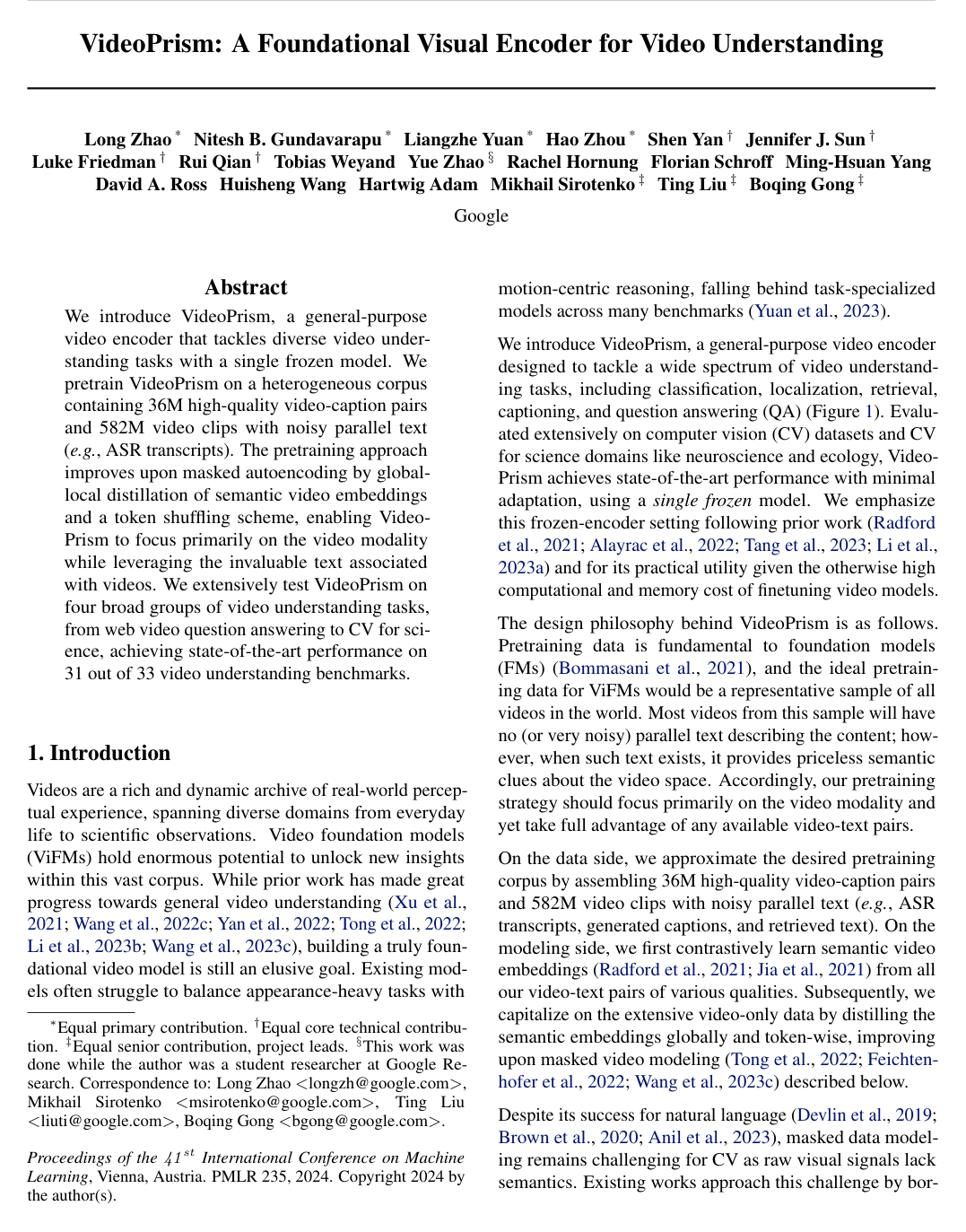
VideoPrism: A Foundational Visual Encoder for Video Understanding
Long Zhao, Nitesh Bharadwaj Gundavarapu, Liangzhe Yuan, Hao Zhou, Shen Yan, Jennifer J. Sun, Luke Friedman, Rui Qian, Tobias Weyand, Yue Zhao, Rachel Hornung, Florian Schroff, Ming-Hsuan Yang, David A. Ross, Huisheng Wang, Hartwig Adam, Mikhail Sirotenko, Ting Liu, Boqing Gong
Why you should read this
Presents VideoPrism, a foundational visual encoder pretrained via a two-stage contrastive and masked modeling pipeline that achieves state-of-the-art results across 31 video understanding benchmarks using a single frozen model.
Added
2026-10-02
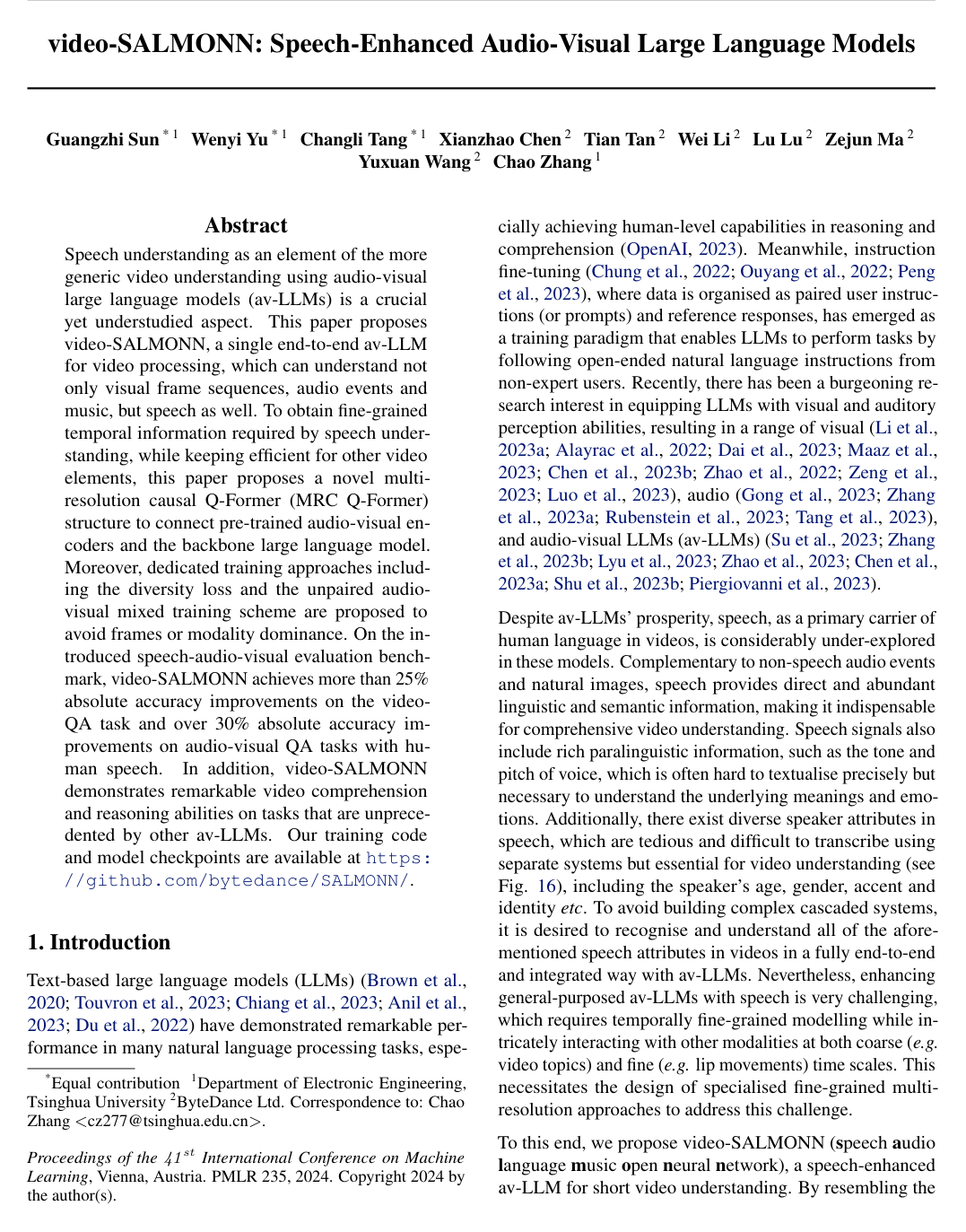
video-SALMONN: Speech-Enhanced Audio-Visual Large Language Models
Guangzhi Sun, Wenyi Yu, Changli Tang, Xianzhao Chen, Tian Tan, Wei Li, Lu Lu, Zejun Ma, Yuxuan Wang, Chao Zhang
Why you should read this
Presents video-SALMONN, an end-to-end multimodal large language model that unifies speech, audio events, and visual perception using a multi-resolution causal Q-Former to enable fine-grained temporal understanding and audio-visual question answering.
Added
2026-10-02
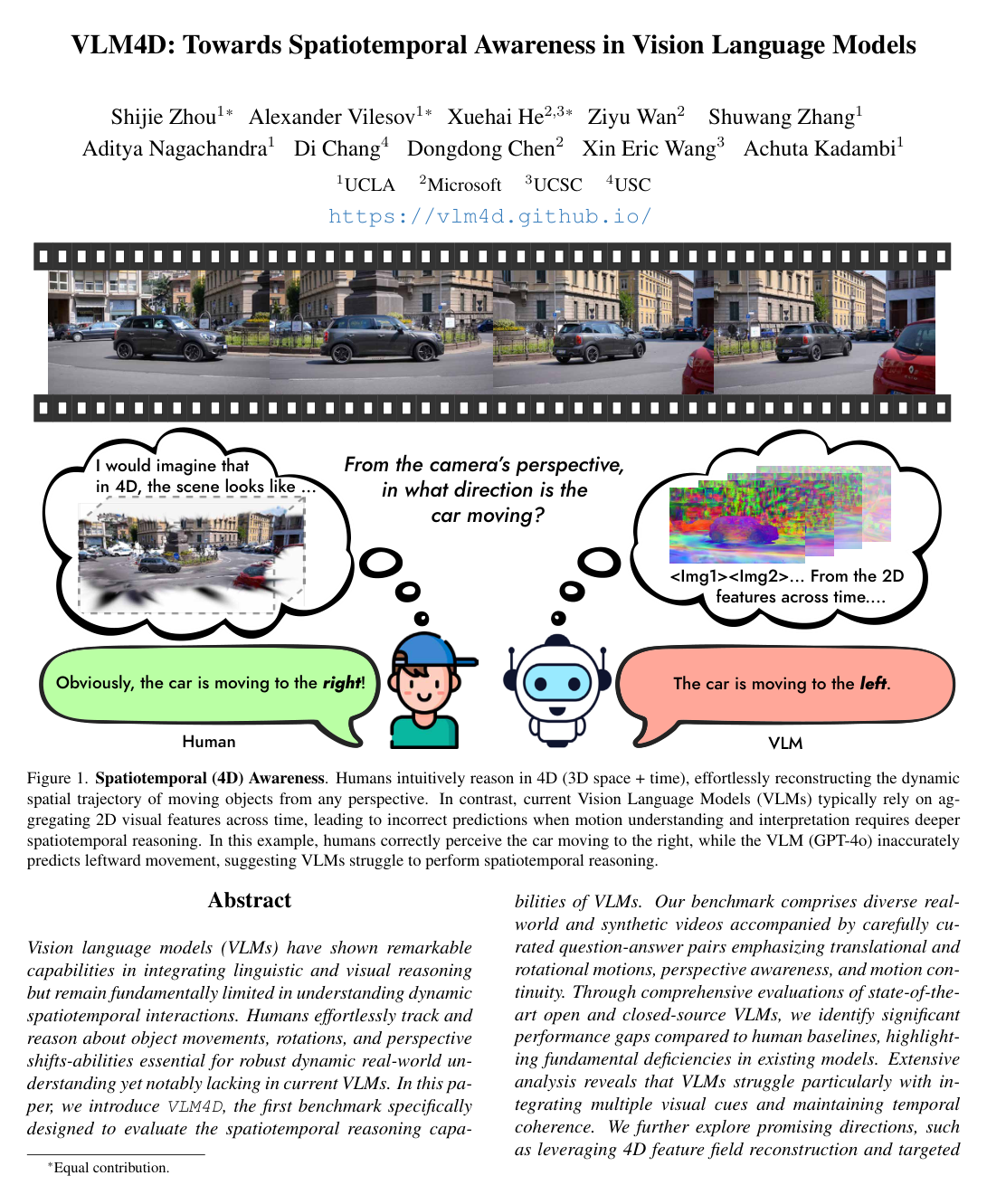
VLM4D: Towards Spatiotemporal Awareness in Vision Language Models
Shijie Zhou, Alexander Vilesov, Xuehai He, Ziyu Wan, Shuwang Zhang, Aditya Nagachandra, Di Chang, Dongdong Chen, Xin Eric Wang, Achuta Kadambi
Why you should read this
Establishes VLM4D as a benchmark for evaluating spatiotemporal reasoning in vision language models across motion and perspective shifts, exposing critical performance gaps compared to humans and demonstrating how 4D feature field reconstruction improves dynamic scene understanding.
Vision language models (VLMs) have shown remarkable capabilities in integrating linguistic and visual reasoning but remain fundamentally limited in understanding dynamic spatiotemporal interactions. Humans effortlessly track and reason about object movements, rotations, and perspective shifts-abilities essential for robust dynamic real-world understanding yet notably lacking in current VLMs. In this paper, we introduce VLM4D, the first benchmark specifically designed to evaluate the spatiotemporal reasoning capabilities of VLMs. Our benchmark comprises diverse real-world and synthetic videos accompanied by carefully curated question-answer pairs emphasizing translational and rotational motions, perspective awareness, and motion continuity. Through comprehensive evaluations of state-of-the-art open and closed-source VLMs, we identify significant performance gaps compared to human baselines, highlighting fundamental deficiencies in existing models. Extensive analysis reveals that VLMs struggle particularly with integrating multiple visual cues and maintaining temporal coherence. We further explore promising directions, such as leveraging 4D feature field reconstruction and targeted spatiotemporal supervised fine-tuning, demonstrating their effectiveness in enhancing spatiotemporal comprehension. Our work aims to encourage deeper exploration into improving VLMs' spatial and temporal grounding, paving the way towards more capable and reliable visual intelligence for dynamic environments.
Added
2026-09-30
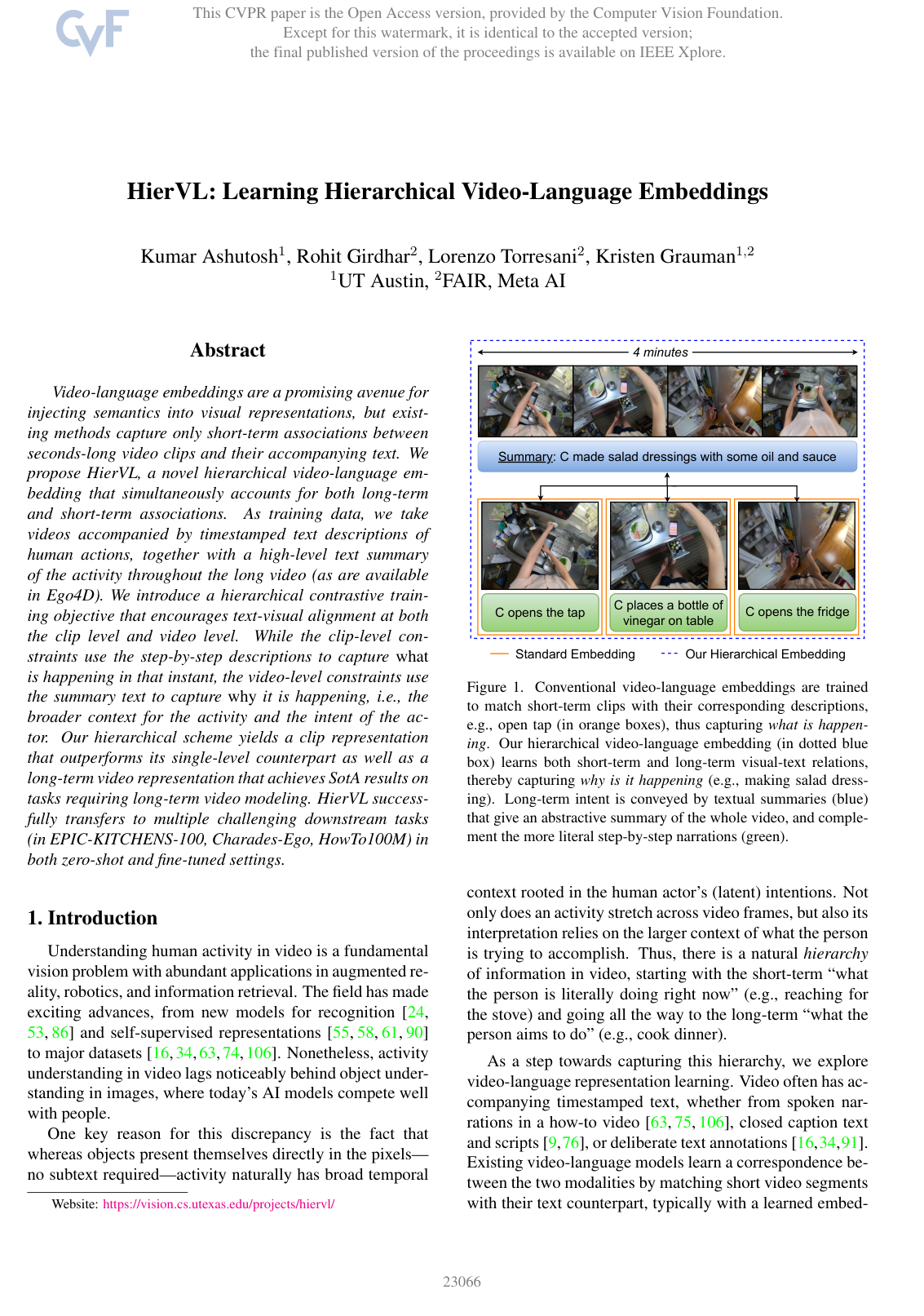
HierVL: Learning Hierarchical Video-Language Embeddings
Kumar Ashutosh, Rohit Girdhar, Lorenzo Torresani, Kristen Grauman
Why you should read this
Proposes a hierarchical video-language framework that jointly aligns short-term action clips with step-by-step descriptions and aggregated video features with abstract summaries to capture both immediate actions and long-term actor intent.
Video-language embeddings are a promising avenue for injecting semantics into visual representations, but existing methods capture only short-term associations between seconds-long video clips and their accompanying text. We propose HierVL, a novel hierarchical video-language embedding that simultaneously accounts for both long-term and short-term associations. As training data, we take videos accompanied by timestamped text descriptions of human actions, together with a high-level text summary of the activity throughout the long video (as are available in Ego4D). We introduce a hierarchical contrastive training objective that encourages text-visual alignment at both the clip level and video level. While the clip-level constraints use the step-by-step descriptions to capture what is happening in that instant, the video-level constraints use the summary text to capture why it is happening, i.e., the broader context for the activity and the intent of the actor. Our hierarchical scheme yields a clip representation that outperforms its single-level counterpart as well as a long-term video representation that achieves SotA results on tasks requiring long-term video modeling. HierVL successfully transfers to multiple challenging downstream tasks (in EPIC-KITCHENS-100, Charades-Ego, HowTo100M) in both zero-shot and fine-tuned settings.
Added
2026-09-26
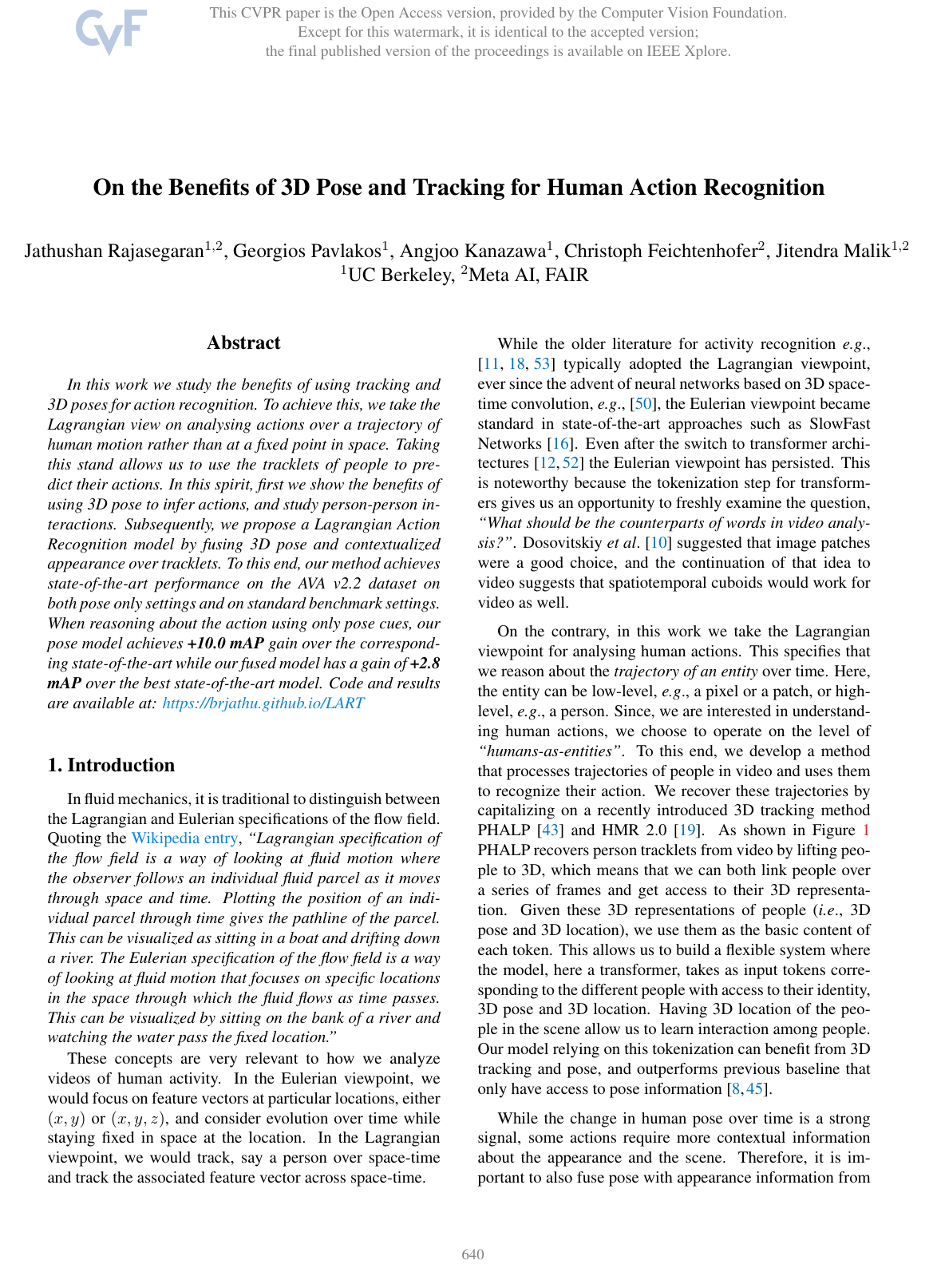
On the Benefits of 3D Pose and Tracking for Human Action Recognition
Jathushan Rajasegaran, Georgios Pavlakos, Angjoo Kanazawa, Christoph Feichtenhofer, Jitendra Malik
Why you should read this
Proposes a human-centric action recognition framework that tokenizes 3D body poses and contextual appearance along tracked trajectories, achieving significant performance gains on the AVA benchmark over conventional video-level methods.
In this work we study the benefits of using tracking and 3D poses for action recognition. To achieve this, we take the Lagrangian view on analysing actions over a trajectory of human motion rather than at a fixed point in space. Taking this stand allows us to use the tracklets of people to predict their actions. In this spirit, first we show the benefits of using 3D pose to infer actions, and study person-person interactions. Subsequently, we propose a Lagrangian Action Recognition model by fusing 3D pose and contextualized appearance over tracklets. To this end, our method achieves state-of-the-art performance on the AVA v2.2 dataset on both pose only settings and on standard benchmark settings. When reasoning about the action using only pose cues, our pose model achieves +10.0 mAP gain over the corresponding state-of-the-art while our fused model has a gain of +2.8 mAP over the best state-of-the-art model. Code and results are available at: https://brjathu.github.io/LART
Added
2026-09-26
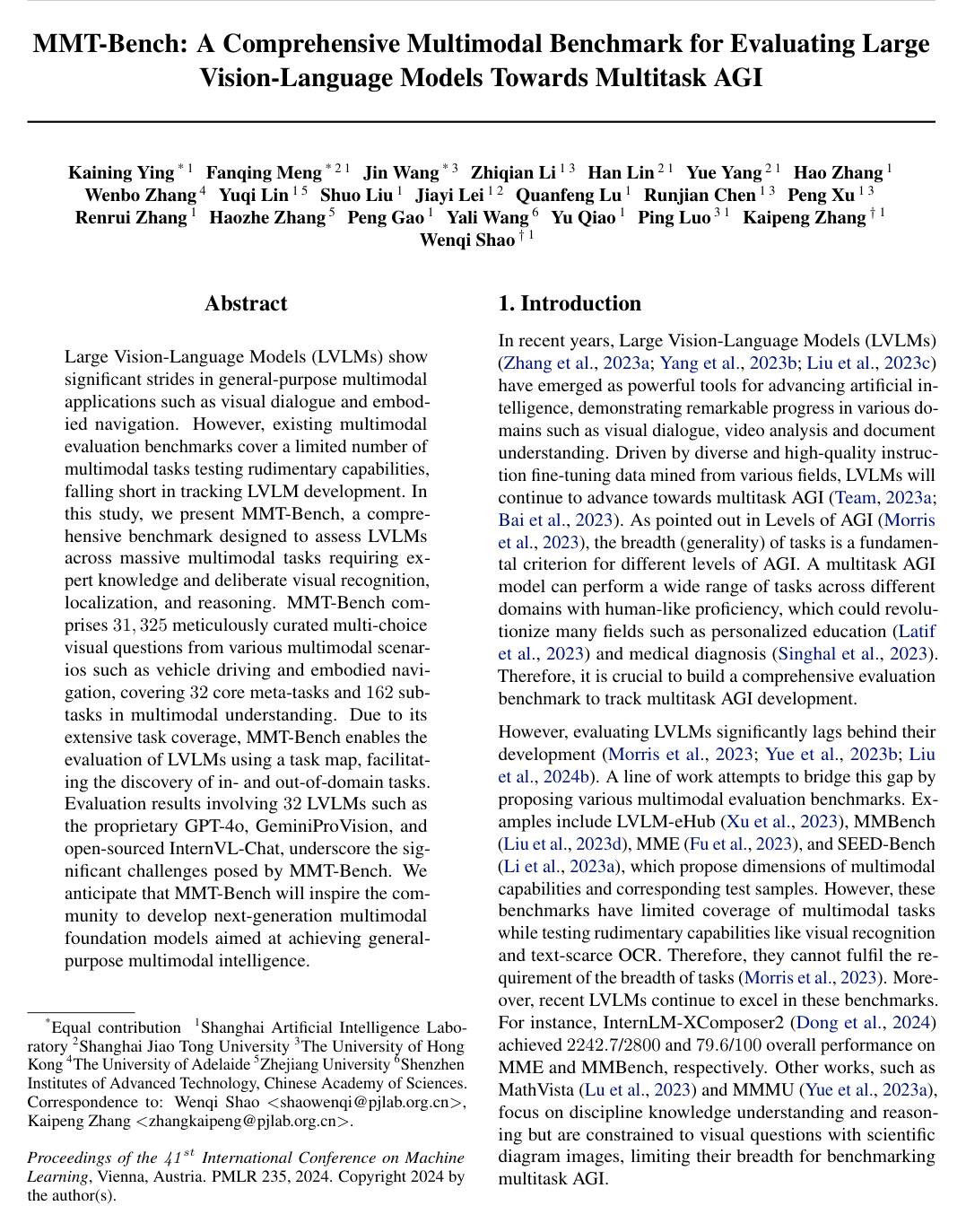
MMT-Bench: A Comprehensive Multimodal Benchmark for Evaluating Large Vision-Language Models Towards Multitask AGI
Kaining Ying, Fanqing Meng, Jin Wang, Zhiqian Li, Han Lin, Yue Yang, Hao Zhang, Wenbo Zhang, Yuqi Lin, Shuo Liu, Jiayi Lei, Quanfeng Lu, Runjian Chen, Peng Xu, Renrui Zhang, Haozhe Zhang, Peng Gao, Yali Wang, Yu Qiao, Ping Luo, Kaipeng Zhang, Wenqi Shao
Why you should read this
Presents MMT-Bench, an extensive evaluation benchmark spanning over 31,000 questions across 162 vision-language tasks, to expose key performance limits in advanced multimodal models and map their progress toward general visual intelligence.
Large Vision-Language Models (LVLMs) show significant strides in general-purpose multimodal applications such as visual dialogue and embodied navigation. However, existing multimodal evaluation benchmarks cover a limited number of multimodal tasks testing rudimentary capabilities, falling short in tracking LVLM development. In this study, we present MMT-Bench, a comprehensive benchmark designed to assess LVLMs across massive multimodal tasks requiring expert knowledge and deliberate visual recognition, localization, and reasoning. MMT-Bench comprises 31,325 meticulously curated multi-choice visual questions from various multimodal scenarios such as vehicle driving and embodied navigation, covering 32 core meta-tasks and 162 subtasks in multimodal understanding. Due to its extensive task coverage, MMT-Bench enables the evaluation of LVLMs using a task map, facilitating the discovery of in- and out-of-domain tasks. Evaluation results involving 32 LVLMs such as the proprietary GPT-4o, GeminiProVision, and open-sourced InternVL-Chat, underscore the significant challenges posed by MMT-Bench. We anticipate that MMT-Bench will inspire the community to develop next-generation multimodal foundation models aimed at achieving general-purpose multimodal intelligence.
Added
2026-09-26
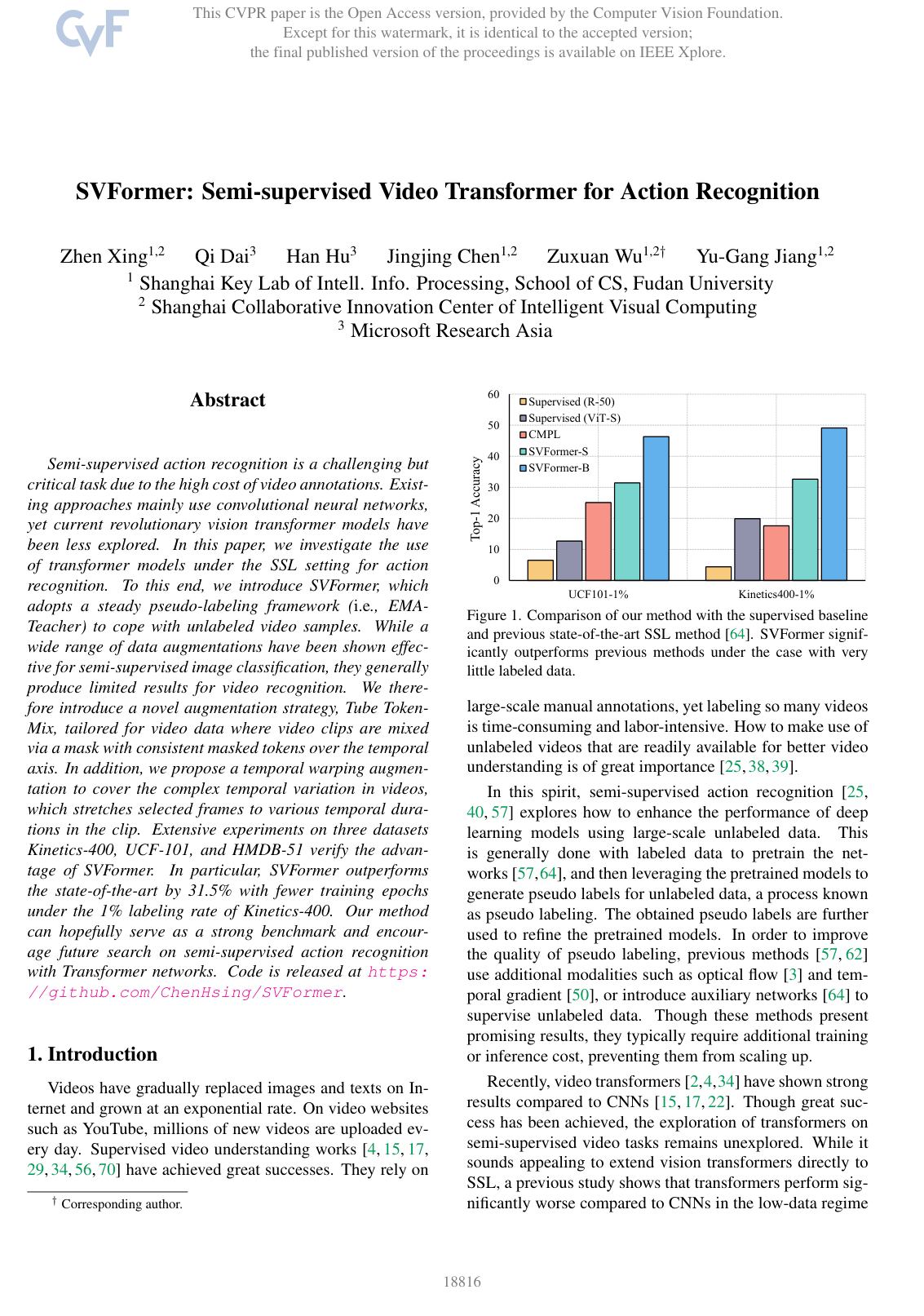
SVFormer: Semi-supervised Video Transformer for Action Recognition
Zhen Xing, Qi Dai, Han Hu, Jingjing Chen, Zuxuan Wu, Yu-Gang Jiang
Why you should read this
Presents SVFormer, a semi-supervised video transformer framework combining an exponential moving average teacher with specialized tube-level token mixing and temporal warping augmentations to substantially improve action recognition performance under extremely limited supervision.
Semi-supervised action recognition is a challenging but critical task due to the high cost of video annotations. Existing approaches mainly use convolutional neural networks, yet current revolutionary vision transformer models have been less explored. In this paper, we investigate the use of transformer models under the SSL setting for action recognition. To this end, we introduce SVFormer, which adopts a steady pseudo-labeling framework (i.e., EMA-Teacher) to cope with unlabeled video samples. While a wide range of data augmentations have been shown effective for semi-supervised image classification, they generally produce limited results for video recognition. We therefore introduce a novel augmentation strategy, Tube TokenMix, tailored for video data where video clips are mixed via a mask with consistent masked tokens over the temporal axis. In addition, we propose a temporal warping augmentation to cover the complex temporal variation in videos, which stretches selected frames to various temporal durations in the clip. Extensive experiments on three datasets Kinetics-400, UCF-101, and HMDB-51 verify the advantage of SVFormer. In particular, SVFormer outperforms the state-of-the-art by 31.5% with fewer training epochs under the 1% labeling rate of Kinetics-400. Our method can hopefully serve as a strong benchmark and encourage future search on semi-supervised action recognition with Transformer networks. Code is released at https://github.com/ChenHsing/SVFormer.
Added
2026-09-26
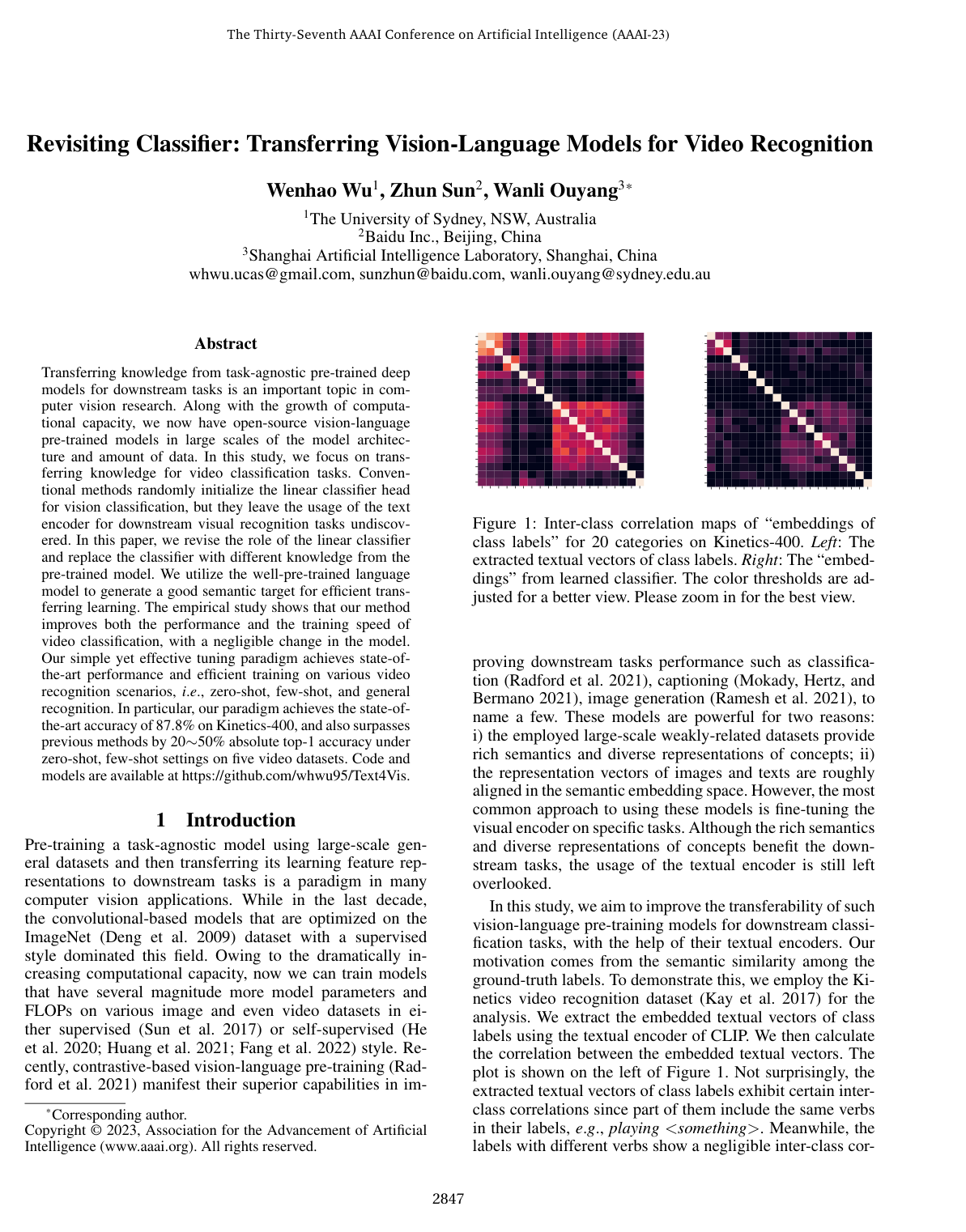
Revisiting Classifier: Transferring Vision-Language Models for Video Recognition
Wenhao Wu, Zhun Sun, Wanli Ouyang
Why you should read this
Proposes replacing the traditional randomly initialized visual classifier with frozen text embeddings from pre-trained vision-language models, drastically boosting video recognition accuracy and convergence speed across zero-shot, few-shot, and fully supervised benchmarks.
Transferring knowledge from task-agnostic pre-trained deep models for downstream tasks is an important topic in computer vision research. Along with the growth of computational capacity, we now have open-source vision-language pre-trained models in large scales of the model architecture and amount of data. In this study, we focus on transferring knowledge for video classification tasks. Conventional methods randomly initialize the linear classifier head for vision classification, but they leave the usage of the text encoder for downstream visual recognition tasks undiscovered. In this paper, we revise the role of the linear classifier and replace the classifier with different knowledge from the pre-trained model. We utilize the well-pre-trained language model to generate a good semantic target for efficient transferring learning. The empirical study shows that our method improves both the performance and the training speed of video classification, with a negligible change in the model. Our simple yet effective tuning paradigm achieves state-of-the-art performance and efficient training on various video recognition scenarios, i.e., zero-shot, few-shot, and general recognition. In particular, our paradigm achieves the state-of-the-art accuracy of 87.8% on Kinetics-400, and also surpasses previous methods by 20~50% absolute top-1 accuracy under zero-shot, few-shot settings on five video datasets. Code and models are available at https://github.com/whwu95/Text4Vis.
Added
2026-09-26
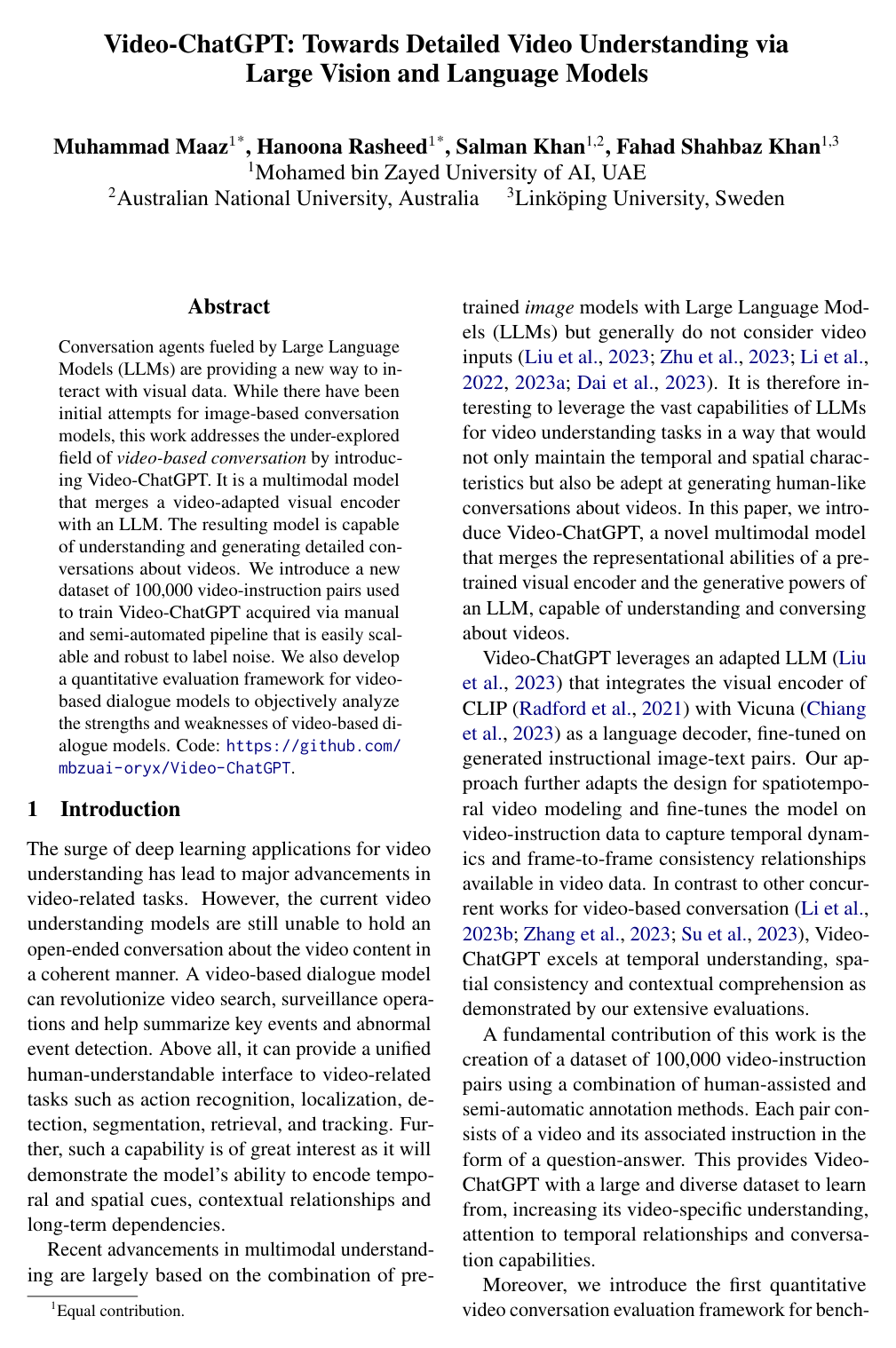
Video-ChatGPT: Towards Detailed Video Understanding via Large Vision and Language Models
Muhammad Maaz, Hanoona Abdul Rasheed, Salman Khan, Fahad Khan
Why you should read this
Presents Video-ChatGPT to enable detailed conversational video understanding by combining a video-adapted visual encoder with a large language model, alongside a 100,000-sample instruction dataset and a standardized quantitative evaluation benchmark.
Conversation agents fueled by Large Language Models (LLMs) are providing a new way to interact with visual data. While there have been initial attempts for image-based conversation models, this work addresses the under-explored field of \emph{video-based conversation} by introducing Video-ChatGPT. It is a multimodal model that merges a video-adapted visual encoder with an LLM. The resulting model is capable of understanding and generating detailed conversations about videos. We introduce a new dataset of 100,000 video-instruction pairs used to train Video-ChatGPT acquired via manual and semi-automated pipeline that is easily scalable and robust to label noise. We also develop a quantitative evaluation framework for video-based dialogue models to objectively analyze the strengths and weaknesses of video-based dialogue models. Code: this https URL.
Added
2026-09-25
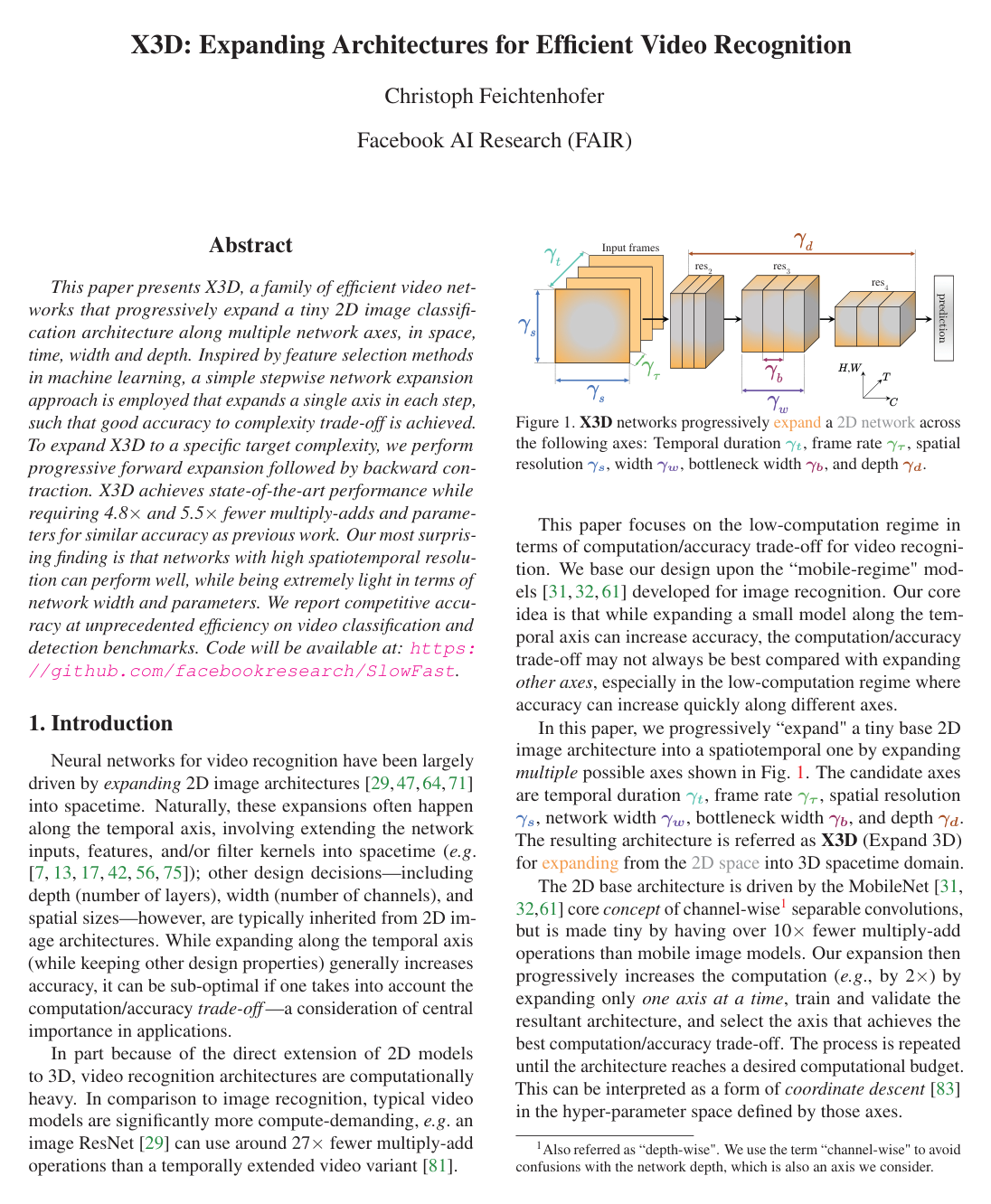
X3D: Expanding Architectures for Efficient Video Recognition
Christoph Feichtenhofer
Why you should read this
Presents an efficient family of video recognition networks by progressively expanding a tiny 2D base model across space, time, width, and depth, achieving top-tier accuracy on video benchmarks with up to five times fewer parameters and operations than existing models.
This paper presents X3D, a family of efficient video networks that progressively expand a tiny 2D image classification architecture along multiple network axes, in space, time, width and depth. Inspired by feature selection methods in machine learning, a simple stepwise network expansion approach is employed that expands a single axis in each step, such that good accuracy to complexity trade-off is achieved. To expand X3D to a specific target complexity, we perform progressive forward expansion followed by backward contraction. X3D achieves state-of-the-art performance while requiring 4.8x and 5.5x fewer multiply-adds and parameters for similar accuracy as previous work. Our most surprising finding is that networks with high spatiotemporal resolution can perform well, while being extremely light in terms of network width and parameters. We report competitive accuracy at unprecedented efficiency on video classification and detection benchmarks. Code will be available at: this https URL
Added
2026-09-25
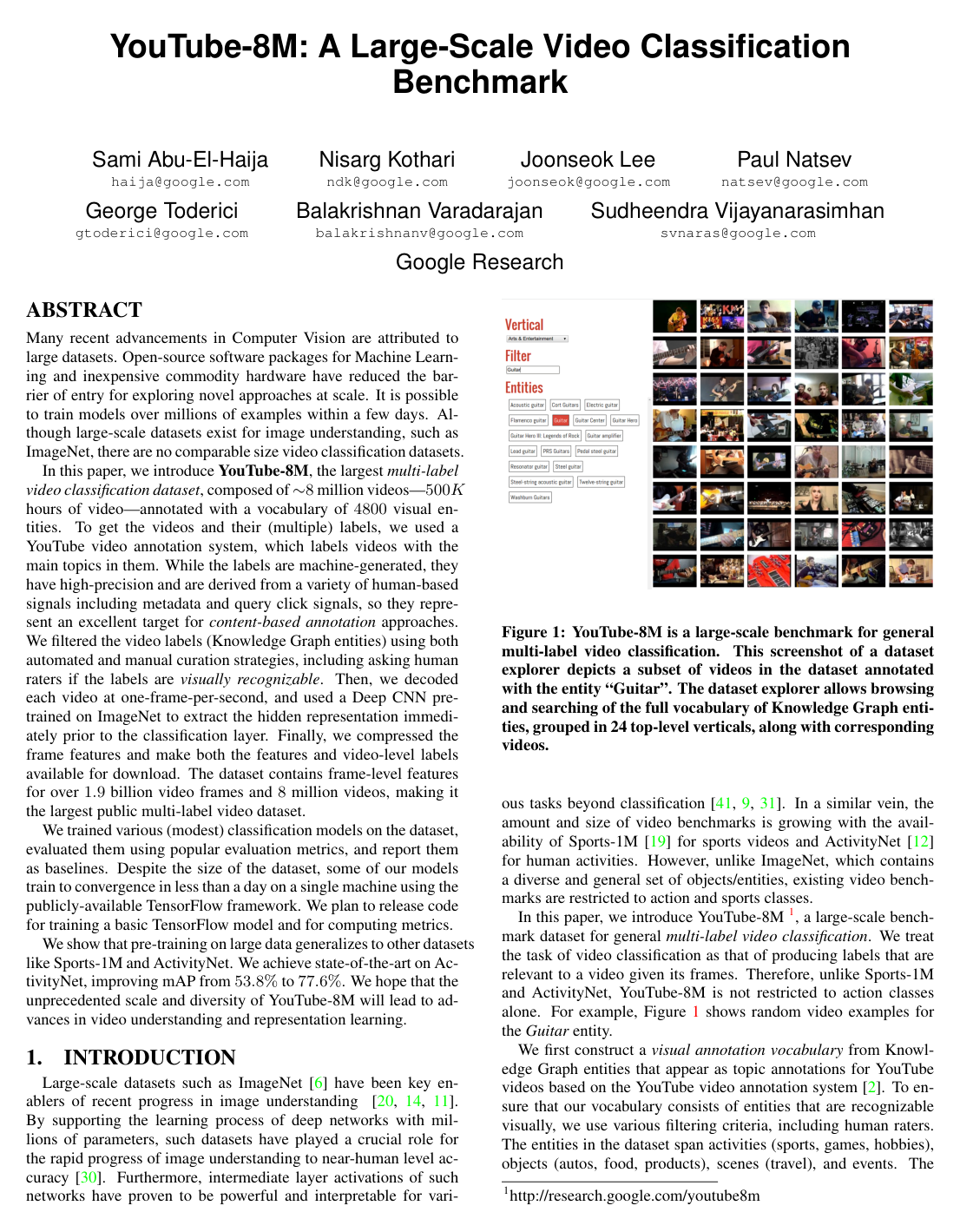
YouTube-8M: A Large-Scale Video Classification Benchmark
Sami Abu-El-Haija, Nisarg Kothari, Joonseok Lee, Paul Natsev, George Toderici, Balakrishnan Varadarajan, Sudheendra Vijayanarasimhan
Why you should read this
Introduces YouTube-8M, a massive multi-label benchmark spanning eight million videos and 4,800 visual entities, providing precomputed deep frame features and standard baselines to lower the barrier for large-scale video classification research.
Many recent advancements in Computer Vision are attributed to large datasets. Open-source software packages for Machine Learning and inexpensive commodity hardware have reduced the barrier of entry for exploring novel approaches at scale. It is possible to train models over millions of examples within a few days. Although large-scale datasets exist for image understanding, such as ImageNet, there are no comparable size video classification datasets. In this paper, we introduce YouTube-8M, the largest multi-label video classification dataset, composed of ~8 million videos (500K hours of video), annotated with a vocabulary of 4800 visual entities. To get the videos and their labels, we used a YouTube video annotation system, which labels videos with their main topics. While the labels are machine-generated, they have high-precision and are derived from a variety of human-based signals including metadata and query click signals. We filtered the video labels (Knowledge Graph entities) using both automated and manual curation strategies, including asking human raters if the labels are visually recognizable. Then, we decoded each video at one-frame-per-second, and used a Deep CNN pre-trained on ImageNet to extract the hidden representation immediately prior to the classification layer. Finally, we compressed the frame features and make both the features and video-level labels available for download. We trained various (modest) classification models on the dataset, evaluated them using popular evaluation metrics, and report them as baselines. Despite the size of the dataset, some of our models train to convergence in less than a day on a single machine using TensorFlow. We plan to release code for training a TensorFlow model and for computing metrics.
Added
2026-09-25
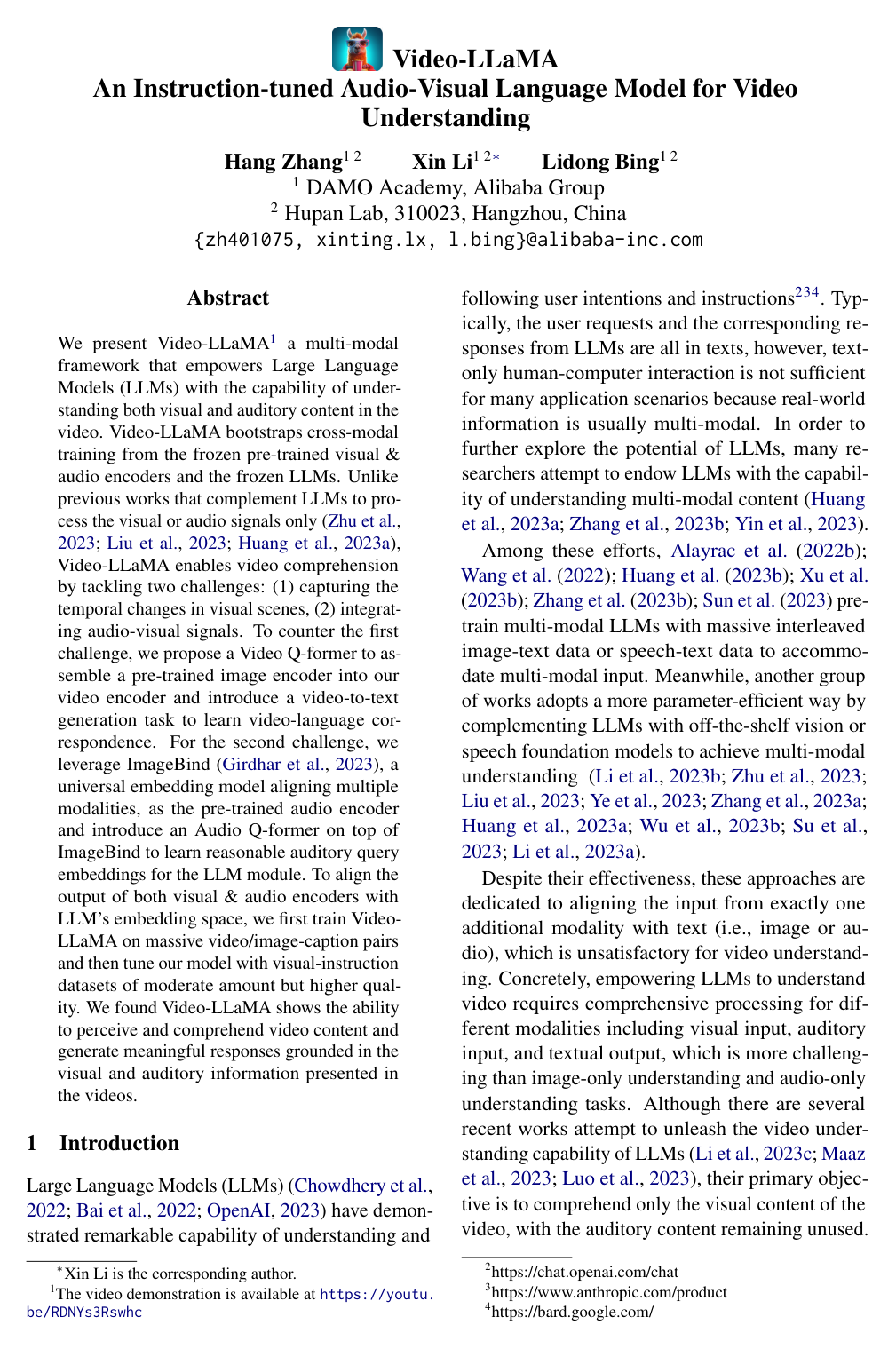
Video-LLaMA: An Instruction-tuned Audio-Visual Language Model for Video Understanding
Hang Zhang, Xin Li, Lidong Bing
Why you should read this
Develops Video-LLaMA, an instruction-tuned multimodal framework that bridges frozen large language models with dedicated video and audio query transformers to achieve conversational understanding of both temporal visual scenes and auditory signals.
We present Video-LLaMA a multi-modal framework that empowers Large Language Models (LLMs) with the capability of understanding both visual and auditory content in the video. Video-LLaMA bootstraps cross-modal training from the frozen pre-trained visual and audio encoders and the frozen LLMs. Unlike previous works that complement LLMs to process the visual or audio signals only, Video-LLaMA enables video comprehension by tackling two challenges: (1) capturing the temporal changes in visual scenes, (2) integrating audio-visual signals. To counter the first challenge, we propose a Video Q-former to assemble a pre-trained image encoder into our video encoder and introduce a video-to-text generation task to learn video-language correspondence. For the second challenge, we leverage ImageBind, a universal embedding model aligning multiple modalities, as the pre-trained audio encoder and introduce an Audio Q-former on top of ImageBind to learn reasonable auditory query embeddings for the LLM module. To align the output of both visual and audio encoders with LLM's embedding space, we first train Video-LLaMA on massive video/image-caption pairs and then tune our model with visual-instruction datasets of moderate amount but higher quality. We found Video-LLaMA shows the ability to perceive and comprehend video content and generate meaningful responses grounded in the visual and auditory information presented in the videos.
Added
2026-09-18
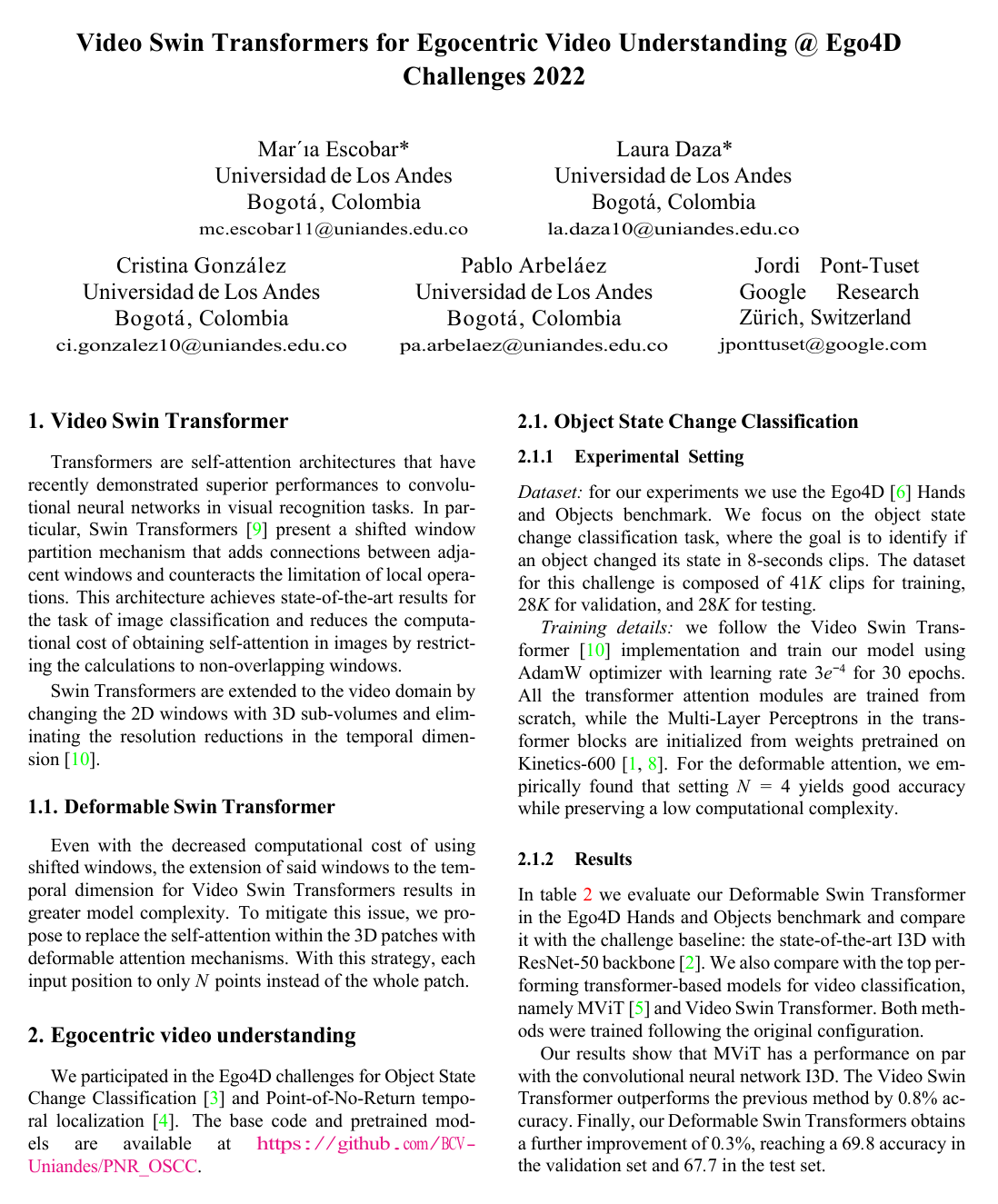
Video Swin Transformer
Ze Liu, Jia Ning, Yue Cao, Yixuan Wei, Zheng Zhang, Stephen Lin, Han Hu
Why you should read this
Extends the Swin Transformer architecture to video recognition via localized 3D spatio-temporal attention, establishing state-of-the-art accuracy on action recognition benchmarks with vastly superior parameter and data efficiency compared to global transformer models.
The vision community is witnessing a modeling shift from CNNs to Transformers, where pure Transformer architectures have attained top accuracy on the major video recognition benchmarks. These video models are all built on Transformer layers that globally connect patches across the spatial and temporal dimensions. In this paper, we instead advocate an inductive bias of locality in video Transformers, which leads to a better speed-accuracy trade-off compared to previous approaches which compute self-attention globally even with spatial-temporal factorization. The locality of the proposed video architecture is realized by adapting the Swin Transformer designed for the image domain, while continuing to leverage the power of pre-trained image models. Our approach achieves state-of-the-art accuracy on a broad range of video recognition benchmarks, including on action recognition (84.9 top-1 accuracy on Kinetics-400 and 86.1 top-1 accuracy on Kinetics-600 with ~20x less pre-training data and ~3x smaller model size) and temporal modeling (69.6 top-1 accuracy on Something-Something v2). The code and models will be made publicly available at this https URL.
Added
2026-09-16
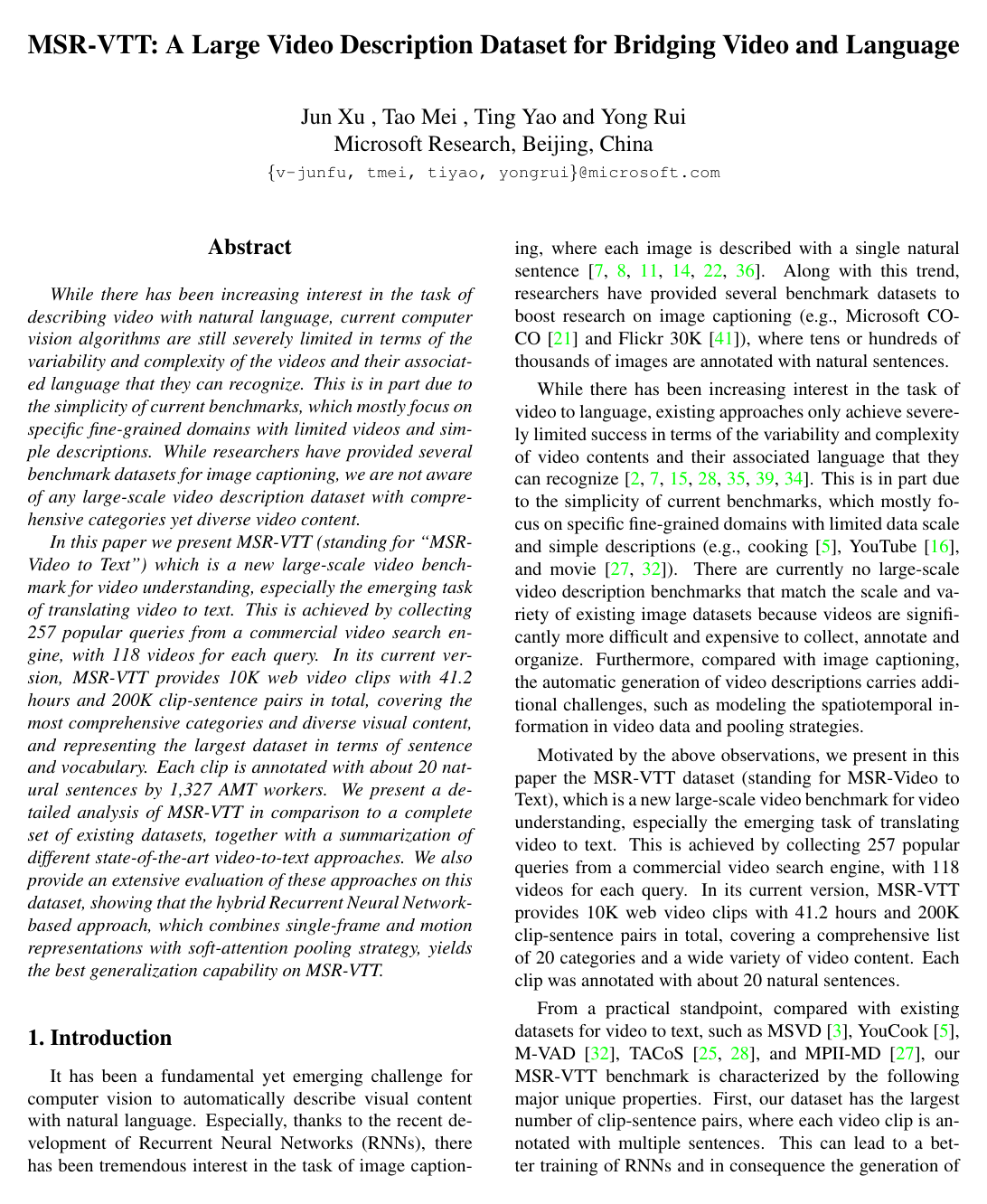
MSR-VTT: A Large Video Description Dataset for Bridging Video and Language
Jun Xu, T. Mei, Ting Yao, Yong Rui
Why you should read this
Introduces MSR-VTT, a large-scale video-to-text benchmark containing 10,000 open-domain video clips and 200,000 natural sentence annotations, paired with extensive evaluations showing that combining 2D spatial and 3D motion features with soft-attention pooling achieves superior video captioning performance.
While there has been increasing interest in the task of describing video with natural language, current computer vision algorithms are still severely limited in terms of the variability and complexity of the videos and their associated language that they can recognize. This is in part due to the simplicity of current benchmarks, which mostly focus on specific fine-grained domains with limited videos and simple descriptions. While researchers have provided several benchmark datasets for image captioning, we are not aware of any large-scale video description dataset with comprehensive categories yet diverse video content. In this paper we present MSR-VTT (standing for “MSR-Video to Text”) which is a new large-scale video benchmark for video understanding, especially the emerging task of translating video to text. This is achieved by collecting 257 popular queries from a commercial video search engine, with 118 videos for each query. In its current version, MSR-VTT provides 10K web video clips with 41.2 hours and 200K clip-sentence pairs in total, covering the most comprehensive categories and diverse visual content, and representing the largest dataset in terms of sentence and vocabulary. Each clip is annotated with about 20 natural sentences by 1,327 AMT workers. We present a detailed analysis of MSR-VTT in comparison to a complete set of existing datasets, together with a summarization of different state-of-the-art video-to-text approaches. We also provide an extensive evaluation of these approaches on this dataset, showing that the hybrid Recurrent Neural Network-based approach, which combines single-frame and motion representations with soft-attention pooling strategy, yields the best generalization capability on MSR-VTT.
Added
2026-09-14
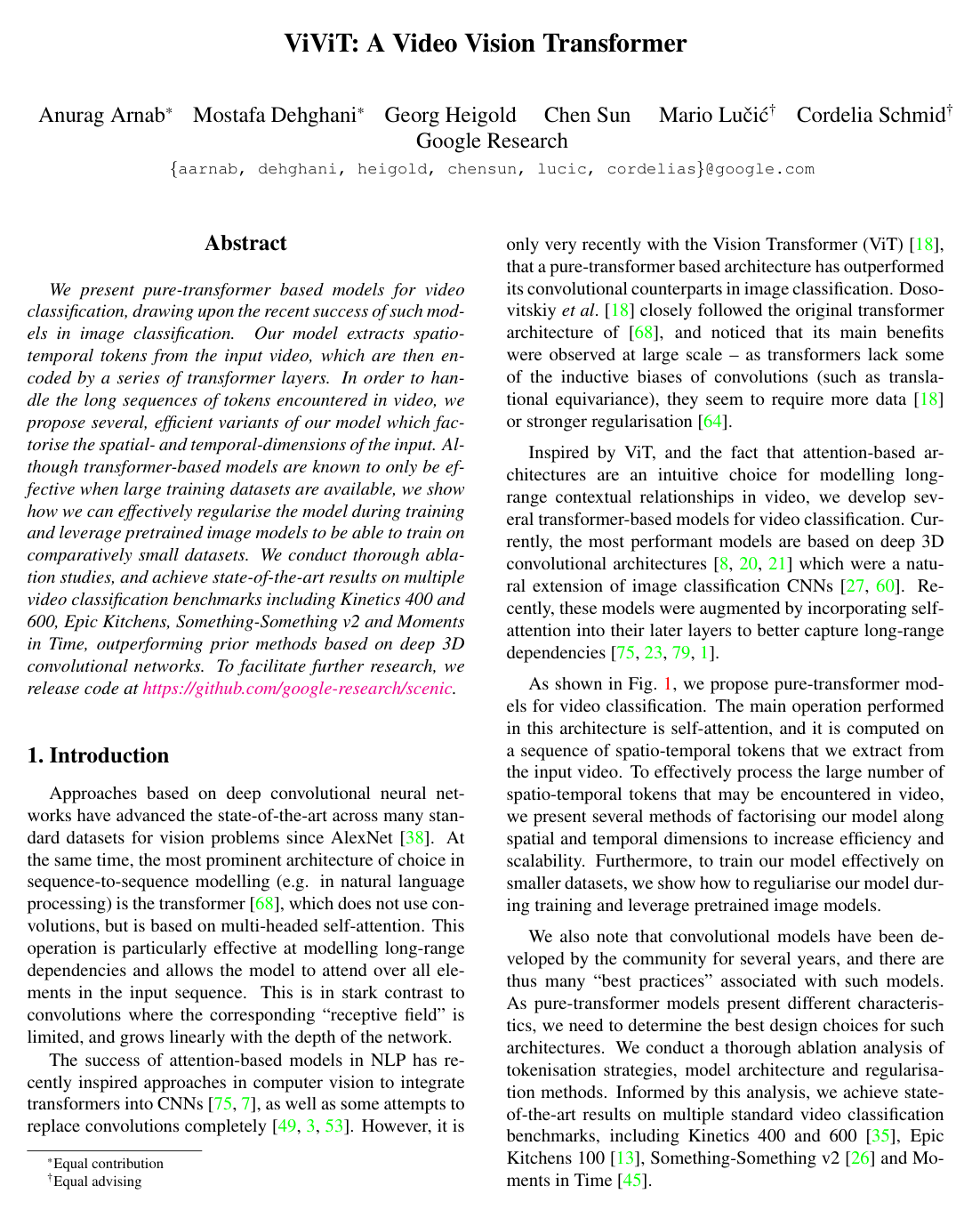
ViViT: A Video Vision Transformer
Anurag Arnab, Mostafa Dehghani, Georg Heigold, Chen Sun, Mario Lučić, Cordelia Schmid
Why you should read this
Introduces ViViT, an efficient pure-transformer framework for video classification that factorizes spatio-temporal dimensions and leverages pretrained image models to surpass standard 3D convolutional networks across major benchmarks.
We present pure-transformer based models for video classification, drawing upon the recent success of such models in image classification. Our model extracts spatio-temporal tokens from the input video, which are then encoded by a series of transformer layers. In order to handle the long sequences of tokens encountered in video, we propose several, efficient variants of our model which factorise the spatial- and temporal-dimensions of the input. Although transformer-based models are known to only be effective when large training datasets are available, we show how we can effectively regularise the model during training and leverage pretrained image models to be able to train on comparatively small datasets. We conduct thorough ablation studies, and achieve state-of-the-art results on multiple video classification benchmarks including Kinetics 400 and 600, Epic Kitchens, Something-Something v2 and Moments in Time, outperforming prior methods based on deep 3D convolutional networks. To facilitate further research, we release code at this https URL
Added
2026-09-12
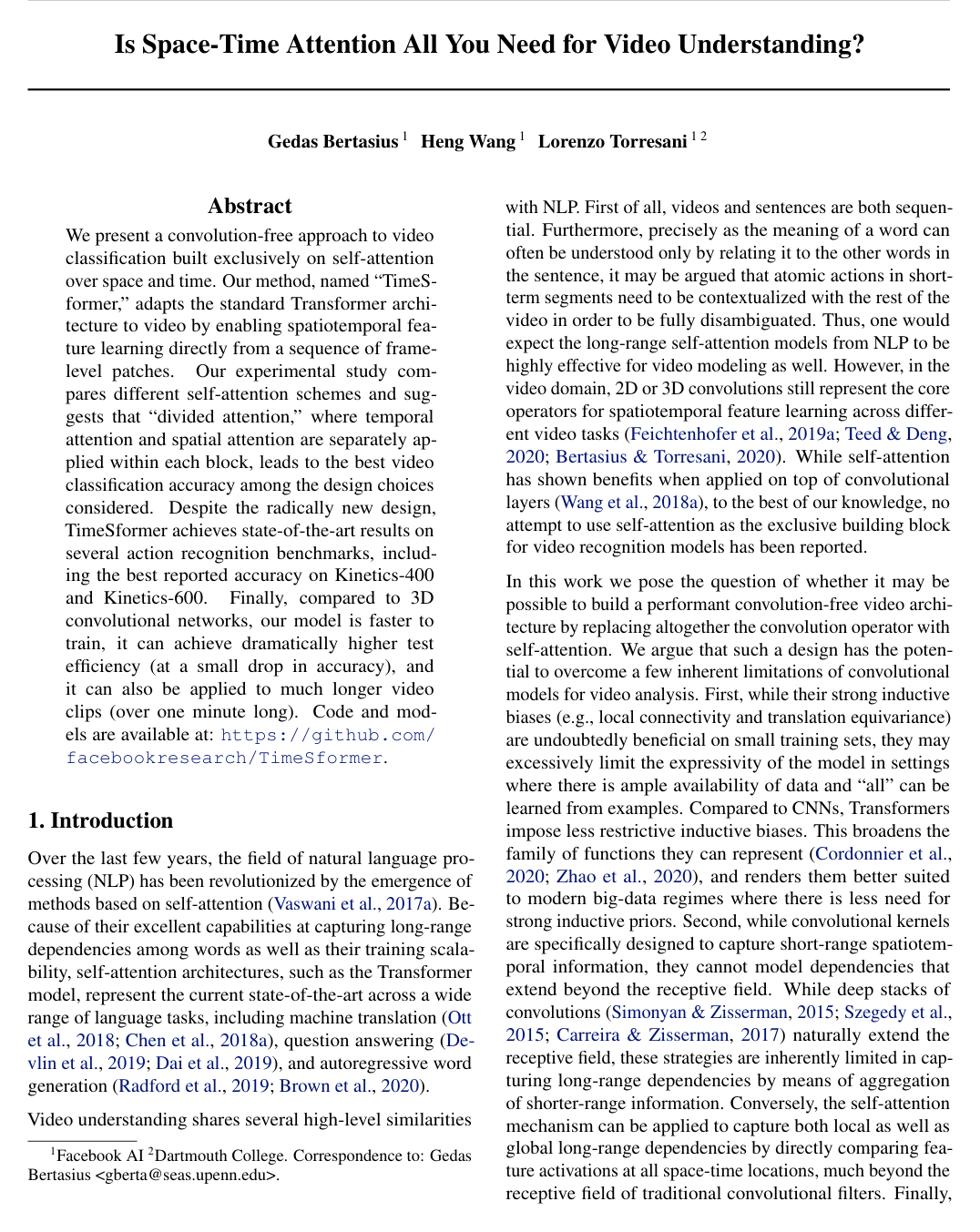
Is Space-Time Attention All You Need for Video Understanding?
Gedas Bertasius, Heng Wang, Lorenzo Torresani
Why you should read this
Introduces TimeSformer, a pure transformer architecture using divided space-time self-attention that achieves state-of-the-art video action recognition while training faster and processing much longer clips than standard 3D convolutional networks.
We present a convolution-free approach to video classification built exclusively on self-attention over space and time. Our method, named "TimeSformer," adapts the standard Transformer architecture to video by enabling spatiotemporal feature learning directly from a sequence of frame-level patches. Our experimental study compares different self-attention schemes and suggests that "divided attention," where temporal attention and spatial attention are separately applied within each block, leads to the best video classification accuracy among the design choices considered. Despite the radically new design, TimeSformer achieves state-of-the-art results on several action recognition benchmarks, including the best reported accuracy on Kinetics-400 and Kinetics-600. Finally, compared to 3D convolutional networks, our model is faster to train, it can achieve dramatically higher test efficiency (at a small drop in accuracy), and it can also be applied to much longer video clips (over one minute long). Code and models are available at: this https URL.
Added
2026-09-11

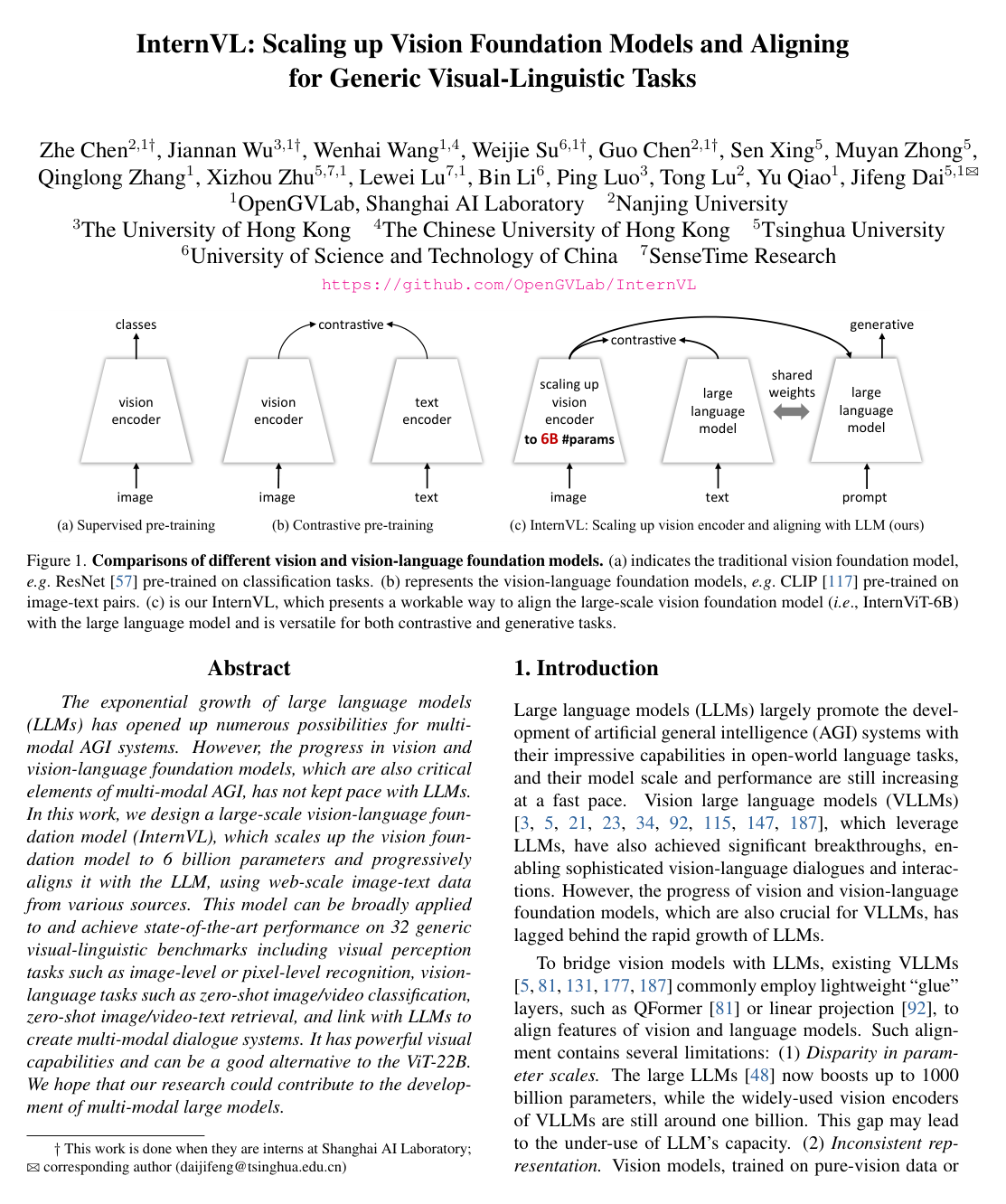
Intern VL: Scaling up Vision Foundation Models and Aligning for Generic Visual-Linguistic Tasks
Zhe Chen, Jiannan Wu, Wenhai Wang, Weijie Su, Guo Chen, Sen Xing, Muyan Zhong, Qinglong Zhang, Xizhou Zhu, Lewei Lu, Bin Li, Ping Luo, Tong Lu, Yu Qiao, Jifeng Dai
Why you should read this
Introduces InternVL, a 6-billion parameter vision foundation model that achieves state-of-the-art performance across 32 diverse benchmarks by utilizing a progressive alignment strategy to bridge the representational and parameter-scale gap between visual encoders and large language models.
The exponential growth of large language models (LLMs) has opened up numerous possibilities for multi-modal AGI systems. However, the progress in vision and vision-language foundation models, which are also critical elements of multi-modal AGI, has not kept pace with LLMs. In this work, we design a large-scale vision-language foun-dation model (Intern VL), which scales up the vision foun-dation model to 6 billion parameters and progressively aligns it with the LLM, using web-scale image-text data from various sources. This model can be broadly applied to and achieve state-of-the-art performance on 32 generic visual-linguistic benchmarks including visual perception tasks such as image-level or pixel-level recognition, vision-language tasks such as zero-shot image/video classification, zero-shot image/video-text retrieval, and link with LLMs to create multi-modal dialogue systems. It has powerful visual capabilities and can be a good alternative to the ViT-22B. We hope that our research could contribute to the development of multi-modal large models.
Added
2026-05-13
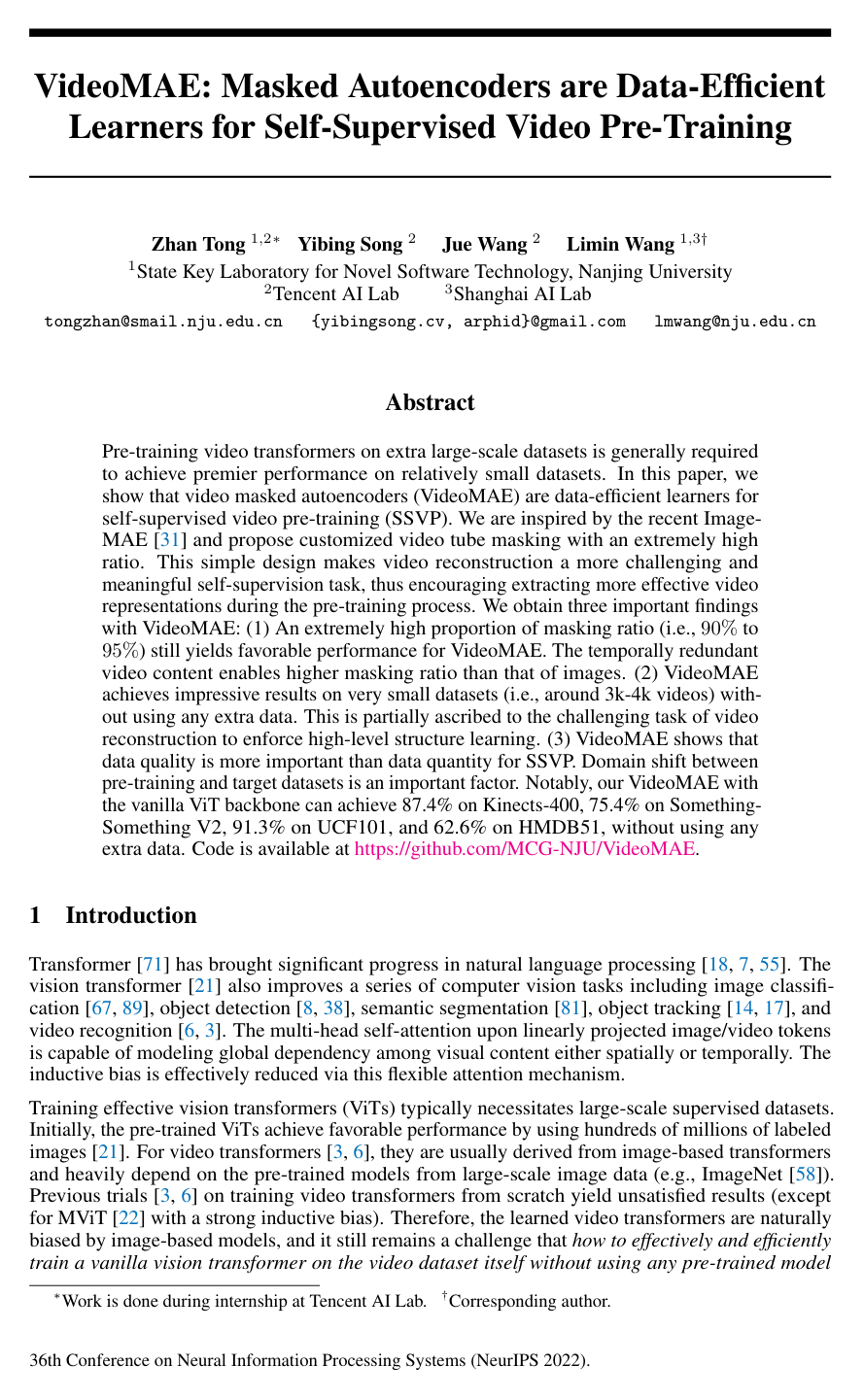
VideoMAE: Masked Autoencoders are Data-Efficient Learners for Self-Supervised Video Pre-Training
Zhan Tong, Yibing Song, Jue Wang, Limin Wang
Why you should read this
Demonstrates that VideoMAE can achieve state-of-the-art performance on video recognition benchmarks with significantly less data, even on small datasets, by utilizing a novel masked autoencoder approach.
Pre-training video transformers on extra large-scale datasets is generally required to achieve premier performance on relatively small datasets. In this paper, we show that video masked autoencoders (VideoMAE) are data-efficient learners for self-supervised video pre-training (SSVP). We are inspired by the recent ImageMAE and propose customized video tube masking with an extremely high ratio. This simple design makes video reconstruction a more challenging self-supervision task, thus encouraging extracting more effective video representations during this pre-training process. We obtain three important findings on SSVP: (1) An extremely high proportion of masking ratio (i.e., 90% to 95%) still yields favorable performance of VideoMAE. The temporally redundant video content enables a higher masking ratio than that of images. (2) VideoMAE achieves impressive results on very small datasets (i.e., around 3k-4k videos) without using any extra data. (3) VideoMAE shows that data quality is more important than data quantity for SSVP. Domain shift between pre-training and target datasets is an important issue. Notably, our VideoMAE with the vanilla ViT can achieve 87.4% on Kinetics-400, 75.4% on Something-Something V2, 91.3% on UCF101, and 62.6% on HMDB51, without using any extra data. Code is available at this https URL.
Added
2026-01-30