Focal Modulation Networks
Jianwei YangChunyuan LiXiyang DaiJianfeng Gao
Proposes FocalNets, an attention-free architecture that replaces self-attention with multi-scale contextual modulation to outperform standard vision transformers across image classification, object detection, and semantic segmentation at comparable computational costs.
Modern computer vision models increasingly rely on Vision Transformers to understand complex images. However, the core mechanism behind these architectures—known as self-attention—suffers from significant computational bottlenecks because its processing cost grows quadratically with image resolution. This high computational burden creates serious trade-offs in inference latency, hardware resource demands, and operational costs when deploying vision models for high-resolution, real-time enterprise applications.
The article introduces and evaluates an attention-free architecture called the Focal Modulation Network (FocalNet). The primary objective is to demonstrate that replacing self-attention with a lighter mechanism called focal modulation delivers superior visual recognition performance, faster processing throughput, and better model interpretability across standard vision benchmarks.
Rather than computing expensive point-to-point interactions across every visual region simultaneously, the authors designed a three-step alternative: extracting multi-scale local-to-global image context using efficient convolutional layers, dynamically condensing this context with a gating mechanism, and injecting the resulting context modulator into each target image token via lightweight element-wise multiplication. The researchers benchmarked this design across extensive public datasets—including ImageNet-1K/22K, COCO, and ADE20K—evaluating image classification, object detection, and image segmentation against leading vision architectures such as Swin Transformer and ConvNeXt.
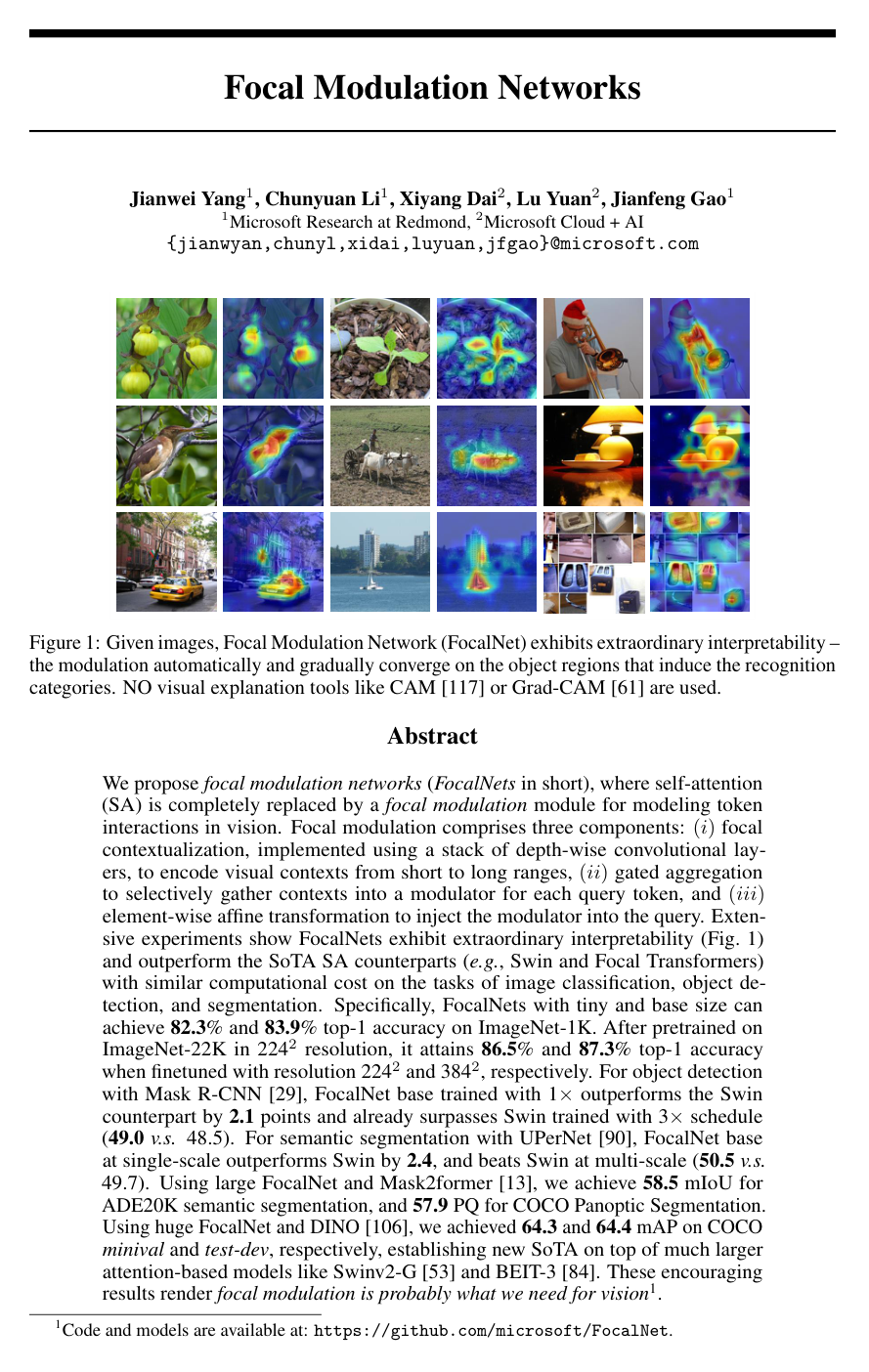
The evaluation produced four primary findings. First, FocalNet achieved state-of-the-art results on benchmark vision tasks while operating at comparable or higher inference speeds. On ImageNet-1K classification, tiny and base FocalNets achieved 82.3% and 83.9% top-1 accuracy, outperforming equivalent Swin Transformer baselines. Second, the architecture demonstrated significant sample and training efficiency in dense prediction tasks: a base FocalNet trained on a standard single-schedule object detection routine outperformed a Swin model trained on a three-times longer schedule (49.0 versus 48.5 average precision). Third, when scaled to 746 million parameters with the DINO framework, FocalNet established a new record on the COCO object detection benchmark (64.4 mAP), surpassing much larger multi-billion-parameter models such as SwinV2-G and BEIT-3 while using substantially less training data. Fourth, the internal modulators naturally localized salient object boundaries without requiring post-hoc visual explanation algorithms, providing intrinsic model interpretability.
These findings indicate that heavy self-attention mechanisms are not essential for top-tier visual performance. By decoupling context gathering from token interactions, organizations can significantly reduce model training durations, lower cloud compute expenditures, and deploy higher-resolution visual models on latency-sensitive edge devices. Furthermore, the built-in visual interpretability reduces deployment risk in safety-critical applications by enabling practitioners to inspect the exact image regions driving model classifications.
Technical leaders and engineering teams should consider piloting FocalNet architectures as a drop-in replacement for standard Vision Transformers in computationally constrained or high-resolution visual processing pipelines. Before full-scale adoption across multimodal platforms, organizations should conduct targeted research, as adapting focal modulation to natural language processing and cross-modal tasks (such as paired text-and-image reasoning) remains an open area requiring further investigation.
Confidence in these findings is high for core visual recognition domains, given the consistent empirical validation across multiple standard tasks and model scales. However, decision-makers should maintain appropriate caution regarding training data biases, particularly when fine-tuning on large web-scraped datasets, and conduct rigorous sanity checks prior to production deployment.
- Paper: Swin Transformer: Hierarchical Vision Transformer using Shifted Windows, Ze Liu et al. (2021). It introduces the shifted-window hierarchical Vision Transformer that serves as the central baseline and efficiency target surpassed by FocalNet.
- Paper: A ConvNet for the 2020s, Zhuang Liu et al. (2022). It modernizes pure convolutional network design to rival Vision Transformers, establishing the key ConvNeXt architecture against which FocalNet directly compares its token-modulation approach.
- Paper: MetaFormer is Actually What You Need for Vision, Weihao Yu et al. (2021). It demonstrates that the general macro-architecture of Vision Transformers can succeed with alternative token mixers, laying the conceptual groundwork for replacing self-attention with focal modulation.
- Paper: An Image is Worth 16x16 Words: Transformers for Image Recognition at Scale, Alexey Dosovitskiy et al. (2021). It establishes the foundational Vision Transformer framework and patch tokenization paradigm whose quadratic computational bottleneck FocalNet is designed to eliminate.
- Paper: Twins: Revisiting the Design of Spatial Attention in Vision Transformers, Xiangxiang Chu et al. (2021). It explores spatially separable and sub-sampled attention to resolve the computational costs of dense prediction, providing critical context for FocalNet's multi-scale contextual design.
- Paper: GCNet: Non-Local Networks Meet Squeeze-Excitation Networks and Beyond, Yue Cao et al. (2019). It examines spatial redundancy in self-attention and formulates lightweight context modeling and feature modulation that directly inform FocalNet's gating and injection mechanisms.
- Paper: CoAtNet: Marrying Convolution and Attention for All Data Sizes, Zihang Dai et al. (2021). It demonstrates how blending depthwise convolutions with self-attention stages balances inductive bias and global capacity, motivating FocalNet's convolutional context aggregation.
- Paper: Attention mechanisms in computer vision: A survey, Meng-Hao Guo et al. (2021). It provides a comprehensive taxonomy of spatial, channel, and hybrid visual attention mechanisms, contextualizing the evolution toward attention-free modulation networks.
- Paper: InternImage: Exploring Large-Scale Vision Foundation Models with Deformable Convolutions, Wenhai Wang et al. (2023). It scales dynamic, deformable convolution-based visual representation up to one billion parameters, continuing FocalNet's exploration of non-attention mechanisms for foundation backbones.
- Paper: ConvNeXt V2: Co-designing and Scaling ConvNets with Masked Autoencoders, Sanghyun Woo et al. (2023). It extends attention-free convolutional architectures to large-scale masked autoencoder pre-training, addressing feature representation and scaling properties relevant to FocalNet's findings.
- Paper: BiFormer: Vision Transformer with Bi-Level Routing Attention, Lei Zhu et al. (2023). It advances dynamic, content-aware sparse routing as an alternative strategy to alleviate the quadratic bottlenecks of vision attention backbones.
- Paper: TransNeXt: Robust Foveal Visual Perception for Vision Transformers, Dai Shi (2024). It builds upon multi-scale foveal visual perception and convolutional gating mechanisms to eliminate window artifacts and enhance dense prediction robustness.
- Paper: Vision Mamba: Efficient Visual Representation Learning with Bidirectional State Space Model, Lianghui Zhu et al. (2024). It investigates linear-time bidirectional state space models as another attention-free alternative for scaling high-resolution visual representation.
- Paper: Efficient Multi-Scale Attention Module with Cross-Spatial Learning, Daliang Ouyang et al. (2023). It develops multi-scale cross-spatial attention blocks that further optimize parallel context gathering and channel retention in vision models.
- Paper: Run, Don't Walk: Chasing Higher FLOPS for Faster Neural Networks, Jierun Chen et al. (2023). It optimizes hardware-level throughput and memory access for lightweight spatial convolutions, complementing FocalNet's goals for edge and real-time visual recognition.