Re-basin via implicit Sinkhorn differentiation

Fidel A. Guerrero-PeñaHeitor Rapela MedeirosThomas DubailMasih AminbeidokhtiEric GrangerMarco Pedersoli

article2023CVPR67 citations

Introduces a fully differentiable neural network re-basin framework using implicit Sinkhorn differentiation, enabling gradient-based optimization of weight permutations for model merging and continual learning via linear mode connectivity.

Listen

Deep neural networks are difficult to analyze and merge because their optimization landscapes contain many symmetric solutions. While models trained from different starting points often achieve functionally equivalent performance, combining them directly causes severe performance degradation due to high loss barriers between them. Aligning internal network components via permutation symmetries—known as re-basin—can eliminate these barriers and enable direct model fusion. However, existing alignment methods rely on discrete, non-differentiable algorithms that optimize layers greedily, frequently getting stuck in suboptimal configurations and remaining difficult to adapt to custom training objectives.

The article evaluates a differentiable re-basin framework using implicit Sinkhorn differentiation to find optimal component permutations across neural network layers. The objective is to demonstrate that this differentiable alignment directly enables gradient-based optimization for arbitrary loss functions, lowers interpolation barriers between independently trained models, and mitigates catastrophic forgetting in continual learning.

To evaluate this framework, the authors conducted empirical comparisons across regression and image classification benchmarks, including polynomial approximation tasks, MNIST, CIFAR-10, and Split CIFAR-100. The approach relaxes discrete permutation matrices into continuous doubly stochastic matrices, optimized using standard gradient descent paired with efficient implicit differentiation. The authors tested this method across three settings: reconstructing exact permutations on synthetic benchmarks, minimizing loss barriers along linear paths connecting two trained models, and continually learning successive tasks by fusing past and incoming model parameters with a small replay buffer.

The experiments produced several key findings. First, the proposed differentiable formulation achieved zero alignment error across all tested network depths and initializations, whereas existing greedy weight-matching algorithms frequently settled in local minima with noticeable alignment discrepancies. Second, when connecting independently trained models, the method reduced loss barriers and path areas significantly better than prior techniques; for instance, on CIFAR-10, the data-driven random-point loss reduced the connection barrier to 0.06 compared to 0.15 for the prior Straight-Through Estimator. Third, applying this re-basin approach to continual learning on Rotated MNIST yielded an accuracy of 78.14% with a low forgetting rate of 0.12, outperforming established baselines such as Average Gradient Episodic Memory at 68.47% accuracy and 0.28 forgetting.

These results demonstrate that neural networks can be merged and adapted flexibly across diverse tasks using standard gradient-based pipelines without requiring complex, hand-crafted assignment solvers. This capability provides a practical foundation for lowering compute and communication costs in distributed systems, ensembling, and lifelong machine learning systems by allowing models to be unified in weight space while preserving prior knowledge.

Organizations aiming to implement continual model updates or model merging should adopt differentiable Sinkhorn alignment as a modular alternative to discrete assignment algorithms. Practitioners should tune the stability-plasticity hyperparameter to strike the desired balance between retaining historical performance and rapidly incorporating new data domains. Where memory resources are constrained, developers must account for the higher memory consumption of Sinkhorn iterations compared to traditional Hungarian-based solvers. Additional testing on larger production architectures and specialized real-world domains remains recommended before wide enterprise deployment.

arXiv: 2212.12042
Cover for Re-basin via implicit Sinkhorn differentiation

Abstract

The recent emergence of new algorithms for permuting models into functionally equivalent regions of the solution space has shed some light on the complexity of error surfaces and some promising properties like mode connectivity. However, finding the permutation that minimizes some objectives is challenging, and current optimization techniques are not differentiable, which makes it difficult to integrate into a gradient-based optimization, and often leads to sub-optimal solutions. In this paper, we propose a Sinkhorn re-basin network with the ability to obtain the transportation plan that better suits a given objective. Unlike the current state-of-art, our method is differentiable and, therefore, easy to adapt to any task within the deep learning domain. Furthermore, we show the advantage of our re-basin method by proposing a new cost function that allows performing incremental learning by exploiting the linear mode connectivity property. The benefit of our method is compared against similar approaches from the literature under several conditions for both optimal transport and linear mode connectivity. The effectiveness of our continual learning method based on re-basin is also shown for several common benchmark datasets, providing experimental results that are competitive with the state-of-art. The source code is provided at https://github.com/fagp/sinkhorn-rebasin.

Table of Contents

  • 1. Introduction
  • 2. Related Work
  • 3. Re-basin via the Sinkhorn Operator
  • 4. Re-basin Incremental Learning
  • 5. Experimental Results and Analysis
  • 5.1. Finding the Optimal Transport
  • 5.2. Linear Mode Connectivity
  • 5.3. Incremental Learning Application
  • 6. Conclusion
  • References

Knowls

  1. Knowl 1 — Permutation-symmetric re-basin transformation

    model/method

    Let fθf_\theta be a neural network with parameters θ={Wi,bi}i=1h\theta=\{W_i,b_i\}_{i=1}^h, where layer ii maps an input zz to ℓi(z)=σ(Wiz+bi)\ell_i(z)=\sigma(W_i z+b_i), WiW_i and bib_i are its weights and biases, and σ\sigma is a nonlinear activation. A re-basin transformation changes the neuron ordering at each hidden layer while preserving the represented function. For permutation matrices PiP_i, with P0=Ph=IP_0=P_h=I, the transformed layer is

    ℓi′(z)=σ ⁣(PiWiPi−1Tz+Pibi).\ell_i'(z)=\sigma\!\left(P_iW_iP_{i-1}^{T}z+P_ib_i\right).

    For an exactly valid permutation, the transformed network satisfies fπP(θ)(x)=fθ(x)f_{\pi_P(\theta)}(x)=f_\theta(x) for every input xx, and therefore has the same task cost. The transformation moves a model to a different, functionally equivalent region of parameter space so that it can be linearly merged with another model.

  2. Knowl 2 — Differentiable Sinkhorn re-basin

    model/method

    The Sinkhorn re-basin replaces each discrete permutation matrix with a differentiable transport plan. For a score matrix X∈Rm×nX\in\mathbb{R}^{m\times n} and temperature τ>0\tau>0, it computes

    Sτ(X)=arg max⁡P∈Π  ⟨P,X⟩F+τh(P),S_\tau(X)=\underset{P\in\Pi}{\operatorname{arg\,max}}\;\langle P,X\rangle_F+\tau h(P),

    where ⟨⋅,⋅⟩F\langle\cdot,\cdot\rangle_F is the Frobenius inner product, h(P)=−∑a,bPablog⁡Pabh(P)=-\sum_{a,b}P_{ab}\log P_{ab} is entropy, and Π\Pi is the transportation polytope with uniform row and column marginals: every row sums to 1/m1/m and every column sums to 1/n1/n. The Sinkhorn iterations start from Sτ(0)(X)=exp⁡(X/τ)S_\tau^{(0)}(X)=\exp(X/\tau) and alternately normalize rows and columns:

    Sτ(t+1)(X)=Tc ⁣(Tr ⁣(Sτ(t)(X))),S_\tau^{(t+1)}(X)=T_c\!\left(T_r\!\left(S_\tau^{(t)}(X)\right)\right),

    where Tr(A)ij=Aij/∑k=1nAikT_r(A)_{ij}=A_{ij}/\sum_{k=1}^{n}A_{ik} and Tc(A)ij=Aij/∑k=1mAkjT_c(A)_{ij}=A_{ij}/\sum_{k=1}^{m}A_{kj}. As tt increases, the iterations approach the entropy-regularized optimum. The paper differentiates this optimum using implicit Sinkhorn differentiation rather than backpropagating through all Sinkhorn iterations, using marginals a=1m/ma=\mathbf{1}_m/m and b=1n/nb=\mathbf{1}_n/n. If PiP_i is a learnable score matrix, the differentiable re-based layer is

    ℓi′(z)=σ ⁣(Sτ(Pi)WiSτ(Pi−1T)z+Sτ(Pi)bi).\ell_i'(z)=\sigma\!\left(S_\tau(P_i)W_iS_\tau(P_{i-1}^{T})z+S_\tau(P_i)b_i\right).

    This construction permits gradient-based optimization of the transport plans for any differentiable objective.

  3. Knowl 3 — Objective functions for learning the re-basin

    model/method

    Given a target model θA\theta_A, a source model θB\theta_B, and a differentiable re-basing transformation πP(θB)\pi_P(\theta_B), the Sinkhorn re-basin can optimize objectives that are not restricted to a linear assignment formulation. The paper uses three objectives.

    The data-free weight-matching objective is the squared parameter distance

    CL2(P;θA,θB)=∥θA−πP(θB)∥22.C_{L2}(P;\theta_A,\theta_B)=\left\|\theta_A-\pi_P(\theta_B)\right\|_2^2.

    The midpoint objective directly minimizes the task cost CC at the center of the interpolation path:

    CMid(P;θA,θB)=C ⁣(θA+πP(θB)2).C_{\mathrm{Mid}}(P;\theta_A,\theta_B)=C\!\left(\frac{\theta_A+\pi_P(\theta_B)}{2}\right).

    The random-point objective samples an interpolation coefficient λ∼U(0,1)\lambda\sim U(0,1) independently at each optimization step and minimizes

    CRnd(P;θA,θB)=C ⁣((1−λ)θA+λπP(θB)).C_{\mathrm{Rnd}}(P;\theta_A,\theta_B)=C\!\left((1-\lambda)\theta_A+\lambda\pi_P(\theta_B)\right).

    Here, C(θ)C(\theta) is the supervised task loss of model parameters θ\theta. The midpoint objective can produce a path with a low center cost but high costs away from the center; random-point sampling is introduced to reduce this multimodal-path failure mode.

  4. Knowl 4 — Re-basin continual-learning update

    model/method

    For a model θi\theta_i after learning datasets T0,…,TiT_0,\ldots,T_i, the method jointly learns a transport plan PiP_i and a residual parameter update δi\delta_i for the next dataset Ti+1T_{i+1}. Its continual-learning objective is

    CCL(δi,Pi;θi)=C ⁣(θi+πPi(θi)2+δi)+β∥δi∥22,C_{CL}(\delta_i,P_i;\theta_i)=C\!\left(\frac{\theta_i+\pi_{P_i}(\theta_i)}{2}+\delta_i\right)+\beta\lVert\delta_i\rVert_2^2,

    where CC is evaluated using the current and replayed previous datasets, β≥0\beta\geq 0 controls residual regularization, and δi\delta_i is a learnable vector in the parameter space. The transport plan and residual are optimized simultaneously:

    (δi∗,Pi∗)=arg min⁡δi,Pi  CCL(δi,Pi;θi).(\delta_i^*,P_i^*)=\underset{\delta_i,P_i}{\operatorname{arg\,min}}\;C_{CL}(\delta_i,P_i;\theta_i).

    The model used for the next episode is then

    θi+1=(1−α)θi+απPi(θi)+δi,\theta_{i+1}=(1-\alpha)\theta_i+\alpha\pi_{P_i}(\theta_i)+\delta_i,

    where α∈[0,1]\alpha\in[0,1] controls stability versus plasticity. Values near 0.50.5 emphasize the midpoint and therefore adaptation to the new dataset, whereas values near 00 or 11 give greater weight to the existing model or its re-based equivalent. In the reported continual-learning experiments, α=0.8\alpha=0.8 was used to favor retention of previous knowledge.

  5. Knowl 5 — General experimental protocol

    experimental setup

    The paper evaluates Sinkhorn re-basin on permutation recovery, linear mode connectivity, and continual learning. Results are reported as means and standard deviations over independent random seeds. The permutation and connectivity experiments use polynomial regression, MNIST, and CIFAR-10 with feedforward networks ranging from two to eight layers; the Sinkhorn approximation uses t=20t=20 normalization iterations and temperature τ=1.0\tau=1.0. The permutation-recovery experiment uses Adam with initial learning rate 0.10.1, at most five optimization iterations, and early stopping upon convergence. The continual-learning experiments use 20 episodes and compare against fine-tuning, elastic weight consolidation, learning without forgetting, and A-GEM. Replay-based methods receive only five examples per class. Rotated MNIST uses a one-hidden-layer network with 256 neurons; Split CIFAR-100 uses a multi-head ResNet-18, with re-basing applied only to its linear layers.

  6. Knowl 6 — Exact recovery of artificially applied permutations

    data/table

    The permutation-recovery experiment gives each method a model and a randomly permuted version of that same model, so the ground-truth transport plan is known. It contains 9 configurations formed by three initializations—random weights sampled from N(0,1)\mathcal{N}(0,1), a model trained on a third-degree polynomial task, and a model trained on a first-degree polynomial task—and three depths with 2, 4, or 8 hidden layers. Each configuration contains 50 model pairs. The metric is the L1L_1 distance between the estimated and ground-truth re-based weights, with all values scaled by 10310^3; lower is better.

    Could not parse LaTeX table

    Sinkhorn re-basin reaches zero error in every configuration, whereas weight matching has nonzero error particularly for random initialization and shallow networks. The result supports the paper’s claim that jointly optimizing all layer transport plans avoids the local minima encountered by the greedy layer-wise weight-matching procedure.

  7. Knowl 7 — Linear mode connectivity criterion

    definition

    For two models θA\theta_A and θB\theta_B with task cost CC, the linear interpolation path is (1−λ)θA+λθB(1-\lambda)\theta_A+\lambda\theta_B for λ∈(0,1)\lambda\in(0,1). The paper measures its excess loss above the straight interpolation of endpoint costs using the barrier

    B(θA,θB)=sup⁡λ∈(0,1)[C ⁣((1−λ)θA+λθB)−((1−λ)C(θA)+λC(θB))].B(\theta_A,\theta_B)=\sup_{\lambda\in(0,1)}\left[C\!\left((1-\lambda)\theta_A+\lambda\theta_B\right)-\left((1-\lambda)C(\theta_A)+\lambda C(\theta_B)\right)\right].

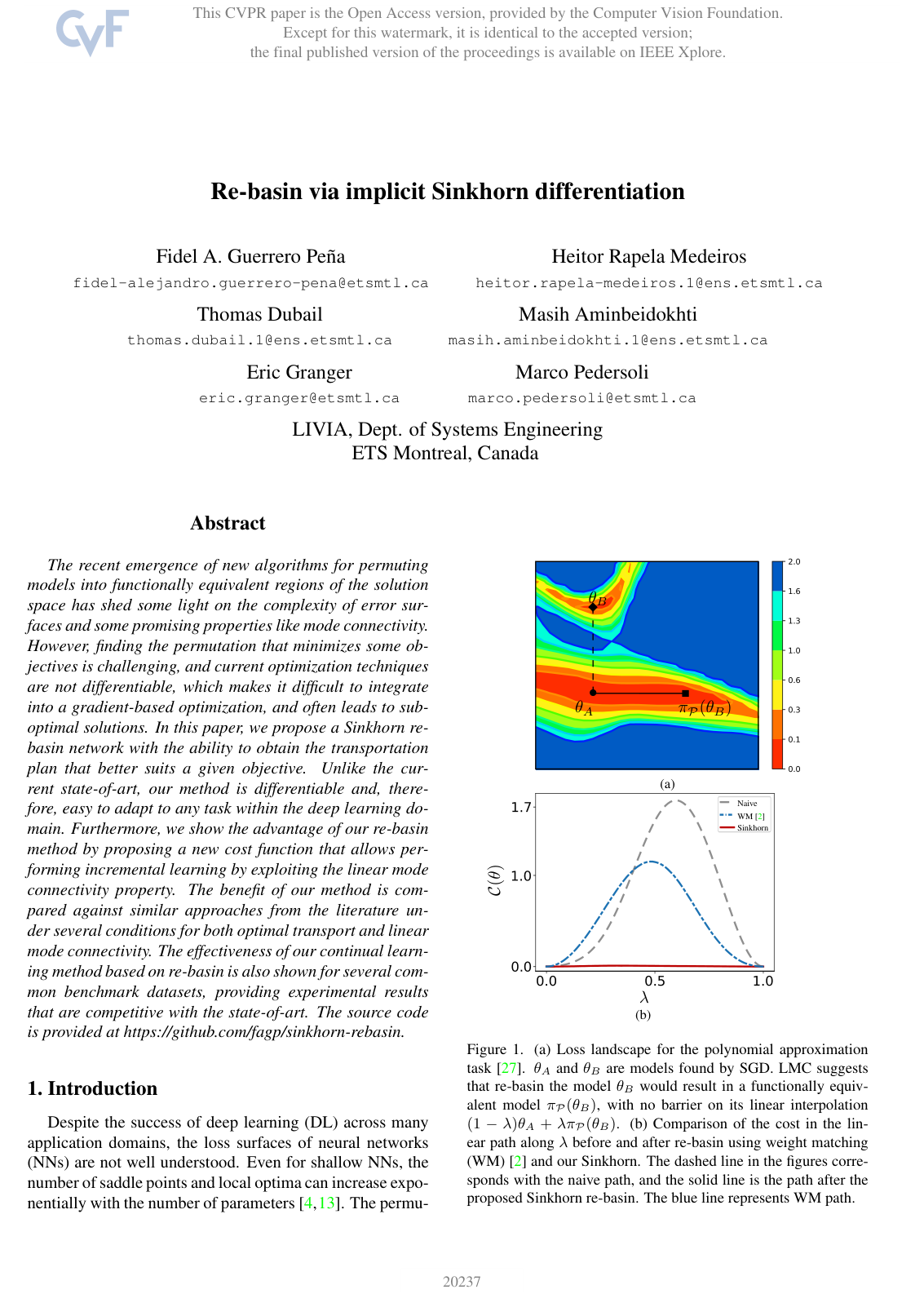
    A small barrier indicates linear mode connectivity: the two endpoints can be connected without a substantial loss increase. The experiments also report the area under the sampled cost curve along the same path; both barrier and area-under-curve have a lower bound of zero. Re-basin is successful when the path from θA\theta_A to πP(θB)\pi_P(\theta_B) has substantially smaller values than the naive path from θA\theta_A to θB\theta_B.

  8. Knowl 8 — Sinkhorn objectives improve linear mode connectivity

    data/table

    Two independently trained networks with two hidden layers are re-based on first- and third-degree polynomial regression, MNIST, and CIFAR-10. Each comparison is repeated 50 times. The reported area under the cost curve and barrier are lower-is-better measures of the linear interpolation between the unchanged network and the re-based network.

    Could not parse LaTeX table

    Every re-basing method improves substantially over the naive interpolation. The data-free Sinkhorn CL2C_{L2} objective improves on weight matching on all datasets except MNIST, where the difference is not significant. The data-driven Sinkhorn objectives improve on the straight-through estimator; random-point optimization is generally strongest on the regression tasks and is comparable to midpoint optimization on CIFAR-10.

  9. Knowl 9 — Continual-learning benchmark results

    data/table

    The continual-learning method is evaluated for 20 episodes on Rotated MNIST and Split CIFAR-100. Accuracy is averaged over previously encountered tasks and higher values are better; forgetting is the average decrease in accuracy on earlier tasks and lower values are better. The re-basin method uses replay with five examples per class and sets α=0.8\alpha=0.8.

    Could not parse LaTeX table

    Re-basin with replay has the highest accuracy and lowest forgetting among the continual-learning methods on both benchmarks. It remains below joint training, which has simultaneous access to all data, but substantially improves over fine-tuning, EWC, LwF, and A-GEM. The particularly low forgetting demonstrates the stability benefit of fusing the current model with its re-based counterpart while allowing a residual update toward the new data.

  10. Knowl 10 — Memory-efficiency limitation

    limitation

    The paper identifies a computational trade-off: greedy Hungarian or linear-assignment approaches generally use less memory than the Sinkhorn operator. Thus, although implicit Sinkhorn differentiation provides a more flexible, differentiable, and objective-agnostic re-basing mechanism, its memory demands can be higher than those of assignment-based weight matching, especially for larger models.

Coverage note — Supplementary-only convolutional/residual-network demonstrations and the detailed $\alpha$/$\beta$ ablation are omitted because their numerical details are not provided in the supplied main paper text.

References

  1. 1.Ryan Prescott Adams and Richard S Zemel. Ranking via sinkhorn propagation. arXiv preprint arXiv:1106.1925, 2011.
  2. 2.Samuel K Ainsworth, Jonathan Hayase, and Siddhartha Srinivasa. Git Re-Basin: Merging Models modulo Permutation Symmetries. arXiv preprint arXiv:2209.04836, 2022.
  3. 3.Aditya Kumar Akash, Sixu Li, and Nicolas García Trillos. Wasserstein Barycenter-based Model Fusion and Linear Mode Connectivity of Neural Networks. arXiv preprint arXiv:2210.06671, 2022.
  4. 4.Peter Auer, Mark Herbster, and Manfred KK Warmuth. Exponentially many local minima for single neurons. Advances in Neural Information Processing Systems, 8, 1995.
  5. 5.Frederik Benzing, Simon Schug, Robert Meier, Johannes von Oswald, Yassir Akram, Nicolas Zucchet, Laurence Aitchison, and Angelika Steger. Random initialisations performing above chance and how to find them. arXiv preprint arXiv:2209.07509, 2022.
  6. 6.Johanni Brea, Berfin Simsek, Bernd Illing, and Wulfram Gerstner. Weight-space symmetry in deep networks gives rise to permutation saddles, connected by equal-loss valleys across the loss landscape. arXiv preprint arXiv:1907.02911, 2019.
  7. 7.Arslan Chaudhry, Marc’Aurelio Ranzato, Marcus Rohrbach, and Mohamed Elhoseiny. Efficient Lifelong Learning with A-GEM. In International Conference on Learning Representations, 2019.
  8. 8.Arslan Chaudhry, Marcus Rohrbach, Mohamed Elhoseiny, Thalaiyasingam Ajanthan, Puneet K Dokania, Philip HS Torr, and Marc’Aurelio Ranzato. On tiny episodic memories in continual learning. arXiv preprint arXiv:1902.10486, 2019.
  9. 9.Felix Draxler, Kambis Veschgini, Manfred Salmhofer, and Fred Hamprecht. Essentially no barriers in neural network energy landscape. In International Conference on Machine Learning, pages 1309–1318. PMLR, 2018.
  10. 10.Marvin Eisenberger, Aysim Toker, Laura Leal-Taixe, Florian Bernard, and Daniel Cremers. A Unified Framework for Implicit Sinkhorn Differentiation. In IEEE/CVF Conference on Computer Vision and Pattern Recognition, pages 509–518, 2022.
  11. 11.Rahim Entezari, Hanie Sedghi, Olga Saukh, and Behnam Neyshabur. The Role of Permutation Invariance in Linear Mode Connectivity of Neural Networks. In International Conference on Learning Representations, 2022.
  12. 12.Jonathan Frankle, Gintare Karolina Dziugaite, Daniel Roy, and Michael Carbin. Linear mode connectivity and the lottery ticket hypothesis. In International Conference on Machine Learning, pages 3259–3269. PMLR, 2020.
  13. 13.Timur Garipov, Pavel Izmailov, Dmitrii Podoprikhin, Dmitry P Vetrov, and Andrew G Wilson. Loss surfaces, mode connectivity, and fast ensembling of dnns. Advances in Neural Information Processing Systems, 31, 2018.
  14. 14.James Kirkpatrick, Razvan Pascanu, Neil Rabinowitz, Joel Veness, Guillaume Desjardins, Andrei A Rusu, Kieran Milan, John Quan, Tiago Ramalho, Agnieszka Grabska-Barwinska, et al. Overcoming catastrophic forgetting in neural networks. Proceedings of the National Academy of Sciences, 114(13):3521–3526, 2017.
  15. 15.Rohith Kuditipudi, Xiang Wang, Holden Lee, Yi Zhang, Zhiyuan Li, Wei Hu, Rong Ge, and Sanjeev Arora. Explaining landscape connectivity of low-cost solutions for multilayer nets. Advances in Neural Information Processing Systems, 32, 2019.
  16. 16.Hao Li, Zheng Xu, Gavin Taylor, Christoph Studer, and Tom Goldstein. Visualizing the loss landscape of neural nets. In Advances in Neural Information Processing Systems, 2018.
  17. 17.Zhizhong Li and Derek Hoiem. Learning without forgetting. IEEE Transactions on Pattern Analysis and Machine Intelligence, 40(12):2935–2947, 2017.
  18. 18.Vincenzo Lomonaco, Lorenzo Pellegrini, Andrea Cossu, Antonio Carta, Gabriele Graffieti, Tyler L. Hayes, Matthias De Lange, Marc Masana, Jary Pomponi, Gido van de Ven, Martin Mundt, Qi She, Keiland Cooper, Jeremy Forest, Eden Belouadah, Simone Calderara, German I. Parisi, Fabio Cuzzolin, Andreas Tolias, Simone Scardapane, Luca Antiga, Subutai Amhad, Adrian Popescu, Christopher Kanan, Joost van de Weijer, Tinne Tuytelaars, Davide Bacciu, and Davide Maltoni. Avalanche: an End-to-End Library for Continual Learning. In IEEE/CVF Conference on Computer Vision and Pattern Recognition, 2nd Continual Learning in Computer Vision Workshop, 2021.
  19. 19.Michael McCloskey and Neal J Cohen. Catastrophic interference in connectionist networks: The sequential learning problem. In Psychology of learning and motivation, volume 24, pages 109–165. Elsevier, 1989.
  20. 20.Sanket Vaibhav Mehta, Darshan Patil, Sarath Chandar, and Emma Strubell. An empirical investigation of the role of pre-training in lifelong learning. arXiv preprint arXiv:2112.09153, 2021.
  21. 21.Gonzalo Mena, David Belanger, Scott Linderman, and Jasper Snoek. Learning Latent Permutations with Gumbel-Sinkhorn Networks. In International Conference on Learning Representations, 2018.
  22. 22.Seyed Iman Mirzadeh, Mehrdad Farajtabar, Dilan Gorur, Razvan Pascanu, and Hassan Ghasemzadeh. Linear Mode Connectivity in Multitask and Continual Learning. In International Conference on Learning Representations, 2021.
  23. 23.Seyed Iman Mirzadeh, Mehrdad Farajtabar, Razvan Pascanu, and Hassan Ghasemzadeh. Understanding the role of training regimes in continual learning. Advances in Neural Information Processing Systems, 33:7308–7320, 2020.
  24. 24.Vaishnavh Nagarajan and J Zico Kolter. Uniform convergence may be unable to explain generalization in deep learning. Advances in Neural Information Processing Systems, 32, 2019.
  25. 25.Roger Ratcliff. Connectionist models of recognition memory: constraints imposed by learning and forgetting functions. Psychological review, 97(2):285, 1990.
  26. 26.Sidak Pal Singh and Martin Jaggi. Model fusion via optimal transport. Advances in Neural Information Processing Systems, 33:22045–22055, 2020.
  27. 27.Johannes von Oswald, Christian Henning, Benjamin F. Grewe, and Joao Sacramento. Continual learning with hypernetworks. In International Conference on Learning Representations, 2020.
  28. 28.Hongyi Wang, Mikhail Yurochkin, Yuekai Sun, Dimitris Papailiopoulos, and Yasaman Khazaeni. Federated learning with matched averaging. arXiv preprint arXiv:2002.06440, 2020.

Citation

MLA
Peña, F. A. G., et al. “Re-basin via Implicit Sinkhorn Differentiation”. arXiv, 2022, http://arxiv.org/abs/2212.12042v1.
APA
Peña, F. A. G., Medeiros, H. R., Dubail, T., Aminbeidokhti, M., Granger, E., & Pedersoli, M. (2022). Re-basin via implicit Sinkhorn differentiation. arXiv. http://arxiv.org/abs/2212.12042v1
Chicago
Peña, F. A. G., H. R. Medeiros, T. Dubail, M. Aminbeidokhti, E. Granger, and M. Pedersoli. 2022. “Re-basin via Implicit Sinkhorn Differentiation”. arXiv. http://arxiv.org/abs/2212.12042v1.
Harvard
Peña, F.A.G. et al. (2022) “Re-basin via implicit Sinkhorn differentiation”, arXiv [Preprint]. Available at: http://arxiv.org/abs/2212.12042v1.
Vancouver
1. Peña FAG, Medeiros HR, Dubail T, Aminbeidokhti M, Granger E, Pedersoli M (2022) Re-basin via implicit Sinkhorn differentiation. arXiv

BibTeX

@article{pena2022basin,
  title = {Re-basin via implicit Sinkhorn differentiation},
  author = {Peña, Fidel A. Guerrero and Medeiros, Heitor Rapela and Dubail, Thomas and Aminbeidokhti, Masih and Granger, Eric and Pedersoli, Marco},
  year = {2022},
  journal = {arXiv},
  url = {http://arxiv.org/abs/2212.12042v1},
  eprint = {2212.12042}
}
Metadata:arXiv

Access the Paper

This paper is available from its original source. Click below to access the PDF.

Open PDF
License: IEEE