Image smoothing via L0 gradient minimization

Li XuCewu LuYi XuJiaya Jia

article2011TOG1,500 citationsTest-of-Time Award, SIGGRAPH ASIA 2023

Proposes an optimization framework based on L0L_0 gradient minimization that globally eliminates low-amplitude details while sharpening salient edges without introducing blur, providing an effective tool for edge extraction, artifact removal, and non-photorealistic rendering.

Listen

Digital image processing frequently requires separating significant structural edges from fine background textures, noise, and minor details. Traditional edge-preserving filtering methods rely on local pixel averaging or magnitude-based penalties, which often blur thin high-contrast boundaries or inadvertently degrade fine-scale structures. The article introduces and evaluates a global optimization framework for image smoothing based on minimizing the discrete count of non-zero gradients, effectively controlling gradient sparsity. The primary objective is to demonstrate that restricting the number of intensity changes across an image eliminates low-amplitude details while globally maintaining and sharpening prominent structural boundaries.

To overcome the computational difficulty of discrete gradient counting, the researchers developed an alternating optimization algorithm using half-quadratic splitting. This framework separates the global problem into two rapidly solvable subproblems: one solved pixel by pixel in closed form, and the other solved globally using Fast Fourier Transforms. The authors evaluated this approach across a variety of visual processing tasks, including edge extraction, non-photorealistic rendering, clip-art compression artifact removal, and layer-based tone mapping, benchmarking the results against established local filters and total variation methods.

The findings show that the sparse gradient formulation sharpens salient edges without causing blurriness or halo artifacts, even on narrow or low-resolution features. In artifact removal benchmarks on 100 JPEG-compressed clip-art images across quality levels from 10 to 90, the method restored degraded images without requiring training data or prior examples; structural similarity metrics showed that images compressed at a quality level of 40 achieved structural fidelity comparable to images rated at quality 90 or higher. Furthermore, the approach stabilizes standard edge detectors by eliminating background noise and processes a standard 600 by 400 pixel image in approximately three seconds in a standard software environment.

These results indicate that global gradient counting provides a reliable, complementary alternative to local filtering frameworks, significantly enhancing visual quality in downstream graphic workflows while reducing manual intervention. Because the method does not penalize large gradient magnitudes, it avoids the contrast degradation typical of total variation models. For layer-based contrast enhancement where over-sharpening could introduce gradient reversal artifacts, the authors developed an automated edge-adjustment scheme using graph-cut optimization to safely re-blur base layers prior to detail boosting.

Practitioners should consider adopting this optimization technique for tasks requiring clean edge preservation, such as image abstraction, sketch generation, and compressed vector or clip-art restoration. When handling wide, gradual illumination changes or high-dynamic-range tone mapping, users should exercise caution with parameter selection to avoid unintended blocky reflections or over-sharpening. While the approximation algorithm demonstrates high numerical stability and visual accuracy across diverse benchmarks, further parameter automation remains recommended for complex lighting environments.

  • Paper: Guided Image Filtering, Kaiming He et al. (2010). It provides foundational insights into edge-preserving image filtering and smoothing against which global gradient optimization techniques are motivated and compared.
  • Paper: Gradient domain high dynamic range compression, Raanan Fattal et al. (2002). It introduces gradient-domain image processing and reconstruction via numerical differential solvers that underpin optimization methods operating directly on image gradients.
  • Paper: Poisson image editing, Patrick Pérez et al. (2003). It establishes the core methodology of manipulating gradient vector fields and solving discrete Poisson equations for visual editing.
  • Paper: A non-local algorithm for image denoising, Antoni Buades et al. (2005). It formalizes key concepts in edge preservation and smoothing behavior that set the standard for evaluating structural image approximation.
  • Paper: Robust Face Recognition via Sparse Representation, John Wright et al. (2009). It demonstrates how sparsity-promoting optimization principles can be applied directly to solve classic visual computing problems.
Cover for Image smoothing via L0 gradient minimization

Abstract

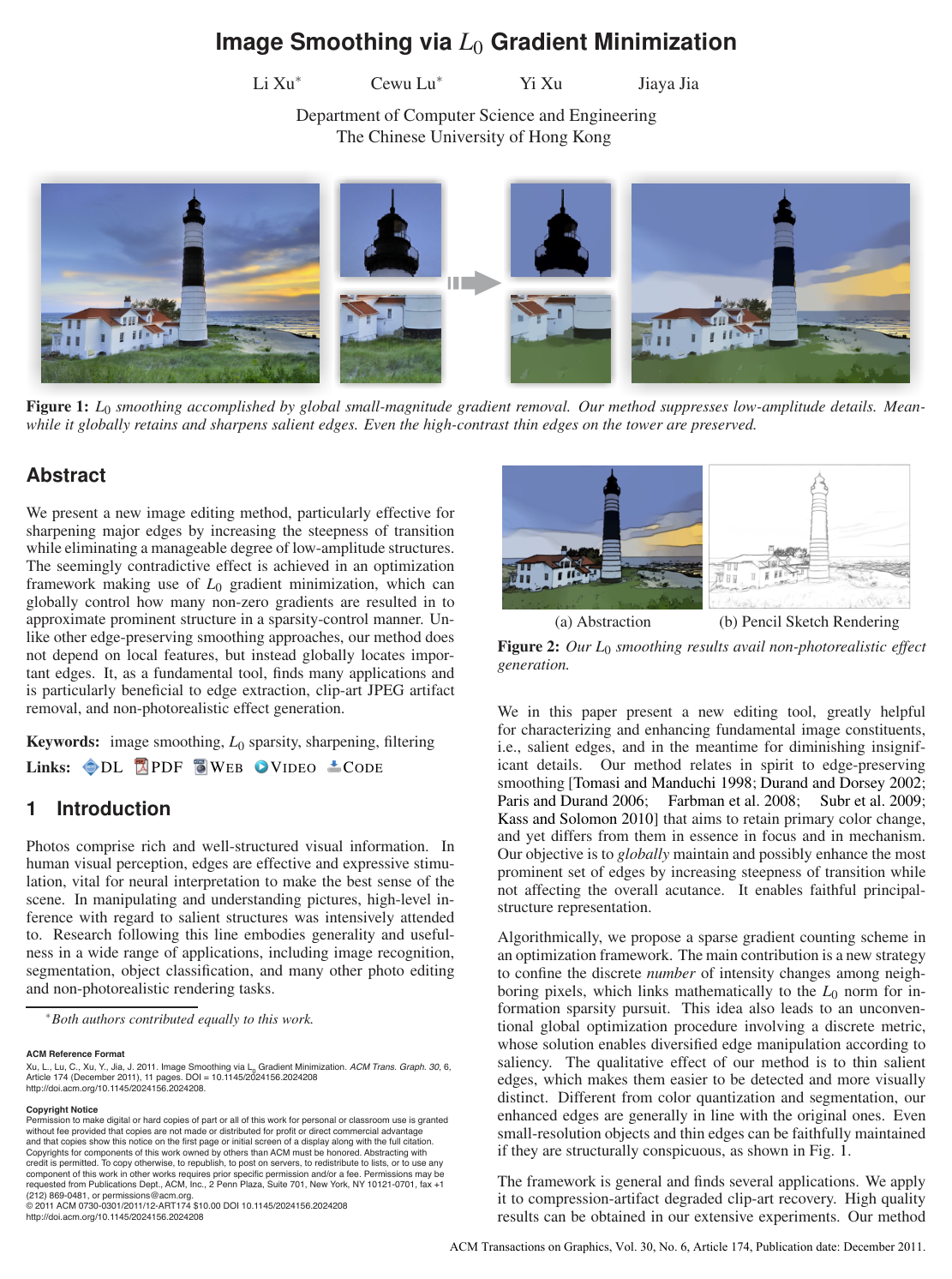
We present a new image editing method, particularly effective for sharpening major edges by increasing the steepness of transition while eliminating a manageable degree of low-amplitude structures. The seemingly contradictive effect is achieved in an optimization framework making use of L0 gradient minimization, which can globally control how many non-zero gradients are resulted in to approximate prominent structure in a sparsity-control manner. Unlike other edge-preserving smoothing approaches, our method does not depend on local features, but instead globally locates important edges. It, as a fundamental tool, finds many applications and is particularly beneficial to edge extraction, clip-art JPEG artifact removal, and non-photorealistic effect generation.

Table of Contents

  • 1 Introduction
  • 2 Background and Motivation
  • 2.1 1D Smoothing
  • 2.2 2D Formulation
  • 3 Solver
  • 3.1 More Analysis
  • 4 Applications
  • 4.1 Edge Enhancement and Extraction
  • 4.2 Image Abstraction and Pencil Sketching
  • 4.3 Clip-Art Compression Artifact Removal
  • 4.4 Layer-Based Contrast Manipulation
  • 5 Discussion and Limitations
  • Acknowledgements
  • References

Knowls

  1. Knowl 1 — 2D L0 Gradient Minimization Formulation

    model/method

    The L0L_0 image smoothing framework globally minimizes the number of non-zero gradient transitions while penalizing deviation from the input image. Let II denote the input image and SS denote the smoothed output image. For each pixel pp, the forward gradient vector is ∇Sp=(∂xSp,∂ySp)T\nabla S_p = (\partial_x S_p, \partial_y S_p)^T, where ∂xSp\partial_x S_p and ∂ySp\partial_y S_p represent spatial forward differences along the xx and yy directions. For color images, the gradient magnitude ∣∂Sp∣|\partial S_p| is defined as the sum of gradient magnitudes across the RGB color channels.

    The gradient counting measure C(S)C(S) counts the number of pixels with non-zero gradient:

    C(S)=#{p∣∣∂xSp∣+∣∂ySp∣≠0}C(S) = \#\{p \mid |\partial_x S_p| + |\partial_y S_p| \neq 0\}

    The smoothed image SS is estimated by solving the unconstrained optimization problem:

    min⁡S∑p(Sp−Ip)2+λC(S)\min_S \sum_p (S_p - I_p)^2 + \lambda C(S)

    where λ>0\lambda > 0 is a global regularization parameter that controls the trade-off between fidelity to II and sparsity of spatial edges. Higher values of λ\lambda yield coarser structures with fewer non-zero boundaries.

  2. Knowl 2 — Alternating Half-Quadratic Optimization for L0 Smoothing

    algorithm

    Because the discrete counting metric C(S)C(S) is non-convex and NP-hard, the optimization problem is solved via an alternating minimization scheme based on half-quadratic splitting. Auxiliary variables hph_p and vpv_p are introduced at each pixel pp to decouple the spatial gradient operators (∂xSp,∂ySp)(\partial_x S_p, \partial_y S_p) from the discrete counting measure, yielding the relaxed objective:

    min⁡S,h,v∑p(Sp−Ip)2+λC(h,v)+β((∂xSp−hp)2+(∂ySp−vp)2)\min_{S, h, v} \sum_p (S_p - I_p)^2 + \lambda C(h,v) + \beta \left( (\partial_x S_p - h_p)^2 + (\partial_y S_p - v_p)^2 \right)

    where C(h,v)=#{p∣∣hp∣+∣vp∣≠0}C(h,v) = \#\{p \mid |h_p| + |v_p| \neq 0\}, and β\beta is an adaptation weight parameter that enforces convergence of (hp,vp)(h_p, v_p) to (∂xSp,∂ySp)(\partial_x S_p, \partial_y S_p) as β→∞\beta \to \infty.

    Input: Input image II, smoothing weight λ\lambda, initial parameter β0=2λ\beta_0 = 2\lambda, maximum parameter βmax⁡=105\beta_{\max} = 10^5, rate κ=2.0\kappa = 2.0
    Output: Smoothed image SS
    Initialize S(0)←I,β←β0,i←0S^{(0)} \leftarrow I, \beta \leftarrow \beta_0, i \leftarrow 0
    repeat
        Compute hp(i)h^{(i)}_p and vp(i)v^{(i)}_p for each pixel pp via hard-thresholding
        Compute S(i+1)S^{(i+1)} via Fourier-domain division
        β←κβ\beta \leftarrow \kappa \beta
        i←i+1i \leftarrow i + 1
    until β≥βmax⁡\beta \ge \beta_{\max}
    return SS

    The algorithm converges in approximately 20 to 30 iterations. Most computational time is spent computing 2D Fast Fourier Transforms and pixel-wise arithmetic operations.

  3. Knowl 3 — Closed-Form Fourier Solution for Image Estimation Subproblem

    theoretical result

    Conditioned on fixed auxiliary gradient fields hh and vv, the subproblem for updating the image SS in the half-quadratic formulation is:

    min⁡S∑p(Sp−Ip)2+β((∂xSp−hp)2+(∂ySp−vp)2)\min_S \sum_p (S_p - I_p)^2 + \beta \left( (\partial_x S_p - h_p)^2 + (\partial_y S_p - v_p)^2 \right)

    Because this energy is quadratic in SS, spatial derivative operators ∂x\partial_x and ∂y\partial_y are diagonalized under the 2D Discrete Fourier Transform, producing the exact closed-form global minimizer:

    S=F−1(F(I)+β(F(∂x)∗F(h)+F(∂y)∗F(v))F(1)+β(F(∂x)∗F(∂x)+F(∂y)∗F(∂y)))S = \mathcal{F}^{-1}\left( \frac{\mathcal{F}(I) + \beta (\mathcal{F}(\partial_x)^* \mathcal{F}(h) + \mathcal{F}(\partial_y)^* \mathcal{F}(v))}{\mathcal{F}(1) + \beta (\mathcal{F}(\partial_x)^* \mathcal{F}(\partial_x) + \mathcal{F}(\partial_y)^* \mathcal{F}(\partial_y))} \right)

    where F\mathcal{F} denotes the 2D Fast Fourier Transform operator, F−1\mathcal{F}^{-1} is the 2D Inverse Fast Fourier Transform, F()∗\mathcal{F}()^* is the complex conjugate, F(1)\mathcal{F}(1) is the Fourier transform of the 2D delta function, and all arithmetic operations (addition, multiplication, division) are component-wise.

  4. Knowl 4 — Decoupled Hard-Thresholding for Gradient Auxiliary Variables

    theoretical result

    Conditioned on a fixed image SS, the subproblem for updating the auxiliary variables (h,v)(h, v) is:

    min⁡h,v∑p((∂xSp−hp)2+(∂ySp−vp)2)+λβC(h,v)\min_{h, v} \sum_p \left( (\partial_x S_p - h_p)^2 + (\partial_y S_p - v_p)^2 \right) + \frac{\lambda}{\beta} C(h, v)

    Because the regularization term is an element-wise sum of indicators C(h,v)=∑pH(∣hp∣+∣vp∣)C(h, v) = \sum_p H(|h_p| + |v_p|) (where H(z)=1H(z) = 1 if z≠0z \neq 0 and 00 otherwise), the energy decomposes into completely decoupled per-pixel minimization problems:

    Ep(hp,vp)=(hp−∂xSp)2+(vp−∂ySp)2+λβH(∣hp∣+∣vp∣)E_p(h_p, v_p) = (h_p - \partial_x S_p)^2 + (v_p - \partial_y S_p)^2 + \frac{\lambda}{\beta} H(|h_p| + |v_p|)

    The analytical global minimum Ep∗E_p^* is achieved by the hard-thresholding rule:

    (hp,vp)={(0,0),if (∂xSp)2+(∂ySp)2≤λβ(∂xSp,∂ySp),if (∂xSp)2+(∂ySp)2>λβ(h_p, v_p) = \begin{cases} (0, 0), & \text{if } (\partial_x S_p)^2 + (\partial_y S_p)^2 \le \frac{\lambda}{\beta} \\[6pt] (\partial_x S_p, \partial_y S_p), & \text{if } (\partial_x S_p)^2 + (\partial_y S_p)^2 > \frac{\lambda}{\beta} \end{cases}

  5. Knowl 5 — Scale-Invariance of L0 Gradient Regularization vs Lp Norms

    theoretical result

    Continuous LpL_p norm regularizers with p≥0.5p \ge 0.5 (including Total Variation with p=1p = 1 and Iterative Reweighted Least Squares formulations) satisfy the positive scalability property:

    ∥ax∥pp=∣a∣p∥x∥pp\|a x\|_p^p = |a|^p \|x\|_p^p

    for any scalar aa. When ∣a∣>1|a| > 1, ∥ax∥pp>∥x∥pp\|a x\|_p^p > \|x\|_p^p, meaning LpL_p regularization penalizes large gradient magnitudes, which attenuates contrast, rounds sharp transitions, and causes edge blurring under strong smoothing.

    In contrast, the L0L_0 gradient metric satisfies:

    #{∣ax∣>0}=#{∣x∣>0},∀a≠0\#\{|a x| > 0\} = \#\{|x| > 0\}, \quad \forall a \neq 0

    Because the L0L_0 norm is invariant to non-zero scaling, it incurs zero marginal penalty for increasing the contrast or steepness of an existing edge. As a result, the optimization flattens low-amplitude variations while sharpening and preserving prominent edges regardless of resolution or scale.

  6. Knowl 6 — Spatially-Varying Gaussian Edge Adjustment for Layer Decomposition

    model/method

    In base-detail layer decomposition for detail magnification and HDR tone mapping, direct L0L_0 smoothing may sharpen transition slopes beyond the original image II, leading to gradient reversal when the detail layer is boosted. To restore natural edge slopes to the base layer SS without restoring flattened low-amplitude noise, a spatially-varying Gaussian scale map σ\sigma is optimized:

    min⁡σ∑p((G(σp)∗S)p−Ip)2+γ((∂xσp)2+(∂yσp)2)\min_\sigma \sum_p \left( (G(\sigma_p) * S)_p - I_p \right)^2 + \gamma \left( (\partial_x \sigma_p)^2 + (\partial_y \sigma_p)^2 \right)

    where G(σp)G(\sigma_p) is a zero-mean 2D Gaussian kernel with standard deviation σp\sigma_p, ∗* is the 2D spatial convolution operator, and γ=10−3\gamma = 10^{-3} enforces spatial smoothness of the scale map.

    To compute the solution, standard deviations are discretized to σp∈{0,1/3,2/3,…,3}\sigma_p \in \{0, 1/3, 2/3, \dots, 3\} with corresponding filter kernel sizes 6σp+16\sigma_p + 1. The resulting multi-label discrete Markov Random Field is solved globally via graph cuts. The final adjusted base layer S′S' is constructed at each pixel pp as Sp′=(G(σp)∗S)pS'_p = (G(\sigma_p) * S)_p.

  7. Knowl 7 — Training-Free Restoration of JPEG Compression Artifacts in Clip-Art

    empirical result

    L0L_0 gradient minimization restores clip-art and cartoon images degraded by Block Discrete Cosine Transform (BDCT) JPEG compression without requiring training data or learning algorithms. Setting λ∈[0.02,0.1]\lambda \in [0.02, 0.1] flattens ringing artifacts across uniform regions while sharpening cartoon boundaries.

    Evaluated across 100 clip-art images compressed under standard JPEG quality factors from 10 to 90, L0L_0 smoothing removes BDCT blocking and deringing artifacts, producing Structural Similarity (SSIM) and Peak Signal-to-Noise Ratio (PSNR) reconstructions where images compressed at quality factor 40 achieve structural fidelity comparable to original compressed images at quality factor 90+90+.

  8. Knowl 8 — Cascaded Bilateral and L0 Smoothing for High-Amplitude Texture Suppression

    model/method

    Because L0L_0 gradient minimization discriminates structures based on gradient amplitude rather than spatial frequency, fine-scale textures with high contrast (such as plush fur or fluff) are preserved if their local gradients exceed the threshold λ\lambda. Conversely, applying strong Bilateral Filtering (BLF) alone suppresses fine texture but blurs salient structural boundaries.

    To eliminate small-resolution, high-amplitude textures while maintaining razor-sharp primary outlines, a two-stage cascaded filtering pipeline is used:

    1. Bilateral filtering is applied to attenuate the amplitude of high-frequency oscillatory textures while preserving coherent large-scale contours.
    2. L0L_0 gradient minimization is applied to the output of the bilateral filter to eliminate the attenuated low-amplitude variations and globally sharpen the prominent boundaries.
  9. Knowl 9 — Over-Sharpening on Broad Illumination Variations and Tone Mapping Limitations

    limitation

    The L0L_0 gradient minimization framework exhibits two notable failure modes:

    1. Broad illumination gradients: When an image contains wide illumination transitions spanning dozens of pixels, setting a high λ\lambda to remove surface textures forces the smooth, gradual transition to collapse into discrete, piece-wise constant staircasing steps (over-sharpening). This requires subsequent spatially-varying Gaussian edge adjustment to avoid visual artifacts during detail magnification.
    2. Tone mapping sensitivity: In HDR tone mapping based on logarithmic layer decomposition, selecting an excessively large smoothing parameter (e.g., λ=0.4\lambda = 0.4) causes gradual lighting gradients to be flattened and transferred into the detail layer, creating unnatural, blocky reflection artifacts in the final low dynamic range rendering unless λ\lambda is tuned to a lower value (e.g., λ≈0.07\lambda \approx 0.07).

Coverage note — Omitted the application-specific pipelines for non-photorealistic rendering (pencil sketching and image abstraction), as they are direct downstream applications combining standard edge detectors (such as Difference of Gaussians/Canny) and tangent stroke rendering with the core L0-smoothed edge maps.

References

  1. 1.ARBELAEZ, P., MAIRE, M., FOWLKES, C., AND MALIK, J. 2011. Contour detection and hierarchical image segmentation. IEEE Trans. Pattern Anal. Mach. Intell. 33, 898–916.
  2. 2.BAE, S., AND DURAND, F. 2007. Defocus magnification. Comput. Graph. Forum 26, 3, 571–579.
  3. 3.BAE, S., PARIS, S., AND DURAND, F. 2006. Two-scale tone management for photographic look. ACM Trans. Graph. 25, 3, 637–645.
  4. 4.BAEK, J., AND JACOBS, D. E. 2010. Accelerating spatially vary-ing gaussian filters. ACM Trans. Graph..
  5. 5.BLACK, M. J., SAPIRO, G., MARIMONT, D. H., AND HEEGER, D. 1998. Robust anisotropic diffusion. IEEE Transactions on Image Processing 7, 3, 421–432.
  6. 6.BLAKE, A., AND ZISSERMAN, A. 1987. Visual reconstruction. The MIT Press.
  7. 7.BOYKOV, Y., VEKSLER, O., AND ZABIH, R. 2001. Fast approx-imate energy minimization via graph cuts. IEEE Trans. Pattern Anal. Mach. Intell. 23, 11, 1222–1239.
  8. 8.CHEN, J., PARIS, S., AND DURAND, F. 2007. Real-time edge-aware image processing with the bilateral grid. ACM Trans. Graph. 26, 3, 103.
  9. 9.CHOUDHURY, P., AND TUMBLIN, J. 2003. The trilateral filter for high contrast images and meshes. In Rendering Techniques, 186–196.
  10. 10.COMANICIU, D., AND MEER, P. 2002. Mean shift: A robust approach toward feature space analysis. IEEE Trans. Pattern Anal. Mach. Intell. 24, 5, 603–619.
  11. 11.CRIMINISI, A., SHARP, T., ROTHER, C., AND PÉREZ, P. 2010. Geodesic image and video editing. ACM Trans. Graph. 29, 5, 134.
  12. 12.DABOV, K., FOI, A., KATKOVNIK, V., AND EGIAZARIAN, K. O. 2007. Image denoising by sparse 3-d transform-domain collab-orative filtering. IEEE Transactions on Image Processing 16, 8, 2080–2095.
  13. 13.DECARLO, D., AND SANTELLA, A. 2002. Stylization and ab-straction of photographs. ACM Trans. Graph. 21, 3, 769–776.
  14. 14.DONOHO, D. 2006. Compressed sensing. IEEE Transactions on Information Theory 52, 4, 1289–1306.
  15. 15.DURAND, F., AND DORSEY, J. 2002. Fast bilateral filtering for the display of high-dynamic-range images. ACM Trans. Graph. 21, 3, 257–266.
  16. 16.FARBMAN, Z., FATTAL, R., LISCHINSKI, D., AND SZELISKI, R. 2008. Edge-preserving decompositions for multi-scale tone and detail manipulation. ACM Trans. Graph. 27, 3.
  17. 17.FARBMAN, Z., FATTAL, R., AND LISCHINSKI, D. 2010. Diffu-sion maps for edge-aware image editing. ACM Trans. Graph..
  18. 18.FATTAL, R., AGRAWALA, M., AND RUSINKIEWICZ, S. 2007. Multiscale shape and detail enhancement from multi-light image collections. ACM Trans. Graph. 26, 3, 51.
  19. 19.FATTAL, R. 2009. Edge-avoiding wavelets and their applications. ACM Trans. Graph. 28, 3.
  20. 20.KASS, M., AND SOLOMON, J. 2010. Smoothed local histogram filters. ACM Trans. Graph. 29, 4.
  21. 21.LEVIN, A., LISCHINSKI, D., AND WEISS, Y. 2004. Colorization using optimization. ACM Trans. Graph. 23, 3, 689–694.
  22. 22.LEVIN, A., FERGUS, R., DURAND, F., AND FREEMAN, W. T. 2007. Image and depth from a conventional camera with a coded aperture. ACM Trans. Graph. 26, 3, 70.
  23. 23.LI, Y., SUN, J., TANG, C.-K., AND SHUM, H.-Y. 2004. Lazy snapping. ACM Trans. Graph. 23, 3, 303–308.
  24. 24.LI, Y., SHARAN, L., AND ADELSON, E. H. 2005. Compress-ing and companding high dynamic range images with subband architectures. ACM Trans. Graph. 24, 3, 836–844.
  25. 25.LISCHINSKI, D., FARBMAN, Z., UYTTENDAELE, M., AND SZELISKI, R. 2006. Interactive local adjustment of tonal val-ues. ACM Trans. Graph. 25, 3, 646–653.
  26. 26.LIU, J., SUN, J., AND SHUM, H.-Y. 2009. Paint selection. ACM Trans. Graph. 28, 3.
  27. 27.MAIRAL, J., BACH, F., PONCE, J., SAPIRO, G., AND ZISSER-MAN, A. 2009. Non-local sparse models for image restoration. In ICCV, 2272–2279.
  28. 28.MAJI, S., VISHNOI, N., AND MALIK, J. 2011. Biased normalized cuts. In CVPR.
  29. 29.PARIS, S., AND DURAND, F. 2006. A fast approximation of the bilateral filter using a signal processing approach. In ECCV (4), 568–580.
  30. 30.PARIS, S., HASINOFF, S. W., AND KAUTZ, J. 2011. Local lapla-cian filters: Edge-aware image processing with a laplacian pyra-mid. ACM Trans. Graph..
  31. 31.PERONA, P., AND MALIK, J. 1990. Scale-space and edge detection using anisotropic diffusion. IEEE Trans. Pattern Anal. Mach. Intell. 12, 7, 629–639.
  32. 32.ROTHER, C., KOLMOGOROV, V., AND BLAKE, A. 2004. ”grab-cut”: interactive foreground extraction using iterated graph cuts. ACM Trans. Graph. 23, 3, 309–314.
  33. 33.RUDIN, L., OSHER, S., AND FATEMI, E. 1992. Nonlinear total variation based noise removal algorithms. Physica D: Nonlinear Phenomena 60, 1-4, 259–268.
  34. 34.SUBR, K., SOLER, C., AND DURAND, F. 2009. Edge-preserving multiscale image decomposition based on local extrema. ACM Trans. Graph. 28, 5.
  35. 35.TOMASI, C., AND MANDUCHI, R. 1998. Bilateral filtering for gray and color images. In ICCV, 839–846.
  36. 36.TUMBLIN, J., AND TURK, G. 1999. Lcis: A boundary hierarchy for detail-preserving contrast reduction. In SIGGRAPH, 83–90.
  37. 37.WANG, Z., BOVIK, A. C., SHEIKH, H. R., AND SIMONCELLI, E. P. 2004. Image quality assessment: from error visibility to structural similarity. IEEE Transactions on Image Processing 13, 4, 600–612.
  38. 38.WANG, G., WONG, T.-T., AND HENG, P.-A. 2006. Deringing cartoons by image analogies. ACM Trans. Graph. 25, 4, 1360–1379.
  39. 39.WANG, Y., YANG, J., YIN, W., AND ZHANG, Y. 2008. A new alternating minimization algorithm for total variation image re-construction. SIAM J. Imaging Sciences 1, 3, 248–272.
  40. 40.WEISS, B. 2006. Fast median and bilateral filtering. ACM Trans. Graph. 25, 3, 519–526.
  41. 41.WINNEMÖLLER, H., OLSEN, S. C., AND GOOCH, B. 2006. Real-time video abstraction. ACM Trans. Graph. 25, 3, 1221–1226.

Citation

MLA
Xu, L., et al. “Image Smoothing via L 0 Gradient Minimization”. Proceedings of the 2011 SIGGRAPH Asia Conference, 2011, pp. 1–2, https://doi.org/10.1145/2024156.2024208.
APA
Xu, L., Lu, C., Xu, Y., & Jia, J. (2011). Image smoothing via L 0 gradient minimization. Proceedings of the 2011 SIGGRAPH Asia Conference, 1–12. https://doi.org/10.1145/2024156.2024208
Chicago
Xu, L., C. Lu, Y. Xu, and J. Jia. 2011. “Image Smoothing via L 0 Gradient Minimization”. Proceedings of the 2011 SIGGRAPH Asia Conference, 1–12. https://doi.org/10.1145/2024156.2024208.
Harvard
Xu, L. et al. (2011) “Image smoothing via L 0 gradient minimization”, Proceedings of the 2011 SIGGRAPH Asia Conference. ACM, pp. 1–12. Available at: https://doi.org/10.1145/2024156.2024208.
Vancouver
1. Xu L, Lu C, Xu Y, Jia J (2011) Image smoothing via L 0 gradient minimization. In: Proceedings of the 2011 SIGGRAPH Asia Conference. ACM, pp 1–12

BibTeX

@inproceedings{Xu_2011, series={SA ’11}, title={Image smoothing via
                    <i>L</i>
                    <sub>0</sub>
                    gradient minimization}, url={http://dx.doi.org/10.1145/2024156.2024208}, DOI={10.1145/2024156.2024208}, booktitle={Proceedings of the 2011 SIGGRAPH Asia Conference}, publisher={ACM}, author={Xu, Li and Lu, Cewu and Xu, Yi and Jia, Jiaya}, year={2011}, month=Dec, pages={1–12}, collection={SA ’11} }
Metadata:Crossref

Access the Paper

This paper is available from its original source. Click below to access the PDF.

Open PDF