
topic
jpeg2000 (jpeg 2000)
JPEG 2000 is an image compression standard and coding system designed to improve upon the original JPEG format. Developed by the Joint Photographic Experts Group, it relies on discrete wavelet transforms rather than discrete cosine transforms, enabling both lossy and lossless compression within a single unified framework. The standard offers superior coding efficiency, progressive transmission by resolution and quality, robust error resilience, and the ability to encode designated regions of interest with higher fidelity. Because of its scalability and high visual performance across a wide range of bit rates, JPEG 2000 is widely adopted in specialized applications such as digital cinema distribution, medical imaging, geospatial analysis, and digital archiving.
3 items
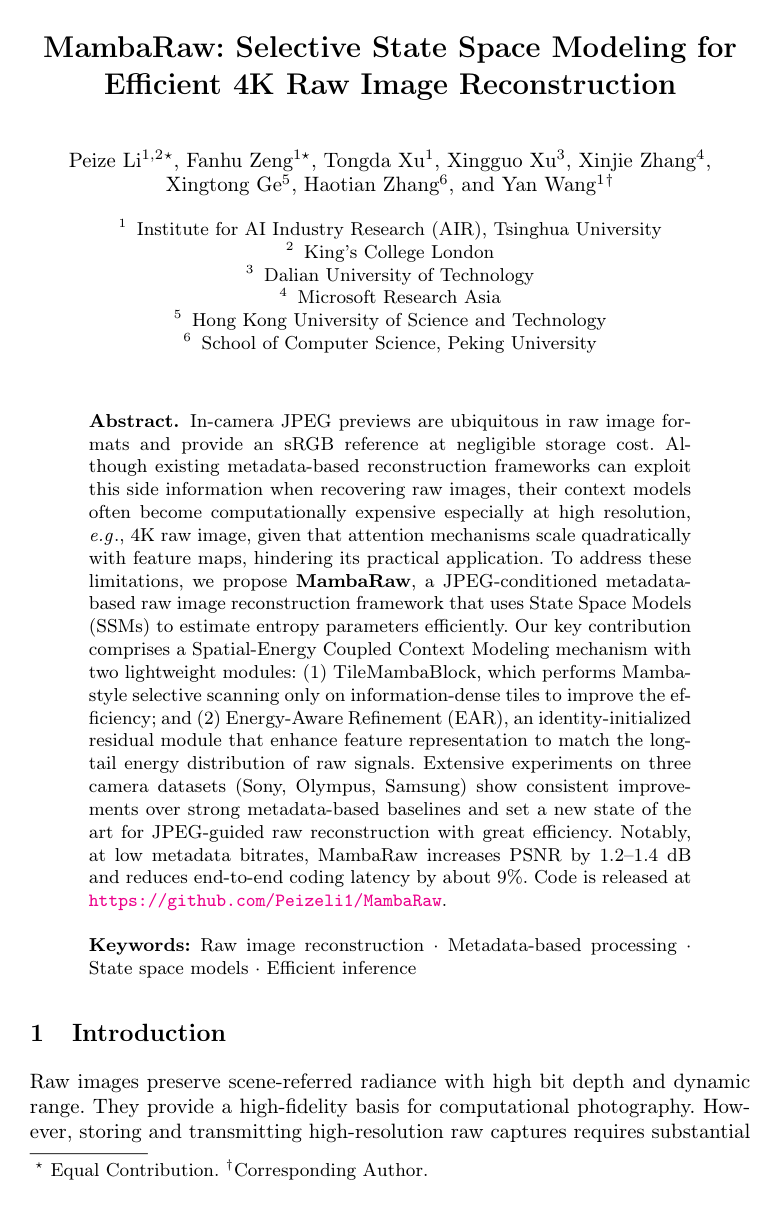
MambaRaw: Selective State Space Modeling for Efficient 4K Raw Image Reconstruction
Peize Li, Fanhu Zeng, Tongda Xu, Xingguo Xu, Xinjie Zhang, Xingtong Ge, Haotian Zhang, Yan Wang
Why you should read this
Presents MambaRaw, a selective state space framework that replaces quadratic attention with tiled scanning to reconstruct 4K raw images from embedded JPEG previews with improved fidelity and reduced coding latency.
In-camera JPEG previews are ubiquitous in raw image formats and provide an sRGB reference at negligible storage cost. Although existing metadata-based reconstruction frameworks can exploit this side information when recovering raw images, their context models often become computationally expensive especially at high resolution, eg, 4K raw image, given that attention mechanisms scale quadratically with feature maps, hindering its practical application. To address these limitations, we propose MambaRaw, a JPEG-conditioned metadata-based raw image reconstruction framework that uses State Space Models (SSMs) to estimate entropy parameters efficiently. Our key contribution comprises a Spatial-Energy Coupled Context Modeling mechanism with two lightweight modules: (1) TileMambaBlock, which performs Mamba-style selective scanning only on information-dense tiles to improve the efficiency; and (2) Energy-Aware Refinement (EAR), an identity-initialized residual module that enhance feature representation to match the long-tail energy distribution of raw signals. Extensive experiments on three camera datasets (Sony, Olympus, Samsung) show consistent improvements over strong metadata-based baselines and set a new state of the art for JPEG-guided raw reconstruction with great efficiency. Notably, at low metadata bitrates, MambaRaw increases PSNR by 1.2--1.4 dB and reduces end-to-end coding latency by about 9%. Code is released at this https URL.
Added
2026-09-29
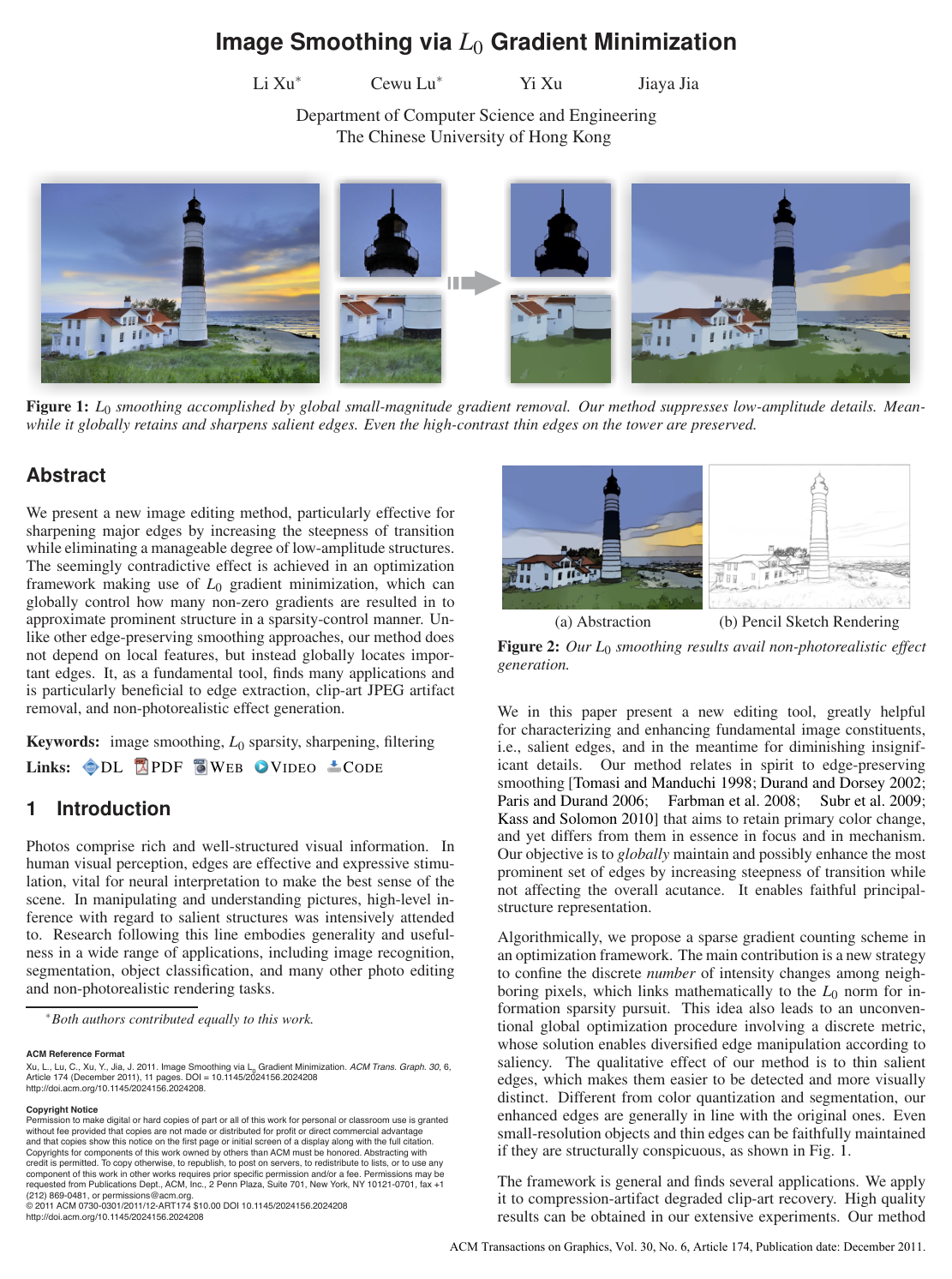
Image smoothing via L0 gradient minimization
Li Xu, Cewu Lu, Yi Xu, Jiaya Jia
Why you should read this
Proposes an optimization framework based on gradient minimization that globally eliminates low-amplitude details while sharpening salient edges without introducing blur, providing an effective tool for edge extraction, artifact removal, and non-photorealistic rendering.
We present a new image editing method, particularly effective for sharpening major edges by increasing the steepness of transition while eliminating a manageable degree of low-amplitude structures. The seemingly contradictive effect is achieved in an optimization framework making use of L0 gradient minimization, which can globally control how many non-zero gradients are resulted in to approximate prominent structure in a sparsity-control manner. Unlike other edge-preserving smoothing approaches, our method does not depend on local features, but instead globally locates important edges. It, as a fundamental tool, finds many applications and is particularly beneficial to edge extraction, clip-art JPEG artifact removal, and non-photorealistic effect generation.
Added
2026-09-25
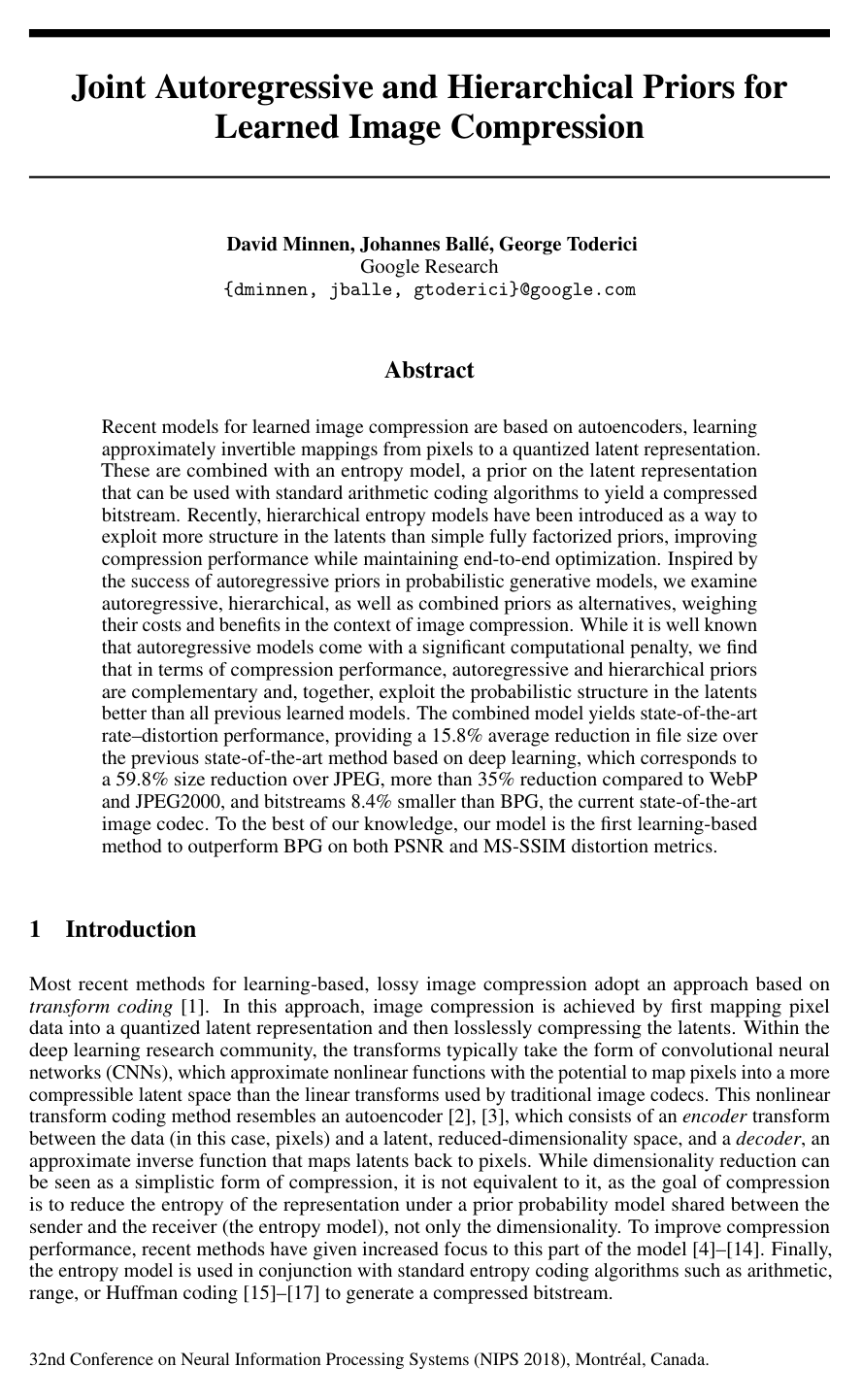
Joint Autoregressive and Hierarchical Priors for Learned Image Compression
David Minnen, Johannes Ballé, George Toderici
Why you should read this
Presents a learned image compression architecture that couples autoregressive and hierarchical priors in the entropy model, establishing the first deep learning approach to outperform traditional BPG codecs across both PSNR and MS-SSIM rate-distortion metrics.
Recent models for learned image compression are based on autoencoders, learning approximately invertible mappings from pixels to a quantized latent representation. These are combined with an entropy model, a prior on the latent representation that can be used with standard arithmetic coding algorithms to yield a compressed bitstream. Recently, hierarchical entropy models have been introduced as a way to exploit more structure in the latents than simple fully factorized priors, improving compression performance while maintaining end-to-end optimization. Inspired by the success of autoregressive priors in probabilistic generative models, we examine autoregressive, hierarchical, as well as combined priors as alternatives, weighing their costs and benefits in the context of image compression. While it is well known that autoregressive models come with a significant computational penalty, we find that in terms of compression performance, autoregressive and hierarchical priors are complementary and, together, exploit the probabilistic structure in the latents better than all previous learned models. The combined model yields state-of-the-art rate--distortion performance, providing a 15.8% average reduction in file size over the previous state-of-the-art method based on deep learning, which corresponds to a 59.8% size reduction over JPEG, more than 35% reduction compared to WebP and JPEG2000, and bitstreams 8.4% smaller than BPG, the current state-of-the-art image codec. To the best of our knowledge, our model is the first learning-based method to outperform BPG on both PSNR and MS-SSIM distortion metrics.
Added
2026-09-24