MemNet: A Persistent Memory Network for Image Restoration
Ying TaiJian YangXiaoming LiuChunyan Xu
Introduces MemNet, a persistent memory network that integrates recursive and gating units to overcome long-term dependency loss in deep models, delivering superior performance across image denoising, super-resolution, and JPEG deblocking.
Image restoration is a foundational capability in digital imaging, tasked with reconstructing clean, high-fidelity images from inputs degraded by noise, low resolution, or compression artifacts. While deep learning models have become the standard solution for these tasks, increasing network depth often leads to the long-term dependency problem, where earlier learned information fades and fails to influence deeper processing stages. This degradation of information flow limits the ability of deep neural networks to accurately recover fine details and textures.
The article demonstrates an 80-layer neural network architecture called MemNet, which introduces persistent memory to resolve long-term dependency issues in deep image restoration models. The system evaluates the effectiveness of this memory framework across three primary restoration applications: image denoising, single-image super-resolution, and compression artifact removal.
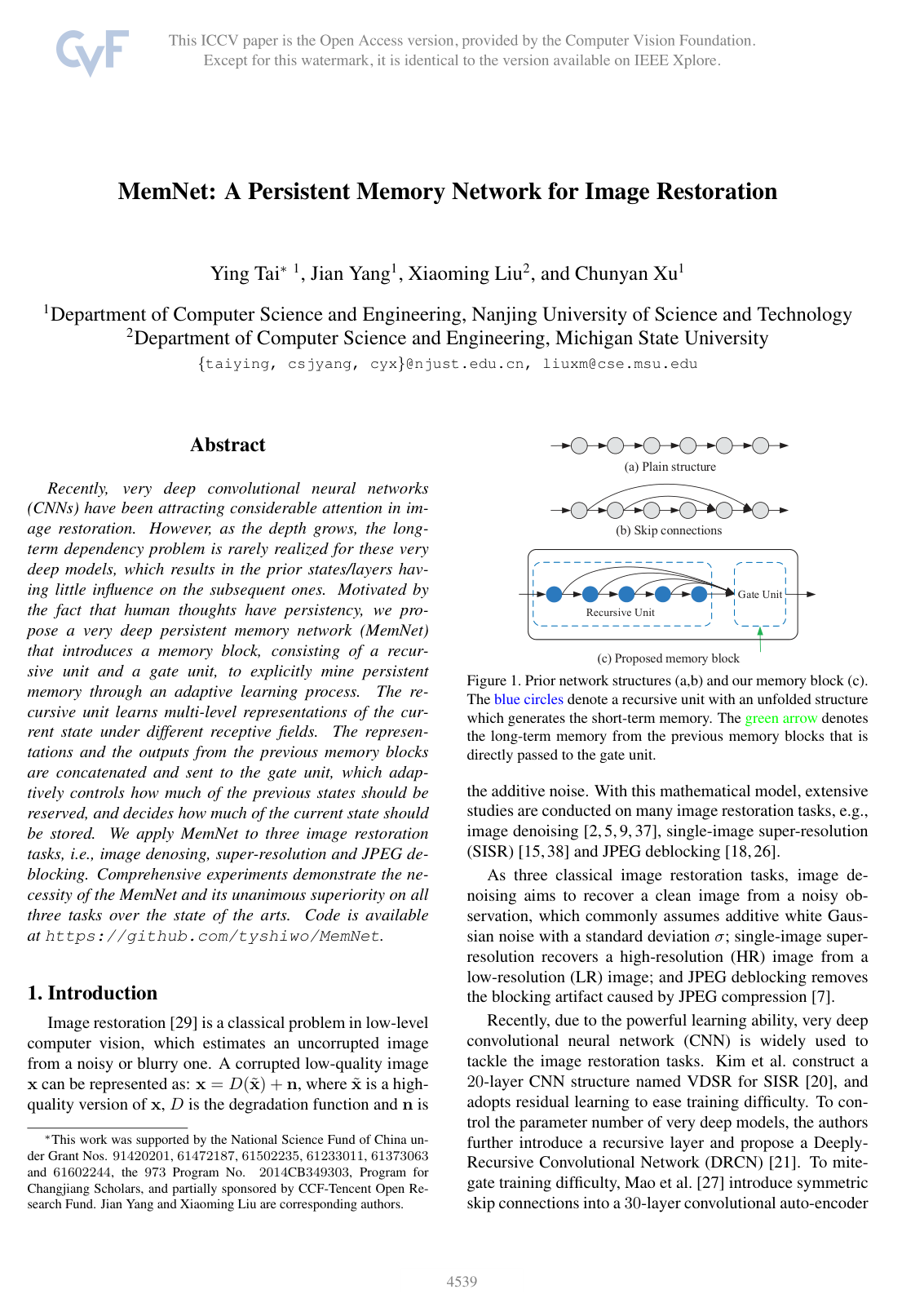
The approach introduces a modular memory block comprising a recursive unit and an adaptive gate unit. The recursive unit generates short-term representations across different levels of detail, while dense connections supply long-term representations from preceding blocks. The gate unit dynamically regulates how much previous information to retain and how much new information to store. MemNet couples this mechanism with multi-level supervised training and residual learning. The authors validated the framework across standard benchmark datasets, including the Berkeley Segmentation Dataset, Set5, Set14, Urban100, Classic5, and LIVE1, testing performance across varying noise levels, scaling factors, and compression quality settings.
The findings confirm that MemNet achieves state-of-the-art restoration quality across all three evaluated applications. First, MemNet outperforms existing models in numerical image quality metrics while producing sharper edges, clearer patterns, and fewer artifacts. Second, structural ablation tests show that dense long-term connections are essential for preserving and recovering mid-to-high frequency details that typical feedforward networks lose. Third, MemNet demonstrates superior parameter and data efficiency; an 80-layer configuration with roughly 677,000 parameters achieved better reconstruction accuracy than competing 20-layer models requiring more than 1.7 million parameters and larger training datasets. Finally, depth scaling experiments revealed continuous performance gains as depth increased up to 212 layers.
These results demonstrate that a single, unified deep learning architecture can effectively handle multiple restoration tasks and varying corruption levels without requiring task-specific structural redesigns. By solving the long-term dependency challenge through feature-level gating rather than expanding model parameter width, organizations can achieve higher image fidelity at lower parameter footprints. This balance offers practical advantages for image-processing pipelines by controlling memory overhead while improving visual quality.
For practical adoption, engineering teams should evaluate MemNet as a unified baseline for image enhancement tasks, adjusting the number of memory blocks to balance latency and reconstruction accuracy for specific hardware targets. While the model delivers high confidence across standard synthetic benchmarks, future work should evaluate performance on real-world sensor corruptions and explore deployment optimizations for real-time edge environments.
- Paper: Image Super-Resolution via Deep Recursive Residual Network, Ying Tai et al. (2017). Introduces recursive residual units to overcome parameter scaling issues in very deep restoration networks, establishing the structural foundation for MemNet's recursive memory mechanism.
- Paper: Deeply-Recursive Convolutional Network for Image Super-Resolution, Jiwon Kim et al. (2016). Provides the foundational deeply recursive convolutional architecture and intermediate supervision strategy that inspired deep recursive formulation in image restoration.
- Paper: Beyond a Gaussian Denoiser: Residual Learning of Deep CNN for Image Denoising, Kai Zhang et al. (2016). Establishes standard residual learning protocols and benchmarks for CNN-based image denoising and multi-task image restoration.
- Paper: Accurate Image Super-Resolution Using Very Deep Convolutional Networks, Jiwon Kim et al. (2016). Demonstrates the benefits of very deep convolutional networks with residual learning and gradient control across multi-scale image super-resolution.
- Paper: Memory Networks, Jason Weston et al. (2014). Pioneers the explicit memory reading and writing architecture that motivated MemNet's persistent memory mechanism for tackling long-term dependencies.
- Paper: Image Super-Resolution Using Deep Convolutional Networks, Chao Dong et al. (2014). Introduces the seminal end-to-end deep convolutional framework for image restoration and single-image super-resolution.
- Paper: Deep Residual Learning for Image Recognition, Kaiming He et al. (2016). Formulates residual learning with identity shortcut connections, enabling effective gradient flow across the very deep networks leveraged by MemNet.
- Paper: Residual Dense Network for Image Super-Resolution, Yulun Zhang et al. (2018). Builds on persistent memory principles by introducing contiguous memory links and dense feature fusion across hierarchical restoration blocks.
- Paper: Image Super-Resolution Using Very Deep Residual Channel Attention Networks, Yulun Zhang et al. (2018). Extends deep residual feature representation by integrating channel-wise attention mechanisms with residual-in-residual architectures.
- Paper: Multi-Stage Progressive Image Restoration, Syed Waqas Zamir et al. (2021). Advances multi-task image restoration by replacing single-stream recursive memories with a multi-stage architecture using supervised attention and cross-stage feature propagation.
- Paper: SwinIR: Image Restoration Using Swin Transformer, Jingyun Liang et al. (2021). Modernizes deep multi-task image restoration across denoising, deblocking, and super-resolution by transitioning from recursive CNN memories to shifted-window Swin Transformers.
- Paper: Restormer: Efficient Transformer for High-Resolution Image Restoration, Syed Waqas Zamir et al. (2022). Generalizes multi-task image restoration to high-resolution pipelines by deploying computationally efficient Transformers to capture long-range spatial context.
- Paper: Pre-Trained Image Processing Transformer, Hanting Chen et al. (2020). Extends universal restoration across diverse tasks through large-scale transformer pre-training with multi-head task adaptation.
- Paper: Uformer: A General U-Shaped Transformer for Image Restoration, Zhendong Wang et al. (2021). Develops a general U-shaped hierarchical Transformer architecture that efficiently captures both long-range dependencies and fine local details across multiple restoration tasks.