Hyperparameters in Reinforcement Learning and How To Tune Them
Theresa EimerMarius LindauerRoberta Raileanu
Demonstrates that automated hyperparameter optimization outperforms manual tuning in reinforcement learning while using less compute, and provides concrete best practices alongside ready-to-use implementations to improve experimental reproducibility.
Deep reinforcement learning (RL) holds immense potential for solving complex autonomous decision-making problems, yet it faces severe reproducibility and evaluation challenges. In standard practice, practitioners tune internal algorithm settings—known as hyperparameters—manually or via exhaustive grid searches over only a few variables. These tuning processes, as well as the random seeds used during training and evaluation, are rarely reported transparently. This lack of standardization leads to costly compute waste, unfair algorithm comparisons, and brittle models that perform poorly in production.
The article evaluates how hyperparameter choices and random noise impact RL algorithm performance and explores whether automated hyperparameter optimization (HPO) methods can replace expensive manual tuning. To demonstrate this, the authors conduct extensive empirical analyses across major RL algorithm classes (PPO, SAC, DQN, and IDAAC) and diverse standard benchmark environments ranging from classic control tasks to complex robotics and procedurally generated games (such as Brax and Procgen). The study benchmarks several black-box automated tuning methods, including Random Search, evolutionary multi-fidelity methods like DEHB, and population-based training techniques like PB2 and BGT.
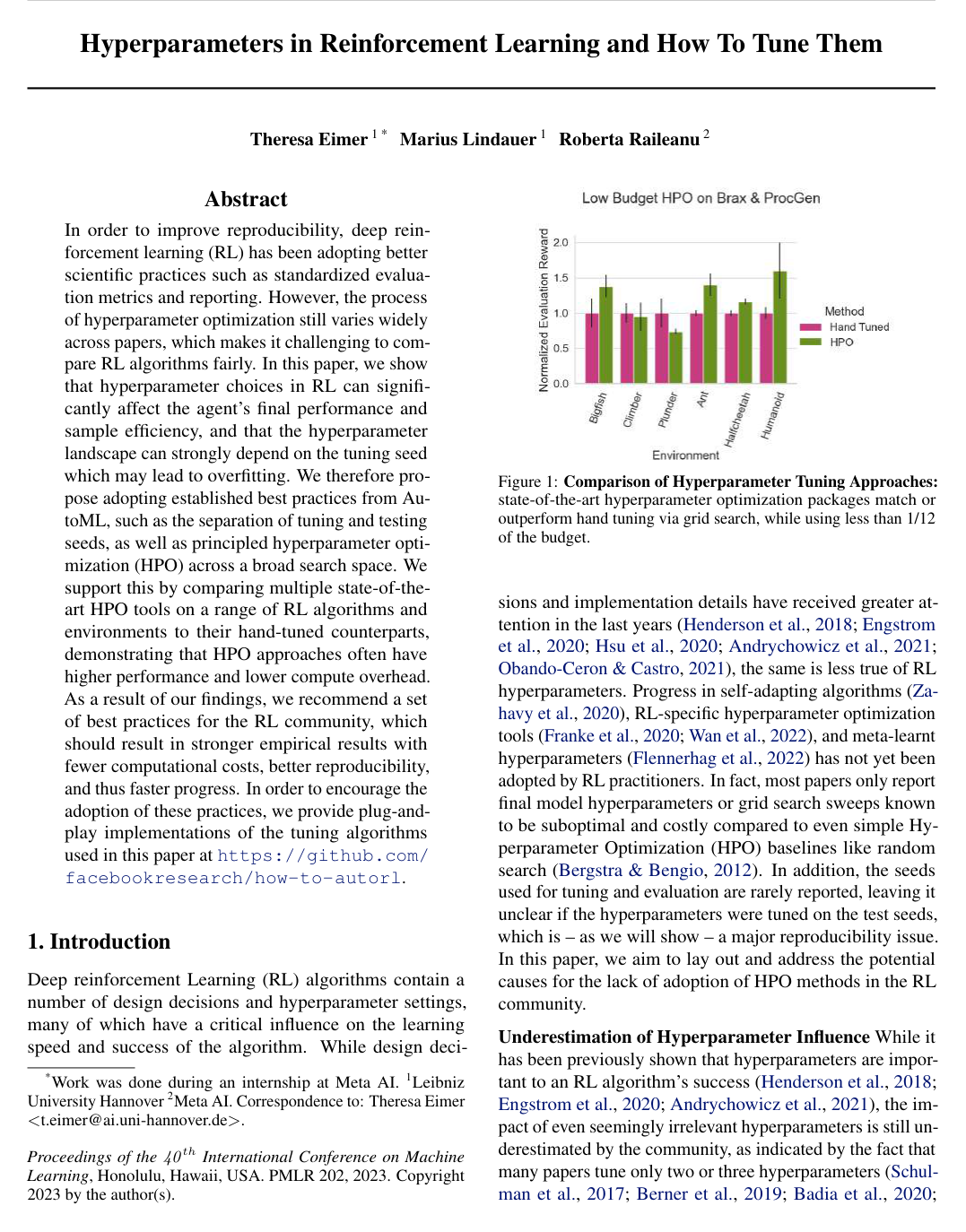
The findings establish that hyperparameter settings critically drive algorithm success, yet the optimization landscape is relatively smooth and predictable. Automated HPO tools regularly match or surpass the performance of meticulously hand-tuned models while consuming a fraction of the computational budget. For instance, on complex tasks, tools like DEHB achieve superior performance using less than one-twelfth of the tuning budget required by standard baseline sweeps. Furthermore, the analysis reveals that RL performance is highly sensitive to random seeds: models tuned on a single seed often overfit drastically, sometimes performing more than four times worse on unseen test seeds. Tuning across 3 to 5 seeds significantly improves generalizability, whereas evaluating beyond that can sharply increase search complexity.
These insights demonstrate that standard manual tuning practices inflate computational costs and obscure true algorithmic progress. Because hyperparameter landscapes are smooth, practitioners do not need complex, algorithm-specific custom tuners; accessible, general-purpose AutoML methods are fully sufficient and highly effective. Adopting these automated approaches reduces the cloud compute overhead required to deploy RL systems, accelerates development timelines, and mitigates the operational risk of deploying overfitted policies.
The article recommends that organizations integrate automated HPO natively into their machine learning pipelines. Teams should tune across broad search spaces rather than cherry-picking two or three parameters, strictly separate tuning seeds from final testing seeds to prevent overfitting, and report exact tuning budgets and protocols to ensure fair comparisons. To facilitate this transition, the authors provide open-source, plug-and-play tuning sweepers compatible with standard RL workflows.
While these conclusions are supported by robust experiments across diverse benchmarks, readers should note that population-based methods exhibited variability and may require larger budgets or specialized restart mechanics to prevent stagnation. Overall, confidence is high that adopting disciplined AutoML best practices and automated tuning frameworks will substantially improve RL reliability and resource efficiency.
- Paper: Deep Reinforcement Learning that Matters, Peter Henderson et al. (2018). This seminal paper exposes the severe reproducibility, seed variance, and hyperparameter sensitivity issues in deep RL that the source directly attempts to solve using AutoML practices.
- Paper: Deep Reinforcement Learning at the Edge of the Statistical Precipice, Rishabh Agarwal et al. (2021). It provides the foundational statistical evaluation framework and diagnostic criteria for handling high variance and small sample sizes when evaluating deep reinforcement learning algorithms.
- Paper: BOHB: Robust and Efficient Hyperparameter Optimization at Scale, Stefan Falkner et al. (2018). It introduces BOHB, one of the premier multi-fidelity AutoML hyperparameter optimization methods evaluated and benchmarked extensively within the source paper.
- Paper: Hyperband: A Novel Bandit-Based Approach to Hyperparameter Optimization, Lisha Li et al. (2016). It presents Hyperband, the fundamental bandit-based resource allocation algorithm underpinning modern multi-fidelity hyperparameter optimization tools analyzed in the source.
- Paper: Algorithms for Hyper-Parameter Optimization, James Bergstra et al. (2011). It introduces the Tree-structured Parzen Estimator (TPE) algorithm, which serves as a core model-based hyperparameter optimization technique evaluated in the source.
- Paper: Optuna: A Next-generation Hyperparameter Optimization Framework, Takuya Akiba et al. (2019). It details Optuna, a leading hyperparameter optimization framework whose algorithms and pruning mechanisms are evaluated for tuning reinforcement learning pipelines.
- Paper: On Over-fitting in Model Selection and Subsequent Selection Bias in Performance Evaluation, Gavin C. Cawley et al. (2010). It establishes the theoretical and empirical risks of overfitting during hyperparameter selection and validation, directly informing the source's insistence on separating tuning and testing seeds.
- Paper: On Hyperparameter Optimization of Machine Learning Algorithms: Theory and Practice, Li Yang et al. (2020). It provides a comprehensive survey of hyperparameter optimization algorithms and software tools that contextualizes the automated methods applied in the source.
- Paper: Random Search for Hyper-Parameter Optimization, James Bergstra et al. (2012). It provides the foundational case for random search over grid search in hyperparameter tuning, establishing the baseline search strategy built upon by the source.
- Paper: Empirical Design in Reinforcement Learning, Andrew Patterson et al. (2024). It builds upon hyperparameter tuning and reproducibility practices to formalize comprehensive experimental design, statistical testing, and reporting protocols across reinforcement learning.