
keyword
world models
In artificial intelligence and machine learning, a world model is an internal computational representation of an external environment that simulates its physical rules, dynamics, and state transitions over time. By learning compact spatial and temporal representations from sensory observations such as video and interaction data, these models predict how an environment will evolve autonomously or in response to specific actions. This predictive capability allows autonomous agents to simulate future outcomes, reason about cause and effect, and train decision-making policies entirely within imagined scenarios without requiring continuous trial and error in the real physical or simulated environment.
8 items
Model-Based Imitation Learning for Urban Driving
Anthony Hu, Gianluca Corrado, Nicolas Griffiths, Zachary Murez, Corina Gurau, Hudson Yeo, Alex Kendall, Roberto Cipolla, Jamie Shotton
Why you should read this
Proposes MILE, a camera-only model-based imitation learning framework that jointly models world dynamics and driving policies entirely from offline demonstration videos, achieving state-of-the-art closed-loop urban driving in CARLA by planning actions purely within imagined latent rollouts.
An accurate model of the environment and the dynamic agents acting in it offers great potential for improving motion planning. We present MILE: a Model-based Imitation LEarning approach to jointly learn a model of the world and a policy for autonomous driving. Our method leverages 3D geometry as an inductive bias and learns a highly compact latent space directly from high-resolution videos of expert demonstrations. Our model is trained on an offline corpus of urban driving data, without any online interaction with the environment. MILE improves upon prior state-of-the-art by 31% in driving score on the CARLA simulator when deployed in a completely new town and new weather conditions. Our model can predict diverse and plausible states and actions, that can be interpretably decoded to bird’s-eye view semantic segmentation. Further, we demonstrate that it can execute complex driving manoeuvres from plans entirely predicted in imagination. Our approach is the first camera-only method that models static scene, dynamic scene, and ego-behaviour in an urban driving environment. The code and model weights are available at https://github.com/wayveai/mile.
Added
2026-10-05
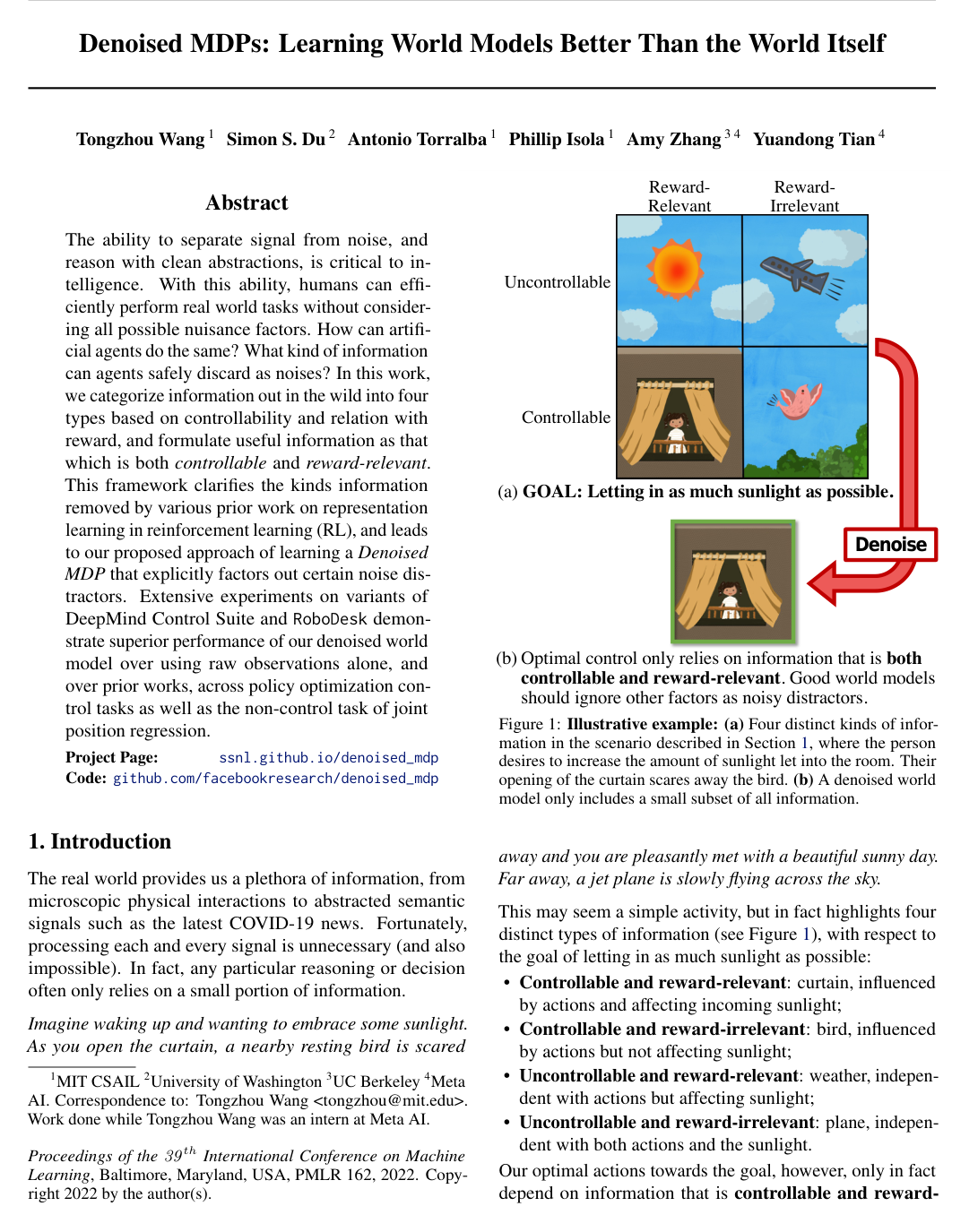
Denoised MDPs: Learning World Models Better Than the World Itself
Tongzhou Wang, Simon S. Du, Antonio Torralba, Phillip Isola, Amy Zhang, Yuandong Tian
Why you should read this
Proposes a model-based reinforcement learning framework that categorizes environmental state information by controllability and reward relevance, learning denoised world models that filter out task-irrelevant visual distractors to improve policy optimization and state representation.
The ability to separate signal from noise, and reason with clean abstractions, is critical to intelligence. With this ability, humans can efficiently perform real world tasks without considering all possible nuisance factors. How can artificial agents do the same? What kind of information can agents safely discard as noises? In this work, we categorize information out in the wild into four types based on controllability and relation with reward, and formulate useful information as that which is both controllable and reward-relevant. This framework clarifies the kinds information removed by various prior work on representation learning in reinforcement learning (RL), and leads to our proposed approach of learning a Denoised MDP that explicitly factors out certain noise distractors. Extensive experiments on variants of DeepMind Control Suite and RoboDesk demonstrate superior performance of our denoised world model over using raw observations alone, and over prior works, across policy optimization control tasks as well as the non-control task of joint position regression.
Added
2026-10-03
How Far Is Video Generation from World Model: A Physical Law Perspective
Bingyi Kang, Yang Yue, Rui Lu, Zhijie Lin, Yang Zhao, Kaixin Wang, Gao Huang, Jiashi Feng
Why you should read this
Demonstrates through controlled 2D mechanics simulations that scaling video diffusion models improves in-distribution and combinatorial generalization but fails to discover fundamental physical laws for out-of-distribution extrapolation, relying instead on case-based mimicry prioritized by superficial visual attributes.
Scaling video generation models is believed to be promising in building world models that adhere to fundamental physical laws. However, whether these models can discover physical laws purely from vision can be questioned. A world model learning the true law should give predictions robust to nuances and correctly extrapolate on unseen scenarios. In this work, we evaluate across three key scenarios: in-distribution, out-of-distribution, and combinatorial generalization. We developed a 2D simulation testbed for object movement and collisions to generate videos deterministically governed by one or more classical mechanics laws. We focus on the scaling behavior of training diffusion-based video generation models to predict object movements based on initial frames. Our scaling experiments show perfect generalization within the distribution, measurable scaling behavior for combinatorial generalization, but failure in out-of-distribution scenarios. Further experiments reveal two key insights about the generalization mechanisms of these models: (1) the models fail to abstract general physical rules and instead exhibit “case-based” generalization behavior, i.e., mimicking the closest training example; (2) when generalizing to new cases, models are observed to prioritize different factors when referencing training data: color > size > velocity > shape. Our study suggests that scaling alone is insufficient for video generation models to uncover fundamental physical laws.
Added
2026-10-01
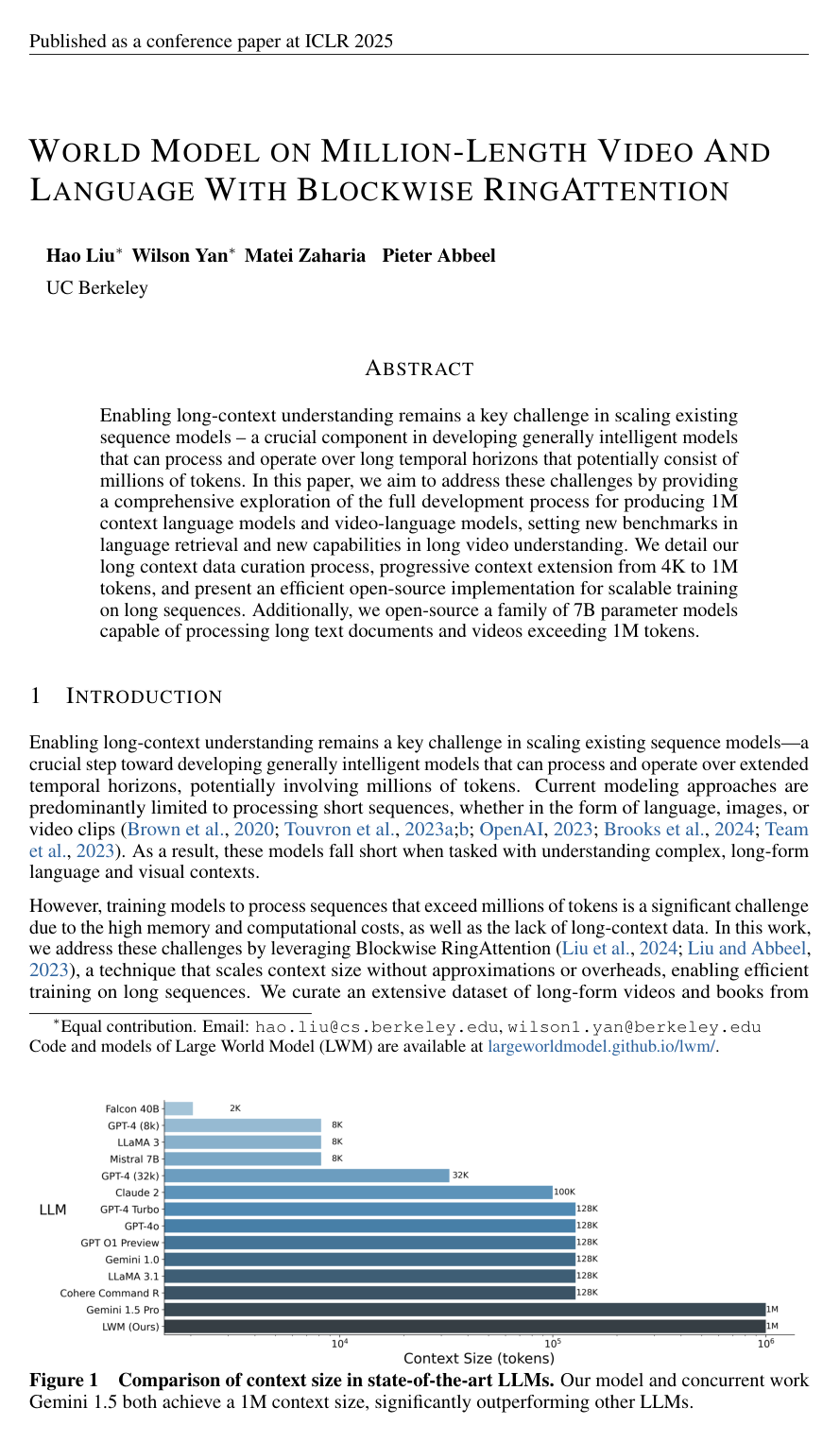
World Model on Million-Length Video And Language With Blockwise RingAttention
Hao Liu, Wilson Yan, Matei Zaharia, Pieter Abbeel
Why you should read this
Presents an open-source training method and 7B parameter model family that scales multimodal context to one million tokens using Blockwise RingAttention, enabling the processing of hour-long videos and massive text sequences.
Enabling long-context understanding remains a key challenge in scaling existing sequence models -- a crucial component in developing generally intelligent models that can process and operate over long temporal horizons that potentially consist of millions of tokens. In this paper, we aim to address these challenges by providing a comprehensive exploration of the full development process for producing 1M context language models and video-language models, setting new benchmarks in language retrieval and new capabilities in long video understanding. We detail our long context data curation process, progressive context extension from 4K to 1M tokens, and present an efficient open-source implementation for scalable training on long sequences. Additionally, we open-source a family of 7B parameter models capable of processing long text documents and videos exceeding 1M tokens.
Added
2026-09-26
Mastering Diverse Domains through World Models
Danijar Hafner, Jurgis Pasukonis, Jimmy Ba, Timothy Lillicrap
Why you should read this
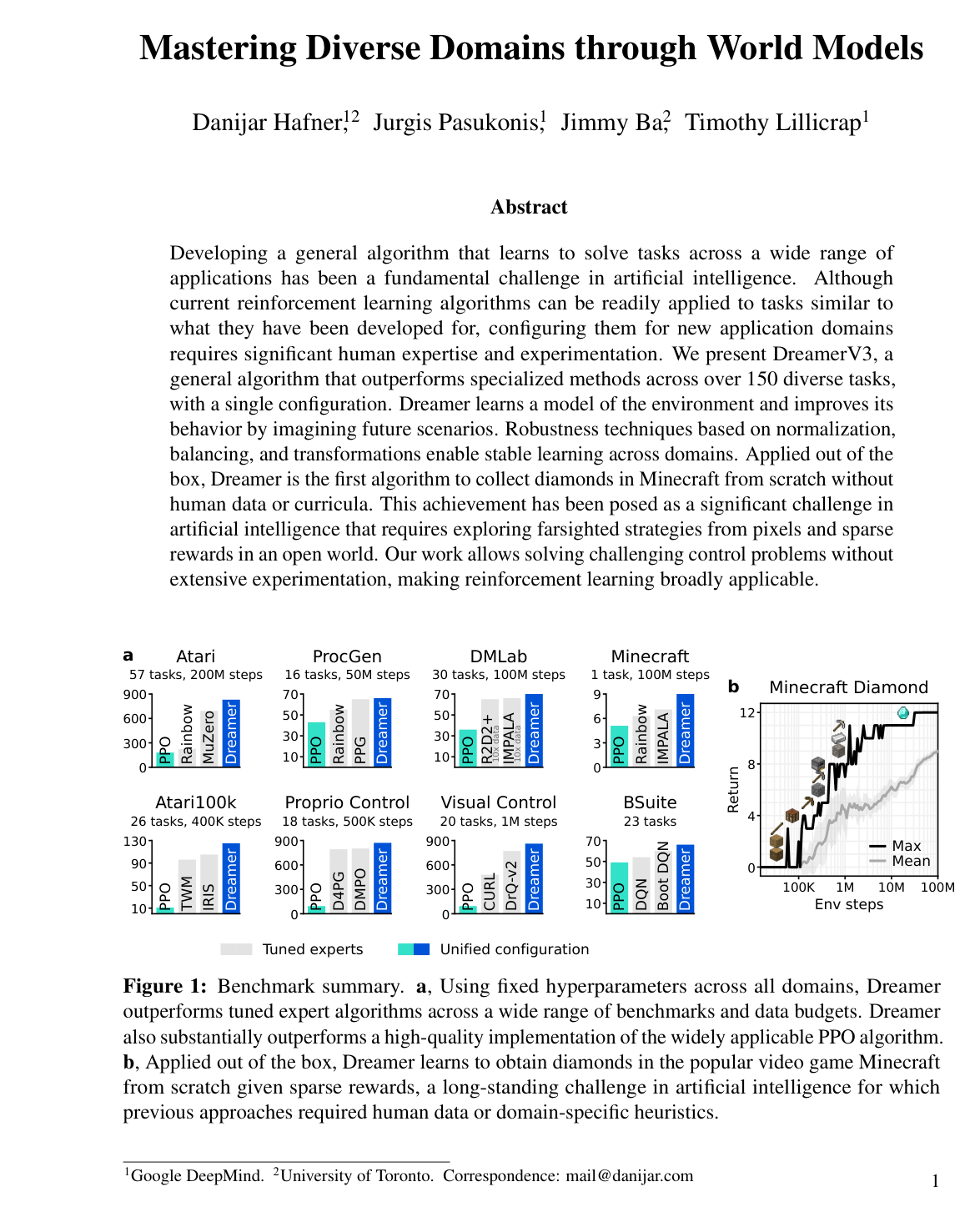
Introduces DreamerV3, a world-model algorithm that solves over 150 diverse reinforcement learning tasks with a single set of hyperparameters and becomes the first to collect diamonds in Minecraft from scratch without human data or curricula.
Developing a general algorithm that learns to solve tasks across a wide range of applications has been a fundamental challenge in artificial intelligence. Although current reinforcement learning algorithms can be readily applied to tasks similar to what they have been developed for, configuring them for new application domains requires significant human expertise and experimentation. We present DreamerV3, a general algorithm that outperforms specialized methods across over 150 diverse tasks, with a single configuration. Dreamer learns a model of the environment and improves its behavior by imagining future scenarios. Robustness techniques based on normalization, balancing, and transformations enable stable learning across domains. Applied out of the box, Dreamer is the first algorithm to collect diamonds in Minecraft from scratch without human data or curricula. This achievement has been posed as a significant challenge in artificial intelligence that requires exploring farsighted strategies from pixels and sparse rewards in an open world. Our work allows solving challenging control problems without extensive experimentation, making reinforcement learning broadly applicable.
Added
2026-09-25
Recurrent World Models Facilitate Policy Evolution
David Ha, Jürgen Schmidhuber
Why you should read this
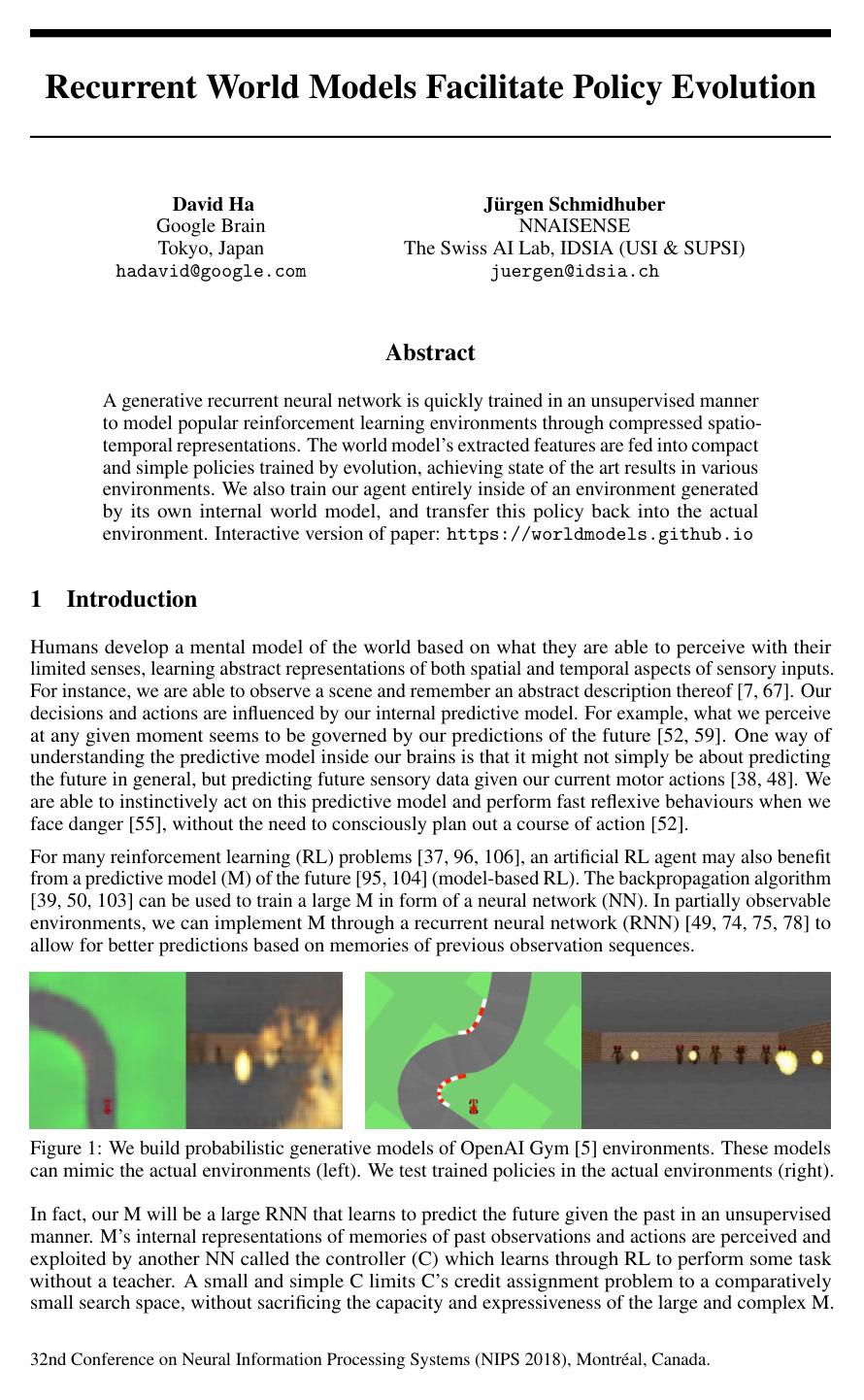
Demonstrates that compact policies can be trained entirely inside hallucinated environments generated by an unsupervised recurrent world model and successfully transferred to complex control tasks.
A generative recurrent neural network is quickly trained in an unsupervised manner to model popular reinforcement learning environments through compressed spatio-temporal representations. The world model's extracted features are fed into compact and simple policies trained by evolution, achieving state of the art results in various environments. We also train our agent entirely inside of an environment generated by its own internal world model, and transfer this policy back into the actual environment. Interactive version of paper at this https URL
Added
2026-09-25
On Training in Imagination
Nadav Timor, Ravid Shwartz-Ziv, Micah Goldblum, Yann LeCun, David Harel
Why you should read this
Quantifies how errors in learned dynamics and reward models affect policy optimization, offering an optimal sample allocation strategy and analyzing the trade-off of using noisy rewards in imagination-based reinforcement learning.
State-of-the-art model-based reinforcement learning methods train policies on imagined rollouts. These rollouts are trajectories generated by a learned dynamics model and are scored by a learned reward model, but without querying the true environment during policy updates. We study this training paradigm by quantifying how errors in learned dynamics and reward models affect returns and policy optimization. First, we extend the analysis of Asadi et al. (2018) to MDPs with learned reward models, and derive the optimal sample allocation--the ratio of dynamics samples to reward samples that minimizes a bound on return error under power-law scaling assumptions. We identify lower Lipschitz constants of the learned dynamics, reward, and policy as a representation desideratum that tightens this bound, and we connect this perspective to the temporal-straightening objective of Wang et al. (2026). Second, we examine how policy optimization with REINFORCE tolerates noisy rewards, which are often cheaper to obtain. We show that zero-mean reward noise leaves the gradient estimator unbiased and adds at most a variance term that decreases with the number of rollouts. This introduces a practical tradeoff: given a fixed budget, should one buy more rollouts with cheaper but noisier rewards, or fewer rollouts with more expensive but less noisy rewards? We reduce this choice to a one-dimensional optimization problem and characterize the optimum.
Added
2026-05-18

Zero-shot World Models Are Developmentally Efficient Learners
Khai Loong Aw, Klemen Kotar, Wanhee Lee, Seungwoo Kim, Khaled Jedoui, Rahul Venkatesh, Lilian Naing Chen, Michael C. Frank, Daniel L.K. Yamins
Why you should read this
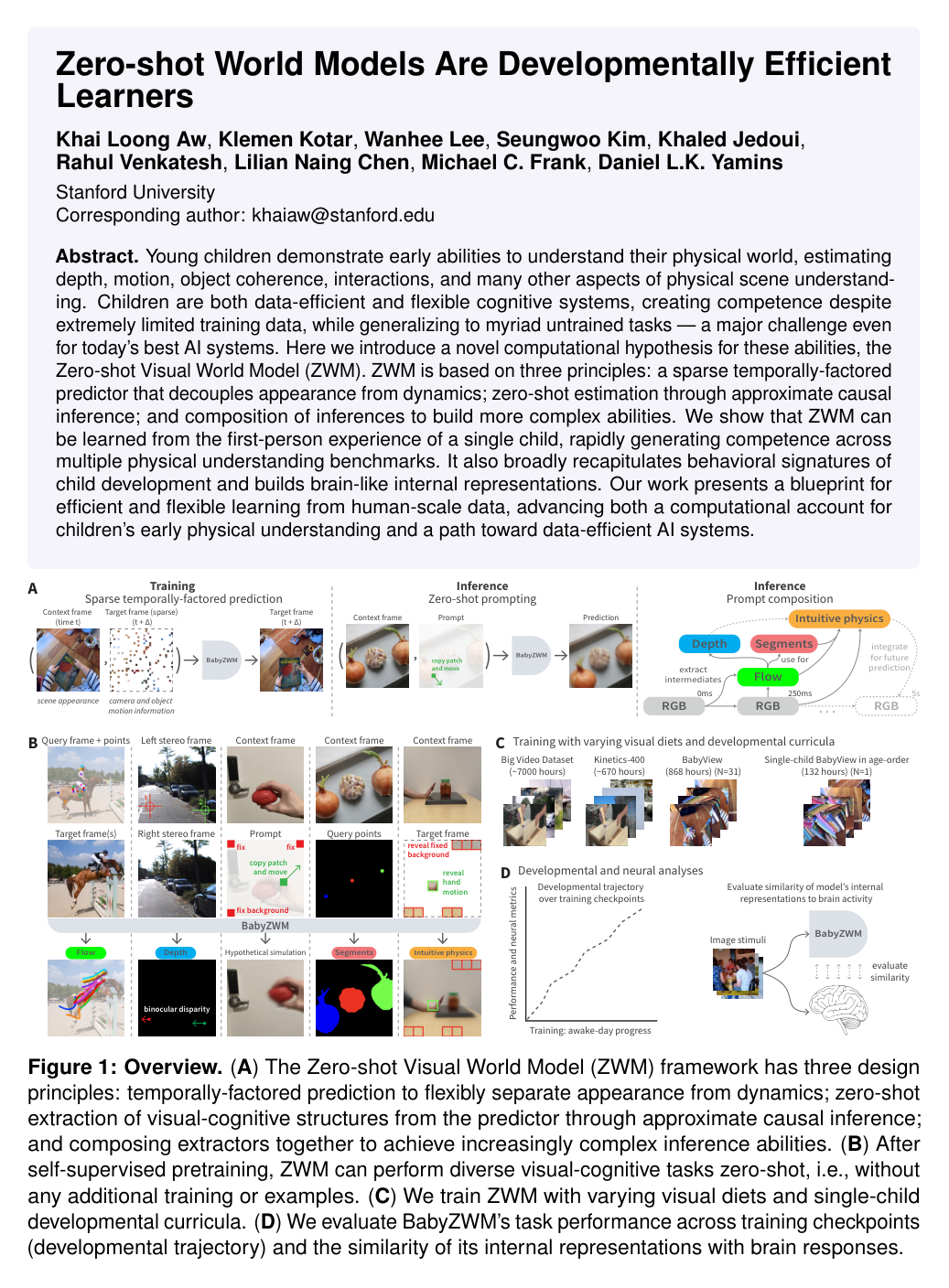
Demonstrates how a novel Zero-shot Visual World Model (ZWM), learned from minimal data, can replicate key aspects of child development in physical understanding and offers a pathway towards creating more data-efficient and flexible AI systems.
Young children demonstrate early abilities to understand their physical world, estimating depth, motion, object coherence, interactions, and many other aspects of physical scene understanding. Children are both data-efficient and flexible cognitive systems, creating competence despite extremely limited training data, while generalizing to myriad untrained tasks -- a major challenge even for today's best AI systems. Here we introduce a novel computational hypothesis for these abilities, the Zero-shot Visual World Model (ZWM). ZWM is based on three principles: a sparse temporally-factored predictor that decouples appearance from dynamics; zero-shot estimation through approximate causal inference; and composition of inferences to build more complex abilities. We show that ZWM can be learned from the first-person experience of a single child, rapidly generating competence across multiple physical understanding benchmarks. It also broadly recapitulates behavioral signatures of child development and builds brain-like internal representations. Our work presents a blueprint for efficient and flexible learning from human-scale data, advancing both a computational account for children's early physical understanding and a path toward data-efficient AI systems.
Added
2026-04-23