
keyword
word representations
Word representations are mathematical encodings, typically in the form of real-valued vectors, that represent words in a format suitable for computational processing by natural language processing systems and machine learning models. These representations map words into a continuous geometric space where spatial relationships, such as distance and direction between vectors, capture syntactic, semantic, and relational similarities based on patterns of word usage across large text corpora. They encompass discrete clustering techniques, static distributed word vectors that assign a fixed embedding to each vocabulary item or subword, and dynamic contextualized representations produced by deep neural networks that adapt a word embedding based on its surrounding linguistic context.
18 items
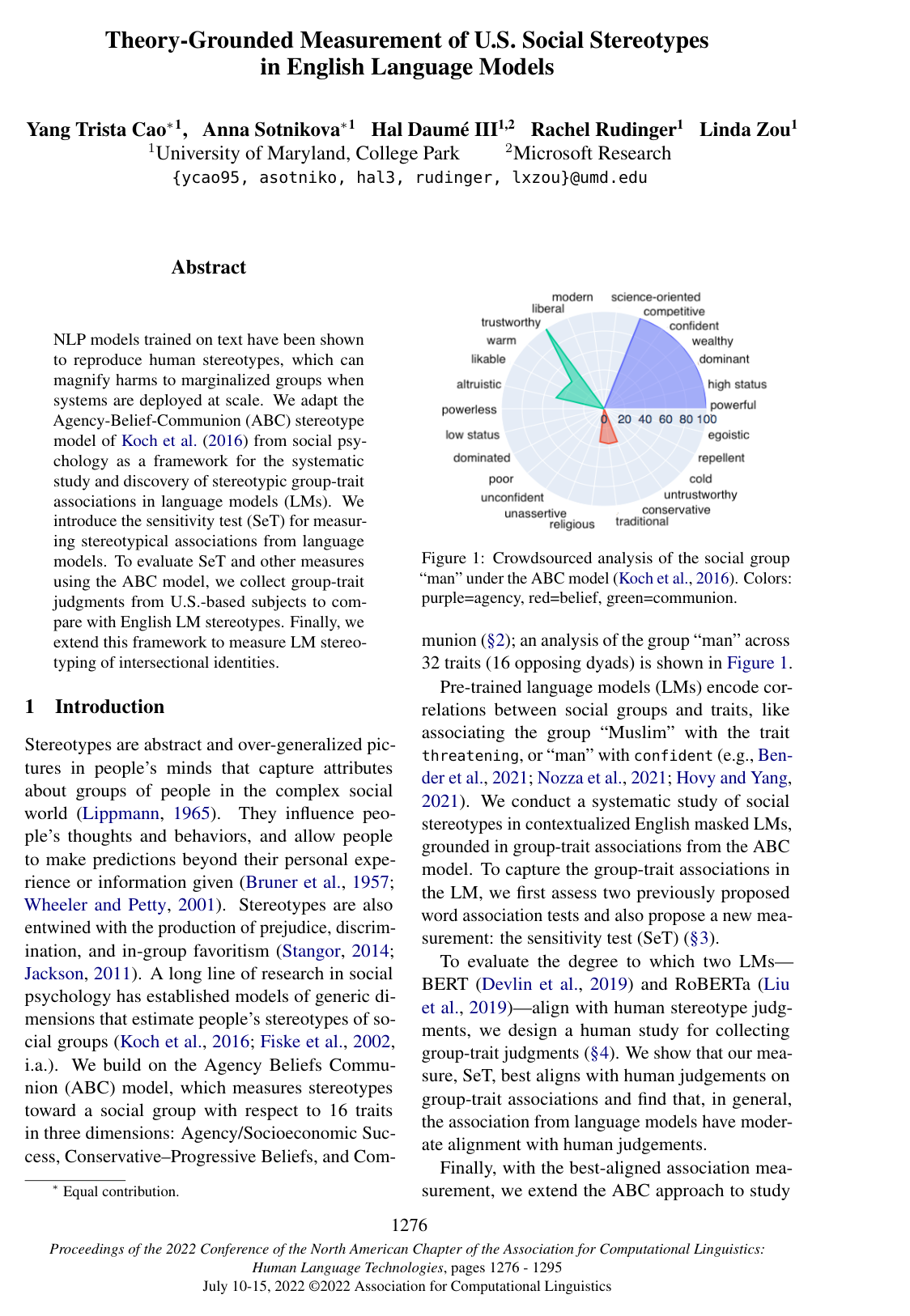
Theory-Grounded Measurement of U.S. Social Stereotypes in English Language Models
Yang Trista Cao, Anna Sotnikova, Hal Daumé III, Rachel Rudinger, Linda Zou
Why you should read this
Adapts a social psychology framework to systematically quantify and evaluate how English language models reproduce human stereotypes across single and intersectional social groups using a novel sensitivity test validated against human judgments.
NLP models trained on text have been shown to reproduce human stereotypes, which can magnify harms to marginalized groups when systems are deployed at scale. We adapt the Agency-Belief-Communion (ABC) stereotype model of Koch et al. (2016) from social psychology as a framework for the systematic study and discovery of stereotypic group-trait associations in language models (LMs). We introduce the sensitivity test (SeT) for measuring stereotypical associations from language models. To evaluate SeT and other measures using the ABC model, we collect group-trait judgments from U.S.-based subjects to compare with English LM stereotypes. Finally, we extend this framework to measure LM stereotyping of intersectional identities.
Added
2026-10-03
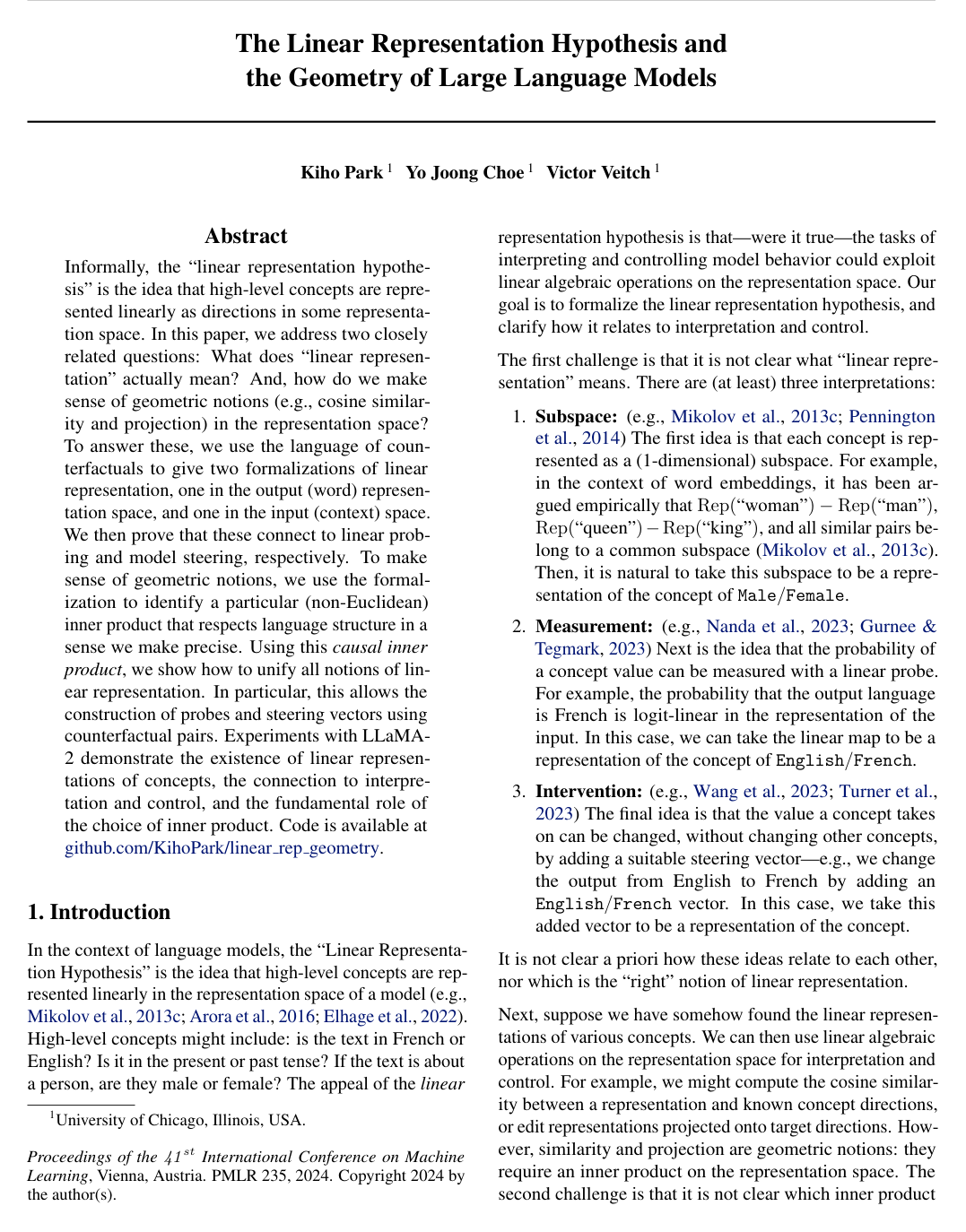
The Linear Representation Hypothesis and the Geometry of Large Language Models
Kiho Park, Yo Joong Choe, Victor Veitch
Why you should read this
Formalizes the linear representation hypothesis using counterfactual pairs to unify linear probing and steering under a causally grounded inner product for large language model representations.
Informally, the "linear representation hypothesis" is the idea that high-level concepts are represented linearly as directions in some representation space. In this paper, we address two closely related questions: What does "linear representation" actually mean? And, how do we make sense of geometric notions (e.g., cosine similarity and projection) in the representation space? To answer these, we use the language of counterfactuals to give two formalizations of linear representation, one in the output (word) representation space, and one in the input (context) space. We then prove that these connect to linear probing and model steering, respectively. To make sense of geometric notions, we use the formalization to identify a particular (non-Euclidean) inner product that respects language structure in a sense we make precise. Using this causal inner product, we show how to unify all notions of linear representation. In particular, this allows the construction of probes and steering vectors using counterfactual pairs. Experiments with LLaMA-2 demonstrate the existence of linear representations of concepts, the connection to interpretation and control, and the fundamental role of the choice of inner product. Code is available at github.com/KihoPark/linear_rep_geometry.
Added
2026-09-26
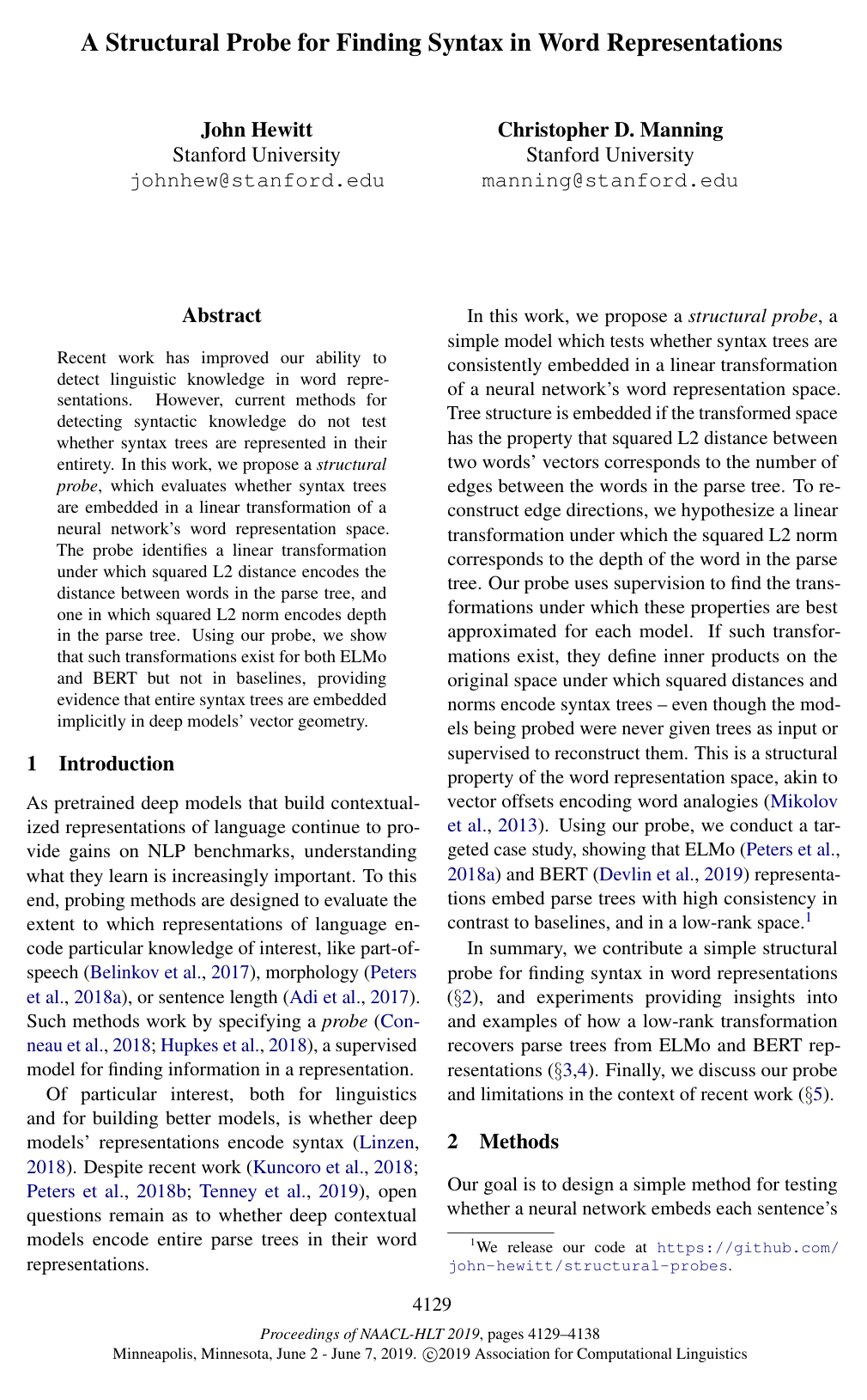
A Structural Probe for Finding Syntax in Word Representations
John Hewitt, Christopher D. Manning
Why you should read this
Proposes a geometric probing framework to demonstrate that contextual language models like BERT and ELMo implicitly embed entire hierarchical syntax trees directly within linear subspaces of their vector representations.
Recent work has improved our ability to detect linguistic knowledge in word representations. However, current methods for detecting syntactic knowledge do not test whether syntax trees are represented in their entirety. In this work, we propose a structural probe, which evaluates whether syntax trees are embedded in a linear transformation of a neural network's word representation space. The probe identifies a linear transformation under which squared L2 distance encodes the distance between words in the parse tree, and one in which squared L2 norm encodes depth in the parse tree. Using our probe, we show that such transformations exist for both ELMo and BERT but not in baselines, providing evidence that entire syntax trees are embedded implicitly in deep models' vector geometry.
Added
2026-09-25
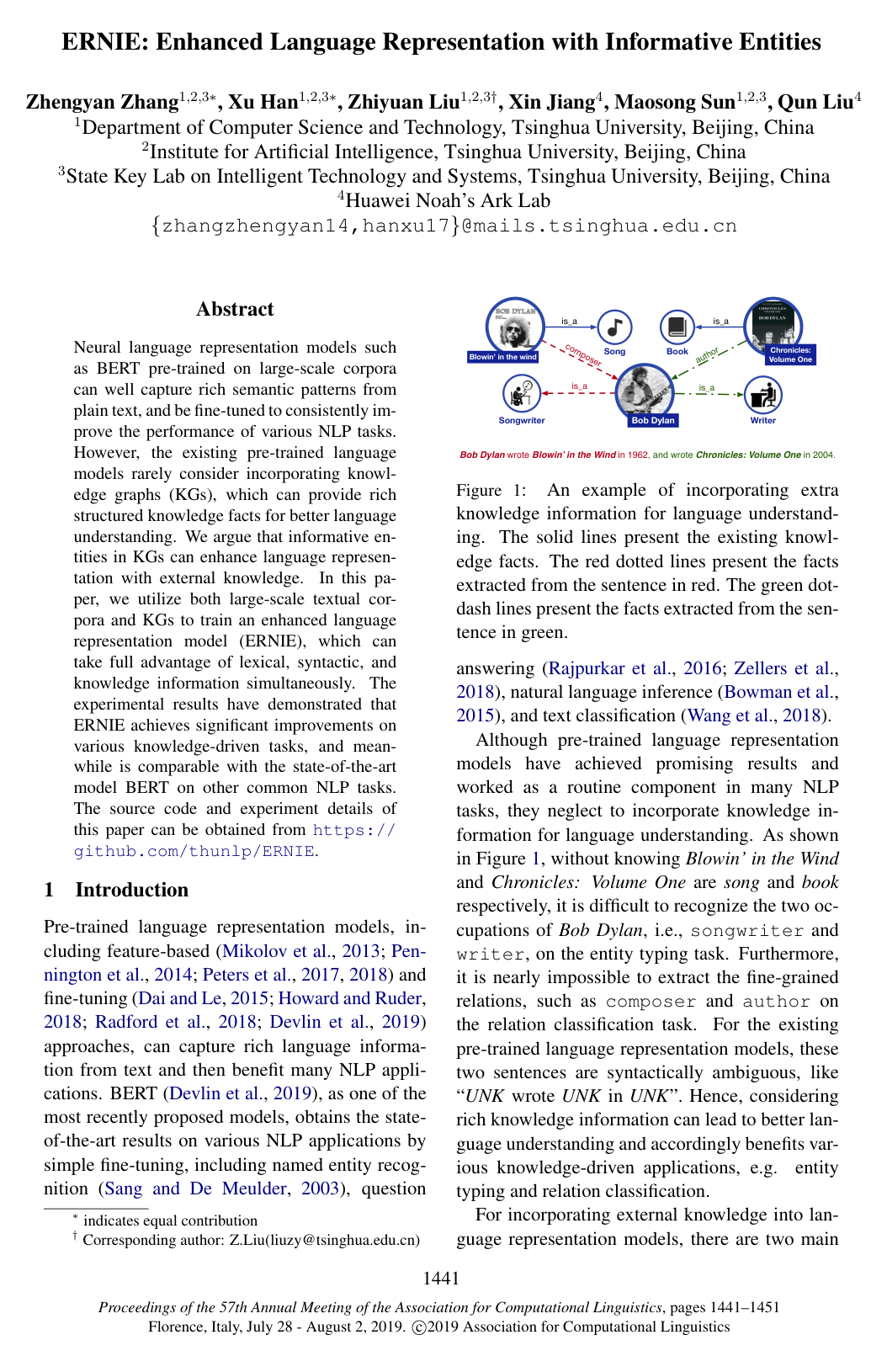
ERNIE: Enhanced Language Representation with Informative Entities
Zhengyan Zhang, Xu Han, Zhiyuan Liu, Xin Jiang, Maosong Sun, Qun Liu
Why you should read this
Introduces ERNIE, a framework that integrates structured knowledge graphs into pre-trained language representations to improve performance on knowledge-driven tasks without sacrificing general language understanding.
Neural language representation models such as BERT pre-trained on large-scale corpora can well capture rich semantic patterns from plain text, and be fine-tuned to consistently improve the performance of various NLP tasks. However, the existing pre-trained language models rarely consider incorporating knowledge graphs (KGs), which can provide rich structured knowledge facts for better language understanding. We argue that informative entities in KGs can enhance language representation with external knowledge. In this paper, we utilize both large-scale textual corpora and KGs to train an enhanced language representation model (ERNIE), which can take full advantage of lexical, syntactic, and knowledge information simultaneously. The experimental results have demonstrated that ERNIE achieves significant improvements on various knowledge-driven tasks, and meanwhile is comparable with the state-of-the-art model BERT on other common NLP tasks. The source code of this paper can be obtained from this https URL.
Added
2026-09-24
Learning Word Vectors for 157 Languages
Edouard Grave, Piotr Bojanowski, Prakhar Gupta, Armand Joulin, Tomas Mikolov
Why you should read this
Provides pre-trained fastText word embeddings for 157 languages trained on massive Wikipedia and Common Crawl data alongside new analogy evaluation benchmarks for French, Hindi, and Polish.
Distributed word representations, or word vectors, have recently been applied to many tasks in natural language processing, leading to state-of-the-art performance. A key ingredient to the successful application of these representations is to train them on very large corpora, and use these pre-trained models in downstream tasks. In this paper, we describe how we trained such high quality word representations for 157 languages. We used two sources of data to train these models: the free online encyclopedia Wikipedia and data from the common crawl project. We also introduce three new word analogy datasets to evaluate these word vectors, for French, Hindi and Polish. Finally, we evaluate our pre-trained word vectors on 10 languages for which evaluation datasets exists, showing very strong performance compared to previous models.
Added
2026-09-24
What Does BERT Learn about the Structure of Language?
Ganesh Jawahar, Benoît Sagot, Djamé Seddah
Why you should read this
Demonstrates how BERT encodes a bottom-to-top hierarchy of surface, syntactic, and semantic information across its layers while implicitly representing tree-like compositional structures to resolve long-distance dependencies.
BERT is a recent language representation model that has surprisingly performed well in diverse language understanding benchmarks. This result indicates the possibility that BERT networks capture structural information about language. In this work, we provide novel support for this claim by performing a series of experiments to unpack the elements of English language structure learned by BERT. We first show that BERT’s phrasal representation captures phrase-level information in the lower layers. We also show that BERT’s intermediate layers encode a rich hierarchy of linguistic information, with surface features at the bottom, syntactic features in the middle and semantic features at the top. BERT turns out to require deeper layers when long-distance dependency information is required, e.g. to track subject-verb agreement. Finally, we show that BERT representations capture linguistic information in a compositional way that mimics classical, tree-like structures.
Added
2026-09-24
Exploiting Similarities among Languages for Machine Translation
Tomas Mikolov, Quoc V. Le, Ilya Sutskever
Why you should read this
Demonstrates that learning a simple linear mapping between monolingual vector spaces can automatically translate missing words and phrases across language pairs with high accuracy using minimal bilingual data.
Dictionaries and phrase tables are the basis of modern statistical machine translation systems. This paper develops a method that can automate the process of generating and extending dictionaries and phrase tables. Our method can translate missing word and phrase entries by learning language structures based on large monolingual data and mapping between languages from small bilingual data. It uses distributed representation of words and learns a linear mapping between vector spaces of languages. Despite its simplicity, our method is surprisingly effective: we can achieve almost 90% precision@5 for translation of words between English and Spanish. This method makes little assumption about the languages, so it can be used to extend and refine dictionaries and translation tables for any language pairs.
Added
2026-09-24
Character-Aware Neural Language Models
Yoon Kim, Yacine Jernite, D. Sontag, Alexander M. Rush
Why you should read this
Proposes a compact language model combining character-level convolutional and highway networks with an LSTM to achieve state-of-the-art word prediction across multiple morphologically rich languages using substantially fewer parameters without input word embeddings.
We describe a simple neural language model that relies only on character-level inputs. Predictions are still made at the word-level. Our model employs a convolutional neural network (CNN) and a highway network over characters, whose output is given to a long short-term memory (LSTM) recurrent neural network language model (RNN-LM). On the English Penn Treebank the model is on par with the existing state-of-the-art despite having 60% fewer parameters. On languages with rich morphology (Arabic, Czech, French, German, Spanish, Russian), the model outperforms word-level/morpheme-level LSTM baselines, again with fewer parameters. The results suggest that on many languages, character inputs are sufficient for language modeling. Analysis of word representations obtained from the character composition part of the model reveals that the model is able to encode, from characters only, both semantic and orthographic information.
Added
2026-09-24
Language (Technology) is Power: A Critical Survey of “Bias” in NLP
Su Lin Blodgett, Solon Barocas, Hal Daum'e, Hanna M. Wallach
Why you should read this
Reveals pervasive conceptual weaknesses across 146 natural language processing bias studies and delivers essential guidelines for aligning technical mitigation methods with normative reasoning and social power dynamics.
We survey 146 papers analyzing "bias" in NLP systems, finding that their motivations are often vague, inconsistent, and lacking in normative reasoning, despite the fact that analyzing "bias" is an inherently normative process. We further find that these papers' proposed quantitative techniques for measuring or mitigating "bias" are poorly matched to their motivations and do not engage with the relevant literature outside of NLP. Based on these findings, we describe the beginnings of a path forward by proposing three recommendations that should guide work analyzing "bias" in NLP systems. These recommendations rest on a greater recognition of the relationships between language and social hierarchies, encouraging researchers and practitioners to articulate their conceptualizations of "bias"---i.e., what kinds of system behaviors are harmful, in what ways, to whom, and why, as well as the normative reasoning underlying these statements---and to center work around the lived experiences of members of communities affected by NLP systems, while interrogating and reimagining the power relations between technologists and such communities.
Added
2026-09-18
What Does BERT Look at? An Analysis of BERT’s Attention
Kevin Clark, Urvashi Khandelwal, Omer Levy, Christopher D. Manning
Why you should read this
Reveals that individual attention heads in BERT encode distinct grammatical relations and coreference patterns, offering an attention-based analysis framework to interpret linguistic knowledge inside transformer models.
Large pre-trained neural networks such as BERT have had great recent success in NLP, motivating a growing body of research investigating what aspects of language they are able to learn from unlabeled data. Most recent analysis has focused on model outputs (e.g., language model surprisal) or internal vector representations (e.g., probing classifiers). Complementary to these works, we propose methods for analyzing the attention mechanisms of pre-trained models and apply them to BERT. BERT's attention heads exhibit patterns such as attending to delimiter tokens, specific positional offsets, or broadly attending over the whole sentence, with heads in the same layer often exhibiting similar behaviors. We further show that certain attention heads correspond well to linguistic notions of syntax and coreference. For example, we find heads that attend to the direct objects of verbs, determiners of nouns, objects of prepositions, and coreferent mentions with remarkably high accuracy. Lastly, we propose an attention-based probing classifier and use it to further demonstrate that substantial syntactic information is captured in BERT's attention.
Added
2026-09-18
BERT Rediscovers the Classical NLP Pipeline
Ian Tenney, Dipanjan Das, Ellie Pavlick
Why you should read this
Reveals that BERT encodes linguistic features sequentially across its layers in the exact order of the traditional NLP pipeline, from part-of-speech tagging to coreference resolution, while dynamically updating earlier representations using higher-level context.
Pre-trained text encoders have rapidly advanced the state of the art on many NLP tasks. We focus on one such model, BERT, and aim to quantify where linguistic information is captured within the network. We find that the model represents the steps of the traditional NLP pipeline in an interpretable and localizable way, and that the regions responsible for each step appear in the expected sequence: POS tagging, parsing, NER, semantic roles, then coreference. Qualitative analysis reveals that the model can and often does adjust this pipeline dynamically, revising lower-level decisions on the basis of disambiguating information from higher-level representations.
Added
2026-09-17
Reasoning With Neural Tensor Networks for Knowledge Base Completion
R. Socher, Danqi Chen, Christopher D. Manning, A. Ng
Why you should read this
Introduces Neural Tensor Networks to predict missing relationships in knowledge bases by replacing standard linear layers with bilinear tensor operations and composing entity representations from pretrained word embeddings.
Knowledge bases are an important resource for question answering and other tasks but often suffer from incompleteness and lack of ability to reason over their discrete entities and relationships. In this paper we introduce an expressive neural tensor network suitable for reasoning over relationships between two entities. Previous work represented entities as either discrete atomic units or with a single entity vector representation. We show that performance can be improved when entities are represented as an average of their constituting word vectors. This allows sharing of statistical strength between, for instance, facts involving the “Sumatran tiger” and “Bengal tiger.” Lastly, we demonstrate that all models improve when these word vectors are initialized with vectors learned from unsupervised large corpora. We assess the model by considering the problem of predicting additional true relations between entities given a subset of the knowledge base. Our model outperforms previous models and can classify unseen relationships in WordNet and FreeBase with an accuracy of 86.2% and 90.0%, respectively.
Added
2026-09-16
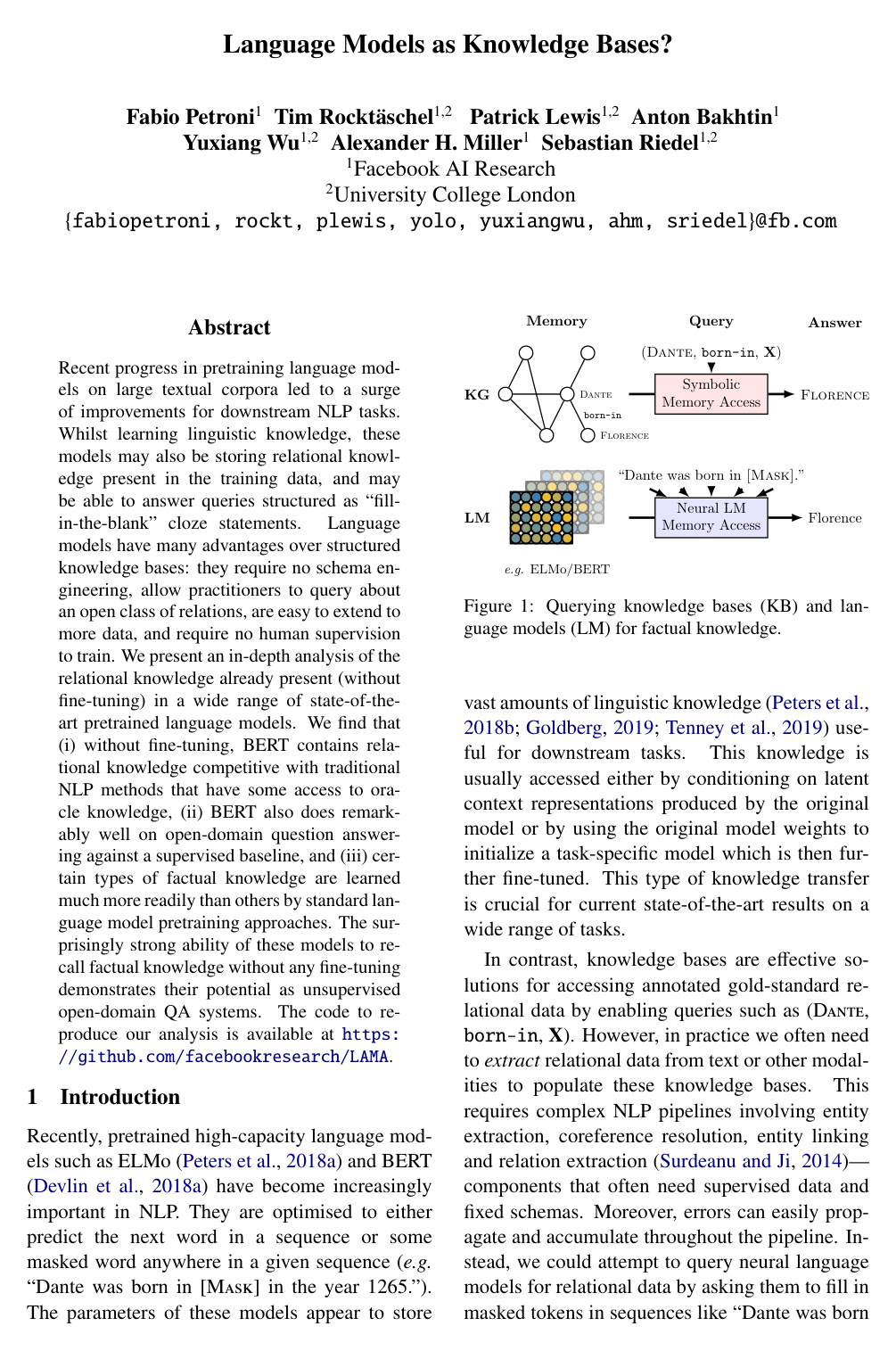
Language Models as Knowledge Bases?
Fabio Petroni, Tim Rocktäschel, Patrick Lewis, Anton Bakhtin, Yuxiang Wu, Alexander H. Miller, Sebastian Riedel
Why you should read this
Demonstrates that pretrained language models store substantial relational facts, enabling them to function as queryable knowledge bases for open-domain question answering without fine-tuning or schema engineering.
Recent progress in pretraining language models on large textual corpora led to a surge of improvements for downstream NLP tasks. Whilst learning linguistic knowledge, these models may also be storing relational knowledge present in the training data, and may be able to answer queries structured as "fill-in-the-blank" cloze statements. Language models have many advantages over structured knowledge bases: they require no schema engineering, allow practitioners to query about an open class of relations, are easy to extend to more data, and require no human supervision to train. We present an in-depth analysis of the relational knowledge already present (without fine-tuning) in a wide range of state-of-the-art pretrained language models. We find that (i) without fine-tuning, BERT contains relational knowledge competitive with traditional NLP methods that have some access to oracle knowledge, (ii) BERT also does remarkably well on open-domain question answering against a supervised baseline, and (iii) certain types of factual knowledge are learned much more readily than others by standard language model pretraining approaches. The surprisingly strong ability of these models to recall factual knowledge without any fine-tuning demonstrates their potential as unsupervised open-domain QA systems. The code to reproduce our analysis is available at this https URL.
Added
2026-09-11
Learning Word Vectors for Sentiment Analysis
Andrew L. Maas, Raymond E. Daly, Peter T. Pham, Dan Huang, Andrew Y. Ng, Christopher Potts
Why you should read this
Proposes a semi-supervised framework for learning word vectors that capture both semantic meaning and sentiment polarity, while establishing the widely used IMDb movie review dataset for sentiment classification.
Unsupervised vector-based approaches to semantics can model rich lexical meanings, but they largely fail to capture sentiment information that is central to many word meanings and important for a wide range of NLP tasks. We present a model that uses a mix of unsupervised and supervised techniques to learn word vectors capturing semantic term–document information as well as rich sentiment content. The proposed model can leverage both continuous and multi-dimensional sentiment information as well as non-sentiment annotations. We instantiate the model to utilize the document-level sentiment polarity annotations present in many online documents (e.g. star ratings). We evaluate the model using small, widely used sentiment and subjectivity corpora and find it out-performs several previously introduced methods for sentiment classification. We also introduce a large dataset of movie reviews to serve as a more robust benchmark for work in this area.
Added
2026-09-09
Enriching Word Vectors with Subword Information
Piotr Bojanowski, Édouard Grave, Armand Joulin, Tomáš Mikolov
Why you should read this
Extends the skip-gram model to incorporate subword character n-grams to build robust representations for out-of-vocabulary words and morphologically rich languages.
Continuous word representations, trained on large unlabeled corpora are useful for many natural language processing tasks. Popular models that learn such representations ignore the morphology of words, by assigning a distinct vector to each word. This is a limitation, especially for languages with large vocabularies and many rare words. In this paper, we propose a new approach based on the skipgram model, where each word is represented as a bag of character n-grams. A vector representation is associated to each character n-gram; words being represented as the sum of these representations. Our method is fast, allowing to train models on large corpora quickly and allows us to compute word representations for words that did not appear in the training data. We evaluate our word representations on nine different languages, both on word similarity and analogy tasks. By comparing to recently proposed morphological word representations, we show that our vectors achieve state-of-the-art performance on these tasks.
Added
2026-05-04

Word Representations: A Simple and General Method for Semi-Supervised Learning.
Joseph Turian, Lev-Arie Ratinov, Yoshua Bengio
Why you should read this
Demonstrates that augmenting supervised NLP systems with unsupervised word representations—such as Brown clusters and neural embeddings—offers a simple, model-agnostic method to significantly improve accuracy on sequence labeling tasks by effectively mitigating data sparsity.
If we take an existing supervised NLP system, a simple and general way to improve accuracy is to use unsupervised word representations as extra word features. We evaluate Brown clusters, Collobert and Weston (2008) embeddings, and HLBL (Mnih & Hinton, 2009) embeddings of words on both NER and chunking. We use near state-of-the-art supervised baselines, and find that each of the three word representations improves the accuracy of these baselines. We find further improvements by combining different word representations. You can download our word features, for off-the-shelf use in existing NLP systems, as well as our code, here: http://metaoptimize.com/projects/wordreprs/
Added
2026-02-21
Distributed Representations of Words and Phrases and their Compositionality
Tomas Mikolov, Ilya Sutskever, Kai Chen, Greg Corrado, Jeffrey Dean
Why you should read this
Demonstrates how to create simple yet powerful word vector representations that capture meaningful relationships between words and phrases, enabling basic arithmetic operations to produce linguistically sensible results while training significantly faster than previous methods.
The recently introduced continuous Skip-gram model is an efficient method for learning high-quality distributed vector representations that capture a large number of precise syntactic and semantic word relationships. In this paper we present several extensions that improve both the quality of the vectors and the training speed. By subsampling of the frequent words we obtain significant speedup and also learn more regular word representations. We also describe a simple alternative to the hierarchical softmax called negative sampling. An inherent limitation of word representations is their indifference to word order and their inability to represent idiomatic phrases. For example, the meanings of "Canada" and "Air" cannot be easily combined to obtain "Air Canada". Motivated by this example, we present a simple method for finding phrases in text, and show that learning good vector representations for millions of phrases is possible.
Added
2026-02-21
Efficient Estimation of Word Representations in Vector Space
Tomáš Mikolov, Kai Chen, Greg Corrado, Jeffrey Dean
Why you should read this
Proposes the continuous bag-of-words and skip-gram architectures that establish the fundamental paradigm of efficiently learning dense semantic vectors from text corpora.
We propose two novel model architectures for computing continuous vector representations of words from very large data sets. The quality of these representations is measured in a word similarity task, and the results are compared to the previously best performing techniques based on different types of neural networks. We observe large improvements in accuracy at much lower computational cost, i.e. it takes less than a day to learn high quality word vectors from a 1.6 billion words data set. Furthermore, we show that these vectors provide state-of-the-art performance on our test set for measuring syntactic and semantic word similarities.
Added
2025-09-29
License
Published with permission