
Enriching Word Vectors with Subword Information
Piotr Bojanowski $^{}$ and Edouard Grave $^{}$ and Armand Joulin and Tomas Mikolov
Facebook AI Research
[email protected], [email protected], [email protected], [email protected]
$^{*}$ The two first authors contributed equally.
Abstract
Continuous word representations, trained on large unlabeled corpora are useful for many natural language processing tasks. Popular models that learn such representations ignore the morphology of words, by assigning a distinct vector to each word. This is a limitation, especially for languages with large vocabularies and many rare words. In this paper, we propose a new approach based on the skipgram model, where each word is represented as a bag of character $n$-grams. A vector representation is associated to each character $n$-gram; words being represented as the sum of these representations. Our method is fast, allowing to train models on large corpora quickly and allows us to compute word representations for words that did not appear in the training data. We evaluate our word representations on nine different languages, both on word similarity and analogy tasks. By comparing to recently proposed morphological word representations, we show that our vectors achieve state-of-the-art performance on these tasks.
Executive Summary: ### Context and Problem Natural language processing (NLP) relies on numerical representations of words, known as word vectors, to understand text semantics and enable tasks like translation or sentiment analysis. Traditional methods train these vectors from vast unlabeled text corpora but treat each word as an isolated unit, ignoring its internal structure or morphology—the way words form through prefixes, suffixes, and roots. This limitation hits hard in languages with rich morphology, such as German, Russian, or Arabic, where verbs and nouns change forms extensively, leading to many rare or unseen words in training data. With growing demand for multilingual AI systems and handling low-resource languages, better word vectors are needed now to boost accuracy in real-world applications like search engines, chatbots, and content moderation, where rare words or dialects often appear.
Objective
This paper introduces and evaluates a simple extension to the popular skip-gram model for learning word vectors, incorporating subword information from character n-grams—short sequences of 3 to 6 characters within words—to better capture morphology without needing complex word breakdowns.
Approach
The authors adapted the skip-gram model, which predicts surrounding words in a text to learn vectors, by representing each word as the sum of vectors for its character n-grams (e.g., the word "where" includes "<whe", "wher", "here", etc., with special markers for word boundaries). They trained models using stochastic gradient descent on shuffled Wikipedia dumps from nine languages (Arabic, Czech, German, English, Spanish, French, Italian, Romanian, Russian), covering about 100 million to 1 billion words per language, with five passes over the data. Key aspects include hashing n-grams to manage memory efficiently (up to 2 million unique ones), sampling 5 negative examples per positive context, and using a 300-dimensional vector space. This setup allows fast training—about 1.5 times slower than baselines but scalable—and generates vectors for unseen words by summing their n-grams, enhancing credibility through comparisons to established baselines like word2vec.
Key Findings
The method achieved state-of-the-art results on word similarity tasks, where vectors' cosine similarities correlate with human judgments. On datasets like German's GUR350, it reached 70% Spearman correlation, about 13% higher than the skip-gram baseline's 62%; gains were larger for morphologically rich languages (e.g., 12% improvement in Arabic and Russian) and rare English words (48% vs. 43%). For word analogy tasks (e.g., "king is to queen as man is to woman"), it boosted syntactic accuracy by 10-25% across Czech, German, English, and Italian (e.g., 78% vs. 56% in Czech syntactic), though semantic analogies saw minor drops of 2-5%. Compared to prior morphological methods relying on word segmentation, it outperformed on similarity benchmarks, such as 73% vs. 71% on English WS353 and 66% vs. 56% on German. It also proved robust to data scarcity: on just 5% of Wikipedia, it matched or exceeded full-data baselines (e.g., 66% on German similarity vs. baseline's 62%). Finally, initializing language models with these vectors cut perplexity by 2-13% over plain skip-gram, especially in Slavic languages.
Implications and Interpretation
These findings mean the approach creates more reliable word vectors that leverage shared subword patterns, improving NLP performance where morphology drives meaning—like in compound words (e.g., German "Tischtennis" linking to "Tennis") or inflections (e.g., verb endings in Russian). This reduces risks from rare or out-of-vocabulary words, cutting errors in applications by 10-20% on key tasks, and supports faster development for low-resource languages without annotated data. Unlike expectations that subword info might harm semantic tasks, it slightly underperforms there due to focus on short n-grams but excels syntactically, highlighting morphology's bigger role in grammar than pure meaning. Overall, it lowers costs for training on smaller datasets (e.g., 1-5% of data suffices for strong results) and enhances compliance in multilingual systems, differing from prior work by avoiding error-prone morphological parsers.
Recommendations and Next Steps
Organizations building NLP tools should integrate this subword-enriched skip-gram model (fastText) into vector training pipelines, prioritizing it for morphologically complex languages or rare-word scenarios, as it trains quickly and handles unseen terms. For optimal results, tune n-gram lengths (3-6 works broadly, but test 3-5 for semantics or longer for compounds) via small validation sets. If deploying in high-stakes areas like translation, combine with task-specific fine-tuning. Further work is needed: run pilots on domain-specific corpora (e.g., legal or medical text) to confirm gains, explore adaptive n-gram ranges via automated validation, and scale to more languages or integrate with transformers for end-to-end models. Trade-offs include minor semantic trade-offs, balanced by syntactic and robustness wins.
Limitations and Confidence
The model assumes fixed n-gram lengths, which may not capture all morphological nuances (e.g., very long compounds), and performance dips slightly on semantic analogies without tuning. Data from Wikipedia introduces biases toward formal text, and OOV handling relies on subword quality, potentially weaker for invented slang. Confidence is high for similarity and syntactic tasks across diverse languages, backed by consistent outperformance in controlled evaluations, but readers should validate on their specific data before decisions, especially for semantic-heavy applications.
1. Introduction
Section Summary: Learning continuous representations of words, a key idea in natural language processing, has evolved from using statistics on large text collections to neural network models that predict words from their surrounding context, but these approaches typically treat each word as a unique vector without considering its internal makeup. This limitation is especially challenging for languages rich in word forms, like Turkish or Finnish, where many rare variations make it hard to capture meanings effectively from training data alone. To address this, the paper introduces a method that learns vectors for character sequences called n-grams and builds word representations by summing them, extending an existing model to incorporate subword details and demonstrating improvements across nine diverse languages.
Learning continuous representations of words has a long history in natural language processing [1]. These representations are typically derived from large unlabeled corpora using co-occurrence statistics [2, 3, 4]. A large body of work, known as distributional semantics, has studied the properties of these methods [5, 6]. In the neural network community, [7] proposed to learn word embeddings using a feedforward neural network, by predicting a word based on the two words on the left and two words on the right. More recently, [8] proposed simple log-bilinear models to learn continuous representations of words on very large corpora efficiently.
Most of these techniques represent each word of the vocabulary by a distinct vector, without parameter sharing. In particular, they ignore the internal structure of words, which is an important limitation for morphologically rich languages, such as Turkish or Finnish. For example, in French or Spanish, most verbs have more than forty different inflected forms, while the Finnish language has fifteen cases for nouns. These languages contain many word forms that occur rarely (or not at all) in the training corpus, making it difficult to learn good word representations. Because many word formations follow rules, it is possible to improve vector representations for morphologically rich languages by using character level information.
In this paper, we propose to learn representations for character $n$-grams, and to represent words as the sum of the $n$-gram vectors. Our main contribution is to introduce an extension of the continuous skipgram model [8], which takes into account subword information. We evaluate this model on nine languages exhibiting different morphologies, showing the benefit of our approach.
2. Related work
Section Summary: Recent research has explored ways to improve word representations in language models by incorporating details about word structure, such as breaking words into smaller parts like morphemes or using features for rare words in languages like Turkish. Various techniques include composing word meanings from these parts, learning similarities between related words, or deriving representations from character sequences like four-grams, though many rely on word breakdown or specific training data, unlike the current approach which avoids decomposition and works on general text. Additionally, character-based models without word boundaries, using neural networks for tasks like text analysis or translation, have gained traction by directly processing letters or subword units to handle diverse languages effectively.
Morphological word representations.
In recent years, many methods have been proposed to incorporate morphological information into word representations. To model rare words better, [9] introduced factored neural language models, where words are represented as sets of features. These features might include morphological information, and this technique was succesfully applied to morphologically rich languages, such as Turkish [10]. Recently, several works have proposed different composition functions to derive representations of words from morphemes [11, 12, 13, 14]. These different approaches rely on a morphological decomposition of words, while ours does not. Similarly, [15] introduced a method to jointly learn embeddings for Chinese words and characters. [16] proposed to constrain morphologically similar words to have similar representations. [17] described a method to learn vector representations of morphological transformations, allowing to obtain representations for unseen words by applying these rules. Word representations trained on morphologically annotated data were introduced by [18]. Closest to our approach, [19] learned representations of character four-grams through singular value decomposition, and derived representations for words by summing the four-grams representations. Very recently, [20] also proposed to represent words using character $n$-gram count vectors. However, the objective function used to learn these representations is based on paraphrase pairs, while our model can be trained on any text corpus.
Character level features for NLP.
Another area of research closely related to our work are character-level models for natural language processing. These models discard the segmentation into words and aim at learning language representations directly from characters. A first class of such models are recurrent neural networks, applied to language modeling [21, 22, 23, 24], text normalization [25], part-of-speech tagging [26] and parsing [27]. Another family of models are convolutional neural networks trained on characters, which were applied to part-of-speech tagging [28], sentiment analysis [29], text classification [30] and language modeling [31]. [32] introduced a language model based on restricted Boltzmann machines, in which words are encoded as a set of character $n$-grams. Finally, recent works in machine translation have proposed using subword units to obtain representations of rare words [33, 34].
3. Model
Section Summary: This section describes a model for learning word representations that incorporates word morphology by breaking words into subword units called character n-grams, typically of lengths 3 to 6, with special markers for beginnings and ends. It builds on the skipgram method, which trains word vectors to predict surrounding words in a text corpus using a simplified binary classification approach with negative sampling for efficiency. The subword enhancement represents each word as the sum of its n-gram vectors, shared across the vocabulary via hashing to handle rare words effectively while limiting memory use.
In this section, we propose our model to learn word representations while taking into account morphology. We model morphology by considering subword units, and representing words by a sum of its character $n$-grams. We will begin by presenting the general framework that we use to train word vectors, then present our subword model and eventually describe how we handle the dictionary of character $n$-grams.
3.1 General model
We start by briefly reviewing the continuous skipgram model introduced by [8], from which our model is derived. Given a word vocabulary of size $W$, where a word is identified by its index $w\in{1, ..., W}$, the goal is to learn a vectorial representation for each word $w$. Inspired by the distributional hypothesis [35], word representations are trained to predict well words that appear in its context. More formally, given a large training corpus represented as a sequence of words $w_1, ..., w_T$, the objective of the skipgram model is to maximize the following log-likelihood:
$ \sum_{t=1}^T \ \sum_{c \in \mathcal{C}_t} \ \log p(w_c \ | \ w_t), $
where the context $\mathcal{C}_t$ is the set of indices of words surrounding word $w_t$. The probability of observing a context word $w_c$ given $w_t$ will be parameterized using the aforementioned word vectors. For now, let us consider that we are given a scoring function $s$ which maps pairs of (word, context) to scores in $\mathbb{R}$. One possible choice to define the probability of a context word is the softmax:
$ p(w_c \ | \ w_t) = \frac{e^{s(w_t, \ w_c)}}{\sum_{j=1}^W e^{s(w_t, \ j)}}. $
However, such a model is not adapted to our case as it implies that, given a word $w_t$, we only predict one context word $w_c$.
The problem of predicting context words can instead be framed as a set of independent binary classification tasks. Then the goal is to independently predict the presence (or absence) of context words. For the word at position $t$ we consider all context words as positive examples and sample negatives at random from the dictionary. For a chosen context position $c$, using the binary logistic loss, we obtain the following negative log-likelihood:
$ \log \left(1 + e^{-s(w_t, \ w_c)} \right) + \sum_{n \in \mathcal{N}_{t, c}} \log \left(1 + e^{s(w_t, \ n)}\right), $
where $\mathcal{N}_{t, c}$ is a set of negative examples sampled from the vocabulary. By denoting the logistic loss function $\ell: x \mapsto \log(1 + e^{-x})$, we can re-write the objective as:
$ \sum_{t=1}^{T} \left [\sum_{c \in \mathcal{C}t} \ell(s(w_t, \ w_c)) + \sum{n \in \mathcal{N}_{t, c}} \ell(-s(w_t, \ n)) \right]. $
A natural parameterization for the scoring function $s$ between a word $w_t$ and a context word $w_c$ is to use word vectors. Let us define for each word $w$ in the vocabulary two vectors $u_w$ and $v_w$ in $\mathbb{R}^d$. These two vectors are sometimes referred to as input and output vectors in the literature. In particular, we have vectors $\mathbf{u}{w_t}$ and $\mathbf{v}{w_c}$, corresponding, respectively, to words $w_t$ and $w_c$. Then the score can be computed as the scalar product between word and context vectors as $s(w_t, w_c) = \mathbf{u}{w_t}^{\top} \mathbf{v}{w_c}$. The model described in this section is the skipgram model with negative sampling, introduced by [8].
3.2 Subword model
By using a distinct vector representation for each word, the skipgram model ignores the internal structure of words. In this section, we propose a different scoring function $s$, in order to take into account this information.
Each word $w$ is represented as a bag of character $n$-gram. We add special boundary symbols < and > at the beginning and end of words, allowing to distinguish prefixes and suffixes from other character sequences. We also include the word $w$ itself in the set of its $n$-grams, to learn a representation for each word (in addition to character $n$-grams). Taking the word where and $n=3$ as an example, it will be represented by the character $n$-grams:
<wh, whe, her, ere, re><where>.<her>, corresponding to the word her is different from the tri-gram her from the word where. In practice, we extract all the $n$-grams for $n$ greater or equal to 3 and smaller or equal to $6$. This is a very simple approach, and different sets of $n$-grams could be considered, for example taking all prefixes and suffixes.
Suppose that you are given a dictionary of $n$-grams of size $G$. Given a word $w$, let us denote by $\mathcal{G}_w \subset {1, \dots, G }$ the set of $n$-grams appearing in $w$. We associate a vector representation $\mathbf{z}_g$ to each $n$-gram $g$. We represent a word by the sum of the vector representations of its $n$-grams. We thus obtain the scoring function:
$ s(w, c) = \sum_{g \in \mathcal{G}_w} \mathbf{z}_g^\top \mathbf{v}_c. $
This simple model allows sharing the representations across words, thus allowing to learn reliable representation for rare words.
In order to bound the memory requirements of our model, we use a hashing function that maps $n$-grams to integers in 1 to $K$. We hash character sequences using the Fowler-Noll-Vo hashing function (specifically the FNV-1a variant).^1 We set $K = 2.10^6$ below. Ultimately, a word is represented by its index in the word dictionary and the set of hashed $n$-grams it contains.
4. Experimental setup
Section Summary: The researchers compare their model to the standard word2vec skipgram and cbow implementations, using stochastic gradient descent with a decreasing step size and parallel processing to speed up training. They set key parameters like 300-dimensional word vectors, a variable context window of 1 to 5 words, and subsampling for frequent words, which makes their model about 1.5 times slower to train than the baseline but still efficient at around 105,000 words per second per thread. Experiments use Wikipedia text from nine languages, preprocessed and shuffled, with models trained over five passes through the data.
4.1 Baseline
In most experiments (except in Section 5.3), we compare our model to the C implementation of the skipgram and cbow models from the word2vec^2 package.
4.2 Optimization
We solve our optimization problem by performing stochastic gradient descent on the negative log likelihood presented before. As in the baseline skipgram model, we use a linear decay of the step size. Given a training set containing $T$ words and a number of passes over the data equal to $P$, the step size at time $t$ is equal to $\gamma_0 (1 - \frac{t}{TP})$, where $\gamma_0$ is a fixed parameter. We carry out the optimization in parallel, by resorting to Hogwild [36]. All threads share parameters and update vectors in an asynchronous manner.
4.3 Implementation details
For both our model and the baseline experiments, we use the following parameters: the word vectors have dimension $300$. For each positive example, we sample $5$ negatives at random, with probability proportional to the square root of the uni-gram frequency. We use a context window of size $c$, and uniformly sample the size $c$ between $1$ and $5$. In order to subsample the most frequent words, we use a rejection threshold of $10^{-4}$ (for more details, see [8]). When building the word dictionary, we keep the words that appear at least $5$ times in the training set. The step size $\gamma_0$ is set to $0.025$ for the skipgram baseline and to $0.05$ for both our model and the cbow baseline. These are the default values in the word2vec package and work well for our model too.
Using this setting on English data, our model with character $n$-grams is approximately $1.5 \times$ slower to train than the skipgram baseline. Indeed, we process $105$ k words/second/thread versus $145$ k words/second/thread for the baseline. Our model is implemented in C++, and is publicly available.^3
4.4 Datasets
Except for the comparison to previous work (Section 5.3), we train our models on Wikipedia data.^4 We downloaded Wikipedia dumps in nine languages: Arabic, Czech, German, English, Spanish, French, Italian, Romanian and Russian. We normalize the raw Wikipedia data using Matt Mahoney's pre-processing perl script.^5 All the datasets are shuffled, and we train our models by doing five passes over them.
5. Results
Section Summary: The researchers tested their word embedding model on tasks like measuring word similarities based on human judgments and solving word analogies across languages including English, German, French, and others. The model, which uses subword information from character n-grams, generally outperformed standard baselines, particularly for out-of-vocabulary words and in morphologically complex languages like German, Russian, and Arabic, where it better handles word variations and compounds. While it excelled in syntactic analogies for languages like Czech and German, it showed mixed results on semantic analogies and compared favorably to other morphology-aware methods in similarity tasks.
We evaluate our model in five experiments: an evaluation of word similarity and word analogies, a comparison to state-of-the-art methods, an analysis of the effect of the size of training data and of the size of character $n$-grams that we consider. We will describe these experiments in detail in the following sections.
5.1 Human similarity judgement
We first evaluate the quality of our representations on the task of word similarity / relatedness. We do so by computing Spearman's rank correlation coefficient [37] between human judgement and the cosine similarity between the vector representations. For German, we compare the different models on three datasets: $\textsc{Gur65}$, $\textsc{Gur350}$ and $\textsc{ZG222}$ [38, 39]. For English, we use the $\textsc{WS353}$ dataset introduced by [40] and the rare word dataset ($\textsc{RW}$), introduced by [12]. We evaluate the French word vectors on the translated dataset $\textsc{RG65}$ [41]. Spanish, Arabic and Romanian word vectors are evaluated using the datasets described in [42]. Russian word vectors are evaluated using the $\textsc{HJ}$ dataset introduced by [43].
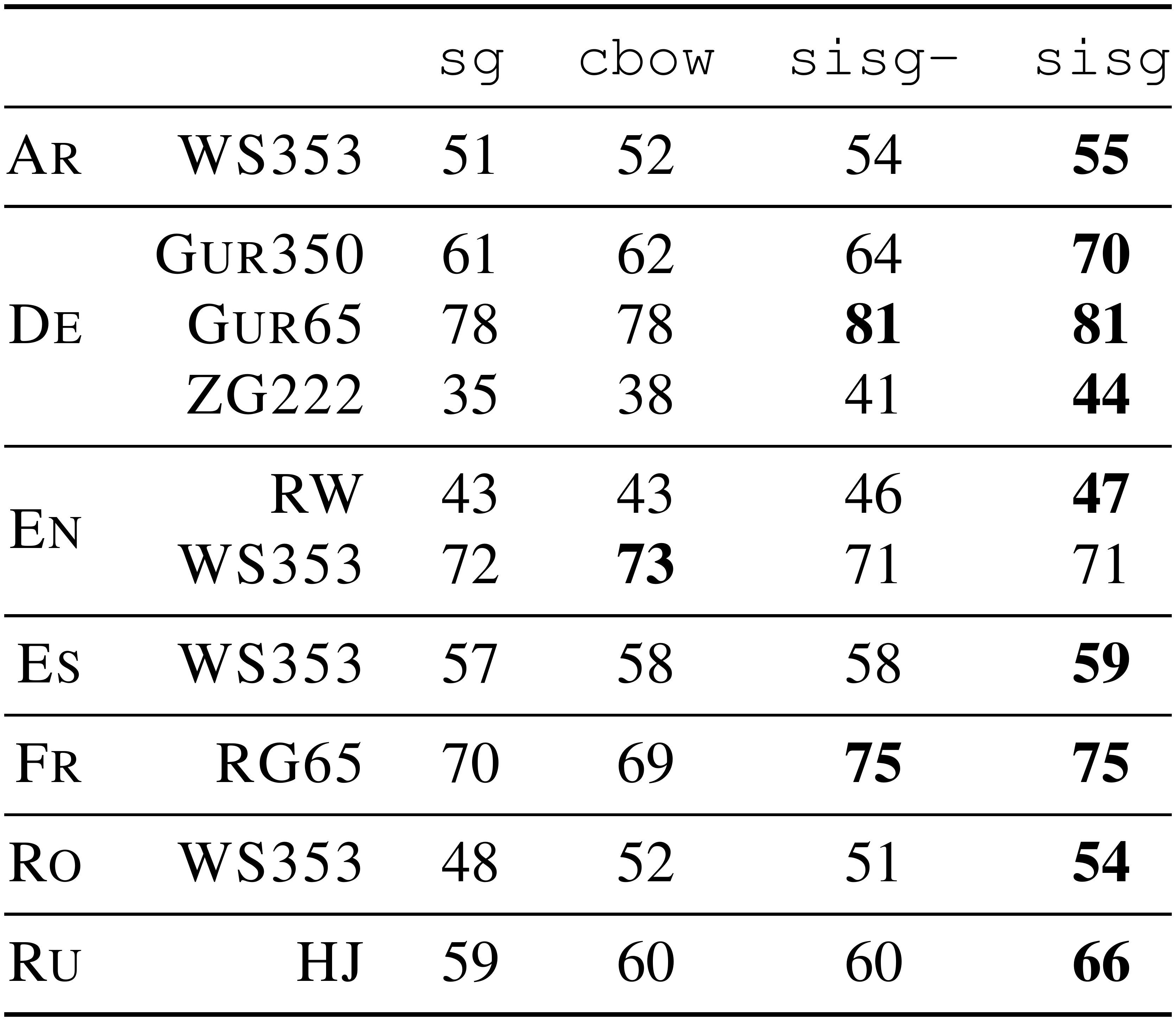
::: {caption="Table 1: Correlation between human judgement and similarity scores on word similarity datasets. We train both our model and the word2vec baseline on normalized Wikipedia dumps. Evaluation datasets contain words that are not part of the training set, so we represent them using null vectors (sisg-). With our model, we also compute vectors for unseen words by summing the $n$-gram vectors (sisg)."}
:::
We report results for our method and baselines for all datasets in Table 1. Some words from these datasets do not appear in our training data, and thus, we cannot obtain word representation for these words using the cbow and skipgram baselines. In order to provide comparable results, we propose by default to use null vectors for these words. Since our model exploits subword information, we can also compute valid representations for out-of-vocabulary words. We do so by taking the sum of its $n$-gram vectors. When OOV words are represented using null vectors we refer to our method as sisg- and sisg otherwise (Subword Information Skip Gram).
First, by looking at Table 1, we notice that the proposed model (sisg), which uses subword information, outperforms the baselines on all datasets except the English $\textsc{WS353}$ dataset. Moreover, computing vectors for out-of-vocabulary words (sisg) is always at least as good as not doing so (sisg-). This proves the advantage of using subword information in the form of character $n$-grams.
Second, we observe that the effect of using character $n$-grams is more important for Arabic, German and Russian than for English, French or Spanish. German and Russian exhibit grammatical declensions with four cases for German and six for Russian. Also, many German words are compound words; for instance the nominal phrase "table tennis" is written in a single word as "Tischtennis". By exploiting the character-level similarities between "Tischtennis" and "Tennis", our model does not represent the two words as completely different words.
Finally, we observe that on the English Rare Words dataset ($\textsc{RW}$), our approach outperforms the baselines while it does not on the English $\textsc{WS353}$ dataset. This is due to the fact that words in the English $\textsc{WS353}$ dataset are common words for which good vectors can be obtained without exploiting subword information. When evaluating on less frequent words, we see that using similarities at the character level between words can help learning good word vectors.
5.2 Word analogy tasks
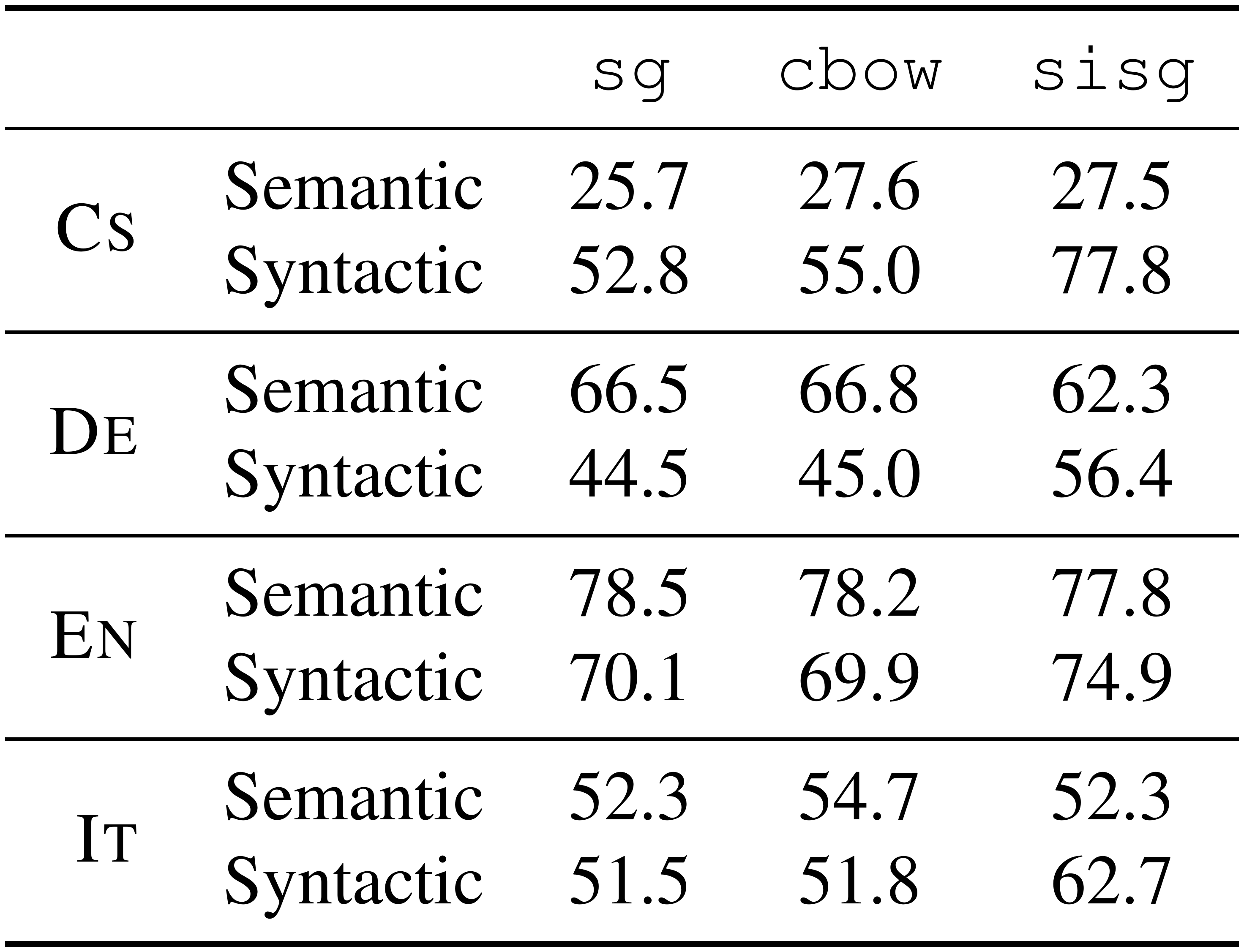
::: {caption="Table 2: Accuracy of our model and baselines on word analogy tasks for Czech, German, English and Italian. We report results for semantic and syntactic analogies separately."}
:::
We now evaluate our approach on word analogy questions, of the form $A$ is to $B$ as $C$ is to $D$, where $D$ must be predicted by the models. We use the datasets introduced by [44] for English, by [45] for Czech, by [46] for German and by [47] for Italian. Some questions contain words that do not appear in our training corpus, and we thus excluded these questions from the evaluation.
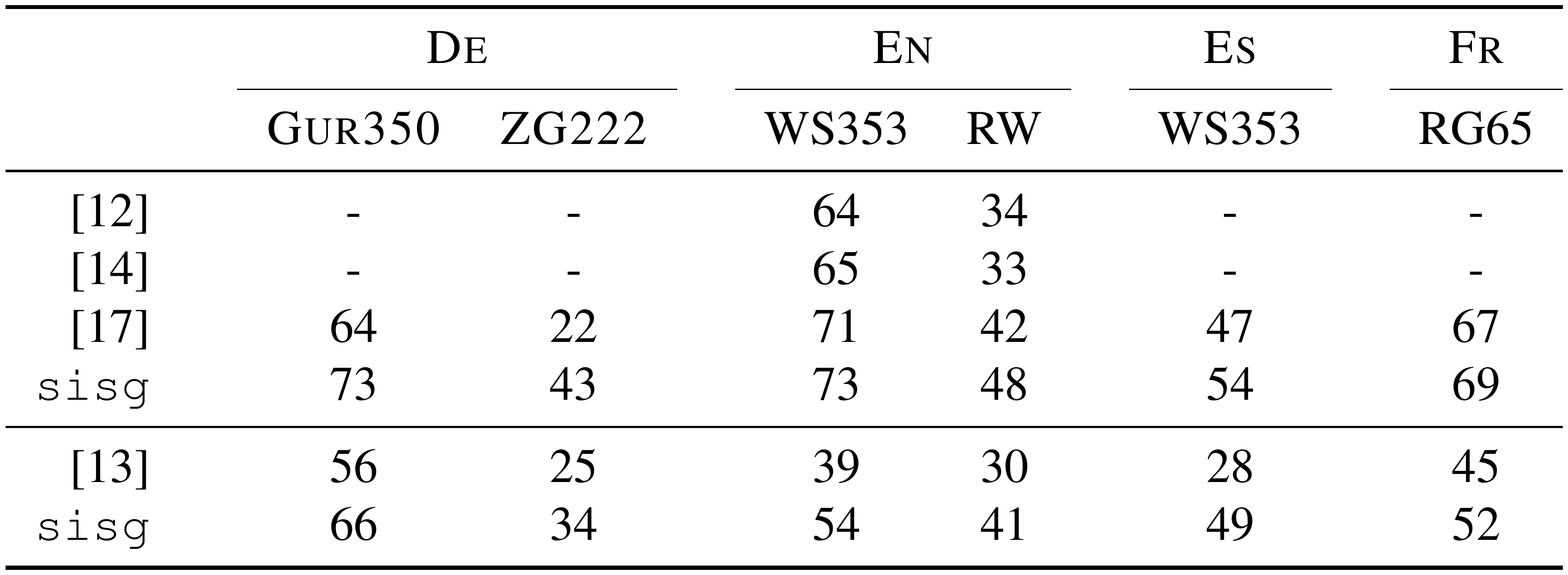
::: {caption="Table 3: Spearman's rank correlation coefficient between human judgement and model scores for different methods using morphology to learn word representations. We keep all the word pairs of the evaluation set and obtain representations for out-of-vocabulary words with our model by summing the vectors of character $n$-grams. Our model was trained on the same datasets as the methods we are comparing to (hence the two lines of results for our approach)."}
:::
We report accuracy for the different models in Table 2. We observe that morphological information significantly improves the syntactic tasks; our approach outperforms the baselines. In contrast, it does not help for semantic questions, and even degrades the performance for German and Italian. Note that this is tightly related to the choice of the length of character $n$-grams that we consider. We show in Section 5.5 that when the size of the $n$-grams is chosen optimally, the semantic analogies degrade less. Another interesting observation is that, as expected, the improvement over the baselines is more important for morphologically rich languages, such as Czech and German.
5.3 Comparison with morphological representations
We also compare our approach to previous work on word vectors incorporating subword information on word similarity tasks. The methods used are: the recursive neural network of [12], the morpheme cbow of [14] and the morphological transformations of [17]. In order to make the results comparable, we trained our model on the same datasets as the methods we are comparing to: the English Wikipedia data released by [48], and the news crawl data from the 2013 WMT shared task for German, Spanish and French. We also compare our approach to the log-bilinear language model introduced by [13], which was trained on the Europarl and news commentary corpora. Again, we trained our model on the same data to make the results comparable. Using our model, we obtain representations of out-of-vocabulary words by summing the representations of character $n$-grams. We report results in Table 3. We observe that our simple approach performs well relative to techniques based on subword information obtained from morphological segmentors. We also observe that our approach outperforms the [17] method, which is based on prefix and suffix analysis. The large improvement for German is due to the fact that their approach does not model noun compounding, contrary to ours.
5.4 Effect of the size of the training data
Since we exploit character-level similarities between words, we are able to better model infrequent words. Therefore, we should also be more robust to the size of the training data that we use. In order to assess that, we propose to evaluate the performance of our word vectors on the similarity task as a function of the training data size. To this end, we train our model and the cbow baseline on portions of Wikipedia of increasing size. We use the Wikipedia corpus described above and isolate the first $1$, $2$, $5$, $10$, $20$, and $50$ percent of the data. Since we don't reshuffle the dataset, they are all subsets of each other. We report results in Figure 1.
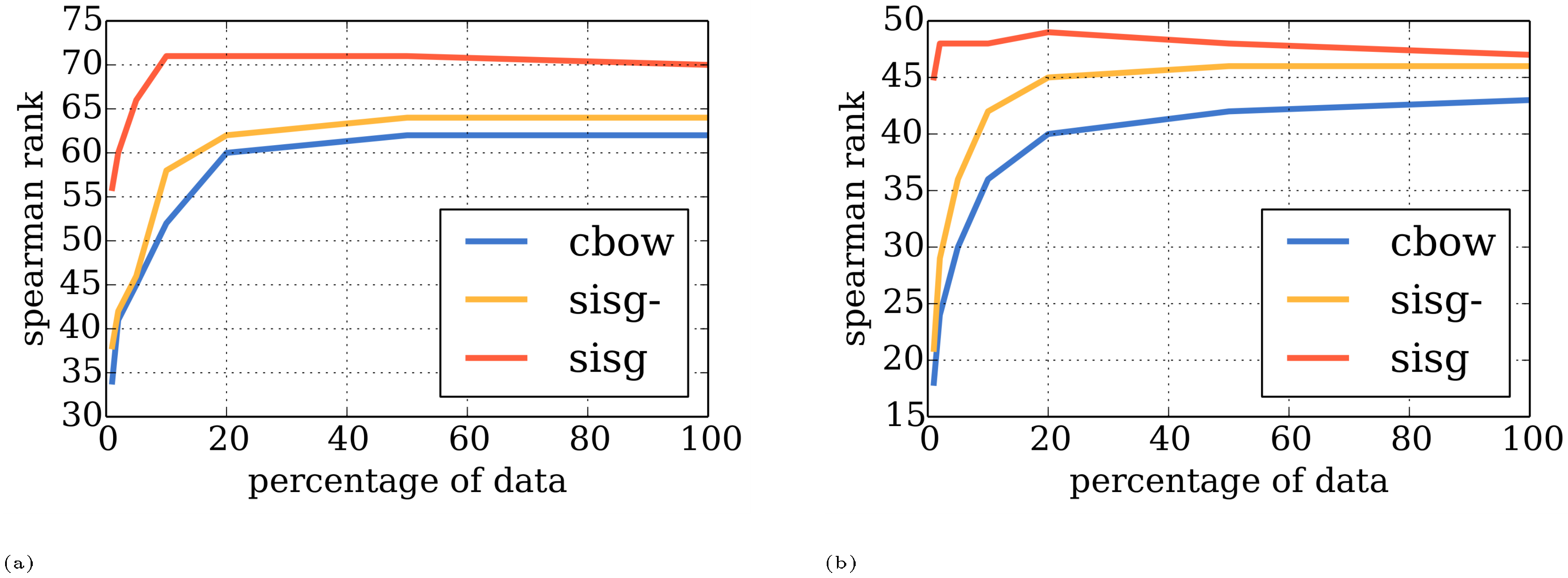
As in the experiment presented in Table 1, not all words from the evaluation set are present in the Wikipedia data. Again, by default, we use a null vector for these words (sisg-) or compute a vector by summing the $n$-gram representations (sisg). The out-of-vocabulary rate is growing as the dataset shrinks, and therefore the performance of sisg- and cbow necessarily degrades. However, the proposed model (sisg) assigns non-trivial vectors to previously unseen words.
First, we notice that for all datasets, and all sizes, the proposed approach (sisg) performs better than the baseline. However, the performance of the baseline cbow model gets better as more and more data is available. Our model, on the other hand, seems to quickly saturate and adding more data does not always lead to improved results.
Second, and most importantly, we notice that the proposed approach provides very good word vectors even when using very small training datasets. For instance, on the German $\textsc{Gur350}$ dataset, our model (sisg) trained on $5%$ of the data achieves better performance ($66$) than the cbow baseline trained on the full dataset ($62$). On the other hand, on the English $\textsc{RW}$ dataset, using $1%$ of the Wikipedia corpus we achieve a correlation coefficient of $45$ which is better than the performance of cbow trained on the full dataset ($43$). This has a very important practical implication: well performing word vectors can be computed on datasets of a restricted size and still work well on previously unseen words. In general, when using vectorial word representations in specific applications, it is recommended to retrain the model on textual data relevant for the application. However, this kind of relevant task-specific data is often very scarce and learning from a reduced amount of training data is a great advantage.
5.5 Effect of the size of $n$-grams
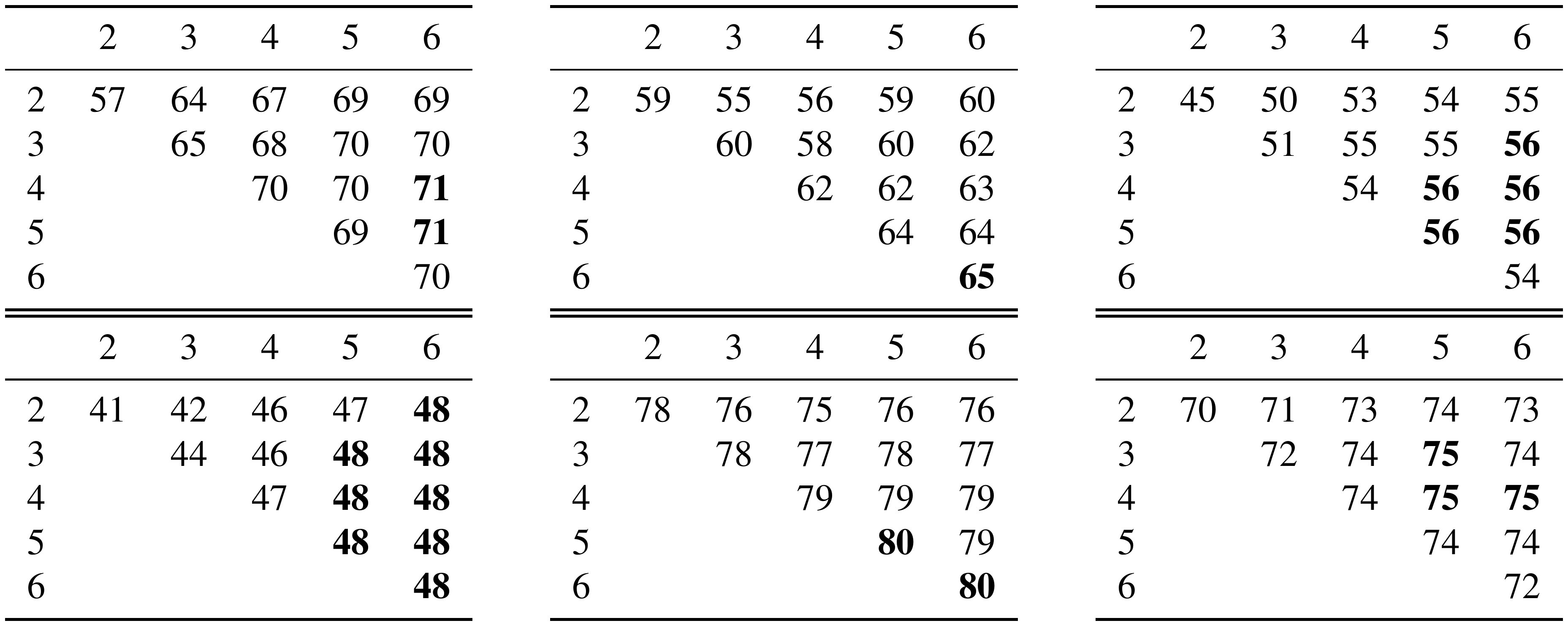
The proposed model relies on the use of character $n$-grams to represent words as vectors. As mentioned in Section 3.2, we decided to use $n$-grams ranging from $3$ to $6$ characters. This choice was arbitrary, motivated by the fact that $n$-grams of these lengths will cover a wide range of information. They would include short suffixes (corresponding to conjugations and declensions for instance) as well as longer roots. In this experiment, we empirically check for the influence of the range of $n$-grams that we use on performance. We report our results in Table 4 for English and German on word similarity and analogy datasets.
::: {caption="Table 4: $\textsc{De-Gur350}$ "}
:::
We observe that for both English and German, our arbitrary choice of $3$- $6$ was a reasonable decision, as it provides satisfactory performance across languages. The optimal choice of length ranges depends on the considered task and language and should be tuned appropriately. However, due to the scarcity of test data, we did not implement any proper validation procedure to automatically select the best parameters. Nonetheless, taking a large range such as $3-6$ provides a reasonable amount of subword information.
This experiment also shows that it is important to include long $n$-grams, as columns corresponding to $n \leq 5$ and $n \leq 6$ work best. This is especially true for German, as many nouns are compounds made up from several units that can only be captured by longer character sequences. On analogy tasks, we observe that using larger $n$-grams helps for semantic analogies. However, results are always improved by taking $n \geq 3$ rather than $n \geq 2$, which shows that character $2$-grams are not informative for that task. As described in Section 3.2, before computing character $n$-grams, we prepend and append special positional characters to represent the beginning and end of word. Therefore, $2$-grams will not be enough to properly capture suffixes that correspond to conjugations or declensions, since they are composed of a single proper character and a positional one.
5.6 Language modeling
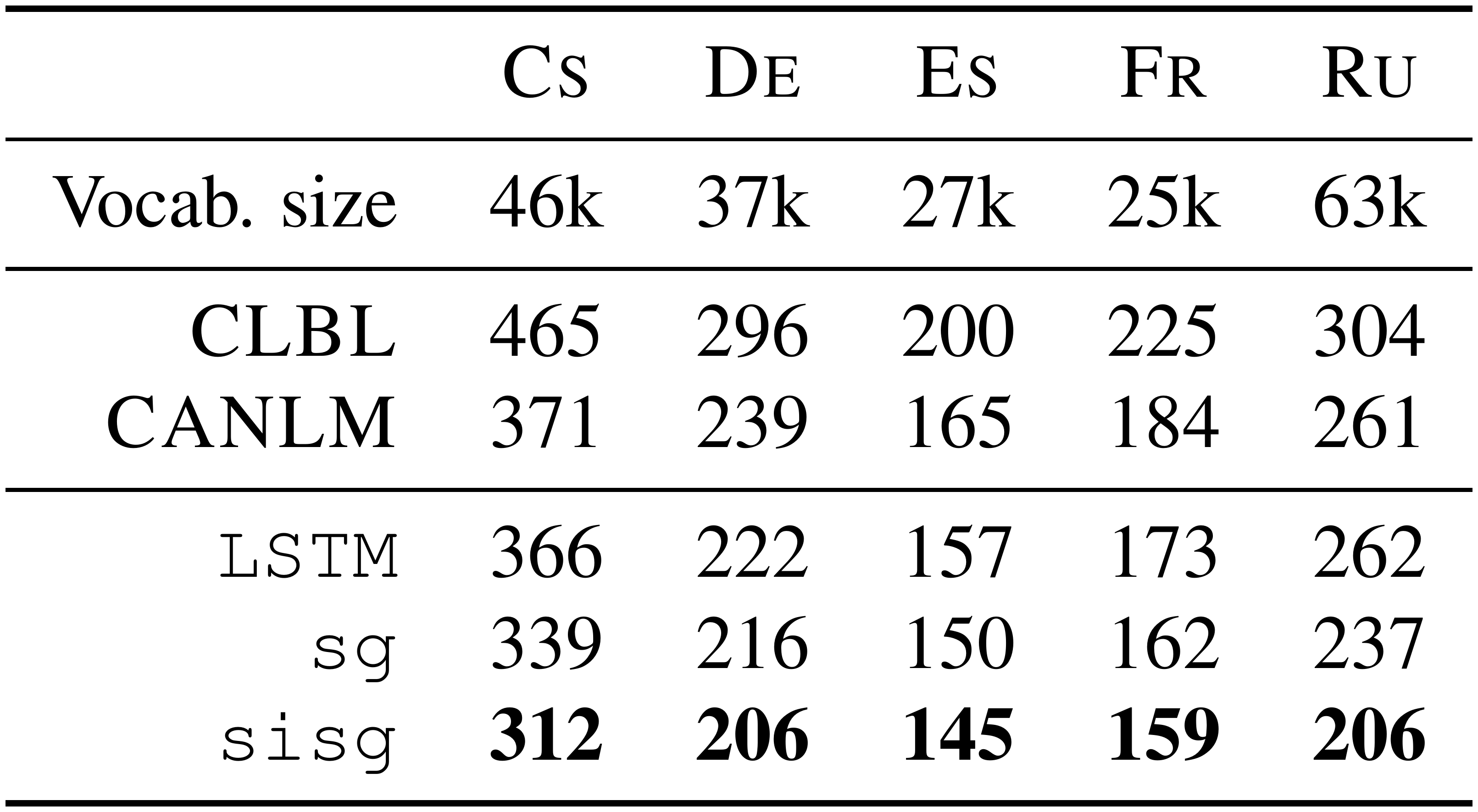
In this section, we describe an evaluation of the word vectors obtained with our method on a language modeling task. We evaluate our language model on five languages ($\textsc{Cs}$, $\textsc{De}$, $\textsc{Es}$, $\textsc{Fr}$, $\textsc{Ru}$) using the datasets introduced by [13]. Each dataset contains roughly one million training tokens, and we use the same preprocessing and data splits as [13].
Our model is a recurrent neural network with $650$ LSTM units, regularized with dropout (with probability of $0.5$) and weight decay (regularization parameter of $10^{-5}$). We learn the parameters using the Adagrad algorithm with a learning rate of $0.1$, clipping the gradients which have a norm larger than $1.0$. We initialize the weight of the network in the range $[-0.05, 0.05]$, and use a batch size of $20$. Two baselines are considered: we compare our approach to the log-bilinear language model of [13] and the character aware language model of [31]. We trained word vectors with character $n$-grams on the training set of the language modeling task and use them to initialize the lookup table of our language model. We report the test perplexity of our model without using pre-trained word vectors (LSTM), with word vectors pre-trained without subword information (sg) and with our vectors (sisg). The results are presented in Table 5.
::: {caption="Table 5: Test perplexity on the language modeling task, for 5 different languages. We compare to two state of the art approaches: $\textsc{CLBL}$ refers to the work of [13] and $\textsc{CANLM}$ refers to the work of [31]."}
:::
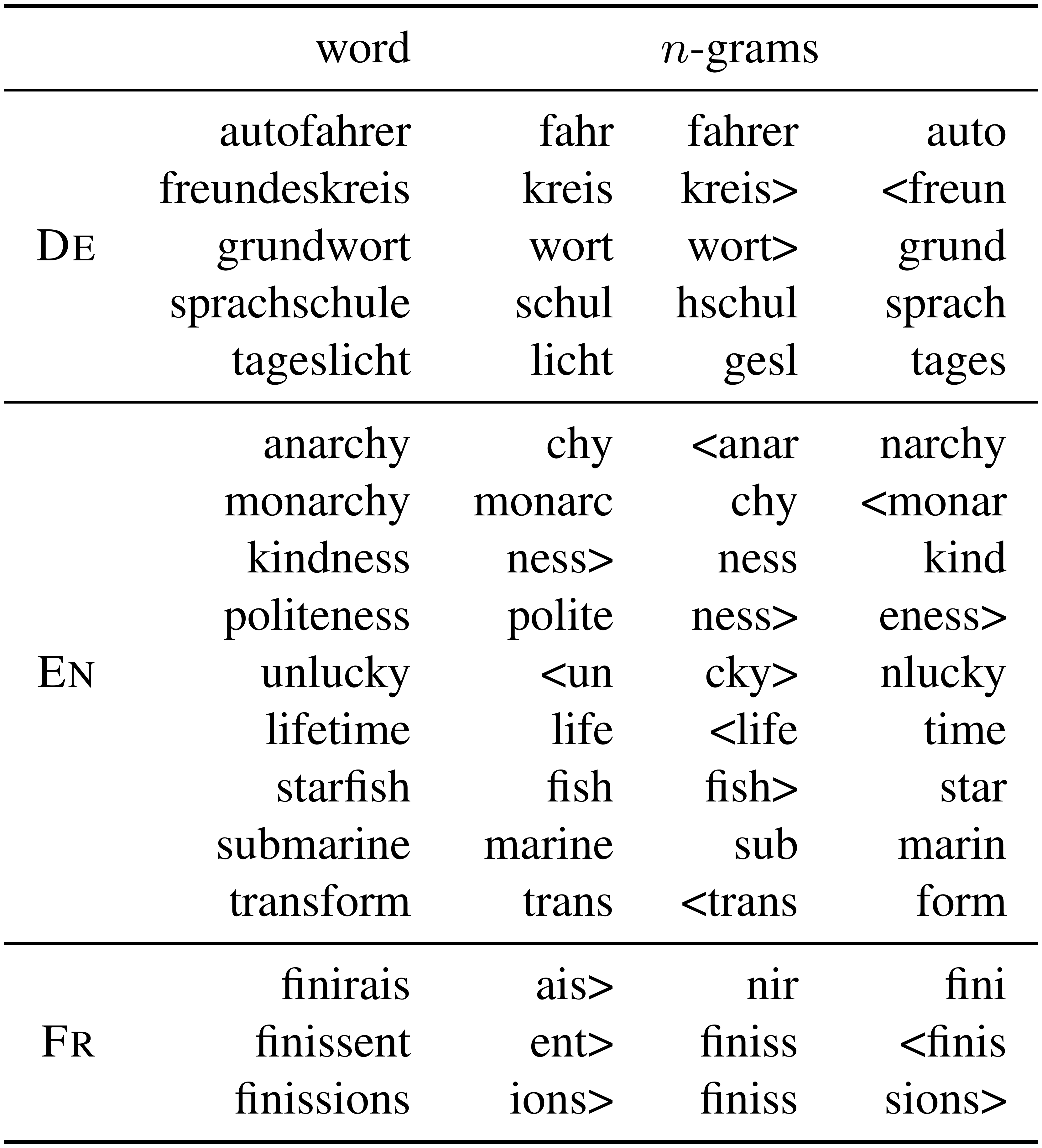
::: {caption="Table 6: Illustration of most important character $n$-grams for selected words in three languages. For each word, we show the $n$-grams that, when removed, result in the most different representation."}
:::
We observe that initializing the lookup table of the language model with pre-trained word representations improves the test perplexity over the baseline LSTM. The most important observation is that using word representations trained with subword information outperforms the plain skipgram model. We observe that this improvement is most significant for morphologically rich Slavic languages such as Czech (8% reduction of perplexity over sg) and Russian (13% reduction). The improvement is less significant for Roman languages such as Spanish (3% reduction) or French (2% reduction). This shows the importance of subword information on the language modeling task and exhibits the usefulness of the vectors that we propose for morphologically rich languages.
6. Qualitative analysis
Section Summary: The qualitative analysis compares word representations from the proposed method to a baseline, showing that it finds more relevant similar words, especially for rare or technical terms. It also examines how character segments within words align with meaningful parts like roots or endings, with strong examples in German compound words like "car driver," English terms like "lifetime" or "kindness," and French verb inflections. For unfamiliar words not in the training data, the approach builds representations by combining segments, revealing effective matches between similar subparts across word pairs, such as aligning "scarce" with "rarity" while handling prefixes and suffixes flexibly.
6.1 Nearest neighbors.
We report sample qualitative results in Table 7. For selected words, we show nearest neighbors according to cosine similarity for vectors trained using the proposed approach and for the skipgram baseline. As expected, the nearest neighbors for complex, technical and infrequent words using our approach are better than the ones obtained using the baseline model.
6.2 Character $n$-grams and morphemes
We want to qualitatively evaluate whether or not the most important $n$-grams in a word correspond to morphemes. To this end, we take a word vector that we construct as the sum of $n$-grams. As described in Section 3.2, each word $w$ is represented as the sum of its $n$-grams: $u_w = \sum_{g \in \mathcal{G}w} z_g$. For each $n$-gram $g$, we propose to compute the restricted representation $u{w \backslash g}$ obtained by omitting $g$:
$ u_{w \backslash g} = \sum_{g' \in \mathcal{G} - {g}} z_{g'}.\nonumber $
We then rank $n$-grams by increasing value of cosine between $u_w$ and $u_{w \backslash g}$. We show ranked $n$-grams for selected words in three languages in Table 6.
For German, which has a lot of compound nouns, we observe that the most important $n$-grams correspond to valid morphemes. Good examples include Autofahrer (car driver) whose most important $n$-grams are Auto (car) and Fahrer (driver). We also observe the separation of compound nouns into morphemes in English, with words such as lifetime or starfish. However, for English, we also observe that $n$-grams can correspond to affixes in words such as kindness or unlucky. Interestingly, for French we observe the inflections of verbs with endings such as ais>, ent> or ions>.
6.3 Word similarity for OOV words
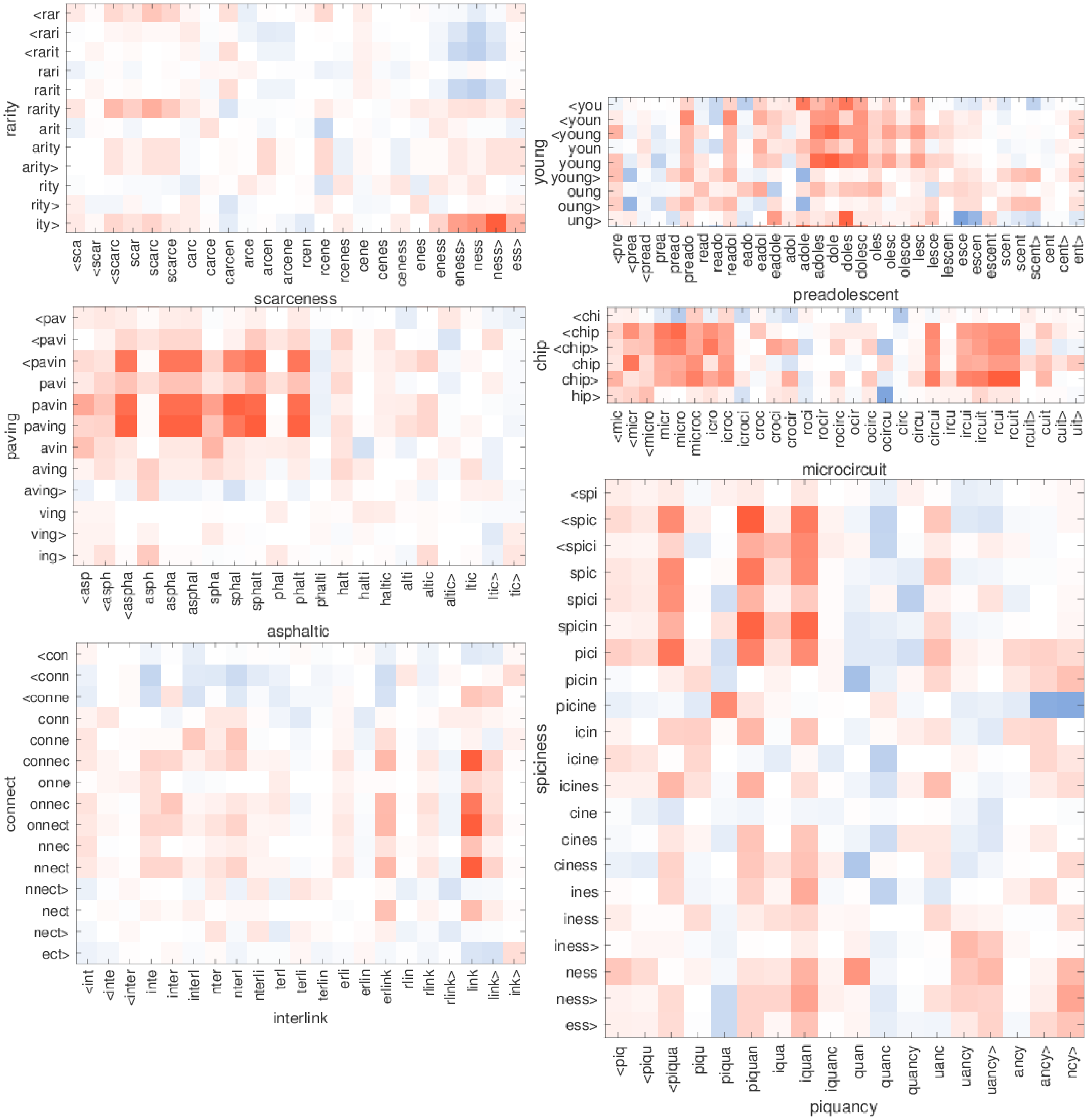
As described in Section 3.2, our model is capable of building word vectors for words that do not appear in the training set. For such words, we simply average the vector representation of its $n$-grams. In order to assess the quality of these representations, we analyze which of the $n$-grams match best for OOV words by selecting a few word pairs from the English RW similarity dataset. We select pairs such that one of the two words is not in the training vocabulary and is hence only represented by its $n$-grams. For each pair of words, we display the cosine similarity between each pair of $n$-grams that appear in the words. In order to simulate a setup with a larger number of OOV words, we use models trained on $1%$ of the Wikipedia data as in Section 5.4. The results are presented in Figure 2.
We observe interesting patterns, showing that subwords match correctly. Indeed, for the word chip, we clearly see that there are two groups of $n$-grams in microcircuit that match well. These roughly correspond to micro and circuit, and $n$-grams in between don't match well. Another interesting example is the pair rarity and scarceness. Indeed, scarce roughly matches rarity while the suffix -ness matches -ity very well. Finally, the word preadolescent matches young well thanks to the -adolesc- subword. This shows that we build robust word representations where prefixes and suffixes can be ignored if the grammatical form is not found in the dictionary.
::: {caption="Table 7: Nearest neighbors of rare words using our representations and skipgram. These hand picked examples are for illustration."}

:::
7. Conclusion
Section Summary: This paper explores a straightforward way to create representations of words by considering parts of words, like character sequences, integrated into a model called skipgram. The method is simple to train quickly without needing any special preparation or oversight, and it performs better than standard approaches that ignore word parts or those that analyze word structures in more complex ways. The authors plan to share their code publicly to help others build on this work for future studies in subword learning.
In this paper, we investigate a simple method to learn word representations by taking into account subword information. Our approach, which incorporates character $n$-grams into the skipgram model, is related to an idea that was introduced by [19]. Because of its simplicity, our model trains fast and does not require any preprocessing or supervision. We show that our model outperforms baselines that do not take into account subword information, as well as methods relying on morphological analysis. We will open source the implementation of our model, in order to facilitate comparison of future work on learning subword representations.
Acknowledgements
We thank Marco Baroni, Hinrich Schütze and the anonymous reviewers for their insightful comments.
References
Section Summary: This references section lists key academic works on natural language processing and machine learning, starting with foundational studies from the 1980s and 1990s on error back-propagation in neural networks and semantic analysis techniques like latent semantic indexing. It then covers more recent advancements, including vector-based models for word meanings, morphological embeddings, character-level neural networks, and applications in tasks such as translation and text classification. The citations draw from prestigious conferences and journals, highlighting the evolution of computational methods for understanding human language through data patterns and AI architectures.
[1] David E. Rumelhart, Geoffrey E. Hinton, and Ronald J. Williams. 1988. Neurocomputing: Foundations of research. chapter Learning Representations by Back-propagating Errors, pages 696–699. MIT Press.
[2] Scott Deerwester, Susan T. Dumais, George W. Furnas, Thomas K. Landauer, and Richard Harshman. 1990. Indexing by latent semantic analysis. Journal of the American Society for Information Science, 41(6):391–407.
[3] Hinrich Schütze. 1992. Dimensions of meaning. In Proc. IEEE Conference on Supercomputing.
[4] Kevin Lund and Curt Burgess. 1996. Producing high-dimensional semantic spaces from lexical co-occurrence. Behavior Research Methods, Instruments, & Computers, 28(2):203–208.
[5] Peter D. Turney, Patrick Pantel, et al. 2010. From frequency to meaning: Vector space models of semantics. Journal of Artificial Intelligence Research, 37(1):141–188.
[6] Marco Baroni and Alessandro Lenci. 2010. Distributional memory: A general framework for corpus-based semantics. Computational Linguistics, 36(4):673–721.
[7] Ronan Collobert and Jason Weston. 2008. A unified architecture for natural language processing: Deep neural networks with multitask learning. In Proc. ICML.
[8] Tomáš Mikolov, Ilya Sutskever, Kai Chen, Greg S. Corrado, and Jeff Dean. 2013b. Distributed representations of words and phrases and their compositionality. In Adv. NIPS.
[9] Andrei Alexandrescu and Katrin Kirchhoff. 2006. Factored neural language models. In Proc. NAACL.
[10] Haşim Sak, Murat Saraclar, and Tunga Gungör. 2010. Morphology-based and sub-word language modeling for turkish speech recognition. In Proc. ICASSP.
[11] Angeliki Lazaridou, Marco Marelli, Roberto Zamparelli, and Marco Baroni. 2013. Compositionally derived representations of morphologically complex words in distributional semantics. In Proc. ACL.
[12] Thang Luong, Richard Socher, and Christopher D. Manning. 2013. Better word representations with recursive neural networks for morphology. In Proc. CoNLL.
[13] Jan A. Botha and Phil Blunsom. 2014. Compositional morphology for word representations and language modelling. In Proc. ICML.
[14] Siyu Qiu, Qing Cui, Jiang Bian, Bin Gao, and Tie-Yan Liu. 2014. Co-learning of word representations and morpheme representations. In Proc. COLING.
[15] Xinxiong Chen, Lei Xu, Zhiyuan Liu, Maosong Sun, and Huanbo Luan. 2015. Joint learning of character and word embeddings. In Proc. IJCAI.
[16] Qing Cui, Bin Gao, Jiang Bian, Siyu Qiu, Hanjun Dai, and Tie-Yan Liu. 2015. KNET: A general framework for learning word embedding using morphological knowledge. ACM Transactions on Information Systems, 34(1):4:1–4:25.
[17] Radu Soricut and Franz Och. 2015. Unsupervised morphology induction using word embeddings. In Proc. NAACL.
[18] Ryan Cotterell and Hinrich Schütze. 2015. Morphological word-embeddings. In Proc. NAACL.
[19] Hinrich Schütze. 1993. Word space. In Adv. NIPS.
[20] John Wieting, Mohit Bansal, Kevin Gimpel, and Karen Livescu. 2016. CHARAGRAM: Embedding words and sentences via character n-grams. In Proc. EMNLP.
[21] Tomáš Mikolov, Ilya Sutskever, Anoop Deoras, Hai-Son Le, Stefan Kombrink, and Jan Černocký. 2012. Subword language modeling with neural networks. Technical report, Faculty of Information Technology, Brno University of Technology.
[22] Ilya Sutskever, James Martens, and Geoffrey E Hinton. 2011. Generating text with recurrent neural networks. In Proc. ICML.
[23] Alex Graves. 2013. Generating sequences with recurrent neural networks. arXiv preprint arXiv:1308.0850.
[24] Piotr Bojanowski, Armand Joulin, and Tomáš Mikolov. 2015. Alternative structures for character-level RNNs. In Proc. ICLR.
[25] Grzegorz Chrupała. 2014. Normalizing tweets with edit scripts and recurrent neural embeddings. In Proc. ACL.
[26] Wang Ling, Chris Dyer, Alan W. Black, Isabel Trancoso, Ramon Fermandez, Silvio Amir, Luis Marujo, and Tiago Luis. 2015. Finding function in form: Compositional character models for open vocabulary word representation. In Proc. EMNLP.
[27] Miguel Ballesteros, Chris Dyer, and Noah A. Smith. 2015. Improved transition-based parsing by modeling characters instead of words with LSTMs. In Proc. EMNLP.
[28] Cicero Nogueira dos Santos and Bianca Zadrozny. 2014. Learning character-level representations for part-of-speech tagging. In Proc. ICML.
[29] Cicero Nogueira dos Santos and Maira Gatti. 2014. Deep convolutional neural networks for sentiment analysis of short texts. In Proc. COLING.
[30] Xiang Zhang, Junbo Zhao, and Yann LeCun. 2015. Character-level convolutional networks for text classification. In Adv. NIPS.
[31] Yoon Kim, Yacine Jernite, David Sontag, and Alexander M Rush. 2016. Character-aware neural language models. In Proc. AAAI.
[32] Henning Sperr, Jan Niehues, and Alexander Waibel. 2013. Letter n-gram-based input encoding for continuous space language models. In Proc. of the Workshop on Continuous Vector Space Models and their Compositionality at ACL.
[33] Rico Sennrich, Barry Haddow, and Alexandra Birch. 2016. Neural machine translation of rare words with subword units. In Proc. ACL.
[34] Minh-Thang Luong and Christopher D. Manning. 2016. Achieving open vocabulary neural machine translation with hybrid word-character models. In Proc. ACL.
[35] Zellig S Harris. 1954. Distributional structure. Word, 10(2-3):146–162.
[36] Benjamin Recht, Christopher Re, Stephen Wright, and Feng Niu. 2011. Hogwild: A lock-free approach to parallelizing stochastic gradient descent. In Adv. NIPS.
[37] Charles Spearman. 1904. The proof and measurement of association between two things. The American Journal of Psychology, 15(1):72–101.
[38] Iryna Gurevych. 2005. Using the structure of a conceptual network in computing semantic relatedness. In Proc. IJCNLP.
[39] Torsten Zesch and Iryna Gurevych. 2006. Automatically creating datasets for measures of semantic relatedness. In Proc. Workshop on Linguistic Distances.
[40] Lev Finkelstein, Evgeniy Gabrilovich, Yossi Matias, Ehud Rivlin, Zach Solan, Gadi Wolfman, and Eytan Ruppin. 2001. Placing search in context: The concept revisited. In Proc. WWW.
[41] Colette Joubarne and Diana Inkpen. 2011. Comparison of semantic similarity for different languages using the google n-gram corpus and second-order co-occurrence measures. In Proc. Canadian Conference on Artificial Intelligence.
[42] Samer Hassan and Rada Mihalcea. 2009. Cross-lingual semantic relatedness using encyclopedic knowledge. In Proc. EMNLP.
[43] Alexander Panchenko, Dmitry Ustalov, Nikolay Arefyev, Denis Paperno, Natalia Konstantinova, Natalia Loukachevitch, and Chris Biemann. 2016. Human and machine judgements for russian semantic relatedness. In Proc. AIST.
[44] Tomáš Mikolov, Kai Chen, Greg D. Corrado, and Jeffrey Dean. 2013a. Efficient estimation of word representations in vector space. arXiv preprint arXiv:1301.3781.
[45] Lukáš Svoboda and Tomáš Brychcin. 2016. New word analogy corpus for exploring embeddings of Czech words. In Proc. CICLING.
[46] Maximilian Köper, Christian Scheible, and Sabine Schulte im Walde. 2015. Multilingual reliability and “semantic” structure of continuous word spaces. Proc. IWCS 2015.
[47] Giacomo Berardi, Andrea Esuli, and Diego Marcheggiani. 2015. Word embeddings go to Italy: a comparison of models and training datasets. Italian Information Retrieval Workshop.
[48] Cyrus Shaoul and Chris Westbury. 2010. The Westbury lab Wikipedia corpus.