
keyword
weak supervision
Weak supervision is a machine learning paradigm in which models are trained using imperfect, higher-level, or noisy supervisory signals instead of expensive, hand-curated, ground-truth annotations. Rather than relying entirely on fine-grained manual labels, weak supervision leverages lower-cost or automated sources of guidance, such as programmatic heuristics, distant supervision, coarse or aggregate labels, proxy rewards, domain constraints, or outputs from less capable auxiliary models. These diverse and potentially inaccurate signals are typically modeled, filtered, or aggregated to train complex predictive systems, allowing machine learning models to scale efficiently across large datasets and generalize effectively in settings where precise expert annotations are scarce, costly, or difficult to obtain.
7 items
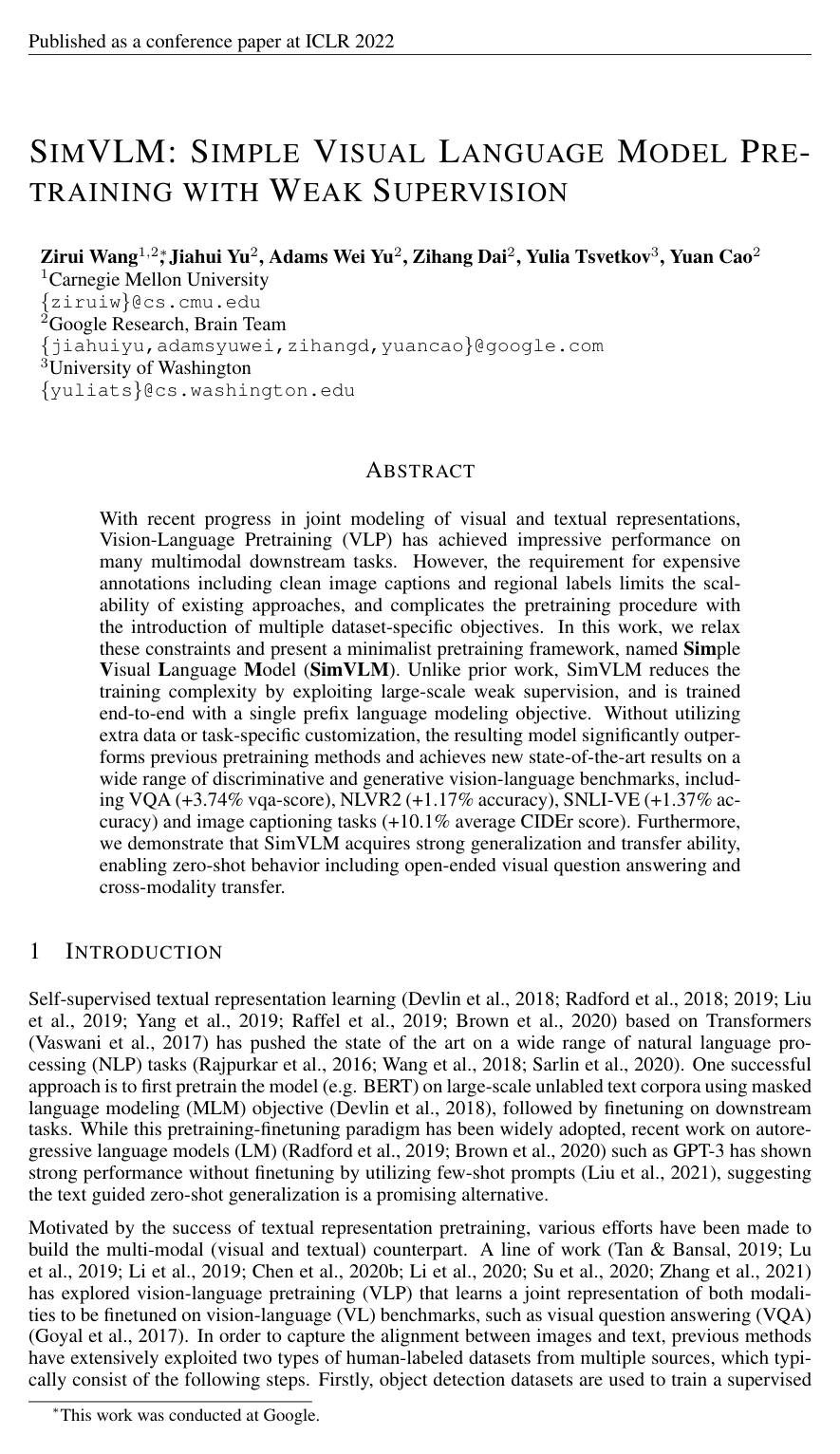
SimVLM: Simple Visual Language Model Pretraining with Weak Supervision
Zirui Wang, Jiahui Yu, Adams Wei Yu, Zihang Dai, Yulia Tsvetkov, Yuan Cao
Why you should read this
Introduces SimVLM, a simplified vision-language model trained end-to-end on weakly supervised data using a single prefix language modeling objective, achieving state-of-the-art benchmark performance and strong zero-shot multimodal capabilities without requiring expensive object-level annotations.
With recent progress in joint modeling of visual and textual representations, Vision-Language Pretraining (VLP) has achieved impressive performance on many multimodal downstream tasks. However, the requirement for expensive annotations including clean image captions and regional labels limits the scalability of existing approaches, and complicates the pretraining procedure with the introduction of multiple dataset-specific objectives. In this work, we relax these constraints and present a minimalist pretraining framework, named Simple Visual Language Model (SimVLM). Unlike prior work, SimVLM reduces the training complexity by exploiting large-scale weak supervision, and is trained end-to-end with a single prefix language modeling objective. Without utilizing extra data or task-specific customization, the resulting model significantly outperforms previous pretraining methods and achieves new state-of-the-art results on a wide range of discriminative and generative vision-language benchmarks, including VQA (+3.74% vqa-score), NLVR2 (+1.17% accuracy), SNLI-VE (+1.37% accuracy) and image captioning tasks (+10.1% average CIDEr score). Furthermore, we demonstrate that SimVLM acquires strong generalization and transfer ability, enabling zero-shot behavior including open-ended visual question answering and cross-modality transfer.
Added
2026-10-05
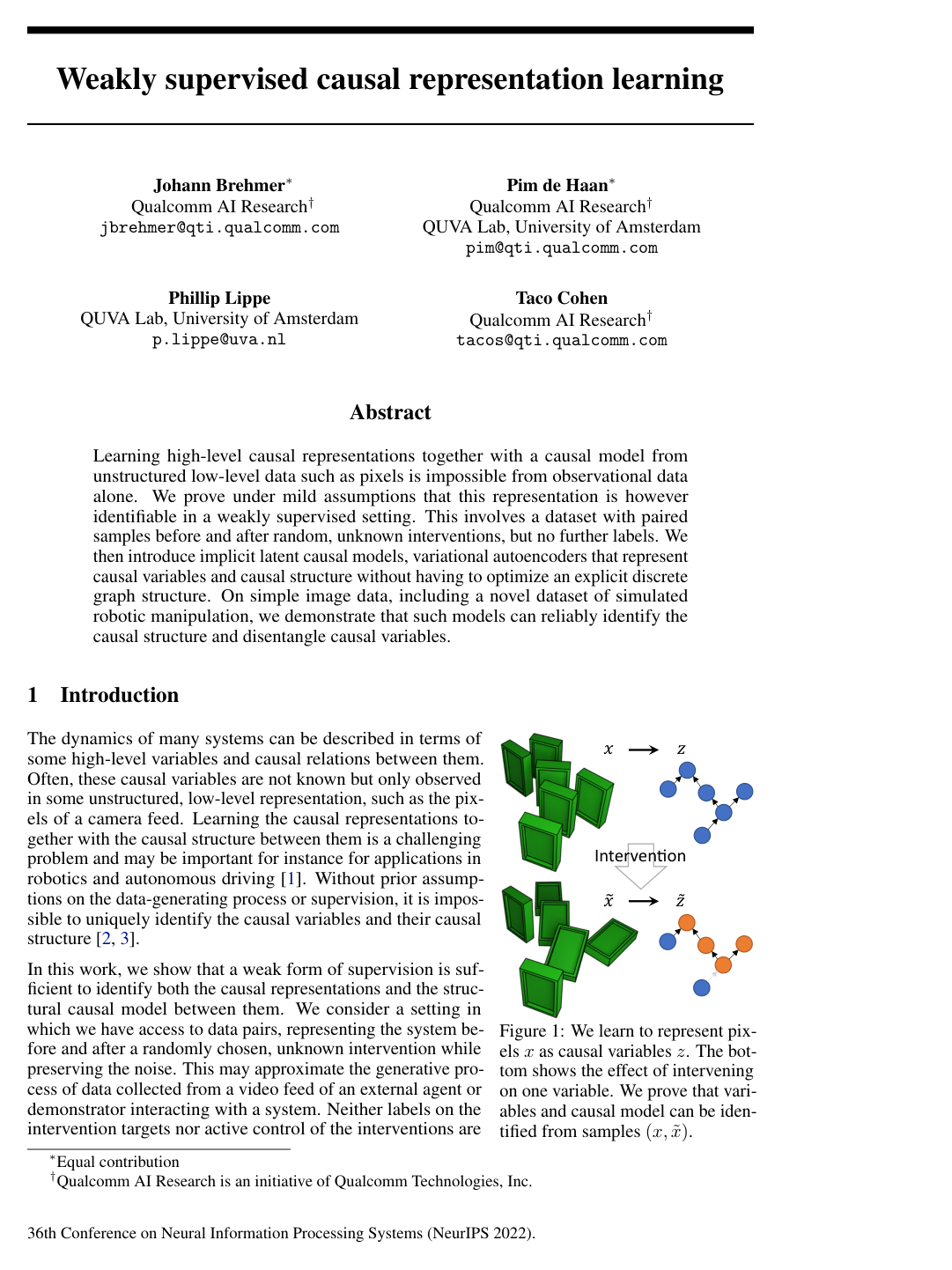
Weakly supervised causal representation learning
Johann Brehmer, Pim de Haan, Phillip Lippe, Taco S. Cohen
Why you should read this
Proves that high-level causal variables and mechanisms can be identified from pixel-level data paired across unknown interventions, and introduces implicit latent causal models to learn these structures without optimizing discrete graphs.
Learning high-level causal representations together with a causal model from unstructured low-level data such as pixels is impossible from observational data alone. We prove under mild assumptions that this representation is however identifiable in a weakly supervised setting. This involves a dataset with paired samples before and after random, unknown interventions, but no further labels. We then introduce implicit latent causal models, variational autoencoders that represent causal variables and causal structure without having to optimize an explicit discrete graph structure. On simple image data, including a novel dataset of simulated robotic manipulation, we demonstrate that such models can reliably identify the causal structure and disentangle causal variables.
Added
2026-09-30
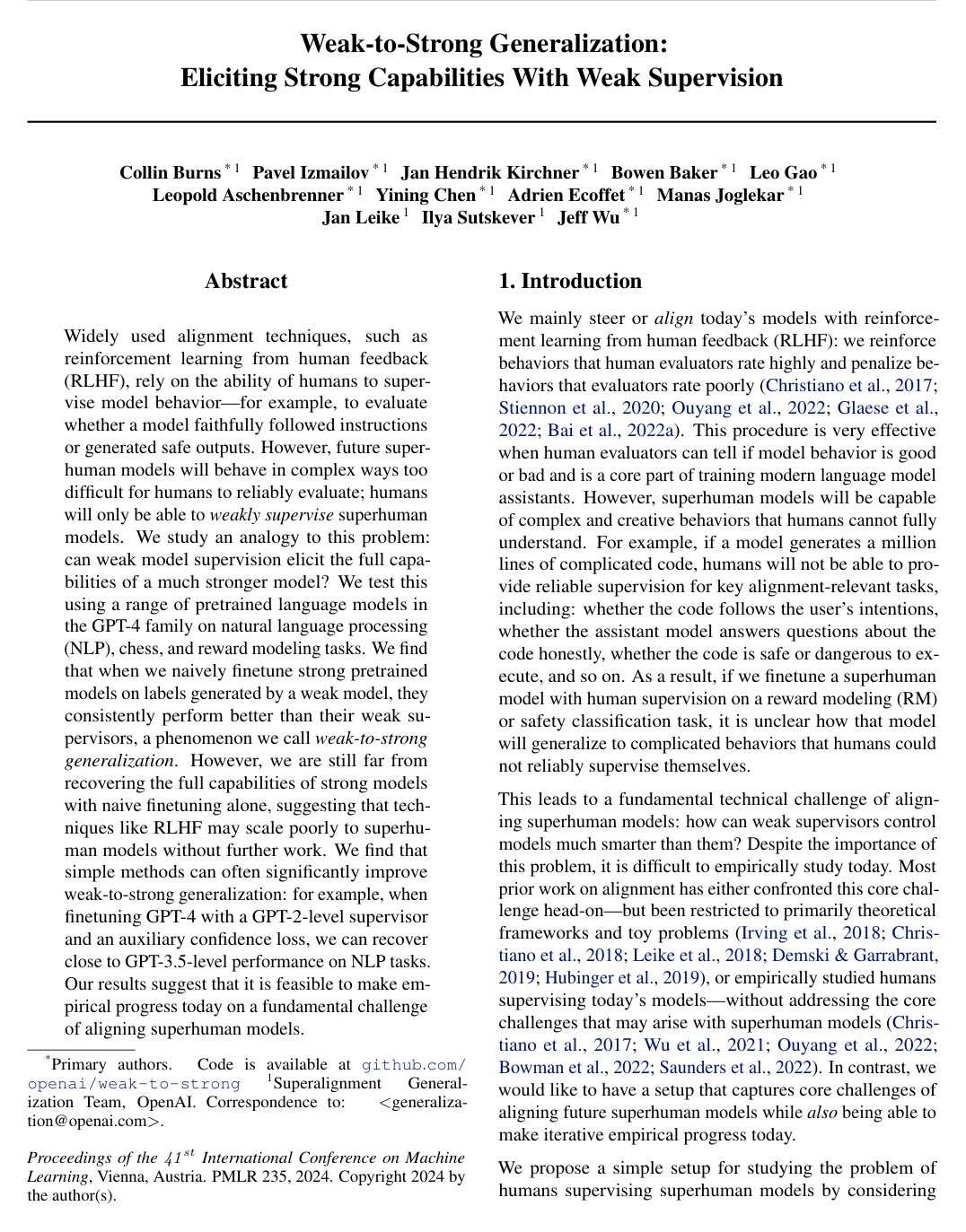
Weak-to-Strong Generalization: Eliciting Strong Capabilities With Weak Supervision
Collin Burns, Pavel Izmailov, Jan Hendrik Kirchner, Bowen Baker, Leo Gao, Leopold Aschenbrenner, Yining Chen, Adrien Ecoffet, Manas Joglekar, Jan Leike, Ilya Sutskever, Jeffrey Wu
Why you should read this
Demonstrates that strong pretrained language models can generalize beyond imperfect supervision from weaker models, providing an empirical methodology and techniques to study how humans might align superhuman AI systems.
Widely used alignment techniques, such as reinforcement learning from human feedback (RLHF), rely on the ability of humans to supervise model behavior—for example, to evaluate whether a model faithfully followed instructions or generated safe outputs. However, future superhuman models will behave in complex ways too difficult for humans to reliably evaluate; humans will only be able to weakly supervise superhuman models. We study an analogy to this problem: can weak model supervision elicit the full capabilities of a much stronger model? We test this using a range of pretrained language models in the GPT-4 family on natural language processing (NLP), chess, and reward modeling tasks. We find that when we naively finetune strong pretrained models on labels generated by a weak model, they consistently perform better than their weak supervisors, a phenomenon we call weak-to-strong generalization. However, we are still far from recovering the full capabilities of strong models with naive finetuning alone, suggesting that techniques like RLHF may scale poorly to superhuman models without further work. We find that simple methods can often significantly improve weak-to-strong generalization: for example, when finetuning GPT-4 with a GPT-2-level supervisor and an auxiliary confidence loss, we can recover close to GPT-3.5-level performance on NLP tasks. Our results suggest that it is feasible to make empirical progress today on a fundamental challenge of aligning superhuman models.
Added
2026-09-26
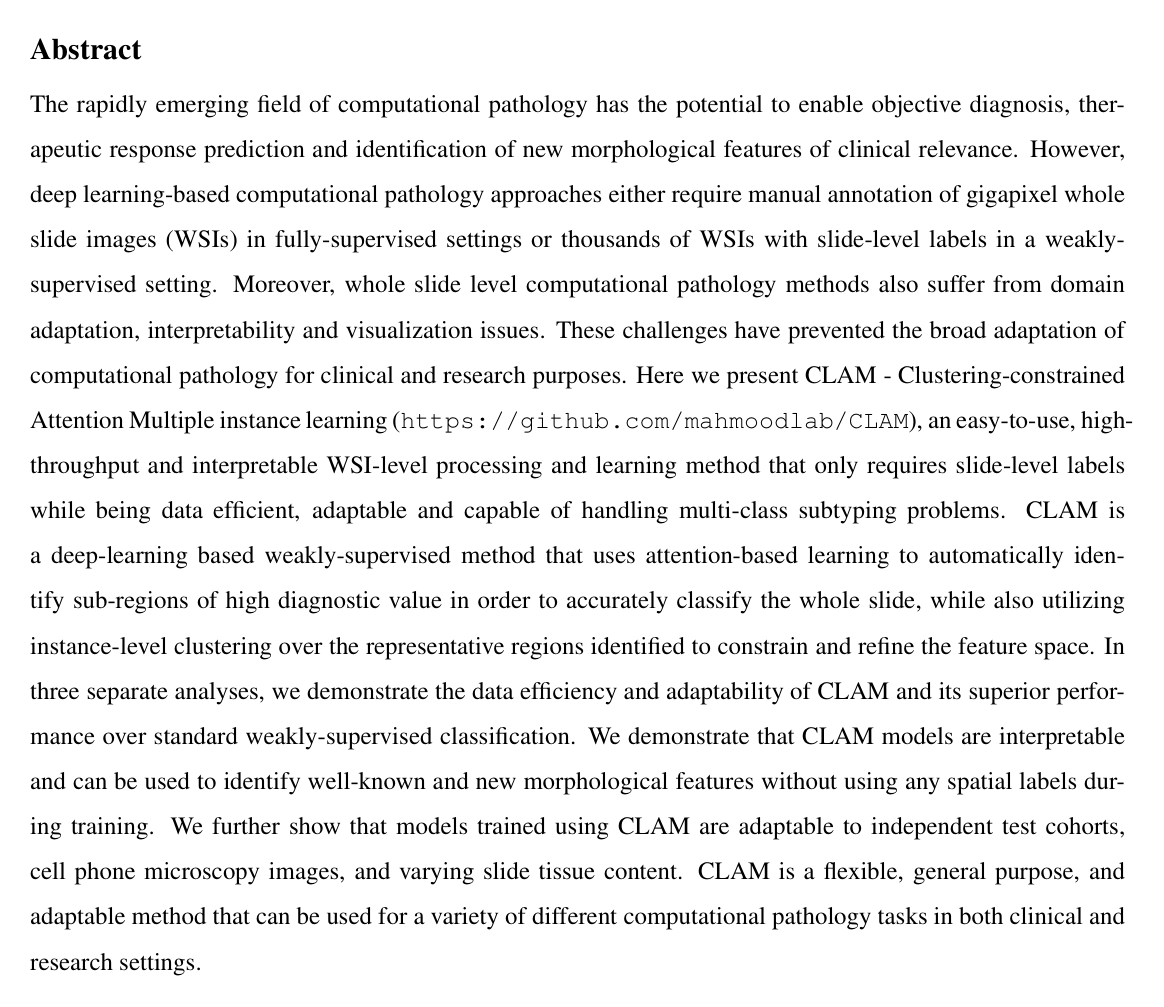
Data-efficient and weakly supervised computational pathology on whole-slide images
Ming Y. Lu, Drew F. K. Williamson, Tiffany Y. Chen, Richard J. Chen, Matteo Barbieri, Faisal Mahmood
Why you should read this
Presents CLAM, a data-efficient deep learning framework that uses clustering-constrained attention to classify gigapixel whole slide images and identify clinically relevant morphological patterns using only slide-level labels.
The rapidly emerging field of computational pathology has the potential to enable objective diagnosis, therapeutic response prediction and identification of new morphological features of clinical relevance. However, deep learning-based computational pathology approaches either require manual annotation of gigapixel whole slide images (WSIs) in fully-supervised settings or thousands of WSIs with slide-level labels in a weakly-supervised setting. Moreover, whole slide level computational pathology methods also suffer from domain adaptation and interpretability issues. These challenges have prevented the broad adaptation of computational pathology for clinical and research purposes. Here we present CLAM - Clustering-constrained attention multiple instance learning, an easy-to-use, high-throughput, and interpretable WSI-level processing and learning method that only requires slide-level labels while being data efficient, adaptable and capable of handling multi-class subtyping problems. CLAM is a deep-learning-based weakly-supervised method that uses attention-based learning to automatically identify sub-regions of high diagnostic value in order to accurately classify the whole slide, while also utilizing instance-level clustering over the representative regions identified to constrain and refine the feature space. In three separate analyses, we demonstrate the data efficiency and adaptability of CLAM and its superior performance over standard weakly-supervised classification. We demonstrate that CLAM models are interpretable and can be used to identify well-known and new morphological features. We further show that models trained using CLAM are adaptable to independent test cohorts, cell phone microscopy images, and biopsies. CLAM is a general-purpose and adaptable method that can be used for a variety of different computational pathology tasks in both clinical and research settings.
Added
2026-09-15
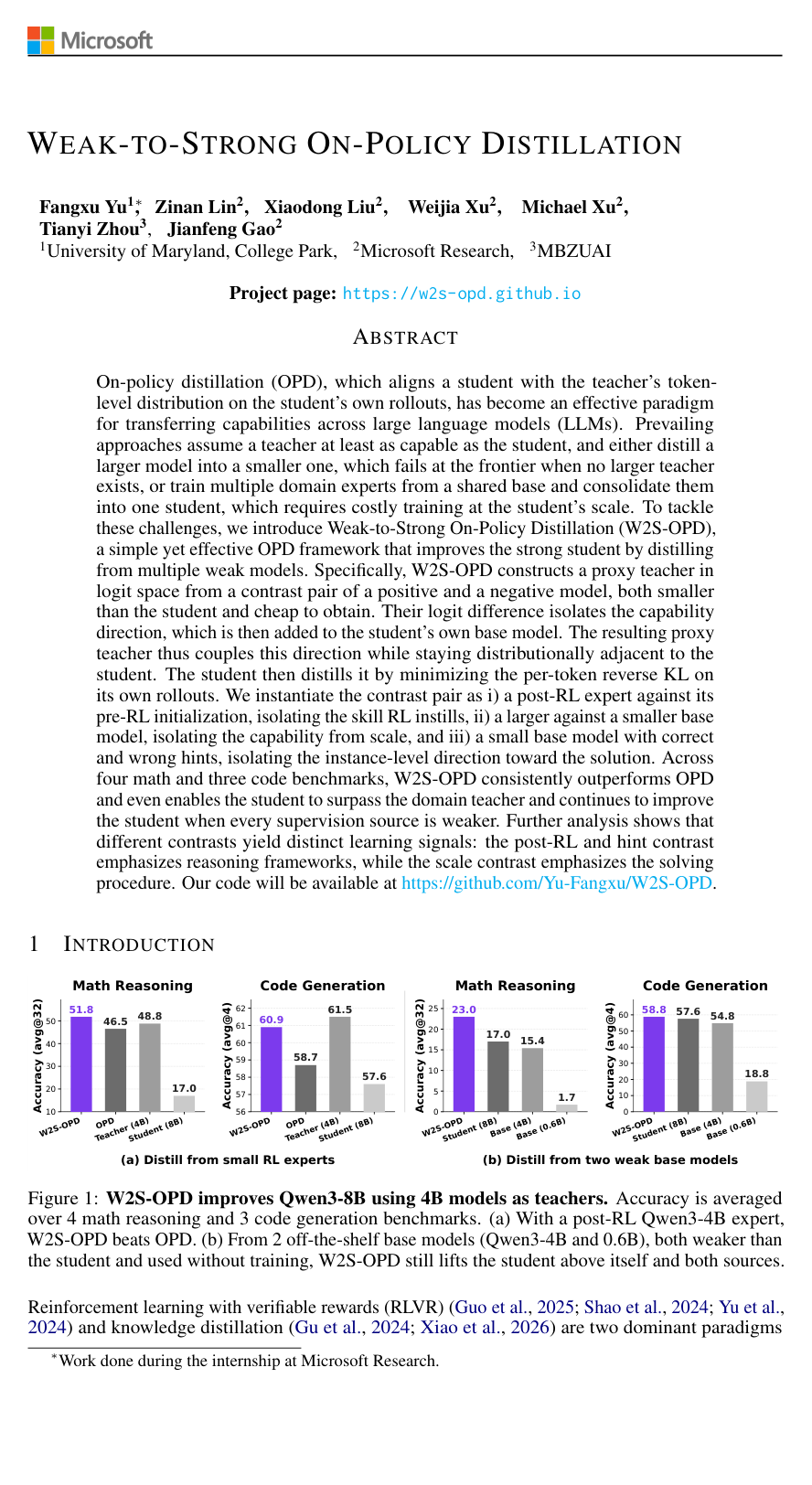
Weak-to-Strong On-Policy Distillation
Fangxu Yu, Zinan Lin, Xiaodong Liu, Weijia Xu, Michael Xu, Tianyi Zhou, Jianfeng Gao
Why you should read this
Introduces Weak-to-Strong On-Policy Distillation (W2S-OPD), a novel framework that significantly improves a strong language model by distilling knowledge from multiple weaker, less costly models, even surpassing the performance of traditional, more powerful teachers.
On-policy distillation (OPD), which aligns a student with the teacher's token-level distribution on the student's own rollouts, is an effective paradigm for transferring capabilities across LLMs. Prevailing approaches assume a teacher at least as capable as the student: they either distill a larger model into a smaller one, which fails at the frontier where no larger teacher exists, or consolidate multiple domain experts trained from a shared base, which requires costly training at the student's scale. We introduce Weak-to-Strong On-Policy Distillation (W2S-OPD), a simple yet effective OPD framework that improves the strong student by distilling from multiple weak models. W2S-OPD constructs a proxy teacher in logit space from a contrast pair of a positive and a negative model, both smaller than the student and cheap to obtain. Their logit difference isolates the capability direction, which is added to the student's own base model, yielding a proxy teacher that couples this direction while staying distributionally adjacent to the student. The student then distills it by minimizing the per-token reverse KL on its own rollouts. We instantiate the contrast pair as i) a post-RL expert against its pre-RL initialization, isolating the skill RL instills, ii) a larger against a smaller base model, isolating the capability from scale, and iii) a small base model with correct versus wrong hints, isolating the instance-level direction toward the solution. Across four math and three code benchmarks, W2S-OPD outperforms OPD, enables the student to surpass the domain teacher, and keeps improving the student even when every supervision source is weaker. Analysis shows different contrasts yield distinct signals: the post-RL and hint contrasts emphasize reasoning frameworks, while the scale contrast emphasizes the solving procedure. Our code will be available at this https URL.
Added
2026-07-31
License
Published with permission
When Can LLMs Learn to Reason with Weak Supervision?
Salman Rahman, Jingyan Shen, Anna Mordvina, Hamid Palangi, Saadia Gabriel, Pavel Izmailov
Why you should read this
Reveals that effective generalization in LLMs trained with weak supervision is governed by prolonged pre-saturation training reward dynamics, which is predicted by reasoning faithfulness and enabled by supervised fine-tuning on explicit reasoning traces plus domain-specific continual pre-training.
Large language models have achieved significant reasoning improvements through reinforcement learning with verifiable rewards (RLVR). Yet as model capabilities grow, constructing high-quality reward signals becomes increasingly difficult, making it essential to understand when RLVR can succeed under weaker forms of supervision. We conduct a systematic empirical study across diverse model families and reasoning domains under three weak supervision settings: scarce data, noisy rewards, and self-supervised proxy rewards. We find that generalization is governed by training reward saturation dynamics: models that generalize exhibit a prolonged pre-saturation phase during which training reward and downstream performance climb together, while models that saturate rapidly memorize rather than learn. We identify reasoning faithfulness, defined as the extent to which intermediate steps logically support the final answer, as the pre-RL property that predicts which regime a model falls into, while output diversity alone is uninformative. Motivated by these findings, we disentangle the contributions of continual pre-training and supervised fine-tuning, finding that SFT on explicit reasoning traces is necessary for generalization under weak supervision, while continual pre-training on domain data amplifies the effect. Applied together to Llama3.2-3B-Base, these interventions enable generalization across all three settings where the base model previously failed.
Added
2026-05-14
License
Published with permission
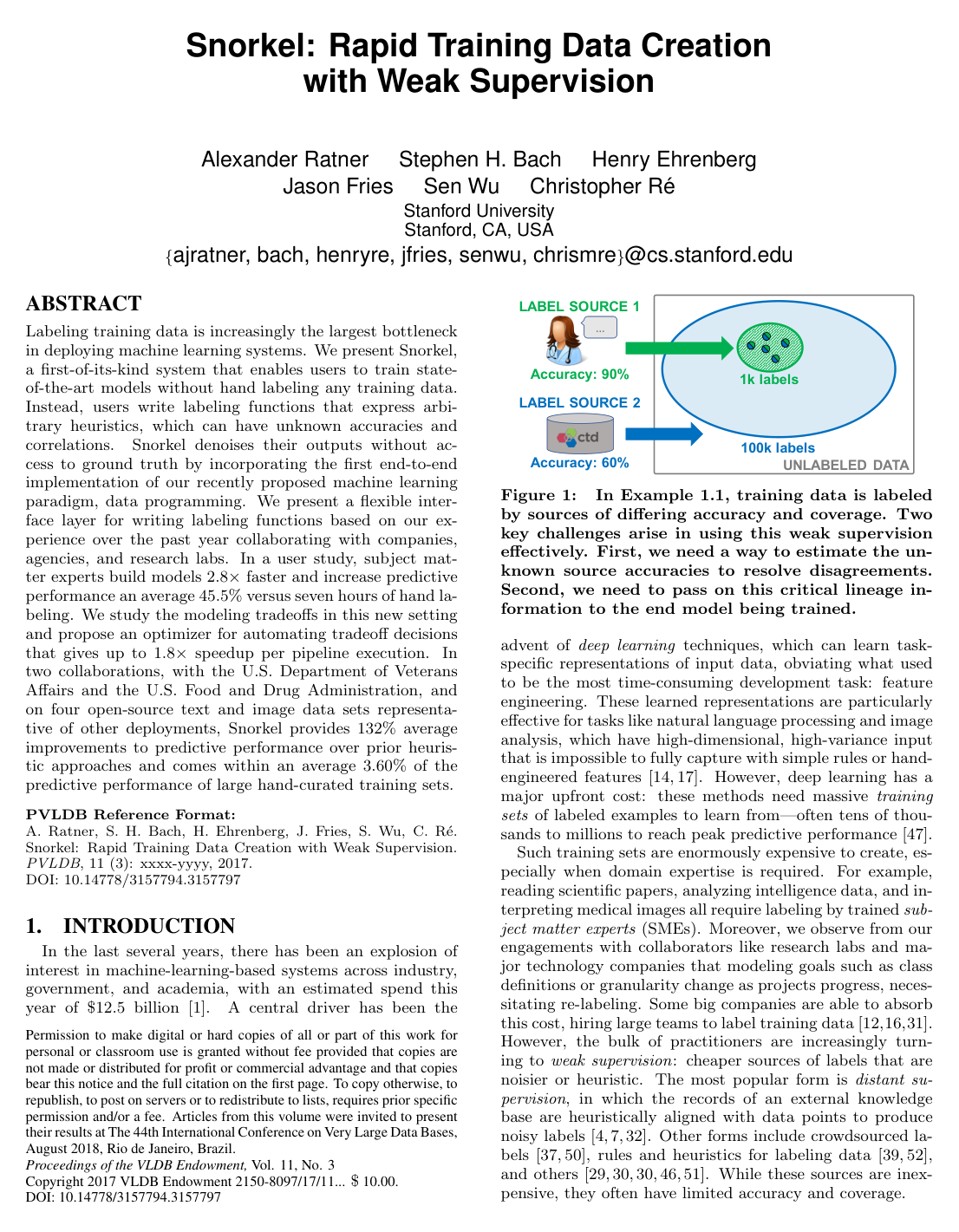
Snorkel: Rapid Training Data Creation with Weak Supervision
Alexander J. Ratner, Stephen H. Bach, Henry R. Ehrenberg, Jason Alan Fries, Sen Wu, Christopher Ré
Why you should read this
Transforms the data pipeline by introducing a framework that programmatically generates and denoises massive training sets via labeling functions rather than manual annotation.
Labeling training data is increasingly the largest bottleneck in deploying machine learning systems. We present Snorkel, a first-of-its-kind system that enables users to train state-of-the-art models without hand labeling any training data. Instead, users write labeling functions that express arbitrary heuristics, which can have unknown accuracies and correlations. Snorkel denoises their outputs without access to ground truth by incorporating the first end-to-end implementation of our recently proposed machine learning paradigm, data programming. We present a flexible interface layer for writing labeling functions based on our experience over the past year collaborating with companies, agencies, and research labs. In a user study, subject matter experts build models 2.8x faster and increase predictive performance an average 45.5% versus seven hours of hand labeling. We study the modeling tradeoffs in this new setting and propose an optimizer for automating tradeoff decisions that gives up to 1.8x speedup per pipeline execution. In two collaborations, with the U.S. Department of Veterans Affairs and the U.S. Food and Drug Administration, and on four open-source text and image data sets representative of other deployments, Snorkel provides 132% average improvements to predictive performance over prior heuristic approaches and comes within an average 3.60% of the predictive performance of large hand-curated training sets.
Added
2026-04-18