
keyword
training dynamics
Training dynamics refers to the time-dependent evolution and trajectory of a machine learning model's parameters, internal representations, and loss values as it undergoes optimization across training steps or epochs. Rather than focusing solely on the final converged state, the study of training dynamics investigates how optimization algorithms navigate complex loss landscapes, how weight updates propagate through the network over time, and the order in which specific features or capabilities are acquired. This analysis often explores distinct phases of learning, such as transitions between initial fitting, representation compression, generalization, and memorization, as well as the varying convergence rates of different model components. By characterizing these temporal behaviors through empirical tracking or mathematical frameworks like continuous-time gradient flows and kernel limits, understanding training dynamics helps explain why models generalize or fail, guiding improvements in optimization stability, data efficiency, and model architecture design.
18 items
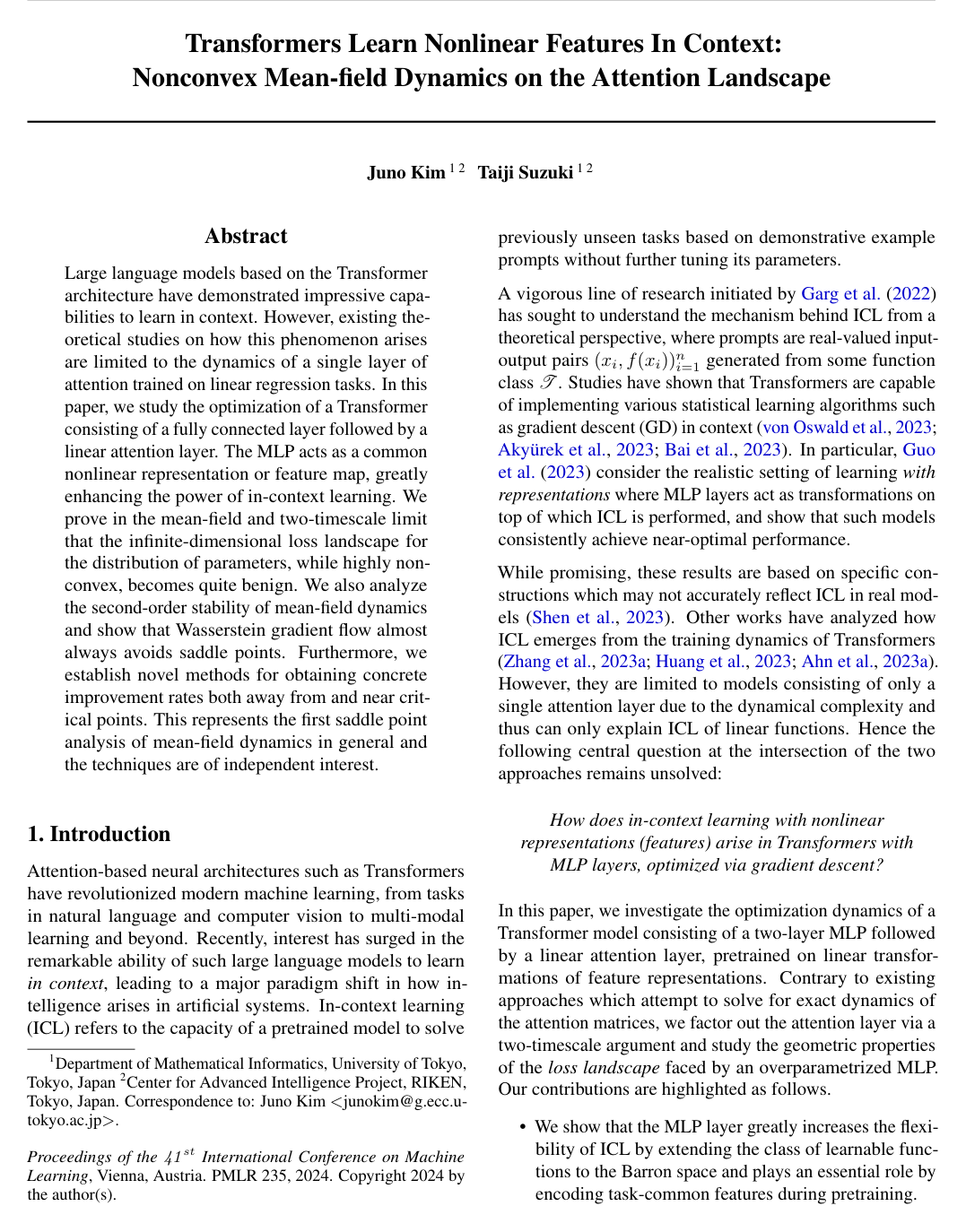
Transformers Learn Nonlinear Features In Context: Nonconvex Mean-field Dynamics on the Attention Landscape
Juno Kim, Taiji Suzuki
Why you should read this
Proves how Transformers learn nonlinear feature representations for in-context learning by establishing that mean-field Wasserstein gradient flow avoids saddle points and converges to global minima despite non-convex optimization.
Large language models based on the Transformer architecture have demonstrated impressive capabilities to learn in context. However, existing theoretical studies on how this phenomenon arises are limited to the dynamics of a single layer of attention trained on linear regression tasks. In this paper, we study the optimization of a Transformer consisting of a fully connected layer followed by a linear attention layer. The MLP acts as a common nonlinear representation or feature map, greatly enhancing the power of in-context learning. We prove in the mean-field and two-timescale limit that the infinite-dimensional loss landscape for the distribution of parameters, while highly non-convex, becomes quite benign. We also analyze the second-order stability of mean-field dynamics and show that Wasserstein gradient flow almost always avoids saddle points. Furthermore, we establish novel methods for obtaining concrete improvement rates both away from and near critical points. This represents the first saddle point analysis of mean-field dynamics in general and the techniques are of independent interest.
Added
2026-10-05
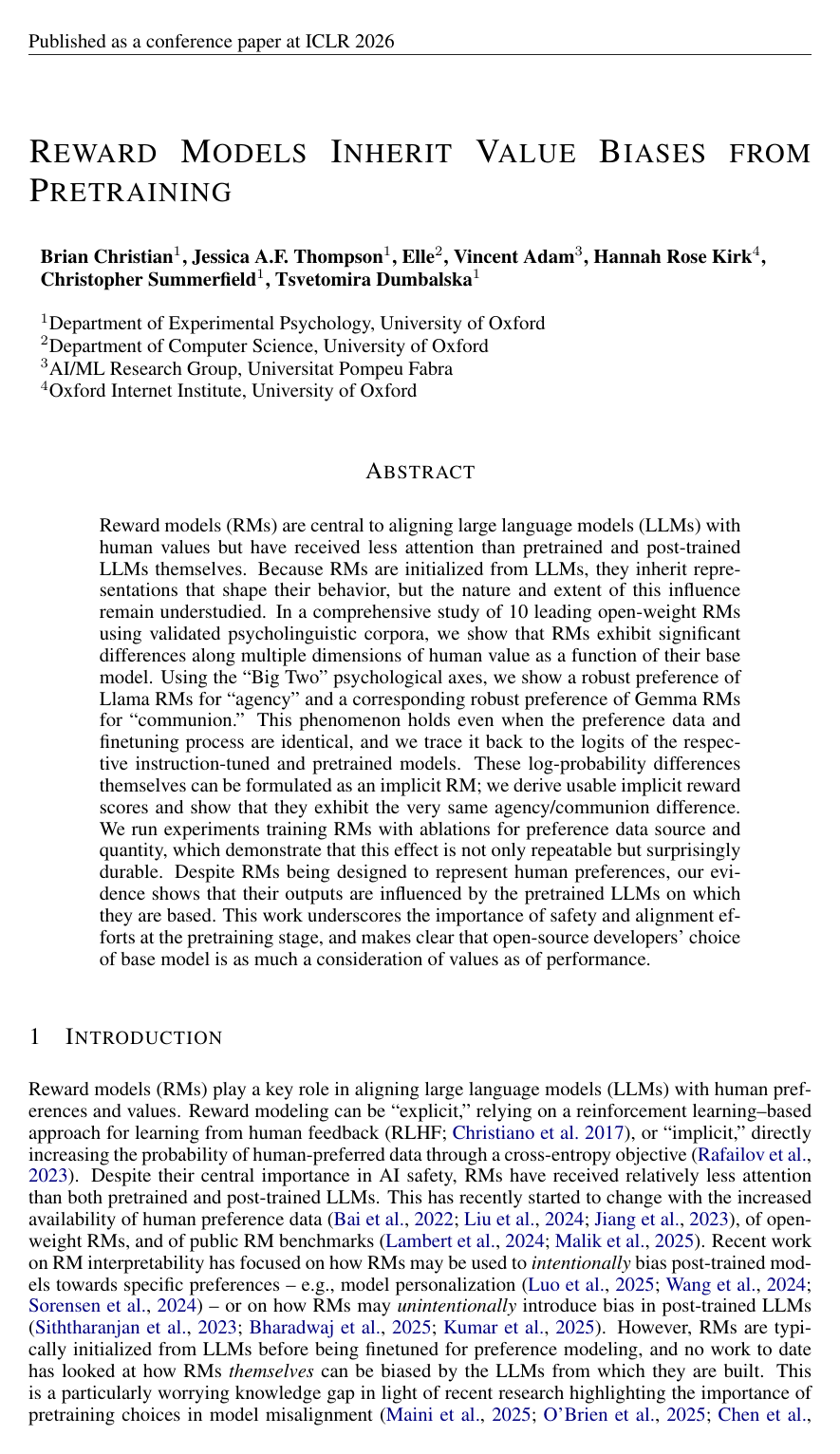
Reward Models Inherit Value Biases from Pretraining
Brian Christian, Jessica A.F. Thompson, Elle, Vincent Adam, Hannah Rose Kirk, Christopher Summerfield, Tsvetomira Dumbalska
Why you should read this
Demonstrates that reward models inherit persistent value biases directly from their pretrained base language models, causing architectures like Llama and Gemma to diverge systematically across psychological dimensions regardless of identical preference training.
Reward models (RMs) are central to aligning large language models (LLMs) with human values but have received less attention than pretrained and post-trained LLMs themselves. Because RMs are initialized from LLMs, they inherit representations that shape their behavior, but the nature and extent of this influence remain understudied. In a comprehensive study of 10 leading open-weight RMs using validated psycholinguistic corpora, we show that RMs exhibit significant differences along multiple dimensions of human value as a function of their base model. Using the "Big Two" psychological axes, we show a robust preference of Llama RMs for "agency" and a corresponding robust preference of Gemma RMs for "communion." This phenomenon holds even when the preference data and finetuning process are identical, and we trace it back to the logits of the respective instruction-tuned and pretrained models. These log-probability differences themselves can be formulated as an implicit RM; we derive usable implicit reward scores and show that they exhibit the very same agency/communion difference. We run experiments training RMs with ablations for preference data source and quantity, which demonstrate that this effect is not only repeatable but surprisingly durable. Despite RMs being designed to represent human preferences, our evidence shows that their outputs are influenced by the pretrained LLMs on which they are based. This work underscores the importance of safety and alignment efforts at the pretraining stage, and makes clear that open-source developers' choice of base model is as much a consideration of values as of performance.
Added
2026-09-29
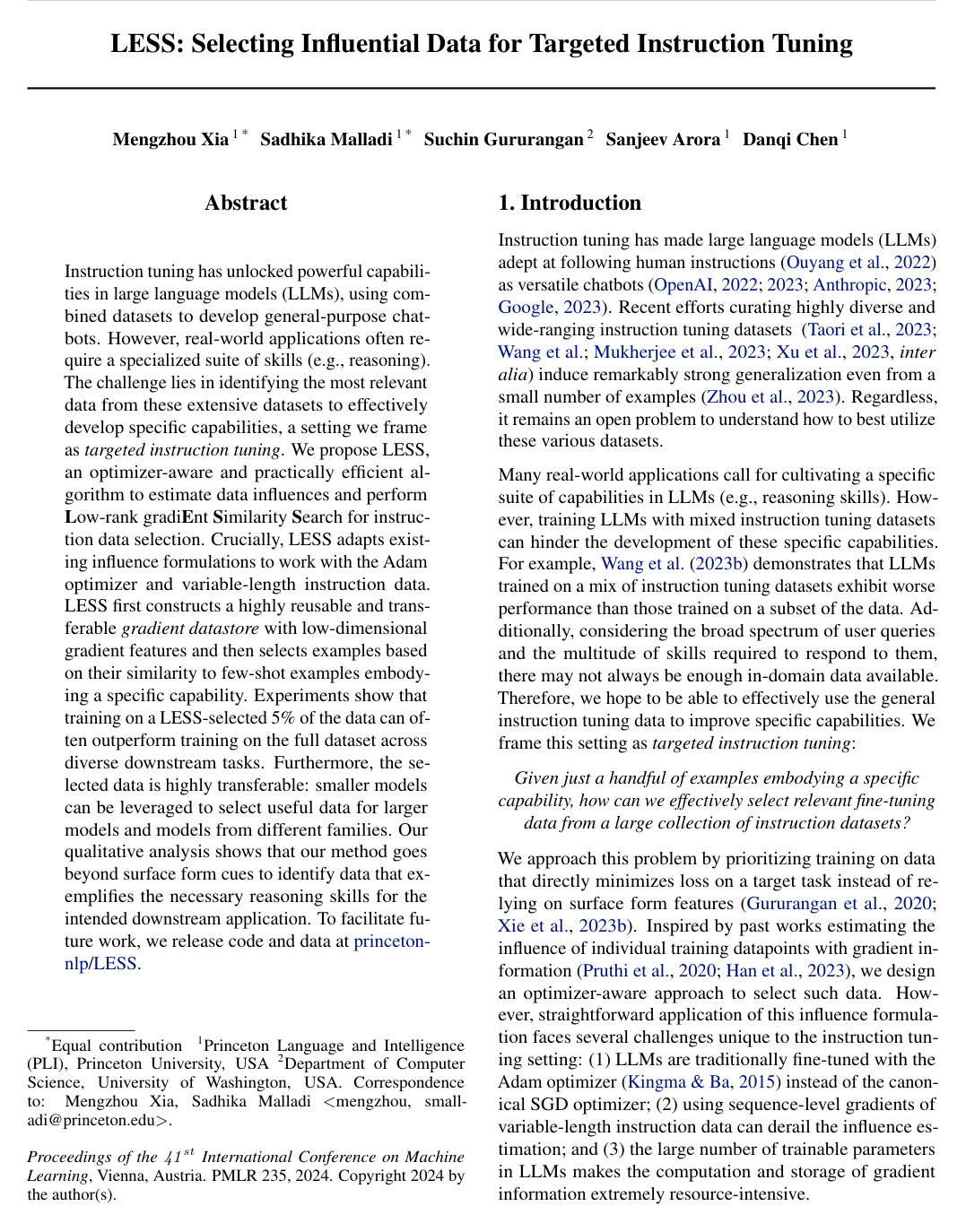
LESS: Selecting Influential Data for Targeted Instruction Tuning
Mengzhou Xia, Sadhika Malladi, Suchin Gururangan, Sanjeev Arora, Danqi Chen
Why you should read this
Proposes LESS, an efficient gradient-based data selection method for targeted instruction tuning that outperforms full-dataset training using only 5% of the data and transfers effectively across model sizes and families.
Instruction tuning has unlocked powerful capabilities in large language models (LLMs), effectively using combined datasets to develop generalpurpose chatbots. However, real-world applications often require a specialized suite of skills (e.g., reasoning). The challenge lies in identifying the most relevant data from these extensive datasets to effectively develop specific capabilities, a setting we frame as targeted instruction tuning. We propose LESS, an optimizer-aware and practically efficient algorithm to effectively estimate data influences and perform Low-rank gradiEnt Similarity Search for instruction data selection. Crucially, LESS adapts existing influence formulations to work with the Adam optimizer and variable-length instruction data. LESS first constructs a highly reusable and transferable gradient datastore with low-dimensional gradient features and then selects examples based on their similarity to few-shot examples embodying a specific capability. Experiments show that training on a LESS-selected 5% of the data can often outperform training on the full dataset across diverse downstream tasks. Furthermore, the selected data is highly transferable: smaller models can be leveraged to select useful data for larger models and models from different families. Our qualitative analysis shows that our method goes beyond surface form cues to identify data that exemplifies the necessary reasoning skills for the intended downstream application.
Added
2026-09-28
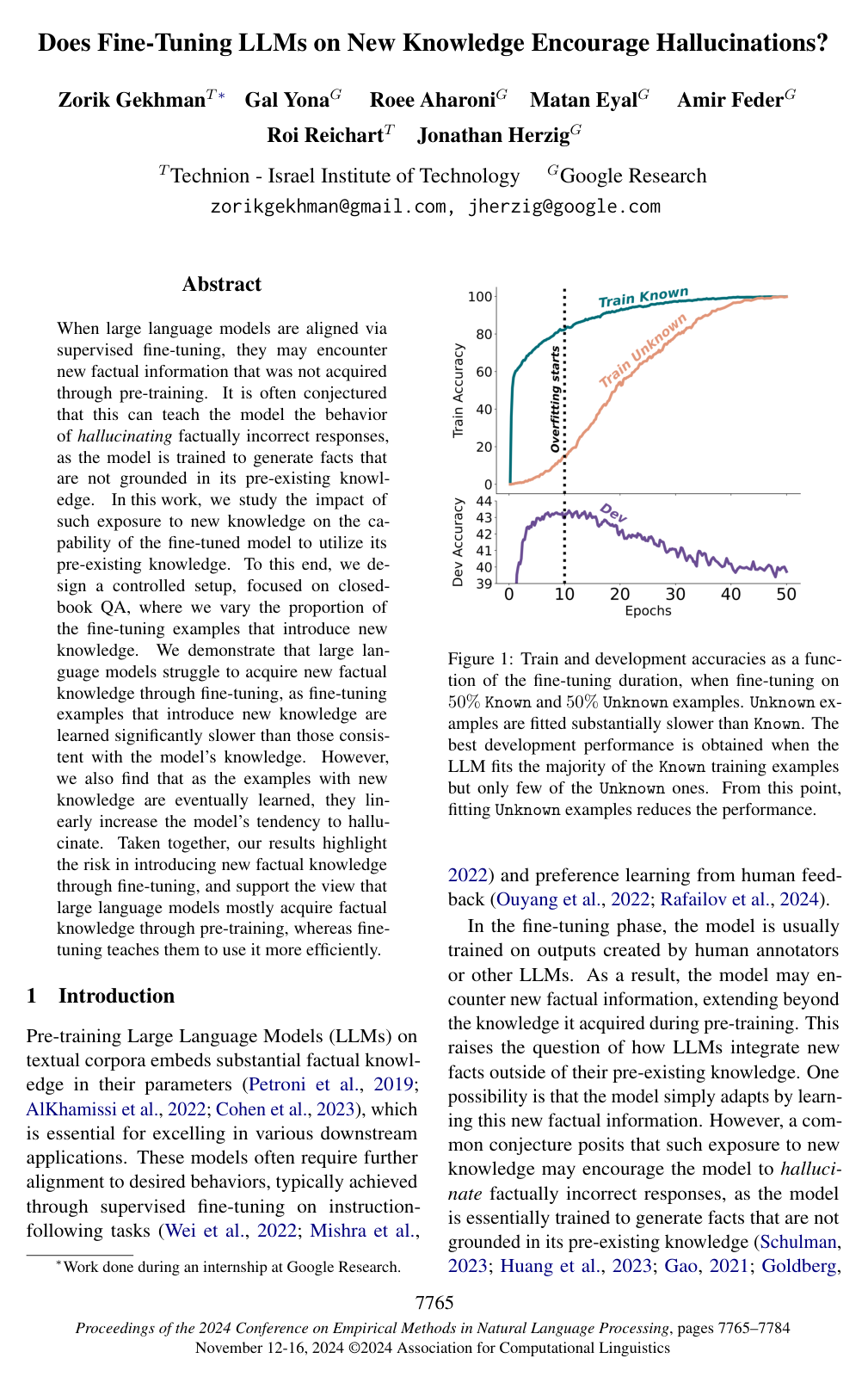
Does Fine-Tuning LLMs on New Knowledge Encourage Hallucinations?
Zorik Gekhman, Gal Yona, Roee Aharoni, Matan Eyal, Amir Feder, Roi Reichart, Jonathan Herzig
Why you should read this
Reveals that fine-tuning language models on unfamiliar factual data causes them to fit new information much slower than known facts while linearly increasing their rate of hallucinations, indicating that fine-tuning should focus on formatting existing knowledge rather than teaching new facts.
When large language models are aligned via supervised fine-tuning, they may encounter new factual information that was not acquired through pre-training. It is often conjectured that this can teach the model the behavior of hallucinating factually incorrect responses, as the model is trained to generate facts that are not grounded in its pre-existing knowledge. In this work, we study the impact of such exposure to new knowledge on the capability of the fine-tuned model to utilize its pre-existing knowledge. To this end, we design a controlled setup, focused on closed-book QA, where we vary the proportion of the fine-tuning examples that introduce new knowledge. We demonstrate that large language models struggle to acquire new factual knowledge through fine-tuning, as fine-tuning examples that introduce new knowledge are learned significantly slower than those consistent with the model's knowledge. However, we also find that as the examples with new knowledge are eventually learned, they linearly increase the model's tendency to hallucinate. Taken together, our results highlight the risk in introducing new factual knowledge through fine-tuning, and support the view that large language models mostly acquire factual knowledge through pre-training, whereas fine-tuning teaches them to use it more efficiently.
Added
2026-09-28
The Quantization Model of Neural Scaling
Eric J. Michaud, Ziming Liu, Uzay Girit, Max Tegmark
Why you should read this
Explains how power law neural scaling and emergent abilities arise by modeling network knowledge as discrete computational skills learned in order of their Zipfian frequency in training data.
We propose the Quantization Model of neural scaling laws, explaining both the observed power law dropoff of loss with model and data size, and also the sudden emergence of new capabilities with scale. We derive this model from what we call the Quantization Hypothesis, where network knowledge and skills are “quantized” into discrete chunks (quanta). We show that when quanta are learned in order of decreasing use frequency, then a power law in use frequencies explains observed power law scaling of loss. We validate this prediction on toy datasets, then study how scaling curves decompose for large language models. Using language model gradients, we automatically decompose model behavior into a diverse set of skills (quanta). We tentatively find that the frequency at which these quanta are used in the training distribution roughly follows a power law corresponding with the empirical scaling exponent for language models, a prediction of our theory.
Added
2026-09-26
In-context Convergence of Transformers
Yu Huang, Yuan Cheng, Yingbin Liang
Why you should read this
Establishes the first finite-time convergence guarantees and characterizes the stage-wise gradient descent dynamics of single-layer softmax transformers performing in-context learning on linear tasks across balanced and imbalanced feature distributions.
Transformers have recently revolutionized many domains in modern machine learning and one salient discovery is their remarkable in-context learning capability, where models can solve an unseen task by utilizing task-specific prompts without further parameters fine-tuning. This also inspired recent theoretical studies aiming to understand the in-context learning mechanism of transformers, which however focused only on linear transformers. In this work, we take the first step toward studying the learning dynamics of a one-layer transformer with softmax attention trained via gradient descent in order to in-context learn linear function classes. We consider a structured data model, where each token is randomly sampled from a set of feature vectors in either balanced or imbalanced fashion. For data with balanced features, we establish the finite-time convergence guarantee with near-zero prediction error by navigating our analysis over two phases of the training dynamics of the attention map. More notably, for data with imbalanced features, we show that the learning dynamics take a stage-wise convergence process, where the transformer first converges to a near-zero prediction error for the query tokens of dominant features, and then converges later to a near-zero error for query tokens of under-represented features, via one and four training phases. Our proof features new techniques for analyzing the competing strengths of two types of attention weights, the change of which determines different training phases.
Added
2026-09-26
How Do Transformers Learn Topic Structure: Towards a Mechanistic Understanding
Yuchen Li, Yuanzhi Li, Andrej Risteski
Why you should read this
Proves mathematically and verifies empirically on topic-modeled data how transformer embeddings and self-attention mechanisms independently learn word co-occurrence structures through a distinct two-stage training dynamic.
While the successes of transformers across many domains are indisputable, accurate understanding of the learning mechanics is still largely lacking. Their capabilities have been probed on benchmarks which include a variety of structured and reasoning tasks—but mathematical understanding is lagging substantially behind. Recent lines of work have begun studying representational aspects of this question: that is, the size/depth/complexity of attention-based networks to perform certain tasks. However, there is no guarantee the learning dynamics will converge to the constructions proposed. In our paper, we provide fine-grained mechanistic understanding of how transformers learn “semantic structure”, understood as capturing co-occurrence structure of words. Precisely, we show, through a combination of mathematical analysis and experiments on Wikipedia data and synthetic data modeled by Latent Dirichlet Allocation (LDA), that the embedding layer and the self-attention layer encode the topical structure. In the former case, this manifests as higher average inner product of embeddings between same-topic words. In the latter, it manifests as higher average pairwise attention between same-topic words. The mathematical results involve several assumptions to make the analysis tractable, which we verify on data, and might be of independent interest as well.
Added
2026-09-26
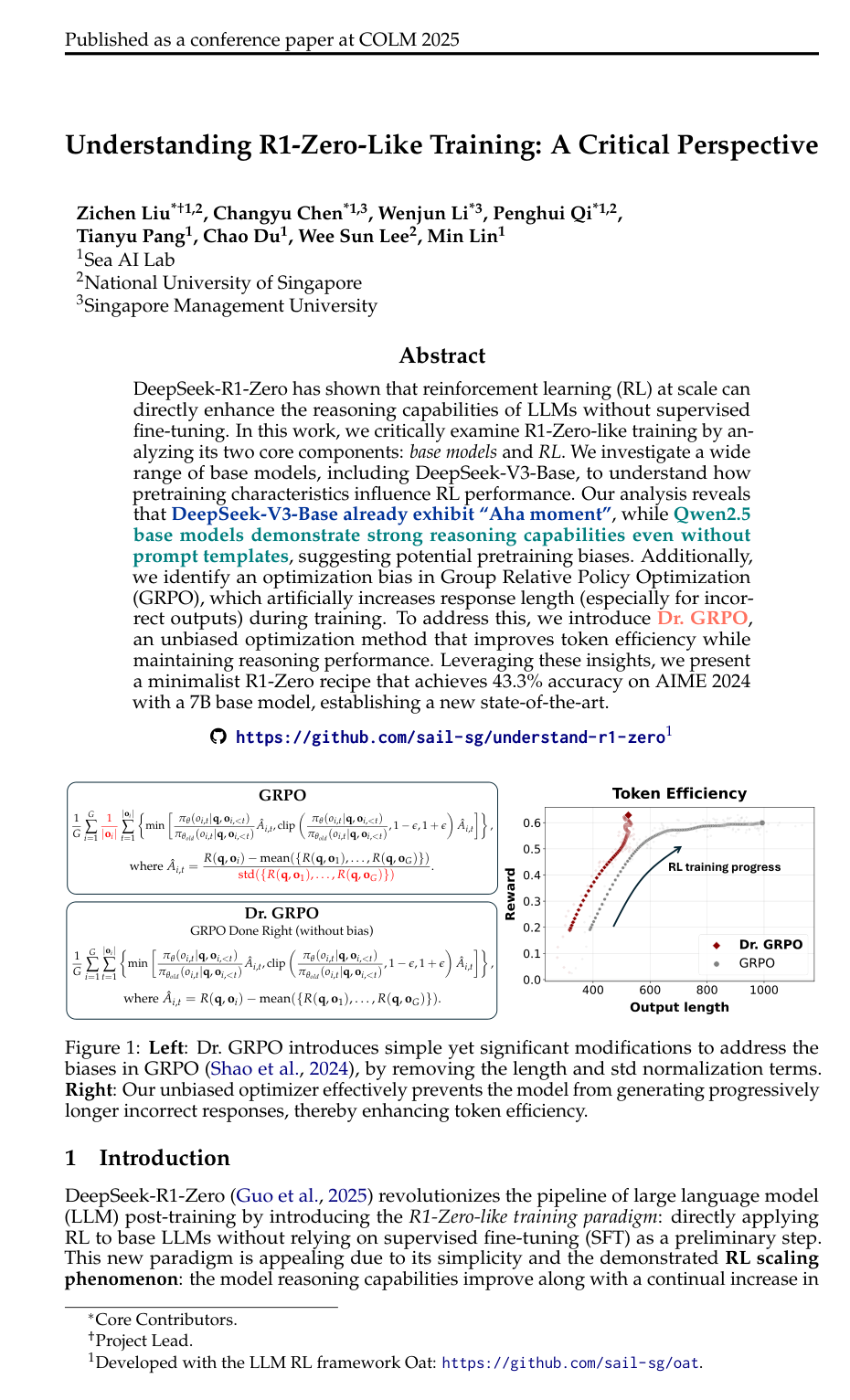
Understanding R1-Zero-Like Training: A Critical Perspective
Zichen Liu, Changyu Chen, Wenjun Li, Penghui Qi, Tianyu Pang, Chao Du, Wee Sun Lee, Min Lin
Why you should read this
Reveals critical pretraining and optimization biases in R1-Zero-like reasoning models, introducing an unbiased algorithm called Dr. GRPO that prevents response length inflation and sets a 7B state-of-the-art benchmark of 43.3% on AIME 2024.
DeepSeek-R1-Zero has shown that reinforcement learning (RL) at scale can directly enhance the reasoning capabilities of LLMs without supervised fine-tuning. In this work, we critically examine R1-Zero-like training by analyzing its two core components: base models and RL. We investigate a wide range of base models, including DeepSeek-V3-Base, to understand how pretraining characteristics influence RL performance. Our analysis reveals that DeepSeek-V3-Base already exhibit ''Aha moment'', while Qwen2.5 base models demonstrate strong reasoning capabilities even without prompt templates, suggesting potential pretraining biases. Additionally, we identify an optimization bias in Group Relative Policy Optimization (GRPO), which artificially increases response length (especially for incorrect outputs) during training. To address this, we introduce Dr. GRPO, an unbiased optimization method that improves token efficiency while maintaining reasoning performance. Leveraging these insights, we present a minimalist R1-Zero recipe that achieves 43.3% accuracy on AIME 2024 with a 7B base model, establishing a new state-of-the-art. Our code is available at this https URL.
Added
2026-09-25
Wide neural networks of any depth evolve as linear models under gradient descent
Jaehoon Lee, Lechao Xiao, Samuel S. Schoenholz, Yasaman Bahri, Roman Novak, Jascha Sohl-Dickstein, Jeffrey Pennington
Why you should read this
Proves that deep neural networks evolve as linear models under gradient descent in the infinite-width limit, bridging complex neural network training dynamics with tractable Gaussian process theory and matching the empirical behavior of practical finite-width architectures.
A longstanding goal in deep learning research has been to precisely characterize training and generalization. However, the often complex loss landscapes of neural networks have made a theory of learning dynamics elusive. In this work, we show that for wide neural networks the learning dynamics simplify considerably and that, in the infinite width limit, they are governed by a linear model obtained from the first-order Taylor expansion of the network around its initial parameters. Furthermore, mirroring the correspondence between wide Bayesian neural networks and Gaussian processes, gradient-based training of wide neural networks with a squared loss produces test set predictions drawn from a Gaussian process with a particular compositional kernel. While these theoretical results are only exact in the infinite width limit, we nevertheless find excellent empirical agreement between the predictions of the original network and those of the linearized version even for finite practically-sized networks. This agreement is robust across different architectures, optimization methods, and loss functions.
Added
2026-09-25
Opening the Black Box of Deep Neural Networks via Information
Ravid Shwartz-Ziv, Naftali Tishby
Why you should read this
Demonstrates through the Information Bottleneck principle that deep neural network training consists of distinct label-fitting and representation-compression phases, explaining theoretically why hidden layers accelerate generalization.
Despite their great success, there is still no comprehensive theoretical understanding of learning with Deep Neural Networks (DNNs) or their inner organization. Previous work proposed to analyze DNNs in the \textit{Information Plane}; i.e., the plane of the Mutual Information values that each layer preserves on the input and output variables. They suggested that the goal of the network is to optimize the Information Bottleneck (IB) tradeoff between compression and prediction, successively, for each layer. In this work we follow up on this idea and demonstrate the effectiveness of the Information-Plane visualization of DNNs. Our main results are: (i) most of the training epochs in standard DL are spent on {\emph compression} of the input to efficient representation and not on fitting the training labels. (ii) The representation compression phase begins when the training errors becomes small and the Stochastic Gradient Decent (SGD) epochs change from a fast drift to smaller training error into a stochastic relaxation, or random diffusion, constrained by the training error value. (iii) The converged layers lie on or very close to the Information Bottleneck (IB) theoretical bound, and the maps from the input to any hidden layer and from this hidden layer to the output satisfy the IB self-consistent equations. This generalization through noise mechanism is unique to Deep Neural Networks and absent in one layer networks. (iv) The training time is dramatically reduced when adding more hidden layers. Thus the main advantage of the hidden layers is computational. This can be explained by the reduced relaxation time, as this it scales super-linearly (exponentially for simple diffusion) with the information compression from the previous layer.
Added
2026-09-24
When and why PINNs fail to train: A neural tangent kernel perspective
Sifan Wang, Xinling Yu, Paris Perdikaris
Why you should read this
Explains why physics-informed neural networks fail to train using neural tangent kernel analysis and develops an adaptive weighting method based on kernel eigenvalues to resolve convergence discrepancies across loss terms.
Physics-informed neural networks (PINNs) have lately received great attention thanks to their flexibility in tackling a wide range of forward and inverse problems involving partial differential equations. However, despite their noticeable empirical success, little is known about how such constrained neural networks behave during their training via gradient descent. More importantly, even less is known about why such models sometimes fail to train at all. In this work, we aim to investigate these questions through the lens of the Neural Tangent Kernel (NTK); a kernel that captures the behavior of fully-connected neural networks in the infinite width limit during training via gradient descent. Specifically, we derive the NTK of PINNs and prove that, under appropriate conditions, it converges to a deterministic kernel that stays constant during training in the infinite-width limit. This allows us to analyze the training dynamics of PINNs through the lens of their limiting NTK and find a remarkable discrepancy in the convergence rate of the different loss components contributing to the total training error. To address this fundamental pathology, we propose a novel gradient descent algorithm that utilizes the eigenvalues of the NTK to adaptively calibrate the convergence rate of the total training error. Finally, we perform a series of numerical experiments to verify the correctness of our theory and the practical effectiveness of the proposed algorithms. The data and code accompanying this manuscript are publicly available at \url{this https URL}.
Added
2026-09-19
Normalized Low-Rank Adaptation
Jiale Kang, Ziyin Yue, Zheng Zhan, Yangyi Huang, Weiyang Liu
Why you should read this
Proposes Normalized Low-Rank Adaptation (NoRA), a technique that normalizes down-projection matrices to accelerate convergence, stabilize training, and mitigate catastrophic forgetting across pretraining, supervised finetuning, and reinforcement learning without introducing parameter or inference overhead.
While low-rank adaptation (LoRA) is widely used for parameter-efficient model adaptation, how to regularize its training dynamics for stable and effective optimization remains underexplored. Because LoRA initializes the up-projection to zero, its early optimization dynamics are largely governed by the down-projection. Building on this observation, we introduce Normalized Low-Rank Adaptation (NoRA), a simple yet effective method that normalizes the down-projection matrices during training. We further show that the same normalization can be applied only at initialization, improving standard LoRA without requiring repeated normalization throughout training. Across pretraining, supervised finetuning, and reinforcement learning, NoRA consistently accelerates convergence, improves performance and training stability, and mitigates catastrophic forgetting. These benefits require neither additional trainable parameters nor inference-time computation, making NoRA a simple and broadly applicable enhancement to LoRA.
Added
2026-09-07
License
Published with permission
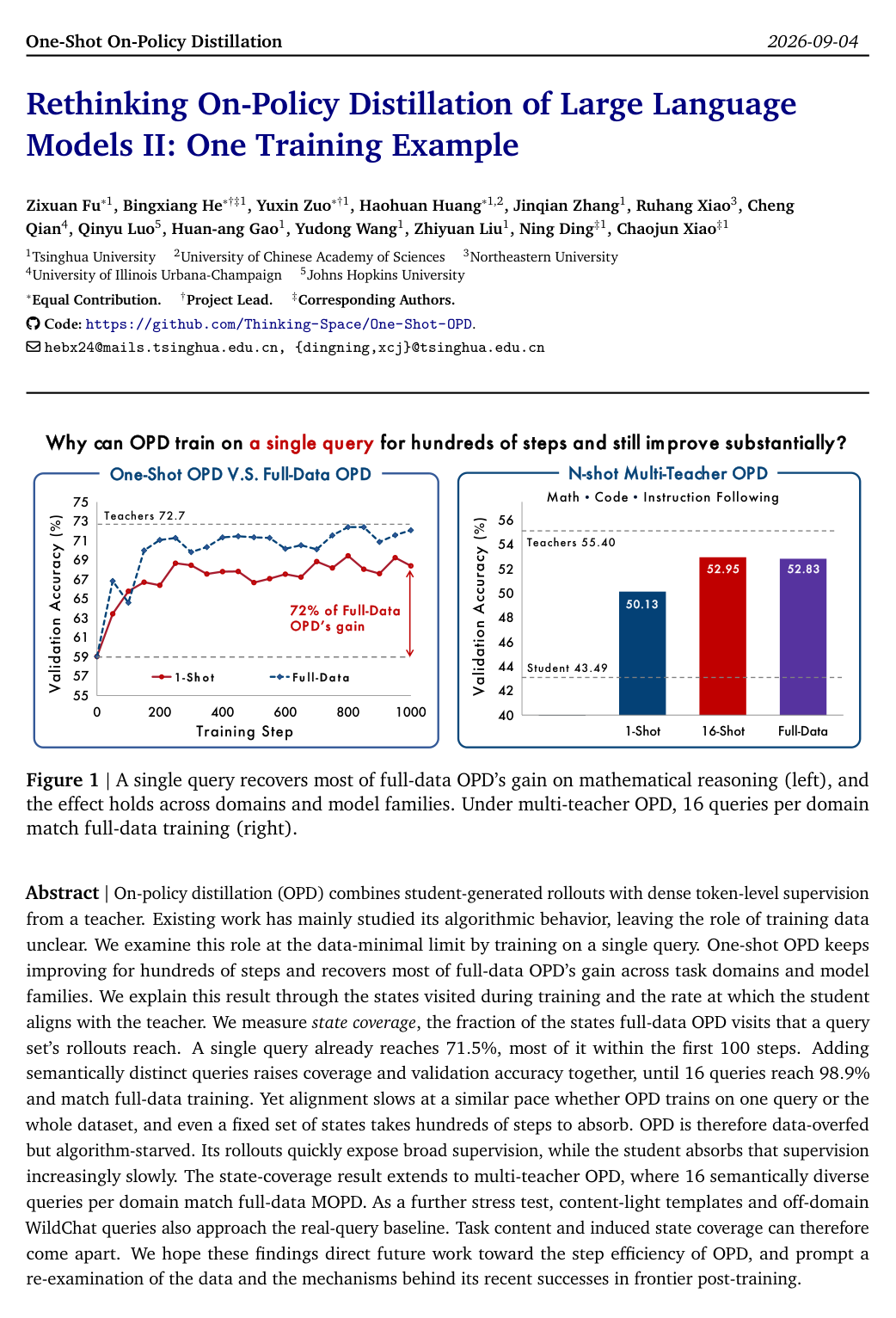
Rethinking On-Policy Distillation of Large Language Models II: One Training Example
Zixuan Fu, Bingxiang He, Yuxin Zuo, Haohuan Huang, Jinqian Zhang, Ruhang Xiao, Cheng Qian, Qinyu Luo, Huan-ang Gao, Yudong Wang, Zhiyuan Liu, Ning Ding, Chaojun Xiao
Why you should read this
Demonstrates that on-policy distillation requires as few as 16 training queries to match full-dataset performance, revealing that student rollouts rapidly achieve broad state coverage while slow student alignment—not data scarcity—is the true training bottleneck.
On-policy distillation (OPD) combines student-generated rollouts with dense token-level supervision from a teacher. Existing work has mainly studied its algorithmic behavior, leaving the role of training data unclear. We examine this role at the data-minimal limit by training on a single query. One-shot OPD keeps improving for hundreds of steps and recovers most of full-data OPD's gain across task domains and model families. We explain this result through the states visited during training and the rate at which the student aligns with the teacher. We measure \emph{state coverage}, the fraction of the states full-data OPD visits that a query set's rollouts reach. A single query already reaches \(71.5\%\), most of it within the first 100 steps. Adding semantically distinct queries raises coverage and validation accuracy together, until 16 queries reach \(98.9\%\) and match full-data training. Yet alignment slows at a similar pace whether OPD trains on one query or the whole dataset, and even a fixed set of states takes hundreds of steps to absorb. OPD is therefore data-overfed but algorithm-starved. Its rollouts quickly expose broad supervision, while the student absorbs that supervision increasingly slowly. The state-coverage result extends to multi-teacher OPD, where 16 semantically diverse queries per domain match full-data MOPD. As a further stress test, content-light templates and off-domain WildChat queries also approach the real-query baseline. Task content and induced state coverage can therefore come apart. We hope these findings direct future work toward the step efficiency of OPD, and prompt a re-examination of the data and the mechanisms behind its recent successes in frontier post-training.
Added
2026-09-05

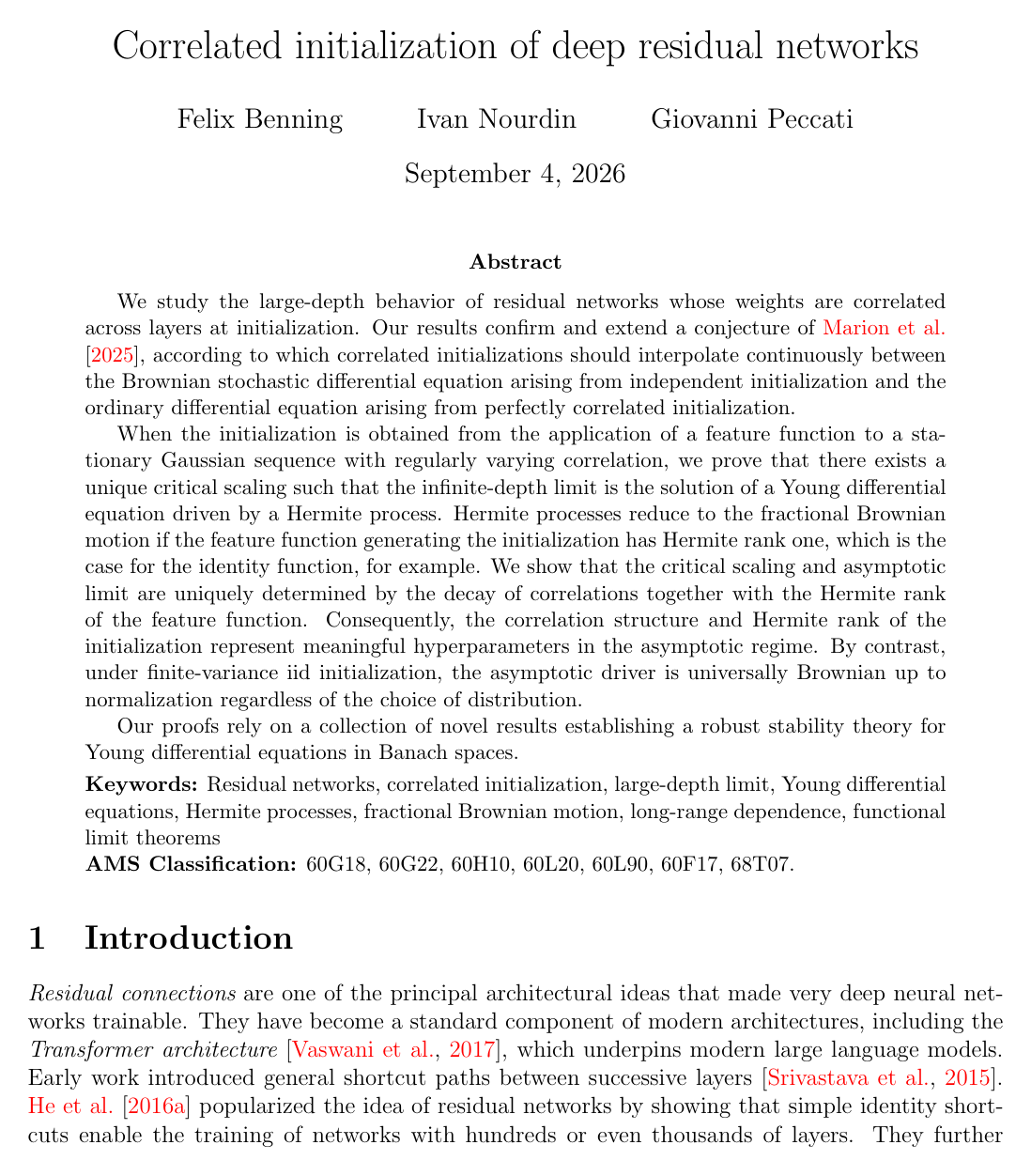
Correlated initialization of deep residual networks
Felix Benning, Ivan Nourdin, Giovanni Peccati
Why you should read this
Proves that layer-correlated weight initializations enable deep residual networks in the infinite-depth limit to converge to Young differential equations driven by Hermite processes, establishing correlation decay as a tunable hyperparameter that bridges the gap between deterministic and Brownian scaling regimes.
We study the large-depth behavior of residual networks whose weights are correlated across layers at initialization. Our results confirm and extend a conjecture of Marion et al. [2025], according to which correlated initializations should interpolate continuously between the Brownian stochastic differential equation arising from independent initialization and the ordinary differential equation arising from perfectly correlated initialization. When the initialization is obtained from the application of a feature function to a stationary Gaussian sequence with regularly varying correlation, we prove that there exists a unique critical scaling such that the infinite-depth limit is the solution of a Young differential equation driven by a Hermite process. Hermite processes reduce to the fractional Brownian motion if the feature function generating the initialization has Hermite rank one, which is the case for the identity function, for example. We show that the critical scaling and asymptotic limit are uniquely determined by the decay of correlations together with the Hermite rank of the feature function. Consequently, the correlation structure and Hermite rank of the initialization represent meaningful hyperparameters in the asymptotic regime. By contrast, under finite-variance iid initialization, the asymptotic driver is universally Brownian up to normalization regardless of the choice of distribution. Our proofs rely on a collection of novel results establishing a robust stability theory for Young differential equations in Banach spaces.
Added
2026-09-05

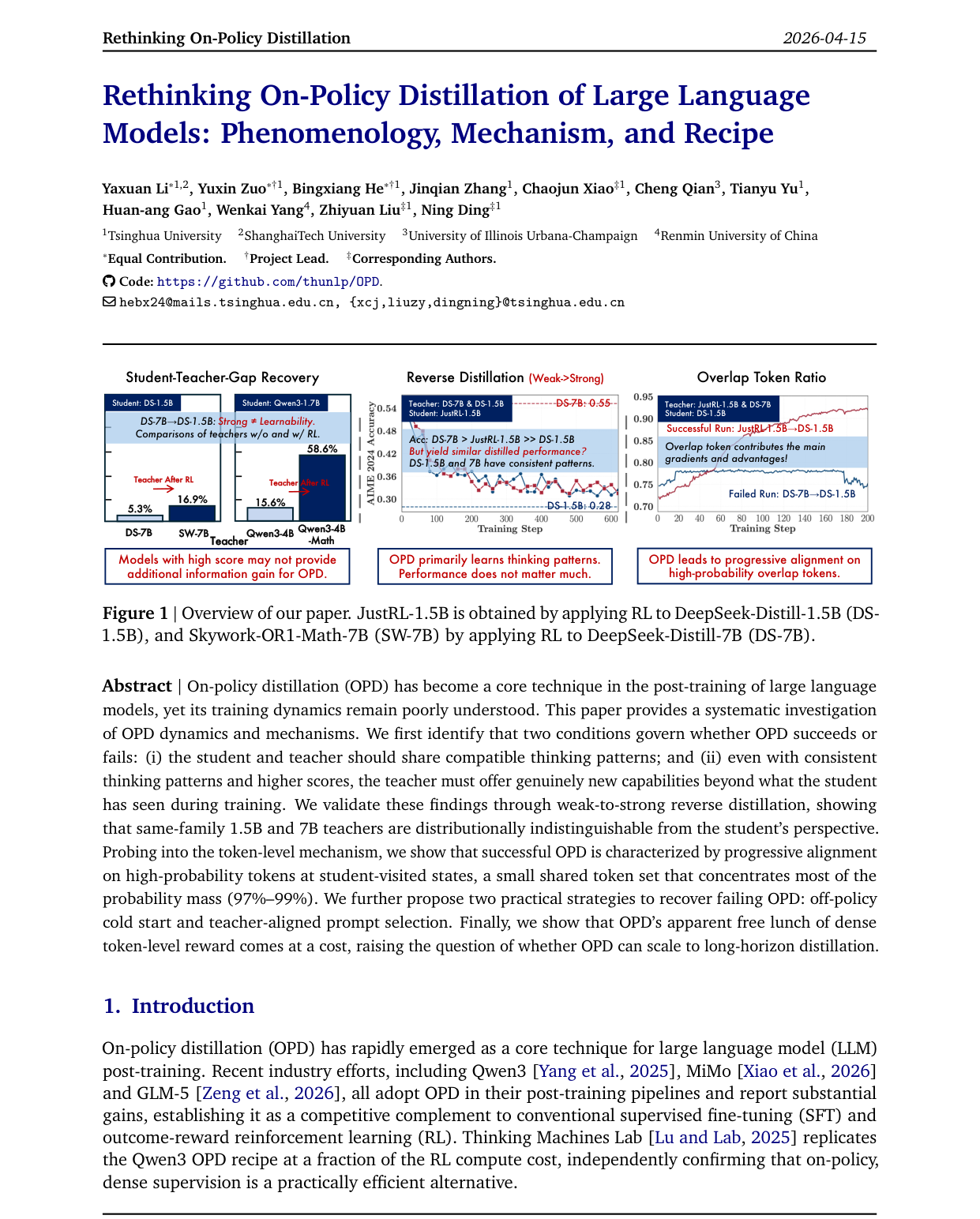
Rethinking On-Policy Distillation of Large Language Models: Phenomenology, Mechanism, and Recipe
Yaxuan Li, Yuxin Zuo, Bingxiang He, Jinqian Zhang, Chaojun Xiao, Cheng Qian, Tianyu Yu, Huan-ang Gao, Wenkai Yang, Zhiyuan Liu, Ning Ding
Why you should read this
Explains the token-level mechanics and failure modes of on-policy language model distillation, providing practical strategies such as off-policy cold starts to rescue failing training runs.
On-policy distillation (OPD) has become a core technique in the post-training of large language models, yet its training dynamics remain poorly understood. This paper provides a systematic investigation of OPD dynamics and mechanisms. We first identify that two conditions govern whether OPD succeeds or fails: (i) the student and teacher should share compatible thinking patterns; and (ii) even with consistent thinking patterns and higher scores, the teacher must offer genuinely new capabilities beyond what the student has seen during training. We validate these findings through weak-to-strong reverse distillation, showing that same-family 1.5B and 7B teachers are distributionally indistinguishable from the student's perspective. Probing into the token-level mechanism, we show that successful OPD is characterized by progressive alignment on high-probability tokens at student-visited states, a small shared token set that concentrates most of the probability mass (97%-99%). We further propose two practical strategies to recover failing OPD: off-policy cold start and teacher-aligned prompt selection. Finally, we show that OPD's apparent free lunch of dense token-level reward comes at a cost, raising the question of whether OPD can scale to long-horizon distillation.
Added
2026-09-03
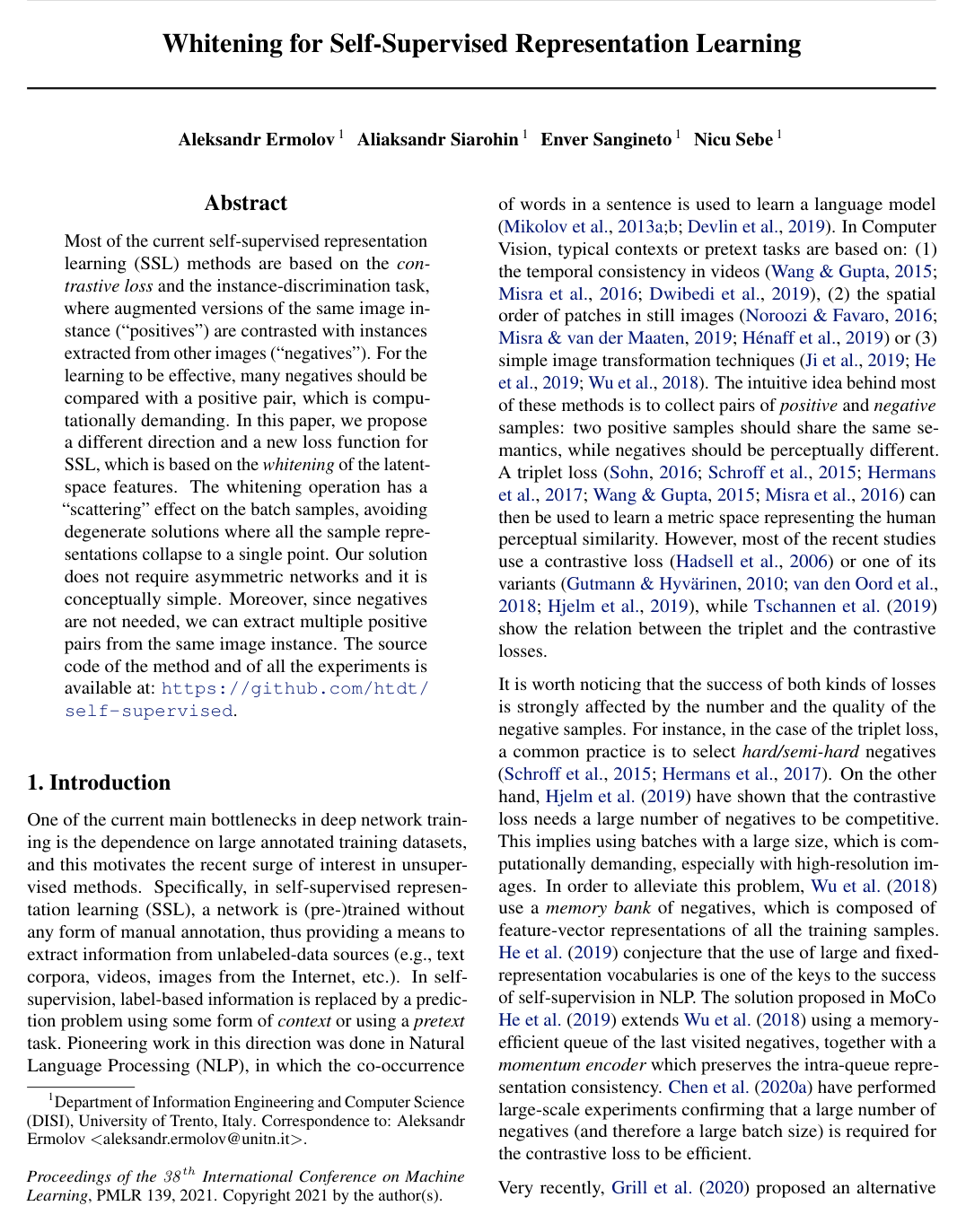
Whitening for Self-Supervised Representation Learning
Aleksandr Ermolov, Aliaksandr Siarohin, Enver Sangineto, Nicu Sebe
Why you should read this
Demonstrates that a simple whitening-based loss function can achieve competitive self-supervised learning performance while eliminating the need for negative samples and computationally expensive large batch sizes that plague existing contrastive methods.
Most of the current self-supervised representation learning (SSL) methods are based on the contrastive loss and the instance-discrimination task, where augmented versions of the same image instance ("positives") are contrasted with instances extracted from other images ("negatives"). For the learning to be effective, many negatives should be compared with a positive pair, which is computationally demanding. In this paper, we propose a different direction and a new loss function for SSL, which is based on the whitening of the latent-space features. The whitening operation has a "scattering" effect on the batch samples, avoiding degenerate solutions where all the sample representations collapse to a single point. Our solution does not require asymmetric networks and it is conceptually simple. Moreover, since negatives are not needed, we can extract multiple positive pairs from the same image instance. The source code of the method and of all the experiments is available at: this https URL.
Added
2026-02-21
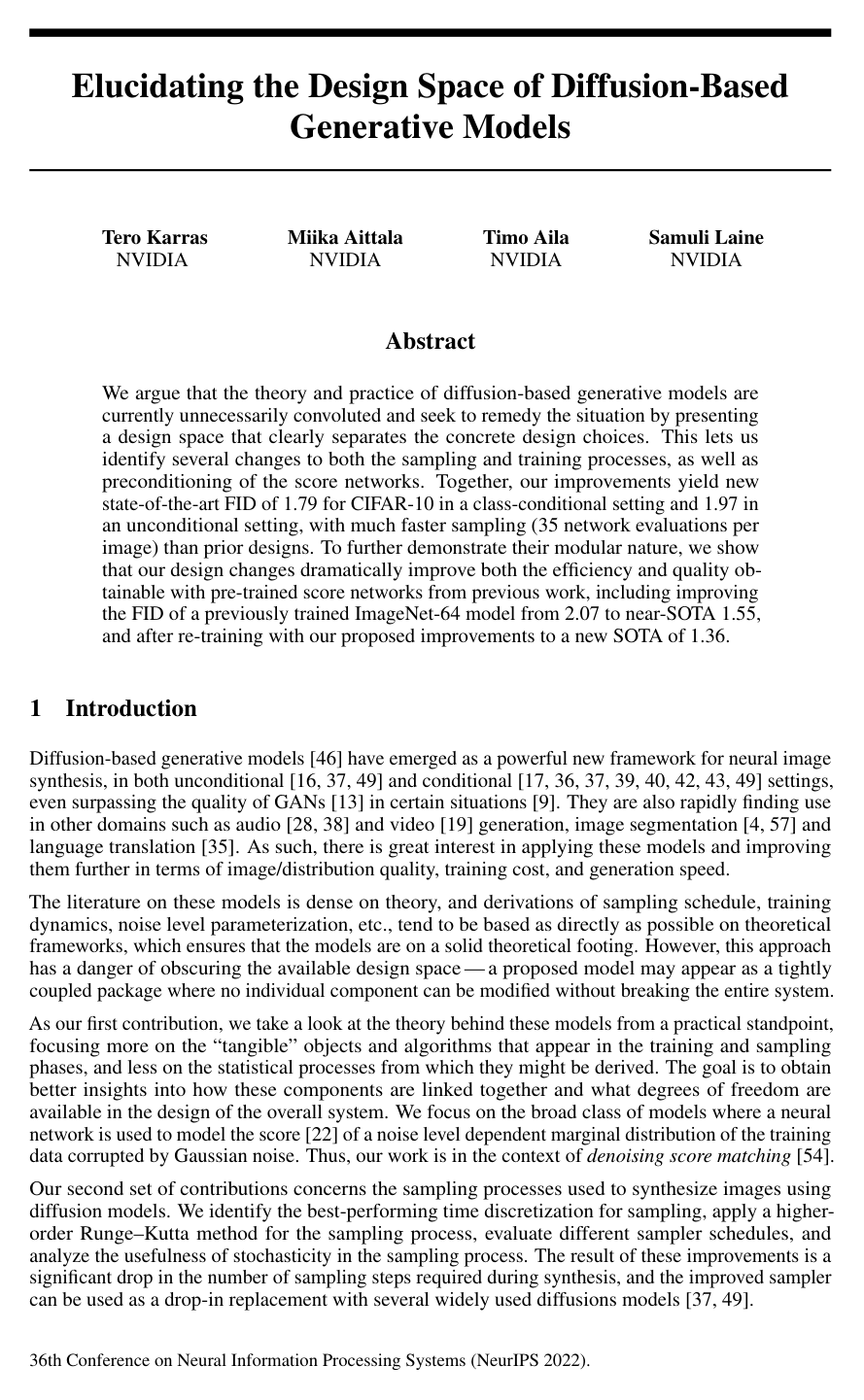
Elucidating the Design Space of Diffusion-Based Generative Models
Tero Karras, Miika Aittala, Timo Aila, Samuli Laine
Why you should read this
Dissects the components of diffusion models (noise schedules, preconditioning, sampling) to purely empirical principles, creating a standardized "best practice" framework.
We argue that the theory and practice of diffusion-based generative models are currently unnecessarily convoluted and seek to remedy the situation by presenting a design space that clearly separates the concrete design choices. This lets us identify several changes to both the sampling and training processes, as well as preconditioning of the score networks. Together, our improvements yield new state-of-the-art FID of 1.79 for CIFAR-10 in a class-conditional setting and 1.97 in an unconditional setting, with much faster sampling (35 network evaluations per image) than prior designs. To further demonstrate their modular nature, we show that our design changes dramatically improve both the efficiency and quality obtainable with pre-trained score networks from previous work, including improving the FID of a previously trained ImageNet-64 model from 2.07 to near-SOTA 1.55, and after re-training with our proposed improvements to a new SOTA of 1.36.
Added
2026-02-21
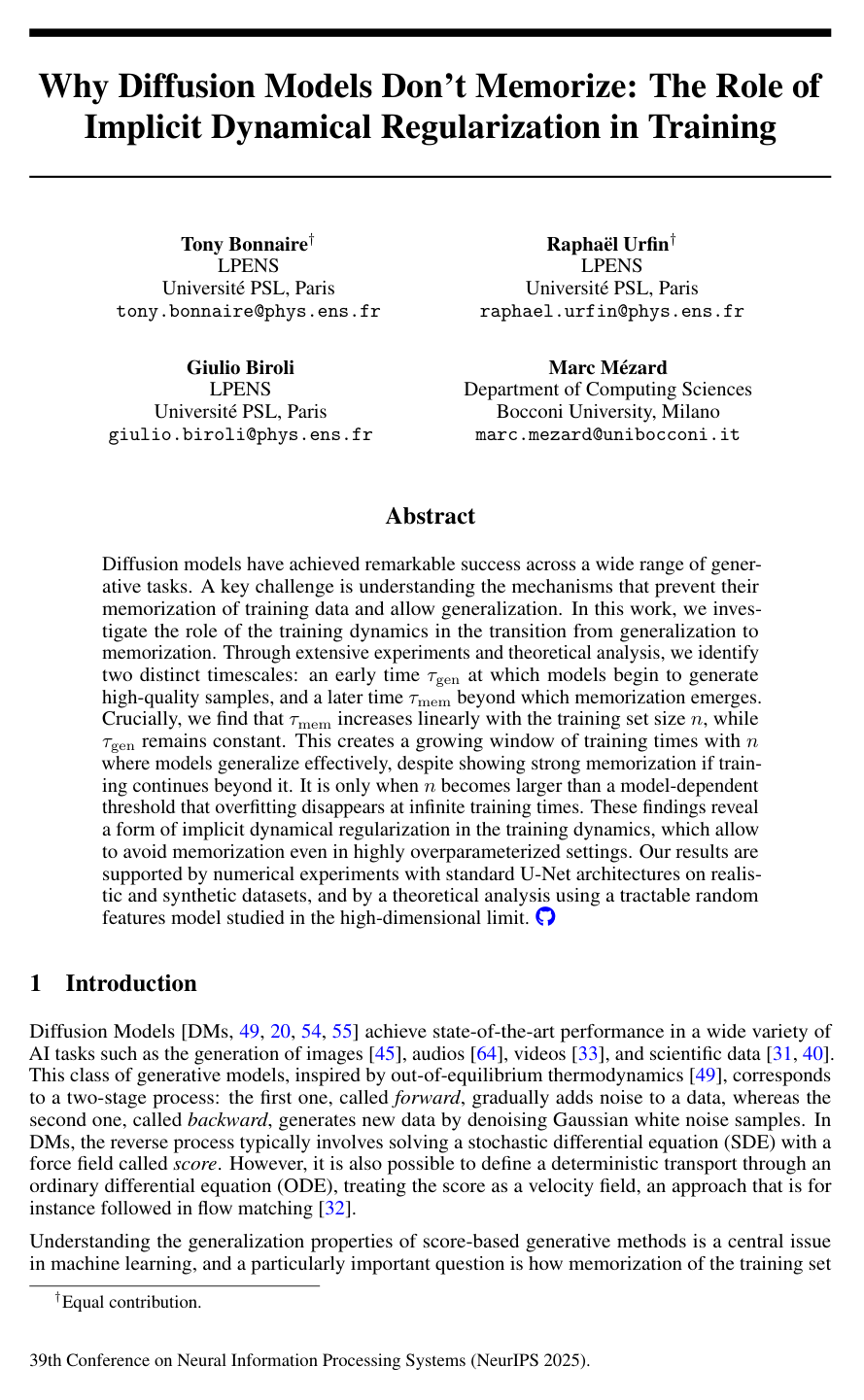
Why Diffusion Models Don't Memorize: The Role of Implicit Dynamical Regularization in Training
Tony Bonnaire, Raphaël Urfin, Giulio Biroli, Marc Mézard
Why you should read this
Reveals how an implicit dynamical regularization in training prevents diffusion models from memorizing, maintaining generalization even in heavily overparameterized settings.
Diffusion models have achieved remarkable success across a wide range of generative tasks. A key challenge is understanding the mechanisms that prevent their memorization of training data and allow generalization. In this work, we investigate the role of the training dynamics in the transition from generalization to memorization. Through extensive experiments and theoretical analysis, we identify two distinct timescales: an early time at which models begin to generate high-quality samples, and a later time beyond which memorization emerges. Crucially, we find that increases linearly with the training set size , while remains constant. This creates a growing window of training times with where models generalize effectively, despite showing strong memorization if training continues beyond it. It is only when becomes larger than a model-dependent threshold that overfitting disappears at infinite training times. These findings reveal a form of implicit dynamical regularization in the training dynamics, which allow to avoid memorization even in highly overparameterized settings. Our results are supported by numerical experiments with standard U-Net architectures on realistic and synthetic datasets, and by a theoretical analysis using a tractable random features model studied in the high-dimensional limit.
Added
2025-12-27