
keyword
text-to-image synthesis
Text-to-image synthesis is an artificial intelligence task that involves automatically generating visual images from natural language text descriptions. Positioned at the intersection of computer vision and natural language processing, the process uses deep learning models to interpret the semantic meaning of an input prompt and translate those concepts into coherent, high-quality visual representations. Core architectures employed for this task include diffusion models, generative adversarial networks, and autoregressive models, which learn cross-modal mappings from large datasets of paired images and text captions. The primary objective is to produce images that are photorealistic or stylistically aligned with the prompt while faithfully preserving the described objects, attributes, spatial relationships, and visual context.
9 items
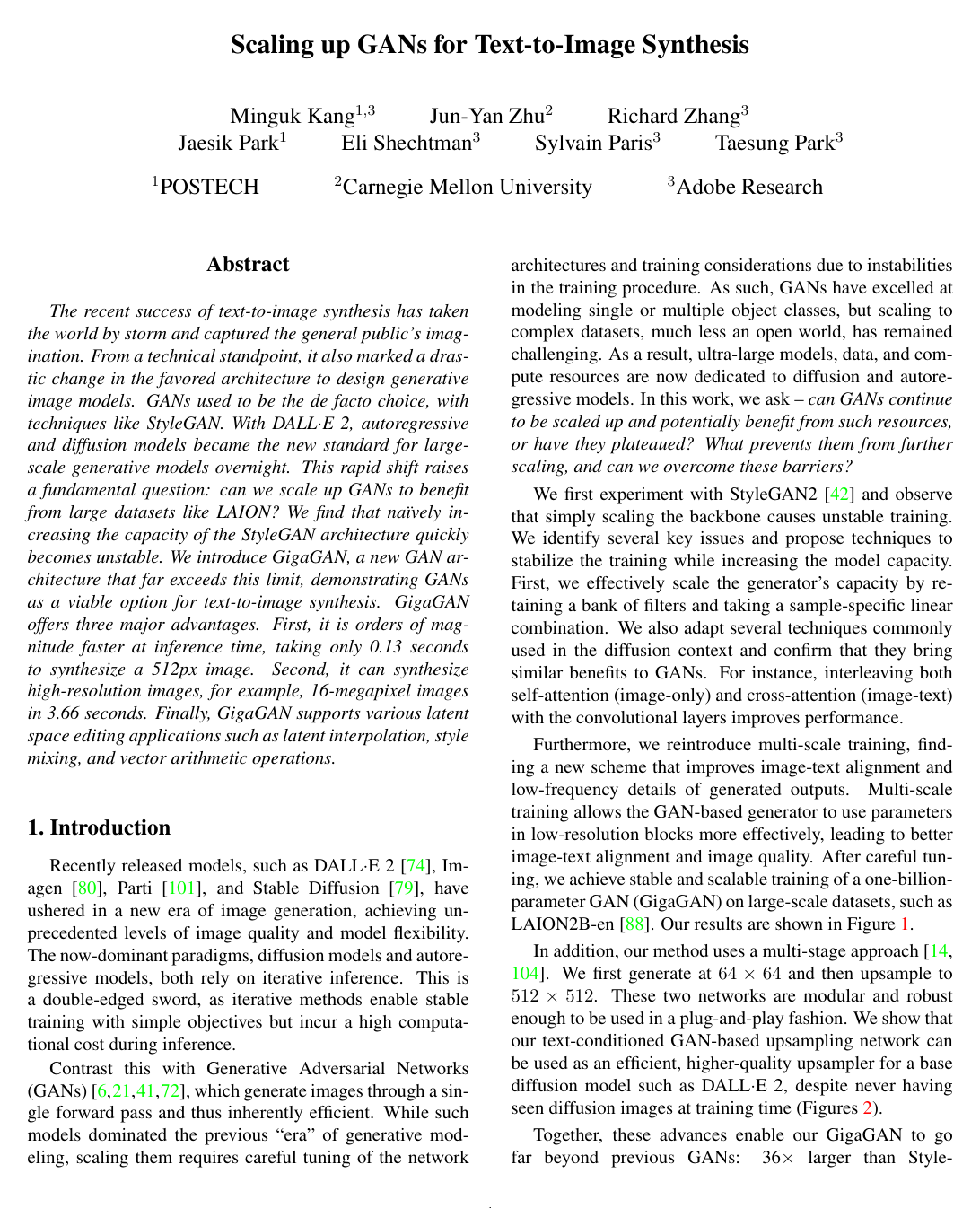
Scaling up GANs for Text-to-Image Synthesis
Minguk Kang, Jun-Yan Zhu, Richard Zhang, Jaesik Park, Eli Shechtman, Sylvain Paris, Taesung Park
Why you should read this
Introduces GigaGAN, a scalable generative adversarial network that generates high-resolution text-to-image outputs orders of magnitude faster than diffusion models while preserving flexible latent space editing.
The recent success of text-to-image synthesis has taken the world by storm and captured the general public's imagination. From a technical standpoint, it also marked a drastic change in the favored architecture to design generative image models. GANs used to be the de facto choice, with techniques like StyleGAN. With DALL-E 2, auto-regressive and diffusion models became the new standard for large-scale generative models overnight. This rapid shift raises a fundamental question: can we scale up GANs to benefit from large datasets like LAION? We find that naÏvely increasing the capacity of the StyleGAN architecture quickly becomes unstable. We introduce GigaGAN, a new GAN architecture that far exceeds this limit, demonstrating GANs as a viable option for text-to-image synthesis. GigaGAN offers three major advantages. First, it is orders of magnitude faster at inference time, taking only 0.13 seconds to synthesize a 512px image. Second, it can synthesize high-resolution images, for example, 16-megapixel pixels in 3.66 seconds. Finally, GigaGAN supports various latent space editing applications such as latent interpolation, style mixing, and vector arithmetic operations.
Added
2026-10-05
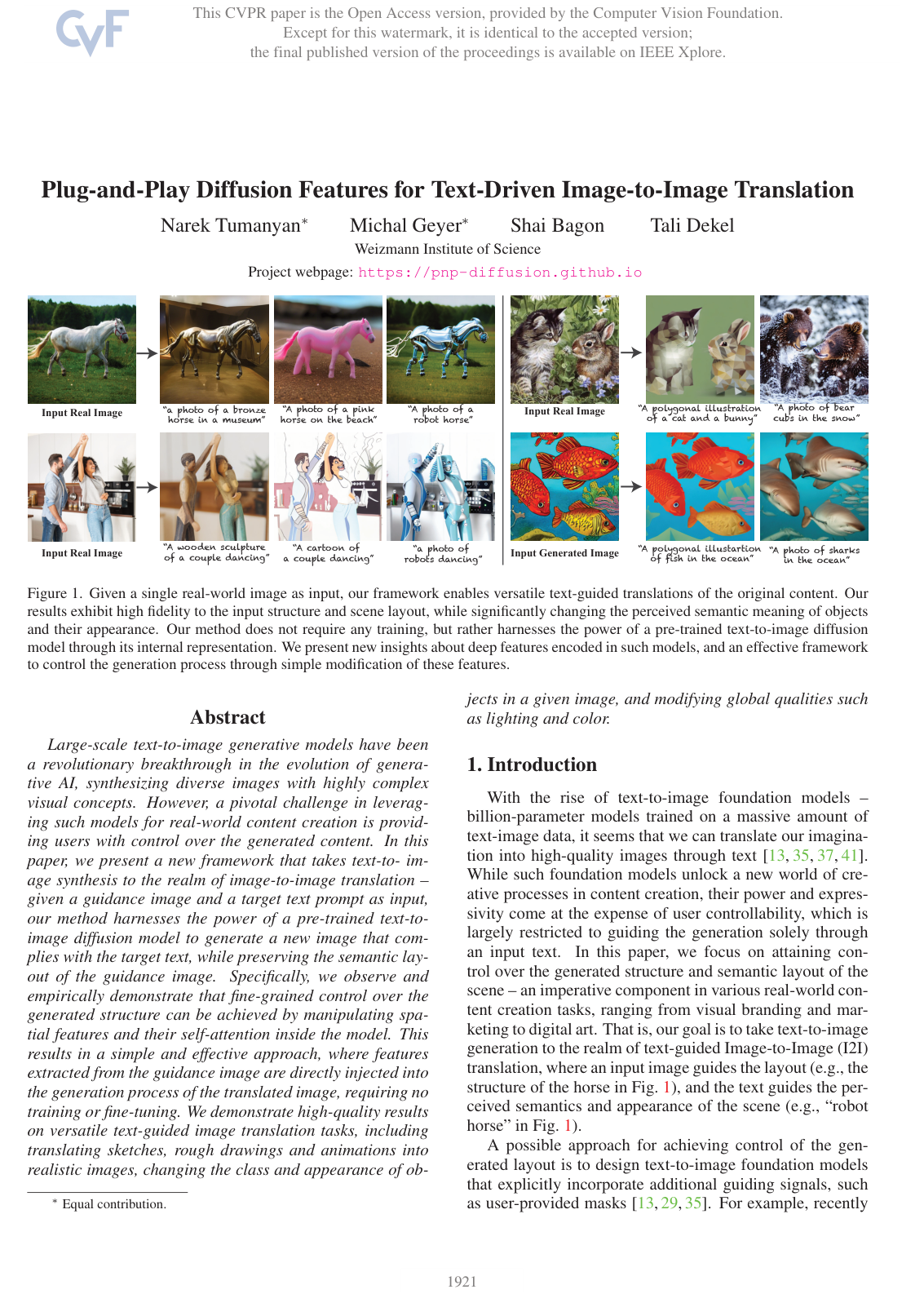
Plug-and-Play Diffusion Features for Text-Driven Image-to-Image Translation
Narek Tumanyan, Michal Geyer, Shai Bagon, Tali Dekel
Why you should read this
Introduces a training-free framework that enables precise text-guided image-to-image translation by directly injecting spatial features and self-attention maps from a source image into a pre-trained diffusion model to preserve visual layout and structure.
Large-scale text-to-image generative models have been a revolutionary breakthrough in the evolution of generative AI, synthesizing diverse images with highly complex visual concepts. However, a pivotal challenge in leveraging such models for real-world content creation is providing users with control over the generated content. In this paper, we present a new framework that takes text-to-image synthesis to the realm of image-to-image translation – given a guidance image and a target text prompt as input, our method harnesses the power of a pre-trained text-to-image diffusion model to generate a new image that complies with the target text, while preserving the semantic layout of the guidance image. Specifically, we observe and empirically demonstrate that fine-grained control over the generated structure can be achieved by manipulating spatial features and their self-attention inside the model. This results in a simple and effective approach, where features extracted from the guidance image are directly injected into the generation process of the translated image, requiring no training or fine-tuning. We demonstrate high-quality results on versatile text-guided image translation tasks, including translating sketches, rough drawings and animations into realistic images, changing the class and appearance of objects in a given image, and modifying global qualities such as lighting and color.
Added
2026-10-04
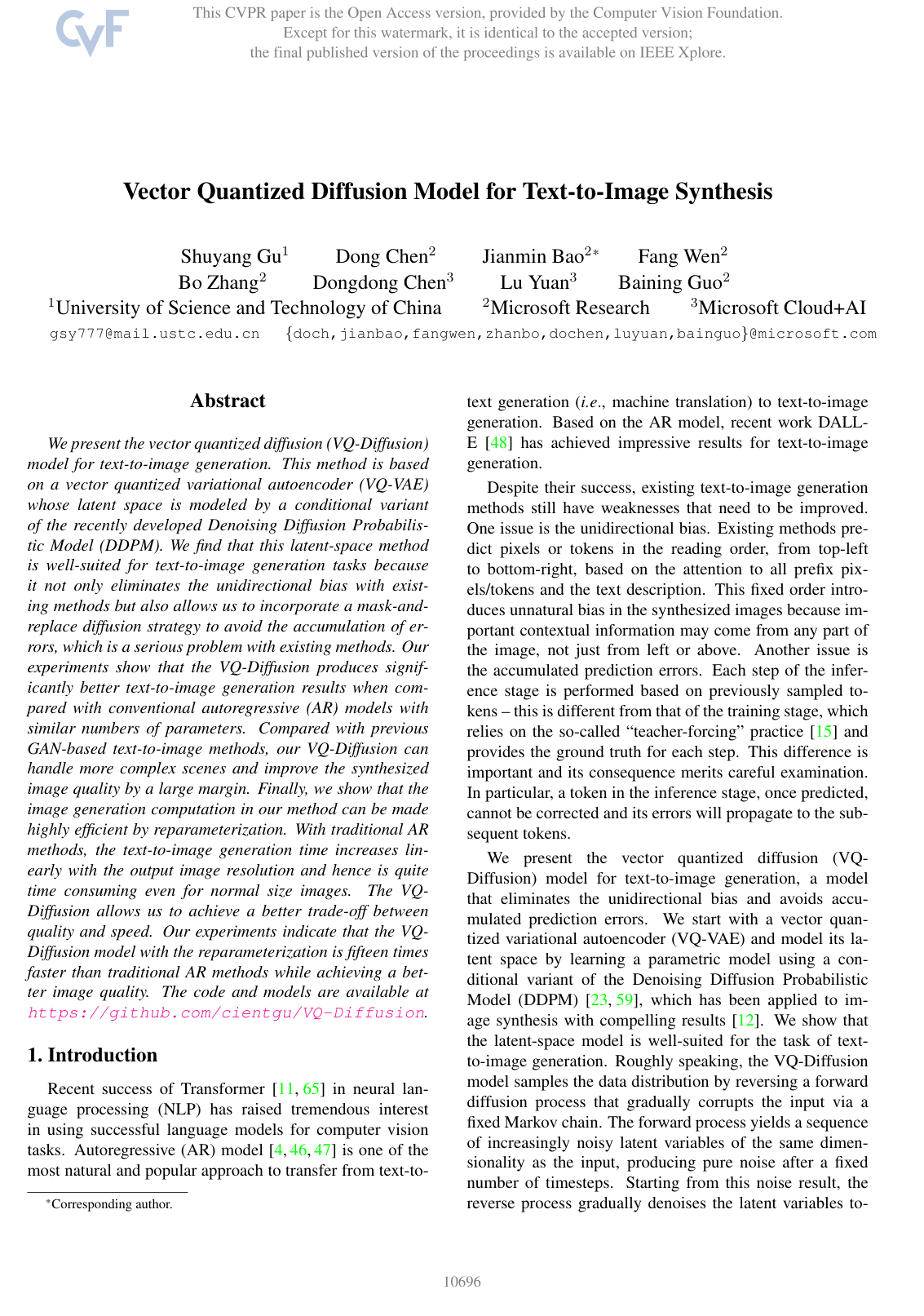
Vector Quantized Diffusion Model for Text-to-Image Synthesis
Shuyang Gu, Dong Chen, Jianmin Bao, Fang Wen, Bo Zhang, Dongdong Chen, Lu Yuan, Baining Guo
Why you should read this
Proposes a non-autoregressive text-to-image framework that models discrete VQ-VAE latent tokens with conditional diffusion, eliminating unidirectional bias and error accumulation while generating higher-quality images up to fifteen times faster than traditional autoregressive models.
We present the vector quantized diffusion (VQ-Diffusion) model for text-to-image generation. This method is based on a vector quantized variational autoencoder (VQ-VAE) whose latent space is modeled by a conditional variant of the recently developed Denoising Diffusion Probabilistic Model (DDPM). We find that this latent-space method is well-suited for text-to-image generation tasks because it not only eliminates the unidirectional bias with existing methods but also allows us to incorporate a mask-and-replace diffusion strategy to avoid the accumulation of errors, which is a serious problem with existing methods. Our experiments show that the VQ-Diffusion produces significantly better text-to-image generation results when compared with conventional autoregressive (AR) models with similar numbers of parameters. Compared with previous GAN-based text-to-image methods, our VQ-Diffusion can handle more complex scenes and improve the synthesized image quality by a large margin. Finally, we show that the image generation computation in our method can be made highly efficient by reparameterization. With traditional AR methods, the text-to-image generation time increases linearly with the output image resolution and hence is quite time consuming even for normal size images. The VQ-Diffusion allows us to achieve a better trade-off between quality and speed. Our experiments indicate that the VQ-Diffusion model with the reparameterization is fifteen times faster than traditional AR methods while achieving a better image quality. The code and models are available at https://github.com/cientgu/VQ-Diffusion.
Added
2026-10-04
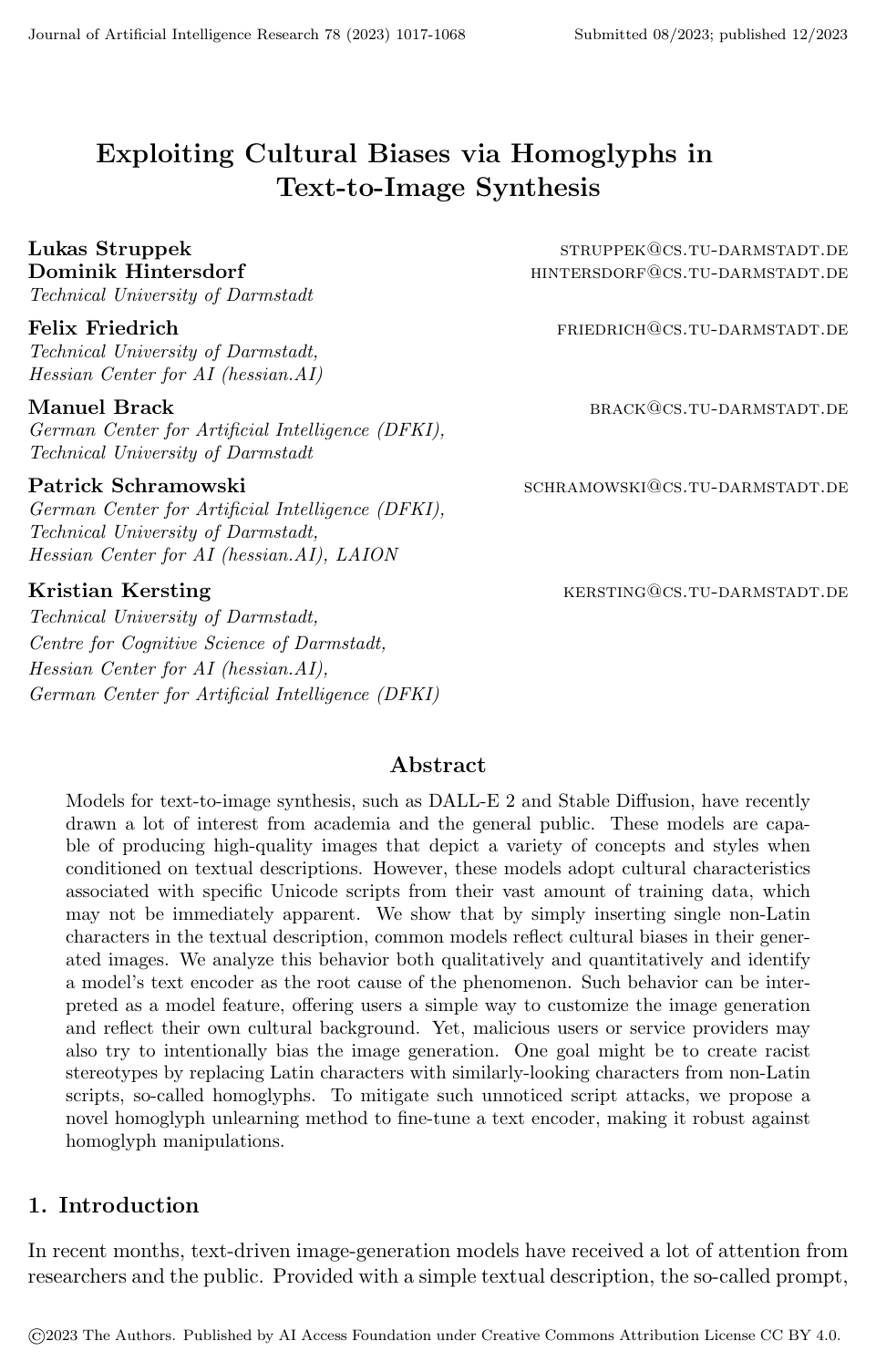
Exploiting Cultural Biases via Homoglyphs in Text-to-Image Synthesis
Lukas Struppek, Dominik Hintersdorf, Felix Friedrich, Manuel Brack, Patrick Schramowski, Kristian Kersting
Why you should read this
Reveals how inserting visually identical non-Latin homoglyphs into prompts covertly triggers cultural stereotypes in text-to-image synthesis, and proposes an unlearning technique to defend text encoders against these script-based attacks.
Models for text-to-image synthesis, such as DALL-E~2 and Stable Diffusion, have recently drawn a lot of interest from academia and the general public. These models are capable of producing high-quality images that depict a variety of concepts and styles when conditioned on textual descriptions. However, these models adopt cultural characteristics associated with specific Unicode scripts from their vast amount of training data, which may not be immediately apparent. We show that by simply inserting single non-Latin characters in a textual description, common models reflect cultural stereotypes and biases in their generated images. We analyze this behavior both qualitatively and quantitatively, and identify a model's text encoder as the root cause of the phenomenon. Additionally, malicious users or service providers may try to intentionally bias the image generation to create racist stereotypes by replacing Latin characters with similarly-looking characters from non-Latin scripts, so-called homoglyphs. To mitigate such unnoticed script attacks, we propose a novel homoglyph unlearning method to fine-tune a text encoder, making it robust against homoglyph manipulations.
Added
2026-10-03
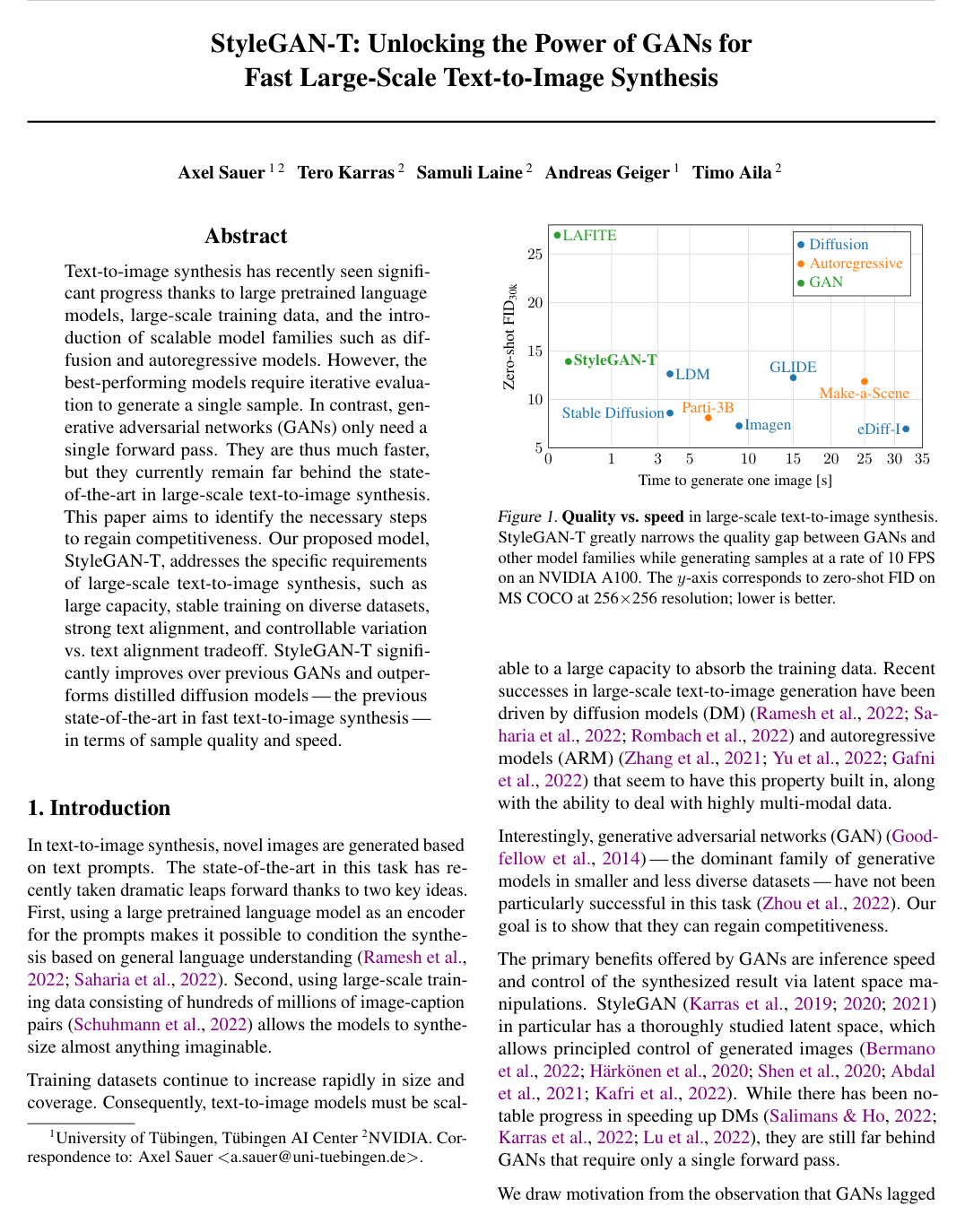
StyleGAN-T: Unlocking the Power of GANs for Fast Large-Scale Text-to-Image Synthesis
Axel Sauer, Tero Karras, Samuli Laine, Andreas Geiger, Timo Aila
Why you should read this
Presents StyleGAN-T, a scalable GAN architecture that produces high-quality, text-aligned images in a single forward pass, outperforming distilled diffusion models in both generation speed and sample fidelity.
Text-to-image synthesis has recently seen significant progress thanks to large pretrained language models, large-scale training data, and the introduction of scalable model families such as diffusion and autoregressive models. However, the best-performing models require iterative evaluation to generate a single sample. In contrast, generative adversarial networks (GANs) only need a single forward pass. They are thus much faster, but they currently remain far behind the state-of-the-art in large-scale text-to-image synthesis. This paper aims to identify the necessary steps to regain competitiveness. Our proposed model, StyleGAN-T, addresses the specific requirements of large-scale text-to-image synthesis, such as large capacity, stable training on diverse datasets, strong text alignment, and controllable variation vs. text alignment tradeoff. StyleGAN-T significantly improves over previous GANs and outperforms distilled diffusion models - the previous state-of-the-art in fast text-to-image synthesis - in terms of sample quality and speed.
Added
2026-09-28
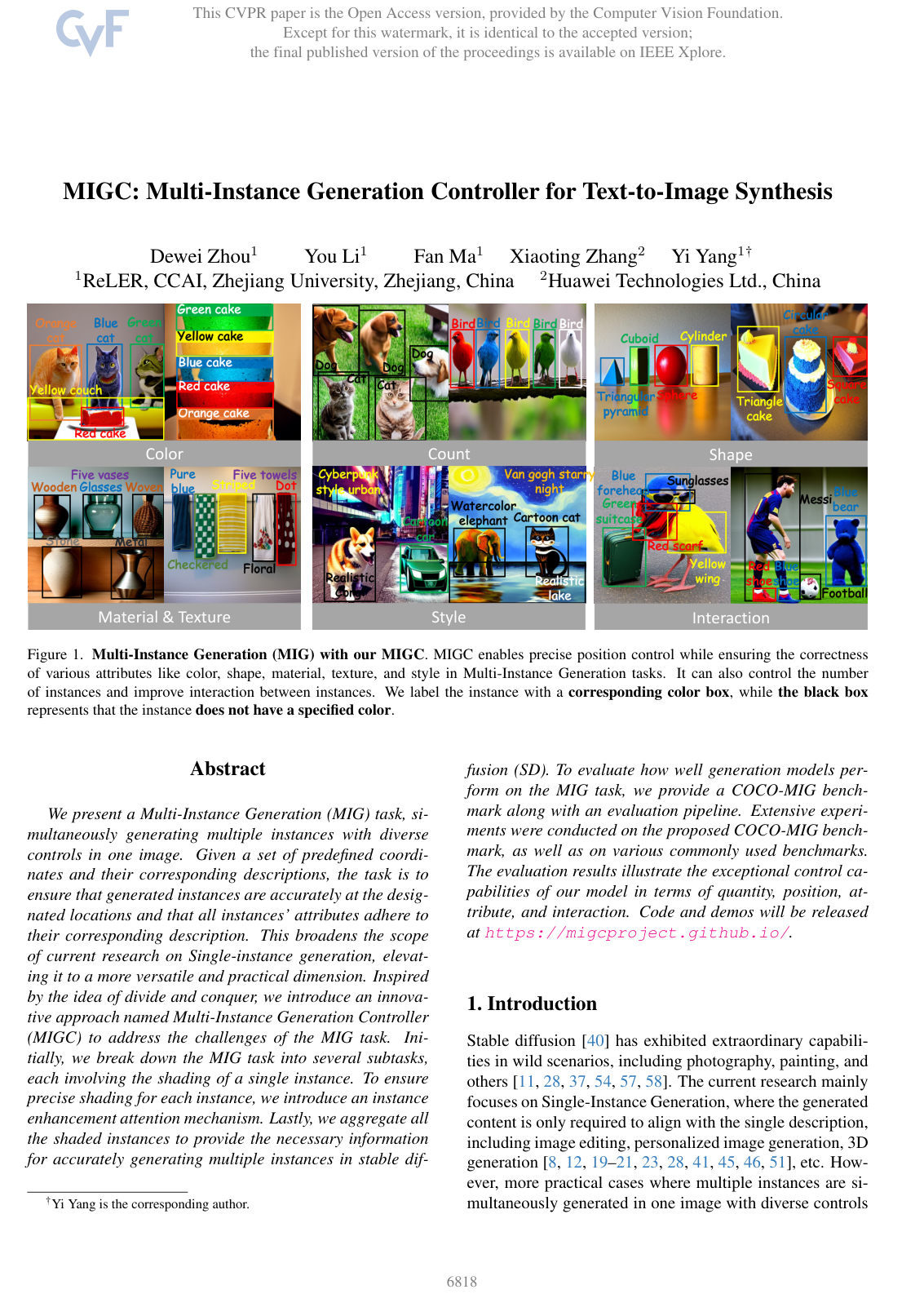
MIGC: Multi-Instance Generation Controller for Text-to-Image Synthesis
Dewei Zhou, You Li, Fan Ma, Xiaoting Zhang, Yi Yang
Why you should read this
Proposes a divide-and-conquer framework for Stable Diffusion that enables precise multi-instance text-to-image synthesis by shading individual instances separately through dedicated attention mechanisms before aggregating them into a unified layout.
We present a Multi-Instance Generation (MIG) task, simultaneously generating multiple instances with diverse controls in one image. Given a set of predefined coordinates and their corresponding descriptions, the task is to ensure that generated instances are accurately at the designated locations and that all instances' attributes adhere to their corresponding description. This broadens the scope of current research on Single-instance generation, elevating it to a more versatile and practical dimension. Inspired by the idea of divide and conquer, we introduce an innovative approach named Multi-Instance Generation Controller (MIGC) to address the challenges of the MIG task. Initially, we break down the MIG task into several subtasks, each involving the shading of a single instance. To ensure precise shading for each instance, we introduce an instance enhancement attention mechanism. Lastly, we aggregate all the shaded instances to provide the necessary information for accurately generating multiple instances in stable diffusion (SD). To evaluate how well generation models perform on the MIG task, we provide a COCO-MIG benchmark along with an evaluation pipeline. Extensive experiments were conducted on the proposed COCO-MIG benchmark, as well as on various commonly used benchmarks. The evaluation results illustrate the exceptional control capabilities of our model in terms of quantity, position, attribute, and interaction. Code and demos will be released at https://migcproject.github.io/.
Added
2026-09-26
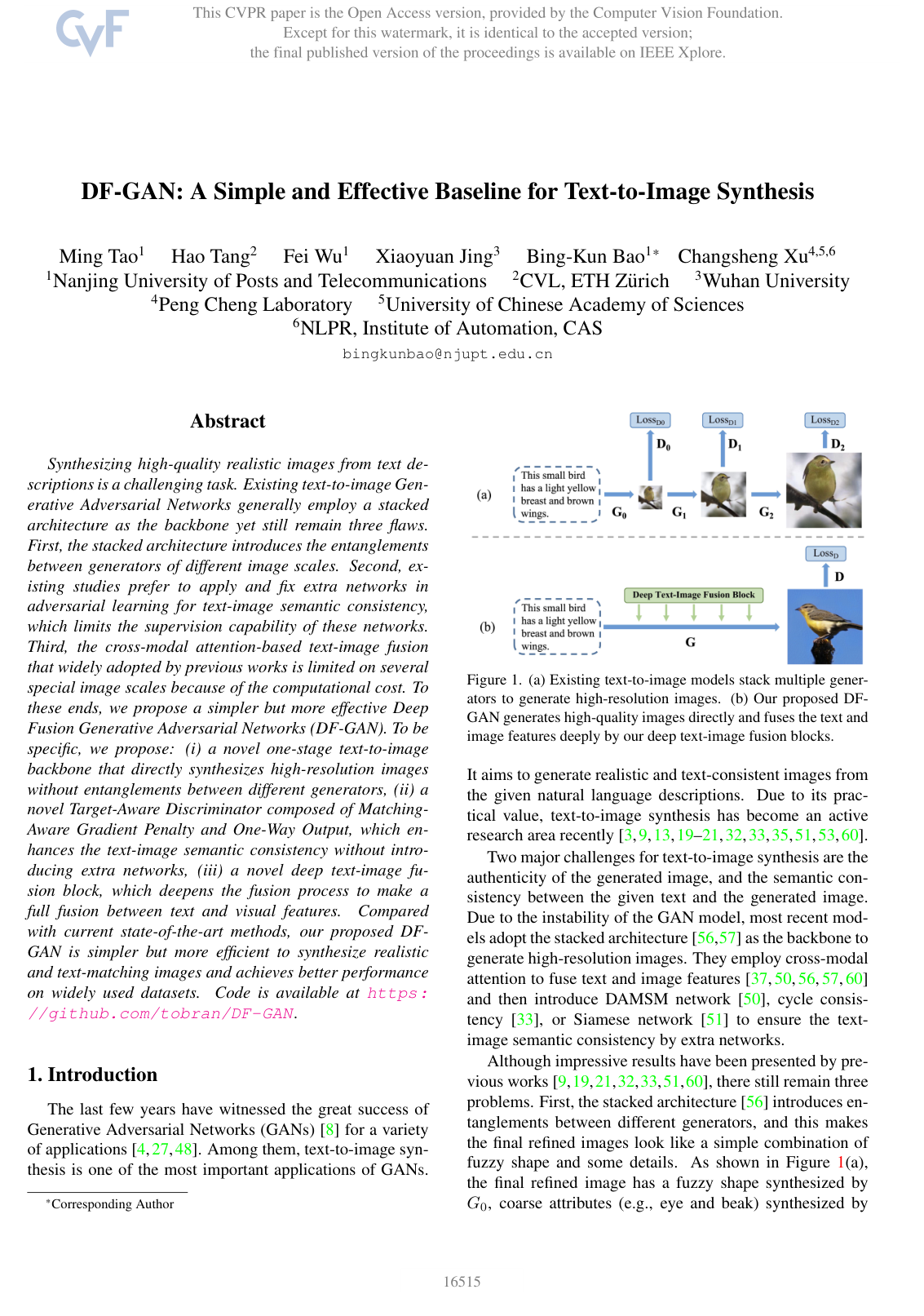
DF-GAN: A Simple and Effective Baseline for Text-to-Image Synthesis
Ming Tao, Hao Tang, Fei Wu, Xiaoyuan Jing, Bing-Kun Bao, Changsheng Xu
Why you should read this
Proposes a simple one-stage text-to-image GAN architecture that directly synthesizes high-resolution images using deep feature fusion blocks and a matching-aware discriminator, outperforming complex multi-stage models without relying on auxiliary networks.
Synthesizing high-quality realistic images from text descriptions is a challenging task. Existing text-to-image Generative Adversarial Networks generally employ a stacked architecture as the backbone yet still remain three flaws. First, the stacked architecture introduces the entanglements between generators of different image scales. Second, existing studies prefer to apply and fix extra networks in adversarial learning for text-image semantic consistency, which limits the supervision capability of these networks. Third, the cross-modal attention-based text-image fusion that widely adopted by previous works is limited on several special image scales because of the computational cost. To these ends, we propose a simpler but more effective Deep Fusion Generative Adversarial Networks (DF-GAN). To be specific, we propose: (i) a novel one-stage text-to-image backbone that directly synthesizes high-resolution images without entanglements between different generators, (ii) a novel Target-Aware Discriminator composed of Matching-Aware Gradient Penalty and One-Way Output, which enhances the text-image semantic consistency without introducing extra networks, (iii) a novel deep text-image fusion block, which deepens the fusion process to make a full fusion between text and visual features. Compared with current state-of-the-art methods, our proposed DF-GAN is simpler but more efficient to synthesize realistic and text-matching images and achieves better performance on widely used datasets. Code is available at https://github.com/tobran/DF-GAN.
Added
2026-09-26
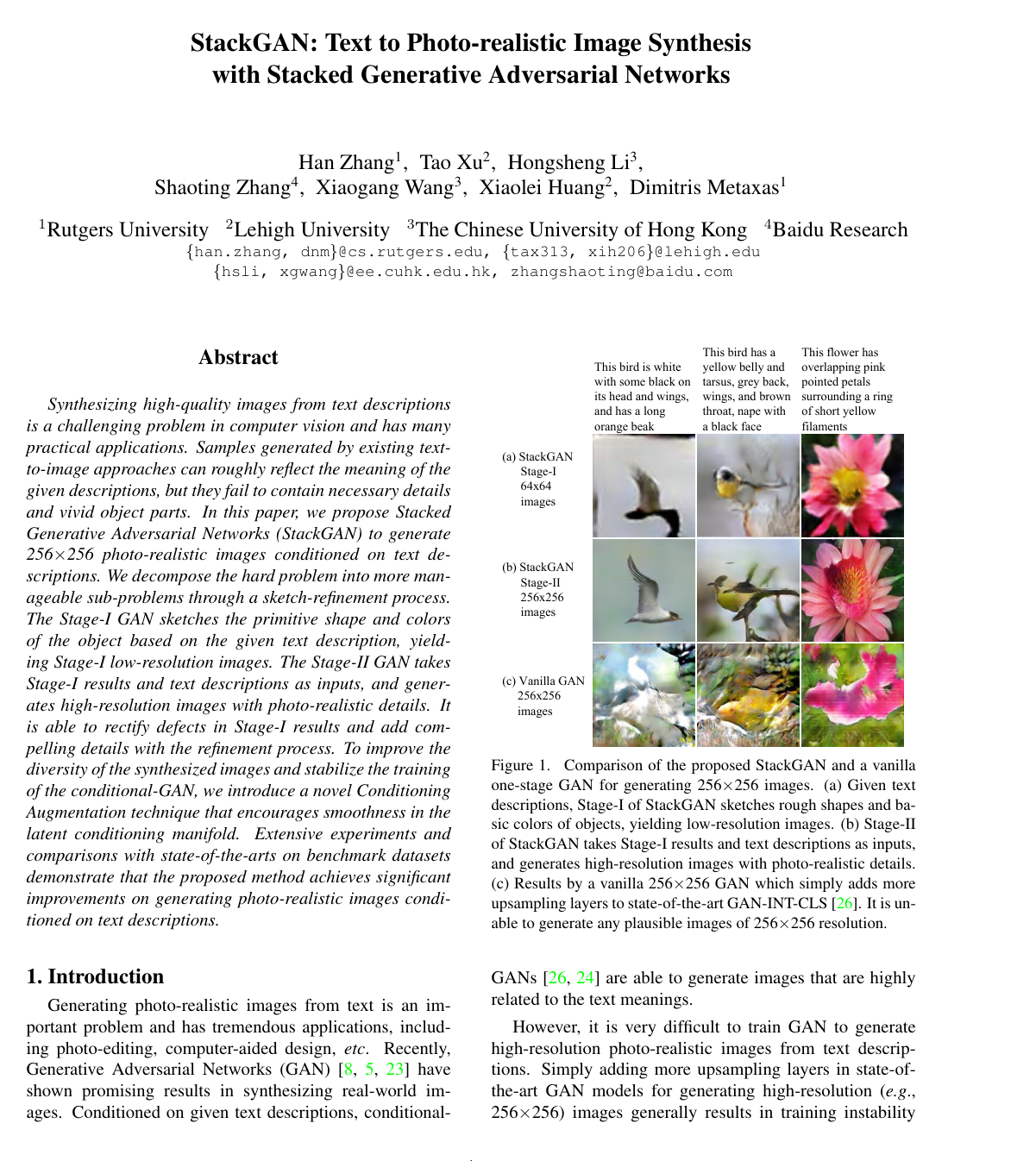
StackGAN: Text to Photo-Realistic Image Synthesis with Stacked Generative Adversarial Networks
Han Zhang, Tao Xu, Hongsheng Li, Shaoting Zhang, Xiaogang Wang, Xiaolei Huang, Dimitris N. Metaxas
Why you should read this
Proposes a two-stage generative adversarial architecture that decomposes text-to-image synthesis into sketch generation and detail refinement, utilizing conditioning augmentation to produce high-resolution, photo-realistic images from text descriptions.
Synthesizing high-quality images from text descriptions is a challenging problem in computer vision and has many practical applications. Samples generated by existing text-to-image approaches can roughly reflect the meaning of the given descriptions, but they fail to contain necessary details and vivid object parts. In this paper, we propose Stacked Generative Adversarial Networks (StackGAN) to generate 256x256 photo-realistic images conditioned on text descriptions. We decompose the hard problem into more manageable sub-problems through a sketch-refinement process. The Stage-I GAN sketches the primitive shape and colors of the object based on the given text description, yielding Stage-I low-resolution images. The Stage-II GAN takes Stage-I results and text descriptions as inputs, and generates high-resolution images with photo-realistic details. It is able to rectify defects in Stage-I results and add compelling details with the refinement process. To improve the diversity of the synthesized images and stabilize the training of the conditional-GAN, we introduce a novel Conditioning Augmentation technique that encourages smoothness in the latent conditioning manifold. Extensive experiments and comparisons with state-of-the-arts on benchmark datasets demonstrate that the proposed method achieves significant improvements on generating photo-realistic images conditioned on text descriptions.
Added
2026-09-14
Generative Adversarial Text to Image Synthesis
Scott Reed, Zeynep Akata, Xinchen Yan, Lajanugen Logeswaran, Bernt Schiele, Honglak Lee
Why you should read this
Introduces a conditional generative adversarial network architecture that bridges text representations and convolutional generators to synthesize realistic images directly from natural language descriptions.
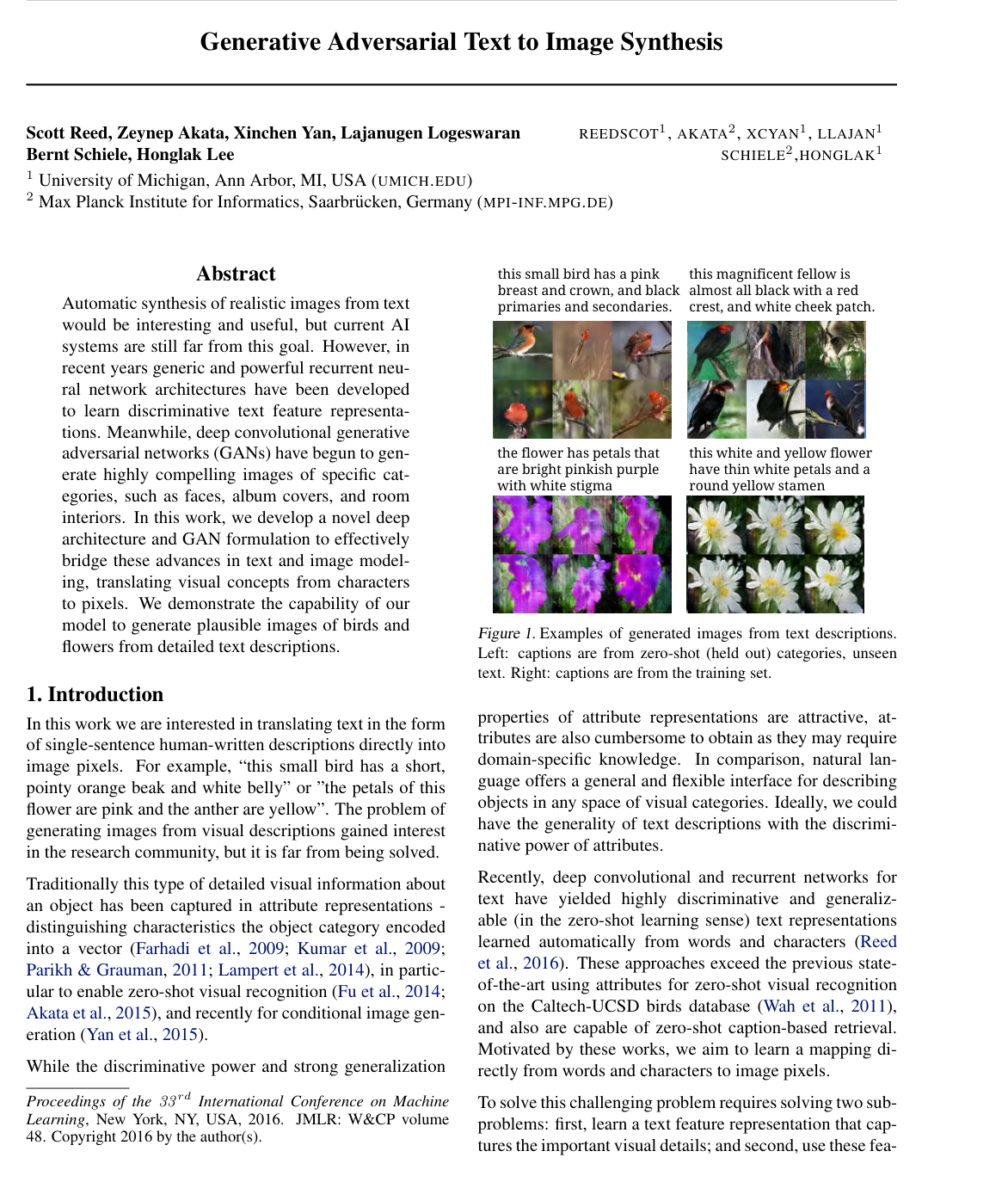
Automatic synthesis of realistic images from text would be interesting and useful, but current AI systems are still far from this goal. However, in recent years generic and powerful recurrent neural network architectures have been developed to learn discriminative text feature representations. Meanwhile, deep convolutional generative adversarial networks (GANs) have begun to generate highly compelling images of specific categories, such as faces, album covers, and room interiors. In this work, we develop a novel deep architecture and GAN formulation to effectively bridge these advances in text and image model- ing, translating visual concepts from characters to pixels. We demonstrate the capability of our model to generate plausible images of birds and flowers from detailed text descriptions.
Added
2026-09-11