StackGAN: Text to Photo-Realistic Image Synthesis with Stacked Generative Adversarial Networks
Han ZhangTao XuHongsheng LiShaoting ZhangXiaogang WangXiaolei HuangDimitris N. Metaxas
Proposes a two-stage generative adversarial architecture that decomposes text-to-image synthesis into sketch generation and detail refinement, utilizing conditioning augmentation to produce high-resolution, photo-realistic images from text descriptions.
The StackGAN paper addresses the longstanding difficulty of turning free-form text descriptions into high-resolution, photo-realistic images. Prior conditional GANs could produce only low-resolution outputs (typically 64×64) that lacked fine object parts and often failed entirely when scaled to 256×256 resolution because the distributions of real and generated images cease to overlap in high-dimensional pixel space.
The work set out to demonstrate that decomposing the generation task into two successive stages, combined with a simple regularization on the text-conditioning manifold, would allow stable training of 256×256 conditional GANs and produce images whose visual quality and text alignment measurably exceed those of existing single-stage models.
The authors trained and evaluated the two-stage architecture on three standard benchmarks—CUB birds, Oxford-102 flowers, and the more complex MS-COCO scenes—using both an automated inception score and blinded human rankings. They also ran controlled ablations that isolated the contribution of the stacked structure, the repeated text conditioning, and the proposed Conditioning Augmentation technique.
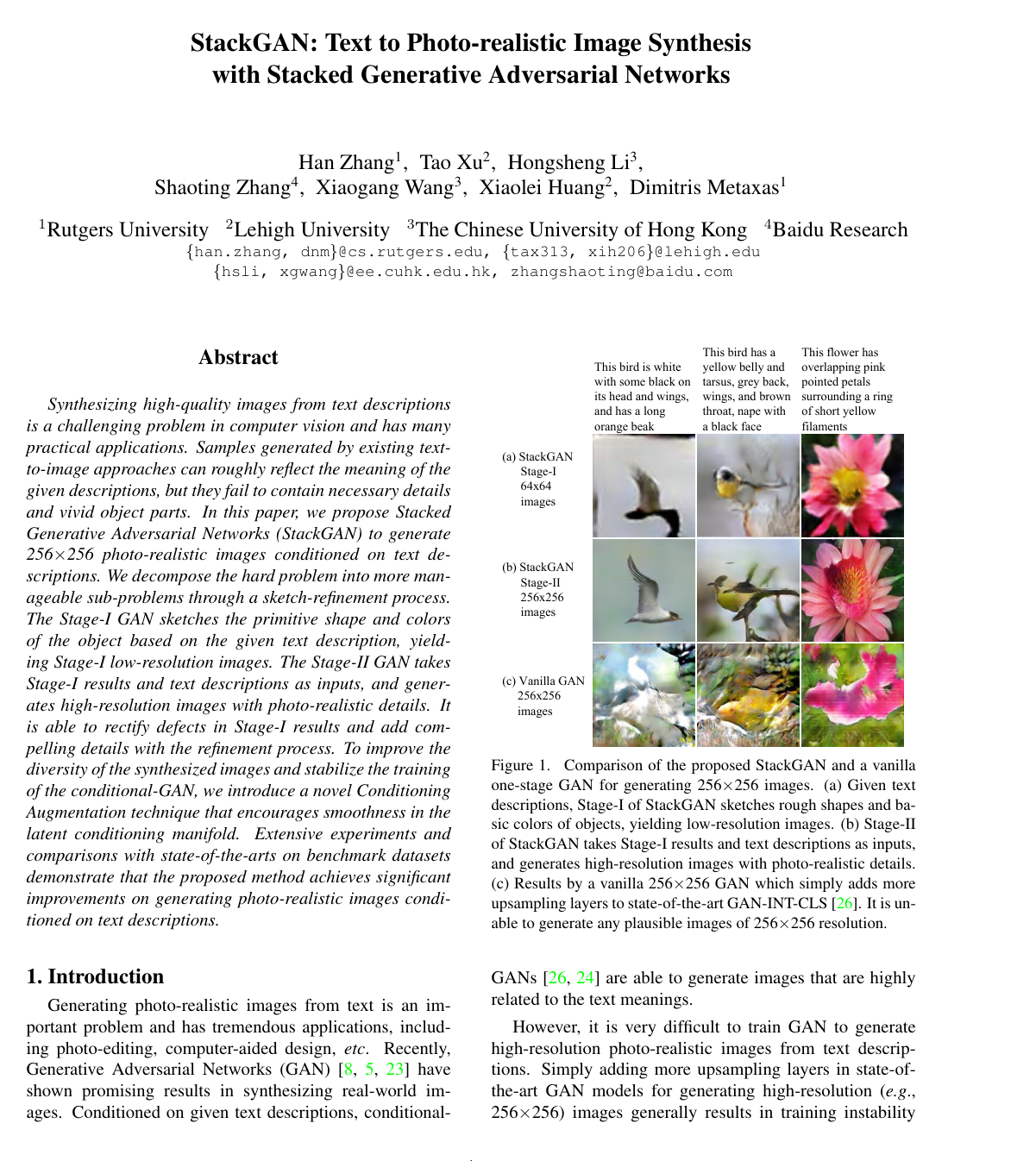
On CUB the model raised the inception score from 2.88 to 3.70 and improved average human rank from 2.81 to 1.37; similar relative gains appeared on Oxford-102 and COCO. Qualitatively, Stage-I produces coherent low-resolution sketches, while Stage-II consistently corrects shape and color errors and adds plausible fine details such as beaks, petals, and textures. The same text embedding can generate diverse yet semantically consistent images when noise or small perturbations are introduced, confirming that Conditioning Augmentation both stabilizes training and increases sample variety. Nearest-neighbor analysis shows the outputs are not simple memorizations of the training set.
These results indicate that text-to-image synthesis can now reach a resolution and realism level useful for downstream applications such as design visualization and automated photo editing. The staged approach also supplies a practical template for other conditional generation tasks that suffer from distribution mismatch at high resolution.
Further gains on complex, multi-object scenes will likely require richer scene-graph conditioning or additional refinement stages; the paper’s COCO results already show noticeably lower fidelity than the single-object bird and flower cases. Extending the method to higher resolutions or video would also need new techniques for temporal consistency and memory-efficient training.
The quantitative and human evaluations rest on established benchmarks and large sample sizes, giving reasonable confidence in the reported improvements for the domains tested. Performance remains sensitive to the quality of the initial Stage-I sketch, and the staged 1,200-epoch training schedule is computationally heavy; both factors should be weighed when planning deployment.