
keyword
text embeddings
Text embeddings are dense numerical vector representations of textual units, such as words, sentences, or entire documents, that capture their semantic and syntactic meaning within a continuous mathematical space. Generated by machine learning models and neural text encoders, these vectors map natural language into fixed-dimensional coordinates where geometric proximity corresponds to conceptual similarity, allowing computational systems to evaluate relationships between texts using distance metrics such as cosine similarity. They serve as foundational components across natural language processing and multimodal artificial intelligence, powering applications such as dense information retrieval, semantic search, text clustering, classification, and cross-modal alignment with images and other data types.
11 items
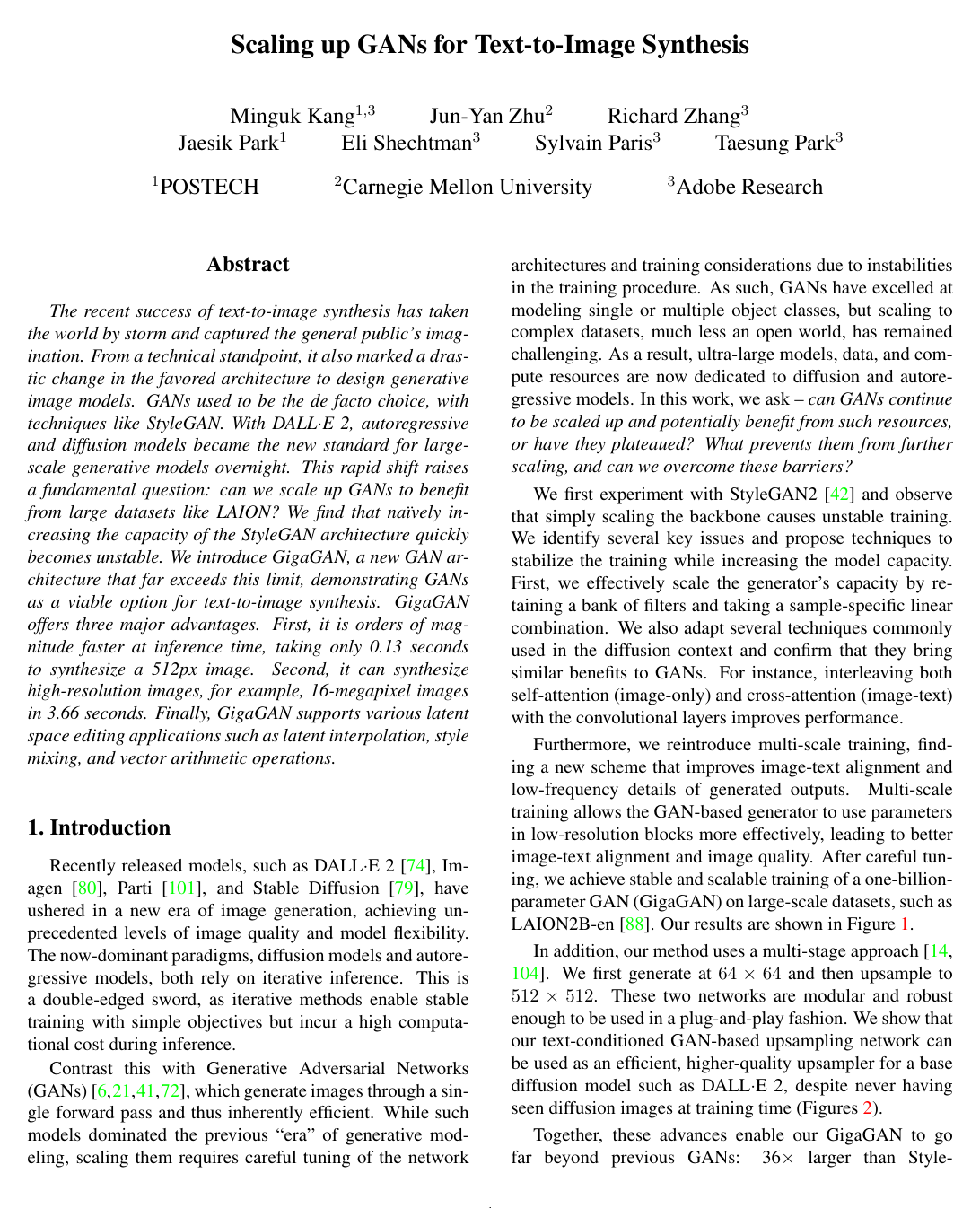
Scaling up GANs for Text-to-Image Synthesis
Minguk Kang, Jun-Yan Zhu, Richard Zhang, Jaesik Park, Eli Shechtman, Sylvain Paris, Taesung Park
Why you should read this
Introduces GigaGAN, a scalable generative adversarial network that generates high-resolution text-to-image outputs orders of magnitude faster than diffusion models while preserving flexible latent space editing.
The recent success of text-to-image synthesis has taken the world by storm and captured the general public's imagination. From a technical standpoint, it also marked a drastic change in the favored architecture to design generative image models. GANs used to be the de facto choice, with techniques like StyleGAN. With DALL-E 2, auto-regressive and diffusion models became the new standard for large-scale generative models overnight. This rapid shift raises a fundamental question: can we scale up GANs to benefit from large datasets like LAION? We find that naÏvely increasing the capacity of the StyleGAN architecture quickly becomes unstable. We introduce GigaGAN, a new GAN architecture that far exceeds this limit, demonstrating GANs as a viable option for text-to-image synthesis. GigaGAN offers three major advantages. First, it is orders of magnitude faster at inference time, taking only 0.13 seconds to synthesize a 512px image. Second, it can synthesize high-resolution images, for example, 16-megapixel pixels in 3.66 seconds. Finally, GigaGAN supports various latent space editing applications such as latent interpolation, style mixing, and vector arithmetic operations.
Added
2026-10-05
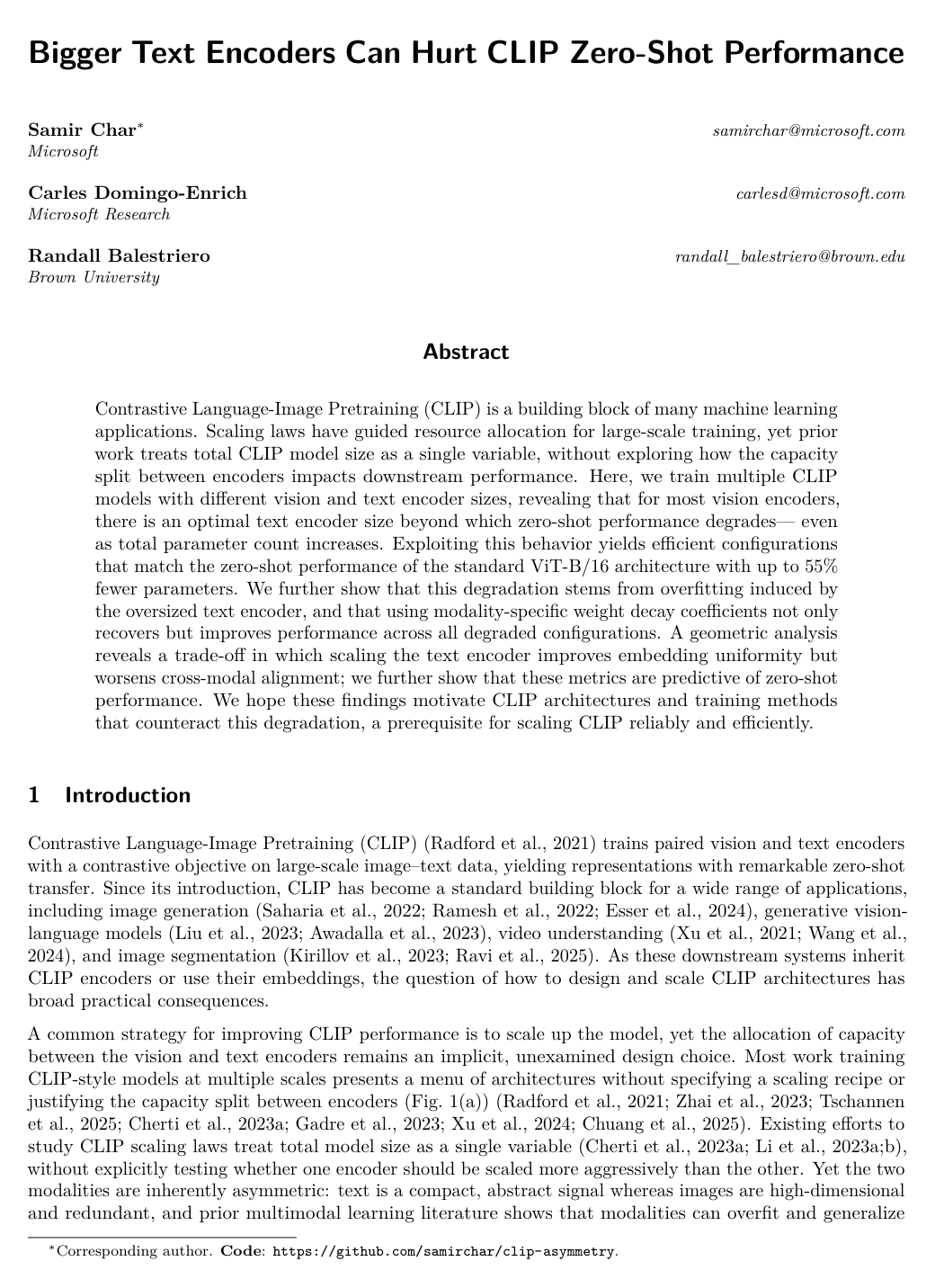
Bigger Text Encoders Can Hurt CLIP Zero-Shot Performance
Samir Char, Carles Domingo-Enrich, Randall Balestriero
Why you should read this
Reveals that scaling CLIP text encoders beyond an optimal size degrades zero-shot accuracy due to cross-modal misalignment, and shows that modality-specific weight decay restores performance with up to 55% fewer parameters.
Contrastive Language-Image Pretraining (CLIP) is a building block of many machine learning applications. Scaling laws have guided resource allocation for large-scale training, yet prior work treats total CLIP model size as a single variable, without exploring how the capacity split between encoders impacts downstream performance. Here, we train multiple CLIP models with different vision and text encoder sizes, revealing that for most vision encoders, there is an optimal text encoder size beyond which zero-shot performance degrades---even as total parameter count increases. Exploiting this behavior yields efficient configurations that match the zero-shot performance of the standard ViT-B/16 architecture with up to 55% fewer parameters. We further show that this degradation stems from overfitting induced by the oversized text encoder, and that using modality-specific weight decay coefficients not only recovers but improves performance across all degraded configurations. A geometric analysis reveals a trade-off in which scaling the text encoder improves embedding uniformity but worsens cross-modal alignment; we further show that these metrics are predictive of zero-shot performance. We hope these findings motivate CLIP architectures and training methods that counteract this degradation, a prerequisite for scaling CLIP reliably and efficiently.
Added
2026-10-05
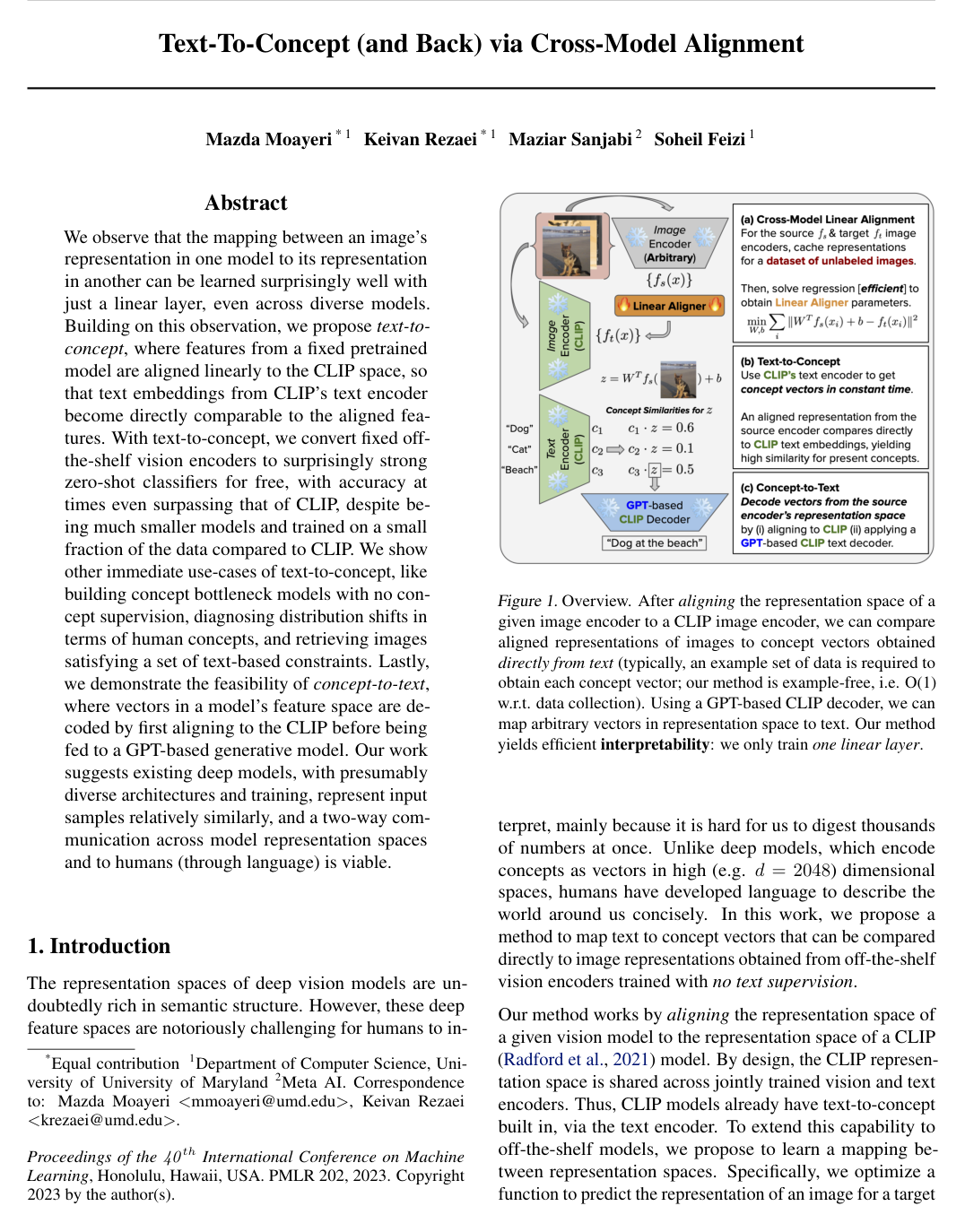
Text-To-Concept (and Back) via Cross-Model Alignment
Mazda Moayeri, Keivan Rezaei, Maziar Sanjabi, Soheil Feizi
Why you should read this
Demonstrates that a simple linear layer can align arbitrary vision encoders with CLIP's feature space, enabling zero-shot classification, unsupervised concept bottleneck models, and two-way translation between internal representations and natural language.
We observe that the mapping between an image’s representation in one model to its representation in another can be learned surprisingly well with just a linear layer, even across diverse models. Building on this observation, we propose text-to-concept, where features from a fixed pretrained model are aligned linearly to the CLIP space, so that text embeddings from CLIP’s text encoder become directly comparable to the aligned features. With text-to-concept, we convert fixed off-the-shelf vision encoders to surprisingly strong zero-shot classifiers for free, with accuracy at times even surpassing that of CLIP, despite being much smaller models and trained on a small fraction of the data compared to CLIP. We show other immediate use-cases of text-to-concept, like building concept bottleneck models with no concept supervision, diagnosing distribution shifts in terms of human concepts, and retrieving images satisfying a set of text-based constraints. Lastly, we demonstrate the feasibility of concept-to-text, where vectors in a model’s feature space are decoded by first aligning to the CLIP before being fed to a GPT-based generative model. Our work suggests existing deep models, with presumably diverse architectures and training, represent input samples relatively similarly, and a two-way communication across model representation spaces and to humans (through language) is viable.
Added
2026-10-03
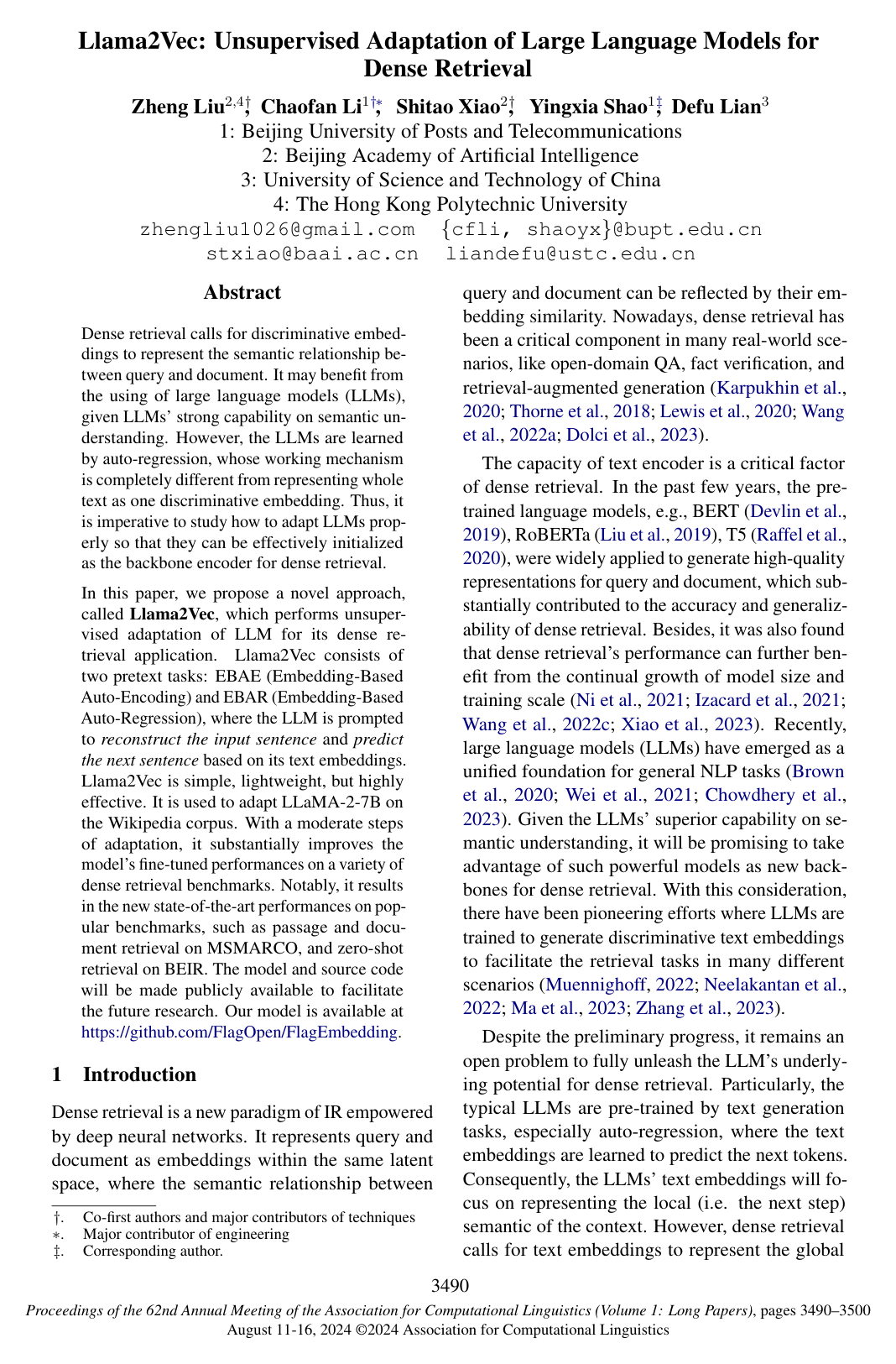
Llama2Vec: Unsupervised Adaptation of Large Language Models for Dense Retrieval
Chaofan Li, Zheng Liu, Shitao Xiao, Yingxia Shao, Defu Lian
Why you should read this
Develops an unsupervised adaptation method using embedding-based auto-encoding and auto-regression tasks to transform autoregressive language models into effective dense retrieval encoders, achieving state-of-the-art performance on MSMARCO and BEIR benchmarks.
Dense retrieval calls for discriminative embeddings to represent the semantic relationship between query and document. It may benefit from the using of large language models (LLMs), given LLMs’ strong capability on semantic understanding. However, the LLMs are learned by auto-regression, whose working mechanism is completely different from representing whole text as one discriminative embedding. Thus, it is imperative to study how to adapt LLMs properly so that they can be effectively initialized as the backbone encoder for dense retrieval. In this paper, we propose a novel approach, called Llama2Vec, which performs unsupervised adaptation of LLM for its dense retrieval application. Llama2Vec consists of two pretext tasks: EBAE (Embedding-Based Auto-Encoding) and EBAR (Embedding-Based Auto-Regression), where the LLM is prompted to reconstruct the input sentence and predict the next sentence based on its text embeddings. Llama2Vec is simple, lightweight, but highly effective. It is used to adapt LLaMA-2-7B on the Wikipedia corpus. With a moderate steps of adaptation, it substantially improves the model’s fine-tuned performances on a variety of dense retrieval benchmarks. Notably, it results in the new state-of-the-art performances on popular benchmarks, such as passage and document retrieval on MSMARCO, and zero-shot retrieval on BEIR. The model and source code will be made publicly available to facilitate the future research. Our model is available at https://github.com/FlagOpen/FlagEmbedding.
Added
2026-10-01
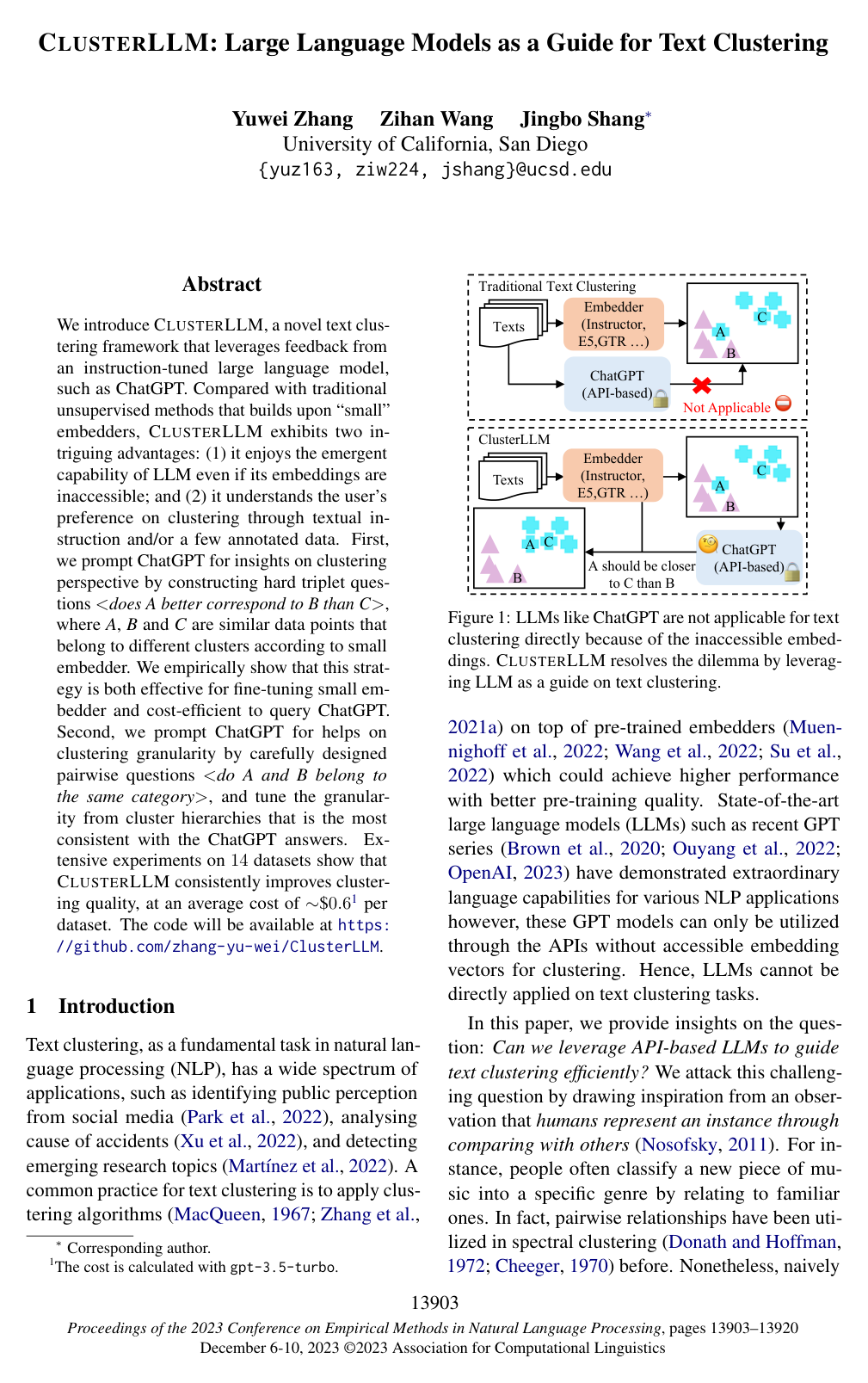
ClusterLLM: Large Language Models as a Guide for Text Clustering
Yuwei Zhang, Zihan Wang, Jingbo Shang
Why you should read this
Proposes a cost-effective framework that queries black-box large language models through informative triplet and pairwise comparisons to guide small embedders and determine cluster granularity based on user preferences.
We introduce ClusterLLM, a novel text clustering framework that leverages feedback from an instruction-tuned large language model, such as ChatGPT. Compared with traditional unsupervised methods that builds upon “small” embedders, ClusterLLM exhibits two intriguing advantages: (1) it enjoys the emergent capability of LLM even if its embeddings are inaccessible; and (2) it understands the user’s preference on clustering through textual instruction and/or a few annotated data. First, we prompt ChatGPT for insights on clustering perspective by constructing hard triplet questions <does A better correspond to B than C>, where A, B and C are similar data points that belong to different clusters according to small embedder. We empirically show that this strategy is both effective for fine-tuning small embedder and cost-efficient to guide ChatGPT. Second, we prompt ChatGPT for helps on clustering granularity by carefully designed pairwise questions <do A and B belong to the same category>, and tune the granularity from cluster hierarchies that is the most consistent with the ChatGPT answers. Extensive experiments on 14 datasets show that ClusterLLM consistently improves clustering quality, at an average cost of ~$0.6¹ per dataset. The code will be available at https://github.com/zhang-yu-wei/ClusterLLM.
Added
2026-10-01
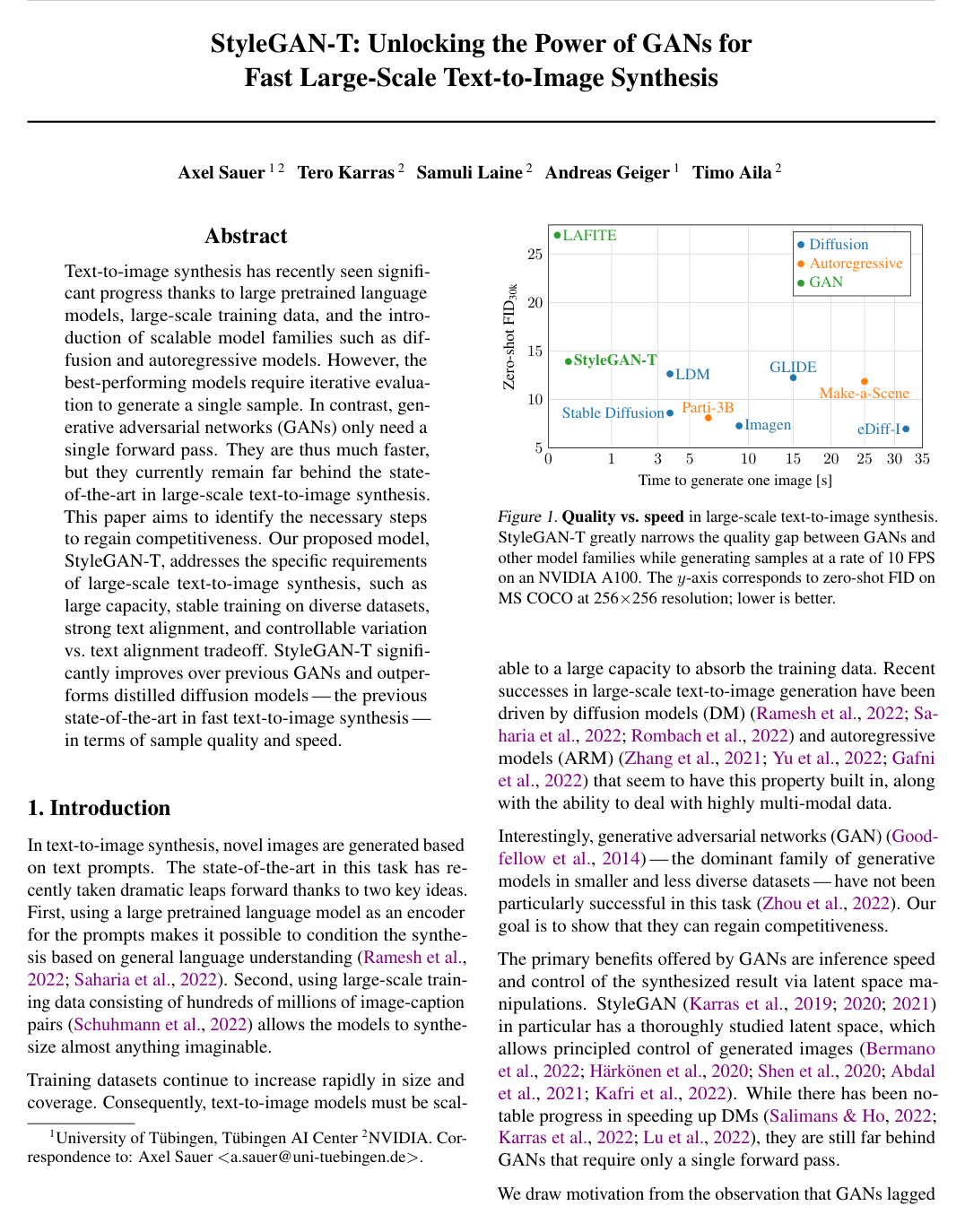
StyleGAN-T: Unlocking the Power of GANs for Fast Large-Scale Text-to-Image Synthesis
Axel Sauer, Tero Karras, Samuli Laine, Andreas Geiger, Timo Aila
Why you should read this
Presents StyleGAN-T, a scalable GAN architecture that produces high-quality, text-aligned images in a single forward pass, outperforming distilled diffusion models in both generation speed and sample fidelity.
Text-to-image synthesis has recently seen significant progress thanks to large pretrained language models, large-scale training data, and the introduction of scalable model families such as diffusion and autoregressive models. However, the best-performing models require iterative evaluation to generate a single sample. In contrast, generative adversarial networks (GANs) only need a single forward pass. They are thus much faster, but they currently remain far behind the state-of-the-art in large-scale text-to-image synthesis. This paper aims to identify the necessary steps to regain competitiveness. Our proposed model, StyleGAN-T, addresses the specific requirements of large-scale text-to-image synthesis, such as large capacity, stable training on diverse datasets, strong text alignment, and controllable variation vs. text alignment tradeoff. StyleGAN-T significantly improves over previous GANs and outperforms distilled diffusion models - the previous state-of-the-art in fast text-to-image synthesis - in terms of sample quality and speed.
Added
2026-09-28
MMTEB: Massive Multilingual Text Embedding Benchmark
Kenneth C. Enevoldsen, Isaac Chung, Imene Kerboua, Mrton Kardos, Ashwin Mathur, David Stap, Jay Gala, Wissam Siblini, Dominik Krzeminski, Genta Indra Winata, Saba Sturua, Saiteja Utpala, Mathieu Ciancone, Marion Schaeffer, Diganta Misra, Shreeya Dhakal, Jonathan Rystrm, Roman Solomatin, mer Veysel agatan, Akash Kundu, et al.
Why you should read this
Presents the Massive Multilingual Text Embedding Benchmark (MMTEB), a suite of over 500 evaluation tasks across 250+ languages that incorporates efficient downsampling methods to drastically cut compute costs while revealing that compact 560M-parameter models can outperform multi-billion-parameter language models.
Text embeddings are typically evaluated on a limited set of tasks, which are constrained by language, domain, and task diversity. To address these limitations and provide a more comprehensive evaluation, we introduce the Massive Multilingual Text Embedding Benchmark (MMTEB) - a large-scale, community-driven expansion of MTEB, covering over 500 quality-controlled evaluation tasks across 250+ languages. MMTEB includes a diverse set of challenging, novel tasks such as instruction following, long-document retrieval, and code retrieval, representing the largest multilingual collection of evaluation tasks for embedding models to date. Using this collection, we develop several highly multilingual benchmarks, which we use to evaluate a representative set of models. We find that while large language models (LLMs) with billions of parameters can achieve state-of-the-art performance on certain language subsets and task categories, the best-performing publicly available model is multilingual-e5-large-instruct with only 560 million parameters. To facilitate accessibility and reduce computational cost, we introduce a novel downsampling method based on inter-task correlation, ensuring a diverse selection while preserving relative model rankings. Furthermore, we optimize tasks such as retrieval by sampling hard negatives, creating smaller but effective splits. These optimizations allow us to introduce benchmarks that drastically reduce computational demands. For instance, our newly introduced zero-shot English benchmark maintains a ranking order similar to the full-scale version but at a fraction of the computational cost.
Added
2026-09-26
Qwen3 Embedding: Advancing Text Embedding and Reranking Through Foundation Models
Yanzhao Zhang, Mingxin Li, Dingkun Long, Xin Zhang, Huan Lin, Baosong Yang, Pengjun Xie, An Yang, Dayiheng Liu, Junyang Lin, Fei Huang, Jingren Zhou
Why you should read this
Presents the open-source Qwen3 Embedding and reranking model suite across 0.6B to 8B parameters, setting new state-of-the-art performance on multilingual and code retrieval benchmarks through foundation-model-driven synthetic data generation and multi-stage training.
In this work, we introduce the Qwen3 Embedding series, a significant advancement over its predecessor, the GTE-Qwen series, in text embedding and reranking capabilities, built upon the Qwen3 foundation models. Leveraging the Qwen3 LLMs' robust capabilities in multilingual text understanding and generation, our innovative multi-stage training pipeline combines large-scale unsupervised pre-training with supervised fine-tuning on high-quality datasets. Effective model merging strategies further ensure the robustness and adaptability of the Qwen3 Embedding series. During the training process, the Qwen3 LLMs serve not only as backbone models but also play a crucial role in synthesizing high-quality, rich, and diverse training data across multiple domains and languages, thus enhancing the training pipeline. The Qwen3 Embedding series offers a spectrum of model sizes (0.6B, 4B, 8B) for both embedding and reranking tasks, addressing diverse deployment scenarios where users can optimize for either efficiency or effectiveness. Empirical evaluations demonstrate that the Qwen3 Embedding series achieves state-of-the-art results across diverse benchmarks. Notably, it excels on the multilingual evaluation benchmark MTEB for text embedding, as well as in various retrieval tasks, including code retrieval, cross-lingual retrieval and multilingual retrieval. To facilitate reproducibility and promote community-driven research and development, the Qwen3 Embedding models are publicly available under the Apache 2.0 license.
Added
2026-09-25
Imagic: Text-Based Real Image Editing with Diffusion Models
Bahjat Kawar, Shiran Zada, Oran Lang, Omer Tov, Huiwen Chang, Tali Dekel, Inbar Mosseri, Michal Irani
Why you should read this
Introduces Imagic, a method that uses pre-trained diffusion models to perform complex, non-rigid semantic edits on a single real image using only a text prompt without requiring masks or multi-view data.
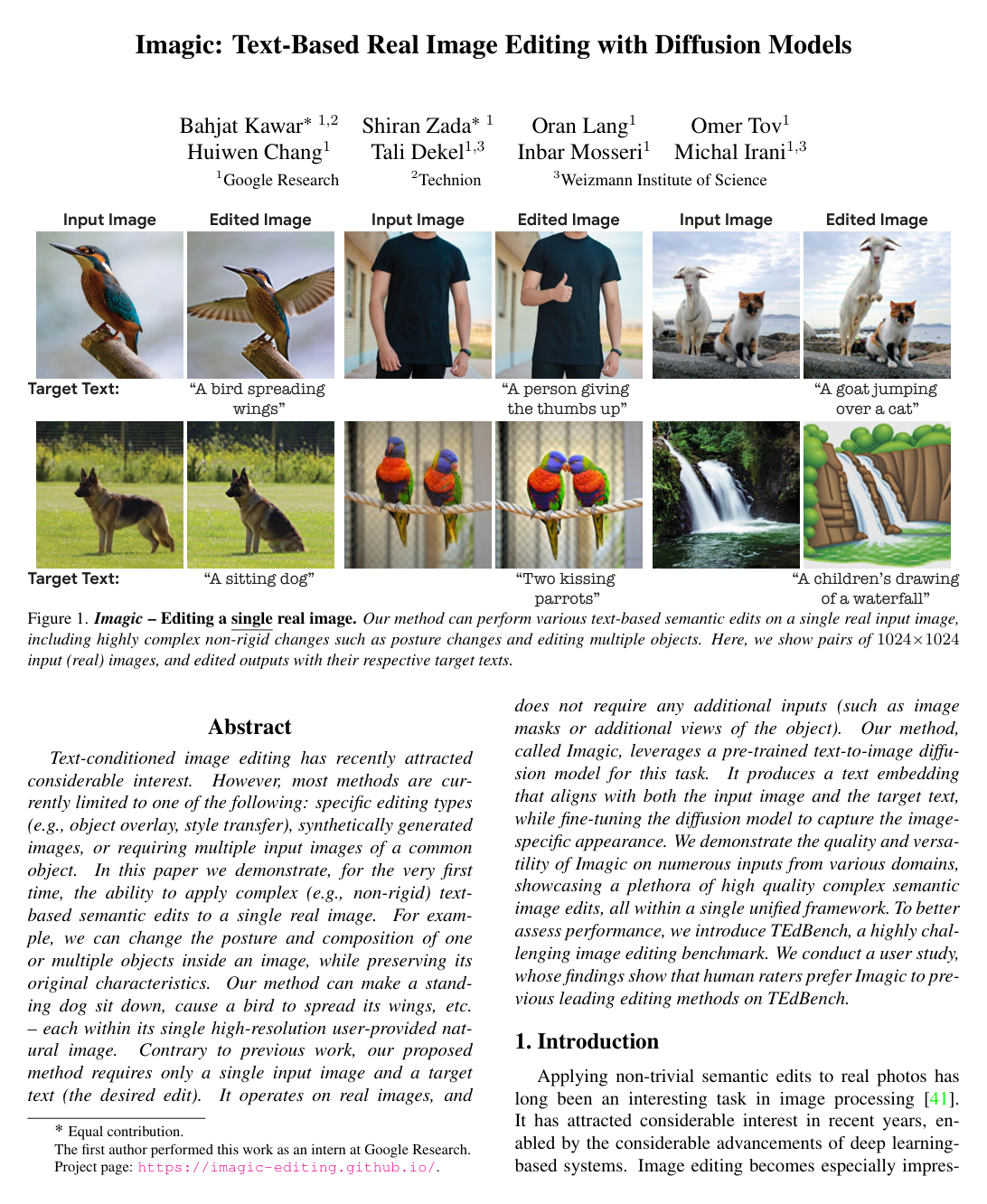
Text-conditioned image editing has recently attracted considerable interest. However, most methods are currently either limited to specific editing types (e.g., object overlay, style transfer), or apply to synthetically generated images, or require multiple input images of a common object. In this paper we demonstrate, for the very first time, the ability to apply complex (e.g., non-rigid) text-guided semantic edits to a single real image. For example, we can change the posture and composition of one or multiple objects inside an image, while preserving its original characteristics. Our method can make a standing dog sit down or jump, cause a bird to spread its wings, etc. -- each within its single high-resolution natural image provided by the user. Contrary to previous work, our proposed method requires only a single input image and a target text (the desired edit). It operates on real images, and does not require any additional inputs (such as image masks or additional views of the object). Our method, which we call "Imagic", leverages a pre-trained text-to-image diffusion model for this task. It produces a text embedding that aligns with both the input image and the target text, while fine-tuning the diffusion model to capture the image-specific appearance. We demonstrate the quality and versatility of our method on numerous inputs from various domains, showcasing a plethora of high quality complex semantic image edits, all within a single unified framework.
Added
2026-09-24
Generative Adversarial Text to Image Synthesis
Scott Reed, Zeynep Akata, Xinchen Yan, Lajanugen Logeswaran, Bernt Schiele, Honglak Lee
Why you should read this
Introduces a conditional generative adversarial network architecture that bridges text representations and convolutional generators to synthesize realistic images directly from natural language descriptions.
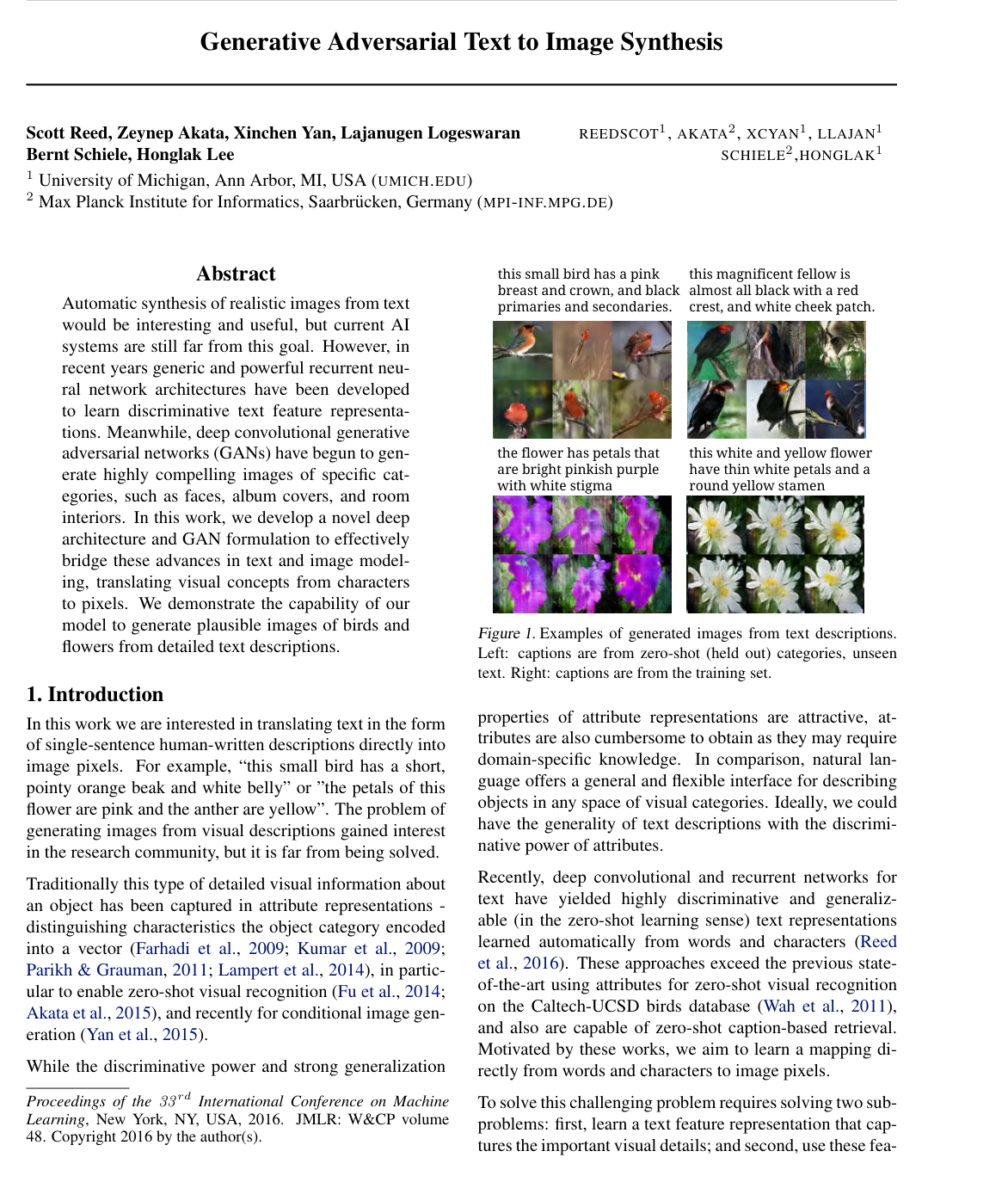
Automatic synthesis of realistic images from text would be interesting and useful, but current AI systems are still far from this goal. However, in recent years generic and powerful recurrent neural network architectures have been developed to learn discriminative text feature representations. Meanwhile, deep convolutional generative adversarial networks (GANs) have begun to generate highly compelling images of specific categories, such as faces, album covers, and room interiors. In this work, we develop a novel deep architecture and GAN formulation to effectively bridge these advances in text and image model- ing, translating visual concepts from characters to pixels. We demonstrate the capability of our model to generate plausible images of birds and flowers from detailed text descriptions.
Added
2026-09-11
Text Embeddings by Weakly-Supervised Contrastive Pre-training
Liang Wang, Nan Yang, Xiaolong Huang, Binxing Jiao, Linjun Yang, Daxin Jiang, Rangan Majumder, Furu Wei
Why you should read this
Introduces E5, a novel family of text embeddings trained with weakly-supervised contrastive pre-training on a curated large-scale dataset, achieving state-of-the-art performance across diverse NLP tasks, including outperforming BM25 in zero-shot retrieval and setting new records on MTEB with significantly fewer parameters.
This paper presents E5, a family of state-of-the-art text embeddings that transfer well to a wide range of tasks. The model is trained in a contrastive manner with weak supervision signals from our curated large-scale text pair dataset (called CCPairs). E5 can be readily used as a general-purpose embedding model for any tasks requiring a single-vector representation of texts such as retrieval, clustering, and classification, achieving strong performance in both zero-shot and fine-tuned settings. We conduct extensive evaluations on 56 datasets from the BEIR and MTEB benchmarks. For zero-shot settings, E5 is the first model that outperforms the strong BM25 baseline on the BEIR retrieval benchmark without using any labeled data. When fine-tuned, E5 obtains the best results on the MTEB benchmark, beating existing embedding models with 40x more parameters.
Added
2026-05-03
