Text-To-Concept (and Back) via Cross-Model Alignment
Mazda MoayeriKeivan RezaeiMaziar SanjabiSoheil Feizi
Demonstrates that a simple linear layer can align arbitrary vision encoders with CLIP's feature space, enabling zero-shot classification, unsupervised concept bottleneck models, and two-way translation between internal representations and natural language.
Deep computer vision models create complex, high-dimensional representations that are rich in semantic information but difficult for humans to interpret directly. Connecting these internal features to human language typically requires massive multimodal datasets, expensive concept annotations, or retraining large networks from scratch. Consequently, smaller, specialized vision models deployed across organizations often operate as opaque black boxes whose rich latent capabilities remain underutilized.
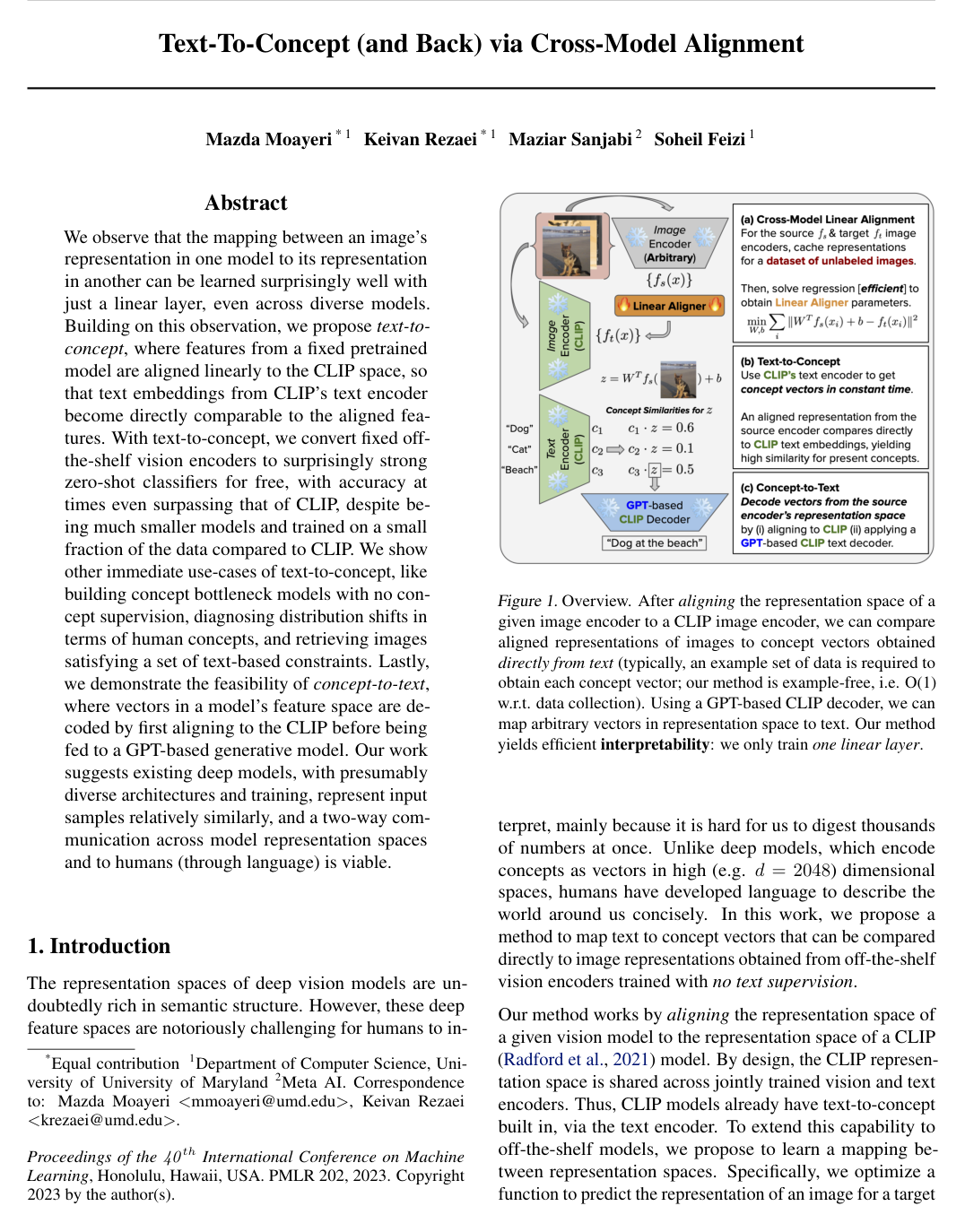
The article demonstrates that diverse computer vision models represent images in fundamentally similar ways and can be aligned using a single, computationally inexpensive linear layer. Its primary objective is to show that linearly mapping off-the-shelf vision encoders to a multimodal CLIP space enables bidirectional communication between models and human language—converting text descriptions into concept vectors within an image model and translating internal model vectors back into readable text.
The researchers evaluated this framework using multiple standard architectures, including standard ResNets, robust ResNets, and Vision Transformers, trained with both supervised and self-supervised methods on the ImageNet dataset. They learned simple affine transformations to align these fixed, single-modality models to CLIP without altering the underlying models or requiring paired image-text training. The credibility of the approach was tested across several downstream tasks, including zero-shot classification, concept-based image retrieval, dataset shift diagnostics, and interpretable classification models, supported by quantitative benchmarks and a human validation study.
The article reports four central findings. First, diverse vision models align remarkably well through linear mapping, indicating that disparate architectures and training methods organize visual data into similar internal geometries. Second, aligning fixed, unimodal models to CLIP grants them strong zero-shot classification abilities; for example, a self-supervised model achieved 85% accuracy on an unseen 17-way categorization, and smaller models trained on roughly 0.3% of CLIP’s data volume occasionally matched or outperformed CLIP itself on specific tasks like color recognition. Third, the framework enables Concept Bottleneck Models without manual concept labeling, achieving 93.8% accuracy on the RIVAL10 benchmark while isolating the exact influence of individual concepts on final predictions. Fourth, translating internal classification vectors into language via a generative text model produced human-verified relevant descriptions in over 92% of evaluated cases.
These findings have major practical implications for model governance, development costs, and system transparency. Organizations can unlock zero-shot recognition, search, and explainability capabilities in smaller, highly efficient models without undertaking expensive multimodal data collection or intensive retraining. The approach lowers compute expenses and provides non-invasive diagnostic tools to detect operational risks, such as data distribution shifts or problematic spurious correlations, before deploying models in production.
Decision-makers should leverage linear alignment techniques to audit existing vision models, build interpretable classifiers for high-stakes domains, and diagnose dataset drift using human-understandable terms. When implementing this method, teams should prefer general regression objectives over task-specific cross-entropy alignment to preserve generalizability across diverse concepts.
The approach exhibits limitations when evaluating fine-grained character recognition tasks like optical character recognition and relies partly on the quality of CLIP text encodings and generative language prompts. Nevertheless, confidence in the core findings remains high, as the underlying linear alignment consistently succeeds across diverse architectures and requires only minimal, scalable optimization.
- Paper: Learning Transferable Visual Models From Natural Language Supervision, Alec Radford et al.. Read the foundational CLIP work first: the source uses CLIP’s shared image–text embedding space as the target for aligning otherwise unimodal vision encoders.
- Paper: Disentangling visual and written concepts in CLIP, Joanna Materzynska et al. (2022). Its linear projections separate written and visual concepts within CLIP, providing a direct precedent for understanding the source’s use of linear maps to make model representations conceptually interpretable.
No sufficiently relevant recommendations were found.