
keyword
space carving
Space carving is a volumetric 3D reconstruction technique in computer vision that recovers the shape of an object or scene from multiple calibrated photographs by iteratively removing unoccupied regions from a solid bounding volume. The method discretizes the target space into a dense grid of 3D voxels and projects each candidate voxel onto the camera views where it is visible. By evaluating whether the projected colors and textures match across these viewpoints, the algorithm determines photometric consistency. Voxels that exhibit inconsistent color values are identified as empty space and carved away, while consistent voxels are retained, progressively refining the volume until it converges to a photo-consistent 3D surface model.
6 items
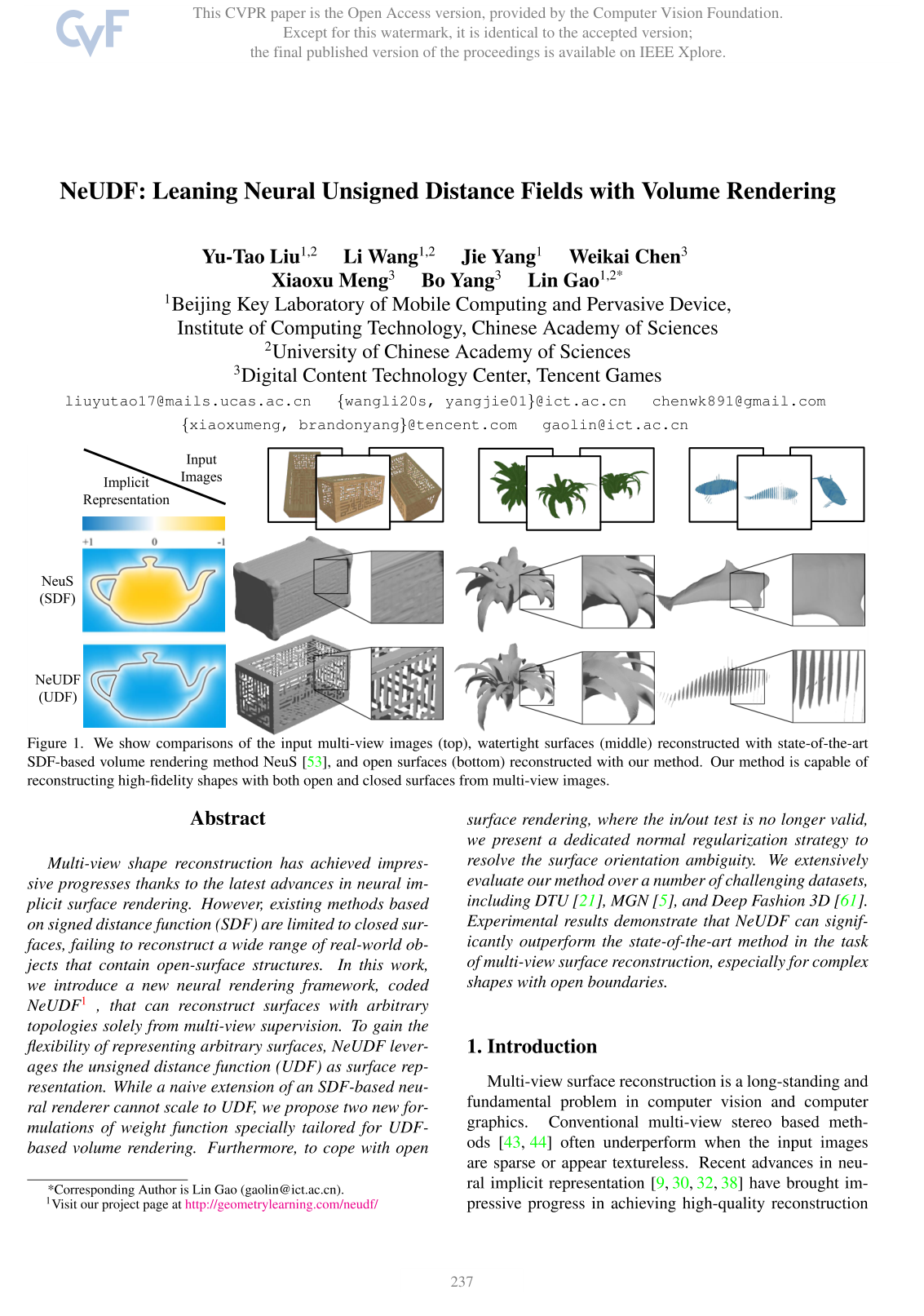
NeUDF: Leaning Neural Unsigned Distance Fields with Volume Rendering
Yu-Tao Liu, Li Wang, Jie Yang, Weikai Chen, Xiaoxu Meng, Bo Yang, Lin Gao
Why you should read this
Proposes an unbiased volume rendering framework tailored for unsigned distance fields, enabling high-fidelity 3D reconstruction of open and non-watertight surfaces solely from multi-view 2D images.
Multi-view shape reconstruction has achieved impressive progresses thanks to the latest advances in neural implicit surface rendering. However, existing methods based on signed distance function (SDF) are limited to closed surfaces, failing to reconstruct a wide range of real-world objects that contain open-surface structures. In this work, we introduce a new neural rendering framework, coded NeUDF , that can reconstruct surfaces with arbitrary topologies solely from multi-view supervision. To gain the flexibility of representing arbitrary surfaces, NeUDF leverages the unsigned distance function (UDF) as surface representation. While a naive extension of an SDF-based neural renderer cannot scale to UDF, we propose two new formulations of weight function specially tailored for UDF-based volume rendering. Furthermore, to cope with open surface rendering, where the in/out test is no longer valid, we present a dedicated normal regularization strategy to resolve the surface orientation ambiguity. We extensively evaluate our method over a number of challenging datasets, including DTU [21], MGN [5], and Deep Fashion 3D [61]. Experimental results demonstrate that NeUDF can significantly outperform the state-of-the-art method in the task of multi-view surface reconstruction, especially for complex shapes with open boundaries.
Added
2026-09-26
HF-NeuS: Improved Surface Reconstruction Using High-Frequency Details
Yiqun Wang, Ivan Skorokhodov, Peter Wonka
Why you should read this
Presents a neural surface reconstruction framework that recovers fine geometric details without 3D supervision by decomposing signed distance functions into base and displacement fields and applying spatially adaptive optimization.
Neural rendering can be used to reconstruct implicit representations of shapes without 3D supervision. However, current neural surface reconstruction methods have difficulty learning high-frequency geometry details, so the reconstructed shapes are often over-smoothed. We develop HF-NeuS, a novel method to improve the quality of surface reconstruction in neural rendering. We follow recent work to model surfaces as signed distance functions (SDFs). First, we offer a derivation to analyze the relationship between the SDF, the volume density, the transparency function, and the weighting function used in the volume rendering equation and propose to model transparency as a transformed SDF. Second, we observe that attempting to jointly encode high-frequency and low-frequency components in a single SDF leads to unstable optimization. We propose to decompose the SDF into base and displacement functions with a coarse-to-fine strategy to increase the high-frequency details gradually. Finally, we design an adaptive optimization strategy that makes the training process focus on improving those regions near the surface where the SDFs have artifacts. Our qualitative and quantitative results show that our method can reconstruct fine-grained surface details and obtain better surface reconstruction quality than the current state of the art. Code available at https://github.com/yiqun-wang/HFS.
Added
2026-09-26
Accurate, Dense, and Robust Multiview Stereopsis
Yasutaka Furukawa, Jean Ponce
Why you should read this
Presents a patch-based multiview stereo algorithm (PMVS) that reconstructs highly accurate, dense 3D surface meshes from calibrated images without requiring bounding volume initializations or artificial smoothing.
This paper proposes a novel algorithm for calibrated multi-view stereopsis that outputs a (quasi) dense set of rectangular patches covering the surfaces visible in the input images. This algorithm does not require any initialization in the form of a bounding volume, and it detects and discards automatically outliers and obstacles. It does not perform any smoothing across nearby features, yet is currently the top performer in terms of both coverage and accuracy for four of the six benchmark datasets presented in [20]. The keys to its performance are effective techniques for enforcing local photometric consistency and global visibility constraints. Stereopsis is implemented as a match, expand, and filter procedure, starting from a sparse set of matched keypoints, and repeatedly expanding these to nearby pixel correspondences before using visibility constraints to filter away false matches. A simple but effective method for turning the resulting patch model into a mesh appropriate for image-based modeling is also presented. The proposed approach is demonstrated on various datasets including objects with fine surface details, deep concavities, and thin structures, outdoor scenes observed from a restricted set of viewpoints, and “crowded” scenes where moving obstacles appear in different places in multiple images of a static structure of interest.
Source
https://vigir.missouri.edu/~gdesouza/Research/Conference_CDs/IEEE_CVPR_2007/data/papers/0278.pdfAdded
2026-09-24
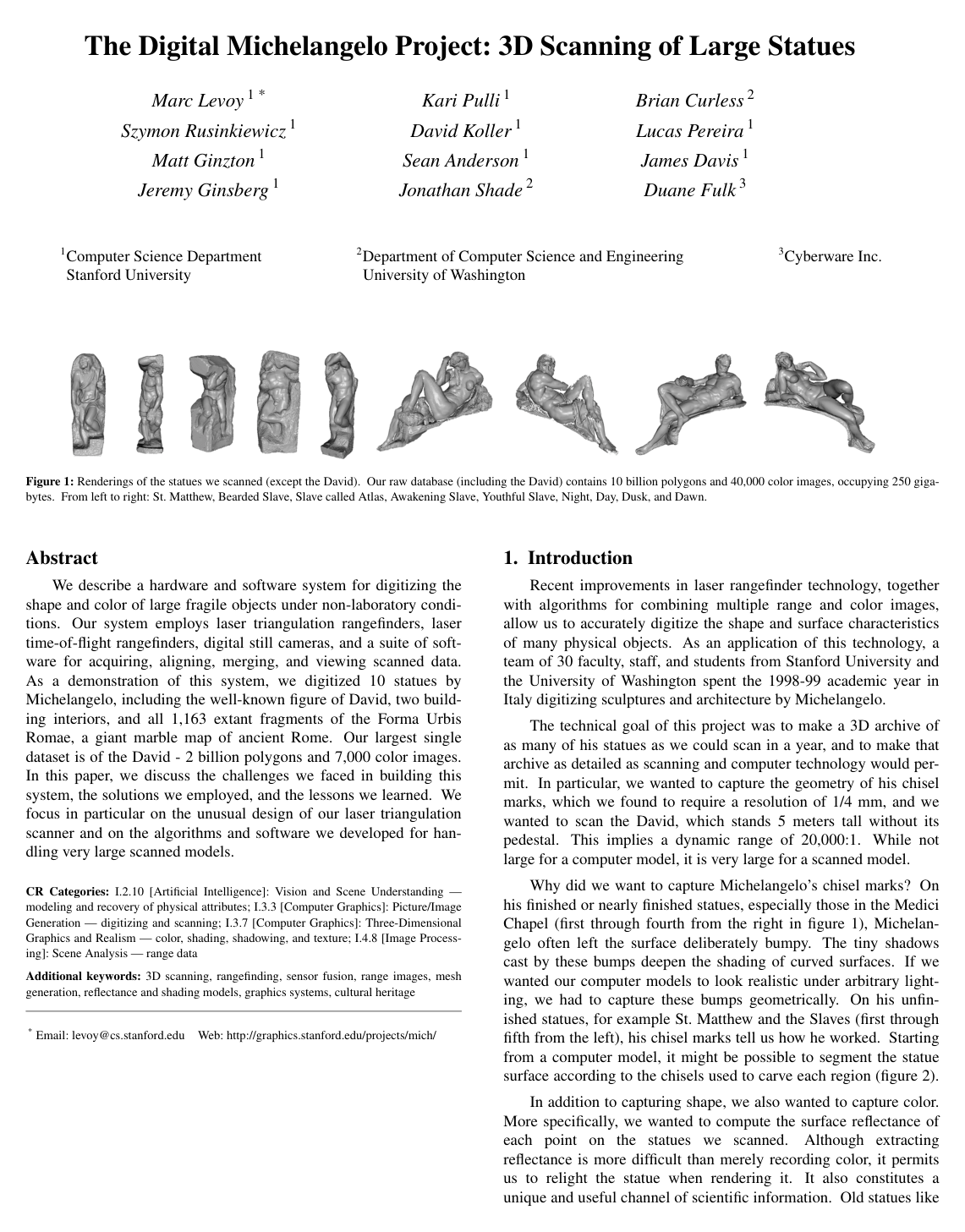
The digital Michelangelo project: 3D scanning of large statues
Marc Levoy, Kari Pulli, Brian Curless, Szymon Rusinkiewicz, David Koller, Lucas Pereira, Matt Ginzton, Sean E. Anderson, James Davis, Jeremy Ginsberg, Jonathan Shade, Duane Fulk
Why you should read this
Presents an end-to-end hardware and software system for high-resolution 3D digitization of large cultural artifacts under field conditions, detailing custom laser triangulation scanners and scalable algorithms capable of processing multi-gigabyte models like Michelangelo's David.
We describe a hardware and software system for digitizing the shape and color of large fragile objects under non-laboratory conditions. Our system employs laser triangulation rangefinders, laser time-of-flight rangefinders, digital still cameras, and a suite of software for acquiring, aligning, merging, and viewing scanned data. As a demonstration of this system, we digitized 10 statues by Michelangelo, including the well-known figure of David, two building interiors, and all 1,163 extant fragments of the Forma Urbis Romae, a giant marble map of ancient Rome. Our largest single dataset is of the David - 2 billion polygons and 7,000 color images. In this paper, we discuss the challenges we faced in building this system, the solutions we employed, and the lessons we learned. We focus in particular on the unusual design of our laser triangulation scanner and on the algorithms and software we developed for handling very large scanned models.
Added
2026-09-18
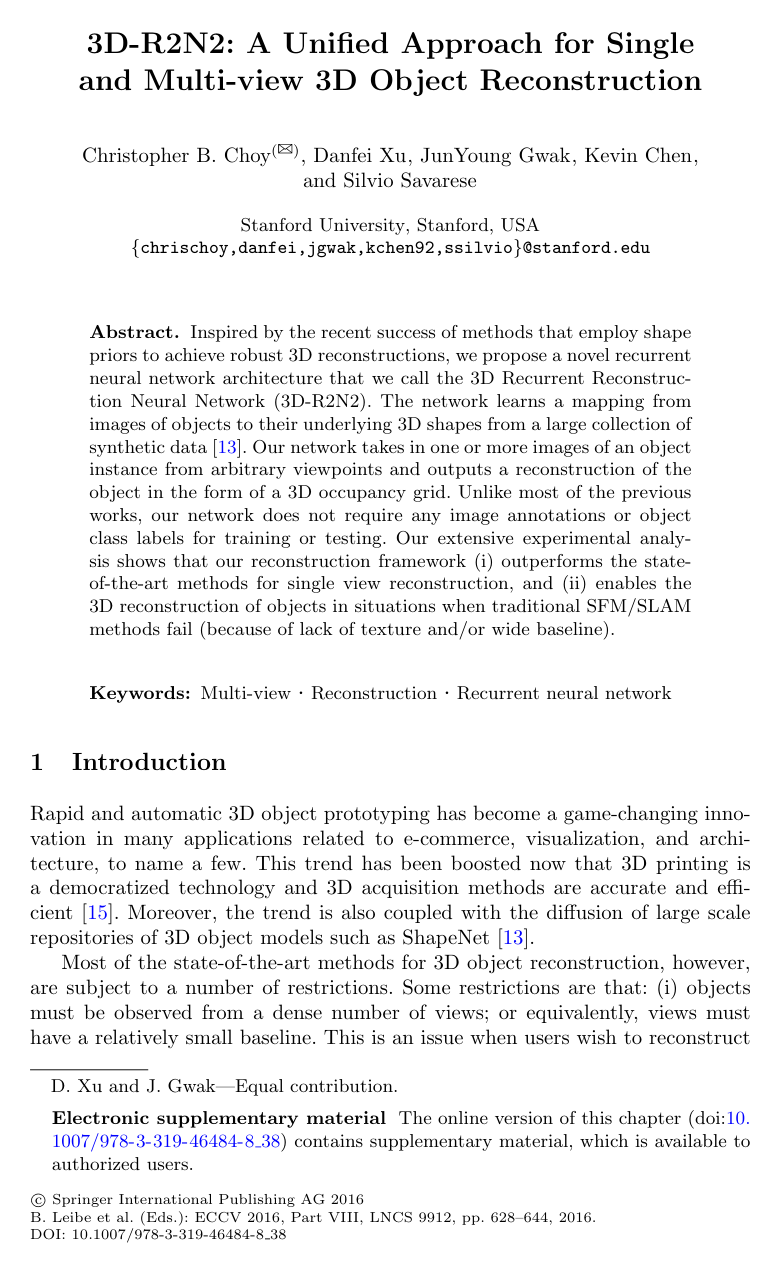
3D-R2N2: A Unified Approach for Single and Multi-view 3D Object Reconstruction
Christopher B. Choy, Danfei Xu, JunYoung Gwak, Kevin Chen, Silvio Savarese
Why you should read this
Proposes a recurrent neural network that unifies single- and multi-view 3D object reconstruction by generating volumetric occupancy grids from arbitrary 2D images without requiring camera poses, class labels, or dense feature matches.
Inspired by the recent success of methods that employ shape priors to achieve robust 3D reconstructions, we propose a novel recurrent neural network architecture that we call the 3D Recurrent Reconstruction Neural Network (3D-R2N2). The network learns a mapping from images of objects to their underlying 3D shapes from a large collection of synthetic data. Our network takes in one or more images of an object instance from arbitrary viewpoints and outputs a reconstruction of the object in the form of a 3D occupancy grid. Unlike most of the previous works, our network does not require any image annotations or object class labels for training or testing. Our extensive experimental analysis shows that our reconstruction framework i) outperforms the state-of-the-art methods for single view reconstruction, and ii) enables the 3D reconstruction of objects in situations when traditional SFM/SLAM methods fail (because of lack of texture and/or wide baseline).
Added
2026-09-18
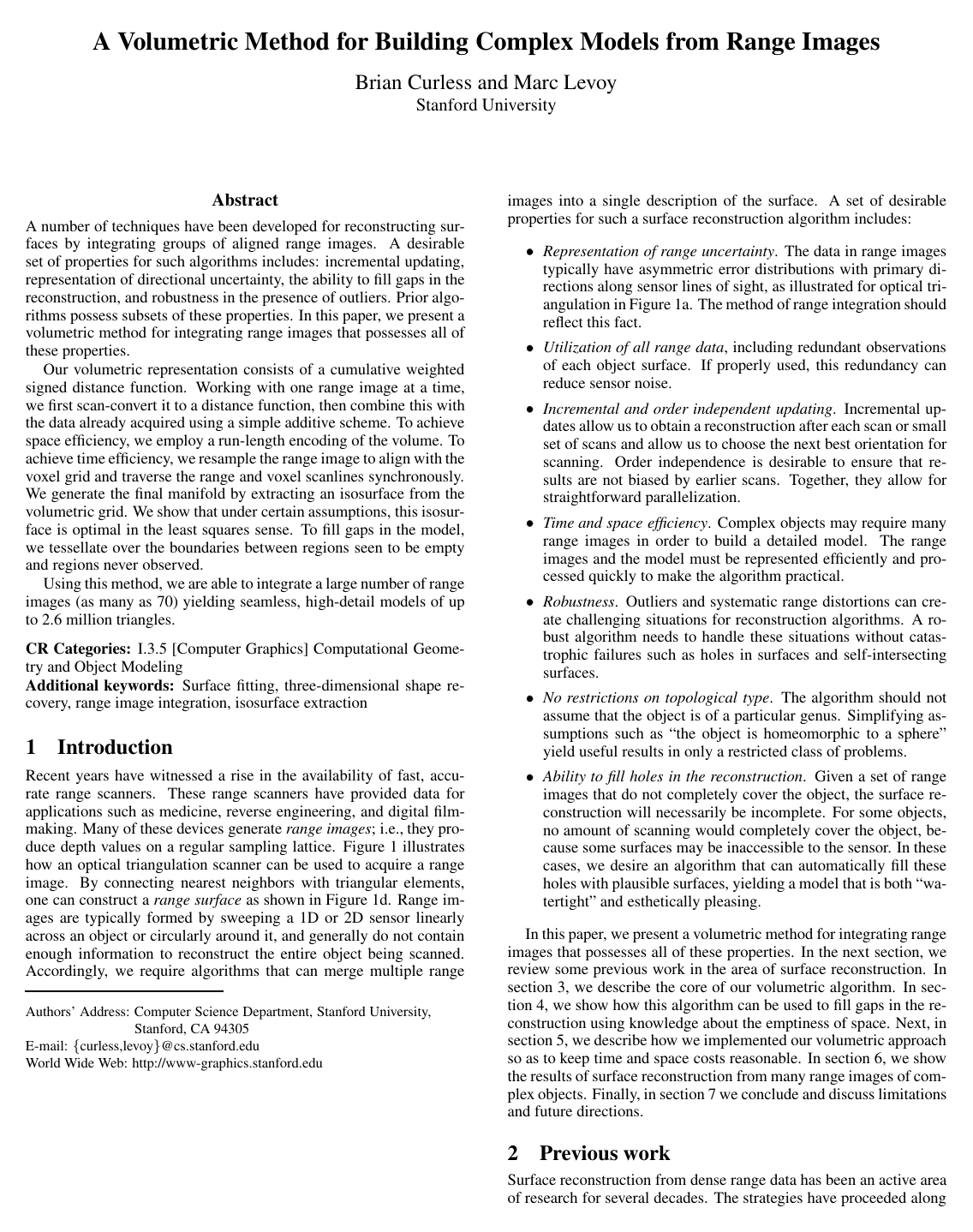
A volumetric method for building complex models from range images
Brian Curless, Marc Levoy
Why you should read this
Introduces a foundational volumetric method that integrates multiple noisy range scans into a cumulative weighted signed distance function, using space carving to produce complete, watertight 3D surface models with least-squares optimality.
A number of techniques have been developed for reconstructing surfaces by integrating groups of aligned range images. A desirable set of properties for such algorithms includes: incremental updating, representation of directional uncertainty, the ability to fill gaps in the reconstruction, and robustness in the presence of outliers. Prior algorithms possess subsets of these properties. In this paper, we present a volumetric method for integrating range images that possesses all of these properties. Our volumetric representation consists of a cumulative weighted signed distance function. Working with one range image at a time, we first scan-convert it to a distance function, then combine this with the data already acquired using a simple additive scheme. To achieve space efficiency, we employ a run-length encoding of the volume. To achieve time efficiency, we resample the range image to align with the voxel grid and traverse the range and voxel scanlines synchronously. We generate the final manifold by extracting an isosurface from the volumetric grid. We show that under certain assumptions, this isosurface is optimal in the least squares sense. To fill gaps in the model, we tessellate over the boundaries between regions seen to be empty and regions never observed. Using this method, we are able to integrate a large number of range images (as many as 70) yielding seamless, high-detail models of up to 2.6 million triangles.
Added
2026-09-11