
keyword
sentence embeddings
Sentence embeddings are dense numerical vector representations of entire sentences that capture their underlying semantic and syntactic meaning in a continuous vector space. Unlike word-level representations that model individual words in isolation, sentence embeddings map complete sentences to fixed-length vectors that preserve overall context, structure, and intent. These vectors are typically generated using pretrained neural networks, contrastive learning objectives, or pooling and weighting mechanisms over lexical representations. By placing sentences with similar meanings close to one another in a shared geometric space, sentence embeddings allow machines to efficiently compute semantic similarity using vector distance metrics and support a wide range of natural language processing tasks, such as dense retrieval, clustering, text classification, and semantic textual similarity.
25 items
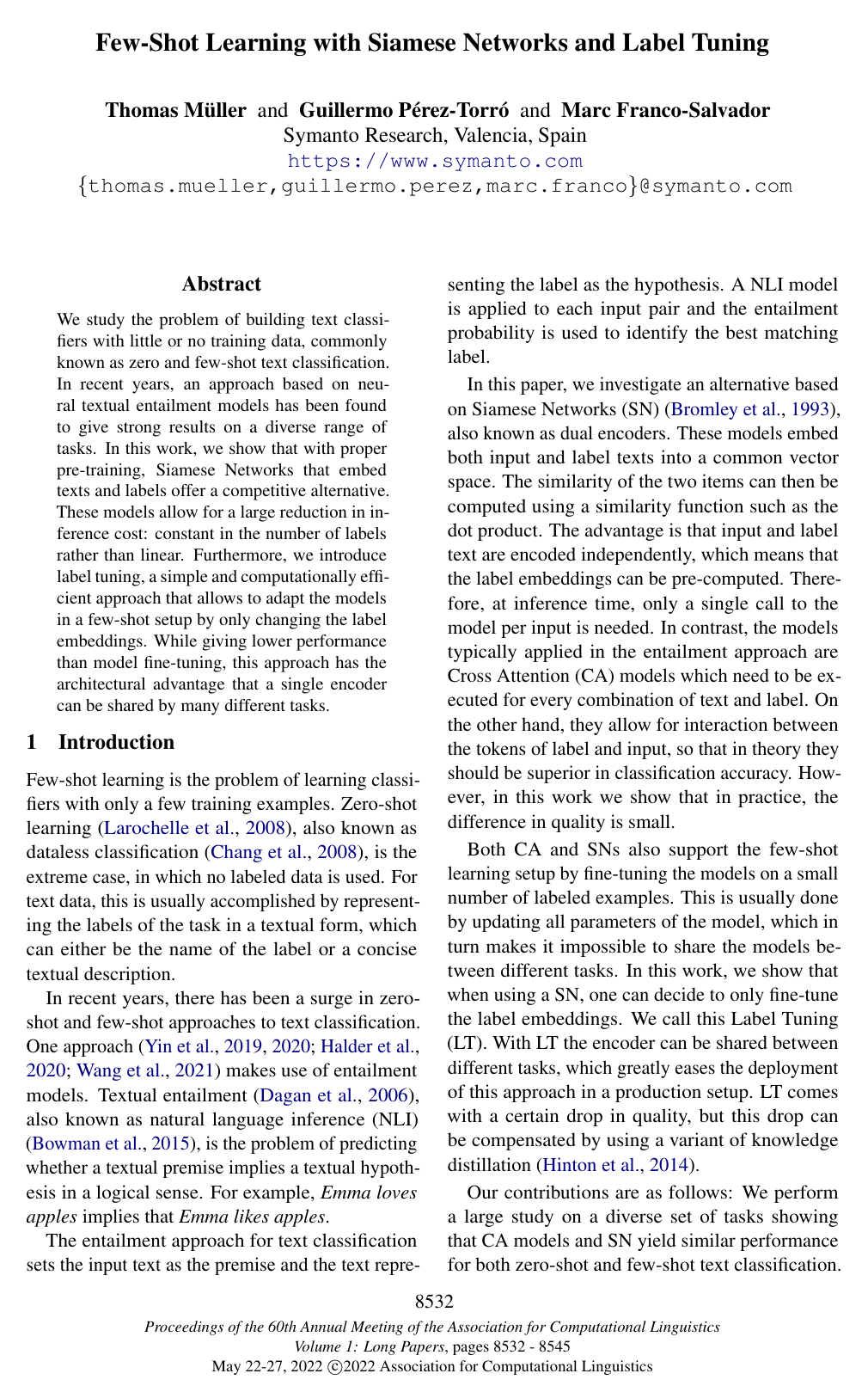
Few-Shot Learning with Siamese Networks and Label Tuning
Thomas Müller, Guillermo Pérez-Torró, Marc Franco-Salvador
Why you should read this
Introduces a scalable Siamese network framework and label tuning method for few-shot text classification that achieves constant-time inference and allows a single text encoder to be shared across multiple tasks by adapting only label embeddings.
We study the problem of building text classifiers with little or no training data, commonly known as zero and few-shot text classification. In recent years, an approach based on neural textual entailment models has been found to give strong results on a diverse range of tasks. In this work, we show that with proper pre-training, Siamese Networks that embed texts and labels offer a competitive alternative. These models allow for a large reduction in inference cost: constant in the number of labels rather than linear. Furthermore, we introduce label tuning, a simple and computationally efficient approach that allows to adapt the models in a few-shot setup by only changing the label embeddings. While giving lower performance than model fine-tuning, this approach has the architectural advantage that a single encoder can be shared by many different tasks.
Added
2026-10-03
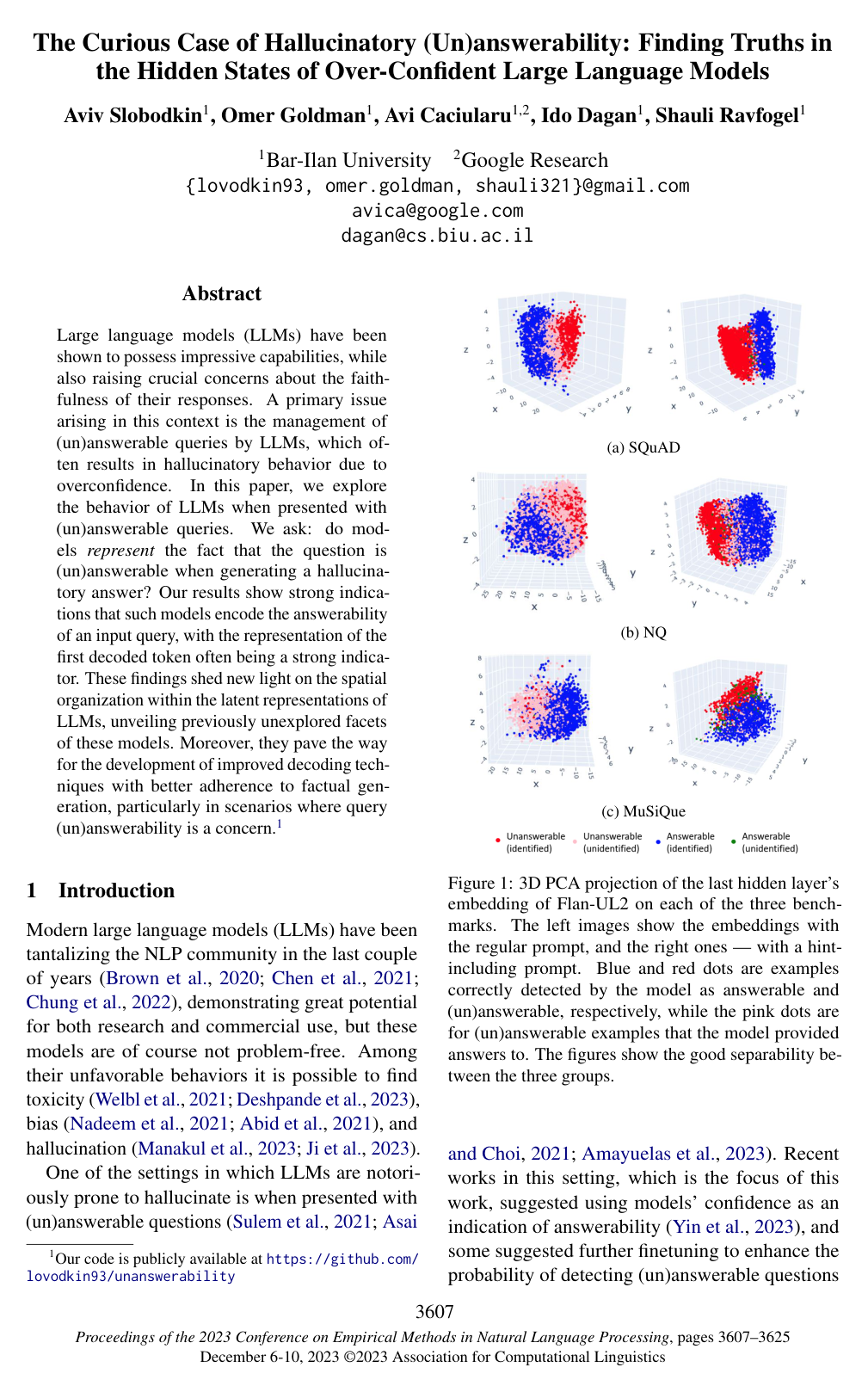
The Curious Case of Hallucinatory (Un)answerability: Finding Truths in the Hidden States of Over-Confident Large Language Models
Aviv Slobodkin, Omer Goldman, Avi Caciularu, Ido Dagan, Shauli Ravfogel
Why you should read this
Reveals that large language models internally encode whether a question is answerable in their hidden states even while generating hallucinatory answers, showing that this linearly separable answerability signal can be extracted to curb overconfident errors.
Large language models (LLMs) have been shown to possess impressive capabilities, while also raising crucial concerns about the faithfulness of their responses. A primary issue arising in this context is the management of (un)answerable queries by LLMs, which often results in hallucinatory behavior due to overconfidence. In this paper, we explore the behavior of LLMs when presented with (un)answerable queries. We ask: do models represent the fact that the question is (un)answerable when generating a hallucinatory answer? Our results show strong indications that such models encode the answerability of an input query, with the representation of the first decoded token often being a strong indicator. These findings shed new light on the spatial organization within the latent representations of LLMs, unveiling previously unexplored facets of these models. Moreover, they pave the way for the development of improved decoding techniques with better adherence to factual generation, particularly in scenarios where query (un)answerability is a concern.
Added
2026-10-03
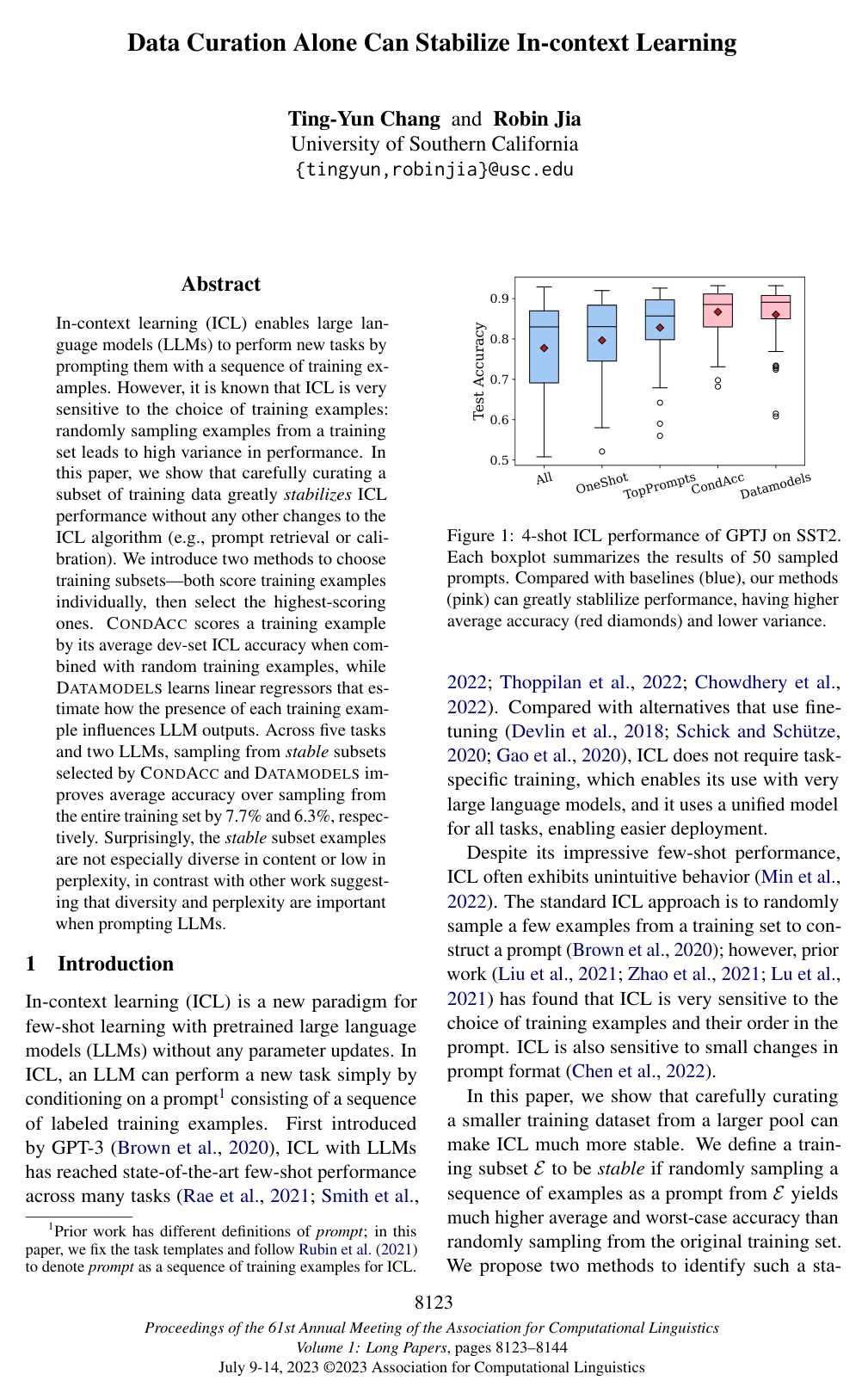
Data Curation Alone Can Stabilize In-context Learning
Ting-Yun Chang, Robin Jia
Why you should read this
Demonstrates that selecting high-value training subsets through individual example scoring significantly reduces performance variance and increases accuracy in in-context learning without requiring dynamic prompt retrieval or model calibration.
In-context learning (ICL) enables large language models (LLMs) to perform new tasks by prompting them with a sequence of training examples. However, it is known that ICL is very sensitive to the choice of training examples: randomly sampling examples from a training set leads to high variance in performance. In this paper, we show that carefully curating a subset of training data greatly stabilizes ICL performance without any other changes to the ICL algorithm (e.g., prompt retrieval or calibration). We introduce two methods to choose training subsets—both score training examples individually, then select the highest-scoring ones. CONDACC scores a training example by its average dev-set ICL accuracy when combined with random training examples, while DATAMODELS learns linear regressors that estimate how the presence of each training example influences LLM outputs. Across five tasks and two LLMs, sampling from stable subsets selected by CONDACC and DATAMODELS improves average accuracy over sampling from the entire training set by 7.7% and 6.3%, respectively. Surprisingly, the stable subset examples are not especially diverse in content or low in perplexity, in contrast with other work suggesting that diversity and perplexity are important when prompting LLMs.
Added
2026-10-02
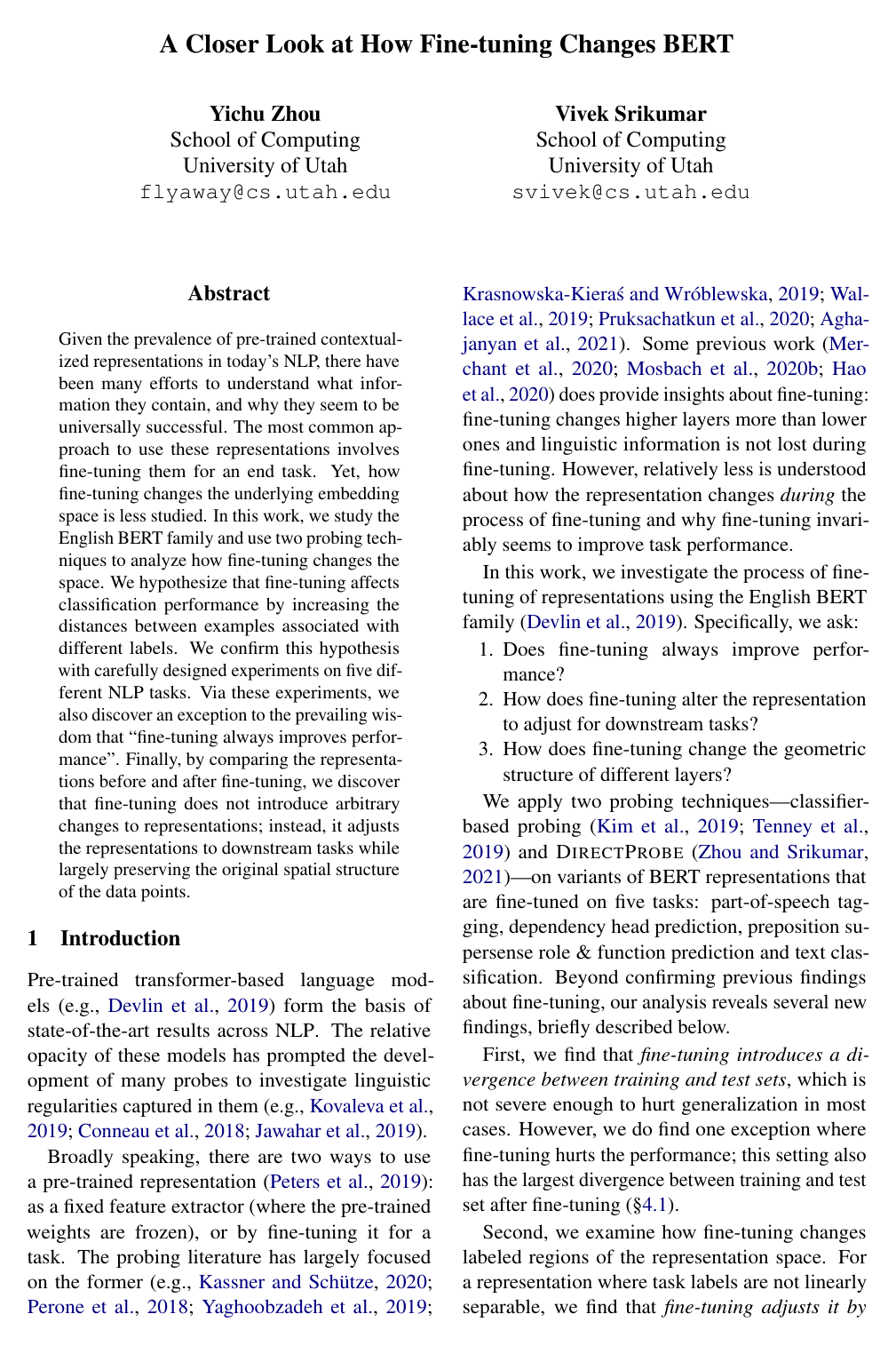
A Closer Look at How Fine-tuning Changes BERT
Yichu Zhou, Vivek Srikumar
Why you should read this
Reveals how fine-tuning improves BERT representations by widening separation distances between distinct label clusters while preserving the model's underlying geometric structure across downstream tasks.
Given the prevalence of pre-trained contextualized representations in today's NLP, there have been many efforts to understand what information they contain, and why they seem to be universally successful. The most common approach to use these representations involves fine-tuning them for an end task. Yet, how fine-tuning changes the underlying embedding space is less studied. In this work, we study the English BERT family and use two probing techniques to analyze how fine-tuning changes the space. We hypothesize that fine-tuning affects classification performance by increasing the distances between examples associated with different labels. We confirm this hypothesis with carefully designed experiments on five different NLP tasks. Via these experiments, we also discover an exception to the prevailing wisdom that "fine-tuning always improves performance". Finally, by comparing the representations before and after fine-tuning, we discover that fine-tuning does not introduce arbitrary changes to representations; instead, it adjusts the representations to downstream tasks while largely preserving the original spatial structure of the data points.
Added
2026-10-02
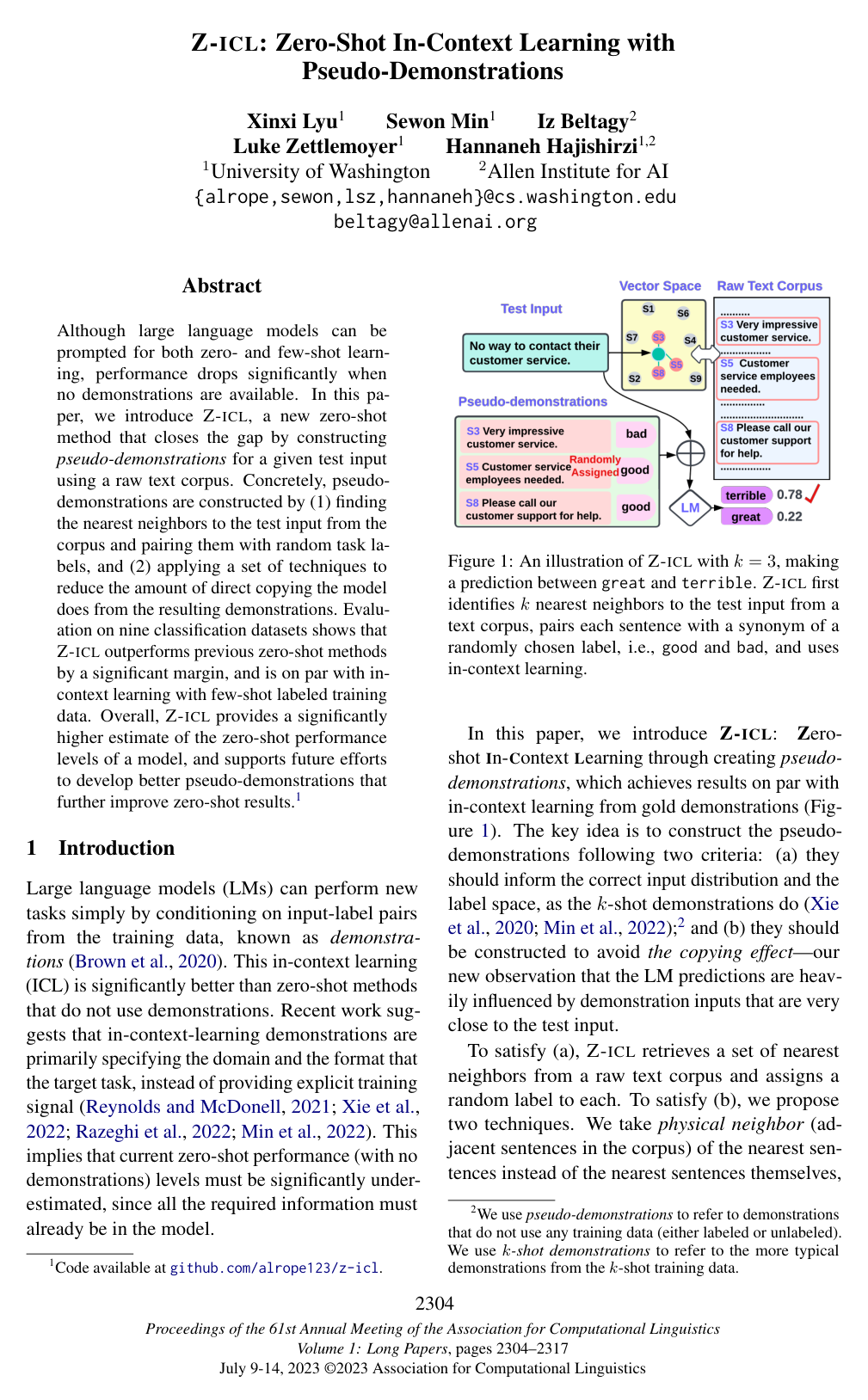
Z-ICL: Zero-Shot In-Context Learning with Pseudo-Demonstrations
Xinxi Lyu, Sewon Min, Iz Beltagy, Luke Zettlemoyer, Hannaneh Hajishirzi
Why you should read this
Introduces a zero-shot prompting method that constructs pseudo-demonstrations from raw, unlabelled text using nearest neighbors and label synonyms, matching the performance of standard few-shot in-context learning without requiring any task annotations.
Large language models (LLMs) can learn new tasks through in-context learning (ICL), where demonstrations condition their predictions. However, collecting high-quality labeled examples across diverse downstream applications may be expensive.
Added
2026-10-02
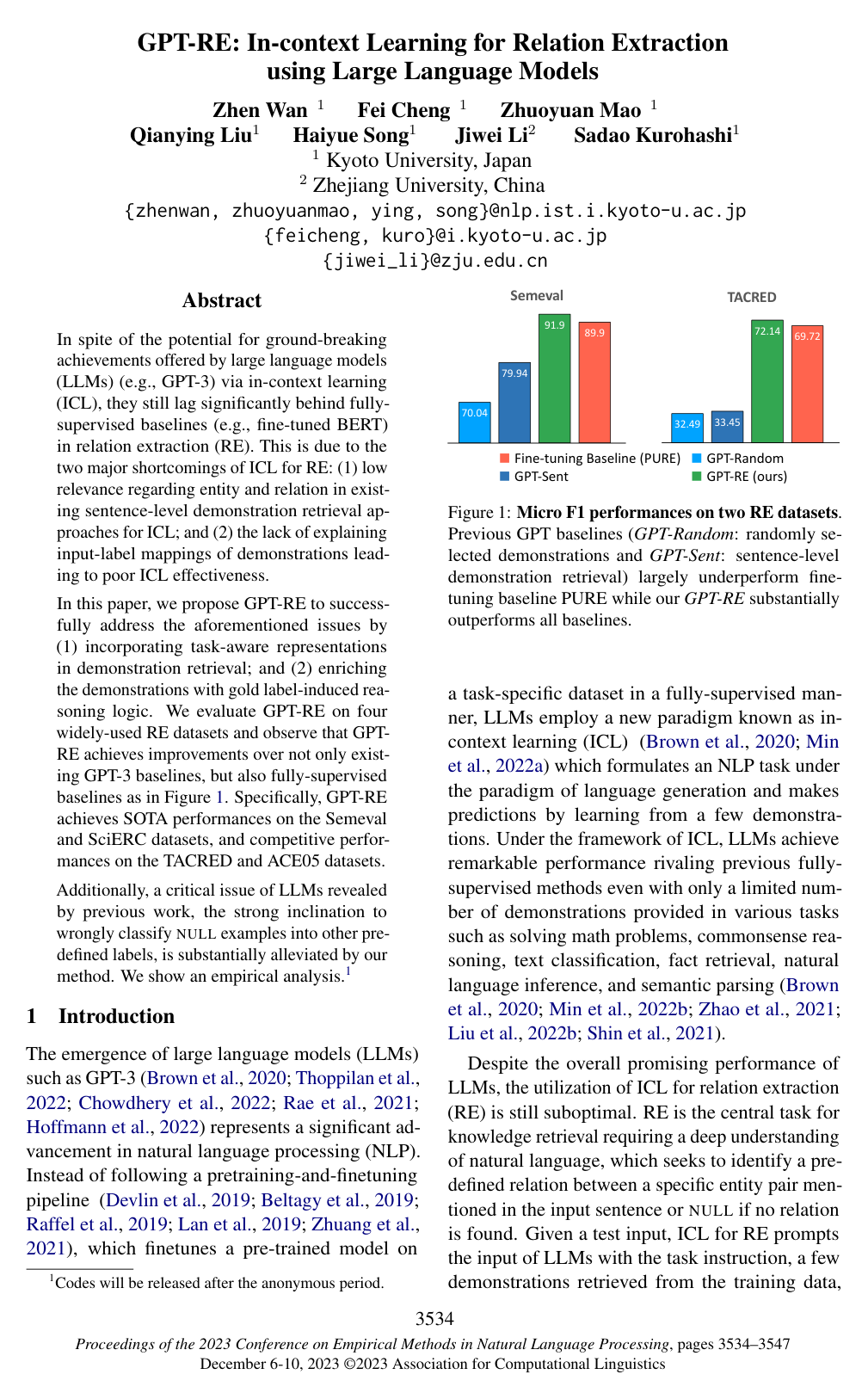
GPT-RE: In-context Learning for Relation Extraction using Large Language Models
Zhen Wan, Fei Cheng, Zhuoyuan Mao, Qianying Liu, Haiyue Song, Jiwei Li, Sadao Kurohashi
Why you should read this
Proposes GPT-RE, a framework that bridges the performance gap between large language models and fully supervised baselines on relation extraction benchmarks by combining task-aware demonstration retrieval with gold-label-induced reasoning.
In spite of the potential for ground-breaking achievements offered by large language models (LLMs) (e.g., GPT-3) via in-context learning (ICL), they still lag significantly behind fully-supervised baselines (e.g., fine-tuned BERT) in relation extraction (RE). This is due to the two major shortcomings of ICL for RE: (1) low relevance regarding entity and relation in existing sentence-level demonstration retrieval approaches for ICL; and (2) the lack of explaining input-label mappings of demonstrations leading to poor ICL effectiveness. In this paper, we propose GPT-RE to successfully address the aforementioned issues by (1) incorporating task-aware representations in demonstration retrieval; and (2) enriching the demonstrations with gold label-induced reasoning logic. We evaluate GPT-RE on four widely-used RE datasets and observe that GPT-RE achieves improvements over not only existing GPT-3 baselines, but also fully-supervised baselines as in Figure 1. Specifically, GPT-RE achieves SOTA performances on the SemEval and SciERC datasets, and competitive performances on the TACRED and ACE05 datasets. Additionally, a critical issue of LLMs revealed by previous work, the strong inclination to wrongly classify NULL examples into other pre-defined labels, is substantially alleviated by our method. We show an empirical analysis.1
Added
2026-09-26
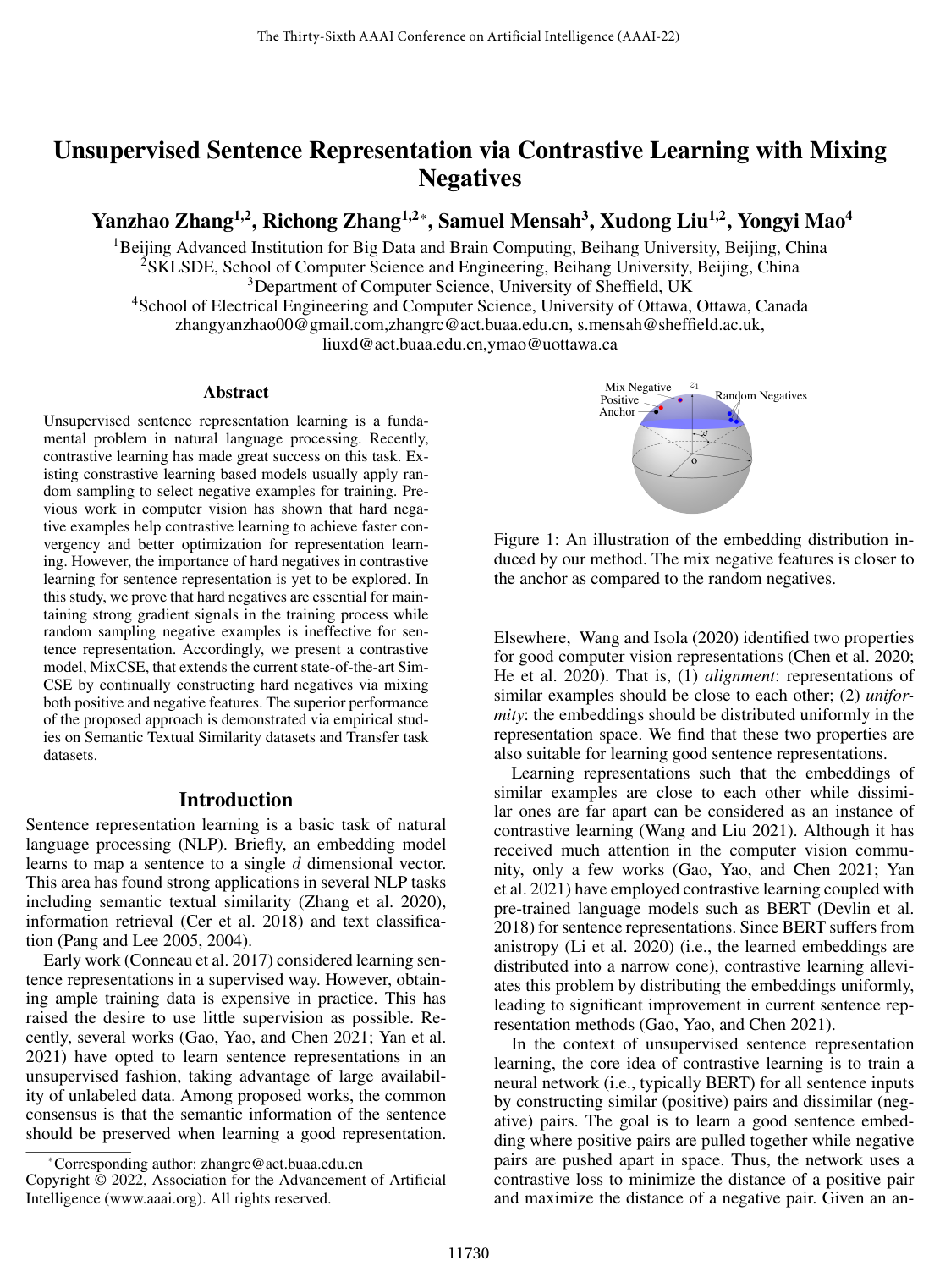
Unsupervised Sentence Representation via Contrastive Learning with Mixing Negatives
Yanzhao Zhang, Richong Zhang, Samuel Mensah, Xudong Liu, Yongyi Mao
Why you should read this
Proposes MixCSE, a contrastive sentence representation framework that overcomes vanishing gradient signals by continually generating artificial hard negative features through mixing positive and negative samples, achieving state-of-the-art results on semantic textual similarity and transfer tasks.
Unsupervised sentence representation learning is a fundamental problem in natural language processing. Recently, contrastive learning has made great success on this task. Existing contrastive learning based models usually apply random sampling to select negative examples for training. Previous work in computer vision has shown that hard negative examples help contrastive learning to achieve faster convergence and better optimization for representation learning. However, the importance of hard negatives in contrastive learning for sentence representation is yet to be explored. In this study, we prove that hard negatives are essential for maintaining strong gradient signals in the training process while random sampling negative examples is ineffective for sentence representation. Accordingly, we present a contrastive model, MixCSE, that extends the current state-of-the-art SimCSE by continually constructing hard negatives via mixing both positive and negative features. The superior performance of the proposed approach is demonstrated via empirical studies on Semantic Textual Similarity datasets and Transfer task datasets.
Added
2026-09-26
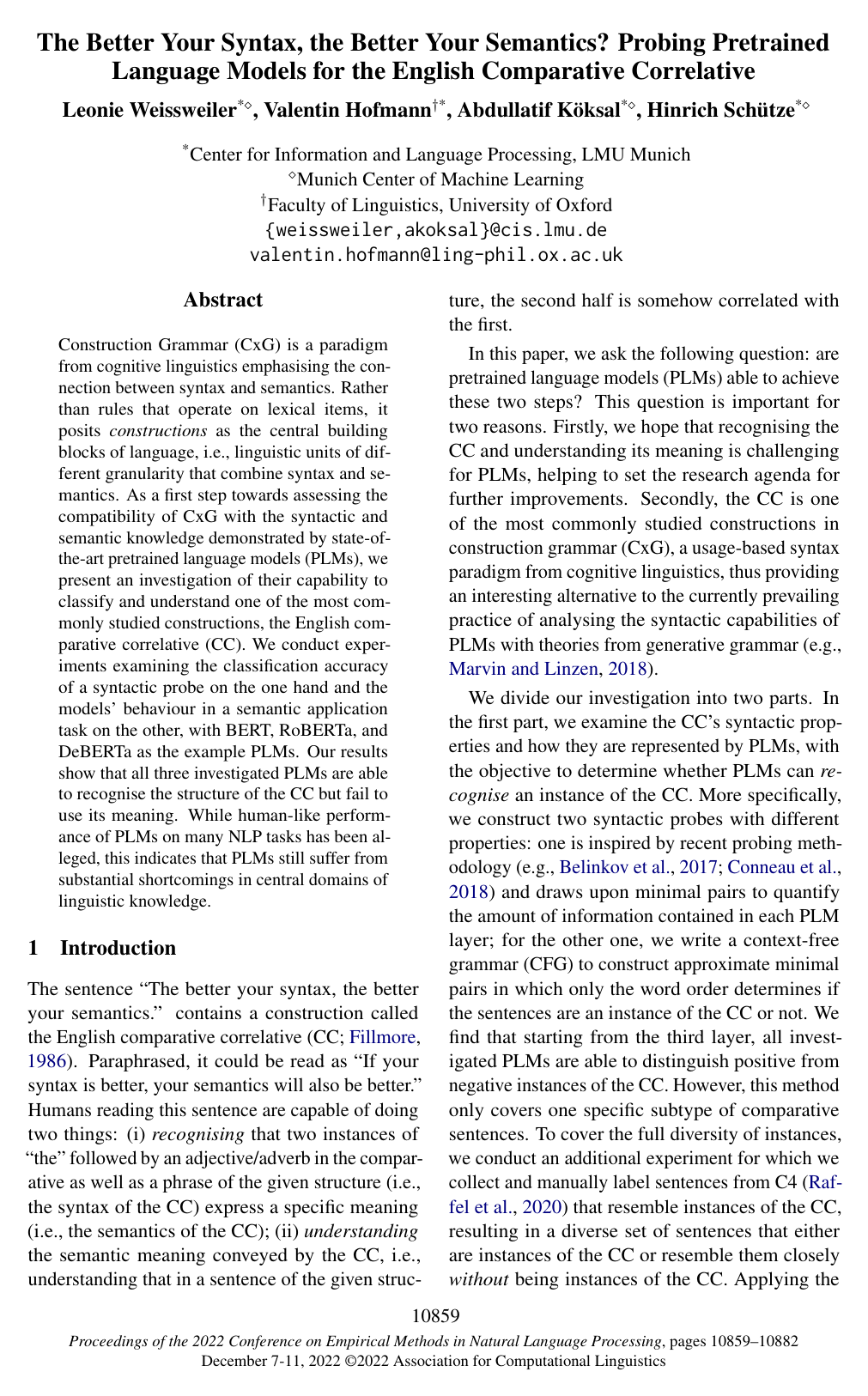
The better your Syntax, the better your Semantics? Probing Pretrained Language Models for the English Comparative Correlative
Leonie Weissweiler, Valentin Hofmann, Abdullatif Köksal, Hinrich Schütze
Why you should read this
Reveals a critical disconnect in pretrained language models by showing that while models like BERT and DeBERTa reliably identify the syntactic structure of comparative correlative constructions, they consistently fail to understand and apply their underlying semantic meaning.
Construction Grammar (CxG) is a paradigm from cognitive linguistics emphasising the connection between syntax and semantics. Rather than rules that operate on lexical items, it posits constructions as the central building blocks of language, i.e., linguistic units of different granularity that combine syntax and semantics. As a first step towards assessing the compatibility of CxG with the syntactic and semantic knowledge demonstrated by state-of-the-art pretrained language models (PLMs), we present an investigation of their capability to classify and understand one of the most commonly studied constructions, the English comparative correlative (CC). We conduct experiments examining the classification accuracy of a syntactic probe on the one hand and the models’ behaviour in a semantic application task on the other, with BERT, RoBERTa, and DeBERTa as the example PLMs. Our results show that all three investigated PLMs are able to recognise the structure of the CC but fail to use its meaning. While human-like performance of PLMs on many NLP tasks has been alleged, this indicates that PLMs still suffer from substantial shortcomings in central domains of linguistic knowledge.
Added
2026-09-26
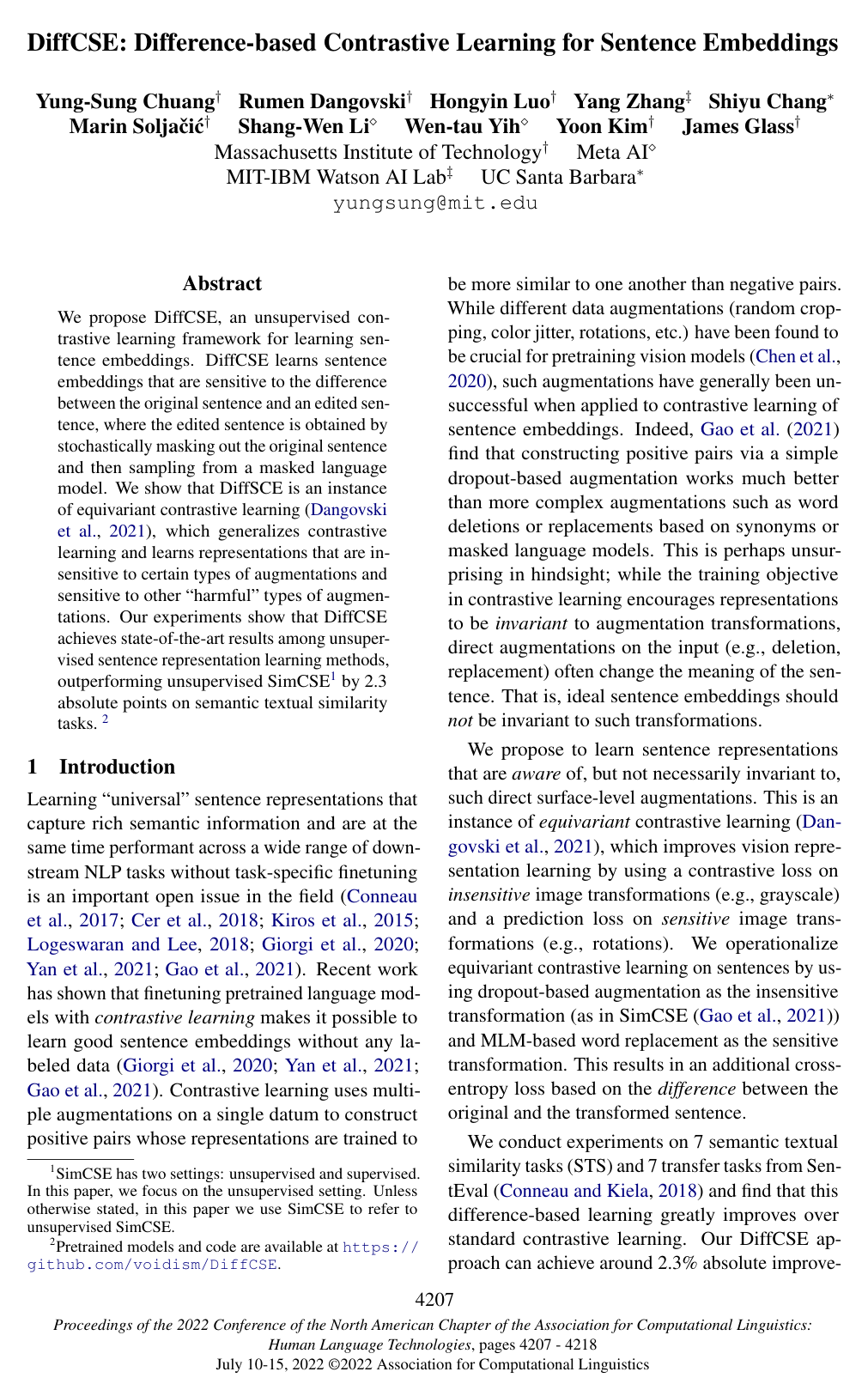
DiffCSE: Difference-based Contrastive Learning for Sentence Embeddings
Yung-Sung Chuang, Rumen Dangovski, Hongyin Luo, Yang Zhang, Shiyu Chang, Marin Soljacic, Shang-Wen Li, Scott Yih, Yoon Kim, James R. Glass
Why you should read this
Proposes DiffCSE, an unsupervised sentence embedding framework that improves semantic similarity performance by pairing standard contrastive learning with an auxiliary difference prediction task to make representations sensitive to meaning-altering word edits.
We propose DiffCSE, an unsupervised contrastive learning framework for learning sentence embeddings. DiffCSE learns sentence embeddings that are sensitive to the difference between the original sentence and an edited sentence, where the edited sentence is obtained by stochastically masking out the original sentence and then sampling from a masked language model. We show that DiffCSE is an instance of equivariant contrastive learning (Dangovski et al., 2021), which generalizes contrastive learning and learns representations that are insensitive to certain types of augmentations and sensitive to other “harmful” types of augmentations. Our experiments show that DiffCSE achieves state-of-the-art results among unsupervised sentence representation learning methods, outperforming unsupervised SimCSE1 by 2.3 absolute points on semantic textual similarity tasks. 2
Added
2026-09-26
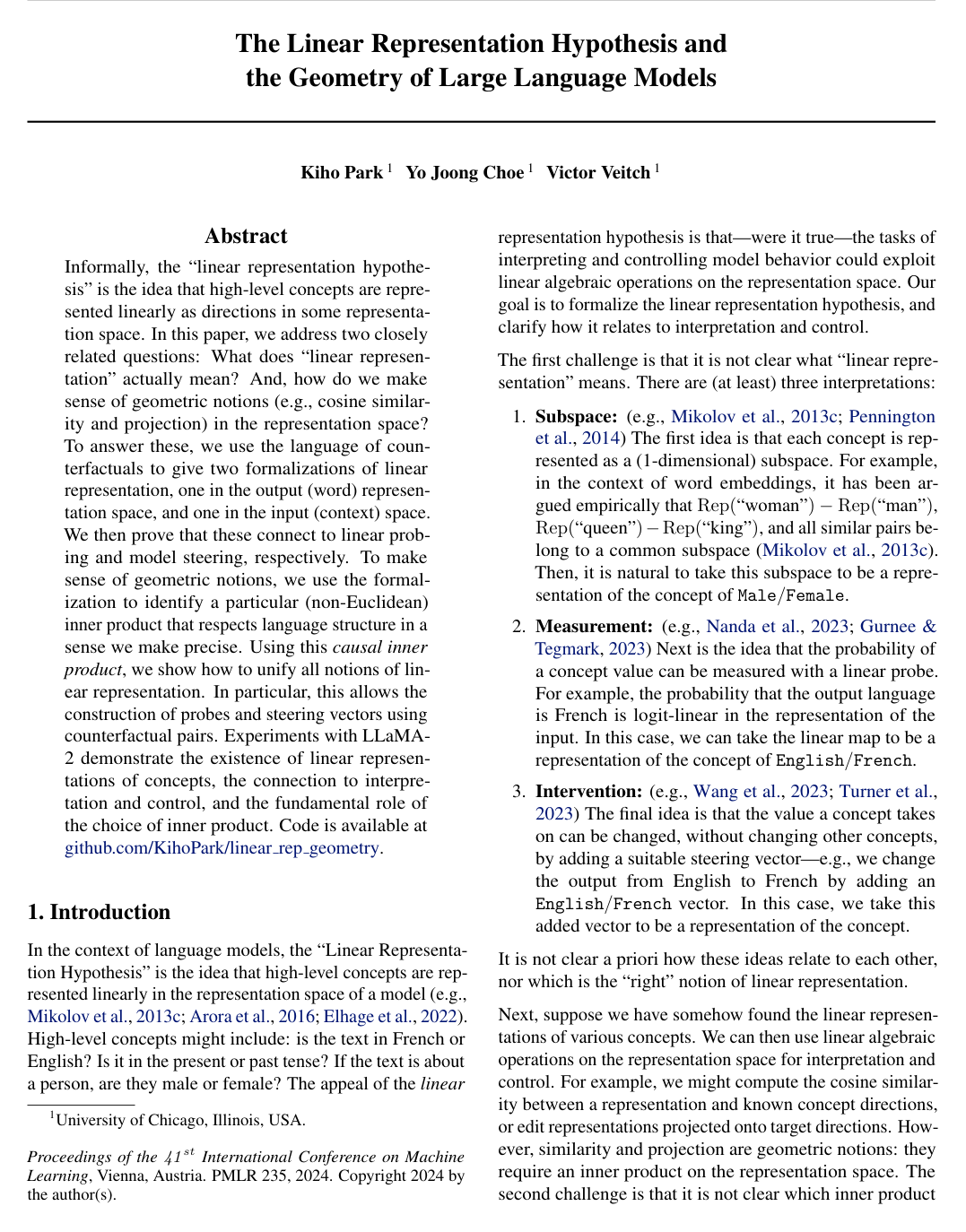
The Linear Representation Hypothesis and the Geometry of Large Language Models
Kiho Park, Yo Joong Choe, Victor Veitch
Why you should read this
Formalizes the linear representation hypothesis using counterfactual pairs to unify linear probing and steering under a causally grounded inner product for large language model representations.
Informally, the "linear representation hypothesis" is the idea that high-level concepts are represented linearly as directions in some representation space. In this paper, we address two closely related questions: What does "linear representation" actually mean? And, how do we make sense of geometric notions (e.g., cosine similarity and projection) in the representation space? To answer these, we use the language of counterfactuals to give two formalizations of linear representation, one in the output (word) representation space, and one in the input (context) space. We then prove that these connect to linear probing and model steering, respectively. To make sense of geometric notions, we use the formalization to identify a particular (non-Euclidean) inner product that respects language structure in a sense we make precise. Using this causal inner product, we show how to unify all notions of linear representation. In particular, this allows the construction of probes and steering vectors using counterfactual pairs. Experiments with LLaMA-2 demonstrate the existence of linear representations of concepts, the connection to interpretation and control, and the fundamental role of the choice of inner product. Code is available at github.com/KihoPark/linear_rep_geometry.
Added
2026-09-26
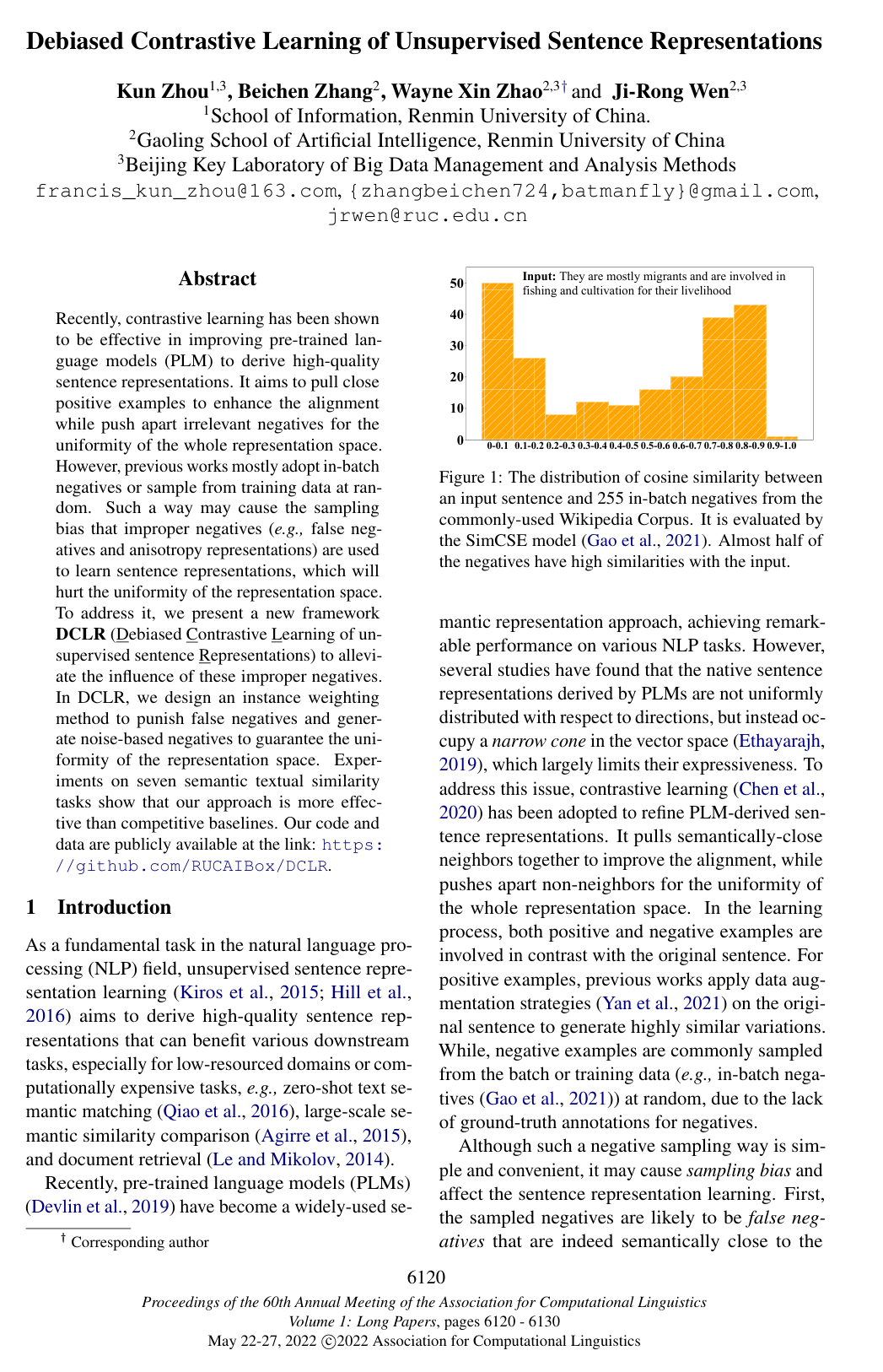
Debiased Contrastive Learning of Unsupervised Sentence Representations
Kun Zhou, Beichen Zhang, Wayne Xin Zhao, Ji-Rong Wen
Why you should read this
Proposes a debiased contrastive learning framework that improves unsupervised sentence embeddings by downweighting false negatives and generating optimized noise-based negative samples to overcome representation anisotropy.
Recently, contrastive learning has been shown to be effective in improving pre-trained language models (PLM) to derive high-quality sentence representations. It aims to pull close positive examples to enhance the alignment while push apart irrelevant negatives for the uniformity of the whole representation space. However, previous works mostly adopt in-batch negatives or sample from training data at random. Such a way may cause the sampling bias that improper negatives (e.g., false negatives and anisotropy representations) are used to learn sentence representations, which will hurt the uniformity of the representation space. To address it, we present a new framework DCLR (Debiased Contrastive Learning of unsupervised sentence Representations) to alleviate the influence of these improper negatives. In DCLR, we design an instance weighting method to punish false negatives and generate noise-based negatives to guarantee the uniformity of the representation space. Experiments on seven semantic textual similarity tasks show that our approach is more effective than competitive baselines. Our code and data are publicly available at the link: https://github.com/RUCAIBox/DCLR.
Added
2026-09-26
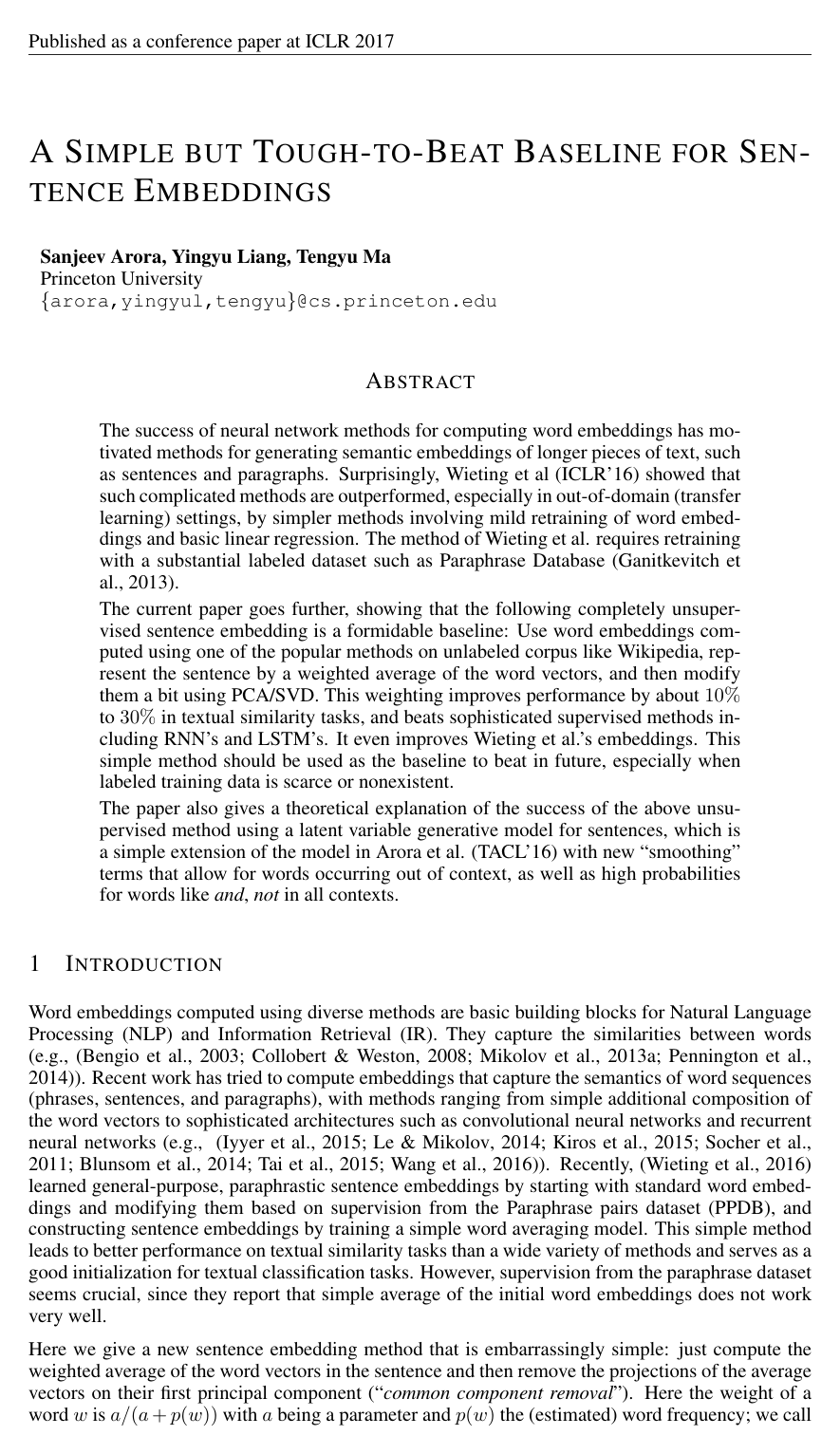
A Simple but Tough-to-Beat Baseline for Sentence Embeddings
Sanjeev Arora, Yingyu Liang, Tengyu Ma
Why you should read this
Proposes an unsupervised sentence embedding baseline combining smooth inverse frequency weighting with principal component removal that consistently outperforms complex neural network models on semantic similarity benchmarks.
The success of neural network methods for computing word embeddings has motivated methods for generating semantic embeddings of longer pieces of text, such as sentences and paragraphs. Surprisingly, Wieting et al (ICLR'16) showed that such complicated methods are outperformed, especially in out-of-domain (transfer learning) settings, by simpler methods involving mild retraining of word embeddings and basic linear regression. The method of Wieting et al. requires retraining with a substantial labeled dataset such as Paraphrase Database (Ganitkevitch et al., 2013). The current paper goes further, showing that the following completely unsupervised sentence embedding is a formidable baseline: Use word embeddings computed using one of the popular methods on unlabeled corpus like Wikipedia, represent the sentence by a weighted average of the word vectors, and then modify them a bit using PCA/SVD. This weighting improves performance by about 10% to 30% in textual similarity tasks, and beats sophisticated supervised methods including RNN's and LSTM's. It even improves Wieting et al.'s embeddings. This simple method should be used as the baseline to beat in future, especially when labeled training data is scarce or nonexistent. The paper also gives a theoretical explanation of the success of the above unsupervised method using a latent variable generative model for sentences, which is a simple extension of the model in Arora et al. (TACL'16) with new "smoothing" terms that allow for words occuring out of context, as well as high probabilities for words like and, not in all contexts.
Added
2026-09-25
A Structural Probe for Finding Syntax in Word Representations
John Hewitt, Christopher D. Manning
Why you should read this
Proposes a geometric probing framework to demonstrate that contextual language models like BERT and ELMo implicitly embed entire hierarchical syntax trees directly within linear subspaces of their vector representations.
Recent work has improved our ability to detect linguistic knowledge in word representations. However, current methods for detecting syntactic knowledge do not test whether syntax trees are represented in their entirety. In this work, we propose a structural probe, which evaluates whether syntax trees are embedded in a linear transformation of a neural network's word representation space. The probe identifies a linear transformation under which squared L2 distance encodes the distance between words in the parse tree, and one in which squared L2 norm encodes depth in the parse tree. Using our probe, we show that such transformations exist for both ELMo and BERT but not in baselines, providing evidence that entire syntax trees are embedded implicitly in deep models' vector geometry.
Added
2026-09-25
What Does BERT Learn about the Structure of Language?
Ganesh Jawahar, Benoît Sagot, Djamé Seddah
Why you should read this
Demonstrates how BERT encodes a bottom-to-top hierarchy of surface, syntactic, and semantic information across its layers while implicitly representing tree-like compositional structures to resolve long-distance dependencies.
BERT is a recent language representation model that has surprisingly performed well in diverse language understanding benchmarks. This result indicates the possibility that BERT networks capture structural information about language. In this work, we provide novel support for this claim by performing a series of experiments to unpack the elements of English language structure learned by BERT. We first show that BERT’s phrasal representation captures phrase-level information in the lower layers. We also show that BERT’s intermediate layers encode a rich hierarchy of linguistic information, with surface features at the bottom, syntactic features in the middle and semantic features at the top. BERT turns out to require deeper layers when long-distance dependency information is required, e.g. to track subject-verb agreement. Finally, we show that BERT representations capture linguistic information in a compositional way that mimics classical, tree-like structures.
Added
2026-09-24
COMET: A Neural Framework for MT Evaluation
Ricardo Rei, Craig Stewart, Ana C Farinha, Alon Lavie
Why you should read this
Introduces COMET, an adaptable neural framework that utilizes pretrained cross-lingual language models to evaluate machine translation quality against both source inputs and reference translations, achieving state-of-the-art correlation with human judgments.
We present COMET, a neural framework for training multilingual machine translation evaluation models which obtains new state-of-the-art levels of correlation with human judgements. Our framework leverages recent breakthroughs in cross-lingual pretrained language modeling resulting in highly multilingual and adaptable MT evaluation models that exploit information from both the source input and a target-language reference translation in order to more accurately predict MT quality. To showcase our framework, we train three models with different types of human judgements: Direct Assessments, Human-mediated Translation Edit Rate and Multidimensional Quality Metrics. Our models achieve new state-of-the-art performance on the WMT 2019 Metrics shared task and demonstrate robustness to high-performing systems.
Added
2026-09-24
What Does BERT Look at? An Analysis of BERT’s Attention
Kevin Clark, Urvashi Khandelwal, Omer Levy, Christopher D. Manning
Why you should read this
Reveals that individual attention heads in BERT encode distinct grammatical relations and coreference patterns, offering an attention-based analysis framework to interpret linguistic knowledge inside transformer models.
Large pre-trained neural networks such as BERT have had great recent success in NLP, motivating a growing body of research investigating what aspects of language they are able to learn from unlabeled data. Most recent analysis has focused on model outputs (e.g., language model surprisal) or internal vector representations (e.g., probing classifiers). Complementary to these works, we propose methods for analyzing the attention mechanisms of pre-trained models and apply them to BERT. BERT's attention heads exhibit patterns such as attending to delimiter tokens, specific positional offsets, or broadly attending over the whole sentence, with heads in the same layer often exhibiting similar behaviors. We further show that certain attention heads correspond well to linguistic notions of syntax and coreference. For example, we find heads that attend to the direct objects of verbs, determiners of nouns, objects of prepositions, and coreferent mentions with remarkably high accuracy. Lastly, we propose an attention-based probing classifier and use it to further demonstrate that substantial syntactic information is captured in BERT's attention.
Added
2026-09-18
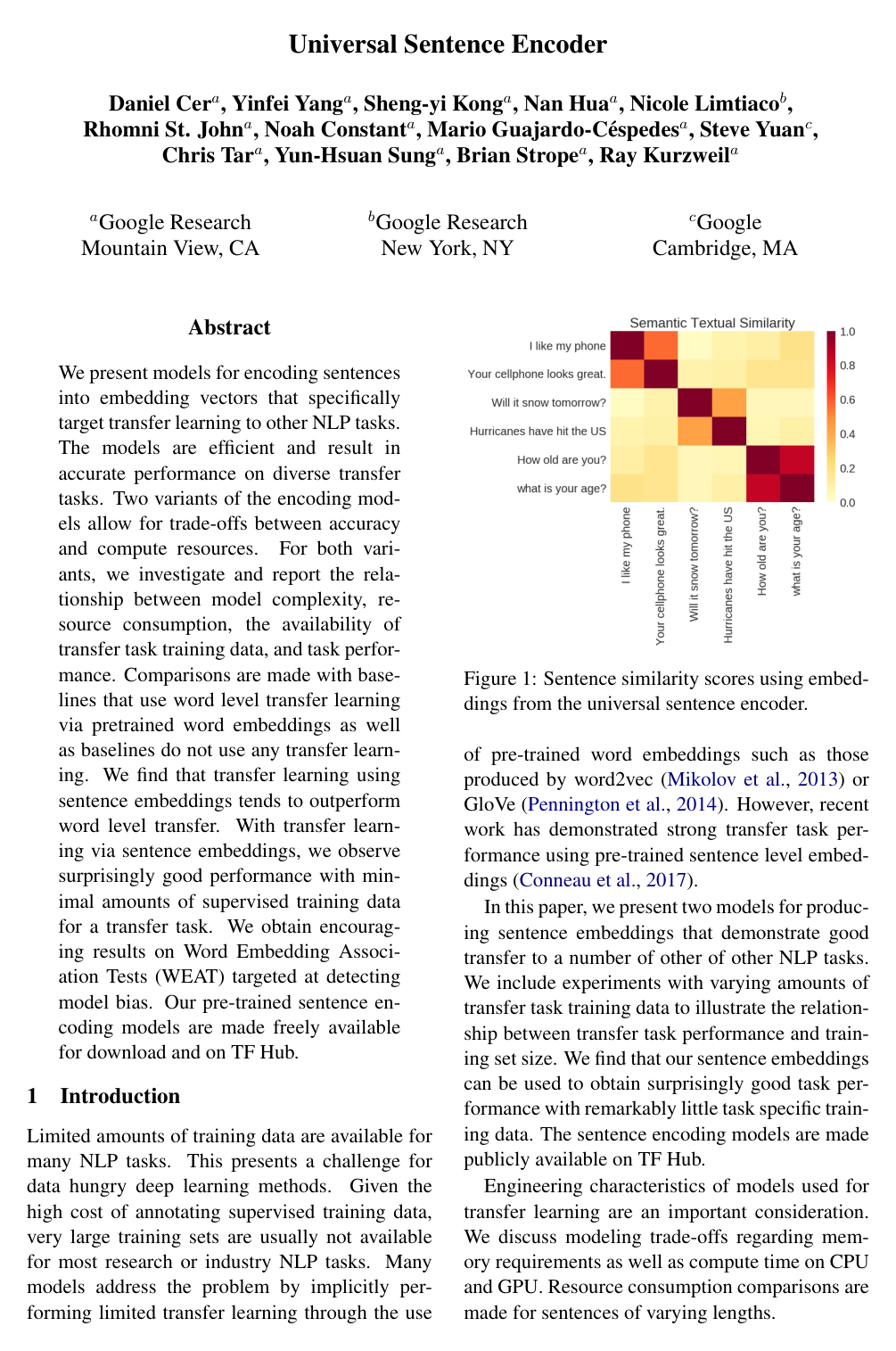
Universal Sentence Encoder
Daniel Cer, Yinfei Yang, Sheng-yi Kong, Nan Hua, Nicole Limtiaco, Rhomni St. John, Noah Constant, Mario Guajardo-Cespedes, Steve Yuan, Chris Tar, Yun-Hsuan Sung, Brian Strope, Ray Kurzweil
Why you should read this
Introduces the Universal Sentence Encoder, providing two pre-trained embedding architectures that balance computational efficiency with accuracy to deliver strong transfer learning performance across diverse language tasks with minimal training data.
We present models for encoding sentences into embedding vectors that specifically target transfer learning to other NLP tasks. The models are efficient and result in accurate performance on diverse transfer tasks. Two variants of the encoding models allow for trade-offs between accuracy and compute resources. For both variants, we investigate and report the relationship between model complexity, resource consumption, the availability of transfer task training data, and task performance. Comparisons are made with baselines that use word level transfer learning via pretrained word embeddings as well as baselines do not use any transfer learning. We find that transfer learning using sentence embeddings tends to outperform word level transfer. With transfer learning via sentence embeddings, we observe surprisingly good performance with minimal amounts of supervised training data for a transfer task. We obtain encouraging results on Word Embedding Association Tests (WEAT) targeted at detecting model bias. Our pre-trained sentence encoding models are made freely available for download and on TF Hub.
Added
2026-09-16
Supervised Learning of Universal Sentence Representations from Natural Language Inference Data
Alexis Conneau, Douwe Kiela, Holger Schwenk, Loïc Barrault, Antoine Bordes
Why you should read this
Demonstrates that training sentence encoders on supervised natural language inference data yields universal embeddings that consistently outperform unsupervised baselines across diverse transfer tasks, establishing inference as an effective pretraining objective for natural language processing.
Many modern NLP systems rely on word embeddings, previously trained in an unsupervised manner on large corpora, as base features. Efforts to obtain embeddings for larger chunks of text, such as sentences, have however not been so successful. Several attempts at learning unsupervised representations of sentences have not reached satisfactory enough performance to be widely adopted. In this paper, we show how universal sentence representations trained using the supervised data of the Stanford Natural Language Inference datasets can consistently outperform unsupervised methods like SkipThought vectors on a wide range of transfer tasks. Much like how computer vision uses ImageNet to obtain features, which can then be transferred to other tasks, our work tends to indicate the suitability of natural language inference for transfer learning to other NLP tasks. Our encoder is publicly available.
Added
2026-09-16
BERTopic: Neural topic modeling with a class-based TF-IDF procedure
Maarten Grootendorst
Why you should read this
Proposes BERTopic, a neural topic modeling technique that combines transformer embeddings with a class-based TF-IDF procedure to extract coherent, interpretable topic representations from unstructured text collections.
Topic models can be useful tools to discover latent topics in collections of documents. Recent studies have shown the feasibility of approach topic modeling as a clustering task. We present BERTopic, a topic model that extends this process by extracting coherent topic representation through the development of a class-based variation of TF-IDF. More specifically, BERTopic generates document embedding with pre-trained transformer-based language models, clusters these embeddings, and finally, generates topic representations with the class-based TF-IDF procedure. BERTopic generates coherent topics and remains competitive across a variety of benchmarks involving classical models and those that follow the more recent clustering approach of topic modeling.
Added
2026-09-13
ALBERT: A Lite BERT for Self-supervised Learning of Language Representations
Zhenzhong Lan, Mingda Chen, Sebastian Goodman, Kevin Gimpel, Piyush Sharma, Radu Soricut
Why you should read this
Proposes ALBERT, a lightweight BERT architecture that uses parameter-sharing techniques and a sentence-order prediction objective to surpass BERT-large on GLUE, SQuAD, and RACE while drastically reducing memory footprint and training costs.
Increasing model size when pretraining natural language representations often results in improved performance on downstream tasks. However, at some point further model increases become harder due to GPU/TPU memory limitations and longer training times. To address these problems, we present two parameter-reduction techniques to lower memory consumption and increase the training speed of BERT. Comprehensive empirical evidence shows that our proposed methods lead to models that scale much better compared to the original BERT. We also use a self-supervised loss that focuses on modeling inter-sentence coherence, and show it consistently helps downstream tasks with multi-sentence inputs. As a result, our best model establishes new state-of-the-art results on the GLUE, RACE, and \squad benchmarks while having fewer parameters compared to BERT-large. The code and the pretrained models are available at this https URL.
Added
2026-09-08
License
Published with permission