Z-ICL: Zero-Shot In-Context Learning with Pseudo-Demonstrations
Xinxi LyuSewon MinIz BeltagyLuke ZettlemoyerHannaneh Hajishirzi
Introduces a zero-shot prompting method that constructs pseudo-demonstrations from raw, unlabelled text using nearest neighbors and label synonyms, matching the performance of standard few-shot in-context learning without requiring any task annotations.
Large language models deliver high performance when guided by few-shot demonstrations, but their accuracy drops significantly in zero-shot settings where no task-specific examples are provided. Because recent research indicates that demonstrations primarily communicate formatting and domain context rather than explicit training rules, standard zero-shot benchmarks substantially underestimate what these models can achieve on their own. The article evaluates a new zero-shot framework called Z-ICL, which automatically constructs synthetic demonstration examples from unannotated text to bridge the performance gap between zero-shot and few-shot classification.
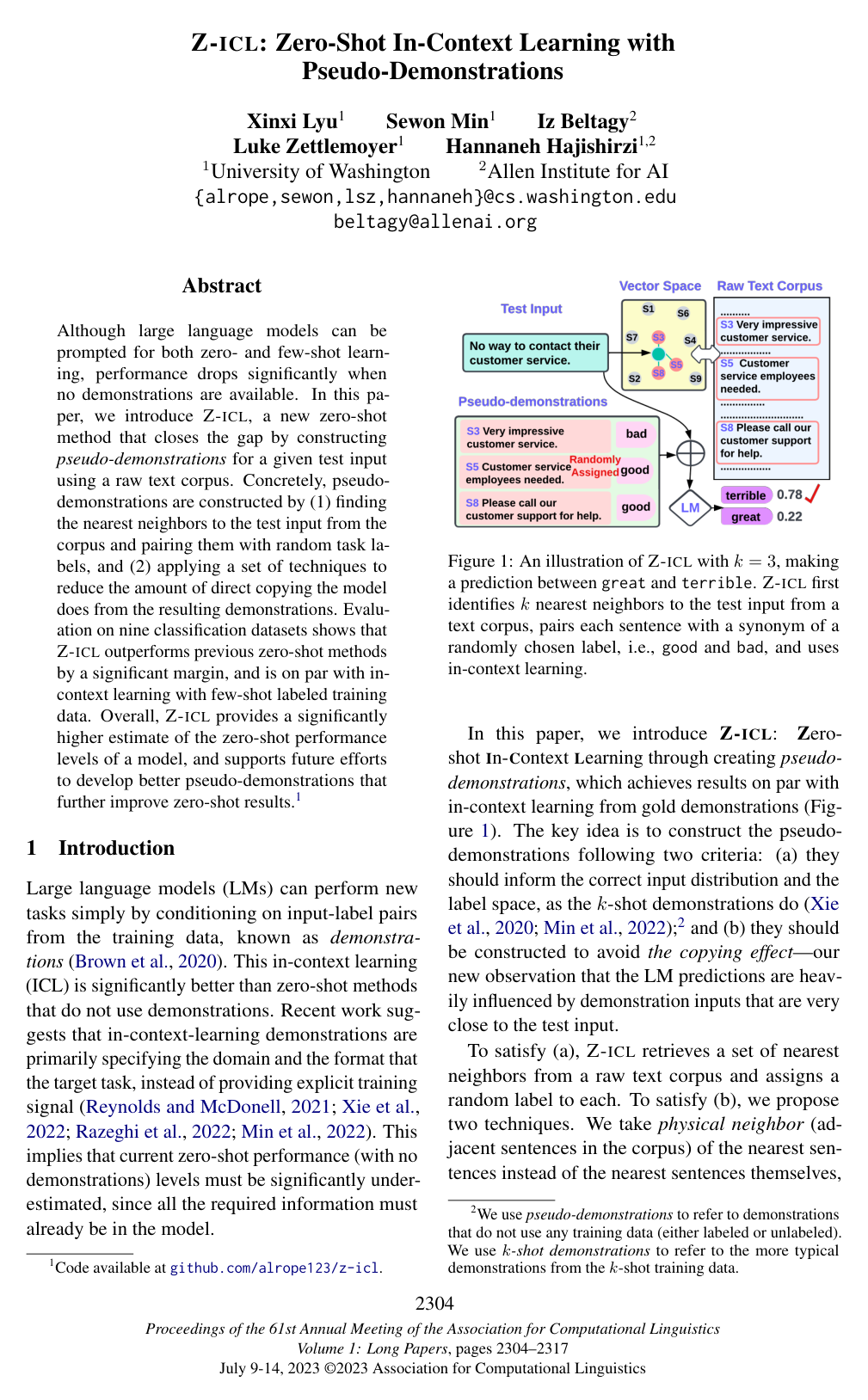
To establish this framework, the article examines the copying effect: a vulnerability where language models blindly reproduce the labels of demonstration examples that closely resemble the test input. To prevent this distortion while still supplying useful context, the Z-ICL method implements a three-step procedure. It first searches a broad text repository to find close matches to the test prompt, selects adjacent sentences rather than the exact matches to ensure contextual relevance without excessive similarity, and pairs these sentences with random synonyms of the target labels. The model then evaluates the target input alongside these artificial examples without requiring manual prompt engineering.
Across nine text classification datasets evaluated on models ranging from 6 billion to 175 billion parameters, Z-ICL consistently outperformed traditional zero-shot methods by an absolute gain of 5 to 30 percentage points. On tasks where the text repository covered the relevant subject matter, the method achieved accuracy on par with standard few-shot learning that relies on human-annotated training data. Ablation experiments confirmed that using adjacent sentences and label synonyms are both essential to suppress label copying, while simply providing text without structured label pairings degraded accuracy.
These findings indicate that organizations can achieve few-shot performance levels without the expense, operational delays, and governance risks associated with sourcing human-labeled datasets. By demonstrating that unannotated text corpora can effectively activate model capabilities, the article highlights an opportunity to lower artificial intelligence deployment costs and simplify prompt engineering pipelines across routine text categorization workflows.
Organizations evaluating large-scale text classification should test retrieval-based synthetic prompts as a direct alternative to manual labeling or intensive prompt tuning. For optimal performance, practitioners should ensure that reference corpora include domains relevant to their target applications, as expanding topic coverage by just 2% produced consistent accuracy gains on previously unsupported domains. Future work should validate this approach on multi-sentence reasoning and open-ended text generation, while automating synonym selection to remove remaining manual steps.
Confidence in these findings is high for standard single-sentence text classification across multiple model architectures. However, decision-makers should recognize existing boundaries: the evaluations focused exclusively on classification tasks, relied on manually chosen label synonyms, and showed reduced performance when domain coverage in the underlying corpus was absent.
- Paper: Rethinking the Role of Demonstrations: What Makes In-Context Learning Work?, Sewon Min et al. (2022). This study establishes that demonstrations can help through their format and input distribution even when labels are random, framing Z-ICL’s use of pseudo-demonstrations and its effort to prevent label copying.
- Paper: Prompt Programming for Large Language Models: Beyond the Few-Shot Paradigm, Laria Reynolds et al. (2021). Its analysis that prompts can cue capabilities already learned by a model gives useful context for why Z-ICL supplies structured context rather than task-specific training examples.
No sufficiently relevant recommendations were found.