
keyword
scene recognition
Scene recognition is a computer vision task that involves analyzing an image or video to classify the overall environment or setting depicted, such as a kitchen, forest, street, or mountain. Unlike object recognition, which focuses on identifying specific individual items within a scene, scene recognition evaluates the global context, spatial layout, and composition of visual elements to determine the broader category of the location. Computational models, such as deep neural networks trained on large-scale scene-centric datasets, perform this task by extracting holistic structural properties and recognizing the characteristic configurations of objects present in an environment. Serving as a foundation for visual scene understanding, scene recognition is widely applied in autonomous systems, robotics, image retrieval, and augmented reality.
20 items
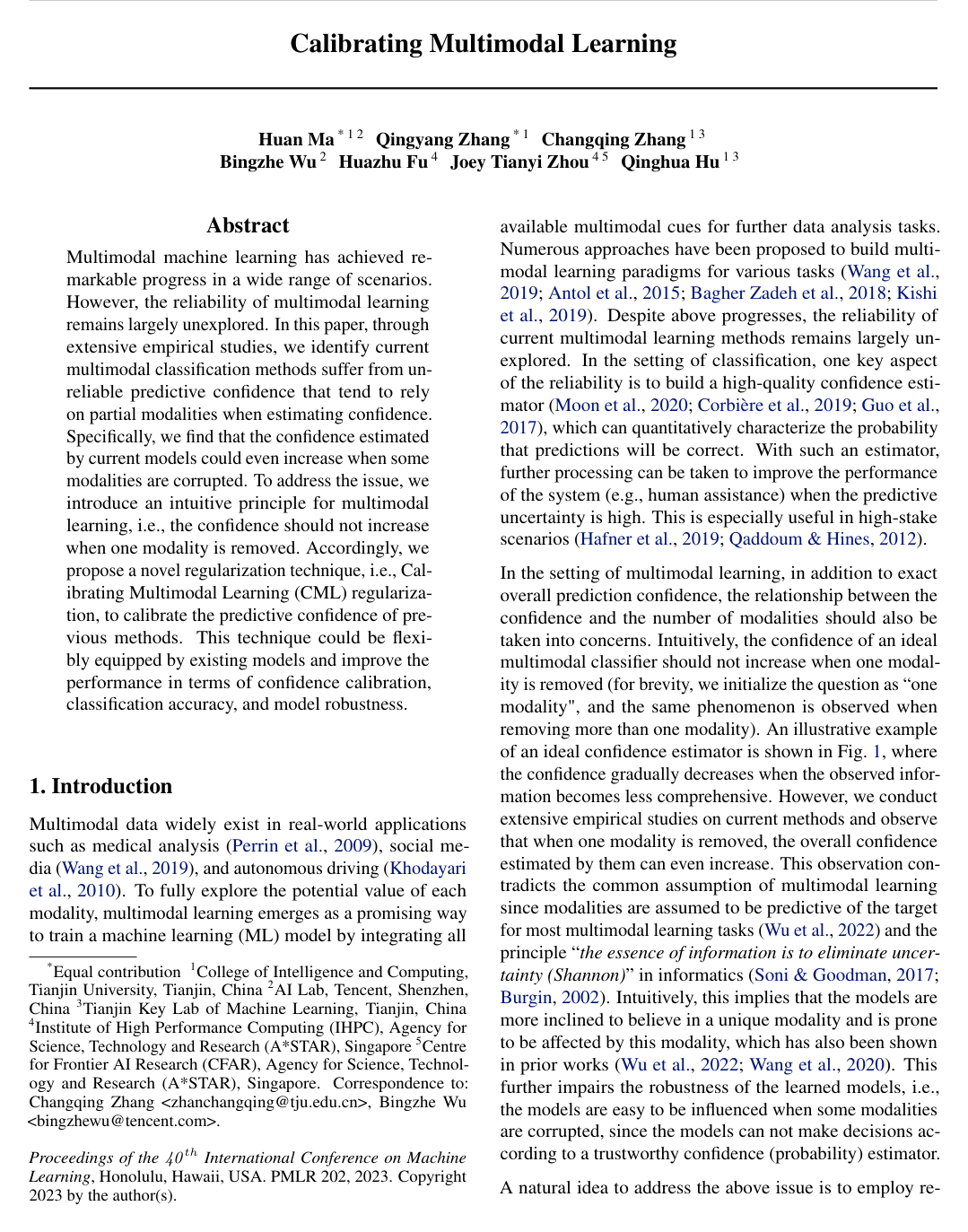
Calibrating Multimodal Learning
Huan Ma, Qingyang Zhang, Changqing Zhang, Bingzhe Wu, Huazhu Fu, Joey Tianyi Zhou, Qinghua Hu
Why you should read this
Proposes a lightweight regularization method that prevents multimodal classifiers from becoming spuriously more confident when modalities are removed or corrupted, ensuring trustworthy uncertainty estimation across diverse architectures.
Multimodal machine learning has achieved remarkable progress in a wide range of scenarios. However, the reliability of multimodal learning remains largely unexplored. In this paper, through extensive empirical studies, we identify current multimodal classification methods suffer from unreliable predictive confidence that tend to rely on partial modalities when estimating confidence. Specifically, we find that the confidence estimated by current models could even increase when some modalities are corrupted. To address the issue, we introduce an intuitive principle for multimodal learning, i.e., the confidence should not increase when one modality is removed. Accordingly, we propose a novel regularization technique, i.e., Calibrating Multimodal Learning (CML) regularization, to calibrate the predictive confidence of previous methods. This technique could be flexibly equipped by existing models and improve the performance in terms of confidence calibration, classification accuracy, and model robustness.
Added
2026-10-05
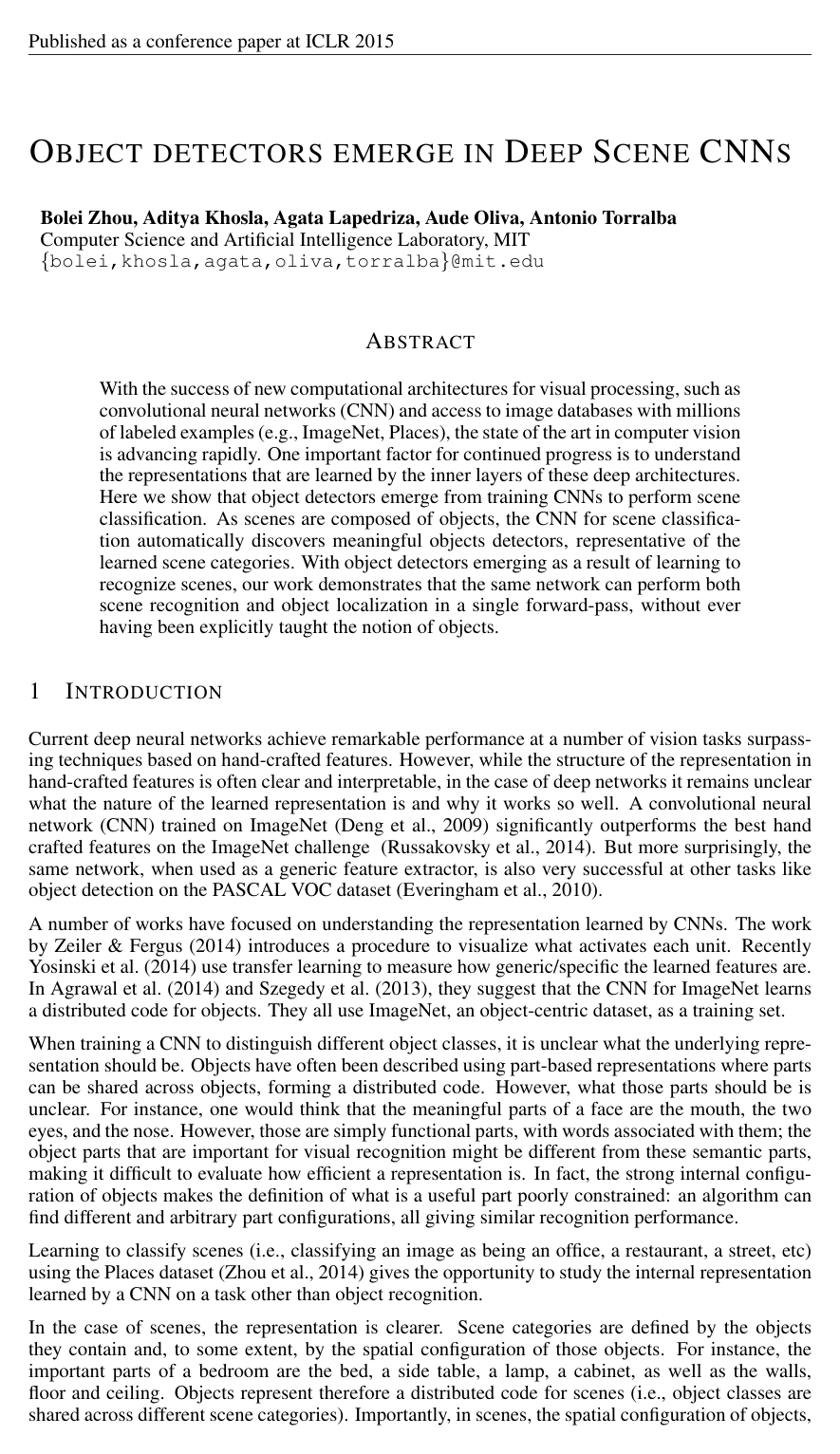
Object Detectors Emerge in Deep Scene CNNs
Bolei Zhou, Aditya Khosla, Agata Lapedriza, Aude Oliva, Antonio Torralba
Why you should read this
Demonstrates that convolutional neural networks trained solely on scene classification spontaneously develop internal object detectors, enabling simultaneous scene recognition and object localization without object-level supervision.
With the success of new computational architectures for visual processing, such as convolutional neural networks (CNN) and access to image databases with millions of labeled examples (e.g., ImageNet, Places), the state of the art in computer vision is advancing rapidly. One important factor for continued progress is to understand the representations that are learned by the inner layers of these deep architectures. Here we show that object detectors emerge from training CNNs to perform scene classification. As scenes are composed of objects, the CNN for scene classification automatically discovers meaningful objects detectors, representative of the learned scene categories. With object detectors emerging as a result of learning to recognize scenes, our work demonstrates that the same network can perform both scene recognition and object localization in a single forward-pass, without ever having been explicitly taught the notion of objects.
Added
2026-09-25
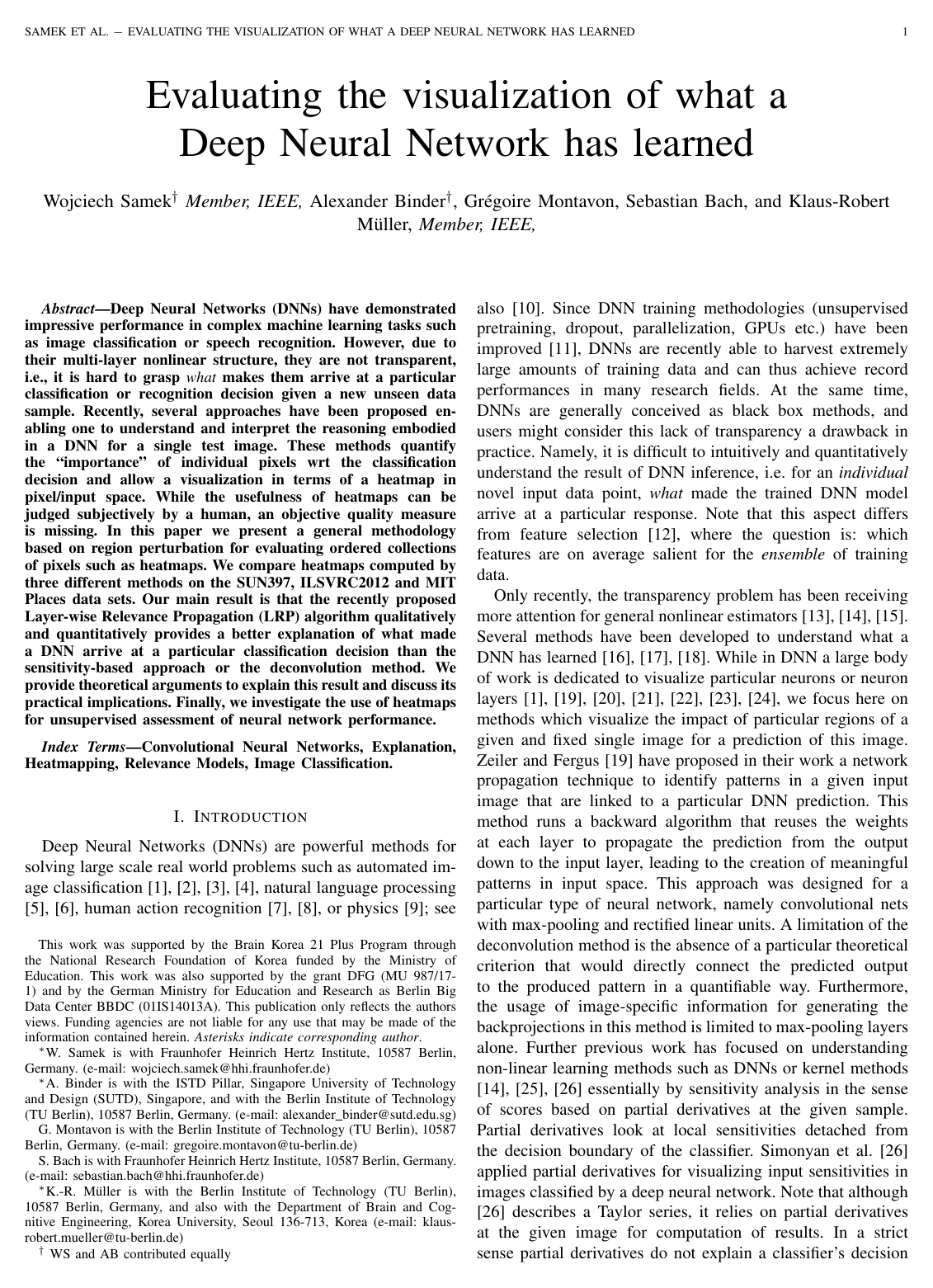
Evaluating the Visualization of What a Deep Neural Network Has Learned
Wojciech Samek, Alexander Binder, Grégoire Montavon, Sebastian Bach, Klaus-Robert Müller
Why you should read this
Introduces a region-perturbation framework for objectively evaluating neural network explanation heatmaps and demonstrates that Layer-wise Relevance Propagation outperforms sensitivity analysis and deconvolution methods across standard image benchmarks.
Deep Neural Networks (DNNs) have demonstrated impressive performance in complex machine learning tasks such as image classification or speech recognition. However, due to their multi-layer nonlinear structure, they are not transparent, i.e., it is hard to grasp what makes them arrive at a particular classification or recognition decision given a new unseen data sample. Recently, several approaches have been proposed enabling one to understand and interpret the reasoning embodied in a DNN for a single test image. These methods quantify the ''importance'' of individual pixels wrt the classification decision and allow a visualization in terms of a heatmap in pixel/input space. While the usefulness of heatmaps can be judged subjectively by a human, an objective quality measure is missing. In this paper we present a general methodology based on region perturbation for evaluating ordered collections of pixels such as heatmaps. We compare heatmaps computed by three different methods on the SUN397, ILSVRC2012 and MIT Places data sets. Our main result is that the recently proposed Layer-wise Relevance Propagation (LRP) algorithm qualitatively and quantitatively provides a better explanation of what made a DNN arrive at a particular classification decision than the sensitivity-based approach or the deconvolution method. We provide theoretical arguments to explain this result and discuss its practical implications. Finally, we investigate the use of heatmaps for unsupervised assessment of neural network performance.
Added
2026-09-25
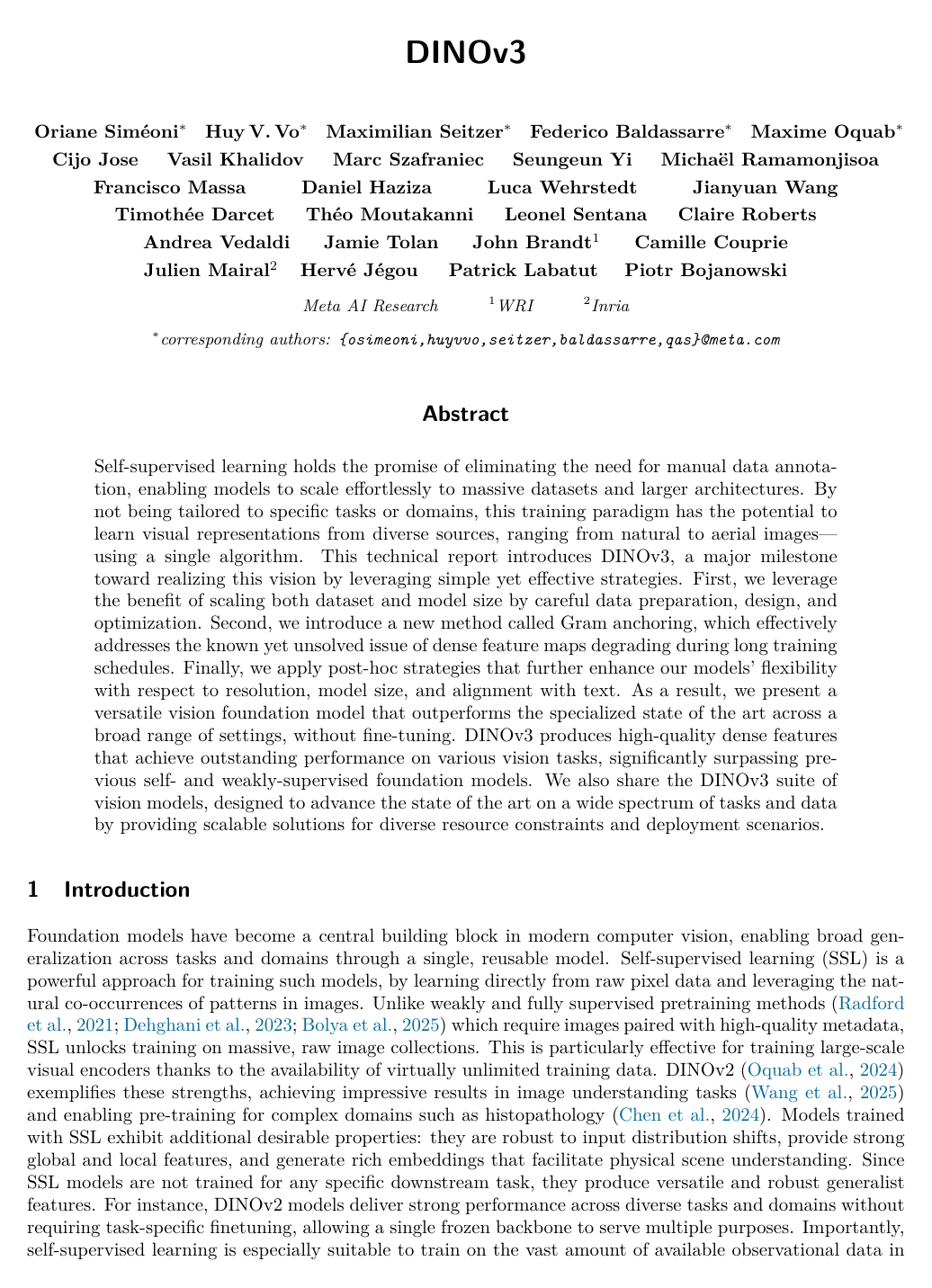
DINOv3
Oriane Siméoni, Huy V. Vo, Maximilian Seitzer, Federico Baldassarre, Maxime Oquab, Cijo Jose, Vasil Khalidov, Marc Szafraniec, Seungeun Yi, Michaël Ramamonjisoa, Francisco Massa, Daniel Haziza, Luca Wehrstedt, Jianyuan Wang, Timothée Darcet, Théo Moutakanni, Leonel Sentana, Claire Roberts, Andrea Vedaldi, Jamie Tolan, John Brandt, Camille Couprie, Julien Mairal, Hervé Jégou, Patrick Labatut, Piotr Bojanowski
Why you should read this
Introduces DINOv3, a self-supervised vision foundation model that incorporates Gram anchoring to prevent feature degradation during extended training and achieves state-of-the-art dense representation performance across diverse visual tasks without fine-tuning.
Self-supervised learning holds the promise of eliminating the need for manual data annotation, enabling models to scale effortlessly to massive datasets and larger architectures. By not being tailored to specific tasks or domains, this training paradigm has the potential to learn visual representations from diverse sources, ranging from natural to aerial images -- using a single algorithm. This technical report introduces DINOv3, a major milestone toward realizing this vision by leveraging simple yet effective strategies. First, we leverage the benefit of scaling both dataset and model size by careful data preparation, design, and optimization. Second, we introduce a new method called Gram anchoring, which effectively addresses the known yet unsolved issue of dense feature maps degrading during long training schedules. Finally, we apply post-hoc strategies that further enhance our models' flexibility with respect to resolution, model size, and alignment with text. As a result, we present a versatile vision foundation model that outperforms the specialized state of the art across a broad range of settings, without fine-tuning. DINOv3 produces high-quality dense features that achieve outstanding performance on various vision tasks, significantly surpassing previous self- and weakly-supervised foundation models. We also share the DINOv3 suite of vision models, designed to advance the state of the art on a wide spectrum of tasks and data by providing scalable solutions for diverse resource constraints and deployment scenarios.
Added
2026-09-25
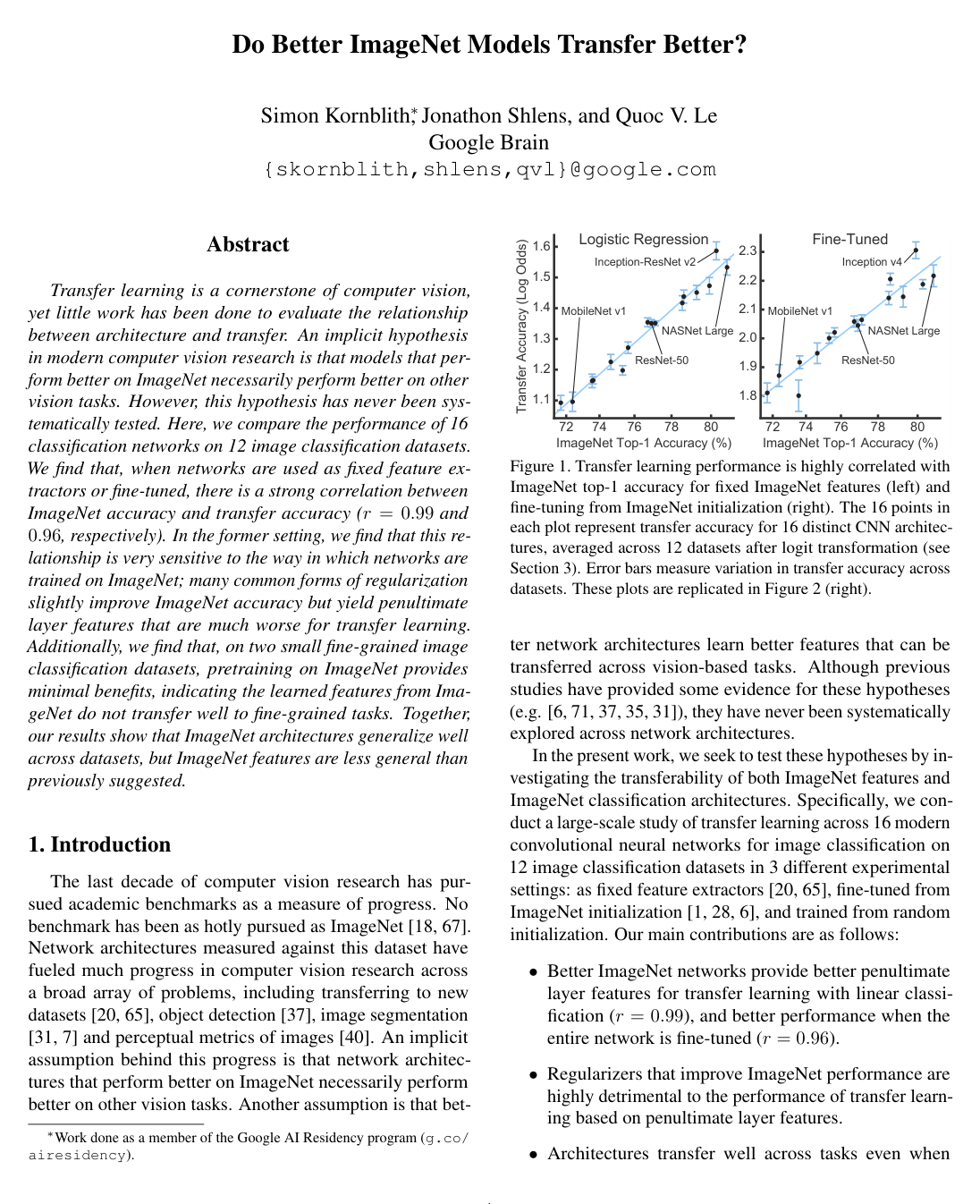
Do Better ImageNet Models Transfer Better?
Simon Kornblith, Jonathon Shlens, Quoc V. Le
Why you should read this
Establishes a strong correlation between ImageNet classification accuracy and downstream transfer performance across sixteen neural architectures, while showing that common regularization techniques can unexpectedly degrade learned feature representations.
Transfer learning is a cornerstone of computer vision, yet little work has been done to evaluate the relationship between architecture and transfer. An implicit hypothesis in modern computer vision research is that models that perform better on ImageNet necessarily perform better on other vision tasks. However, this hypothesis has never been systematically tested. Here, we compare the performance of 16 classification networks on 12 image classification datasets. We find that, when networks are used as fixed feature extractors or fine-tuned, there is a strong correlation between ImageNet accuracy and transfer accuracy ( and , respectively). In the former setting, we find that this relationship is very sensitive to the way in which networks are trained on ImageNet; many common forms of regularization slightly improve ImageNet accuracy but yield penultimate layer features that are much worse for transfer learning. Additionally, we find that, on two small fine-grained image classification datasets, pretraining on ImageNet provides minimal benefits, indicating the learned features from ImageNet do not transfer well to fine-grained tasks. Together, our results show that ImageNet architectures generalize well across datasets, but ImageNet features are less general than previously suggested.
Added
2026-09-24
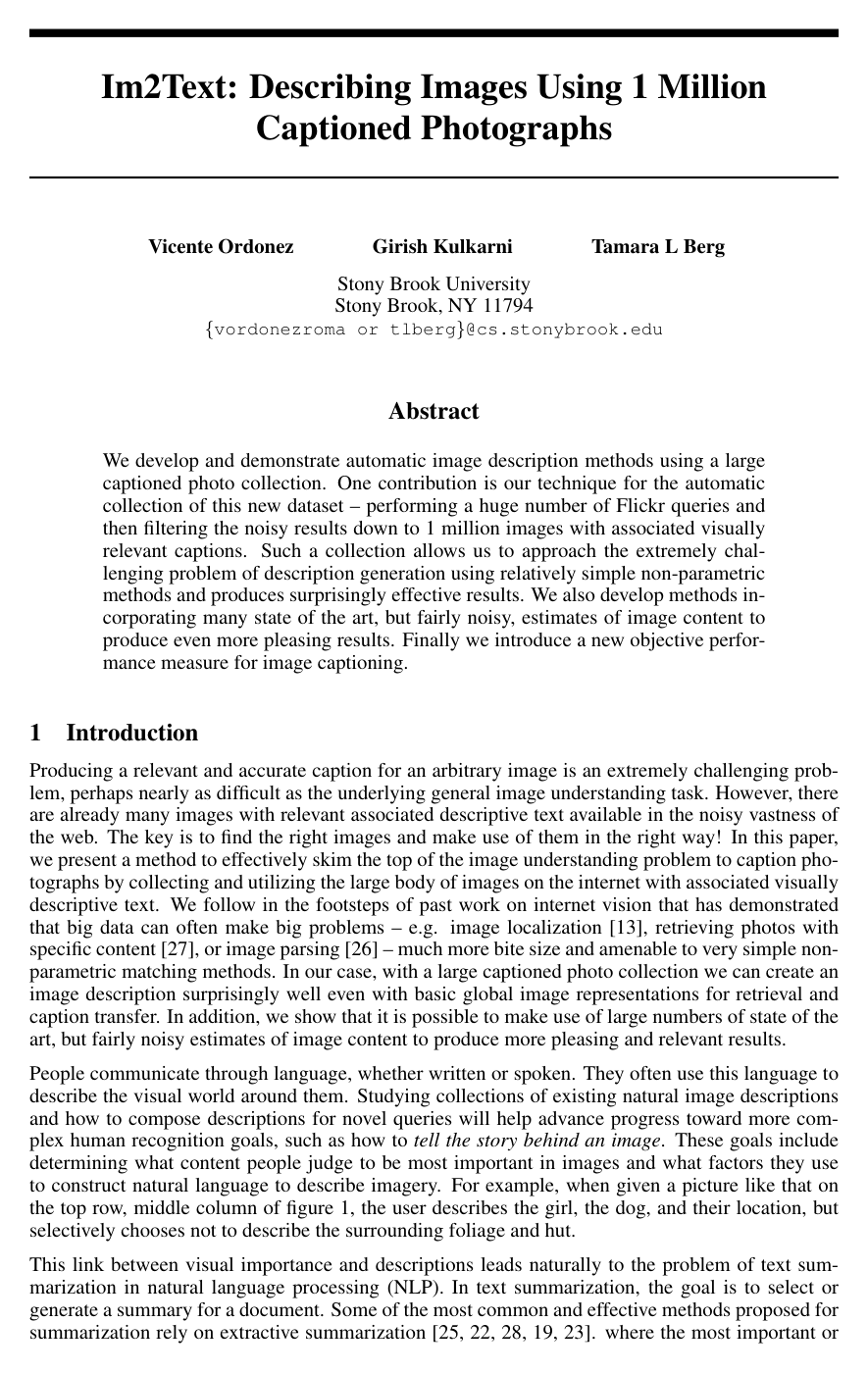
Im2Text: Describing Images Using 1 Million Captioned Photographs
Vicente Ordonez, Girish Kulkarni, Tamara L. Berg
Why you should read this
Introduces a web-scale dataset of one million filtered captioned photographs alongside non-parametric retrieval methods that effectively generate natural image descriptions by transferring human captions.
We develop and demonstrate automatic image description methods using a large captioned photo collection. One contribution is our technique for the automatic collection of this new dataset – performing a huge number of Flickr queries and then filtering the noisy results down to 1 million images with associated visually relevant captions. Such a collection allows us to approach the extremely challenging problem of description generation using relatively simple non-parametric methods and produces surprisingly effective results. We also develop methods incorporating many state of the art, but fairly noisy, estimates of image content to produce even more pleasing results. Finally we introduce a new objective performance measure for image captioning.
Added
2026-09-24
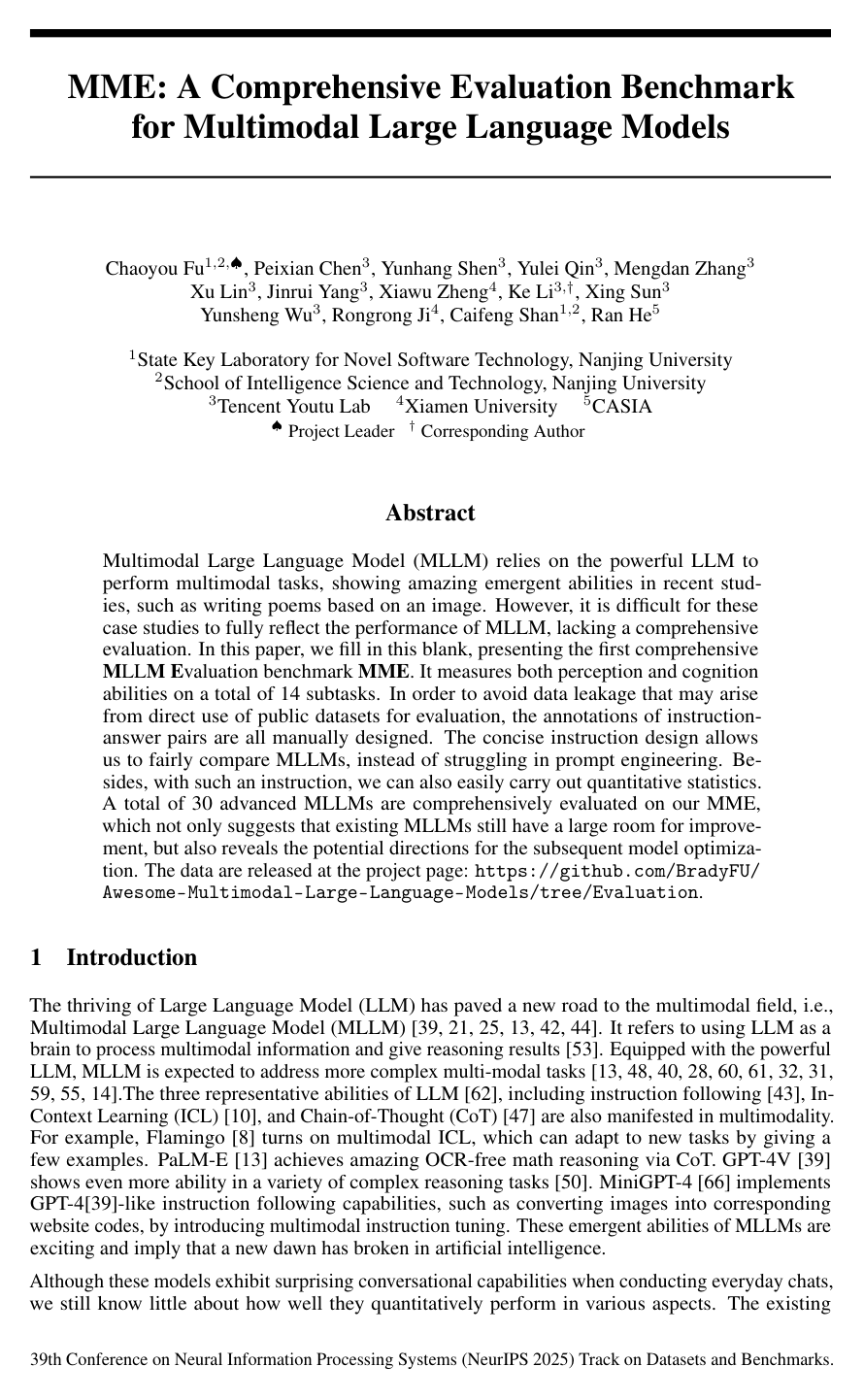
MME: A Comprehensive Evaluation Benchmark for Multimodal Large Language Models
Chaoyou Fu, Peixian Chen, Yunhang Shen, Yulei Qin, Mengdan Zhang, Xu Lin, Z. Qiu, Wei Lin, Jinrui Yang, Xiawu Zheng, Ke Li, Xing Sun, Rongrong Ji
Why you should read this
Presents MME, a comprehensive benchmark spanning 14 perception and cognition subtasks with manually designed prompts to avoid data leakage, offering a standardized evaluation across 30 multimodal large language models to identify current performance bottlenecks and future optimization directions.
Multimodal Large Language Model (MLLM) relies on the powerful LLM to perform multimodal tasks, showing amazing emergent abilities in recent studies, such as writing poems based on an image. However, it is difficult for these case studies to fully reflect the performance of MLLM, lacking a comprehensive evaluation. In this paper, we fill in this blank, presenting the first comprehensive MLLM Evaluation benchmark MME. It measures both perception and cognition abilities on a total of 14 subtasks. In order to avoid data leakage that may arise from direct use of public datasets for evaluation, the annotations of instruction-answer pairs are all manually designed. The concise instruction design allows us to fairly compare MLLMs, instead of struggling in prompt engineering. Besides, with such an instruction, we can also easily carry out quantitative statistics. A total of 30 advanced MLLMs are comprehensively evaluated on our MME, which not only suggests that existing MLLMs still have a large room for improvement, but also reveals the potential directions for the subsequent model optimization. The data are released at the project page this https URL.
Added
2026-09-24
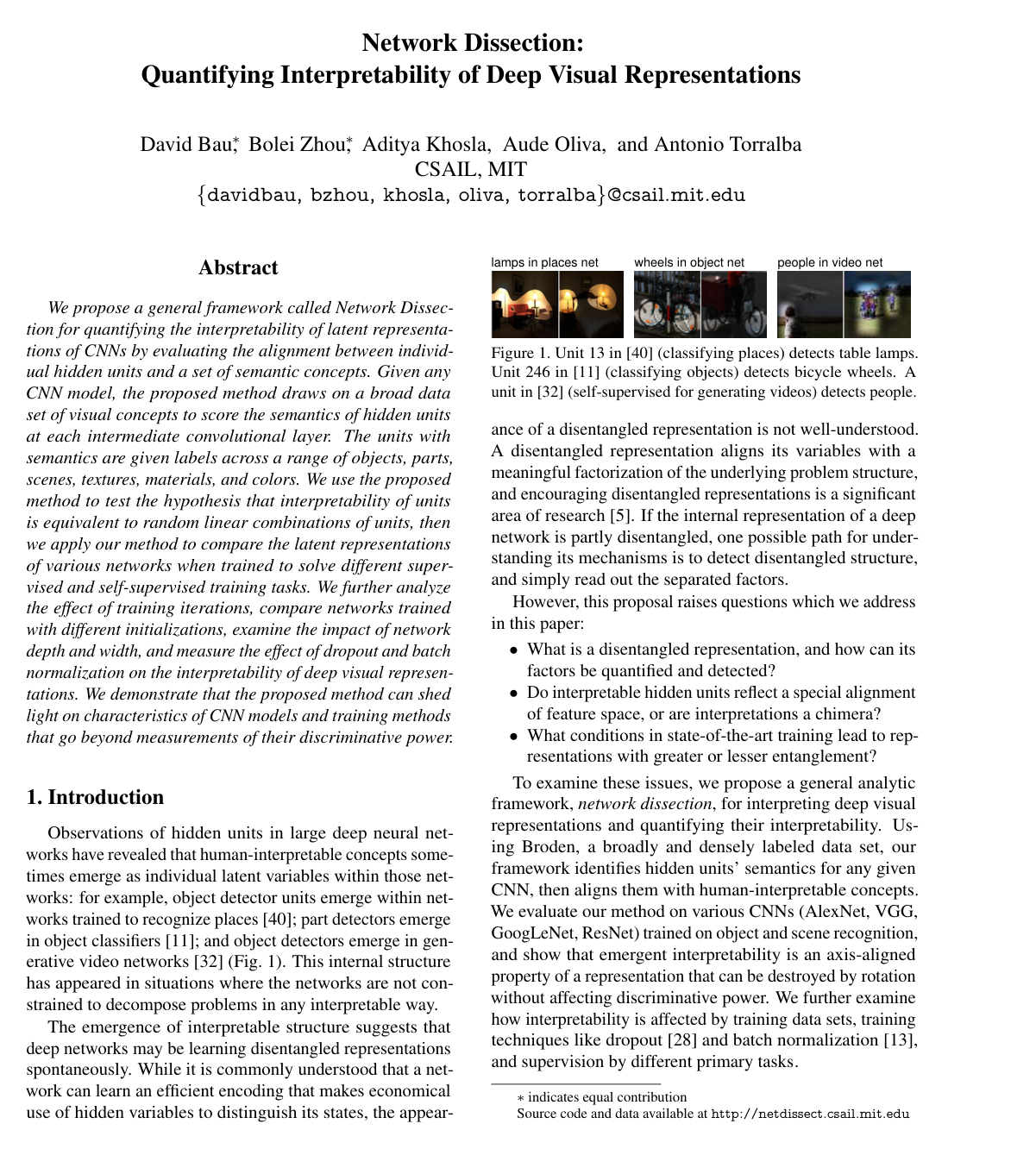
Network Dissection: Quantifying Interpretability of Deep Visual Representations
David Bau, Bolei Zhou, Aditya Khosla, Aude Oliva, Antonio Torralba
Why you should read this
Proposes Network Dissection, a framework to quantify the interpretability of convolutional neural networks by scoring how individual latent units align with distinct visual concepts such as objects, textures, and colors across various architectures and training objectives.
We propose a general framework called Network Dissection for quantifying the interpretability of latent representations of CNNs by evaluating the alignment between individual hidden units and a set of semantic concepts. Given any CNN model, the proposed method draws on a broad data set of visual concepts to score the semantics of hidden units at each intermediate convolutional layer. The units with semantics are given labels across a range of objects, parts, scenes, textures, materials, and colors. We use the proposed method to test the hypothesis that interpretability of units is equivalent to random linear combinations of units, then we apply our method to compare the latent representations of various networks when trained to solve different supervised and self-supervised training tasks. We further analyze the effect of training iterations, compare networks trained with different initializations, examine the impact of network depth and width, and measure the effect of dropout and batch normalization on the interpretability of deep visual representations. We demonstrate that the proposed method can shed light on characteristics of CNN models and training methods that go beyond measurements of their discriminative power.
Added
2026-09-18
Evaluating Color Descriptors for Object and Scene Recognition
K. V. D. Sande, T. Gevers, Cees G. M. Snoek
Why you should read this
Establishes a systematic taxonomy and evaluation framework for color descriptors under varying photometric conditions, demonstrating that methods like OpponentSIFT substantially improve object and scene recognition accuracy over standard intensity-based SIFT.
Image category recognition is important to access visual information on the level of objects and scene types. So far, intensity-based descriptors have been widely used for feature extraction at salient points. To increase illumination invariance and discriminative power, color descriptors have been pro- posed. Because many different descriptors exist, a structured overview is required of color invariant descriptors in the context of image category recognition. Therefore, this paper studies the invariance properties and the distinctiveness of color descriptors¹ in a structured way. The analytical invariance properties of color descriptors are explored, using a taxonomy based on invariance properties with respect to photometric transformations, and tested experimentally using a dataset with known illumination conditions. In addition, the distinctiveness of color descriptors is assessed experimentally using two benchmarks, one from the image domain and one from the video domain. From the theoretical and experimental results, it can be derived that invariance to light intensity changes and light color changes affects category recognition. The results reveal further that, for light intensity shifts, the usefulness of invariance is category-specific. Overall, when choosing a single descriptor and no prior knowledge about the dataset and object and scene categories is available, the OpponentSIFT is recommended. Furthermore, a combined set of color descriptors outperforms intensity- based SIFT and improves category recognition by 8% on the PASCAL VOC 2007 and by 7% on the Mediamill Challenge.
Added
2026-09-16
Unified Perceptual Parsing for Scene Understanding
Tete Xiao, Yingcheng Liu, Bolei Zhou, Yuning Jiang, Jian Sun
Why you should read this
Develops UPerNet, a multi-task framework that learns from heterogeneous annotations to simultaneously parse visual concepts across scenes, objects, parts, and textures for comprehensive image understanding.
Humans recognize the visual world at multiple levels: we effortlessly categorize scenes and detect objects inside, while also identifying the textures and surfaces of the objects along with their different compositional parts. In this paper, we study a new task called Unified Perceptual Parsing, which requires the machine vision systems to recognize as many visual concepts as possible from a given image. A multi-task framework called UPerNet and a training strategy are developed to learn from heterogeneous image annotations. We benchmark our framework on Unified Perceptual Parsing and show that it is able to effectively segment a wide range of concepts from images. The trained networks are further applied to discover visual knowledge in natural scenes. Models are available at \url{this https URL}.
Added
2026-09-14
LSUN: Construction of a Large-scale Image Dataset using Deep Learning with Humans in the Loop
Fisher Yu, Ari Seff, Yinda Zhang, Shuran Song, Thomas Funkhouser, Jianxiong Xiao
Why you should read this
Presents an efficient human-in-the-loop labeling framework that scales dataset construction using deep model predictions, producing the massive LSUN visual recognition benchmark spanning millions of scene and object images.
While there has been remarkable progress in the performance of visual recognition algorithms, the state-of-the-art models tend to be exceptionally data-hungry. Large labeled training datasets, expensive and tedious to produce, are required to optimize millions of parameters in deep network models. Lagging behind the growth in model capacity, the available datasets are quickly becoming outdated in terms of size and density. To circumvent this bottleneck, we propose to amplify human effort through a partially automated labeling scheme, leveraging deep learning with humans in the loop. Starting from a large set of candidate images for each category, we iteratively sample a subset, ask people to label them, classify the others with a trained model, split the set into positives, negatives, and unlabeled based on the classification confidence, and then iterate with the unlabeled set. To assess the effectiveness of this cascading procedure and enable further progress in visual recognition research, we construct a new image dataset, LSUN. It contains around one million labeled images for each of 10 scene categories and 20 object categories. We experiment with training popular convolutional networks and find that they achieve substantial performance gains when trained on this dataset.
Added
2026-09-14
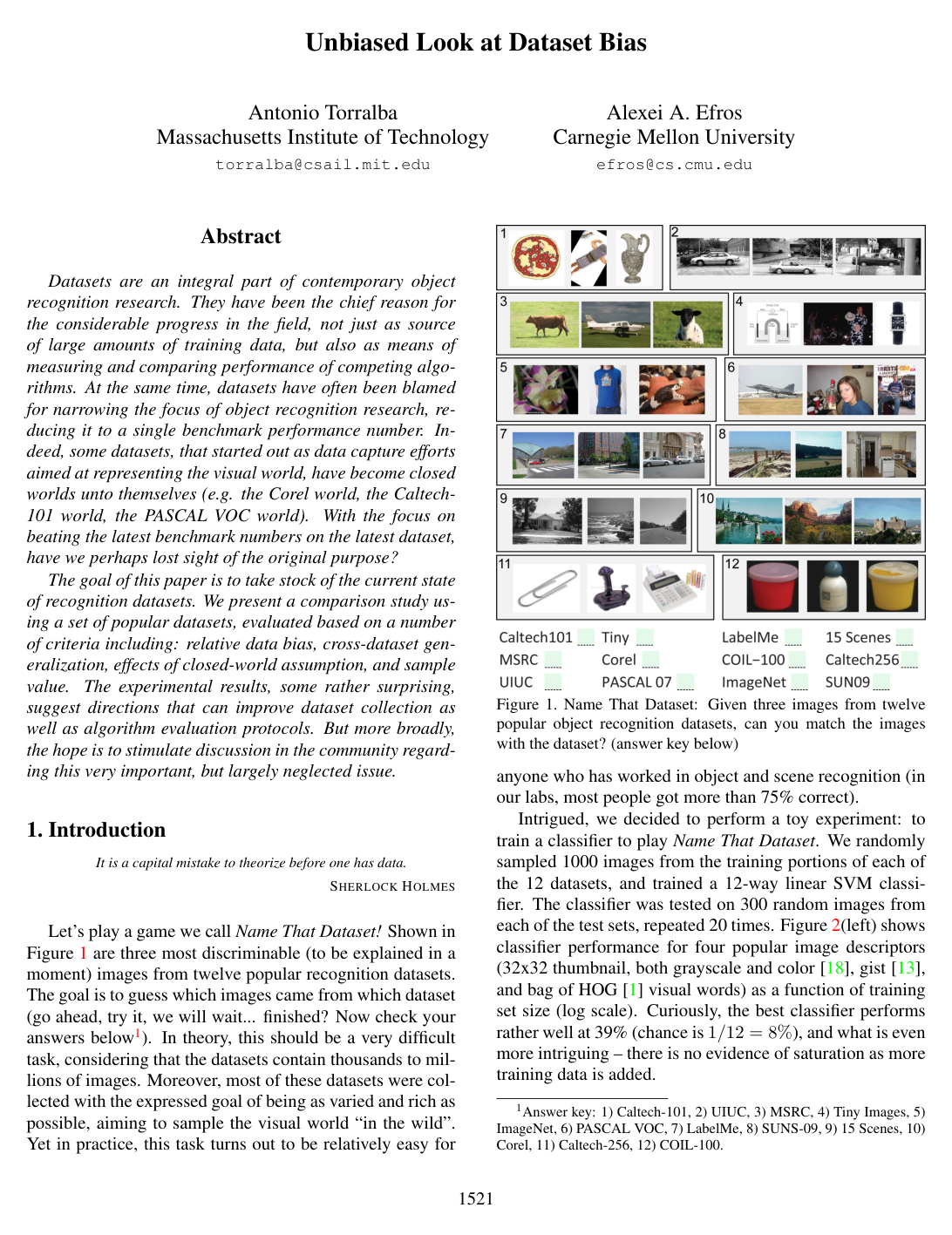
Unbiased look at dataset bias
A. Torralba, Alexei A. Efros
Why you should read this
Exposes pervasive bias in visual recognition benchmarks by proving that classifiers learn unique dataset signatures rather than generalizable visual concepts, and introduces cross-dataset evaluation metrics to measure and mitigate these distortions.
Datasets are an integral part of contemporary object recognition research. They have been the chief reason for the considerable progress in the field, not just as source of large amounts of training data, but also as means of measuring and comparing performance of competing algorithms. At the same time, datasets have often been blamed for narrowing the focus of object recognition research, reducing it to a single benchmark performance number. Indeed, some datasets, that started out as data capture efforts aimed at representing the visual world, have become closed worlds unto themselves (e.g. the Corel world, the Caltech-101 world, the PASCAL VOC world). With the focus on beating the latest benchmark numbers on the latest dataset, have we perhaps lost sight of the original purpose? The goal of this paper is to take stock of the current state of recognition datasets. We present a comparison study using a set of popular datasets, evaluated based on a number of criteria including: relative data bias, cross-dataset generalization, effects of closed-world assumption, and sample value. The experimental results, some rather surprising, suggest directions that can improve dataset collection as well as algorithm evaluation protocols. But more broadly, the hope is to stimulate discussion in the community regarding this very important, but largely neglected issue.
Added
2026-09-14
Learning Deep Features for Scene Recognition using Places Database
Bolei Zhou, Àgata Lapedriza, Jianxiong Xiao, A. Torralba, A. Oliva
Why you should read this
Introduces the 7-million-image Places database and demonstrates that convolutional neural networks trained on scene-centric data develop distinct visual representations that significantly outperform object-trained models on scene recognition tasks.
Scene recognition is one of the hallmark tasks of computer vision, allowing definition of a context for object recognition. Whereas the tremendous recent progress in object recognition tasks is due to the availability of large datasets like ImageNet and the rise of Convolutional Neural Networks (CNNs) for learning high-level features, performance at scene recognition has not attained the same level of success. This may be because current deep features trained from ImageNet are not competitive enough for such tasks. Here, we introduce a new scene-centric database called Places with over 7 million labeled pictures of scenes. We propose new methods to compare the density and diversity of image datasets and show that Places is as dense as other scene datasets and has more diversity. Using CNN, we learn deep features for scene recognition tasks, and establish new state-of-the-art results on several scene-centric datasets. A visualization of the CNN layers' responses allows us to show differences in the internal representations of object-centric and scene-centric networks.
Added
2026-09-12
Colorful Image Colorization
Richard Zhang, Phillip Isola, Alexei A. Efros
Why you should read this
Proposes a convolutional neural network that treats automatic image colorization as a classification task with class-rebalancing, generating plausible colors while establishing colorization as an effective pretext task for self-supervised visual representation learning.
Given a grayscale photograph as input, this paper attacks the problem of hallucinating a plausible color version of the photograph. This problem is clearly underconstrained, so previous approaches have either relied on significant user interaction or resulted in desaturated colorizations. We propose a fully automatic approach that produces vibrant and realistic colorizations. We embrace the underlying uncertainty of the problem by posing it as a classification task and use class-rebalancing at training time to increase the diversity of colors in the result. The system is implemented as a feed-forward pass in a CNN at test time and is trained on over a million color images. We evaluate our algorithm using a "colorization Turing test," asking human participants to choose between a generated and ground truth color image. Our method successfully fools humans on 32% of the trials, significantly higher than previous methods. Moreover, we show that colorization can be a powerful pretext task for self-supervised feature learning, acting as a cross-channel encoder. This approach results in state-of-the-art performance on several feature learning benchmarks.
Added
2026-09-11
Places: A 10 Million Image Database for Scene Recognition
Bolei Zhou, Agata Lapedriza, Aditya Khosla, Aude Oliva, Antonio Torralba
Why you should read this
Introduces the 10-million-image Places database for scene classification and demonstrates that deep neural networks trained on broad environments spontaneously learn to detect objects without explicit object-level supervision.
The rise of multi-million-item dataset initiatives has enabled data-hungry machine learning algorithms to reach near-human semantic classification performance at tasks such as visual object and scene recognition. Here we describe the Places Database, a repository of 10 million scene photographs, labeled with scene semantic categories, comprising a large and diverse list of the types of environments encountered in the world. Using the state-of-the-art Convolutional Neural Networks (CNNs), we provide scene classification CNNs (Places-CNNs) as baselines, that significantly outperform the previous approaches. Visualization of the CNNs trained on Places shows that object detectors emerge as an intermediate representation of scene classification. With its high-coverage and high-diversity of exemplars, the Places Database along with the Places-CNNs offer a novel resource to guide future progress on scene recognition problems.
Added
2026-09-10
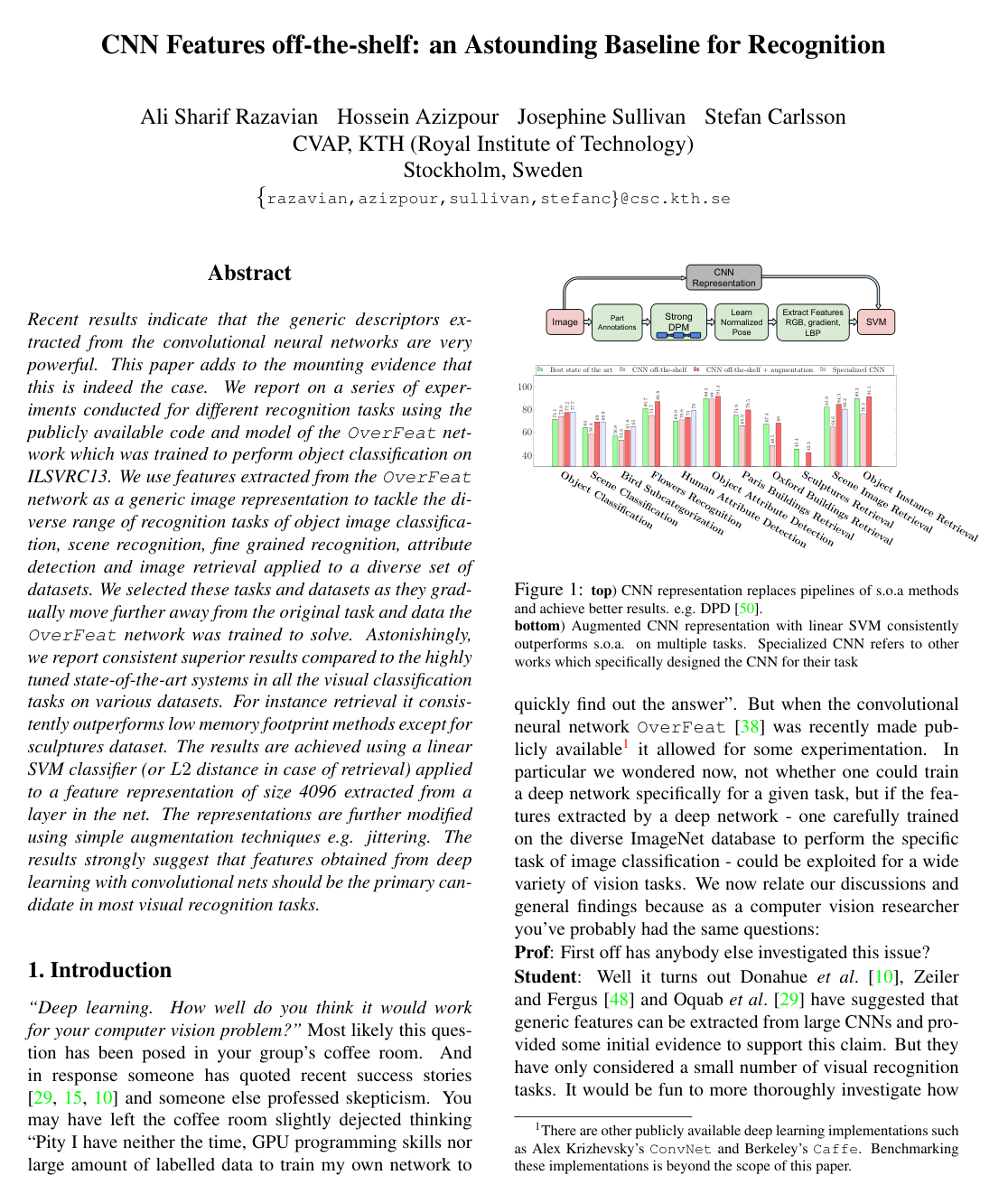
CNN Features Off-the-Shelf: An Astounding Baseline for Recognition
Ali Sharif Razavian, Hossein Azizpour, Josephine Sullivan, Stefan Carlsson
Why you should read this
Demonstrates that off-the-shelf features extracted from pre-trained deep convolutional neural networks consistently outperform task-specific methods across diverse visual classification and retrieval benchmarks when paired with simple linear classifiers.
Recent results indicate that the generic descriptors extracted from the convolutional neural networks are very powerful. This paper adds to the mounting evidence that this is indeed the case. We report on a series of experiments conducted for different recognition tasks using the publicly available code and model of the \overfeat network which was trained to perform object classification on ILSVRC13. We use features extracted from the \overfeat network as a generic image representation to tackle the diverse range of recognition tasks of object image classification, scene recognition, fine grained recognition, attribute detection and image retrieval applied to a diverse set of datasets. We selected these tasks and datasets as they gradually move further away from the original task and data the \overfeat network was trained to solve. Astonishingly, we report consistent superior results compared to the highly tuned state-of-the-art systems in all the visual classification tasks on various datasets. For instance retrieval it consistently outperforms low memory footprint methods except for sculptures dataset. The results are achieved using a linear SVM classifier (or distance in case of retrieval) applied to a feature representation of size 4096 extracted from a layer in the net. The representations are further modified using simple augmentation techniques e.g. jittering. The results strongly suggest that features obtained from deep learning with convolutional nets should be the primary candidate in most visual recognition tasks.
Added
2026-09-10
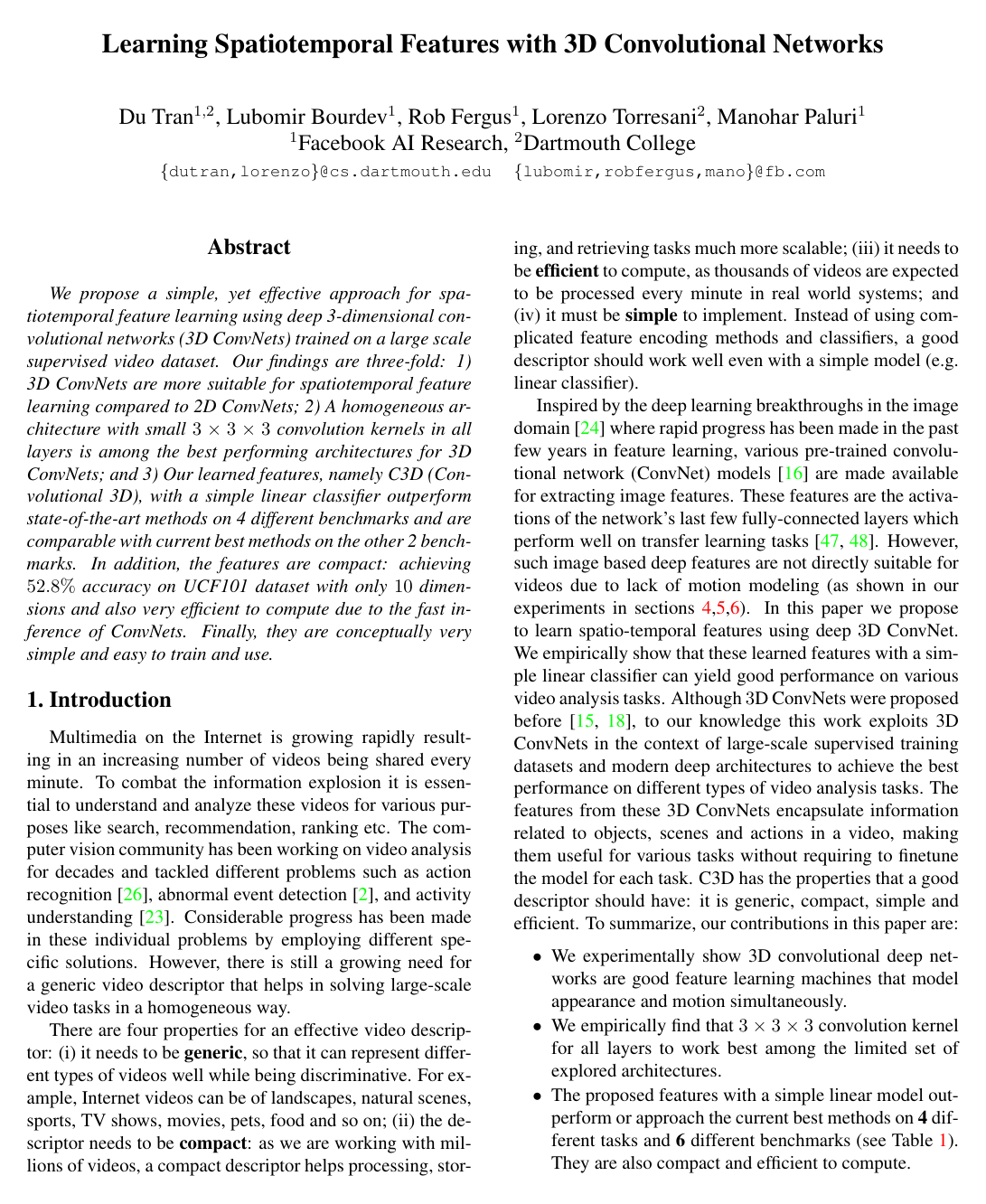
Learning Spatiotemporal Features with 3D Convolutional Networks
Du Tran, Lubomir Bourdev, Rob Fergus, Lorenzo Torresani, Manohar Paluri
Why you should read this
Proposes C3D, a 3D convolutional network architecture with 3x3x3 filters that extracts compact, efficient spatiotemporal features capable of surpassing state-of-the-art video analysis methods across diverse action recognition benchmarks.
We propose a simple, yet effective approach for spatiotemporal feature learning using deep 3-dimensional convolutional networks (3D ConvNets) trained on a large scale supervised video dataset. Our findings are three-fold: 1) 3D ConvNets are more suitable for spatiotemporal feature learning compared to 2D ConvNets; 2) A homogeneous architecture with small 3x3x3 convolution kernels in all layers is among the best performing architectures for 3D ConvNets; and 3) Our learned features, namely C3D (Convolutional 3D), with a simple linear classifier outperform state-of-the-art methods on 4 different benchmarks and are comparable with current best methods on the other 2 benchmarks. In addition, the features are compact: achieving 52.8% accuracy on UCF101 dataset with only 10 dimensions and also very efficient to compute due to the fast inference of ConvNets. Finally, they are conceptually very simple and easy to train and use.
Added
2026-09-07
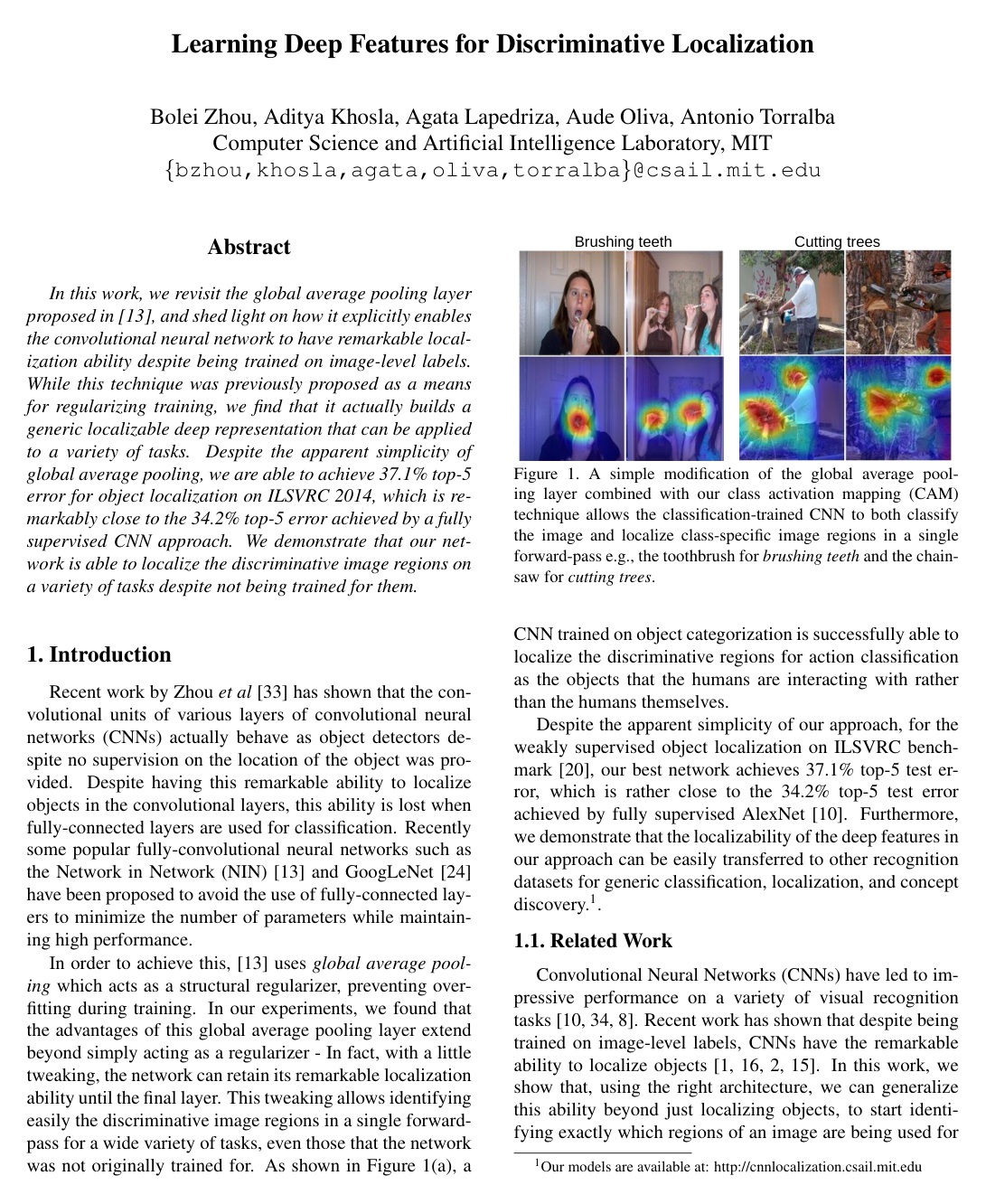
Learning Deep Features for Discriminative Localization
Bolei Zhou, Aditya Khosla, Agata Lapedriza, Aude Oliva, Antonio Torralba
Why you should read this
Introduces Class Activation Mapping to demonstrate how convolutional neural networks trained solely on image-level labels can accurately localize objects and discriminative features in a single forward pass by repurposing global average pooling layers.
In this work, we revisit the global average pooling layer proposed in [13], and shed light on how it explicitly enables the convolutional neural network to have remarkable localization ability despite being trained on image-level labels. While this technique was previously proposed as a means for regularizing training, we find that it actually builds a generic localizable deep representation that can be applied to a variety of tasks. Despite the apparent simplicity of global average pooling, we are able to achieve 37.1% top-5 error for object localization on ILSVRC 2014, which is remarkably close to the 34.2% top-5 error achieved by a fully supervised CNN approach. We demonstrate that our network is able to localize the discriminative image regions on a variety of tasks despite not being trained for them
Added
2026-02-21
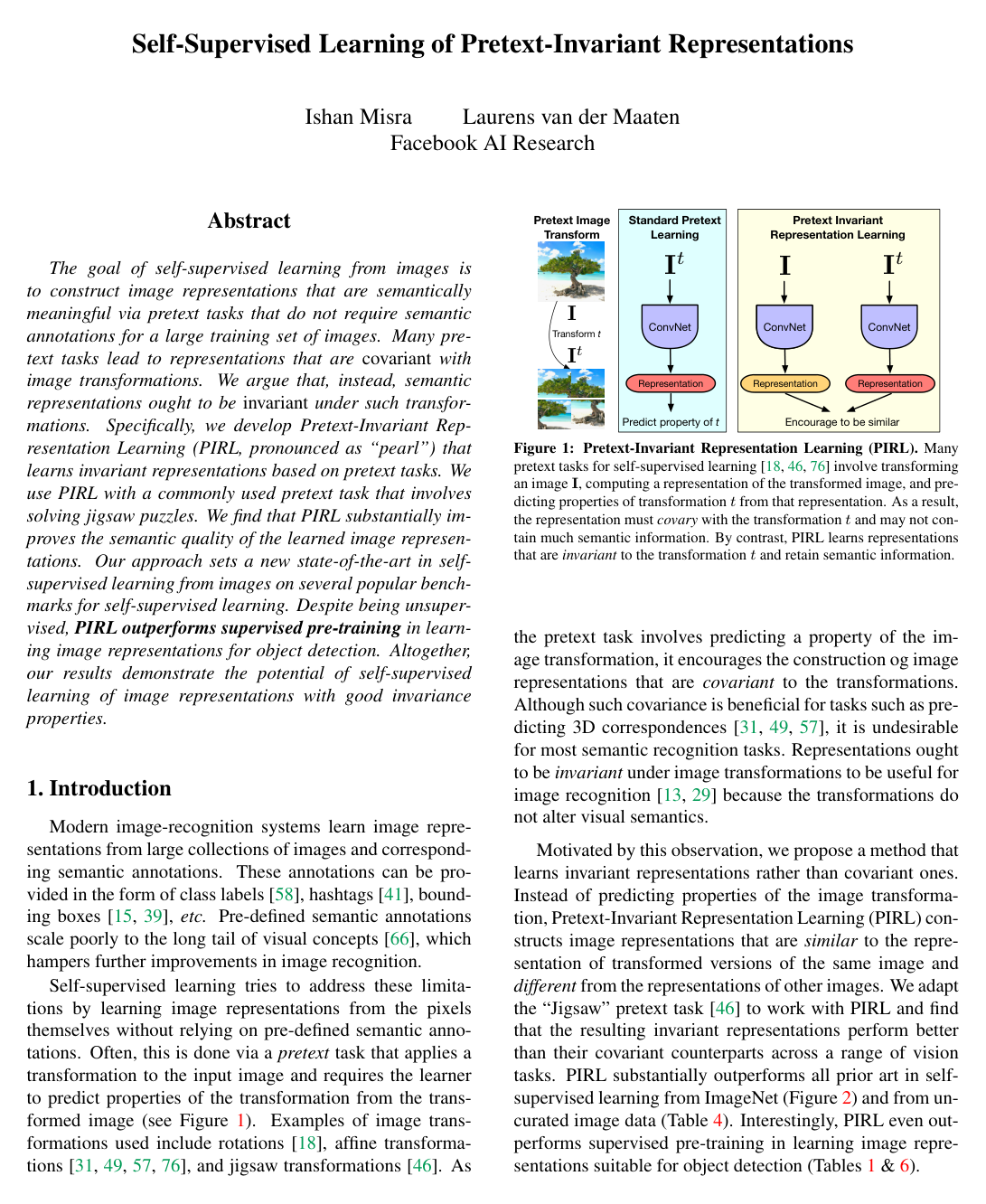
Self-Supervised Learning of Pretext-Invariant Representations
Ishan Misra, Laurens van der Maaten
Why you should read this
Demonstrates that learning image representations to be invariant to transformations rather than predictive of them substantially improves the quality of self-supervised visual features, achieving state-of-the-art results and even surpassing supervised pre-training for object detection.
The goal of self-supervised learning from images is to construct image representations that are semantically meaningful via pretext tasks that do not require semantic annotations for a large training set of images. Many pretext tasks lead to representations that are covariant with image transformations. We argue that, instead, semantic representations ought to be invariant under such transformations. Specifically, we develop Pretext-Invariant Representation Learning (PIRL, pronounced as "pearl") that learns invariant representations based on pretext tasks. We use PIRL with a commonly used pretext task that involves solving jigsaw puzzles. We find that PIRL substantially improves the semantic quality of the learned image representations. Our approach sets a new state-of-the-art in self-supervised learning from images on several popular benchmarks for self-supervised learning. Despite being unsupervised, PIRL outperforms supervised pre-training in learning image representations for object detection. Altogether, our results demonstrate the potential of self-supervised learning of image representations with good invariance properties.
Added
2026-02-21
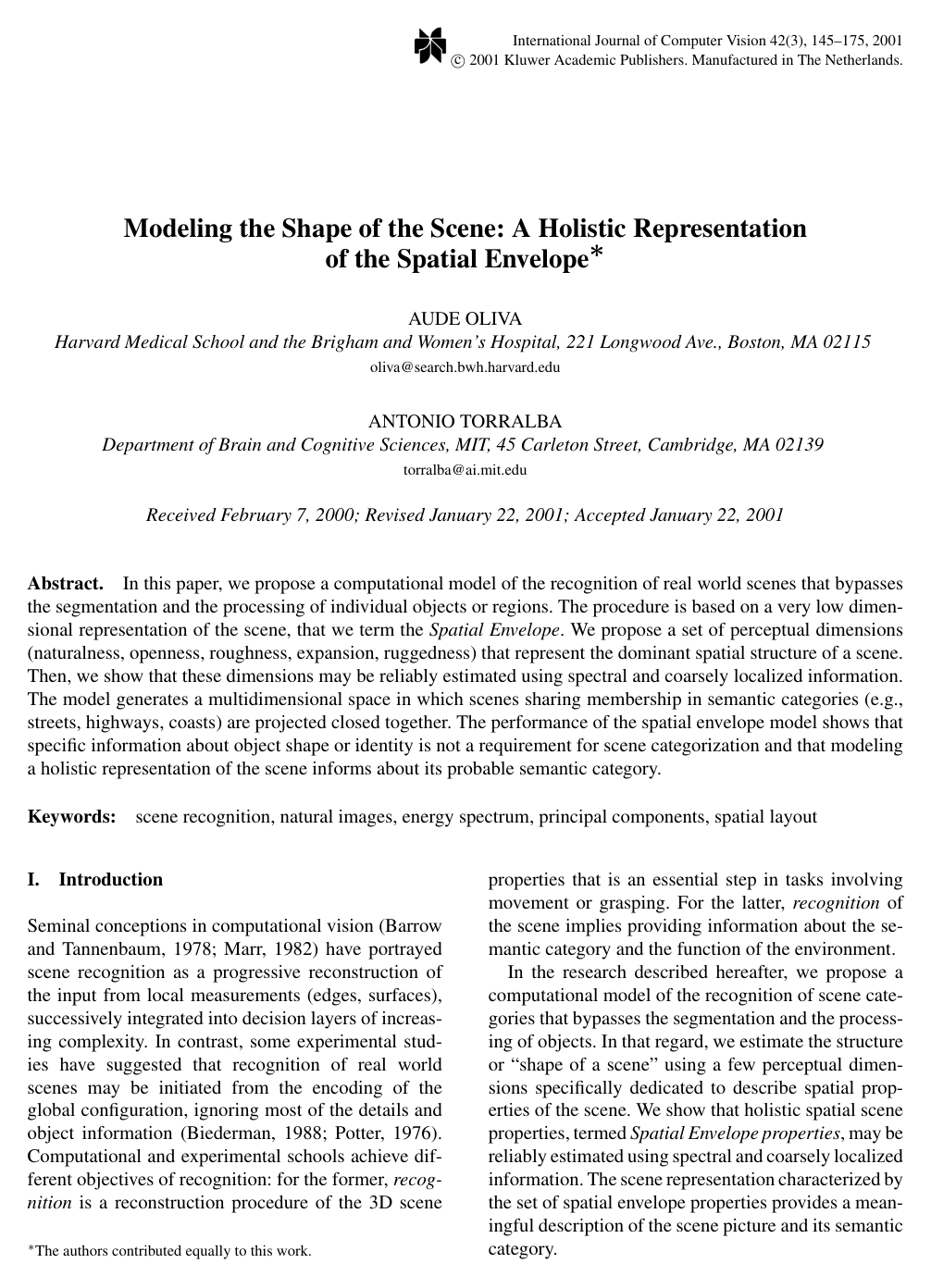
Modeling the Shape of the Scene: A Holistic Representation of the Spatial Envelope
Aude Oliva, Antonio Torralba
Why you should read this
Demonstrates that scenes can be recognized and categorized based on their overall spatial structure alone, without needing to identify individual objects or their details, by introducing a simple five-dimensional description of scene geometry that works with only coarse visual information.
In this paper, we propose a computational model of the recognition of real world scenes that bypasses the segmentation and the processing of individual objects or regions. The procedure is based on a very low dimensional representation of the scene, that we term the Spatial Envelope. We propose a set of perceptual dimensions (naturalness, openness, roughness, expansion, ruggedness) that represent the dominant spatial structure of a scene. Then, we show that these dimensions may be reliably estimated using spectral and coarsely localized information. The model generates a multidimensional space in which scenes sharing membership in semantic categories (e.g., streets, highways, coasts) are projected closed together. The performance of the spatial envelope model shows that specific information about object shape or identity is not a requirement for scene categorization and that modeling a holistic representation of the scene informs about its probable semantic category.
Added
2026-02-21