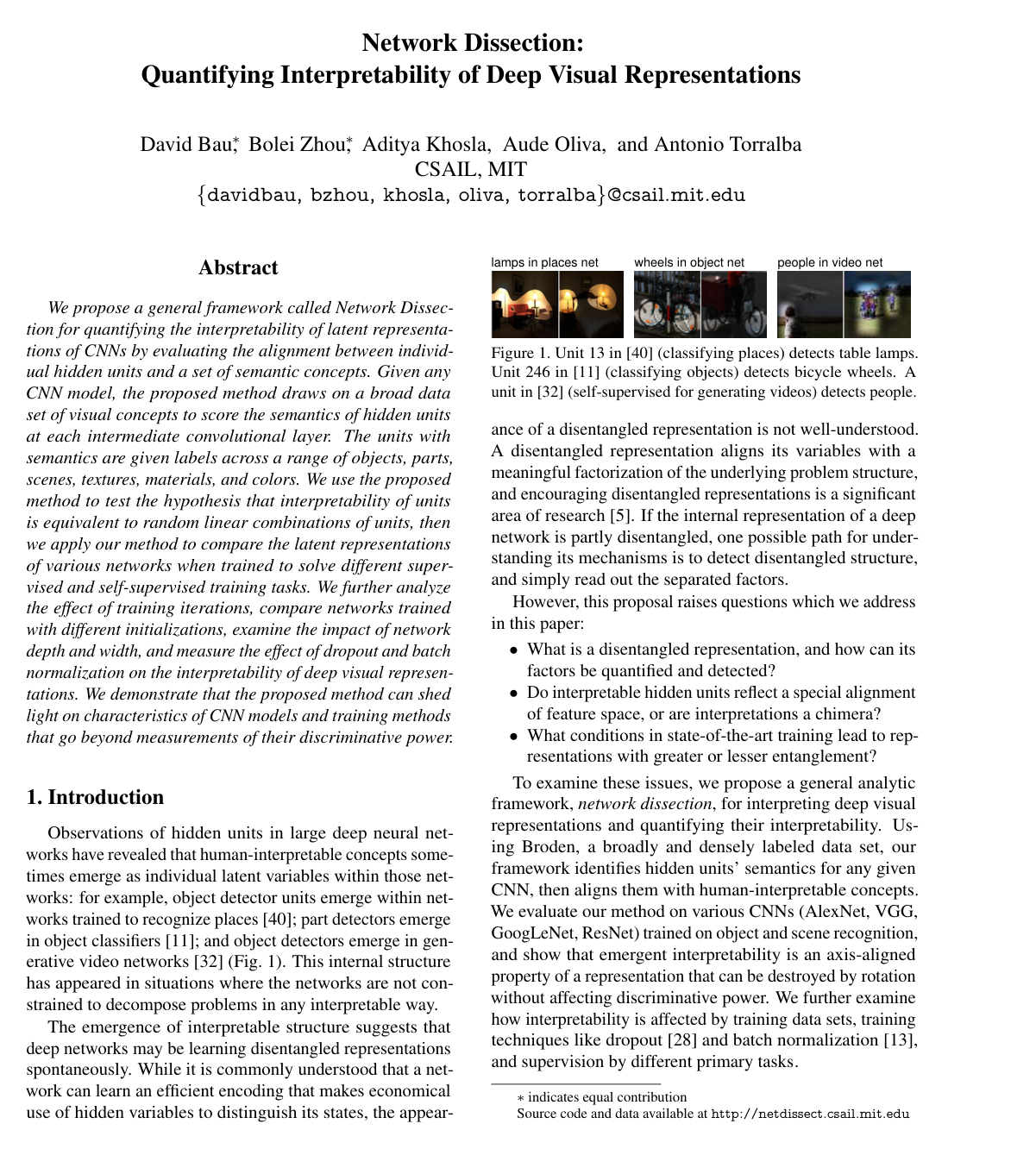
Network Dissection: Quantifying Interpretability of Deep Visual Representations

David BauBolei ZhouAditya KhoslaAude OlivaAntonio Torralba

article2017CVPR1,830 citations

Proposes Network Dissection, a framework to quantify the interpretability of convolutional neural networks by scoring how individual latent units align with distinct visual concepts such as objects, textures, and colors across various architectures and training objectives.

Listen

Deep neural networks are increasingly deployed across critical industries, yet they often function as opaque black boxes whose internal decision-making processes are difficult to understand and audit. While individual hidden units in vision models sometimes appear to learn recognizable concepts like objects or textures spontaneously, the field has lacked a standardized, quantitative method to verify whether these representations are truly meaningful and disentangled. Understanding whether and how neural networks structure human-interpretable concepts is essential for ensuring accountability, safety, and reliability in real-world artificial intelligence deployments.

The article establishes an automated framework called Network Dissection to quantify the interpretability of convolutional neural network layers by scoring how cleanly individual hidden units align with specific visual concepts. It sets out to evaluate whether this interpretability is an inherent property of network structure, and to demonstrate how network architectures, training datasets, and optimization techniques influence interpretability.

To conduct this evaluation, the researchers created the Broadly and Densely Labeled (Broden) dataset, which integrates pixel-level annotations for 1,197 visual concepts spanning objects, scenes, parts, materials, textures, and colors. The framework evaluates the activation maps of individual convolutional units within a network as binary segmentation masks across Broden images. It then computes an Intersection over Union metric to quantify how accurately each unit identifies a concept without requiring retraining or backpropagation. The authors tested multiple standard network architectures across supervised and self-supervised training tasks, various training iterations, regularization methods, and mathematical transformations of feature spaces.

The analysis produced several key findings. First, interpretability is an axis-aligned property tied to individual units rather than an arbitrary mathematical artifact; applying random orthogonal rotations to feature space reduced the number of unique concept detectors by 80% despite maintaining identical discriminative accuracy. Second, deeper architectures exhibited higher interpretability, with ResNet producing the most concept detectors, followed by VGG, GoogLeNet, and AlexNet. Third, the supervision objective strongly dictates emergent concepts: supervised scene classification generated more high-level object detectors than object classification, whereas self-supervised models primarily formed lower-level texture detectors. Fourth, standard training techniques significantly alter transparency: while models with different initializations converged to similar levels of interpretability, batch normalization caused a substantial drop in interpretability, and widening network layers without increasing depth significantly increased the number of interpretable detectors.

These findings demonstrate that interpretability and predictive accuracy are separate properties of neural networks that must be monitored independently. A model can achieve high accuracy while having entirely scrambled, uninterpretable internal representations, creating hidden risks for governance, compliance, and auditing. System designers should not assume that high benchmark performance equates to transparent reasoning. Furthermore, common optimization techniques like batch normalization may accelerate training at the direct expense of system interpretability.

Organizations developing or auditing computer vision systems should adopt automated interpretability metrics as a standard component of model evaluation alongside classification accuracy. Where interpretability is critical for safety and compliance, practitioners should consider deeper or wider architectures trained on diverse scene-level data, while carefully managing regularizations that degrade transparency. Future engineering work must focus on developing optimization methods that provide the convergence benefits of batch normalization without destroying unit-level interpretability.

The study's primary limitation is that Network Dissection relies on predefined concept dictionaries; units tracking valid, nuanced concepts absent from the Broden dataset cannot be scored. While confidence in the primary findings is high across standard vision architectures, further work is required to extend automated dissection to other domains such as natural language processing and multimodal foundation models.

  • Paper: Intriguing properties of neural networks, Christian Szegedy et al. (2014). It introduces the fundamental hypothesis that individual hidden units do not have privileged semantic meaning compared to random directions in activation space, a core claim that Network Dissection directly tests and refines.
  • Paper: Visualizing and Understanding Convolutional Networks, Matthew D. Zeiler et al. (2014). It pioneered the qualitative visualization of intermediate convolutional unit activations to uncover hierarchical visual features, providing the empirical baseline that Network Dissection turns into a quantitative benchmark.
  • Paper: Understanding Neural Networks Through Deep Visualization, Jason Yosinski et al. (2015). It established early empirical evidence that high-level visual concept detectors spontaneously emerge in intermediate layers of deep networks, motivating a systematic evaluation framework.
  • Paper: Learning Deep Features for Discriminative Localization, Bolei Zhou et al. (2016). It demonstrates how individual convolutional units encode localized discriminative regions across categories, forming an essential foundation for assigning explicit semantic concept masks to hidden features.
  • Paper: Deep Inside Convolutional Networks: Visualising Image Classification Models and Saliency Maps, Karen Simonyan et al. (2013). It provides foundational methods for gradient-based class visualization and spatial localization in deep convolutional networks.
  • Paper: The Mythos of Model Interpretability, Zachary C. Lipton (2016). It establishes a foundational conceptual taxonomy for model interpretability and post-hoc explanations in machine learning.
Cover for Network Dissection: Quantifying Interpretability of Deep Visual Representations

Abstract

We propose a general framework called Network Dissection for quantifying the interpretability of latent representations of CNNs by evaluating the alignment between individual hidden units and a set of semantic concepts. Given any CNN model, the proposed method draws on a broad data set of visual concepts to score the semantics of hidden units at each intermediate convolutional layer. The units with semantics are given labels across a range of objects, parts, scenes, textures, materials, and colors. We use the proposed method to test the hypothesis that interpretability of units is equivalent to random linear combinations of units, then we apply our method to compare the latent representations of various networks when trained to solve different supervised and self-supervised training tasks. We further analyze the effect of training iterations, compare networks trained with different initializations, examine the impact of network depth and width, and measure the effect of dropout and batch normalization on the interpretability of deep visual representations. We demonstrate that the proposed method can shed light on characteristics of CNN models and training methods that go beyond measurements of their discriminative power.

Table of Contents

  • 1 Introduction
  • 1.1 Related Work
  • 2 Network Dissection
  • 2.1 Broden: Broadly and Densely Labeled Dataset
  • 2.2 Scoring Unit Interpretability
  • 3 Experiments
  • 3.1 Human Evaluation of Interpretations
  • 3.2 Measurement of Axis-Aligned Interpretability
  • 3.3 Disentangled Concepts by Layer
  • 3.4 Network Architectures and Supervisions
  • 3.5 Training Conditions vs. Interpretability
  • 3.6 Discrimination vs. Interpretability
  • 3.7 Layer Width vs. Interpretability
  • 4 Conclusion
  • References

Knowls

  1. Knowl 1 — Network Dissection Method for Quantifying Unit Interpretability

    model/method

    Network Dissection is a framework for quantifying the interpretability of individual hidden convolutional units in deep neural networks by evaluating each unit as a binary segmentation model for specific human-interpretable visual concepts.

    For an input image xx from a labeled concept dataset and a convolutional unit kk, let Ak(x)A_k(x) denote the spatial activation map produced by unit kk. Across all images and spatial locations in the dataset, a threshold TkT_k is computed representing the top 0.0050.005 activation quantile, satisfying P(ak>Tk)=0.005P(a_k > T_k) = 0.005.

    To align spatial resolutions, Ak(x)A_k(x) is upsampled to the input image resolution via bilinear interpolation (anchoring interpolants at receptive field centers) to produce Sk(x)S_k(x). A binary segmentation mask is then obtained by thresholding:

    Mk(x)≡Sk(x)≥TkM_k(x) \equiv S_k(x) \ge T_k

    For any concept cc with ground-truth binary mask Lc(x)L_c(x), the alignment between unit kk and concept cc is measured by the dataset-wide intersection over union score:

    IoUk,c=∑x∈Xc∣Mk(x)∩Lc(x)∣∑x∈Xc∣Mk(x)∪Lc(x)∣IoU_{k,c} = \frac{\sum_{x \in X_c} |M_k(x) \cap L_c(x)|}{\sum_{x \in X_c} |M_k(x) \cup L_c(x)|}

    where XcX_c denotes the subset of dataset images annotated with at least one concept of the same semantic category as cc, and ∣⋅∣|\cdot| denotes set cardinality. A unit kk is classified as a detector for concept cc if IoUk,c>0.04IoU_{k,c} > 0.04. Each unit is matched to its highest-scoring concept label, and the total interpretability of a convolutional layer is measured by the count of distinct, unique visual concepts aligned with its units.

  2. Knowl 2 — Broadly and Densely Labeled Dataset (Broden)

    definition

    The Broadly and Densely Labeled Dataset (Broden) is a unified, multi-source visual benchmark designed to evaluate semantic alignment across low-level and high-level visual concepts. Broden merges pixel-level annotations and full-image tags from five constituent datasets:

    • ADE20K: scenes, objects, and object parts
    • OpenSurfaces: materials
    • Pascal-Context: objects
    • Pascal-Part: object parts
    • Describable Textures Dataset (DTD): textures

    In addition, all pixels are annotated with one of 11 universal color terms based on the color naming model of van de Weijer.

    Concept labels are normalized into standard English words, merged across shared synonyms (omitting positional prefixes such as 'left' or 'top' and filtering out 29 overly broad hypernyms), and retained only if represented by at least 10 image samples. In total, Broden comprises 1,197 classes distributed across six categories:

    • Scenes: 468 classes (average 38 samples/class)
    • Objects: 584 classes (average 491 samples/class)
    • Parts: 234 classes (average 854 samples/class)
    • Materials: 32 classes (average 1,703 samples/class)
    • Textures: 47 classes (average 140 samples/class)
    • Colors: 11 classes (average 59,250 samples/class)
  3. Knowl 3 — Axis-Alignment of Emergent Interpretability under Basis Rotations

    empirical result

    Emergent interpretability in deep convolutional representations is an axis-aligned property of the natural basis learned during training, rather than an axis-independent property distributed arbitrarily throughout the activation space.

    Let f(x)∈R256f(x) \in \mathbb{R}^{256} denote the 256-channel conv5 feature representation of an AlexNet model trained on Places205. Applying a random orthogonal change of basis Q∈SO(256)Q \in SO(256) sampled uniformly via Gram-Schmidt QR decomposition yields the rotated representation r=Qf(x)r = Qf(x). Downstream linear classification operates with mathematically identical discriminative power via weights g′(r)≡g(QTr)=g(f(x))g'(r) \equiv g(Q^T r) = g(f(x)).

    Under this orthogonal transformation, the number of unique visual concept detectors identified by Network Dissection in Qf(x)Qf(x) drops by 80% relative to the original representation f(x)f(x). Evaluating continuous fractional rotations along the minimal geodesic QαQ^\alpha (for 0≤α≤10 \le \alpha \le 1, computed via Schur decomposition from identity II to QQ) demonstrates a monotonic reduction in the number of unique concept detectors as α\alpha increases from 00 to 11.

    This demonstrates that individual units align with disentangled human-interpretable concepts specifically along the canonical axes of the representation, and that interpretability can be eliminated through rotation without altering discriminative power.

  4. Knowl 4 — Layer-wise Semantic Hierarchy and Task-Dependent Concept Emergence

    empirical result

    Network Dissection across successive convolutional layers (conv1 through conv5) of AlexNet reveals a consistent structural hierarchy of emergent semantic concepts:

    • Lower layers (conv1 and conv2) are predominantly aligned with low-level visual features, specifically colors and textures.
    • Intermediate layers (conv3 and conv4) show increasing numbers of texture, material, and part detectors.
    • Higher layers (conv5) are dominated by high-level semantic concepts, specifically object detectors, part detectors, and scene detectors.

    Furthermore, the distribution of emergent concepts depends strongly on the network's primary training task. An AlexNet architecture trained on scene classification (Places205) develops significantly more object and object-part detectors in higher convolutional layers than an identical architecture trained on object classification (ImageNet), reflecting the compositional structure of scenes containing multiple constituent objects.

  5. Knowl 5 — Impact of Network Architecture and Supervision on Emergent Interpretability

    empirical result

    Network Dissection across diverse architectures and training supervision regimes demonstrates systematic differences in the quantity and quality of emergent visual detectors:

    • Architecture Depth: Among supervised models, deeper convolutional architectures produce higher numbers of unique semantic detectors in their final convolutional layer, following the hierarchy ResNet-152 > VGG-16 > GoogLeNet > AlexNet.
    • Supervised Dataset: Training on scene-centric datasets yields higher overall unit interpretability and a greater number of unique object detectors than object-centric datasets (Places365 > Places205 > ImageNet).
    • Supervised vs. Self-Supervised Learning: Models trained with full supervision on large labeled datasets (e.g., Places365, ImageNet) learn substantially more object and part detectors than models trained on self-supervised pretext tasks (such as context prediction, jigsaw puzzle solving, ego-motion prediction, video frame tracking/order, split-brain cross-channel prediction, and colorization).
    • Pretext Task Specificity: Self-supervised networks primarily produce low-level texture and surface detectors aligned with their objective. For instance, colorization networks develop almost zero color detectors, whereas ambient sound prediction and puzzle-solving models develop moderate numbers of object and part detectors.
  6. Knowl 6 — Impact of Regularization, Initialization, and Training Progression on Concept Emergence

    empirical result

    Controlled experiments on AlexNet trained on Places205 reveal how training dynamics and regularization techniques influence single-unit interpretability:

    • Random Initialization: Different random initializations trained for the same number of iterations converge to virtually identical numbers of total and unique concept detectors, demonstrating convergent learning of internal representations.
    • Training Dynamics: Object and part detectors begin emerging at approximately 10,000 iterations (at batch size 256). Concept detectors emerge directly without passing through intermediate category stages (units in conv5 do not start as low-level texture detectors before transforming into object detectors).
    • Dropout: Removing dropout from fully connected layers yields a representation with more texture detectors but significantly fewer high-level object detectors.
    • Batch Normalization: Applying batch normalization across all convolutional layers substantially decreases the number of unique concept detectors, while validation classification accuracy remains comparable (50.5% with batch normalization vs. 50.0% baseline). This loss of interpretability is attributed to activation whitening, which facilitates unconstrained rotational drift of intermediate feature axes during optimization.
  7. Knowl 7 — Effect of Layer Width on Disentangled Concept Emergence

    empirical result

    Increasing convolutional layer width promotes the emergence of a larger number of disentangled semantic concept detectors without degrading classification performance.

    In the AlexNet-GAP-Wide architecture, the standard fully connected layers of AlexNet are removed, the width of the conv5 layer is tripled from 256 channels to 768 channels, and a global average pooling (GAP) layer is added to pool the 768 features directly into the final classification layer. When trained on Places365, AlexNet-GAP-Wide achieves classification accuracy within 0.5% top-1 accuracy of standard AlexNet, but yields a substantially larger total number of concept detectors and unique concept detectors at conv5.

    Increasing the conv5 channel count further to 1,024 and 2,048 units does not produce a significant further increase in unique concept detectors, indicating an architectural or task-driven capacity ceiling on the number of distinct explanatory factors learned.

  8. Knowl 8 — Correlation Between Emergent Object Detectors and Downstream Transfer Accuracy

    empirical result

    The number of unique object detectors emerging in the final convolutional layer of a deep visual representation exhibits a positive correlation with downstream linear transfer performance on the Action40 human action recognition dataset.

    Evaluating representations extracted from the final convolutional layer of various CNNs using a linear support vector machine (SVM with regularization parameter C=0.001C=0.001) shows that supervised models with high counts of emergent concept detectors generally achieve higher action classification test accuracy than self-supervised models with low concept detector counts.

    However, overall detector count alone does not fully determine transfer performance: ResNet-152 trained on ImageNet achieves higher Action40 classification accuracy than ResNet-152 trained on Places365, despite the Places365 model possessing a higher number of unique object detectors. This demonstrates that transfer accuracy depends on both the degree of disentanglement and the domain suitability of the emergent concepts to the downstream task.

  9. Knowl 9 — Human Agreement with Automated Network Dissection Interpretations

    empirical result

    An evaluation using Amazon Mechanical Turk (AMT) demonstrates that concept labels automatically assigned by Network Dissection closely match human visual judgments, particularly in higher convolutional layers.

    For each unit in an AlexNet trained on Places205, raters evaluated the top-15 most highly activating image patches to judge whether the assigned label accurately described the patches. Across the subset of units where human raters confirmed ground-truth human descriptions, the agreement rates of Network Dissection labels versus independent human consistency were:

    • conv1: 37% Network Dissection label agreement (vs. 82% human-to-human consistency; 57/96 interpretable units)
    • conv2: 56% Network Dissection label agreement (vs. 76% human-to-human consistency; 126/256 interpretable units)
    • conv3: 54% Network Dissection label agreement (vs. 83% human-to-human consistency; 247/384 interpretable units)
    • conv4: 59% Network Dissection label agreement (vs. 82% human-to-human consistency; 258/384 interpretable units)
    • conv5: 71% Network Dissection label agreement (vs. 91% human-to-human consistency; 194/256 interpretable units)

    Agreement increases with layer depth, reflecting higher human and algorithmic consensus on high-level semantic categories (objects and parts) compared to low-level textural patterns.

Coverage note — No substantial contributed material was omitted; specific objective loss functions of external self-supervised baseline algorithms were omitted as they are standard external methods.

References

  1. 1.P. Agrawal, J. Carreira, and J. Malik. Learning to see by moving. In Proc. ICCV, 2015.
  2. 2.P. Agrawal, R. Girshick, and J. Malik. Analyzing the performance of multilayer neural networks for object recognition. Proc. ECCV, 2014.
  3. 3.G. Alain and Y. Bengio. Understanding intermediate layers using linear classifier probes. arXiv:1610.01644, 2016.
  4. 4.S. Bell, K. Bala, and N. Snavely. Intrinsic images in the wild. ACM Trans. on Graphics (SIGGRAPH), 2014.
  5. 5.Y. Bengio, A. Courville, and P. Vincent. Representation learning: A review and new perspectives. IEEE transactions on pattern analysis and machine intelligence, 35(8):1798–1828, 2013.
  6. 6.X. Chen, R. Mottaghi, X. Liu, S. Fidler, R. Urtasun, and A. Yuille. Detect what you can: Detecting and representing objects using holistic models and body parts. In Proc. CVPR, 2014.
  7. 7.M. Cimpoi, S. Maji, I. Kokkinos, S. Mohamed, and A. Vedaldi. Describing textures in the wild. In Proc. CVPR, 2014.
  8. 8.P. Diaconis. What is a random matrix? Notices of the AMS, 52(11):1348–1349, 2005.
  9. 9.C. Doersch, A. Gupta, and A. A. Efros. Unsupervised visual representation learning by context prediction. In Proc. CVPR, 2015.
  10. 10.R. Gao, D. Jayaraman, and K. Grauman. Object-centric representation learning from unlabeled videos. arXiv:1612.00500, 2016.
  11. 11.A. Gonzalez-Garcia, D. Modolo, and V. Ferrari. Do semantic parts emerge in convolutional neural networks? arXiv:1607.03738, 2016.
  12. 12.K. He, X. Zhang, S. Ren, and J. Sun. Deep residual learning for image recognition. In Proc. CVPR, 2016.
  13. 13.S. Ioffe and C. Szegedy. Batch normalization: Accelerating deep network training by reducing internal covariate shift. arXiv:1502.03167, 2015.
  14. 14.D. Jayaraman and K. Grauman. Learning image representations tied to ego-motion. In Proc. ICCV, 2015.
  15. 15.A. Krizhevsky, I. Sutskever, and G. E. Hinton. Imagenet classification with deep convolutional neural networks. In Advances in neural information processing systems, pages 1097–1105, 2012.
  16. 16.Y. Li, J. Yosinski, J. Clune, H. Lipson, and J. Hopcroft. Convergent learning: Do different neural networks learn the same representations? arXiv:1511.07543, 2015.
  17. 17.A. Mahendran and A. Vedaldi. Understanding deep image representations by inverting them. Proc. CVPR, 2015.
  18. 18.I. Misra, C. L. Zitnick, and M. Hebert. Shuffle and learn: unsupervised learning using temporal order verification. In Proc. ECCV, 2016.
  19. 19.R. Mottaghi, X. Chen, X. Liu, N.-G. Cho, S.-W. Lee, S. Fidler, R. Urtasun, and A. Yuille. The role of context for object detection and semantic segmentation in the wild. In Proc. CVPR, 2014.
  20. 20.A. Nguyen, A. Dosovitskiy, J. Yosinski, T. Brox, and J. Clune. Synthesizing the preferred inputs for neurons in neural networks via deep generator networks. In Advances in Neural Information Processing Systems, 2016.
  21. 21.M. Noroozi and P. Favaro. Unsupervised learning of visual representations by solving jigsaw puzzles. In Proc. ECCV, 2016.
  22. 22.A. Owens, J. Wu, J. H. McDermott, W. T. Freeman, and A. Torralba. Ambient sound provides supervision for visual learning. In Proc. ECCV, 2016.
  23. 23.R. Q. Quiroga, L. Reddy, G. Kreiman, C. Koch, and I. Fried. Invariant visual representation by single neurons in the human brain. Nature, 435(7045):1102–1107, 2005.
  24. 24.A. S. Razavian, H. Azizpour, J. Sullivan, and S. Carlsson. Cnn features off-the-shelf: an astounding baseline for recognition. arXiv:1403.6382, 2014.
  25. 25.O. Russakovsky, J. Deng, H. Su, J. Krause, S. Satheesh, S. Ma, Z. Huang, A. Karpathy, A. Khosla, M. Bernstein, et al. Imagenet large scale visual recognition challenge. Int’l Journal of Computer Vision, 2015.
  26. 26.K. Simonyan, A. Vedaldi, and A. Zisserman. Deep inside convolutional networks: Visualising image classification models and saliency maps. International Conference on Learning Representations Workshop, 2014.
  27. 27.K. Simonyan and A. Zisserman. Very deep convolutional networks for large-scale image recognition. arXiv:1409.1556, 2014.
  28. 28.N. Srivastava, G. E. Hinton, A. Krizhevsky, I. Sutskever, and R. Salakhutdinov. Dropout: a simple way to prevent neural networks from overfitting. Journal of Machine Learning Research, 15(1):1929–1958, 2014.
  29. 29.C. Szegedy, W. Liu, Y. Jia, P. Sermanet, S. Reed, D. Anguelov, D. Erhan, V. Vanhoucke, and A. Rabinovich. Going deeper with convolutions. In Proc. CVPR, 2015.
  30. 30.C. Szegedy, W. Zaremba, I. Sutskever, J. Bruna, D. Erhan, I. Goodfellow, and R. Fergus. Intriguing properties of neural networks. arXiv:1312.6199, 2013.
  31. 31.J. Van De Weijer, C. Schmid, J. Verbeek, and D. Larlus. Learning color names for real-world applications. IEEE Transactions on Image Processing, 18(7):1512–1523, 2009.
  32. 32.C. Vondrick, H. Pirsiavash, and A. Torralba. Generating videos with scene dynamics. arXiv:1609.02612, 2016.
  33. 33.X. Wang and A. Gupta. Unsupervised learning of visual representations using videos. In Proc. CVPR, 2015.
  34. 34.B. Yao, X. Jiang, A. Khosla, A. L. Lin, L. Guibas, and L. Fei-Fei. Human action recognition by learning bases of action attributes and parts. In Proc. ICCV, 2011.
  35. 35.J. Yosinski, J. Clune, Y. Bengio, and H. Lipson. How transferable are features in deep neural networks? In Advances in Neural Information Processing Systems, 2014.
  36. 36.S. Zagoruyko and N. Komodakis. Wide residual networks. arXiv:1605.07146, 2016.
  37. 37.M. D. Zeiler and R. Fergus. Visualizing and understanding convolutional networks. Proc. ECCV, 2014.
  38. 38.R. Zhang, P. Isola, and A. A. Efros. Colorful image colorization. In Proc. ECCV. Springer, 2016.
  39. 39.R. Zhang, P. Isola, and A. A. Efros. Split-brain autoencoders: Unsupervised learning by cross-channel prediction. In Proc. CVPR, 2017.
  40. 40.B. Zhou, A. Khosla, A. Lapedriza, A. Oliva, and A. Torralba. Object detectors emerge in deep scene cnns. International Conference on Learning Representations, 2015.
  41. 41.B. Zhou, A. Khosla, A. Lapedriza, A. Torralba, and A. Oliva. Places: An image database for deep scene understanding. arXiv:1610.02055, 2016.
  42. 42.B. Zhou, A. Lapedriza, J. Xiao, A. Torralba, and A. Oliva. Learning deep features for scene recognition using places database. In Advances in Neural Information Processing Systems, 2014.
  43. 43.B. Zhou, H. Zhao, X. Puig, S. Fidler, A. Barriuso, and A. Torralba. Scene parsing through ade20k dataset. Proc. CVPR, 2017.

Citation

MLA
Bau, D., et al. “Network Dissection: Quantifying Interpretability of Deep Visual Representations”. arXiv, 2017, http://arxiv.org/abs/1704.05796v1.
APA
Bau, D., Zhou, B., Khosla, A., Oliva, A., & Torralba, A. (2017). Network Dissection: Quantifying Interpretability of Deep Visual Representations. arXiv. http://arxiv.org/abs/1704.05796v1
Chicago
Bau, D., B. Zhou, A. Khosla, A. Oliva, and A. Torralba. 2017. “Network Dissection: Quantifying Interpretability of Deep Visual Representations”. arXiv. http://arxiv.org/abs/1704.05796v1.
Harvard
Bau, D. et al. (2017) “Network Dissection: Quantifying Interpretability of Deep Visual Representations”, arXiv [Preprint]. Available at: http://arxiv.org/abs/1704.05796v1.
Vancouver
1. Bau D, Zhou B, Khosla A, Oliva A, Torralba A (2017) Network Dissection: Quantifying Interpretability of Deep Visual Representations. arXiv

BibTeX

@article{bau2017network,
  title = {Network Dissection: Quantifying Interpretability of Deep Visual Representations},
  author = {Bau, David and Zhou, Bolei and Khosla, Aditya and Oliva, Aude and Torralba, Antonio},
  year = {2017},
  journal = {arXiv},
  url = {http://arxiv.org/abs/1704.05796v1},
  eprint = {1704.05796}
}
Metadata:arXiv

Source Code

This paper has an official code repository available. Click below to access the source code.

View Repository

Access the Paper

This paper is available from its original source. Click below to access the PDF.

Open PDF

License: IEEE