
keyword
robot learning
Robot learning is an interdisciplinary subfield of artificial intelligence and robotics that enables autonomous physical systems to acquire new skills, adapt their behavior, and execute complex tasks through data-driven algorithms rather than explicit, manual programming. By leveraging paradigms such as reinforcement learning, imitation learning, and multimodal foundation models, robot learning frameworks process sensory observations, such as visual feeds, tactile feedback, and natural language instructions, to generate coordinated motor actions. This approach allows robots to handle dynamic physical environments, perform dexterous manipulation and navigation, generalize learned policies to unseen scenarios, and effectively transfer control strategies from simulation to real-world hardware.
23 items
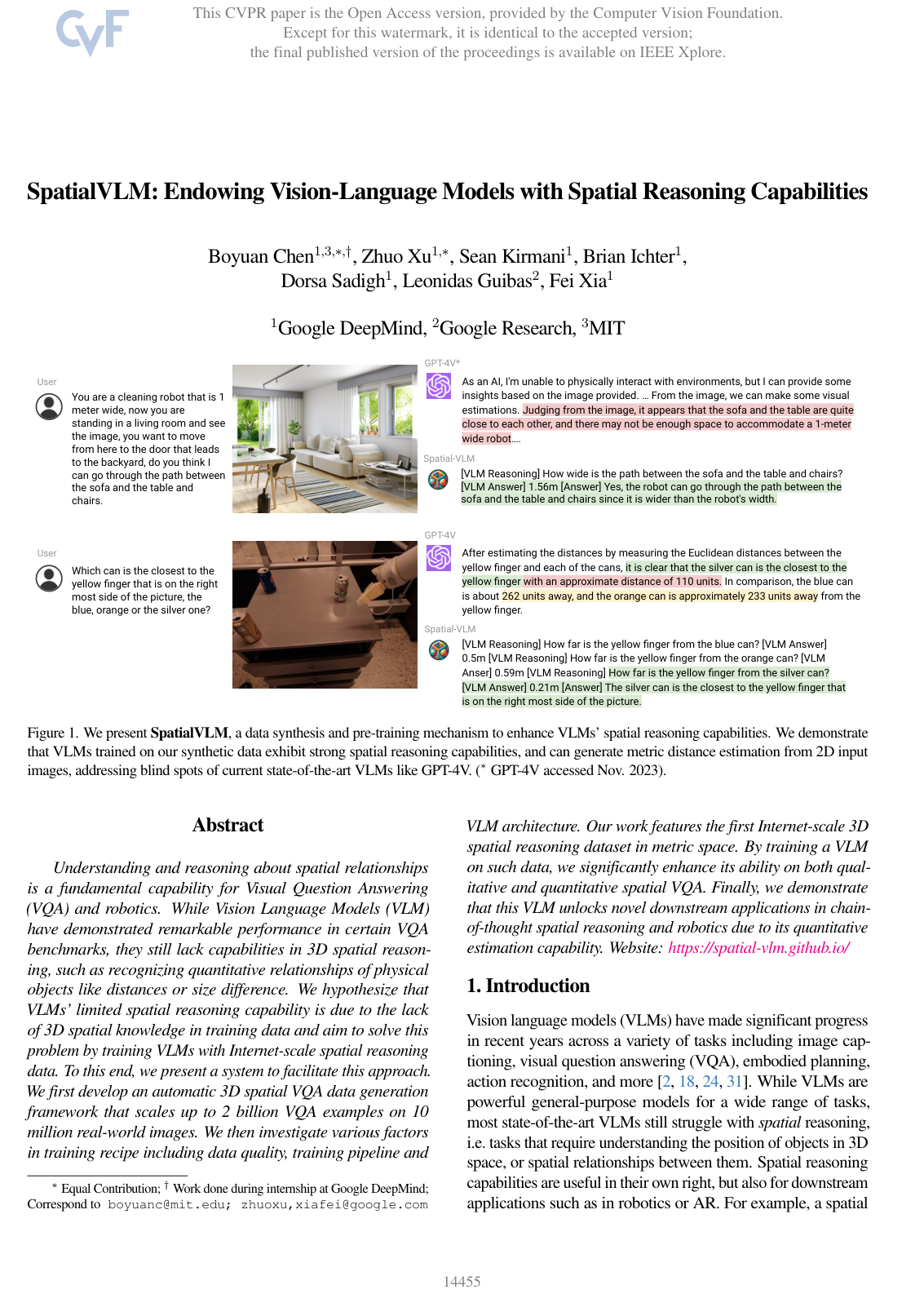
SpatialVLM: Endowing Vision-Language Models with Spatial Reasoning Capabilities
Boyuan Chen, Zhuo Xu, Sean Kirmani, Brian Ichter, Dorsa Sadigh, Leonidas J. Guibas, Fei Xia
Why you should read this
Introduces SpatialVLM, a model trained on a two-billion-example 3D spatial reasoning dataset that equips vision-language architectures with direct metric distance and physical size estimation for robotics.
Understanding and reasoning about spatial relationships is a fundamental capability for Visual Question Answering (VQA) and robotics. While Vision Language Models (VLM) have demonstrated remarkable performance in certain VQA benchmarks, they still lack capabilities in 3D spatial reasoning, such as recognizing quantitative relationships of physical objects like distances or size differences. We hypothesize that VLMs' limited spatial reasoning capability is due to the lack of 3D spatial knowledge in training data and aim to solve this problem by training VLMs with Internet-scale spatial reasoning data. To this end, we present a system to facilitate this approach. We first develop an automatic 3D spatial VQA data generation framework that scales up to 2 billion VQA examples on 10 million real-world images. We then investigate various factors in the training recipe, including data quality, training pipeline, and VLM architecture. Our work features the first internet-scale 3D spatial reasoning dataset in metric space. By training a VLM on such data, we significantly enhance its ability on both qualitative and quantitative spatial VQA. Finally, we demonstrate that this VLM unlocks novel downstream applications in chain-of-thought spatial reasoning and robotics due to its quantitative estimation capability. Project website: this https URL
Added
2026-10-05
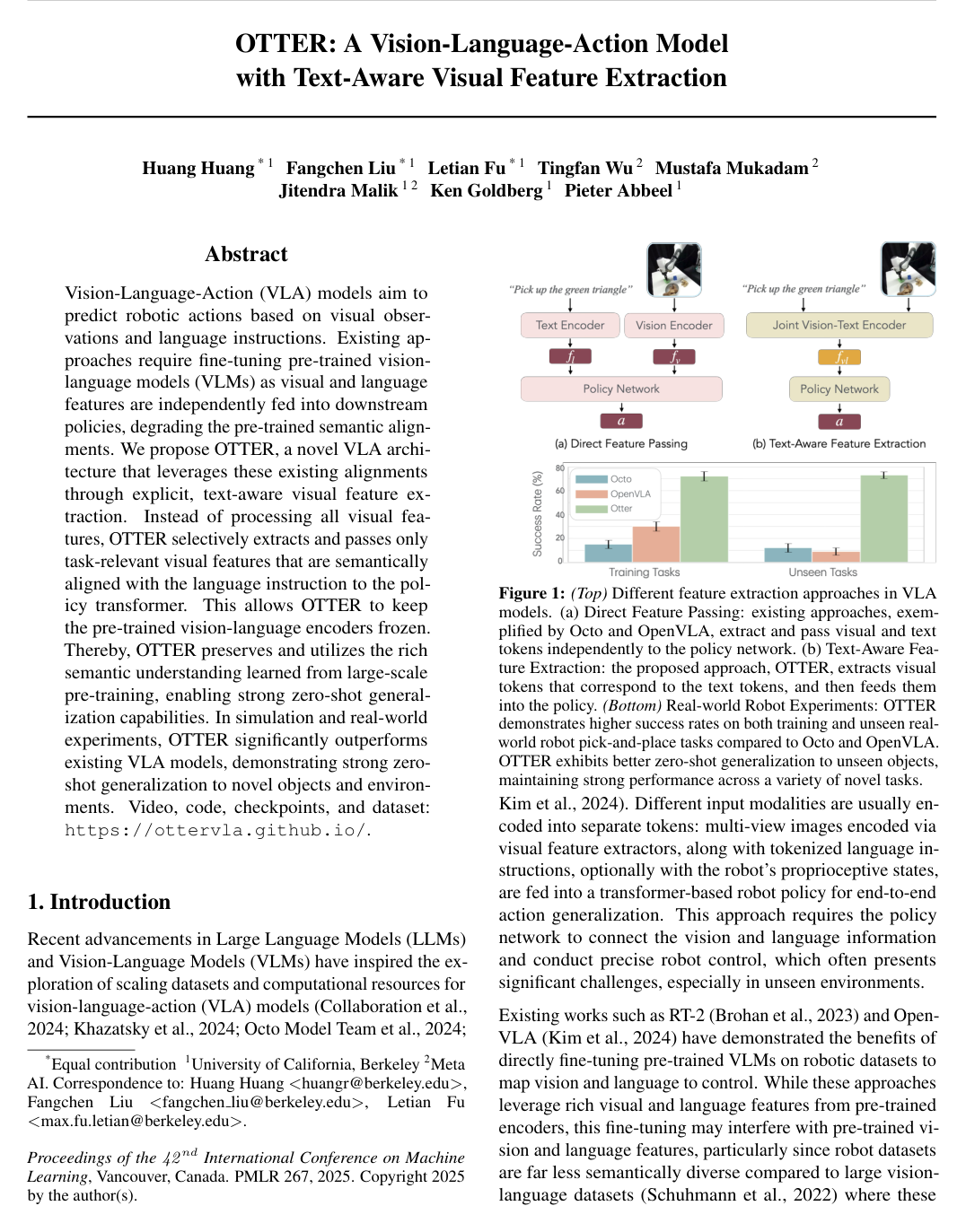
OTTER: A Vision-Language-Action Model with Text-Aware Visual Feature Extraction
Huang Huang, Fangchen Liu, Letian Fu, Tingfan Wu, Mustafa Mukadam, Jitendra Malik, Ken Goldberg, Pieter Abbeel
Why you should read this
Proposes a vision-language-action architecture that extracts task-relevant visual tokens aligned with text instructions using frozen pre-trained encoders, achieving superior zero-shot generalization in robot manipulation without degrading multi-modal semantic alignments through fine-tuning.
Vision-Language-Action (VLA) models aim to predict robotic actions based on visual observations and language instructions. Existing approaches require fine-tuning pre-trained vision-language models (VLMs) as visual and language features are independently fed into downstream policies, degrading the pre-trained semantic alignments. We propose OTTER, a novel VLA architecture that leverages these existing alignments through explicit, text-aware visual feature extraction. Instead of processing all visual features, OTTER selectively extracts and passes only task-relevant visual features that are semantically aligned with the language instruction to the policy transformer. This allows OTTER to keep the pre-trained vision-language encoders frozen. Thereby, OTTER preserves and utilizes the rich semantic understanding learned from large-scale pre-training, enabling strong zero-shot generalization capabilities. In simulation and real-world experiments, OTTER significantly outperforms existing VLA models, demonstrating strong zero-shot generalization to novel objects and environments. Video, code, checkpoints, and dataset: https://ottervla.github.io/.
Added
2026-10-05
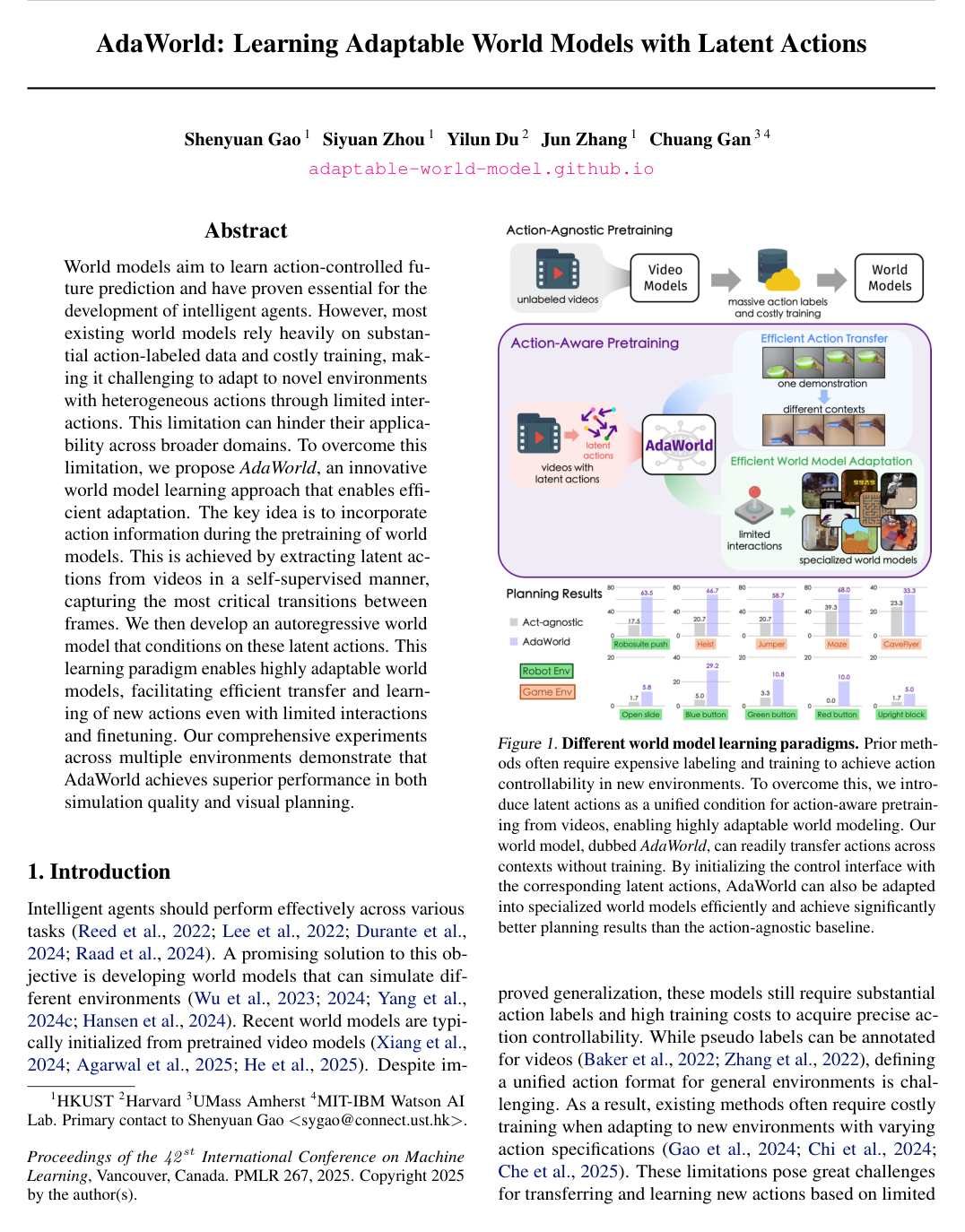
AdaWorld: Learning Adaptable World Models with Latent Actions
Shenyuan Gao, Siyuan Zhou, Yilun Du, Jun Zhang, Chuang Gan
Why you should read this
Proposes AdaWorld, a pretraining framework that extracts self-supervised latent actions from unlabeled videos to condition autoregressive world models, enabling fast adaptation and visual planning in novel environments with minimal interaction data.
World models aim to learn action-controlled future prediction and have proven essential for the development of intelligent agents. However, most existing world models rely heavily on substantial action-labeled data and costly training, making it challenging to adapt to novel environments with heterogeneous actions through limited interactions. This limitation can hinder their applicability across broader domains. To overcome this limitation, we propose AdaWorld, an innovative world model learning approach that enables efficient adaptation. The key idea is to incorporate action information during the pretraining of world models. This is achieved by extracting latent actions from videos in a self-supervised manner, capturing the most critical transitions between frames. We then develop an autoregressive world model that conditions on these latent actions. This learning paradigm enables highly adaptable world models, facilitating efficient transfer and learning of new actions even with limited interactions and finetuning. Our comprehensive experiments across multiple environments demonstrate that AdaWorld achieves superior performance in both simulation quality and visual planning.
Added
2026-10-03
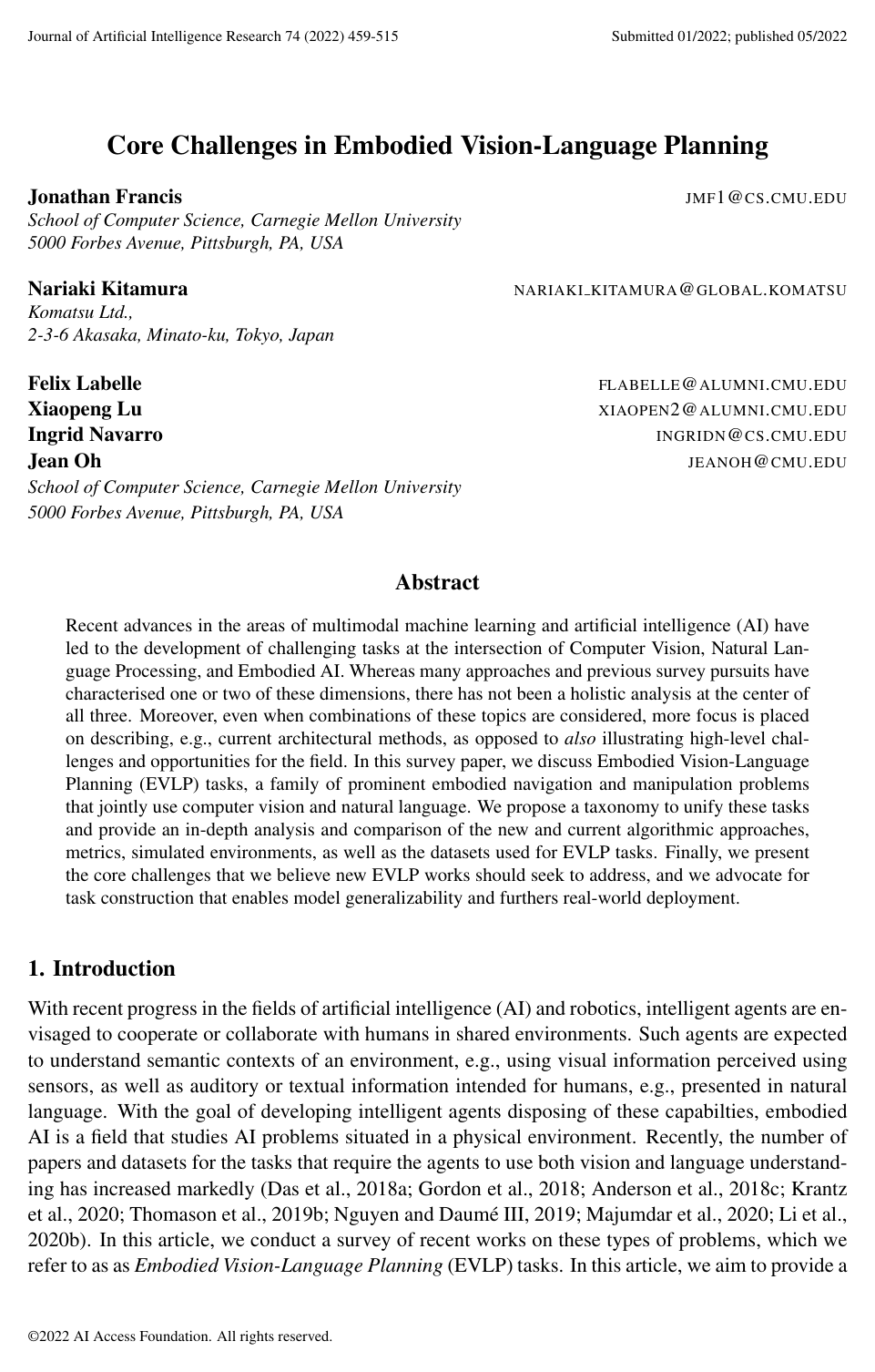
Core Challenges in Embodied Vision-Language Planning
Jonathan Francis, Nariaki Kitamura, Felix Labelle, Xiaopeng Lu, Ingrid Navarro, Jean Oh
Why you should read this
Presents a unifying taxonomy and comparative review of embodied vision-language planning methods, benchmarks, and simulation environments to clarify critical open challenges for deploying interactive agents in the physical world.
Recent advances in the areas of multimodal machine learning and artificial intelligence (AI) have led to the development of challenging tasks at the intersection of Computer Vision, Natural Language Processing, and Embodied AI. Whereas many approaches and previous survey pursuits have characterised one or two of these dimensions, there has not been a holistic analysis at the center of all three. Moreover, even when combinations of these topics are considered, more focus is placed on describing, e.g., current architectural methods, as opposed to also illustrating high-level challenges and opportunities for the field. In this survey paper, we discuss Embodied Vision-Language Planning (EVLP) tasks, a family of prominent embodied navigation and manipulation problems that jointly use computer vision and natural language. We propose a taxonomy to unify these tasks and provide an in-depth analysis and comparison of the new and current algorithmic approaches, metrics, simulated environments, as well as the datasets used for EVLP tasks. Finally, we present the core challenges that we believe new EVLP works should seek to address, and we advocate for task construction that enables model generalizability and furthers real-world deployment.
Added
2026-10-03
Prompting Decision Transformer for Few-Shot Policy Generalization
Mengdi Xu, Yikang Shen, Shun Zhang, Yuchen Lu, Ding Zhao, Joshua B. Tenenbaum, Chuang Gan
Why you should read this
Presents Prompt-DT, a sequence-modeling approach that conditions decision transformers on short demonstration trajectory prompts to enable offline policy adaptation to unseen and out-of-distribution control tasks without fine-tuning.
Human can leverage prior experience and learn novel tasks from a handful of demonstrations. In contrast to offline meta-reinforcement learning, which aims to achieve quick adaptation through better algorithm design, we investigate the effect of architecture inductive bias on the few-shot learning capability. We propose a Prompt-based Decision Transformer (Prompt-DT), which leverages the sequential modeling ability of the Transformer architecture and the prompt framework to achieve few-shot adaptation in offline RL. We design the trajectory prompt, which contains segments of the few-shot demonstrations, and encodes task-specific information to guide policy generation. Our experiments in five MuJoCo control benchmarks show that Prompt-DT is a strong few-shot learner without any extra finetuning on unseen target tasks. Prompt-DT outperforms its variants and strong meta offline RL baselines by a large margin with a trajectory prompt containing only a few timesteps. Prompt-DT is also robust to prompt length changes and can generalize to out-of-distribution (OOD) environments. Project page: https://mxu34.github.io/PromptDT/.
Added
2026-09-28
AHA: A Vision-Language-Model for Detecting and Reasoning Over Failures in Robotic Manipulation
Jiafei Duan, Wilbert Pumacay, Nishanth Kumar, Yi Ru Wang, Shulin Tian, Wentao Yuan, Ranjay Krishna, Dieter Fox, Ajay Mandlekar, Yijie Guo
Why you should read this
Introduces an open-source vision-language model trained on synthetically perturbed demonstrations to detect and reason about robotic manipulation failures, boosting downstream policy success rates by 21.4% across reinforcement learning, planning, and real-world execution.
Robotic manipulation in open-world settings requires not only task execution but also the ability to detect and learn from failures. While recent advances in vision-language models (VLMs) and large language models (LLMs) have improved robots' spatial reasoning and problem-solving abilities, they still struggle with failure recognition, limiting their real-world applicability. We introduce AHA, an open-source VLM designed to detect and reason about failures in robotic manipulation using natural language. By framing failure detection as a free-form reasoning task, AHA identifies failures and provides detailed, adaptable explanations across different robots, tasks, and environments. We fine-tuned AHA using FailGen, a scalable framework that generates the first large-scale dataset of robotic failure trajectories, the AHA dataset. FailGen achieves this by procedurally perturbing successful demonstrations from simulation. Despite being trained solely on the AHA dataset, AHA generalizes effectively to real-world failure datasets, robotic systems, and unseen tasks. It surpasses the second-best model (GPT-4o in-context learning) by 10.3% and exceeds the average performance of six compared models including five state-of-the-art VLMs by 35.3% across multiple metrics and datasets. We integrate AHA into three manipulation frameworks that utilize LLMs/VLMs for reinforcement learning, task and motion planning, and zero-shot trajectory generation. AHA's failure feedback enhances these policies' performances by refining dense reward functions, optimizing task planning, and improving sub-task verification, boosting task success rates by an average of 21.4% across all three tasks compared to GPT-4 models.
Added
2026-09-26
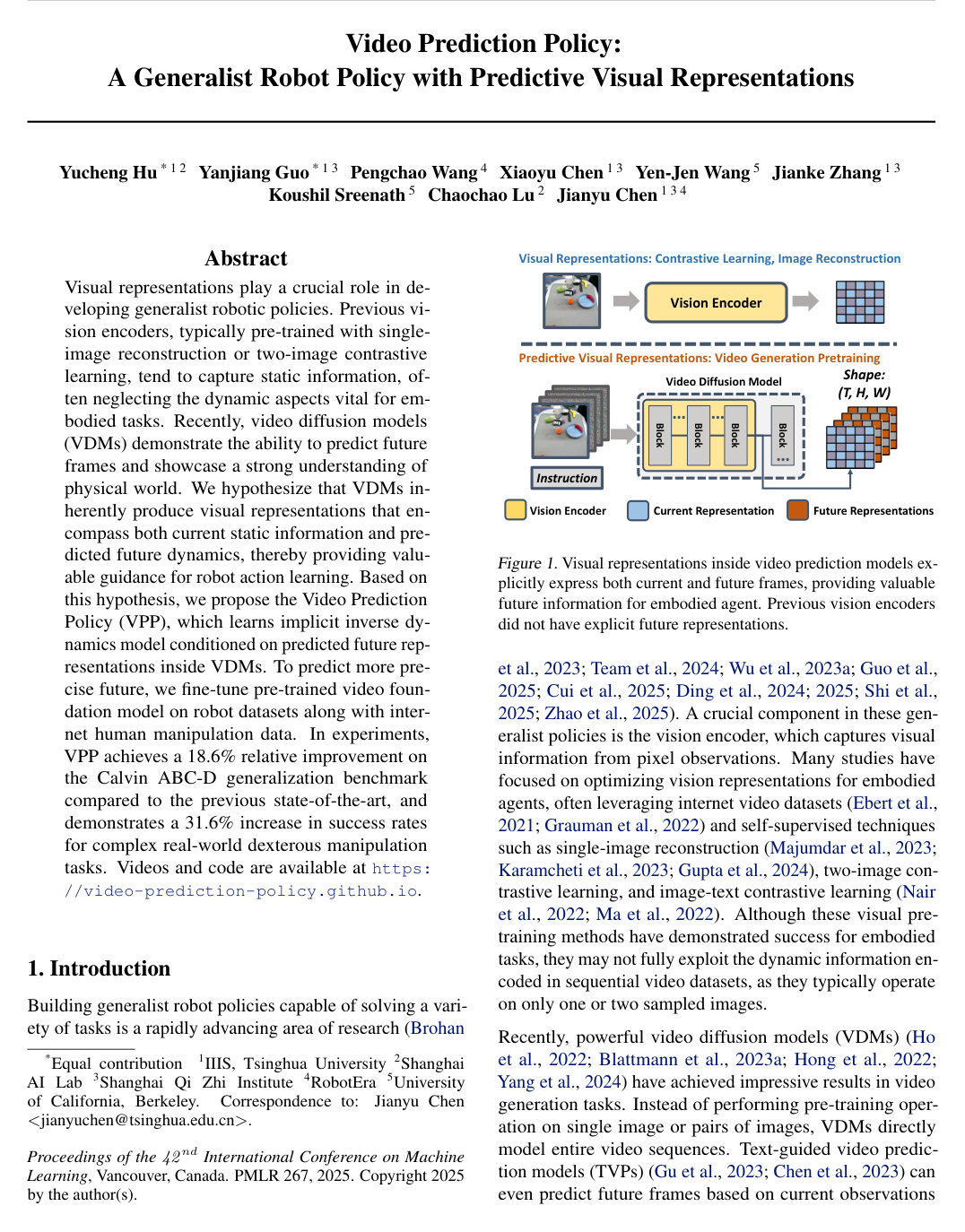
Video Prediction Policy: A Generalist Robot Policy with Predictive Visual Representations
Yucheng Hu, Yanjiang Guo, Pengchao Wang, Xiaoyu Chen, Yen-Jen Wang, Jianke Zhang, Koushil Sreenath, Chaochao Lu, Jianyu Chen
Why you should read this
Proposes Video Prediction Policy, a framework that extracts predictive dynamic representations directly from fine-tuned video diffusion models to guide implicit inverse dynamics for generalist robotic control, achieving substantial gains in both simulated benchmarks and real-world dexterous manipulation.
Visual representations play a crucial role in developing generalist robotic policies. Previous vision encoders, typically pre-trained with single-image reconstruction or two-image contrastive learning, tend to capture static information, often neglecting the dynamic aspects vital for embodied tasks. Recently, video diffusion models (VDMs) demonstrate the ability to predict future frames and showcase a strong understanding of physical world. We hypothesize that VDMs inherently produce visual representations that encompass both current static information and predicted future dynamics, thereby providing valuable guidance for robot action learning. Based on this hypothesis, we propose the Video Prediction Policy (VPP), which learns implicit inverse dynamics model conditioned on predicted future representations inside VDMs. To predict more precise future, we fine-tune pre-trained video foundation model on robot datasets along with internet human manipulation data. In experiments, VPP achieves a 18.6% relative improvement on the Calvin ABC-D generalization benchmark compared to the previous state-of-the-art, and demonstrates a 31.6% increase in success rates for complex real-world dexterous manipulation tasks. Videos and code are available at https://video-prediction-policy.github.io.
Added
2026-09-26
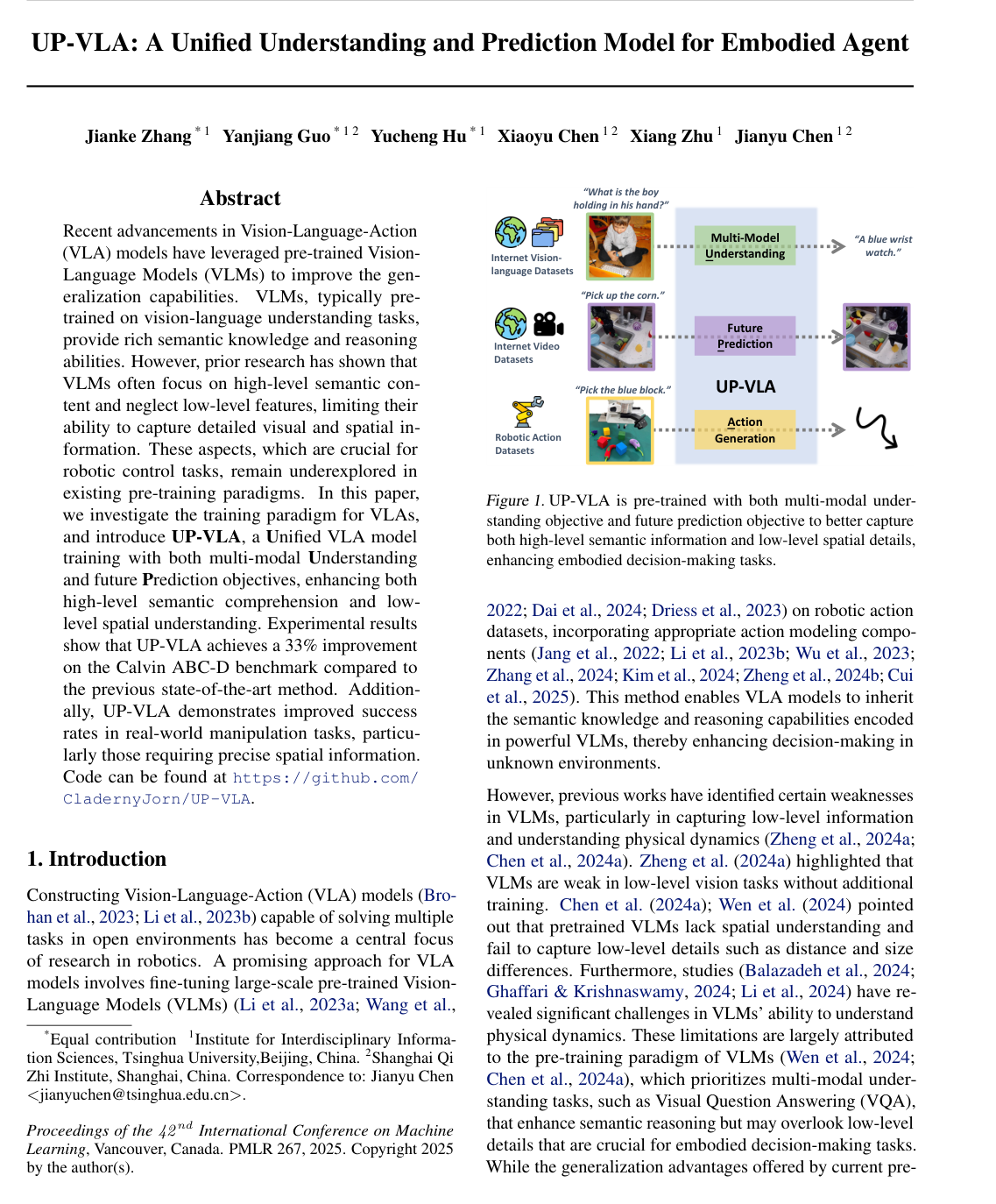
UP-VLA: A Unified Understanding and Prediction Model for Embodied Agent
Jianke Zhang, Yanjiang Guo, Yucheng Hu, Xiaoyu Chen, Xiang Zhu, Jianyu Chen
Why you should read this
Proposes a unified training paradigm for Vision-Language-Action models that couples multi-modal understanding with future visual prediction to capture both high-level semantics and low-level spatial details, boosting robot manipulation success on the Calvin benchmark by 33%.
Added
2026-09-26
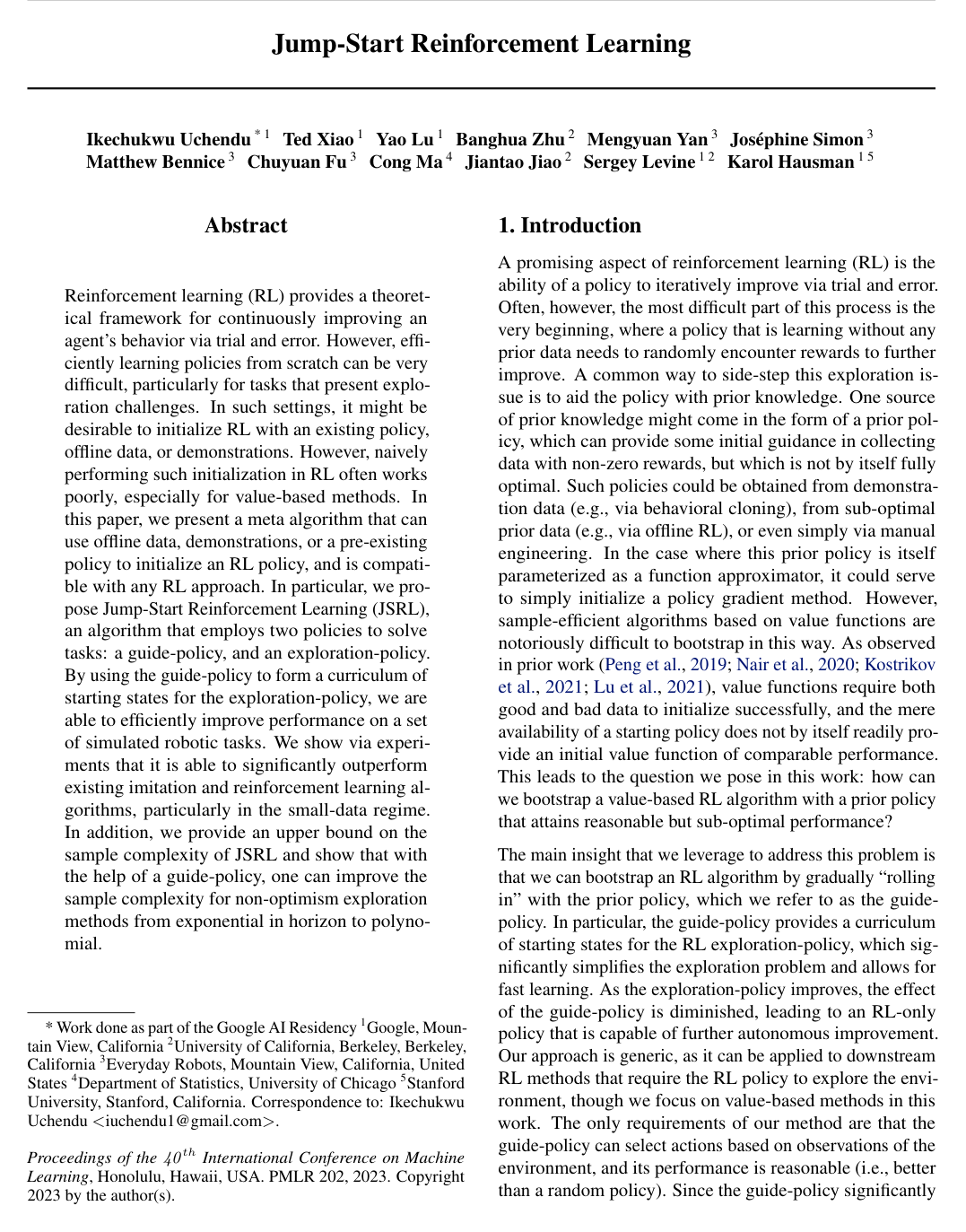
Jump-Start Reinforcement Learning
Ikechukwu Uchendu, Ted Xiao, Yao Lu, Banghua Zhu, Mengyuan Yan, Joséphine Simon, Matthew Bennice, Chuyuan Fu, Cong Ma, Jiantao Jiao, Sergey Levine, Karol Hausman
Why you should read this
Proposes a meta-algorithm that bootstraps value-based reinforcement learning using a prior guide-policy to initialize exploration trajectories, reducing sample complexity from exponential to polynomial and outperforming standard imitation and RL baselines.
Reinforcement learning (RL) provides a theoretical framework for continuously improving an agent's behavior via trial and error. However, efficiently learning policies from scratch can be very difficult, particularly for tasks that present exploration challenges. In such settings, it might be desirable to initialize RL with an existing policy, offline data, or demonstrations. However, naively performing such initialization in RL often works poorly, especially for value-based methods. In this paper, we present a meta algorithm that can use offline data, demonstrations, or a pre-existing policy to initialize an RL policy, and is compatible with any RL approach. In particular, we propose Jump-Start Reinforcement Learning (JSRL), an algorithm that employs two policies to solve tasks: a guide-policy, and an exploration-policy. By using the guide-policy to form a curriculum of starting states for the exploration-policy, we are able to efficiently improve performance on a set of simulated robotic tasks. We show via experiments that it is able to significantly outperform existing imitation and reinforcement learning algorithms, particularly in the small-data regime. In addition, we provide an upper bound on the sample complexity of JSRL and show that with the help of a guide-policy, one can improve the sample complexity for non-optimism exploration methods from exponential in horizon to polynomial.
Added
2026-09-26
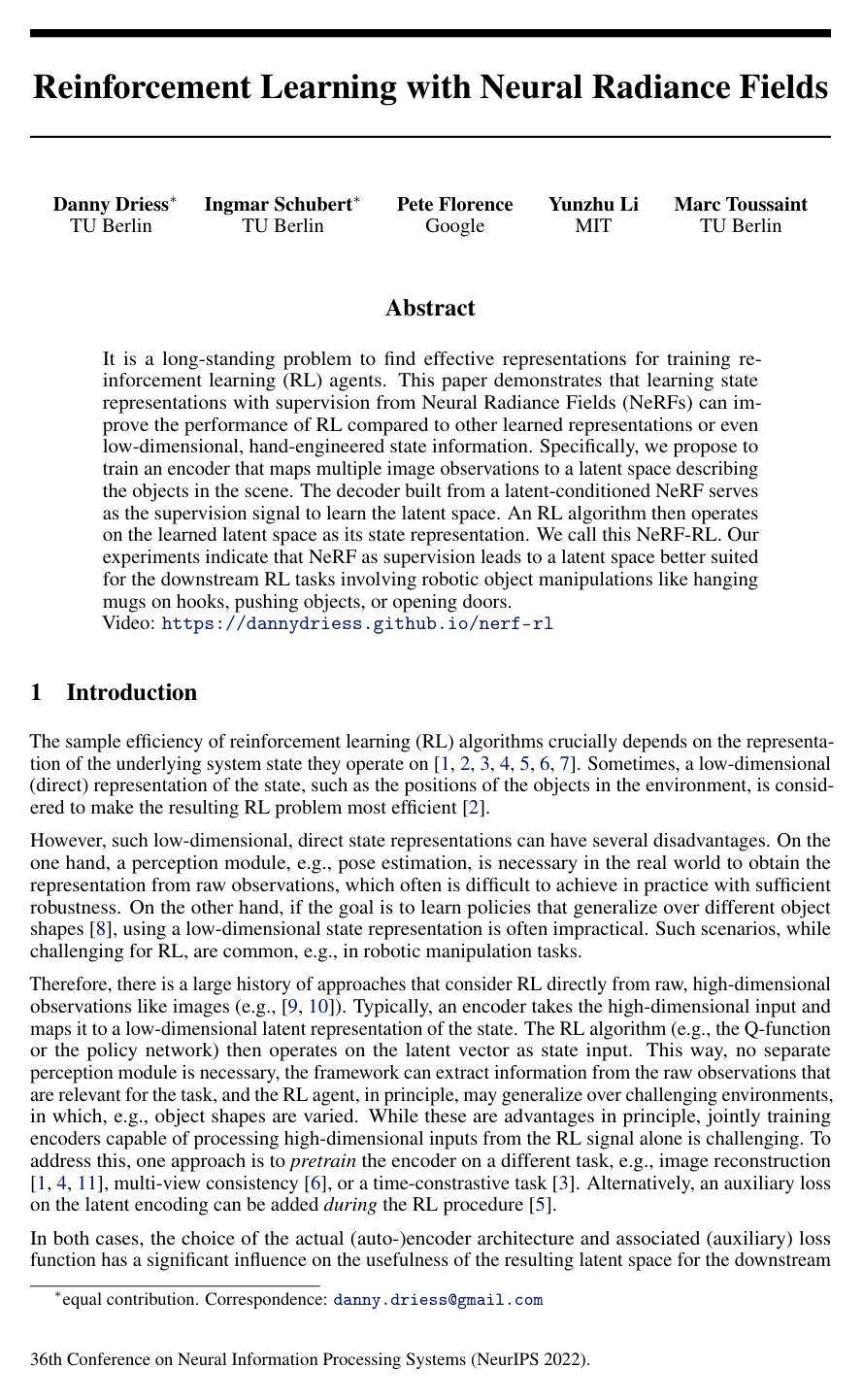
Reinforcement Learning with Neural Radiance Fields
Danny Driess, Ingmar Schubert, Pete Florence, Yunzhu Li, Marc Toussaint
Why you should read this
Demonstrates that using Neural Radiance Fields as a self-supervision signal to train visual encoders yields 3D-aware latent state representations that substantially improve the sample efficiency and generalization of reinforcement learning agents on complex robotic manipulation tasks.
It is a long-standing problem to find effective representations for training reinforcement learning (RL) agents. This paper demonstrates that learning state representations with supervision from Neural Radiance Fields (NeRFs) can improve the performance of RL compared to other learned representations or even low-dimensional, hand-engineered state information. Specifically, we propose to train an encoder that maps multiple image observations to a latent space describing the objects in the scene. The decoder built from a latent-conditioned NeRF serves as the supervision signal to learn the latent space. An RL algorithm then operates on the learned latent space as its state representation. We call this NeRF-RL. Our experiments indicate that NeRF as supervision leads to a latent space better suited for the downstream RL tasks involving robotic object manipulations like hanging mugs on hooks, pushing objects, or opening doors. Video: https://dannydriess.github.io/nerf-rl
Added
2026-09-26
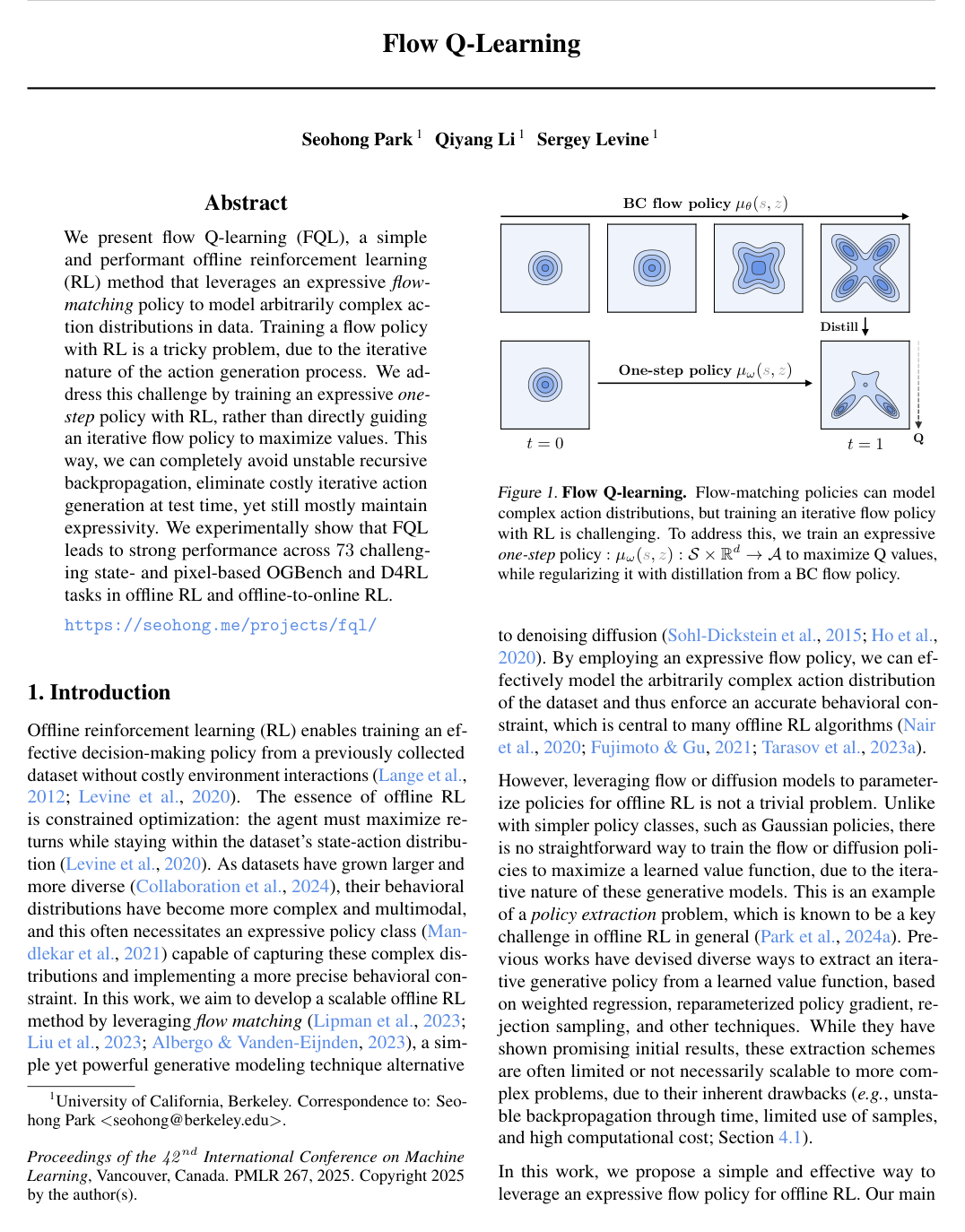
Flow Q-Learning
Seohong Park, Qiyang Li, Sergey Levine
Why you should read this
Proposes Flow Q-learning, a method that distills a multi-step flow-matching behavioral model into an expressive one-step actor to bypass unstable backpropagation through time and achieve fast, high-performing offline reinforcement learning.
We present flow Q-learning (FQL), a simple and performant offline reinforcement learning (RL) method that leverages an expressive flow-matching policy to model arbitrarily complex action distributions in data. Training a flow policy with RL is a tricky problem, due to the iterative nature of the action generation process. We address this challenge by training an expressive one-step policy with RL, rather than directly guiding an iterative flow policy to maximize values. This way, we can completely avoid unstable recursive backpropagation, eliminate costly iterative action generation at test time, yet still mostly maintain expressivity. We experimentally show that FQL leads to strong performance across 73 challenging state- and pixel-based OGBench and D4RL tasks in offline RL and offline-to-online RL. https://seohong.me/projects/fql/
Added
2026-09-26
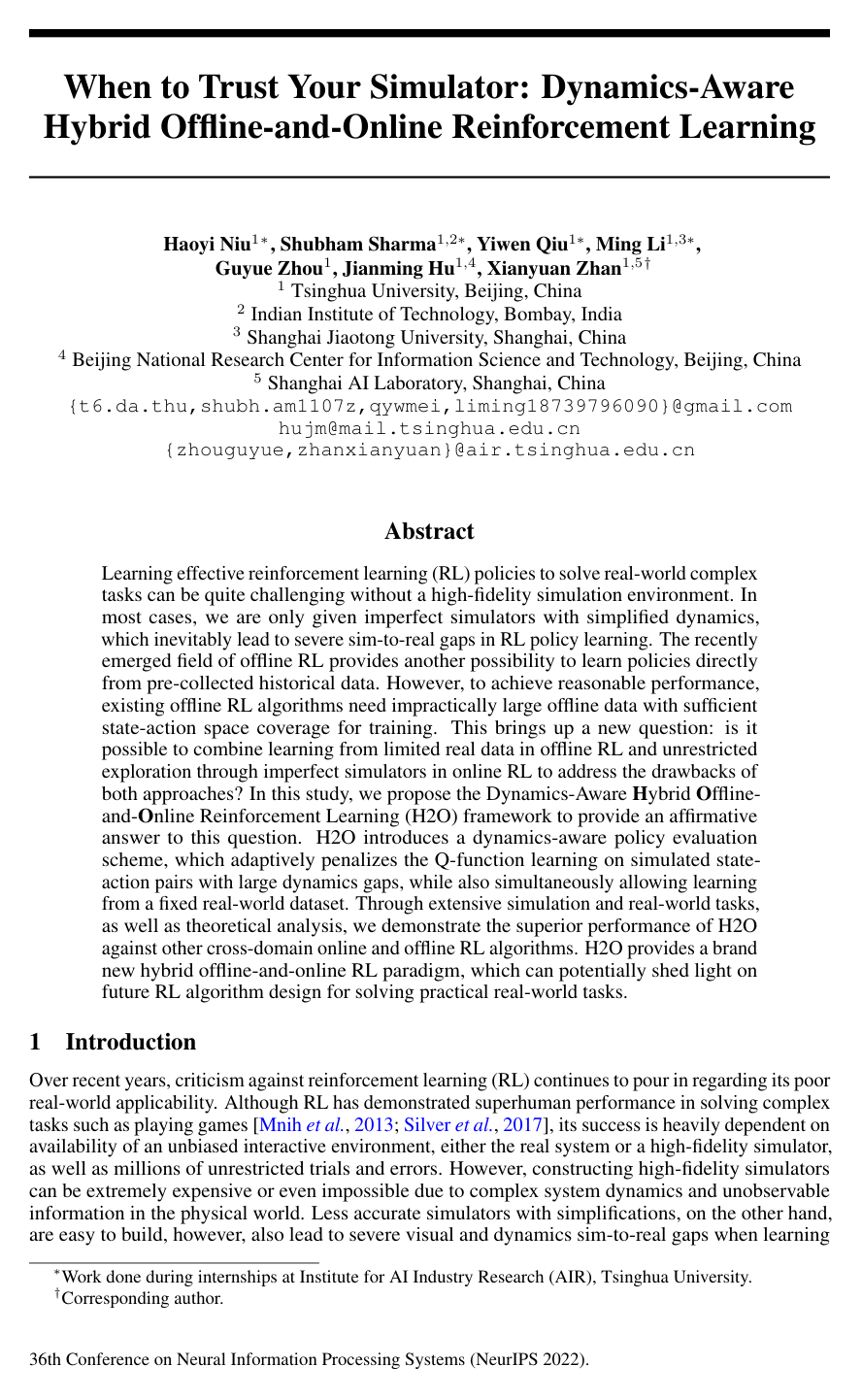
When to Trust Your Simulator: Dynamics-Aware Hybrid Offline-and-Online Reinforcement Learning
Haoyi Niu, Shubham Sharma, Yiwen Qiu, Ming Li, Guyue Zhou, Jianming Hu, Xianyuan Zhan
Why you should read this
Proposes the H2O framework, a hybrid reinforcement learning method that bridges sim-to-real dynamics gaps by adaptively penalizing value function estimates during simulation rollouts while learning directly from limited real-world datasets.
Learning effective reinforcement learning (RL) policies to solve real-world complex tasks can be quite challenging without a high-fidelity simulation environment. In most cases, we are only given imperfect simulators with simplified dynamics, which inevitably lead to severe sim-to-real gaps in RL policy learning. The recently emerged field of offline RL provides another possibility to learn policies directly from pre-collected historical data. However, to achieve reasonable performance, existing offline RL algorithms need impractically large offline data with sufficient state-action space coverage for training. This brings up a new question: is it possible to combine learning from limited real data in offline RL and unrestricted exploration through imperfect simulators in online RL to address the drawbacks of both approaches? In this study, we propose the Dynamics-Aware Hybrid Offline-and-Online Reinforcement Learning (H2O) framework to provide an affirmative answer to this question. H2O introduces a dynamics-aware policy evaluation scheme, which adaptively penalizes the Q-function learning on simulated state-action pairs with large dynamics gaps, while also simultaneously allowing learning from a fixed real-world dataset. Through extensive simulation and real-world tasks, as well as theoretical analysis, we demonstrate the superior performance of H2O against other cross-domain online and offline RL algorithms. H2O provides a brand new hybrid offline-and-online RL paradigm, which can potentially shed light on future RL algorithm design for solving practical real-world tasks.
Added
2026-09-26
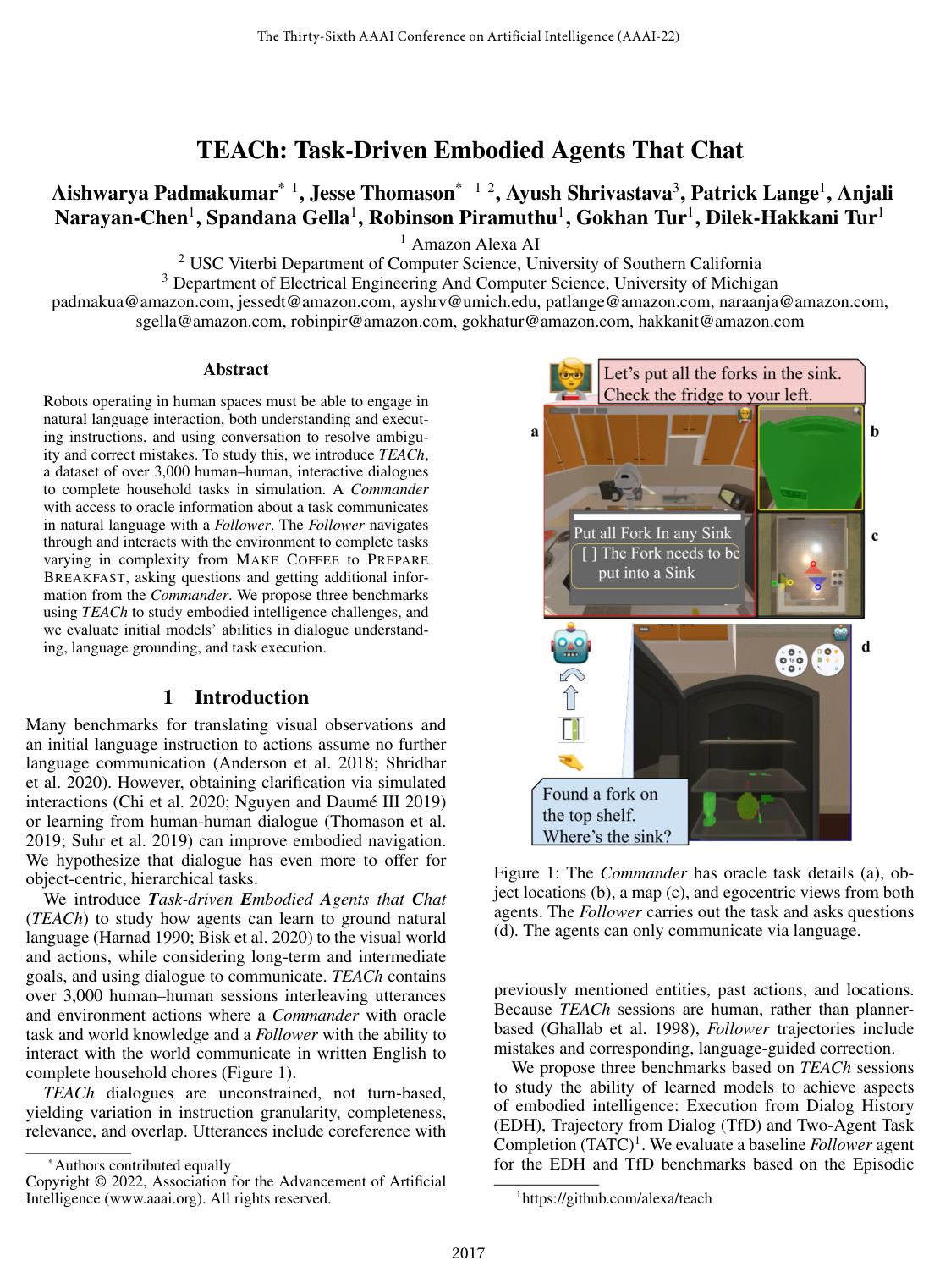
TEACh: Task-Driven Embodied Agents That Chat
Aishwarya Padmakumar, Jesse Thomason, Ayush Shrivastava, Patrick Lange, Anjali Narayan-Chen, Spandana Gella, Robinson Piramuthu, Gökhan Tür, Dilek Hakkani-Tür
Why you should read this
Introduces TEACh, a dataset and benchmark suite of over 3,000 simulated human-human dialogues that pairs freeform interactive communication with physical household object manipulation to advance conversational embodied AI agents.
Robots operating in human spaces must be able to engage in natural language interaction, both understanding and executing instructions, and using conversation to resolve ambiguity and correct mistakes. To study this, we introduce TEACh, a dataset of over 3,000 human–human, interactive dialogues to complete household tasks in simulation. A Commander with access to oracle information about a task communicates in natural language with a Follower. The Follower navigates through and interacts with the environment to complete tasks varying in complexity from MAKE COFFEE to PREPARE BREAKFAST, asking questions and getting additional information from the Commander. We propose three benchmarks using TEACh to study embodied intelligence challenges, and we evaluate initial models’ abilities in dialogue understanding, language grounding, and task execution.
Added
2026-09-26
EmbodiedGPT: Vision-Language Pre-Training via Embodied Chain of Thought
Yao Mu, Qinglong Zhang, Mengkang Hu, Wenhai Wang, Mingyu Ding, Jun Jin, Bin Wang, Jifeng Dai, Yu Qiao, Ping Luo
Why you should read this
Presents EmbodiedGPT, a vision-language foundation model that connects high-level chain-of-thought task planning to low-level robot control to substantially increase manipulation success rates across benchmarks like Franka Kitchen and Meta-World.
Embodied AI is a crucial frontier in robotics, capable of planning and executing action sequences for robots to accomplish long-horizon tasks in physical environments. In this work, we introduce EmbodiedGPT, an end-to-end multi-modal foundation model for embodied AI, empowering embodied agents with multi-modal understanding and execution capabilities. To achieve this, we have made the following efforts: (i) We craft a large-scale embodied planning dataset, termed EgoCOT. The dataset consists of carefully selected videos from the Ego4D dataset, along with corresponding high-quality language instructions. Specifically, we generate a sequence of sub-goals with the "Chain of Thoughts" mode for effective embodied planning. (ii) We introduce an efficient training approach to EmbodiedGPT for high-quality plan generation, by adapting a 7B large language model (LLM) to the EgoCOT dataset via prefix tuning. (iii) We introduce a paradigm for extracting task-related features from LLM-generated planning queries to form a closed loop between high-level planning and low-level control. Extensive experiments show the effectiveness of EmbodiedGPT on embodied tasks, including embodied planning, embodied control, visual captioning, and visual question answering. Notably, EmbodiedGPT significantly enhances the success rate of the embodied control task by extracting more effective features. It has achieved a remarkable 1.6 times increase in success rate on the Franka Kitchen benchmark and a 1.3 times increase on the Meta-World benchmark, compared to the BLIP-2 baseline fine-tuned with the Ego4D dataset.
Added
2026-09-26
GR00T N1: An Open Foundation Model for Generalist Humanoid Robots
NVIDIA, Johan Bjorck, Fernando Castañeda, Nikita Cherniadev, Xingye Da, Runyu Ding, Linxi "Jim" Fan, Yu Fang, Dieter Fox, Fengyuan Hu, Spencer Huang, Joel Jang, Zhenyu Jiang, Jan Kautz, Kaushil Kundalia, Lawrence Lao, Zhiqi Li, Zongyu Lin, Kevin Lin, Guilin Liu, Edith Llontop, Loic Magne, Ajay Mandlekar, Avnish Narayan, Soroush Nasiriany, Scott Reed, You Liang Tan, Guanzhi Wang, Zu Wang, Jing Wang, Qi Wang, Jiannan Xiang, Yuqi Xie, Yinzhen Xu, Zhenjia Xu, Seonghyeon Ye, Zhiding Yu, Ao Zhang, Hao Zhang, Yizhou Zhao, Ruijie Zheng, Yuke Zhu
Why you should read this
Presents GR00T N1, an open vision-language-action foundation model for humanoid robots that combines multimodal reasoning with a diffusion transformer to execute real-time, language-guided bimanual manipulation across diverse embodiments.
General-purpose robots need a versatile body and an intelligent mind. Recent advancements in humanoid robots have shown great promise as a hardware platform for building generalist autonomy in the human world. A robot foundation model, trained on massive and diverse data sources, is essential for enabling the robots to reason about novel situations, robustly handle real-world variability, and rapidly learn new tasks. To this end, we introduce GR00T N1, an open foundation model for humanoid robots. GR00T N1 is a Vision-Language-Action (VLA) model with a dual-system architecture. The vision-language module (System 2) interprets the environment through vision and language instructions. The subsequent diffusion transformer module (System 1) generates fluid motor actions in real time. Both modules are tightly coupled and jointly trained end-to-end. We train GR00T N1 with a heterogeneous mixture of real-robot trajectories, human videos, and synthetically generated datasets. We show that our generalist robot model GR00T N1 outperforms the state-of-the-art imitation learning baselines on standard simulation benchmarks across multiple robot embodiments. Furthermore, we deploy our model on the Fourier GR-1 humanoid robot for language-conditioned bimanual manipulation tasks, achieving strong performance with high data efficiency.
Added
2026-09-25
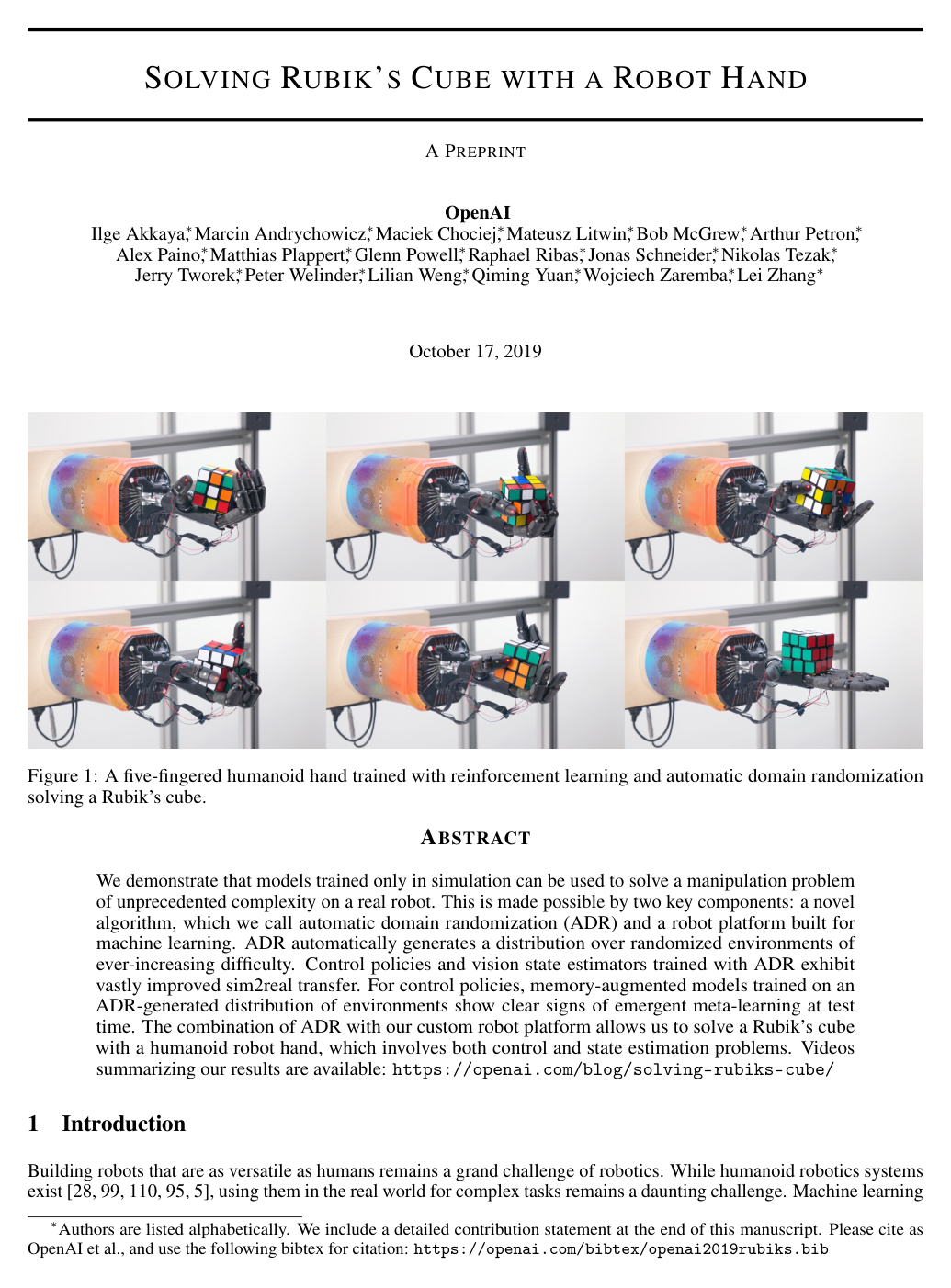
Solving Rubik's Cube with a Robot Hand
OpenAI, Ilge Akkaya, Marcin Andrychowicz, Maciek Chociej, Mateusz Litwin, Bob McGrew, Arthur Petron, Alex Paino, Matthias Plappert, Glenn Powell, Raphael Ribas, Jonas Schneider, Nikolas Tezak, Jerry Tworek, Peter Welinder, Lilian Weng, Qiming Yuan, Wojciech Zaremba, Lei Zhang
Why you should read this
Demonstrates that policies trained entirely in simulation via Automatic Domain Randomization can solve a physical Rubik's cube on a humanoid robot hand, establishing a viable approach for zero-shot sim-to-real transfer in dexterous manipulation.
We demonstrate that models trained only in simulation can be used to solve a manipulation problem of unprecedented complexity on a real robot. This is made possible by two key components: a novel algorithm, which we call automatic domain randomization (ADR) and a robot platform built for machine learning. ADR automatically generates a distribution over randomized environments of ever-increasing difficulty. Control policies and vision state estimators trained with ADR exhibit vastly improved sim2real transfer. For control policies, memory-augmented models trained on an ADR-generated distribution of environments show clear signs of emergent meta-learning at test time. The combination of ADR with our custom robot platform allows us to solve a Rubik's cube with a humanoid robot hand, which involves both control and state estimation problems. Videos summarizing our results are available: this https URL
Added
2026-09-25
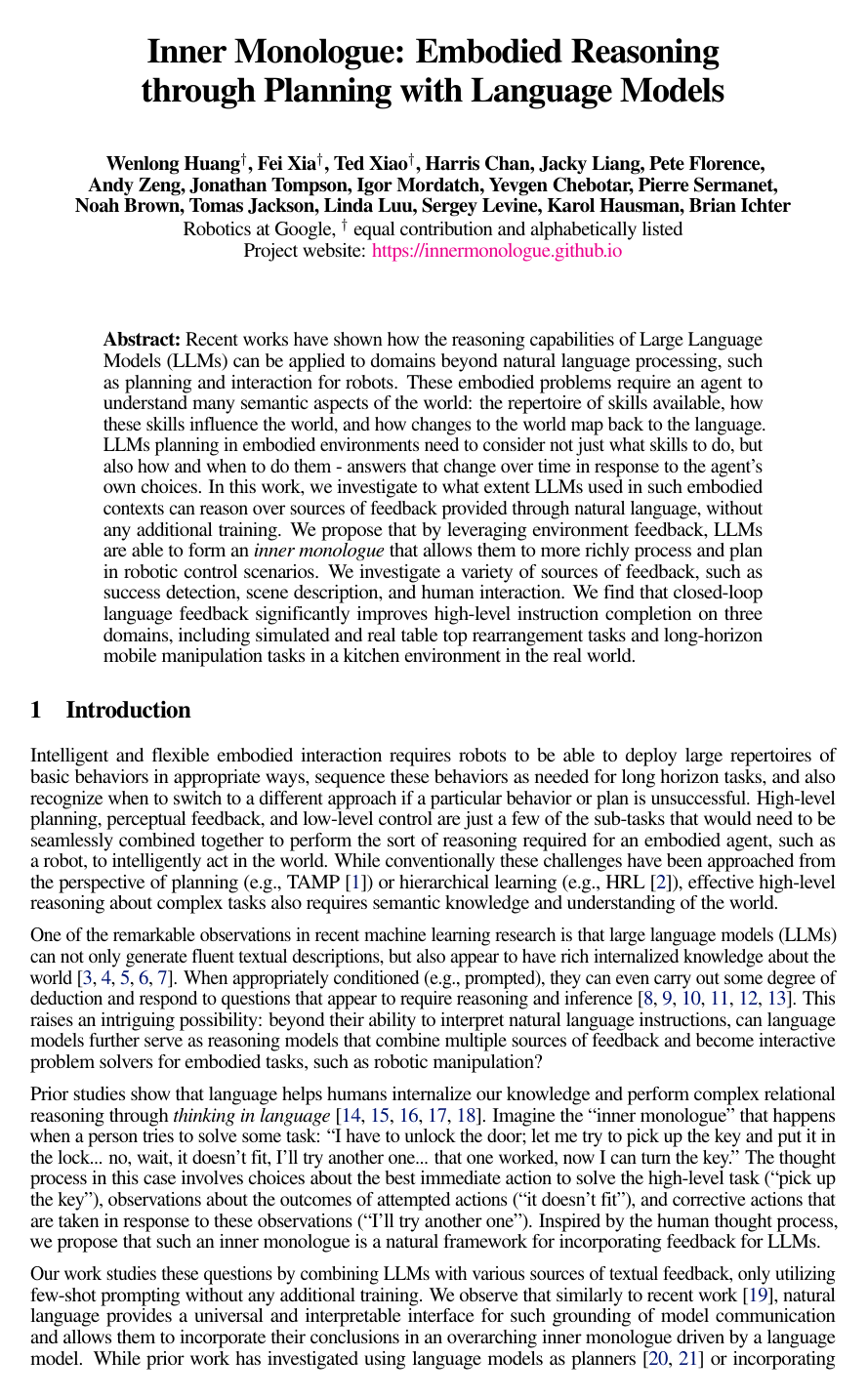
Inner Monologue: Embodied Reasoning through Planning with Language Models
Wenlong Huang, Fei Xia, Ted Xiao, Harris Chan, Jacky Liang, Pete Florence, Andy Zeng, Jonathan Tompson, Igor Mordatch, Yevgen Chebotar, Pierre Sermanet, Noah Brown, Tomas Jackson, Linda Luu, Sergey Levine, Karol Hausman, Brian Ichter
Why you should read this
Demonstrates how integrating real-time textual environment feedback into large language models enables closed-loop embodied reasoning and replanning without additional training, substantially improving the success rate of complex, long-horizon robotic tasks.
Recent works have shown how the reasoning capabilities of Large Language Models (LLMs) can be applied to domains beyond natural language processing, such as planning and interaction for robots. These embodied problems require an agent to understand many semantic aspects of the world: the repertoire of skills available, how these skills influence the world, and how changes to the world map back to the language. LLMs planning in embodied environments need to consider not just what skills to do, but also how and when to do them - answers that change over time in response to the agent's own choices. In this work, we investigate to what extent LLMs used in such embodied contexts can reason over sources of feedback provided through natural language, without any additional training. We propose that by leveraging environment feedback, LLMs are able to form an inner monologue that allows them to more richly process and plan in robotic control scenarios. We investigate a variety of sources of feedback, such as success detection, scene description, and human interaction. We find that closed-loop language feedback significantly improves high-level instruction completion on three domains, including simulated and real table top rearrangement tasks and long-horizon mobile manipulation tasks in a kitchen environment in the real world.
Added
2026-09-24
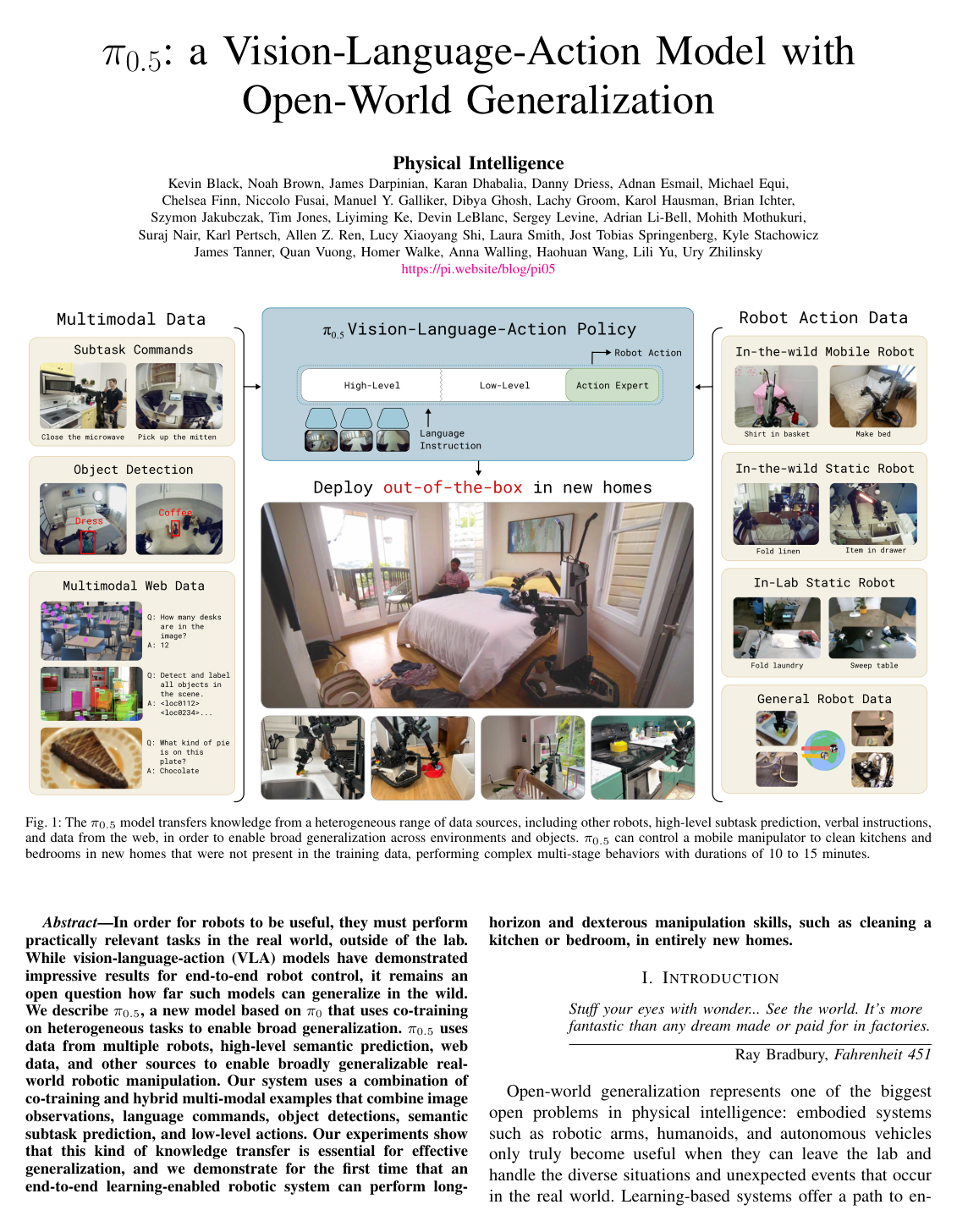
π0.5: a Vision-Language-Action Model with Open-World Generalization
Physical Intelligence, Kevin Black, Noah Brown, James Darpinian, Karan Dhabalia, Danny Driess, Adnan Esmail, Michael Equi, Chelsea Finn, Niccolo Fusai, Manuel Y. Galliker, Dibya Ghosh, Lachy Groom, Karol Hausman, Brian Ichter, Szymon Jakubczak, Tim Jones, Liyiming Ke, Devin LeBlanc, Sergey Levine, Adrian Li-Bell, Mohith Mothukuri, Suraj Nair, Karl Pertsch, Allen Z. Ren, Lucy Xiaoyang Shi, Laura Smith, Jost Tobias Springenberg, Kyle Stachowicz, James Tanner, Quan Vuong, Homer Walke, Anna Walling, Haohuan Wang, Lili Yu, Ury Zhilinsky
Why you should read this
Presents , an end-to-end vision-language-action model that leverages heterogeneous co-training across multi-robot and web data to perform dexterous, long-horizon manipulation tasks in previously unseen real-world homes.
In order for robots to be useful, they must perform practically relevant tasks in the real world, outside of the lab. While vision-language-action (VLA) models have demonstrated impressive results for end-to-end robot control, it remains an open question how far such models can generalize in the wild. We describe , a new model based on that uses co-training on heterogeneous tasks to enable broad generalization. \ uses data from multiple robots, high-level semantic prediction, web data, and other sources to enable broadly generalizable real-world robotic manipulation. Our system uses a combination of co-training and hybrid multi-modal examples that combine image observations, language commands, object detections, semantic subtask prediction, and low-level actions. Our experiments show that this kind of knowledge transfer is essential for effective generalization, and we demonstrate for the first time that an end-to-end learning-enabled robotic system can perform long-horizon and dexterous manipulation skills, such as cleaning a kitchen or bedroom, in entirely new homes.
Added
2026-09-24
Isaac Gym: High Performance GPU-Based Physics Simulation For Robot Learning
Viktor Makoviychuk, Lukasz Wawrzyniak, Yunrong Guo, Michelle Lu, Kier Storey, Miles Macklin, David Hoeller, Nikita Rudin, Arthur Allshire, Ankur Handa, Gavriel State
Why you should read this
Presents an end-to-end GPU-accelerated physics simulation framework that eliminates CPU data transfer bottlenecks to train complex robotic reinforcement learning policies up to three orders of magnitude faster on a single GPU.
Isaac Gym offers a high performance learning platform to train policies for wide variety of robotics tasks directly on GPU. Both physics simulation and the neural network policy training reside on GPU and communicate by directly passing data from physics buffers to PyTorch tensors without ever going through any CPU bottlenecks. This leads to blazing fast training times for complex robotics tasks on a single GPU with 2-3 orders of magnitude improvements compared to conventional RL training that uses a CPU based simulator and GPU for neural networks. We host the results and videos at \url{this https URL} and isaac gym can be downloaded at \url{this https URL}.
Added
2026-09-18
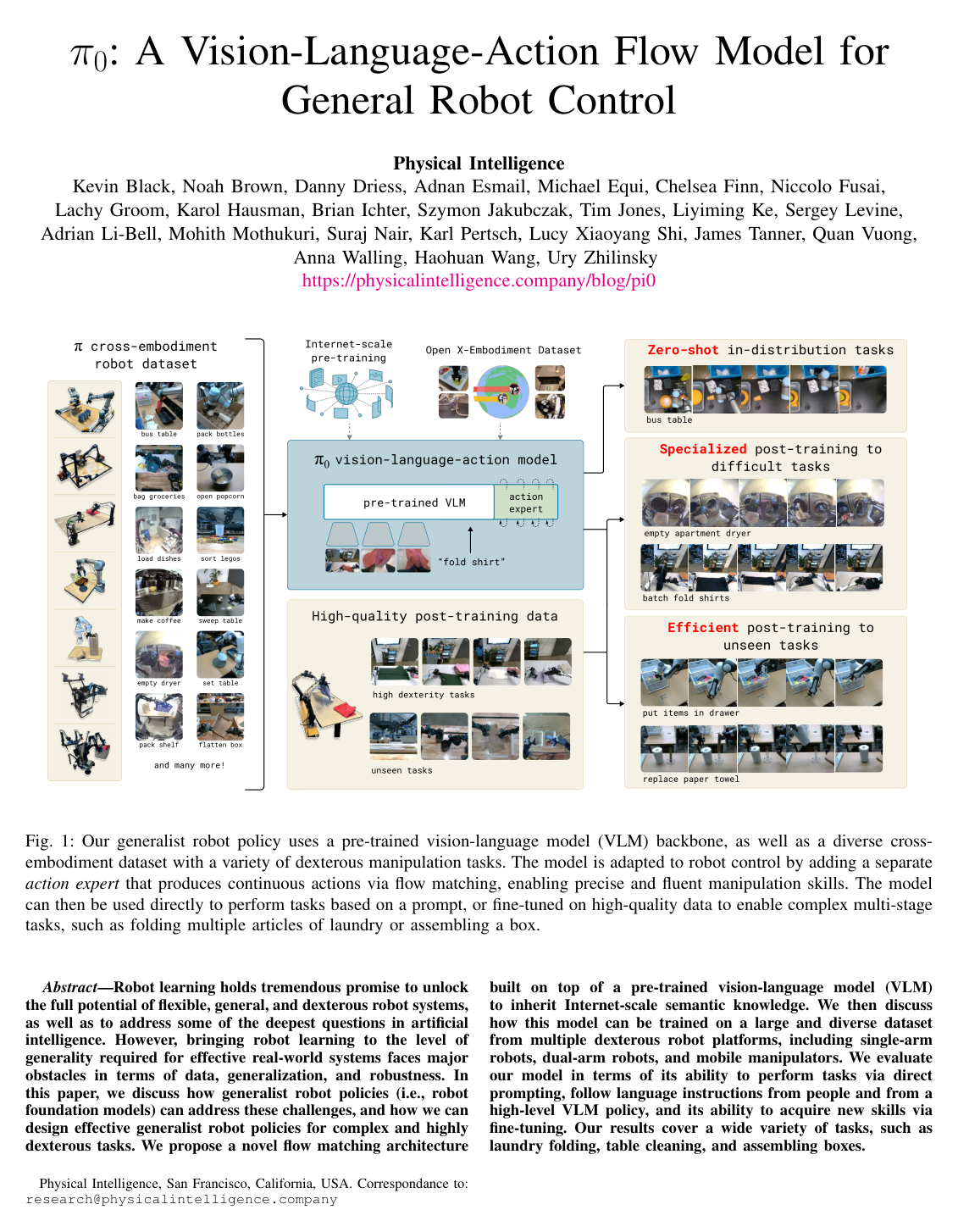
π0: A Vision-Language-Action Flow Model for General Robot Control
Kevin Black, Noah Brown, Danny Driess, Adnan Esmail, Michael Equi, Chelsea Finn, Niccolo Fusai, Lachy Groom, Karol Hausman, Brian Ichter, Szymon Jakubczak, Tim Jones, Liyiming Ke, Sergey Levine, Adrian Li-Bell, Mohith Mothukuri, Suraj Nair, Karl Pertsch, Lucy Xiaoyang Shi, James Tanner, Quan Vuong, Anna Walling, Haohuan Wang, Ury Zhilinsky
Why you should read this
Presents π₀, a vision-language-action model that combines flow matching with pre-trained vision-language representations to enable generalist, highly dexterous control across single-arm, dual-arm, and mobile manipulation platforms.
Robot learning holds tremendous promise to unlock the full potential of flexible, general, and dexterous robot systems, as well as to address some of the deepest questions in artificial intelligence. However, bringing robot learning to the level of generality required for effective real-world systems faces major obstacles in terms of data, generalization, and robustness. In this paper, we discuss how generalist robot policies (i.e., robot foundation models) can address these challenges, and how we can design effective generalist robot policies for complex and highly dexterous tasks. We propose a novel flow matching architecture built on top of a pre-trained vision-language model (VLM) to inherit Internet-scale semantic knowledge. We then discuss how this model can be trained on a large and diverse dataset from multiple dexterous robot platforms, including single-arm robots, dual-arm robots, and mobile manipulators. We evaluate our model in terms of its ability to perform tasks in zero shot after pre-training, follow language instructions from people and from a high-level VLM policy, and its ability to acquire new skills via fine-tuning. Our results cover a wide variety of tasks, such as laundry folding, table cleaning, and assembling boxes.
Added
2026-09-14