π0.5: a Vision-Language-Action Model with Open-World Generalization
Physical IntelligenceKevin BlackNoah BrownJames DarpinianKaran DhabaliaDanny DriessAdnan EsmailMichael EquiChelsea FinnNiccolo Fusai
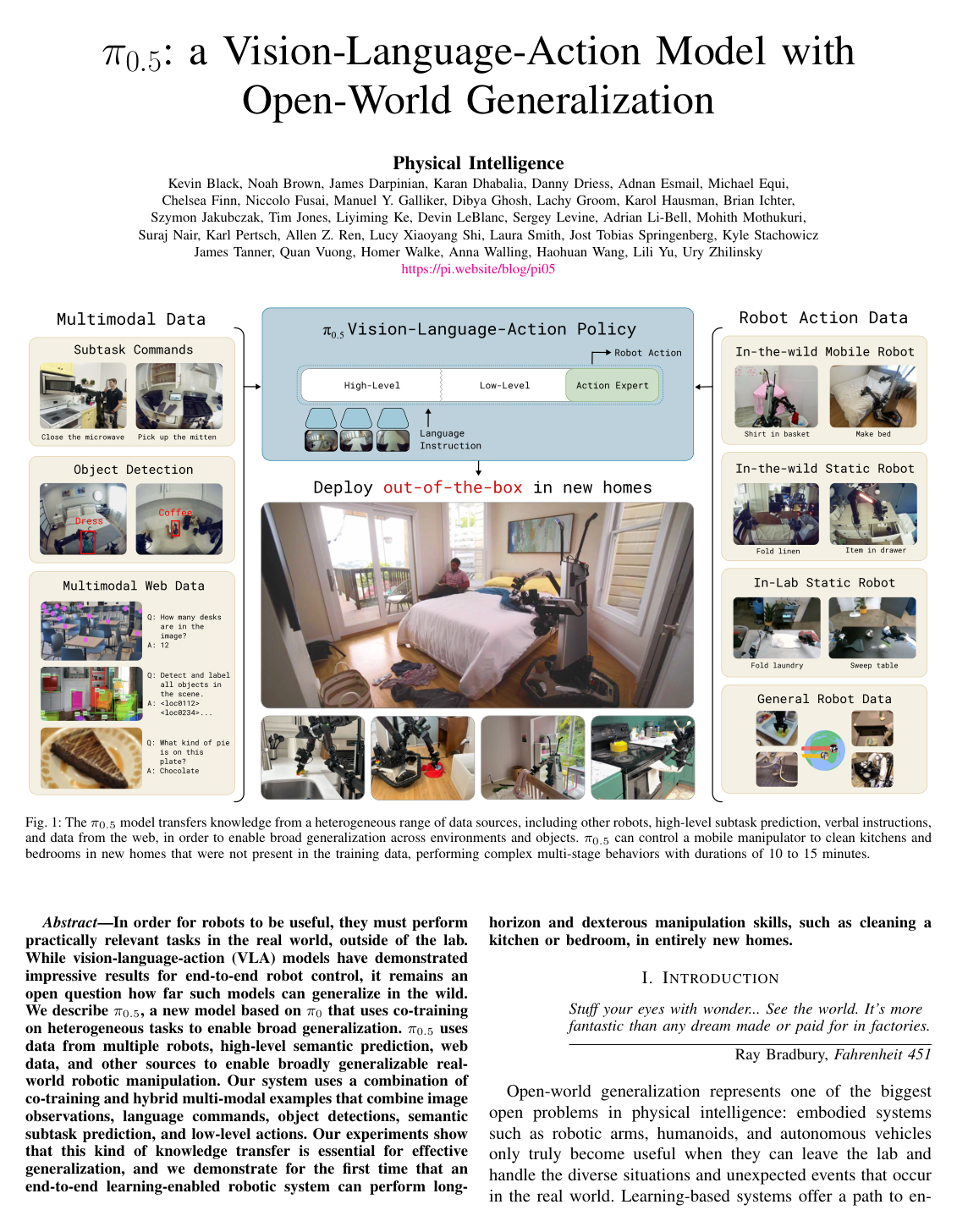
Presents , an end-to-end vision-language-action model that leverages heterogeneous co-training across multi-robot and web data to perform dexterous, long-horizon manipulation tasks in previously unseen real-world homes.
Deploying autonomous robots to perform complex household tasks in novel real-world environments remains a fundamental hurdle in robotics. Traditional vision-language-action models often fail when encountering unseen layouts, unfamiliar objects, or long-horizon tasks, largely because scaling real-world demonstration collection across every possible domestic environment is prohibitively expensive and logistically impractical.
The article demonstrates and evaluates a vision-language-action model, named π0.5, designed to achieve open-world generalization. The central objective is to evaluate whether co-training a unified model on heterogeneous data sources allows mobile manipulators to perform intricate, multi-stage domestic tasks out-of-the-box in entirely new homes.
To address this challenge, the authors implemented a two-stage hierarchical training approach. The model combines a core vision-language transformer backbone with a specialized continuous action expert. During the initial pre-training phase, the architecture learns over discrete tokens representing a broad mixture of data, where 97.6% of the examples come from non-target sources, including web data (visual question answering, image captioning, and object detection), multi-robot laboratory data, and static arm demonstrations across diverse environments. In the post-training phase, the model is specialized using approximately 400 hours of mobile manipulator demonstrations across roughly 100 homes, combined with verbal supervisory instructions and flow matching for real-time continuous control. The authors evaluated the system through extensive multi-trial experiments across 12 testing sites, including six mock rooms and six rooms in three completely unseen real homes, measuring performance on extended tasks lasting up to 10 to 15 minutes.
The findings show that π0.5 achieves high task success in previously unseen environments, matching the performance of baseline models trained directly within the test homes. Transfer across heterogeneous robotic embodiments proved critical; omitting non-mobile or cross-embodiment laboratory data significantly degraded manipulation success. Incorporating multimodal web data substantially enhanced language following and physical reasoning, especially for novel, out-of-distribution object categories. Furthermore, explicit high-level subtask prediction outperformed flat action architectures and external planning models such as zero-shot GPT-4, and language following accuracy improved consistently as the number of distinct training environments scaled up to 104 locations.
These results indicate that robotic foundation models do not require massive fleets of target hardware collecting data in every deployment setting. Instead, broad generalization can be effectively achieved by transferring knowledge from cheaper, heterogeneous data streams, such as static robot arms, web data, and human verbal instructions. This design reduces the cost, time, and hardware wear associated with scaling physical data collection while significantly improving the robustness of general-purpose robots.
Organizations developing or deploying robotic manipulation systems should prioritize heterogeneous co-training frameworks over narrow, single-platform data collection pipelines. Teams should implement structured, two-level inference pipelines that link high-level semantic reasoning to fast continuous action generation, while also capturing verbal supervisor corrections during operation. Future technical roadmaps should focus on expanding model context to handle partial observability—such as room-to-room navigation—and refining grasp execution on complex physical fixtures like non-standard drawer handles.
While the reported results demonstrate high confidence across structured domestic tasks, users should maintain caution. The model still experiences occasional failures due to visual occlusions and repetitive subtask loops, and it relies on relatively short textual instructions rather than complex, highly nuanced user prompts.
- Paper: π0: A Vision-Language-Action Flow Model for General Robot Control, Kevin Black et al. (2024). Provides the foundational π0 flow-matching vision-language-action architecture upon which π0.5 directly builds.
- Paper: RT-2: Vision-Language-Action Models Transfer Web Knowledge to Robotic Control, Anthony Brohan et al. (2023). Introduces the paradigm of co-fine-tuning vision-language models on web data and robot actions to transfer semantic knowledge to control.
- Paper: OpenVLA: An Open-Source Vision-Language-Action Model, Moo Jin Kim et al. (2024). Establishes open-source vision-language-action pre-training across multi-robot dataset mixtures for generalized manipulation.
- Paper: PaLM-E: An Embodied Multimodal Language Model, Danny Driess et al. (2023). Demonstrates how co-training embodied language models on internet vision-language data significantly enhances robotic task planning and generalization.
- Paper: RT-1: Robotics Transformer for Real-World Control at Scale, Anthony Brohan et al. (2023). Pioneers large-scale multi-task transformer policies trained on diverse real-world robotic demonstration datasets.
- Paper: Do As I Can, Not As I Say: Grounding Language in Robotic Affordances, Michael Ahn et al. (2022). Shows how high-level semantic language reasoning can be grounded into executable low-level robotic affordances.
- Paper: Learning Fine-Grained Bimanual Manipulation with Low-Cost Hardware, Tony Z. Zhao et al. (2023). Presents action chunking transformers for learning fine-grained, dexterous bimanual manipulation from demonstrations.
- Paper: TwinBrainVLA: Unleashing the Potential of Generalist VLMs for Embodied Tasks via Asymmetric Mixture-of-Transformers, Bin Yu et al. (2026). Explores dual-pathway architectures and flow-matching control to prevent catastrophic forgetting when adapting general vision-language models to robot manipulation.
- Paper: DynamicVLA: A Vision-Language-Action Model for Dynamic Object Manipulation, Haozhe Xie et al. (2026). Extends VLA control strategies to dynamic manipulation settings using continuous inference and action streaming.
- Paper: CoA-VLA: Improving Vision-Language-Action Models via Visual-Textual Chain-of-Affordance, Jinming Li et al. (2025). Builds upon VLA architectures by embedding explicit step-by-step visual and textual chain-of-affordance reasoning into action generation.
- Paper: RDT-1B: a Diffusion Foundation Model for Bimanual Manipulation, Songming Liu et al. (2025). Applies large-scale multi-robot pre-training and unified physical action spaces to scale diffusion-based foundation models for bimanual manipulation.
- Paper: Vision-Language-Action Models: Concepts, Progress, Applications and Challenges, Ranjan Sapkota et al. (2025). Provides a comprehensive survey framing recent unified vision-language-action foundation models and their deployment challenges.