π0: A Vision-Language-Action Flow Model for General Robot Control
Kevin BlackNoah BrownDanny DriessAdnan EsmailMichael EquiChelsea FinnNiccolo FusaiLachy GroomKarol HausmanBrian Ichter
Presents π₀, a vision-language-action model that combines flow matching with pre-trained vision-language representations to enable generalist, highly dexterous control across single-arm, dual-arm, and mobile manipulation platforms.
The article addresses the challenge of creating flexible, general-purpose robot systems capable of handling diverse physical tasks in real-world settings. Current robot learning struggles with limited data availability, poor generalization across environments, and insufficient robustness to variations or errors, limiting practical deployment despite advances in specialized AI.
The article set out to evaluate whether a generalist robot policy, pre-trained on large-scale diverse data and refined through targeted fine-tuning, could achieve broad capabilities and high dexterity across multiple robot platforms and complex tasks.
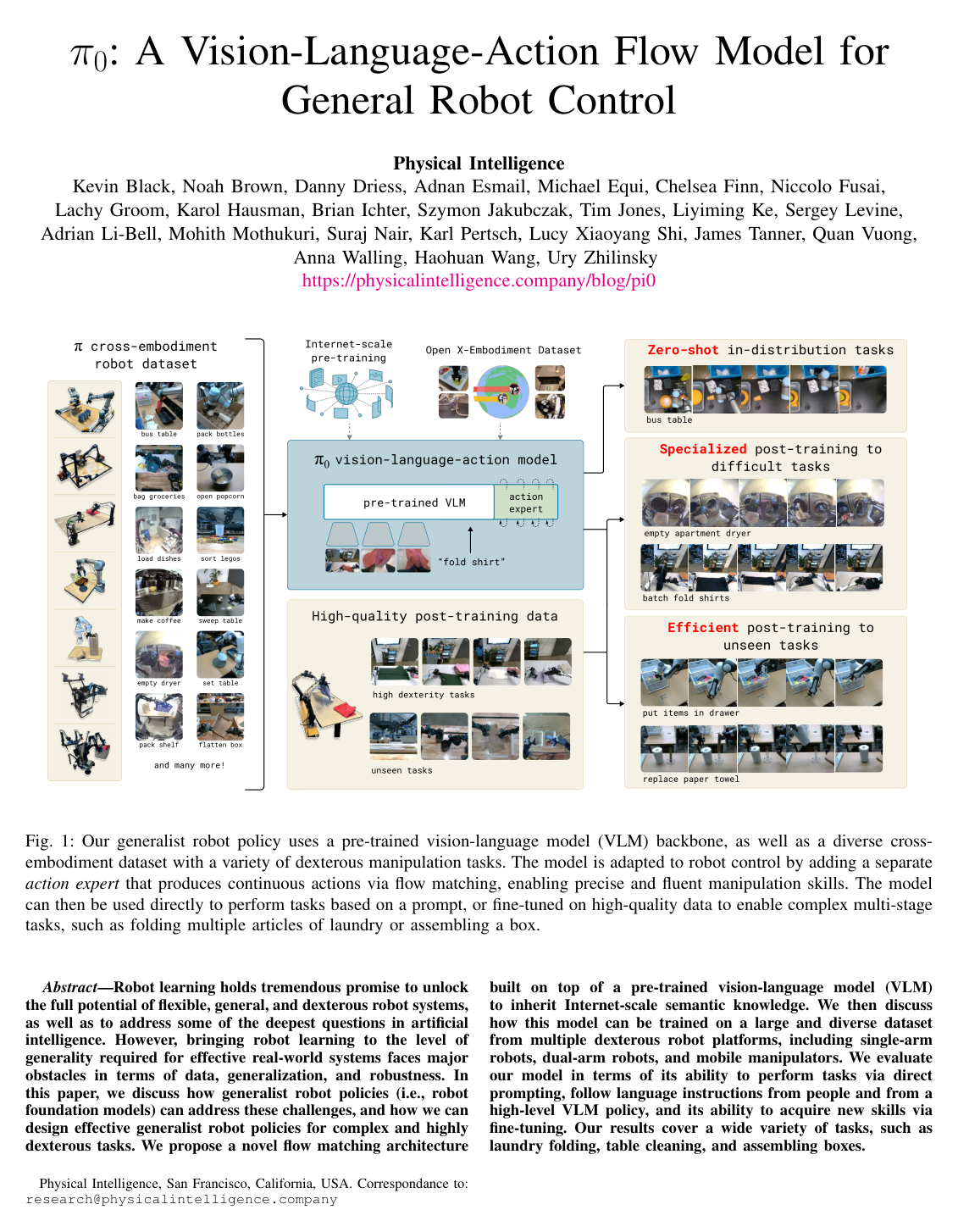
The approach involved developing π0, a model built on a pre-trained vision-language model backbone augmented with an action expert using flow matching to generate continuous actions. It was pre-trained on roughly 10,000 hours of robot data spanning seven robot configurations and 68 tasks, combined with open-source datasets, then either used directly or fine-tuned on smaller high-quality datasets for specific applications.
Key findings indicate that the pre-trained model substantially outperformed prior vision-language-action models and diffusion-based baselines on out-of-box tasks such as shirt folding and table bussing, with near-perfect success on easier variants and large margins on harder ones. It demonstrated strong language command following, benefiting from both human and high-level model guidance, and achieved effective fine-tuning on new dexterous tasks with as little as one to five hours of data. On complex multi-stage tasks including laundry folding, box assembly, and egg packing, the full pre-training and fine-tuning recipe enabled reliable performance exceeding 50 percent of maximum scores where other methods failed.
These results suggest that combining Internet-scale semantic knowledge from vision-language models with large-scale robot pre-training and a post-training phase can produce policies that balance broad generalization with precise, fluent execution, potentially reducing the data and engineering effort needed for new robot applications.
The article indicates that next steps should focus on refining data composition and weighting strategies during pre-training, determining the minimum data volumes required for near-perfect reliability on specific tasks, and testing transfer to additional domains such as navigation or locomotion.
Limitations include incomplete reliability on some evaluated tasks, uncertainty about optimal data mixtures, and the absence of evidence for universality across highly distinct robot domains; confidence in the core performance gains is high based on consistent outperformance across multiple experiments, but caution is warranted when extrapolating to untested settings or larger scales.
- Paper: RT-2: Vision-Language-Action Models Transfer Web Knowledge to Robotic Control, Anthony Brohan et al. (2023). RT-2 establishes the foundational vision-language-action (VLA) paradigm of fine-tuning web-scale visual-language backbones directly for robotic control, which π0 builds upon and enhances with flow matching.
- Paper: RT-1: Robotics Transformer for Real-World Control at Scale, Anthony Brohan et al. (2023). RT-1 introduced large-scale multi-task robot data collection and transformer-based policy learning that serves as a direct architectural and empirical predecessor to the π0 foundation model.
- Paper: OpenVLA: An Open-Source Vision-Language-Action Model, Moo Jin Kim et al. (2024). OpenVLA provides key methodology for adapting pre-trained vision-language models across diverse multi-robot datasets, serving as a primary open VLA baseline that π0 directly evaluates against and improves upon.
- Paper: PaLM-E: An Embodied Multimodal Language Model, Danny Driess et al. (2023). PaLM-E demonstrated how pre-trained language models can ingest multimodal sensory inputs for embodied decision-making, providing essential background for generalist robot policy formulation.
- Paper: Learning Fine-Grained Bimanual Manipulation with Low-Cost Hardware, Tony Z. Zhao et al. (2023). ACT established action chunking and sequence modeling for fine-grained bimanual manipulation, laying the groundwork for continuous high-frequency action generation in π0.
- Paper: RDT-1B: a Diffusion Foundation Model for Bimanual Manipulation, Songming Liu et al. (2025). RDT-1B extends foundation-scale continuous action modeling by proposing a diffusion-based transformer with a unified physical action space specifically designed for dexterous bimanual manipulation.
- Paper: TwinBrainVLA: Unleashing the Potential of Generalist VLMs for Embodied Tasks via Asymmetric Mixture-of-Transformers, Bin Yu et al. (2026). TwinBrainVLA builds upon flow-matching VLA models like π0 by using an asymmetric dual-pathway architecture to mitigate catastrophic forgetting of semantic reasoning during embodied fine-tuning.
- Paper: CoA-VLA: Improving Vision-Language-Action Models via Visual-Textual Chain-of-Affordance, Jinming Li et al. (2025). CoA-VLA advances VLA continuous policy execution by injecting visual-textual chains of affordances directly into the policy network to enable step-by-step spatial reasoning.
- Paper: DynamicVLA: A Vision-Language-Action Model for Dynamic Object Manipulation, Haozhe Xie et al. (2026). DynamicVLA adapts vision-language-action architectures to fast, moving-object manipulation through continuous inference and real-time action streaming.
- Paper: Vision-Language-Action Models: Concepts, Progress, Applications and Challenges, Ranjan Sapkota et al. (2025). This survey provides a structured overview of the subsequent concepts, progress, and deployment challenges across modern vision-language-action foundation models, contextualizing π0 within the broader literature.