
keyword
reasoning segmentation
Reasoning segmentation is a computer vision task in which an artificial intelligence model generates precise pixel-level masks for visual targets based on complex, implicit, or non-visual text prompts. Unlike traditional segmentation methods that rely on explicit object categories, bounding boxes, or straightforward referring expressions, reasoning segmentation requires the system to interpret nuanced user intentions, infer spatial or causal relationships, and apply broader contextual or world knowledge to deduce which visual elements in an image or video satisfy the description.
5 items
LISA: Reasoning Segmentation via Large Language Model
Xin Lai, Zhuotao Tian, Yukang Chen, Yanwei Li, Yuhui Yuan, Shu Liu, Jiaya Jia
Why you should read this
Introduces the task of reasoning segmentation alongside LISA, an end-to-end multimodal architecture that decodes special text tokens into binary masks to segment targets specified by implicit, knowledge-intensive user instructions.
Although perception systems have made remarkable advancements in recent years, they still rely on explicit human instruction or pre-defined categories to identify the target objects before executing visual recognition tasks. Such systems cannot actively reason and comprehend implicit user intention. In this work, we propose a new segmentation task — reasoning segmentation. The task is designed to output a segmentation mask given a complex and implicit query text. Furthermore, we establish a benchmark comprising over one thousand image-instruction-mask data samples, incorporating intricate reasoning and world knowledge for evaluation purposes. Finally, we present LISA: large Language Instructed Segmentation Assistant, which inherits the language generation capabilities of multimodal Large Language Models (LLMs) while also possessing the ability to produce segmentation masks. We expand the original vocabulary with a <SEG> token and propose the embedding-as-mask paradigm to unlock the segmentation capability. Remarkably, LISA can handle cases involving complex reasoning and world knowledge. Also, it demonstrates robust zero-shot capability when trained exclusively on reasoning-free datasets. In addition, fine-tuning the model with merely 239 reasoning segmentation data samples results in further performance enhancement. Both quantitative and qualitative experiments show our method effectively unlocks new reasoning segmentation capabilities for multimodal LLMs. Code, models, and data are available at github.com/dvlab-research/LISA.
Added
2026-10-05
OMG-LLaVA: Bridging Image-level, Object-level, Pixel-level Reasoning and Understanding
Tao Zhang, Xiangtai Li, Hao Fei, Haobo Yuan, Shengqiong Wu, Shunping Ji, Chen Change Loy, Shuicheng Yan
Why you should read this
Unifies image-level conversation, object-level visual prompting, and pixel-level segmentation into a single multimodal framework powered by one visual encoder, one decoder, and one LLM trained end-to-end.
Current universal segmentation methods demonstrate strong capabilities in pixel-level image and video understanding. However, they lack reasoning abilities and cannot be controlled via text instructions. In contrast, large vision-language multimodal models exhibit powerful vision-based conversation and reasoning capabilities but lack pixel-level understanding and have difficulty accepting visual prompts for flexible user interaction. This paper proposes OMG-LLaVA, a new and elegant framework combining powerful pixel-level vision understanding with reasoning abilities. It can accept various visual and text prompts for flexible user interaction. Specifically, we use a universal segmentation method as the visual encoder, integrating image information, perception priors, and visual prompts into visual tokens provided to the LLM. The LLM is responsible for understanding the user’s text instructions and providing text responses and pixel-level segmentation results based on the visual information. We propose perception prior embedding to better integrate perception priors with image features. OMG-LLaVA achieves image-level, object-level, and pixel-level reasoning and understanding in a single model, matching or surpassing the performance of specialized methods on multiple benchmarks. Rather than using LLM to connect each specialist, our work aims at end-to-end training on one encoder, one decoder, and one LLM. The code and model have been released for further research.
Added
2026-09-26
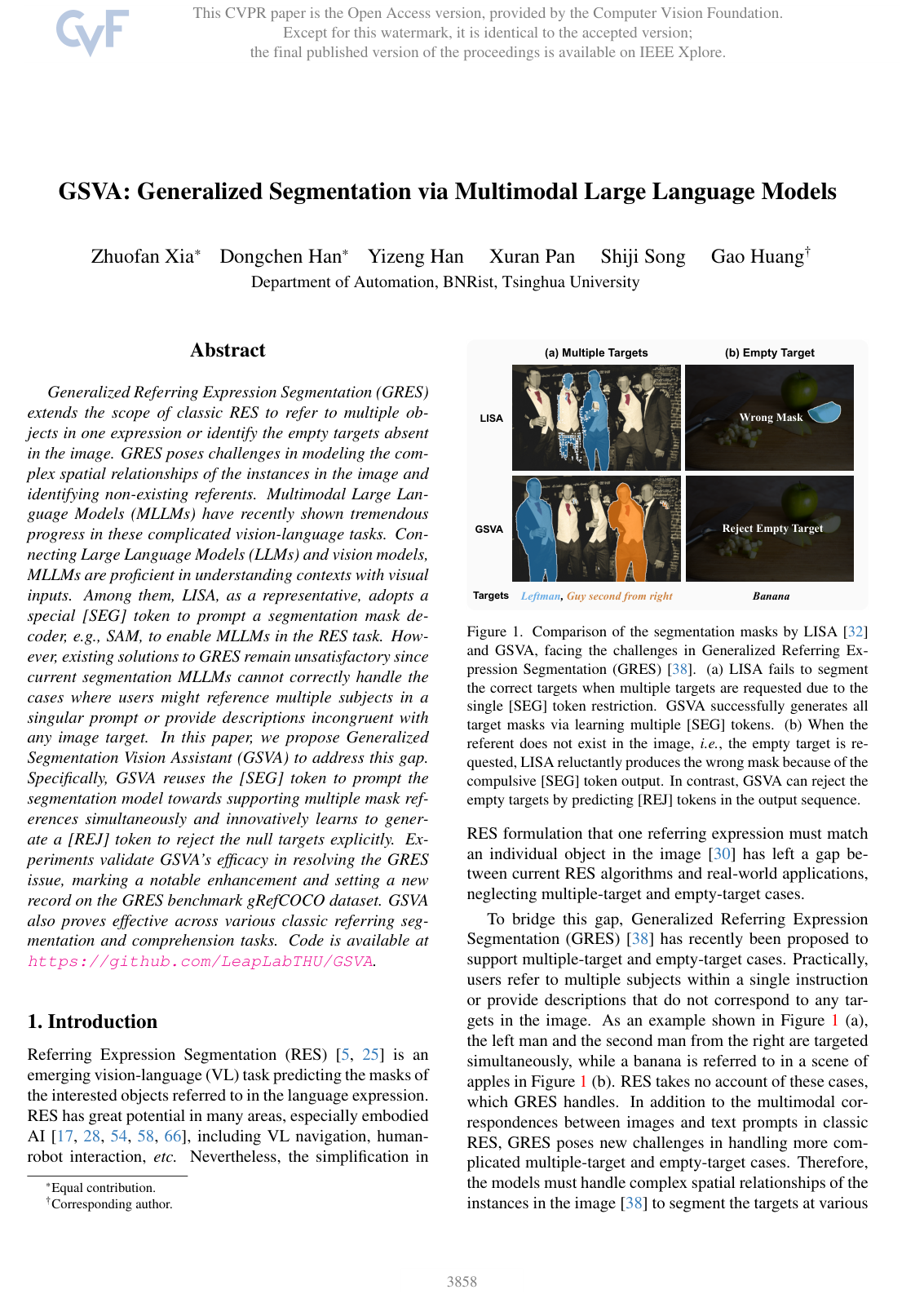
GSVA: Generalized Segmentation via Multimodal Large Language Models
Zhuofan Xia, Dongchen Han, Yizeng Han, Xuran Pan, Shiji Song, Gao Huang
Why you should read this
Presents a multimodal framework that enables language models to segment multiple target objects simultaneously and explicitly reject non-existent targets using dedicated tokens, setting a new state of the art on the gRefCOCO benchmark.
Generalized Referring Expression Segmentation (GRES) extends the scope of classic RES to refer to multiple objects in one expression or identify the empty targets absent in the image. GRES poses challenges in modeling the complex spatial relationships of the instances in the image and identifying non-existing referents. Multimodal Large Language Models (MLLMs) have recently shown tremendous progress in these complicated vision-language tasks. Connecting Large Language Models (LLMs) and vision models, MLLMs are proficient in understanding contexts with visual inputs. Among them, LISA, as a representative, adopts a special [SEG] token to prompt a segmentation mask decoder, e.g., SAM, to enable MLLMs in the RES task. However, existing solutions to GRES remain unsatisfactory since current segmentation MLLMs cannot correctly handle the cases where users might reference multiple subjects in a singular prompt or provide descriptions incongruent with any image target. In this paper, we propose Generalized Segmentation Vision Assistant (GSVA) to address this gap. Specifically, GSVA reuses the [SEG] token to prompt the segmentation model towards supporting multiple mask references simultaneously and innovatively learns to generate a [REJ] token to reject the null targets explicitly. Experiments validate GSVA’s efficacy in resolving the GRES issue, marking a notable enhancement and setting a new record on the GRES benchmark gRefCOCO dataset. GSVA also proves effective across various classic referring segmentation and comprehension tasks. Code is available at https://github.com/LeapLabTHU/GSVA.
Added
2026-09-26
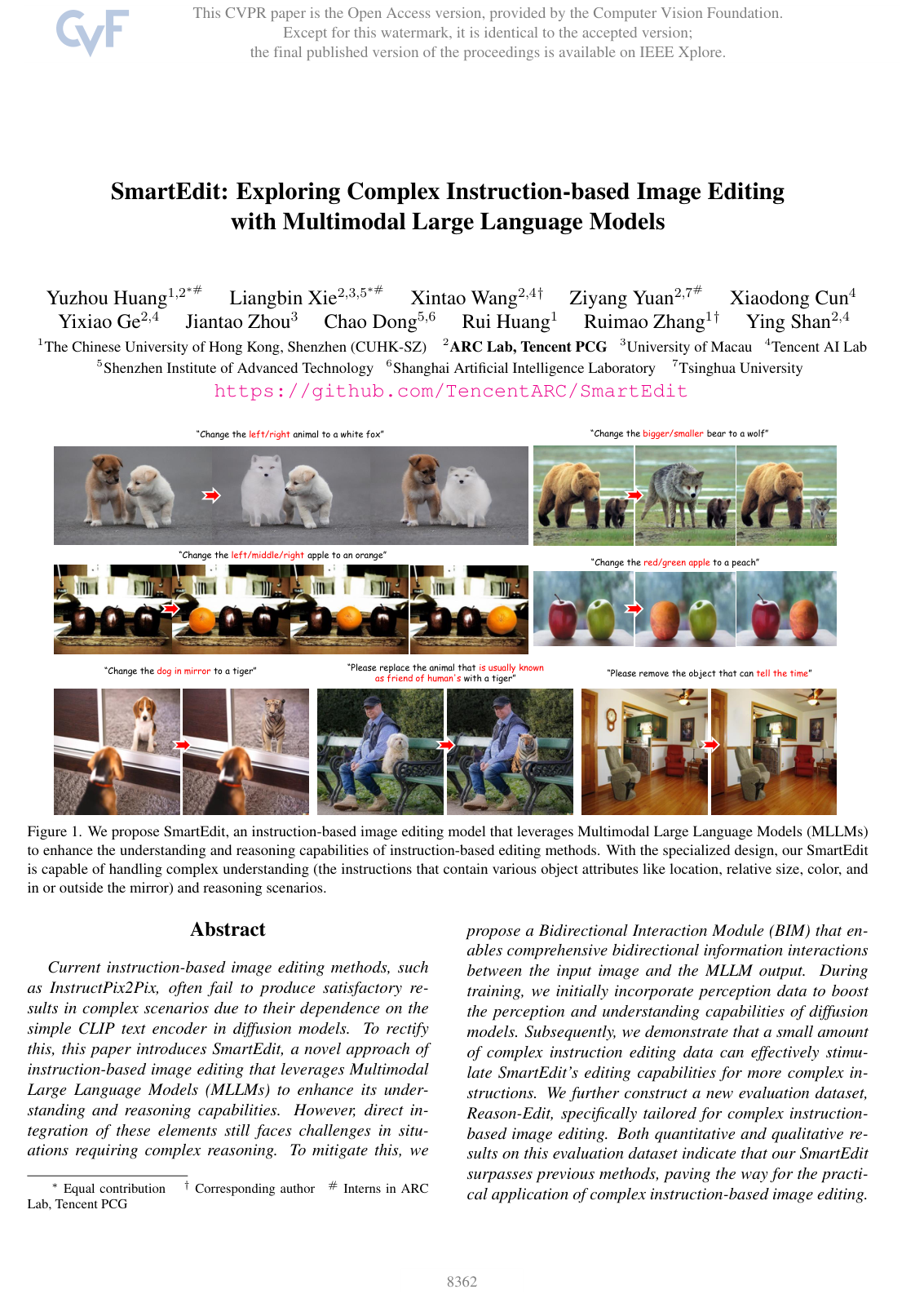
SmartEdit: Exploring Complex Instruction-Based Image Editing with Multimodal Large Language Models
Yuzhou Huang, Liangbin Xie, Xintao Wang, Ziyang Yuan, Xiaodong Cun, Yixiao Ge, Jiantao Zhou, Chao Dong, Rui Huang, Ruimao Zhang, Ying Shan
Why you should read this
Develops SmartEdit, a framework integrating multimodal large language models with diffusion models via a bidirectional interaction module and targeted perception training to execute image editing instructions requiring multi-object reasoning and world knowledge.
Current instruction-based image editing methods, such as InstructPix2Pix, often fail to produce satisfactory results in complex scenarios due to their dependence on the simple CLIP text encoder in diffusion models. To rectify this, this paper introduces SmartEdit, a novel approach of instruction-based image editing that leverages Multimodal Large Language Models (MLLMs) to enhance its understanding and reasoning capabilities. However, direct integration of these elements still faces challenges in situations requiring complex reasoning. To mitigate this, we propose a Bidirectional Interaction Module (BIM) that enables comprehensive bidirectional information interactions between the input image and the MLLM output. During training, we initially incorporate perception data to boost the perception and understanding capabilities of diffusion models. Subsequently, we demonstrate that a small amount of complex instruction editing data can effectively stimulate SmartEdit's editing capabilities for more complex instructions. We further construct a new evaluation dataset, Reason-Edit, specifically tailored for complex instruction-based image editing. Both quantitative and qualitative results on this evaluation dataset indicate that our SmartEdit surpasses previous methods, paving the way for the practical application of complex instruction-based image editing.
Added
2026-09-26
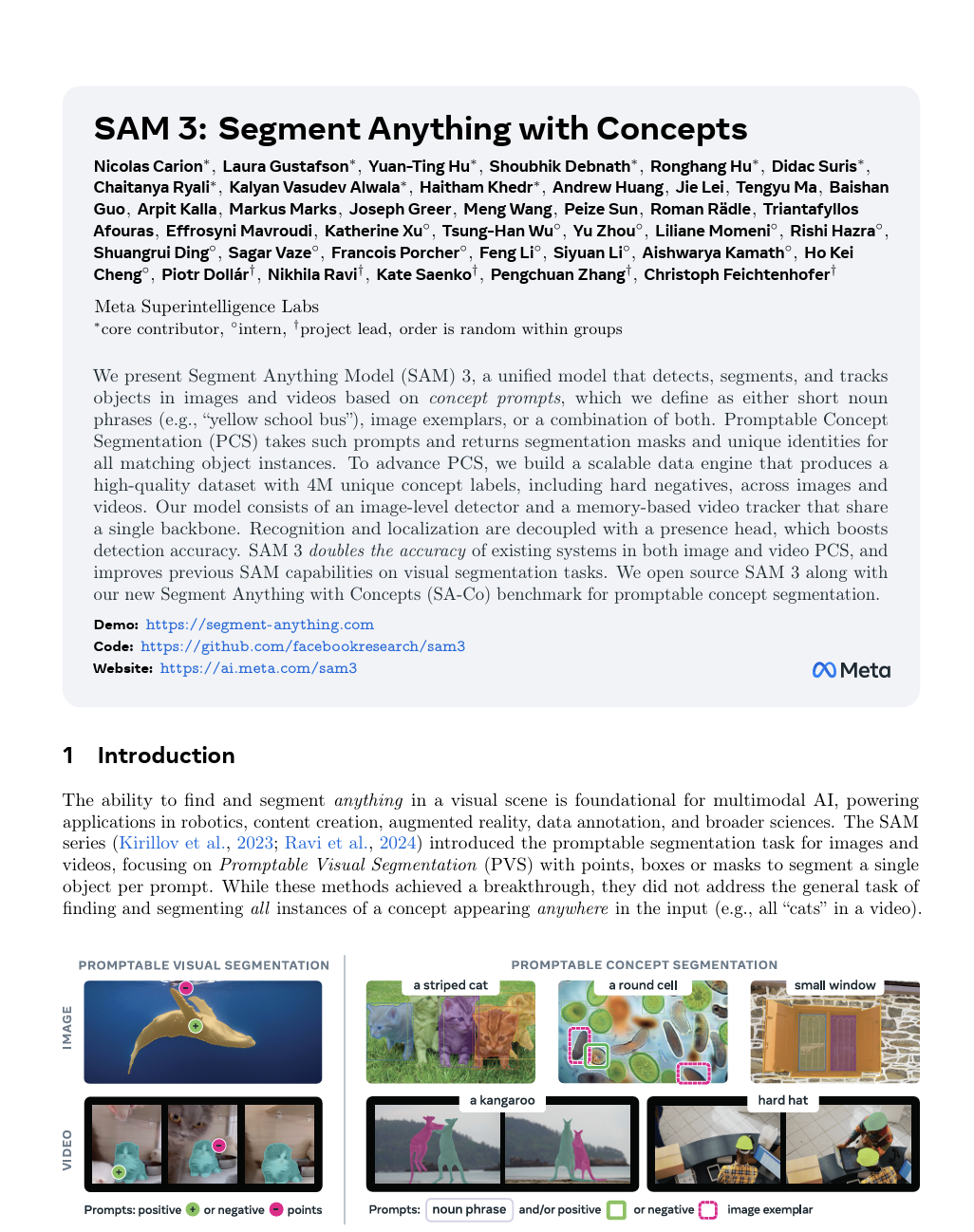
SAM 3: Segment Anything with Concepts
Nicolas Carion, Laura Gustafson, Yuan-Ting Hu, Shoubhik Debnath, Ronghang Hu, Didac Suris, Chaitanya Ryali, Kalyan Vasudev Alwala, Haitham Khedr, Andrew Huang, Jie Lei, Tengyu Ma, Baishan Guo, Arpit Kalla, Markus Marks, Joseph Greer, Meng Wang, Peize Sun, Roman Rädle, Triantafyllos Afouras, Effrosyni Mavroudi, Katherine Xu, Tsung-Han Wu, Yu Zhou, Liliane Momeni, Rishi Hazra, Shuangrui Ding, Sagar Vaze, Francois Porcher, Feng Li, Siyuan Li, Aishwarya Kamath, Ho Kei Cheng, Piotr Dollár, Nikhila Ravi, Kate Saenko, Pengchuan Zhang, Christoph Feichtenhofer
Why you should read this
Doubles the accuracy of existing systems by introducing SAM 3, a unified model that detects, segments, and tracks objects in images and videos using concept prompts, significantly advancing promptable concept segmentation.
We present Segment Anything Model (SAM) 3, a unified model that detects, segments, and tracks objects in images and videos based on concept prompts, which we define as either short noun phrases (e.g., "yellow school bus"), image exemplars, or a combination of both. Promptable Concept Segmentation (PCS) takes such prompts and returns segmentation masks and unique identities for all matching object instances. To advance PCS, we build a scalable data engine that produces a high-quality dataset with 4M unique concept labels, including hard negatives, across images and videos. Our model consists of an image-level detector and a memory-based video tracker that share a single backbone. Recognition and localization are decoupled with a presence head, which boosts detection accuracy. SAM 3 doubles the accuracy of existing systems in both image and video PCS, and improves previous SAM capabilities on visual segmentation tasks. We open source SAM 3 along with our new Segment Anything with Concepts (SA-Co) benchmark for promptable concept segmentation.
Added
2025-12-24
