SmartEdit: Exploring Complex Instruction-Based Image Editing with Multimodal Large Language Models
Yuzhou HuangLiangbin XieXintao WangZiyang YuanXiaodong CunYixiao GeJiantao ZhouChao DongRui HuangRuimao Zhang
Develops SmartEdit, a framework integrating multimodal large language models with diffusion models via a bidirectional interaction module and targeted perception training to execute image editing instructions requiring multi-object reasoning and world knowledge.
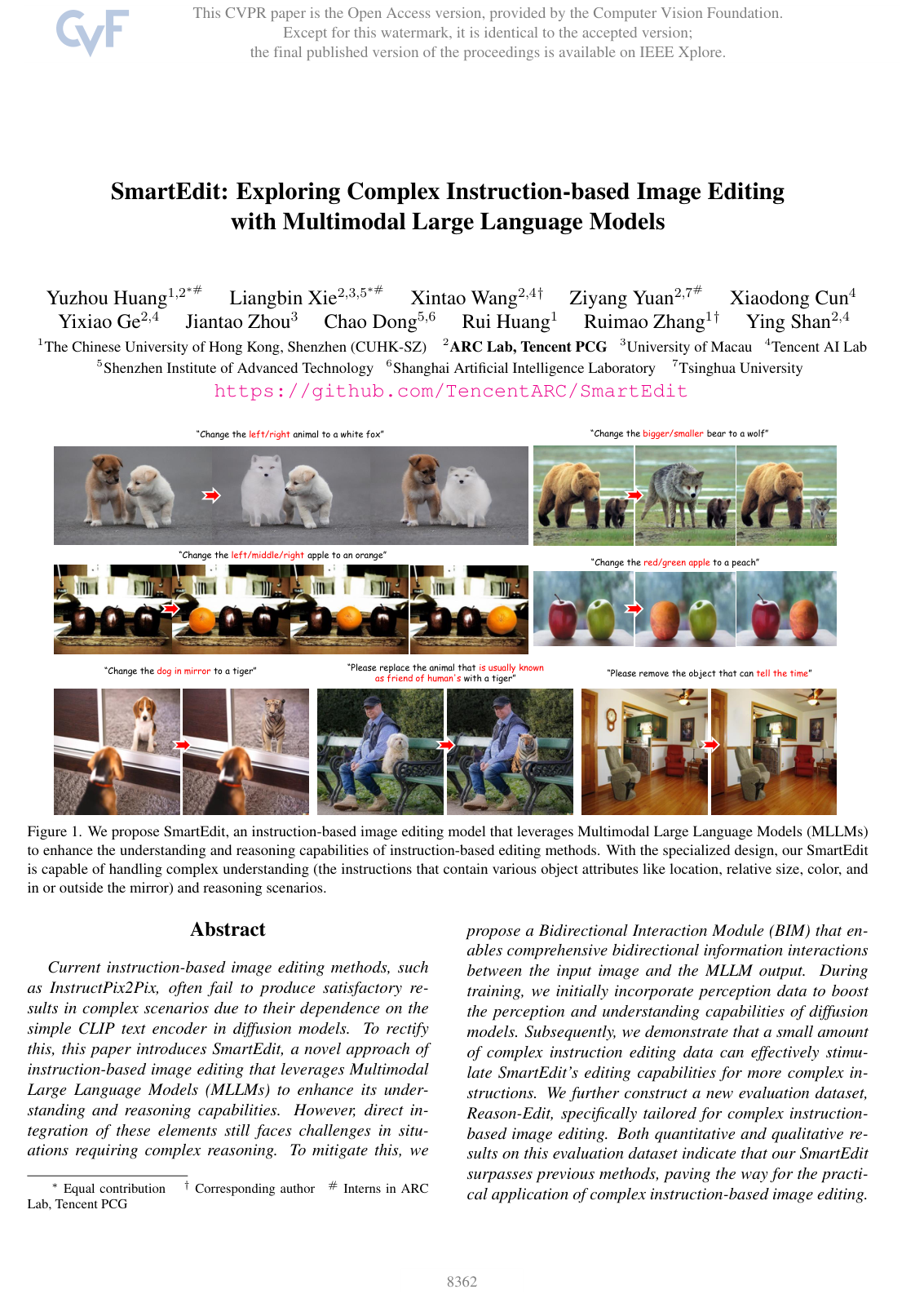
Modern digital workflows increasingly rely on text-guided image editing, yet existing tools struggle when presented with nuanced user commands. Current systems frequently fail when tasks require distinguishing specific targets among multiple objects based on spatial location, color, or context, as well as when world knowledge and reasoning are needed to infer the target (such as identifying "the tool used to cut cakes"). These failures stem from conventional models relying on basic text encoders that cannot reason or effectively fuse image details with complex instructions.
The article demonstrates an advanced image editing framework, termed SmartEdit, that integrates multimodal large language models—artificial intelligence systems that simultaneously understand language and images—into image diffusion generation to handle complex understanding and reasoning instructions. The approach pairs the multimodal language model with a novel Bidirectional Interaction Module to enable comprehensive two-way communication between text instructions and image features, while incorporating segmentation data and a targeted synthetic dataset of 476 complex image-instruction pairs during training. The authors also establish a new benchmark called Reason-Edit, comprising 219 image-text evaluation pairs, to rigorously assess performance.
The findings show that SmartEdit substantially outperforms leading baseline methods across both complex understanding and reasoning tasks. In reasoning scenarios, SmartEdit models achieved human-evaluated instruction alignment scores of approximately 79% to 82%, compared to baseline scores ranging between 28% and 48%. Ablation experiments confirmed that removing the Bidirectional Interaction Module or reverting to one-way information sharing markedly degraded output quality. Furthermore, training ablation showed that pairing perception data with a small set of high-quality complex examples was critical: instruction alignment rose from roughly 20–23% with standard editing data up to 71–79% when the full dataset strategy was employed.
These results demonstrate that complex, reasoning-based image editing can be achieved without the prohibitive expense of generating massive specialized datasets. By combining targeted perceptual pre-training, lightweight fine-tuning, and bidirectional feature interaction, organizations can deploy more capable generative vision systems with higher accuracy, reduced operational failure rates, and greater alignment with human intent.
Decision-makers should consider adopting multimodal reasoning architectures and bidirectional fusion modules when designing next-generation image generation and editing pipelines. Future development should focus on expanding complex evaluation benchmarks, optimizing computational efficiency during inference, and scaling the synthetic data pipeline to cover broader operational domains.
- Paper: InstructPix2Pix: Learning to Follow Image Editing Instructions, Tim Brooks et al. (2023). SmartEdit directly identifies and targets the limitations of InstructPix2Pix's CLIP-based instruction editing pipeline when handling complex reasoning tasks.
- Paper: Visual Instruction Tuning, Haotian Liu et al. (2023). SmartEdit leverages multimodal large language models and visual instruction tuning pioneered by LLaVA to empower diffusion models with complex reasoning and perception.
- Paper: Prompt-to-Prompt Image Editing with Cross Attention Control, Amir Hertz et al. (2022). Prompt-to-Prompt introduces the foundational cross-attention control mechanisms used across diffusion-based editing frameworks.
- Paper: High-Resolution Image Synthesis with Latent Diffusion Models, Robin Rombach et al. (2022). Latent Diffusion Models provide the underlying generative framework and cross-attention conditioning mechanisms that SmartEdit adapts.
- Paper: Adding Conditional Control to Text-to-Image Diffusion Models, Lvmin Zhang et al. (2023). ControlNet establishes the structural conditioning paradigms that inform how external perception and control signals interface with diffusion backbones.
- Paper: InstructBLIP: Towards General-purpose Vision-Language Models with Instruction Tuning, Wenliang Dai et al. (2023). InstructBLIP establishes instruction-aware visual feature extraction for multimodal models, which motivates the bidirectional visual-language interaction in SmartEdit.
- Paper: A survey on multimodal large language models, Shukang Yin et al. (2023). This survey provides essential background on the design of multimodal large language model connectors and training pipelines used to power vision-language reasoning.
- Paper: VIEScore: Towards Explainable Metrics for Conditional Image Synthesis Evaluation, Max Ku et al. (2024). VIEScore leverages multimodal LLMs to systematically evaluate conditional image synthesis and editing outputs like those generated by SmartEdit.
- Paper: Show-o: One Single Transformer to Unify Multimodal Understanding and Generation, Jinheng Xie et al. (2025). Show-o moves beyond separate MLLM-diffusion pipelines to unify multimodal understanding and diffusion generation into a single end-to-end transformer architecture.
- Paper: Visual CoT: Advancing Multi-Modal Language Models with a Comprehensive Dataset and Benchmark for Chain-of-Thought Reasoning, Hao Shao et al. (2024). Visual CoT expands multimodal chain-of-thought visual grounding and reasoning capabilities, which directly advances the complex visual reasoning foundations utilized in SmartEdit.
- Paper: Everything in Its Place: Benchmarking Spatial Intelligence of Text-to-Image Models, Zengbin Wang et al. (2026). SpatialGenEval provides rigorous spatial reasoning and object-interaction benchmarks to evaluate the fine-grained spatial placement and manipulation required in complex image editing.