
keyword
prompt engineering
Prompt engineering is the practice of designing, refining, and optimizing textual inputs or instructions to effectively guide artificial intelligence models, such as large language models and vision-language systems, toward producing accurate and desired outputs. Rather than modifying the underlying model architecture or retraining its parameters, prompt engineering structures the input context using methods such as task descriptions, persona assignments, structured templates, few-shot demonstration examples, and step-by-step reasoning chains. By carefully crafting the phrasing, context, and information format, practitioners can elicit specific behaviors, improve factual accuracy, enhance complex multi-step problem solving, and adapt general-purpose pretrained models to specialized downstream tasks across diverse applications.
24 items
In-Context Impersonation Reveals Large Language Models' Strengths and Biases
Leonard Salewski, Stephan Alaniz, Isabel Rio-Torto, Eric Schulz, Zeynep Akata
Why you should read this
Demonstrates that prompting large language models to impersonate specific personas not only boosts task performance through simulated domain expertise and age-appropriate exploration strategies, but also exposes latent demographic biases in multimodal and reasoning evaluations.
In everyday conversations, humans can take on different roles and adapt their vocabulary to their chosen roles. We explore whether LLMs can take on, that is impersonate, different roles when they generate text in-context. We ask LLMs to assume different personas before solving vision and language tasks. We do this by prefixing the prompt with a persona that is associated either with a social identity or domain expertise. In a multi-armed bandit task, we find that LLMs pretending to be children of different ages recover human-like developmental stages of exploration. In a language-based reasoning task, we find that LLMs impersonating domain experts perform better than LLMs impersonating non-domain experts. Finally, we test whether LLMs’ impersonations are complementary to visual information when describing different categories. We find that impersonation can improve performance: an LLM prompted to be a bird expert describes birds better than one prompted to be a car expert. However, impersonation can also uncover LLMs’ biases: an LLM prompted to be a man describes cars better than one prompted to be a woman. These findings demonstrate that LLMs are capable of taking on diverse roles and that this in-context impersonation can be used to uncover their strengths and hidden biases. Our code is available at https://github.com/ExplainableML/in-context-impersonation.
Added
2026-10-05
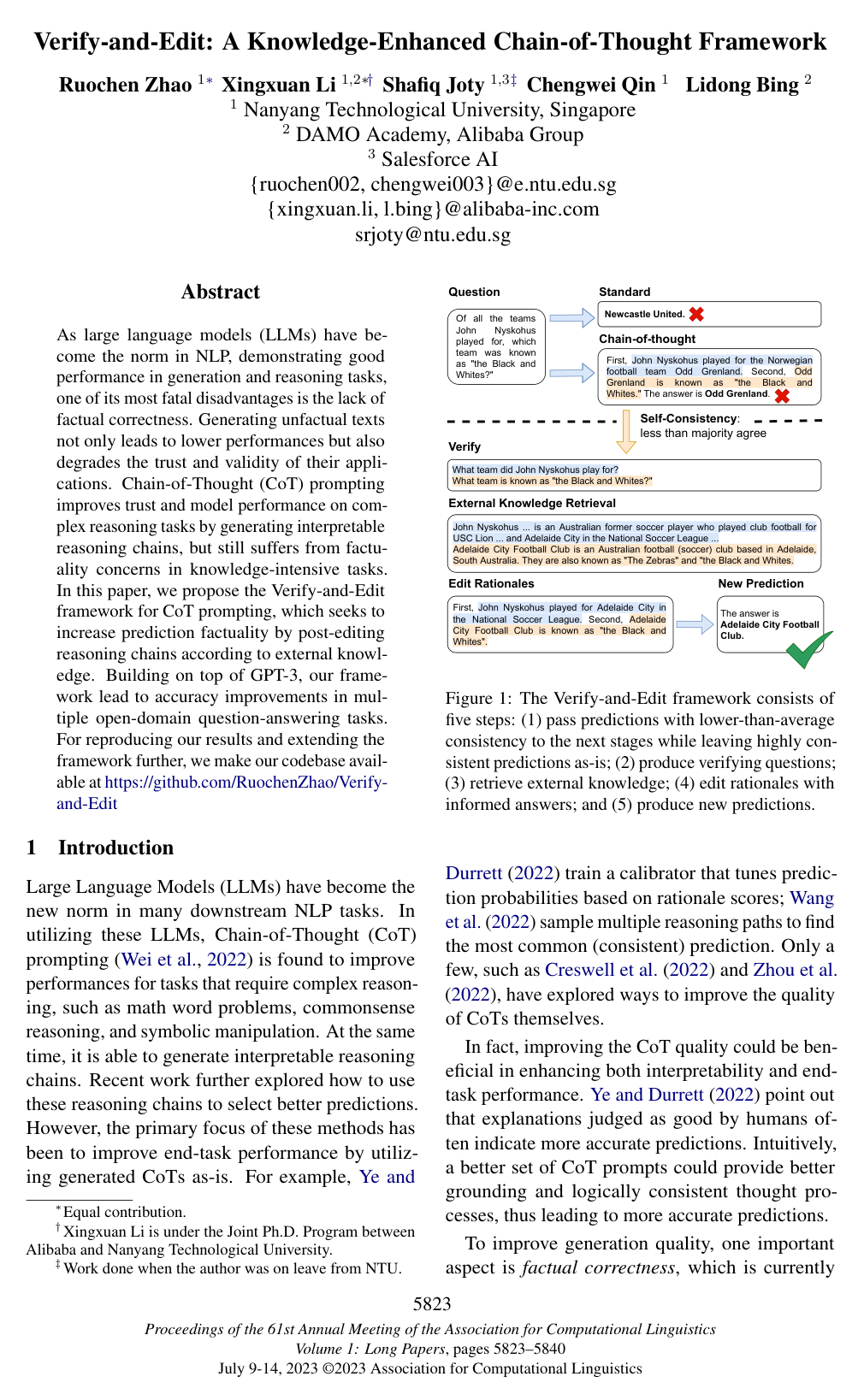
Verify-and-Edit: A Knowledge-Enhanced Chain-of-Thought Framework
Ruochen Zhao, Xingxuan Li, Shafiq Joty, Chengwei Qin, Lidong Bing
Why you should read this
Proposes a framework that detects uncertain reasoning in large language models and corrects factual errors within chain-of-thought rationales using external retrieval, substantially boosting accuracy on open-domain question answering.
As large language models (LLMs) have become the norm in NLP, demonstrating good performance in generation and reasoning tasks, one of its most fatal disadvantages is the lack of factual correctness. Generating unfactual texts not only leads to lower performances but also degrades the trust and validity of their applications. Chain-of-Thought (CoT) prompting improves trust and model performance on complex reasoning tasks by generating interpretable reasoning chains, but still suffers from factuality concerns in knowledge-intensive tasks. In this paper, we propose the Verify-and-Edit framework for CoT prompting, which seeks to increase prediction factuality by post-editing reasoning chains according to external knowledge. Building on top of GPT-3, our framework lead to accuracy improvements in multiple open-domain question-answering tasks. For reproducing our results and extending the framework further, we make our codebase available at https://github.com/RuochenZhao/Verify-and-Edit
Added
2026-10-05
Complexity-Based Prompting for Multi-Step Reasoning
Yao Fu, Hao-Chun Peng, Ashish Sabharwal, Peter Clark, Tushar Khot
Why you should read this
Introduces complexity-based prompting, a simple strategy showing that selecting in-context examples and decoding paths with more reasoning steps substantially boosts large language model performance on multi-step mathematical and logical reasoning tasks.
We study the task of prompting large-scale language models to perform multi-step reasoning. Existing work shows that when prompted with a chain of thoughts (CoT), sequences of short sentences describing intermediate reasoning steps towards a final answer, large language models can generate new reasoning chains and predict answers for new inputs. A central question is which reasoning examples make the most effective prompts. In this work, we propose complexity-based prompting, a simple and effective example selection scheme for multi-step reasoning. We show that prompts with higher reasoning complexity, i.e., chains with more reasoning steps, achieve substantially better performance on multi-step reasoning tasks over strong baselines. We further extend our complexity-based criteria from prompting (selecting inputs) to decoding (selecting outputs), where we sample multiple reasoning chains from the model, then choose the majority of generated answers from complex reasoning chains (over simple chains). When used to prompt GPT-3 and Codex, our approach substantially improves multi-step reasoning accuracy and achieves new state-of-the-art (SOTA) performance on three math benchmarks (GSM8K, MultiArith, and MathQA) and two BigBenchHard tasks (Date Understanding and Penguins), with an average +5.3 and up to +18 accuracy improvements. Compared with existing example selection schemes like manual tuning or retrieval-based selection, selection based on reasoning complexity is intuitive, easy to implement, and annotation-efficient. Further results demonstrate the robustness of performance gains from complex prompts under format perturbation and distribution shift.
Added
2026-10-05
Pron vs Prompt: Can Large Language Models already Challenge a World-Class Fiction Author at Creative Text Writing?
Guillermo Marco, Julio Gonzalo, María Teresa Mateo Girona, Ramón Santos
Why you should read this
Demonstrates that state-of-the-art language models remain far behind elite human authors in creative fiction through a head-to-head contest between GPT-4 and an award-winning novelist evaluated across 5,400 expert literary assessments.
It has become routine to report research results where Large Language Models (LLMs) outperform average humans in a wide range of language-related tasks, and creative text writing is no exception. It seems natural, then, to raise the bid: Are LLMs ready to compete in creative writing skills with a top (rather than average) novelist? To provide an initial answer for this question, we have carried out a contest between Patricio Pron (an awarded novelist, considered one of the best of his generation) and GPT-4 (one of the top performing LLMs), in the spirit of AI-human duels such as DeepBlue vs Kasparov and AlphaGo vs Lee Sidol. We asked Pron and GPT-4 to provide thirty titles each, and then to write short stories for both their titles and their opponent's. Then, we prepared an evaluation rubric inspired by Boden's definition of creativity, and we collected 5,400 manual assessments provided by literature critics and scholars. The results of our experimentation indicate that LLMs are still far from challenging a top human creative writer, and that reaching such level of autonomous creative writing skills probably cannot be reached simply with larger language models.
Added
2026-10-05
A Simple Zero-shot Prompt Weighting Technique to Improve Prompt Ensembling in Text-Image Models
James Urquhart Allingham, Jie Ren, Michael W. Dusenberry, Xiuye Gu, Yin Cui, Dustin Tran, Jeremiah Zhe Liu, Balaji Lakshminarayanan
Why you should read this
Proposes a bias-corrected zero-shot prompt weighting algorithm that automatically scores and ensembles prompts for text-image models without needing labeled validation data or manual prompt engineering.
Added
2026-10-03
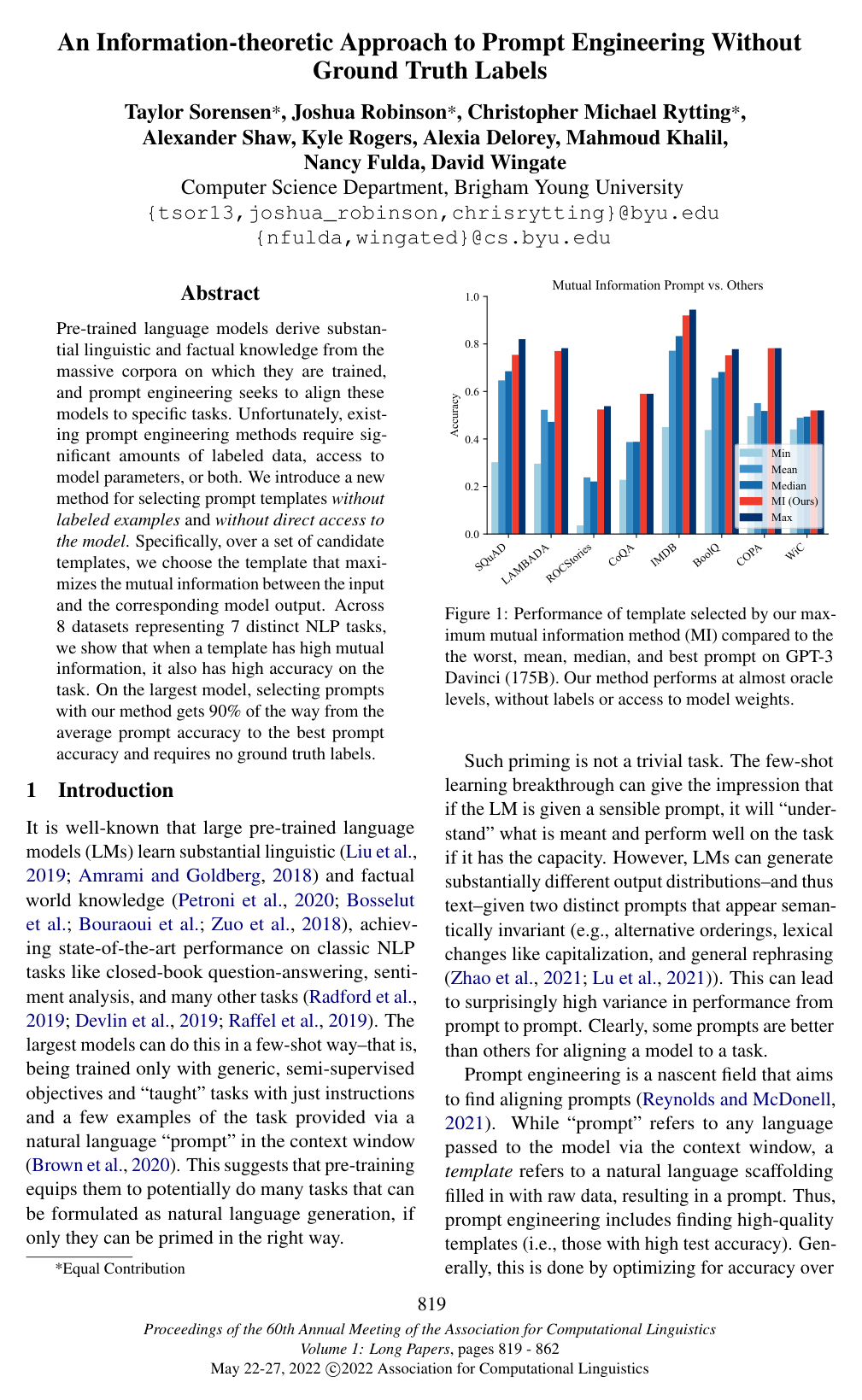
An Information-theoretic Approach to Prompt Engineering Without Ground Truth Labels
Taylor Sorensen, Joshua Robinson, Christopher Michael Rytting, Alexander Glenn Shaw, Kyle Jeffrey Rogers, Alexia Pauline Delorey, Mahmoud Khalil, Nancy Fulda, David Wingate
Why you should read this
Proposes an unsupervised, black-box prompt selection method that optimizes mutual information between inputs and language model outputs to identify top-performing prompt templates without requiring labeled data or access to model weights.
Pre-trained language models derive substantial linguistic and factual knowledge from the massive corpora on which they are trained, and prompt engineering seeks to align these models to specific tasks. Unfortunately, existing prompt engineering methods require significant amounts of labeled data, access to model parameters, or both. We introduce a new method for selecting prompt templates without labeled examples and without direct access to the model. Specifically, over a set of candidate templates, we choose the template that maximizes the mutual information between the input and the corresponding model output. Across 8 datasets representing 7 distinct NLP tasks, we show that when a template has high mutual information, it also has high accuracy on the task. On the largest model, selecting prompts with our method gets 90% of the way from the average prompt accuracy to the best prompt accuracy and requires no ground truth labels.
Added
2026-10-01
Understanding the LLM-ification of CHI: Unpacking the Impact of LLMs at CHI through a Systematic Literature Review
Rock Yuren Pang, Hope Schroeder, Kynnedy Simone Smith, Solon Barocas, Ziang Xiao, Emily Tseng, Danielle Bragg
Why you should read this
Establishes a comprehensive taxonomy of large language model adoption across 153 CHI papers, identifying their roles as research tools and simulated participants while providing practical questions to address prevalent validity and reproducibility concerns.
Large language models (LLMs) have been positioned to revolutionize HCI, by reshaping not only the interfaces, design patterns, and sociotechnical systems that we study, but also the research practices we use. To-date, however, there has been little understanding of LLMs' uptake in HCI. We address this gap via a systematic literature review of 153 CHI papers from 2020-24 that engage with LLMs. We taxonomize: (1) domains where LLMs are applied; (2) roles of LLMs in HCI projects; (3) contribution types; and (4) acknowledged limitations and risks. We find LLM work in 10 diverse domains, primarily via empirical and artifact contributions. Authors use LLMs in five distinct roles, including as research tools or simulated users. Still, authors often raise validity and reproducibility concerns, and overwhelmingly study closed models. We outline opportunities to improve HCI research with and on LLMs, and provide guiding questions for researchers to consider the validity and appropriateness of LLM-related work.
Added
2026-09-30
Enhancing Reasoning Capabilities of Small Language Models with Blueprints and Prompt Template Search
Dongge Han, Menglin Xia, Daniel Madrigal, Samuel Kessler, Ankur Mallick, Xuchao Zhang, Mirian Hipolito Garcia, Jin Xu, Victor Ruehle, Saravan Rajmohan
Why you should read this
Presents a training-free framework that improves the reasoning accuracy and stability of small language models on math, coding, and logic benchmarks by combining structured blueprints with automated prompt template search.
Small language models (SLMs) offer promising and efficient alternatives to large language models (LLMs). However, SLMs' limited capacity restricts their reasoning capabilities and makes them sensitive to prompt variations. To address these challenges, we propose a novel framework that enhances SLM reasoning capabilities through LLM generated blueprints. The blueprints provide structured, high-level reasoning guides that help SLMs systematically tackle related problems. Furthermore, our framework integrates a prompt template search mechanism to mitigate the SLMs' sensitivity to prompt variations. Our framework demonstrates improved SLM performance across various tasks, including math (GSM8K), coding (MBPP), and logic reasoning (BBH). Our approach improves the reasoning capabilities of SLMs without increasing model size or requiring additional training, offering a lightweight and deployment-friendly solution for on-device or resource-constrained environments.
Added
2026-09-29
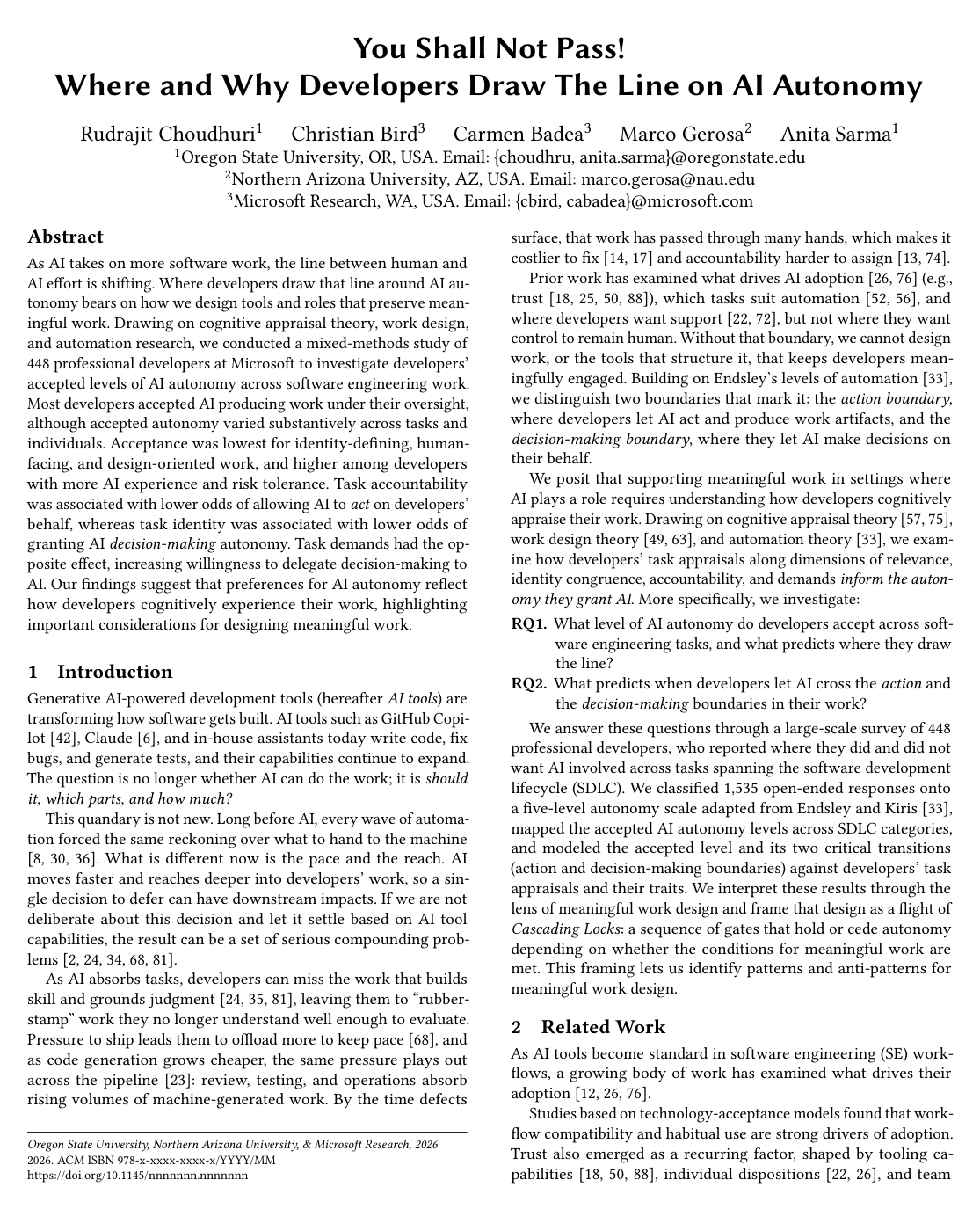
You Shall Not Pass! Where and Why Developers Draw The Line on AI Autonomy
Rudrajit Choudhuri, Christian Bird, Carmen Badea, Marco Gerosa, Anita Sarma
Why you should read this
Identifies the psychological and operational factors that govern where professional developers accept AI autonomy, showing that task identity and accountability restrict automated decision-making while high workload drives delegation.
As AI takes on more software work, the line between human and AI effort is shifting. Where developers draw that line around AI autonomy bears on how we design tools and roles that preserve meaningful work. Drawing on cognitive appraisal theory, work design, and automation research, we conducted a mixed-methods study of 448 professional developers at Microsoft to investigate their accepted levels of AI autonomy across software engineering work. Most developers accepted AI producing work under their oversight, although accepted autonomy varied substantively across tasks and individuals. Acceptance was lowest for identity-defining, human-facing, and design-oriented work, and higher among developers with more AI experience and risk tolerance. Task accountability was associated with lower odds of allowing AI to act on developers' behalf, whereas task identity was associated with lower odds of granting AI decision-making autonomy. Task demands had the opposite effect, increasing willingness to delegate decision-making to AI. Our findings suggest that preferences for AI autonomy reflect how developers cognitively experience their work, highlighting important considerations for designing meaningful work.
Added
2026-09-29
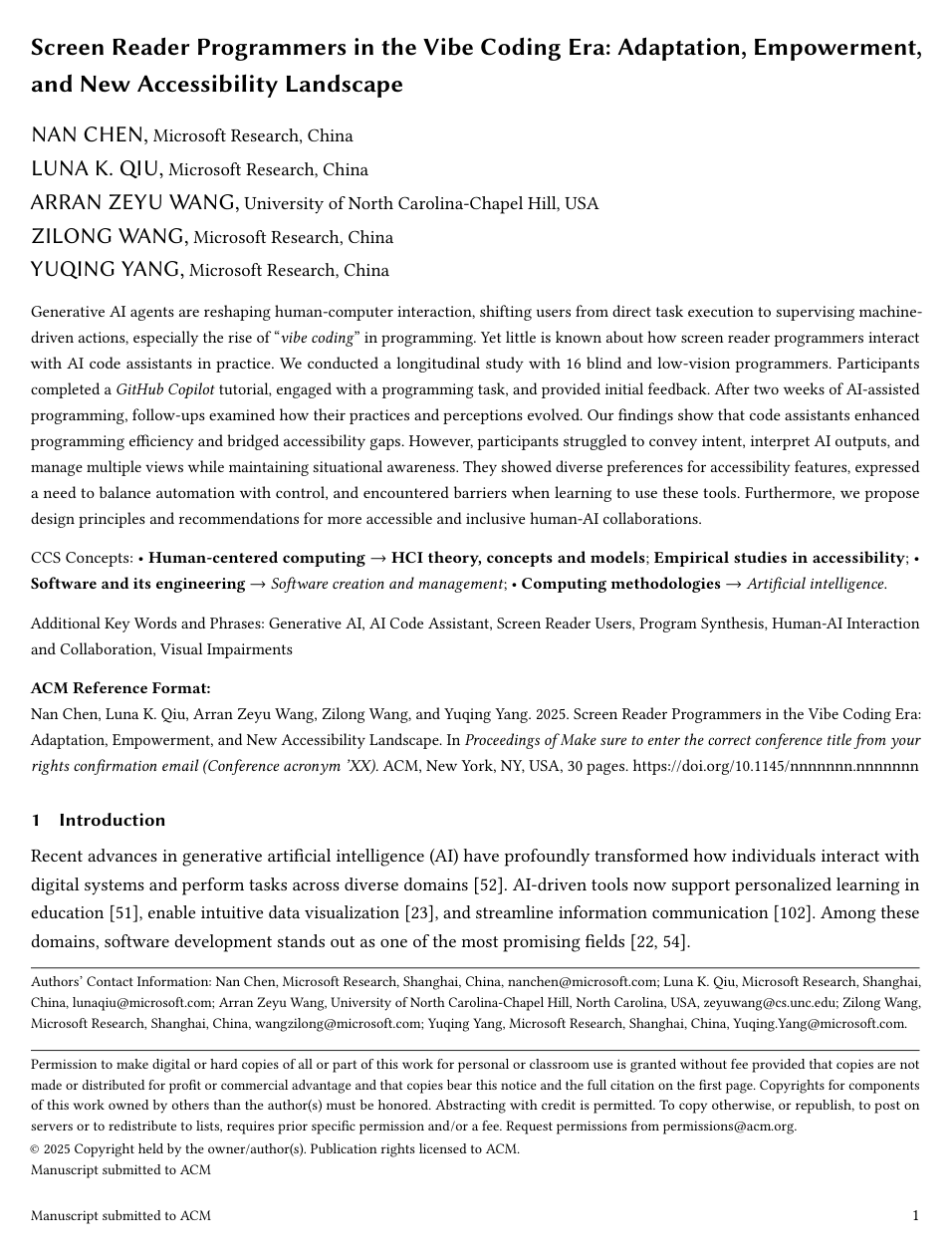
Screen Reader Programmers in the Vibe Coding Era: Adaptation, Empowerment, and New Accessibility Landscape
Nan Chen, Luna K. Qiu, Arran Zeyu Wang, Zilong Wang, Yuqing Yang
Why you should read this
Reveals how blind and low-vision developers interact with AI code assistants through a longitudinal study, identifying key accessibility barriers in interpreting machine-generated output and situational awareness while establishing actionable design principles for inclusive programming tools.
Generative AI agents are reshaping human-computer interaction, shifting users from direct task execution to supervising machine-driven actions, especially the rise of "vibe coding" in programming. Yet little is known about how screen reader programmers interact with AI code assistants in practice. We conducted a longitudinal study with 16 blind and low-vision programmers. Participants completed a GitHub Copilot tutorial, engaged with a programming task, and provided initial feedback. After two weeks of AI-assisted programming, follow-ups examined how their practices and perceptions evolved. Our findings show that code assistants enhanced programming efficiency and bridged accessibility gaps. However, participants struggled to convey intent, interpret AI outputs, and manage multiple views while maintaining situational awareness. They showed diverse preferences for accessibility features, expressed a need to balance automation with control, and encountered barriers when learning to use these tools. Furthermore, we propose design principles and recommendations for more accessible and inclusive human-AI collaborations.
Added
2026-09-29
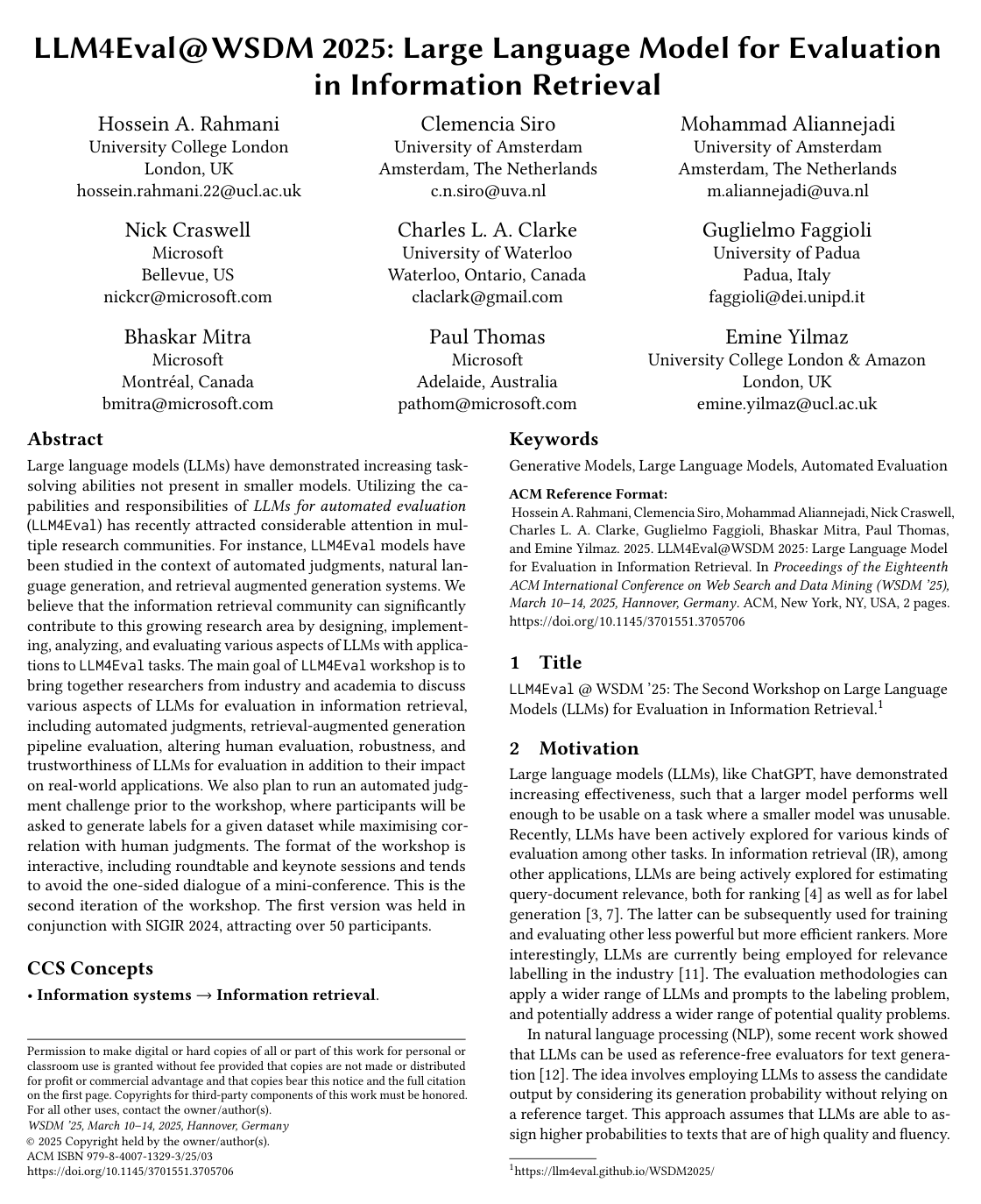
LLM4Eval@WSDM 2025: Large Language Model for Evaluation in Information Retrieval
Hossein A. Rahmani, Clemencia Siro, Mohammad Aliannejadi, Nick Craswell, Charles L A Clarke, Guglielmo Faggioli, Bhaskar Mitra, Paul Thomas, Emine Yilmaz
Why you should read this
Presents the scope and shared task for the LLM4Eval workshop at WSDM 2025, detailing how researchers use large language models to automate relevance judgments, evaluate retrieval-augmented generation pipelines, and replace or support human assessments.
Large language models (LLMs) have demonstrated increasing task-solving abilities not present in smaller models. Utilizing the capabilities and responsibilities of LLMs for automated evaluation (LLM4Eval) has recently attracted considerable attention in multiple research communities. For instance, LLM4Eval models have been studied in the context of automated judgments, natural language generation, and retrieval augmented generation systems. We believe that the information retrieval community can significantly contribute to this growing research area by designing, implementing, analyzing, and evaluating various aspects of LLMs with applications to LLM4Eval tasks. The main goal of LLM4Eval workshop is to bring together researchers from industry and academia to discuss various aspects of LLMs for evaluation in information retrieval, including automated judgments, retrieval-augmented generation pipeline evaluation, altering human evaluation, robustness, and trustworthiness of LLMs for evaluation in addition to their impact on real-world applications. We also plan to run an automated judgment challenge prior to the workshop, where participants will be asked to generate labels for a given dataset while maximising correlation with human judgments. The format of the workshop is interactive, including roundtable and keynote sessions and tends to avoid the one-sided dialogue of a mini-conference. This is the second iteration of the workshop. The first version was held in conjunction with SIGIR 2024, attracting over 50 participants.
Added
2026-09-29
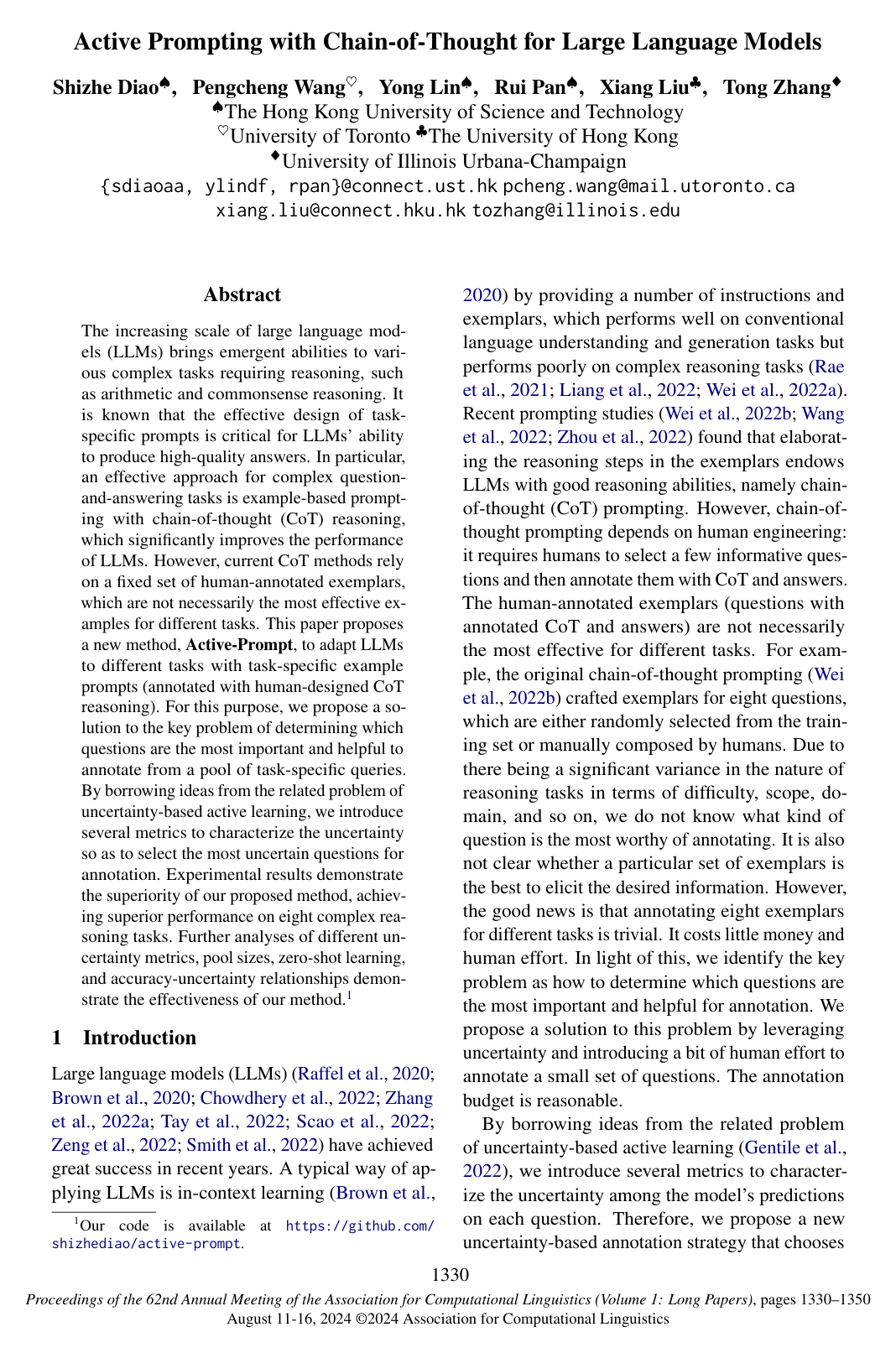
Active Prompting with Chain-of-Thought for Large Language Models
Shizhe Diao, Pengcheng Wang, Yong Lin, Rui Pan, Xiang Liu, Tong Zhang
Why you should read this
Proposes an uncertainty-based active learning framework that identifies and selects the most informative task-specific questions for human chain-of-thought annotation, significantly improving large language model reasoning performance with minimal labeling effort.
The increasing scale of large language models (LLMs) brings emergent abilities to various complex tasks requiring reasoning, such as arithmetic and commonsense reasoning. It is known that the effective design of task-specific prompts is critical for LLMs' ability to produce high-quality answers. In particular, an effective approach for complex question-and-answering tasks is example-based prompting with chain-of-thought (CoT) reasoning, which significantly improves the performance of LLMs. However, current CoT methods rely on a fixed set of human-annotated exemplars, which are not necessarily the most effective examples for different tasks. This paper proposes a new method, Active-Prompt, to adapt LLMs to different tasks with task-specific example prompts (annotated with human-designed CoT reasoning). For this purpose, we propose a solution to the key problem of determining which questions are the most important and helpful to annotate from a pool of task-specific queries. By borrowing ideas from the related problem of uncertainty-based active learning, we introduce several metrics to characterize the uncertainty so as to select the most uncertain questions for annotation. Experimental results demonstrate the superiority of our proposed method, achieving superior performance on eight complex reasoning tasks. Further analyses of different uncertainty metrics, pool sizes, zero-shot learning, and accuracy-uncertainty relationships demonstrate the effectiveness of our method.
Added
2026-09-28
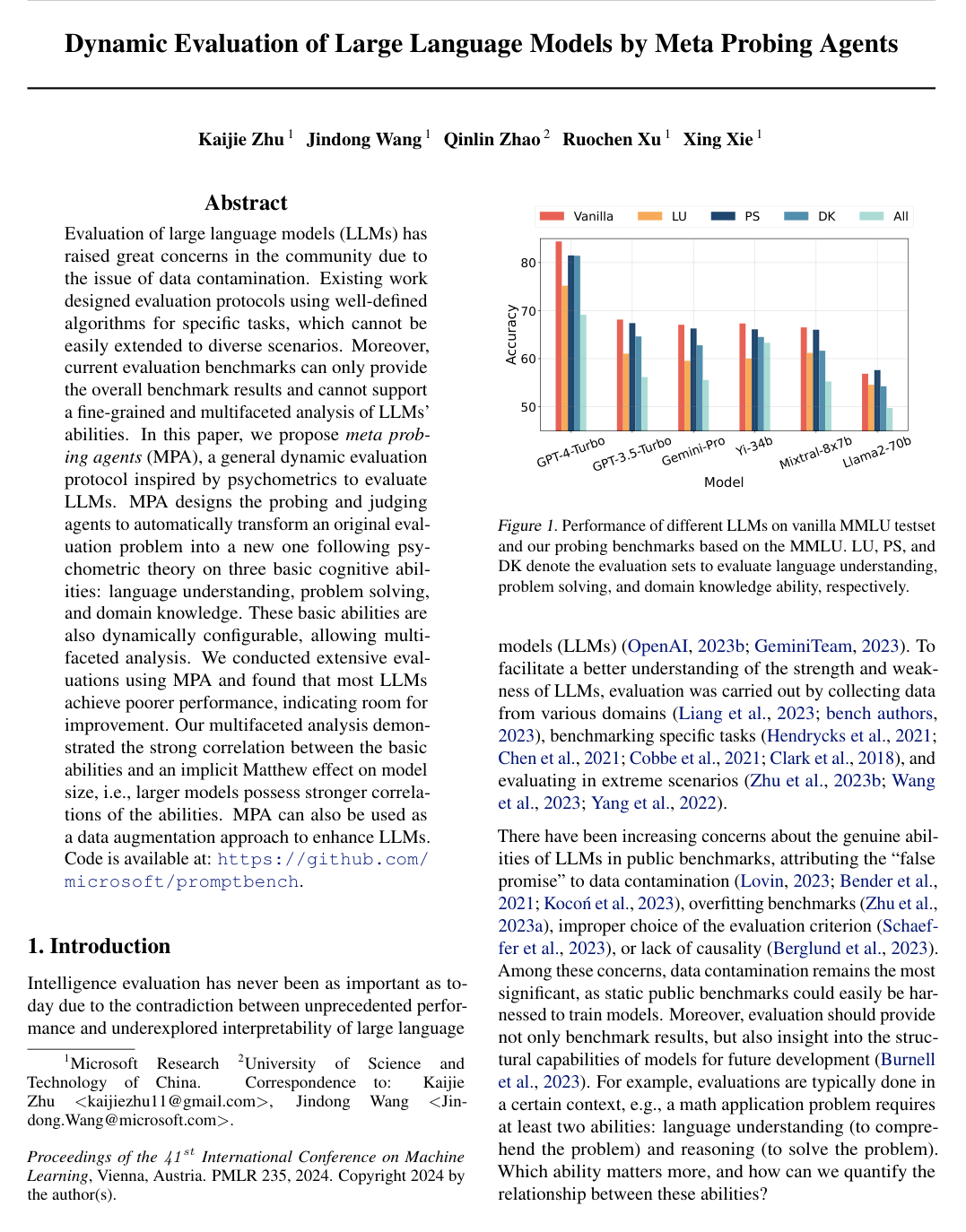
Dynamic Evaluation of Large Language Models by Meta Probing Agents
Kaijie Zhu, Jindong Wang, Qinlin Zhao, Ruochen Xu, Xing Xie
Why you should read this
Proposes a psychometrics-inspired dynamic evaluation framework using collaborative probing and judging agents to systematically transform existing benchmarks, exposing widespread performance drops from data contamination and uncovering strong correlations among underlying cognitive abilities in large language models.
Evaluation of large language models (LLMs) has raised great concerns in the community due to the issue of data contamination. Existing work designed evaluation protocols using well-defined algorithms for specific tasks, which cannot be easily extended to diverse scenarios. Moreover, current evaluation benchmarks can only provide the overall benchmark results and cannot support a fine-grained and multifaceted analysis of LLMs' abilities. In this paper, we propose meta probing agents (MPA), a general dynamic evaluation protocol inspired by psychometrics to evaluate LLMs. MPA designs the probing and judging agents to automatically transform an original evaluation problem into a new one following psychometric theory on three basic cognitive abilities: language understanding, problem solving, and domain knowledge. These basic abilities are also dynamically configurable, allowing multifaceted analysis. We conducted extensive evaluations using MPA and found that most LLMs achieve poorer performance, indicating room for improvement. Our multifaceted analysis demonstrated the strong correlation between the basic abilities and an implicit Matthew effect on model size, i.e., larger models possess stronger correlations of the abilities. MPA can also be used as a data augmentation approach to enhance LLMs. Code is available at: https://github.com/microsoft/promptbench.
Added
2026-09-26
Memory-assisted prompt editing to improve GPT-3 after deployment
Aman Madaan, Niket Tandon, Peter Clark, Yiming Yang
Why you should read this
Proposes an interactive framework that pairs deployed large language models with an external memory of user feedback to dynamically update prompts and correct instruction misunderstandings without costly retraining.
Large LMs such as GPT-3, while powerful, are not immune to mistakes, but are prohibitively costly to retrain. One failure mode is misinterpreting a user’s instruction (e.g., GPT-3 interpreting "What word is similar to good?" to mean a homonym, while the user intended a synonym). Our goal is to allow users to correct such errors directly through interaction – without retraining. Our approach pairs GPT-3 with a growing memory of cases where the model misunderstood the user’s intent and was provided with feedback, clarifying the instruction. Given a new query, our memory-enhanced GPT-3 uses feedback from similar, prior queries to enrich the prompt. Through simple proof-of-concept experiments, we show how a (simulated) user can interactively teach a deployed GPT-3, doubling its accuracy on basic lexical tasks (e.g., generate a synonym) where users query in different, novel (often misunderstood) ways. In such scenarios, memory helps avoid repeating similar past mistakes. Our simple idea is a first step towards strengthening deployed models, potentially broadening their utility.
Added
2026-09-26
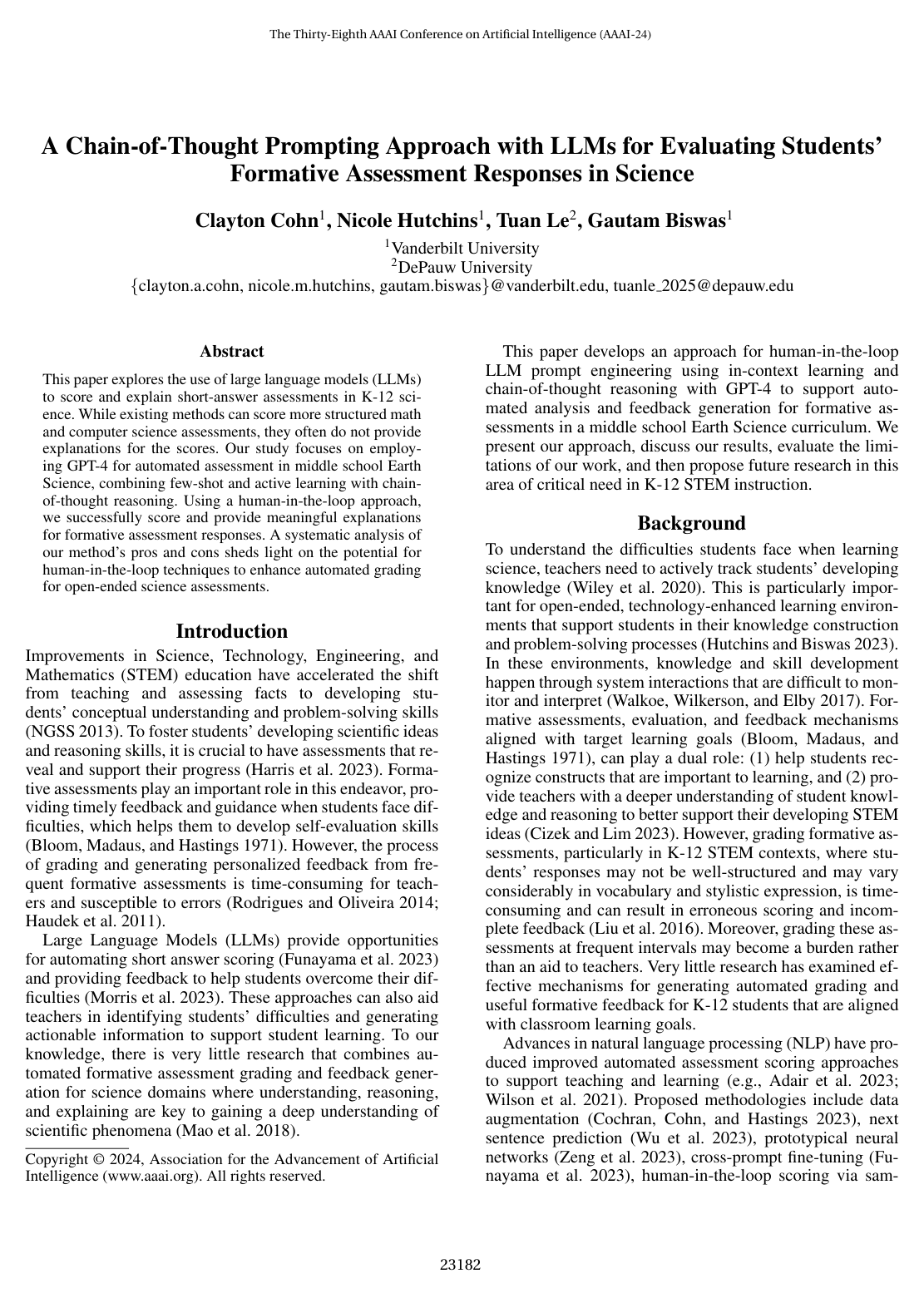
A Chain-of-Thought Prompting Approach with LLMs for Evaluating Students' Formative Assessment Responses in Science
Clayton Cohn, Nicole Hutchins, Tuan Le, Gautam Biswas
Why you should read this
Develops a human-in-the-loop framework combining GPT-4 with chain-of-thought prompting and active learning to automatically grade open-ended middle school science assessments while generating actionable explanatory feedback.
This paper explores the use of large language models (LLMs) to score and explain short-answer assessments in K-12 science. While existing methods can score more structured math and computer science assessments, they often do not provide explanations for the scores. Our study focuses on employing GPT-4 for automated assessment in middle school Earth Science, combining few-shot and active learning with chain-of-thought reasoning. Using a human-in-the-loop approach, we successfully score and provide meaningful explanations for formative assessment responses. A systematic analysis of our method’s pros and cons sheds light on the potential for human-in-the-loop techniques to enhance automated grading for open-ended science assessments.
Added
2026-09-26
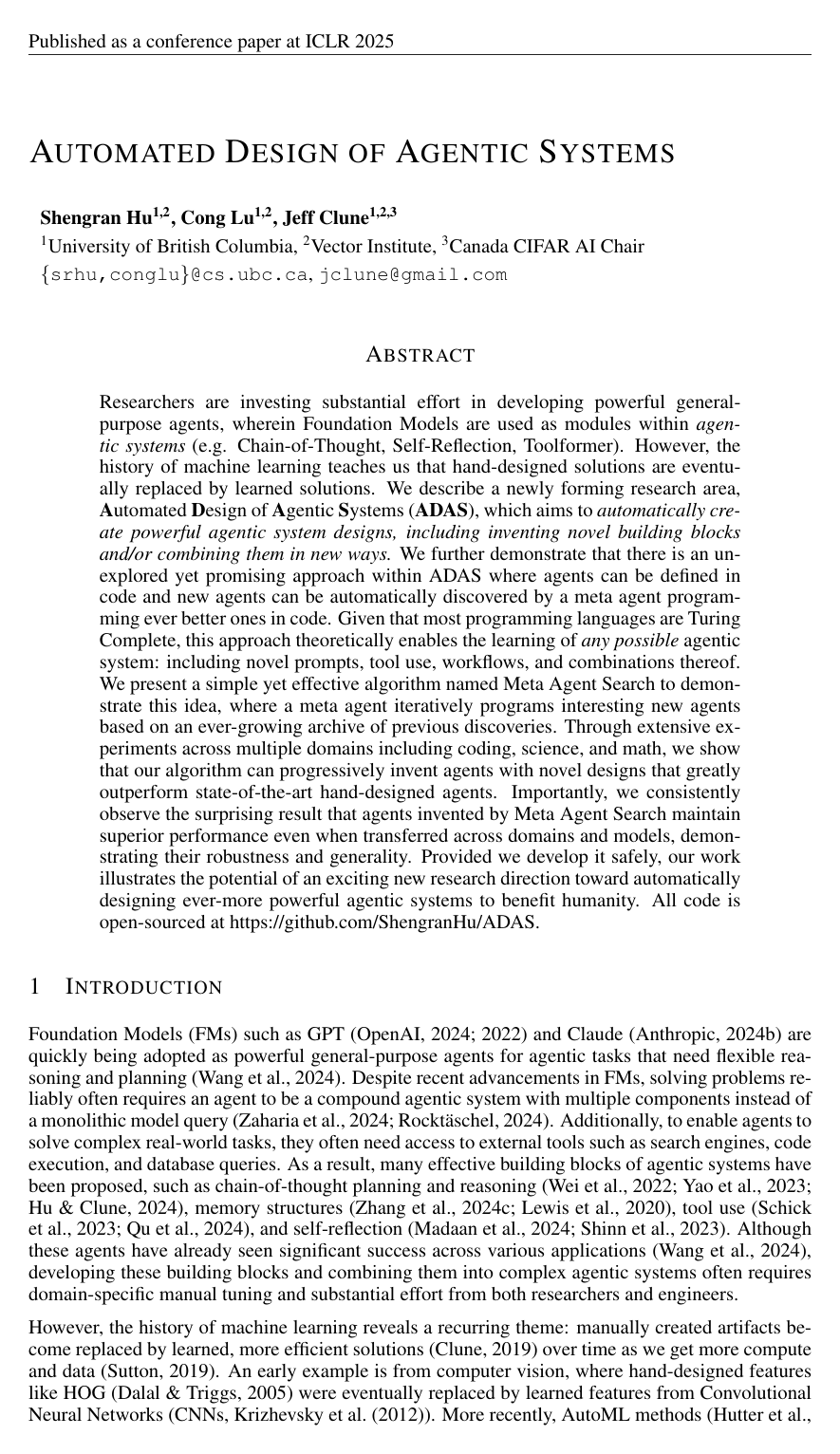
Automated Design of Agentic Systems
Shengran Hu, Cong Lu, Jeff Clune
Why you should read this
Proposes Meta Agent Search, an automated design method where a meta-agent writes code to discover novel agentic architectures that consistently outperform hand-designed baselines and generalize across diverse models and tasks.
Researchers are investing substantial effort in developing powerful general-purpose agents, wherein Foundation Models are used as modules within agentic systems (e.g. Chain-of-Thought, Self-Reflection, Toolformer). However, the history of machine learning teaches us that hand-designed solutions are eventually replaced by learned solutions. We describe a newly forming research area, Automated Design of Agentic Systems (ADAS), which aims to automatically create powerful agentic system designs, including inventing novel building blocks and/or combining them in new ways. We further demonstrate that there is an unexplored yet promising approach within ADAS where agents can be defined in code and new agents can be automatically discovered by a meta agent programming ever better ones in code. Given that programming languages are Turing Complete, this approach theoretically enables the learning of any possible agentic system: including novel prompts, tool use, workflows, and combinations thereof. We present a simple yet effective algorithm named Meta Agent Search to demonstrate this idea, where a meta agent iteratively programs interesting new agents based on an ever-growing archive of previous discoveries. Through extensive experiments across multiple domains including coding, science, and math, we show that our algorithm can progressively invent agents with novel designs that greatly outperform state-of-the-art hand-designed agents. Importantly, we consistently observe the surprising result that agents invented by Meta Agent Search maintain superior performance even when transferred across domains and models, demonstrating their robustness and generality. Provided we develop it safely, our work illustrates the potential of an exciting new research direction toward automatically designing ever-more powerful agentic systems to benefit humanity.
Added
2026-09-26
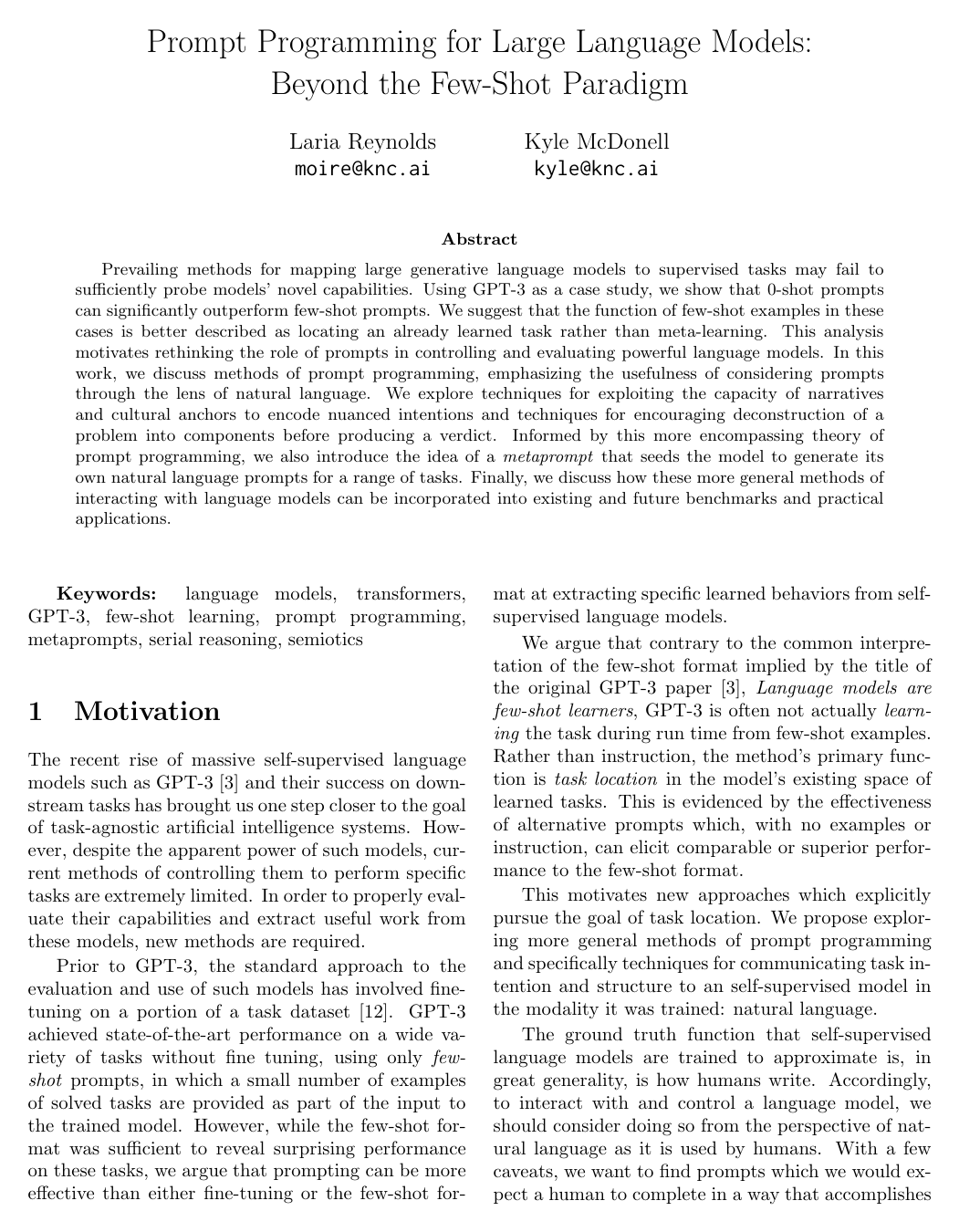
Prompt Programming for Large Language Models: Beyond the Few-Shot Paradigm
Laria Reynolds, Kyle McDonell
Why you should read this
Demonstrates how structured prompt programming techniques, including problem deconstruction and automated metaprompting, allow zero-shot prompts to outperform standard few-shot methods by directly accessing latent capabilities in large language models.
Prevailing methods for mapping large generative language models to supervised tasks may fail to sufficiently probe models' novel capabilities. Using GPT-3 as a case study, we show that 0-shot prompts can significantly outperform few-shot prompts. We suggest that the function of few-shot examples in these cases is better described as locating an already learned task rather than meta-learning. This analysis motivates rethinking the role of prompts in controlling and evaluating powerful language models. In this work, we discuss methods of prompt programming, emphasizing the usefulness of considering prompts through the lens of natural language. We explore techniques for exploiting the capacity of narratives and cultural anchors to encode nuanced intentions and techniques for encouraging deconstruction of a problem into components before producing a verdict. Informed by this more encompassing theory of prompt programming, we also introduce the idea of a metaprompt that seeds the model to generate its own natural language prompts for a range of tasks. Finally, we discuss how these more general methods of interacting with language models can be incorporated into existing and future benchmarks and practical applications.
Added
2026-09-25
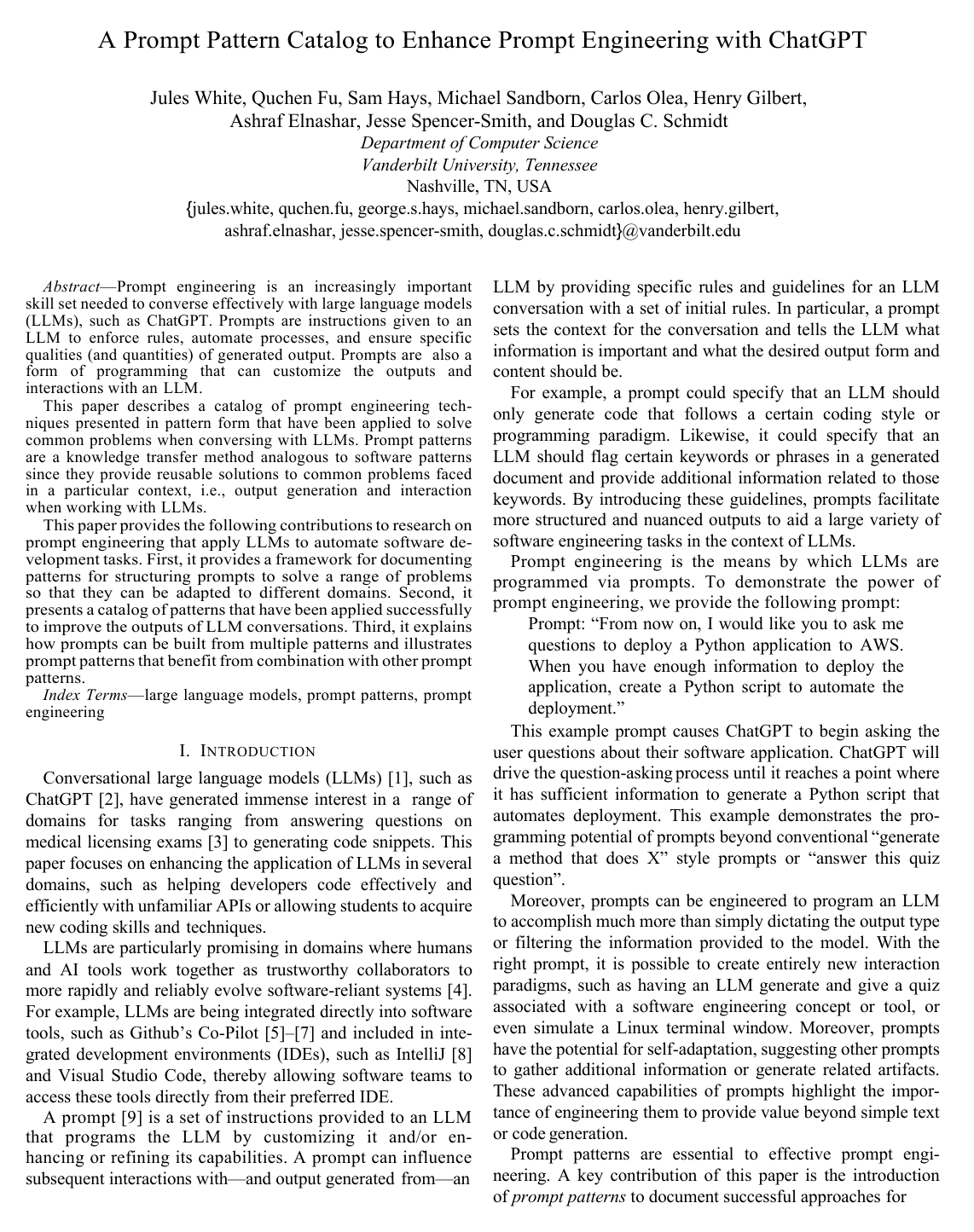
A Prompt Pattern Catalog to Enhance Prompt Engineering with ChatGPT
Jules White, Quchen Fu, Sam Hays, Michael Sandborn, Carlos Olea, Henry Gilbert, Ashraf Elnashar, Jesse Spencer-Smith, Douglas C. Schmidt
Why you should read this
Presents a structured catalog of reusable prompt engineering patterns modeled after software design patterns to solve common problems and systematically improve interactions with large language models.
Prompt engineering is an increasingly important skill set needed to converse effectively with large language models (LLMs), such as ChatGPT. Prompts are instructions given to an LLM to enforce rules, automate processes, and ensure specific qualities (and quantities) of generated output. Prompts are also a form of programming that can customize the outputs and interactions with an LLM. This paper describes a catalog of prompt engineering techniques presented in pattern form that have been applied to solve common problems when conversing with LLMs. Prompt patterns are a knowledge transfer method analogous to software patterns since they provide reusable solutions to common problems faced in a particular context, i.e., output generation and interaction when working with LLMs. This paper provides the following contributions to research on prompt engineering that apply LLMs to automate software development tasks. First, it provides a framework for documenting patterns for structuring prompts to solve a range of problems so that they can be adapted to different domains. Second, it presents a catalog of patterns that have been applied successfully to improve the outputs of LLM conversations. Third, it explains how prompts can be built from multiple patterns and illustrates prompt patterns that benefit from combination with other prompt patterns.
Added
2026-09-18
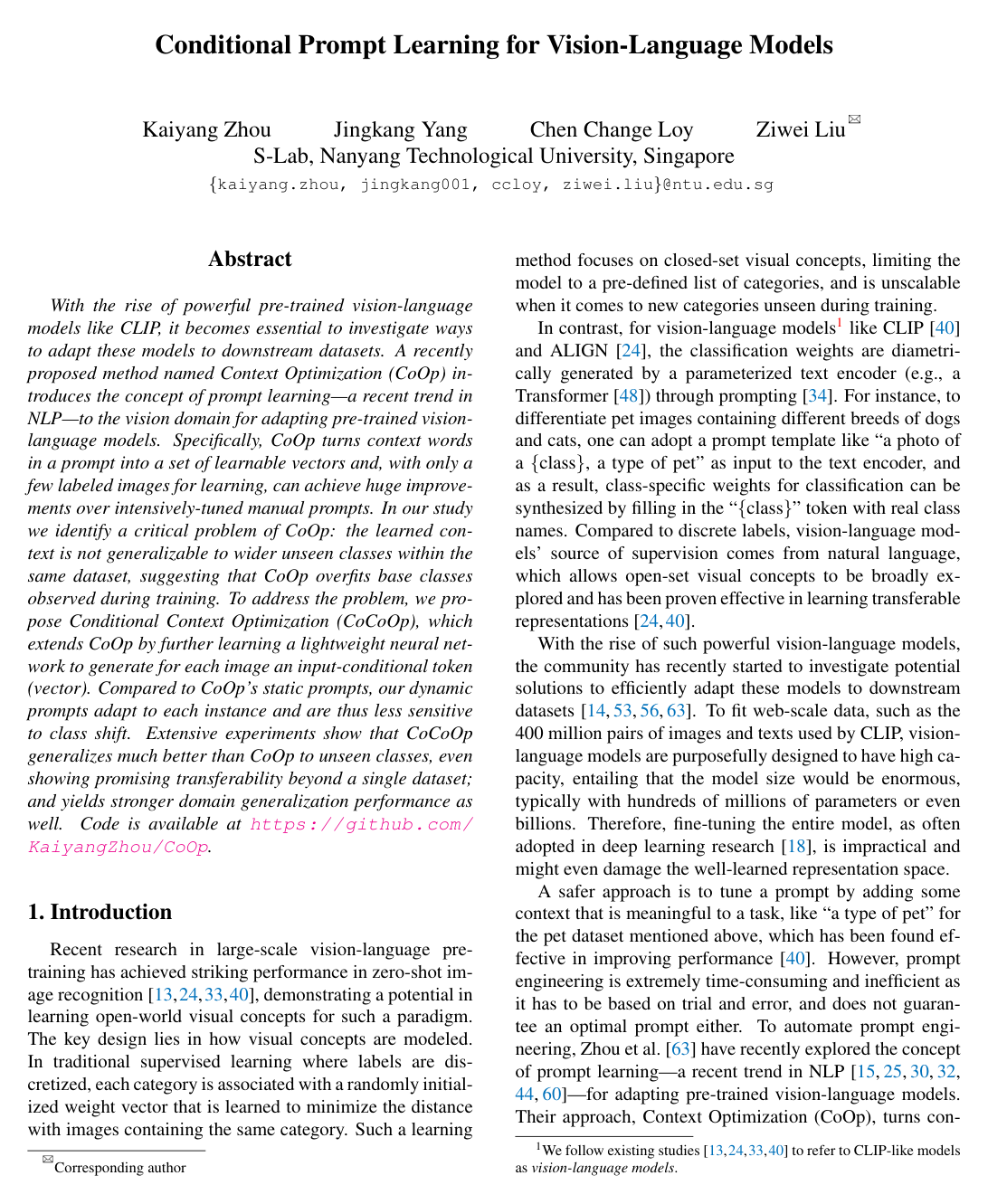
Conditional Prompt Learning for Vision-Language Models
Kaiyang Zhou, Jingkang Yang, Chen Change Loy, Ziwei Liu
Why you should read this
Proposes Conditional Context Optimization (CoCoOp), an instance-conditional prompt learning approach that prevents vision-language models like CLIP from overfitting to training classes and substantially improves generalization to unseen categories and new domains.
With the rise of powerful pre-trained vision-language models like CLIP, it becomes essential to investigate ways to adapt these models to downstream datasets. A recently proposed method named Context Optimization (CoOp) introduces the concept of prompt learning -- a recent trend in NLP -- to the vision domain for adapting pre-trained vision-language models. Specifically, CoOp turns context words in a prompt into a set of learnable vectors and, with only a few labeled images for learning, can achieve huge improvements over intensively-tuned manual prompts. In our study we identify a critical problem of CoOp: the learned context is not generalizable to wider unseen classes within the same dataset, suggesting that CoOp overfits base classes observed during training. To address the problem, we propose Conditional Context Optimization (CoCoOp), which extends CoOp by further learning a lightweight neural network to generate for each image an input-conditional token (vector). Compared to CoOp's static prompts, our dynamic prompts adapt to each instance and are thus less sensitive to class shift. Extensive experiments show that CoCoOp generalizes much better than CoOp to unseen classes, even showing promising transferability beyond a single dataset; and yields stronger domain generalization performance as well. Code is available at this https URL.
Added
2026-09-14
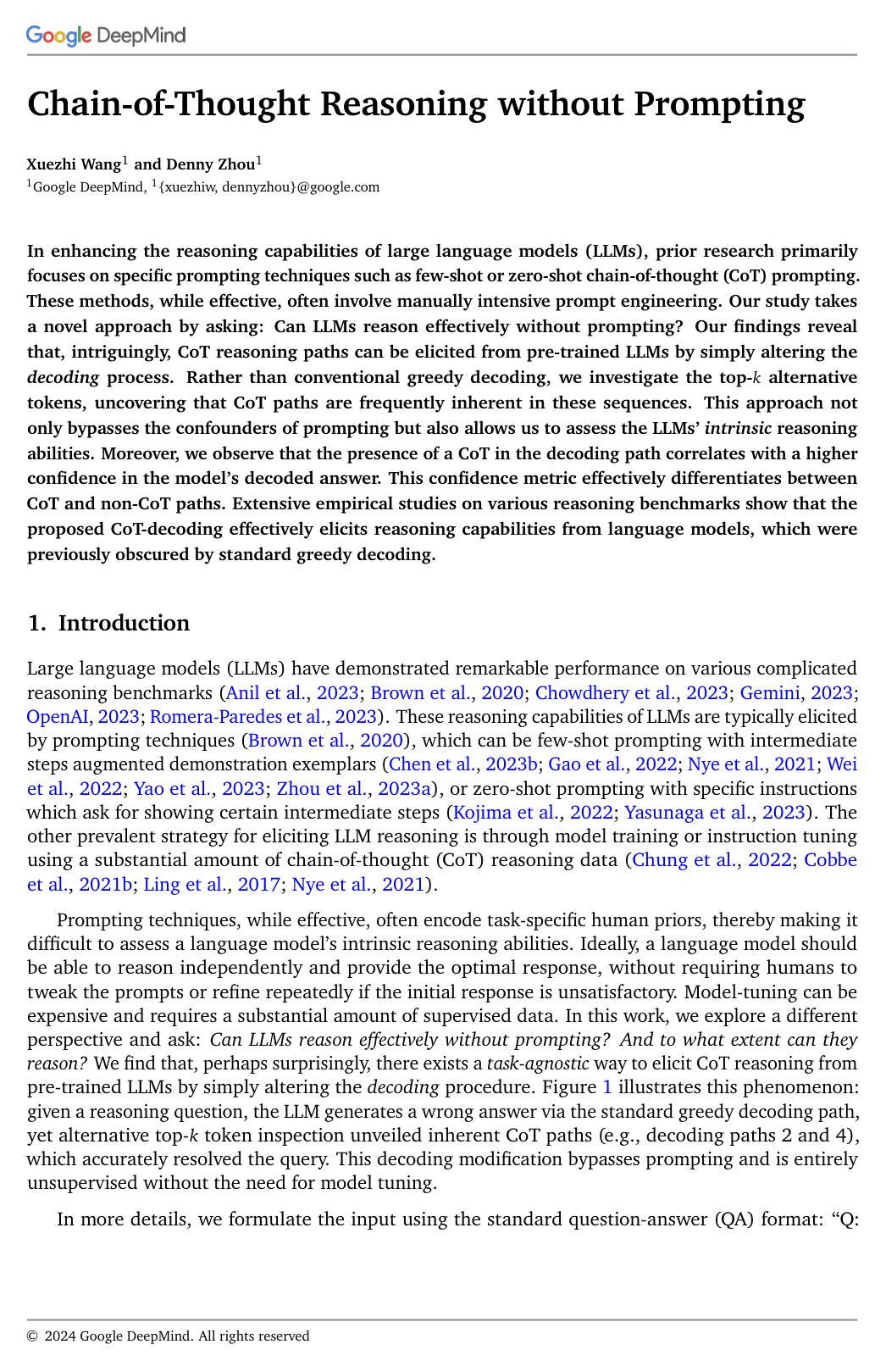
Chain-of-Thought Reasoning Without Prompting
Xuezhi Wang, Denny Zhou
Why you should read this
Reveals that large language models possess intrinsic chain-of-thought reasoning capabilities that can be elicited without prompt engineering or fine-tuning simply by exploring alternative top-k decoding paths.
In enhancing the reasoning capabilities of large language models (LLMs), prior research primarily focuses on specific prompting techniques such as few-shot or zero-shot chain-of-thought (CoT) prompting. These methods, while effective, often involve manually intensive prompt engineering. Our study takes a novel approach by asking: Can LLMs reason effectively without prompting? Our findings reveal that, intriguingly, CoT reasoning paths can be elicited from pre-trained LLMs by simply altering the \textit{decoding} process. Rather than conventional greedy decoding, we investigate the top- alternative tokens, uncovering that CoT paths are frequently inherent in these sequences. This approach not only bypasses the confounders of prompting but also allows us to assess the LLMs' \textit{intrinsic} reasoning abilities. Moreover, we observe that the presence of a CoT in the decoding path correlates with a higher confidence in the model's decoded answer. This confidence metric effectively differentiates between CoT and non-CoT paths. Extensive empirical studies on various reasoning benchmarks show that the proposed CoT-decoding effectively elicits reasoning capabilities from language models, which were previously obscured by standard greedy decoding.
Added
2026-09-14
