Dynamic Evaluation of Large Language Models by Meta Probing Agents
Kaijie ZhuJindong WangQinlin ZhaoRuochen XuXing Xie
Proposes a psychometrics-inspired dynamic evaluation framework using collaborative probing and judging agents to systematically transform existing benchmarks, exposing widespread performance drops from data contamination and uncovering strong correlations among underlying cognitive abilities in large language models.
Assessing large language models through static public benchmarks increasingly misleads decision-makers due to data contamination, where models inadvertently memorize publicly available test questions during training rather than demonstrating genuine reasoning. Furthermore, standard aggregate test scores fail to isolate underlying cognitive competencies. The article introduces and evaluates Meta Probing Agents, an automated, psychometrically grounded dynamic evaluation framework designed to measure true model capabilities and break the static nature of standard benchmarks.
The framework deploys a collaborative agent architecture: a probing agent transforms standard benchmark questions across three core cognitive dimensions—language understanding, problem solving, and domain knowledge—using techniques such as paraphrasing, adding extraneous context, and introducing plausible distractor choices. A judge agent then adversarially validates whether each revised question retains semantic equivalence and correctness relative to the original. The evaluation tested leading proprietary models (such as GPT-4-Turbo and Gemini-Pro) and open-source models (such as Llama2-70b-chat and Mixtral-8x7b-Instruct) across established benchmarks including MMLU, ARC-C, GSM8K, and subsets of BigBench-Hard. Human expert verification confirmed the validity of the dynamically generated questions with a 94% semantic equivalence rate and a 97% correctness rate.
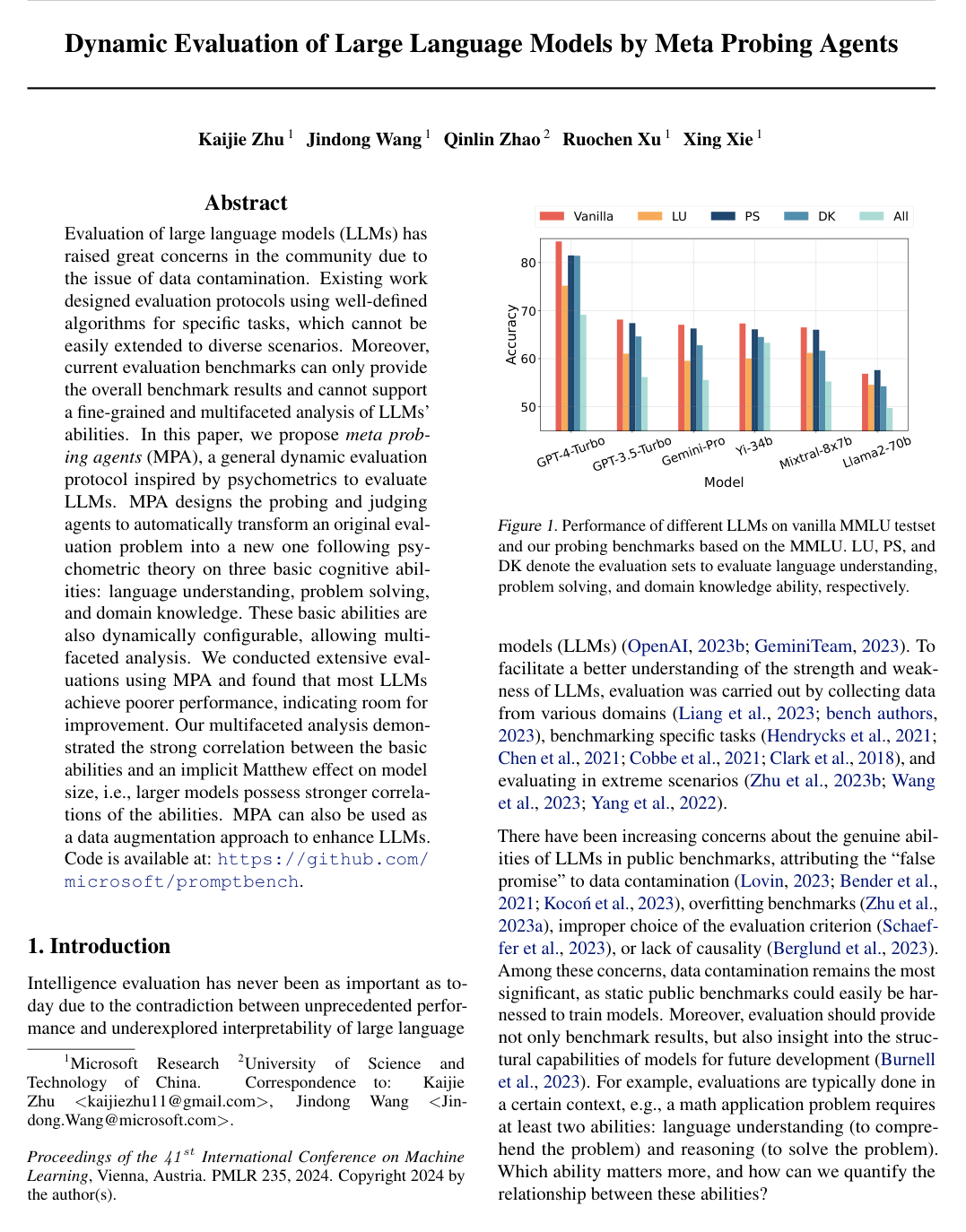
The evaluation revealed several critical findings. First, all models suffered substantial performance declines on dynamic benchmarks compared to their baseline scores; for instance, GPT-4-Turbo experienced a 15.54 percentage point drop on MMLU and an 11.49 point drop on ARC-C, indicating that standard benchmark performance is inflated by memorization. Second, open-source models exhibited higher rates of performance degradation when questions were altered, showing greater vulnerability to contamination. Third, standard prompt engineering techniques, such as Chain-of-Thought and In-Context Learning, provided only marginal improvements and failed to recover lost accuracy. Fourth, fine-grained analysis revealed strong cross-ability correlations, particularly between language understanding and problem solving, alongside a Matthew effect where larger models demonstrated tighter integration across all three cognitive dimensions. Finally, a pilot study demonstrated that using questions generated by the framework for fine-tuning improved model accuracy by an average of 2% on test benchmarks.
These findings imply that relying on published benchmark figures introduces significant risk when deploying models into complex, dynamic environments, as static scores mask core capability gaps in professional and ethical domains such as law, ethics, and psychology. Organizations should avoid relying solely on static public leaderboards for model selection and procurement. Instead, technical leaders should adopt dynamic, multi-agent probing frameworks for pre-deployment audits and explore probing-based data augmentation to fine-tune and strengthen model reasoning.
While the findings are well supported across thousands of test instances, current implementation depends heavily on advanced models like GPT-4-Turbo to reliably generate and judge questions, as weaker models introduce unintended drift in question meaning. Decision-makers should treat current benchmark rankings with healthy skepticism and consider expanding dynamic probing across broader, domain-specific evaluation sets before executing high-stakes deployments.
- Paper: Measuring Massive Multitask Language Understanding, Dan Hendrycks et al. (2020). It introduces the foundational MMLU benchmark that the source dynamically transforms and uses as a primary baseline to evaluate contamination.
- Paper: Challenging BIG-Bench Tasks and Whether Chain-of-Thought Can Solve Them, Mirac Suzgun et al. (2022). It establishes the BIG-Bench Hard subset and chain-of-thought baselines that the source directly probes to test complex problem-solving abilities.
- Paper: Judging LLM-as-a-Judge with MT-Bench and Chatbot Arena, Lianmin Zheng et al. (2023). It provides the foundational framework and validation for using large language models as automated evaluators and judges, a core mechanism of the source's judge agents.
- Paper: Large Language Models Can Be Easily Distracted by Irrelevant Context, Freda Shi et al. (2023). It demonstrates how irrelevant contextual additions degrade reasoning on math benchmarks like GSM8K, establishing the perturbation techniques adapted by the source.
- Paper: Adversarial Examples for Evaluating Reading Comprehension Systems, Robin Jia et al. (2017). It pioneers adversarial distractor insertion for testing reading comprehension, directly inspiring the source's probing agent perturbation strategies.
- Paper: Beyond the Imitation Game: Quantifying and extrapolating the capabilities of language models, BIG-bench authors (2022). It introduces the broad BIG-bench multi-task evaluation suite from which the source draws key problem sets to evaluate cognitive reasoning capabilities.
- Paper: MMLU-Pro: A More Robust and Challenging Multi-Task Language Understanding Benchmark, Yubo Wang et al. (2024). It builds upon the need for robust, contamination-resistant evaluations by redesigning MMLU with expanded options and higher-level reasoning tasks.
- Paper: MATH-Perturb: Benchmarking LLMs' Math Reasoning Abilities against Hard Perturbations, Kaixuan Huang et al. (2025). It extends dynamic probing methodologies to mathematical reasoning by implementing hard, structural perturbations to uncover memorization.
- Paper: GSM-Symbolic: Understanding the Limitations of Mathematical Reasoning in Large Language Models, Iman Mirzadeh et al. (2025). It develops a symbolic template perturbation pipeline for GSM8K to further evaluate the variance and limitations of mathematical reasoning exposed by dynamic testing.
- Paper: LiveCodeBench: Holistic and Contamination Free Evaluation of Large Language Models for Code, Naman Jain et al. (2025). It tackles the benchmark contamination challenge highlighted by the source by establishing a continuously updated, live problem stream for code evaluation.
- Paper: JudgeBench: A Benchmark for Evaluating LLM-Based Judges, Sijun Tan et al. (2025). It evaluates the reliability of the automated LLM judge models upon which multi-agent evaluation frameworks like the source depend.
- Paper: Agent-as-a-Judge: Evaluate Agents with Agents, Mingchen Zhuge et al. (2025). It generalizes agent-based evaluation from question-answering perturbations to inspecting full multi-step trajectory workflows in autonomous agents.
- Paper: Artifacts or Abduction: How Do LLMs Answer Multiple-Choice Questions Without the Question?, Nishant Balepur et al. (2024). It investigates the underlying mechanisms of dataset artifacts and shortcuts in standard multiple-choice benchmarks when questions are altered or removed.
- Paper: A Survey on LLM-as-a-Judge, Jiawei Gu et al. (2024). It provides a systematic survey and taxonomy of LLM judge architectures, addressing the biases and limitations observed in multi-agent evaluation frameworks.