
Chain-of-Thought Reasoning without Prompting
Xuezhi Wang$^{1}$ and Denny Zhou$^{1}$
$^{1}$ Google DeepMind, $^{1}$ {xuezhiw, dennyzhou}@google.com
Abstract
In enhancing the reasoning capabilities of large language models (LLMs), prior research primarily focuses on specific prompting techniques such as few-shot or zero-shot chain-of-thought (CoT) prompting. These methods, while effective, often involve manually intensive prompt engineering. Our study takes a novel approach by asking: Can LLMs reason effectively without prompting? Our findings reveal that, intriguingly, CoT reasoning paths can be elicited from pre-trained LLMs by simply altering the decoding process. Rather than conventional greedy decoding, we investigate the top-$k$ alternative tokens, uncovering that CoT paths are frequently inherent in these sequences. This approach not only bypasses the confounders of prompting but also allows us to assess the LLMs' intrinsic reasoning abilities. Moreover, we observe that the presence of a CoT in the decoding path correlates with a higher confidence in the model's decoded answer. This confidence metric effectively differentiates between CoT and non-CoT paths. Extensive empirical studies on various reasoning benchmarks show that the proposed CoT-decoding effectively elicits reasoning capabilities from language models, which were previously obscured by standard greedy decoding.
Executive Summary: Large language models have shown strong results on reasoning benchmarks, yet these capabilities have typically required either carefully engineered prompts or expensive instruction tuning on chain-of-thought data. Both approaches introduce human priors, raise costs, and make it hard to judge what the models can do on their own. The paper therefore asks whether pre-trained models already contain usable reasoning paths that can be surfaced without any task-specific prompting or additional training.
The authors test this idea by feeding models a plain question-answer prefix and then examining the top-k alternative tokens at the very first decoding step instead of following the single greedy path. From each chosen first token they continue with ordinary greedy decoding. They also record a simple confidence score—the average probability gap between the model’s top two tokens when it produces the final answer—and use that score to rank the resulting paths. Experiments cover grade-school math problems, a year-parity commonsense task, and several symbolic reasoning suites, run on the PaLM-2 family, Mistral-7B, and Gemma-7B in both pre-trained and instruction-tuned versions.
Across these benchmarks the single greedy path rarely contains a chain-of-thought and often yields low accuracy. In contrast, one or more of the top-k alternatives frequently produce coherent intermediate steps that lead to the correct answer. Selecting the path with the highest final-answer confidence reliably extracts these chains and lifts accuracy—for example from 9.9 % to 25.1 % on Mistral-7B GSM8K and from 34.8 % to 63.2 % on the largest PaLM-2 model. Gains are largest on tasks that resemble material seen during pre-training and shrink as the number of required reasoning steps grows. The same procedure also improves already-tuned models and narrows much of the gap between pre-trained and instruction-tuned performance without using any supervised data.
These results indicate that current models possess more reasoning capacity than greedy decoding alone reveals, and that the apparent need for elaborate prompting or tuning is partly an artifact of that decoding choice. The added cost is modest—ten parallel paths instead of one—and the method can be combined with existing prompts to obtain still larger gains. Limitations include extra inference compute, reduced reliability on fully open-ended answers, and the current restriction to branching only at the first token. Future work could explore branching at later steps, use the discovered paths for lightweight fine-tuning, or develop cheaper ways to identify high-confidence chains.
1. Introduction
Section Summary: Large language models often appear unable to reason well unless guided by carefully designed prompts or extra training data, but this limitation may stem from how their outputs are normally generated. By examining not only the single most likely next word but also other high-probability alternatives during generation, coherent chains of reasoning emerge naturally from the model without any prompting. The authors show that these alternative paths frequently lead to correct answers and can be identified by tracking which paths produce greater model confidence in the final result.
Large language models (LLMs) have demonstrated remarkable performance on various complicated reasoning benchmarks ([1, 2, 3, 4, 5, 6]). These reasoning capabilities of LLMs are typically elicited by prompting techniques ([5]), which can be few-shot prompting with intermediate steps augmented demonstration exemplars ([7, 8, 9, 10, 11, 12]), or zero-shot prompting with specific instructions which ask for showing certain intermediate steps ([13, 14]). The other prevalent strategy for eliciting LLM reasoning is through model training or instruction tuning using a substantial amount of chain-of-thought (CoT) reasoning data ([15, 16, 7, 17]).
Prompting techniques, while effective, often encode task-specific human priors, thereby making it difficult to assess a language model's intrinsic reasoning abilities. Ideally, a language model should be able to reason independently and provide the optimal response, without requiring humans to tweak the prompts or refine repeatedly if the initial response is unsatisfactory. Model-tuning can be expensive and requires a substantial amount of supervised data. In this work, we explore a different perspective and ask: Can LLMs reason effectively without prompting? And to what extent can they reason? We find that, perhaps surprisingly, there exists a task-agnostic way to elicit CoT reasoning from pre-trained LLMs by simply altering the decoding procedure. Figure 1 illustrates this phenomenon: given a reasoning question, the LLM generates a wrong answer via the standard greedy decoding path, yet alternative top-$k$ token inspection unveiled inherent CoT paths (e.g., decoding paths 2 and 4), which accurately resolved the query. This decoding modification bypasses prompting and is entirely unsupervised without the need for model tuning.
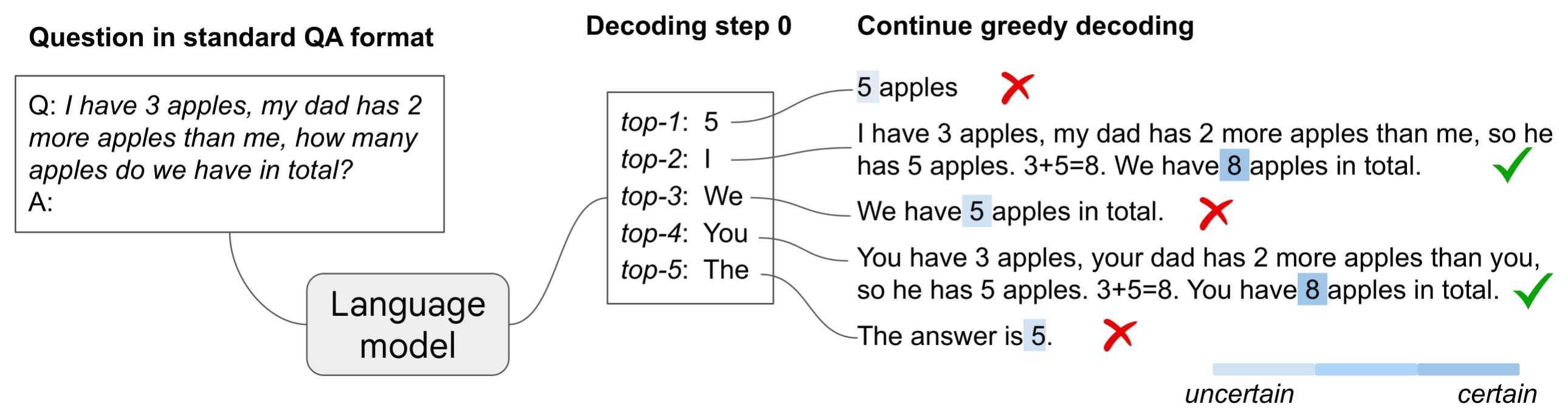
In more details, we formulate the input using the standard question-answer (QA) format: "Q: [question]</span>nA:".[^1] While most existing work suggest that LLMs falter in such direct-QA scenarios on reasoning ([18, 7, 8, 13]), our findings reveal a nuanced picture. We observe that LLMs indeed struggle with reasoning when relying solely on greedily decoded paths. However, when we consider alternative paths among the top-$k$ tokens, CoT reasoning patterns emerge naturally within the decoding trajectories of LLMs. In addition, we have observed an interesting pattern: the model demonstrates increased confidence in the final answer when a CoT reasoning path is present in the decoding process. As illustrated in Figure 1, this is evident where paths 2 and 4 show heightened certainty in arriving at the correct answer "8", contrasting sharply with the high uncertainty in paths that lead to the incorrect "5". Leveraging this phenomenon, we develop a method to sift through the top-$k$ decoding paths, which we refer to as CoT-decoding, thereby isolating the most reliable paths for model output.
[^1]: The QA format is only needed because without it a pre-trained language model will continue the question instead of answering. It is also the most basic formatting employed in existing works for pre-trained models.
Our contributions are summarized as follows:
- We present a novel finding that LLMs can reason by simple decoding changes, without the use of prompting. In contrast to prior research that focuses on refining prompts to elicit reasoning from LLMs, our work, for the first time, shows that the reasoning process can be readily elicited by simple decoding changes. Moreover, we challenge the prevailing notion in the literature that LLMs are inherently incapable of effective reasoning without prompting. We show that this belief is an artifact of considering only the greedy path during decoding, and the model's reasoning paths can be revealed by traversing the alternative decoding paths.
- Our method enables a better understanding of LLMs'intrinsic reasoning capabilities without imposing human priors. The employment of intricate prompting techniques often introduces various human priors, making it difficult to distinguish between the extent of "human teaching" and the degree to which LLMs can reason independently. Our approach bypasses the confounders introduced by prompting, enabling a more truthful assessment of the models' intrinsic reasoning abilities. Our study reveals that pre-trained language models inherently possess reasoning capabilities for many tasks including math and commonsense reasoning, and existing prompting approaches mostly serve the role of bringing those inherent reasoning paths forward as the top decoding paths. In contrast, the CoT-paths are less prevalent in complex and highly synthetic tasks, where the few-shot CoT demonstrations play a "teaching" role in guiding how models solve a task, with models primarily mimicing the format of these prompts to generate accurate reasoning paths.
- We further propose CoT-decoding that reliably selects CoT-paths based on answer confidence. We find that the language model's confidence in its final answers increases when a CoT is present in its decoding path. Leveraging this increased confidence, we propose CoT-decoding to select more reliable decoding paths, demonstrating significant improvements over greedy decoding across various reasoning benchmarks.
2. Chain-of-Thought (CoT) Decoding
Section Summary: Pre-trained language models already contain strong reasoning abilities, but standard greedy decoding tends to bypass them by jumping straight to an answer, which often produces errors on tasks like math or commonsense questions. Exploring just a few alternative first tokens and then decoding normally from there frequently surfaces natural chain-of-thought reasoning paths that were hidden by the greedy approach. The authors therefore propose CoT-decoding, which ranks these paths by measuring how confident the model becomes in its final answer; paths containing explicit reasoning steps reliably yield much higher confidence and can be selected without extra prompting or human guidance.
2.1 Pre-trained Language Models Can Reason without Prompting
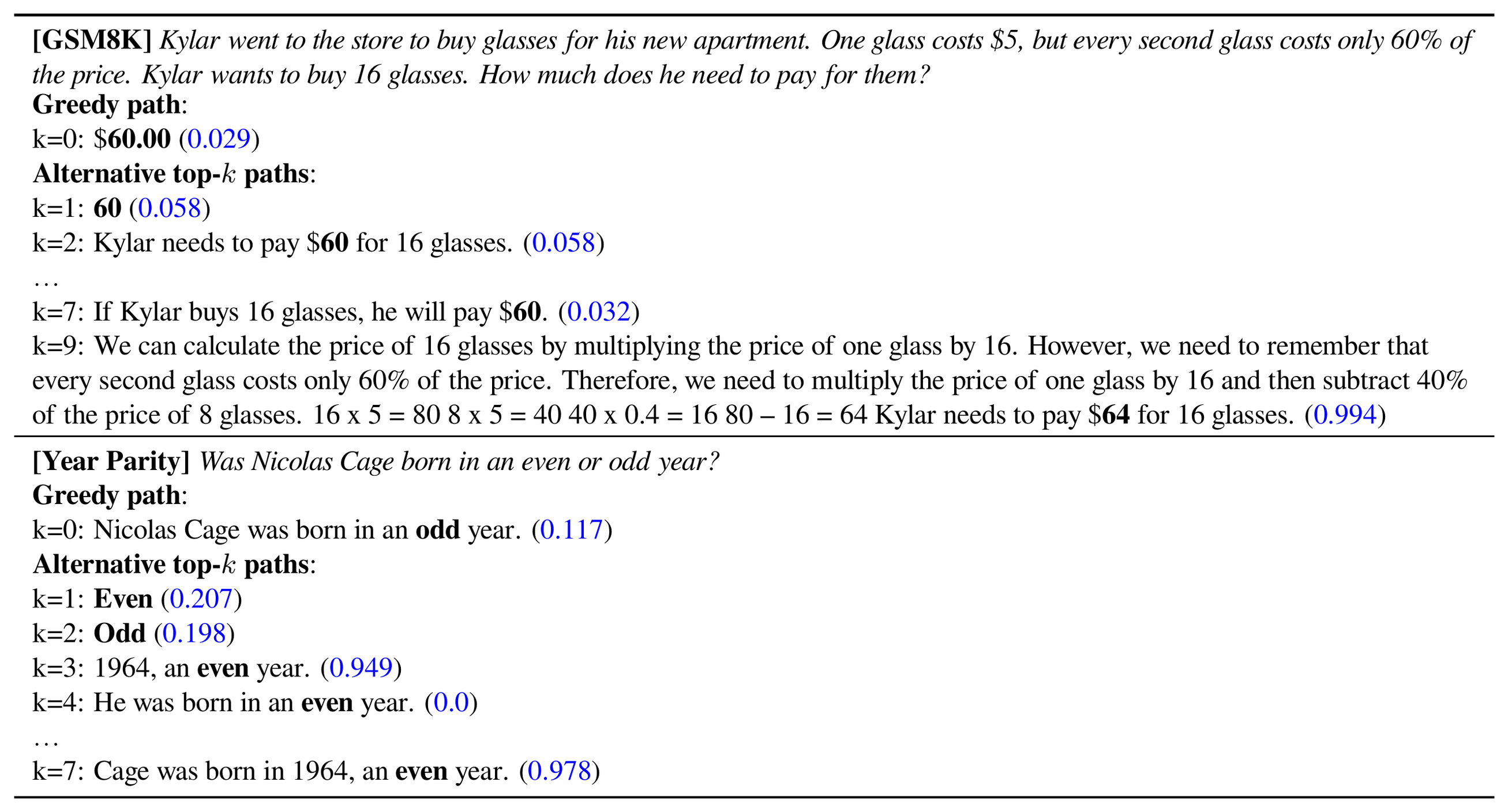
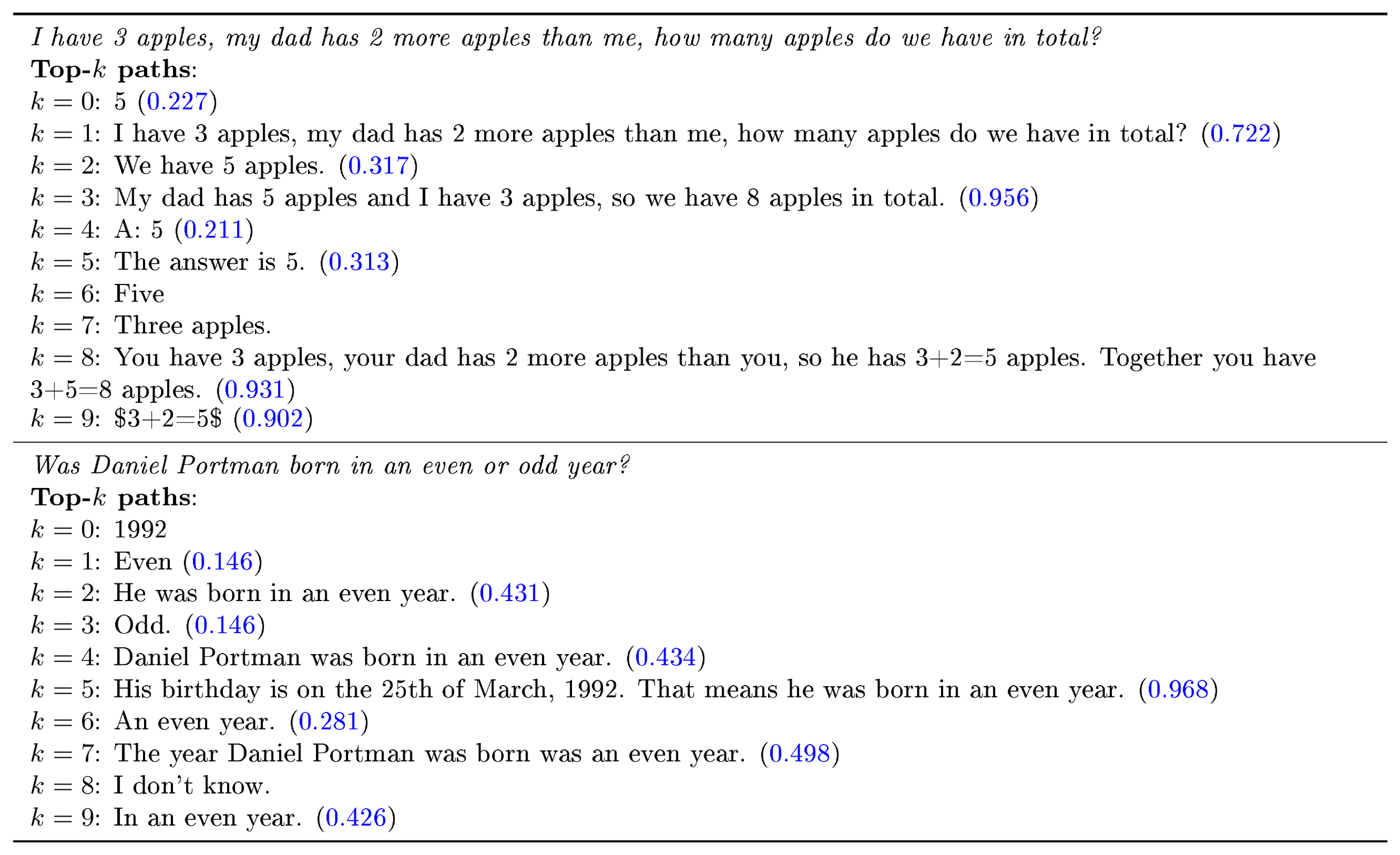
We investigate whether pre-trained language models inherently possess reasoning capabilities, without explicit prompts or human intervention. In Table 1, we show example decoding paths across math (GSM8K, [18]) and commonsense reasoning (year parity, [19]). We employ the pre-trained PaLM-2 large model ([2]) to compare its greedy decoding path ($k=0$), predominantly used in state-of-the-art LLMs for reasoning tasks, with alternative decoding paths ($k>0$), where $k$ represents the choice of the $k$-th token at the first decoding step.
::: {caption="Table 1: Examples of greedy decoded paths and alternative top- $k$ paths over the PaLM-2 Large model. The model's confidence over the answers (bolded) are highlighted in blue (See § 2.2 for details)."}
:::
LLMs indeed cannot reason if we only consider the greedy decoding path.
First, we observe that models employing greedy decoding often does not contain a CoT path, opting to solve problems directly. This tendency may stem from the model's skewed perception of problem difficulty, shaped by its pre-training on predominantly simpler questions. Consequently, the model is predisposed to immediate problem-solving. This observation aligns with findings in ([18, 7, 8, 13]), which show that direct-answer prompts generally result in low accuracy on reasoning tasks even for large language models.
LLMs can reason if we consider the alternative decoding paths.
Contrastingly, an intriguing phenomenon emerges when exploring alternative top-$k$ ($k>0$) tokens at the first decoding step. Continuing with greedy decoding from this point reveals natural CoT reasoning in many cases. These findings suggest that large language models possess inherent reasoning capabilities for numerous tasks following pre-training, but these abilities are obscured by the predominant use of greedy decoding. These reasoning paths can be easily uncovered by incorporating alternative decoding paths.
For instance, in the GSM8K question (Table 1), a valid CoT emerges at $k=9$. Similarly, in the year parity task, greedy decoding attempts to directly answer the parity question at $k=0$, leading to a random choice between "even" and "odd" which often results in an incorrect answer. However, when exploring $k>0$, the model naturally generates CoT paths at $k=3$ and $k=7$, where it first determines the year before resolving the parity.
2.2 CoT-Decoding for Extracting CoT Paths
In this section, we further show how we can reliably extract those CoT-paths during the decoding process. Table 1 illustrates that CoT paths do not consistently outrank non-CoT ones in the model's probability assessment. Moreover, they often do not represent the predominant answer among all paths, rendering methods like self-consistency ([20]) inapplicable. For instance, in the GSM8K question, the prevalent answer "60", which aligns with the greedy decoding result, fails to serve as a reliable indicator for identifying the correct path.
Interestingly, upon examining the model's logits, we found that the presence of a CoT path typically leads to a more confident decoding of the final answer, characterized by a significant probability disparity between the top and secondary tokens:
$ \Delta_{k, \text{answer}} = \frac{1}{|\text{answer}|}\sum_{x_t\in \text{answer}} p(x^1_t \mid x_{<t}) - p(x^2_t \mid x_{<t}). $
Here $x^1_t$ and $x^2_t$ represent the top two tokens at the $t$-th decoding step in the $k$-th decoding path, chosen for their maximum post-softmax probabilities from the vocabulary, given $x_t$ being part of the answer tokens. This uncertainty measure is similar to the minimum-margin approach in ([21]) and in our case, the model's overall confidence in decoding the final answer is approximated by averaging these probability differences for all relevant answer tokens $x_t$. For example, for the GSM8K question in Table 1, given the answer "60", we average the probability differences for all tokens in that answer, i.e., "6" and "0".[^2]
[^2]: We also considered other popular choices for measuring the model's uncertainty ([22]), e.g., using the model's probability on the token itself (i.e., $p(x^1_t \mid x_{<t})$ only), which performs slightly worse compared to the min-margin approach. In addition, an entropy estimate is not accurate due to the large vocabulary size in LLMs and the common use of vocabulary truncation.
This method, referred to as CoT-decoding, extracts such CoT paths among the decoded paths from the model. As illustrated in Table 1, each decoding path is marked with its corresponding $\Delta$ value in blue (the answer tokens are bolded). It is evident that paths with a CoT component exhibit a significantly higher $\Delta$, highlighting the model's increased confidence, as opposed to paths without CoT. We also did a quantitative analysis by manually examining the first 100 questions in GSM8K, and among those, if we take the decoding path with the highest answer confidence among the top-10 decoding paths, 88% of them contain CoT paths. This shows an overwhelmingly high correlation between the model's answer confidence and the CoT paths.
Comparing different CoT-path extraction approaches.
In Table 2, we compare different ways to extract the CoT-paths out of the top-10 decoded paths. It is easy to see that the model's own probability measure does not serve as a reliable indicator, nor does the model's length-normalized probability (since an intuition could be a CoT-path should usually be a longer decoding path, which is not always the case, e.g., on the year parity task). In contrast, CoT-decoding can reliably extract the CoT-paths, yielding a significant boost on the model's reasoning performance.
: Table 2: CoT-decoding reliably extracts the CoT-paths compared to other methods (on PaLM-2 L).
| GSM8K (top-100) | Year Parity | |
|---|---|---|
| Greedy decoding | 44.0% | 57.0% |
| Decode 10 paths, rank by model's highest log-prob | 37.0% | 55.0% |
| Decode 10 paths, rank by model's highest length-normalized log-prob | 51.0% | 57.0% |
| CoT-decoding (decode 10 paths, rank by model's answer confidence) | 72.0% | 95.0% |
Identify the answer spans.
Computing $\Delta$ requires identifying the answer spans in a model's response. One common approach used for public models is to extract the last numerical value in math reasoning tasks, or the final option in set-based reasoning tasks, as the answer, following the Tülu evaluation ([23, 24, 25]). Alternatively, similarly to the method used in [13], we can also extend the model's output with the prompt "So the answer is", and then align these continuations with spans in the model's decoding path as the answer.
: Table 3: CoT-decoding and self-consistency w/o prompts on GSM8K.
| Mistral-7B | PaLM-2 L | |
|---|---|---|
| Greedy decoding | 9.9% | 34.8% |
| Self-consistency without CoT-prompt (10 paths) | 12.9% | 40.6% |
| CoT-decoding (10 paths) | 25.1% | 63.2% |
Sampling under the standard QA format.
CoT-decoding explores alternative tokens at the first decoding step. A natural question arises: can sampling achieve a similar effect and unveil the CoT reasoning paths? We found that, although sampling works well under few-shot CoT prompting ([20]), it does not exhibit the desired behaviour without the prompts. We compare CoT-decoding with self-consistency when no CoT prompt is used in Table 3. The ineffectiveness of sampling stems from the model's strong tendency in providing a direct answer during decoding, hence the first token tends to have less diversity compared to CoT-decoding. In contrast, CoT-decoding works by explicitly encouraging diversity at the first decoding step.
Branching at other decoding steps.
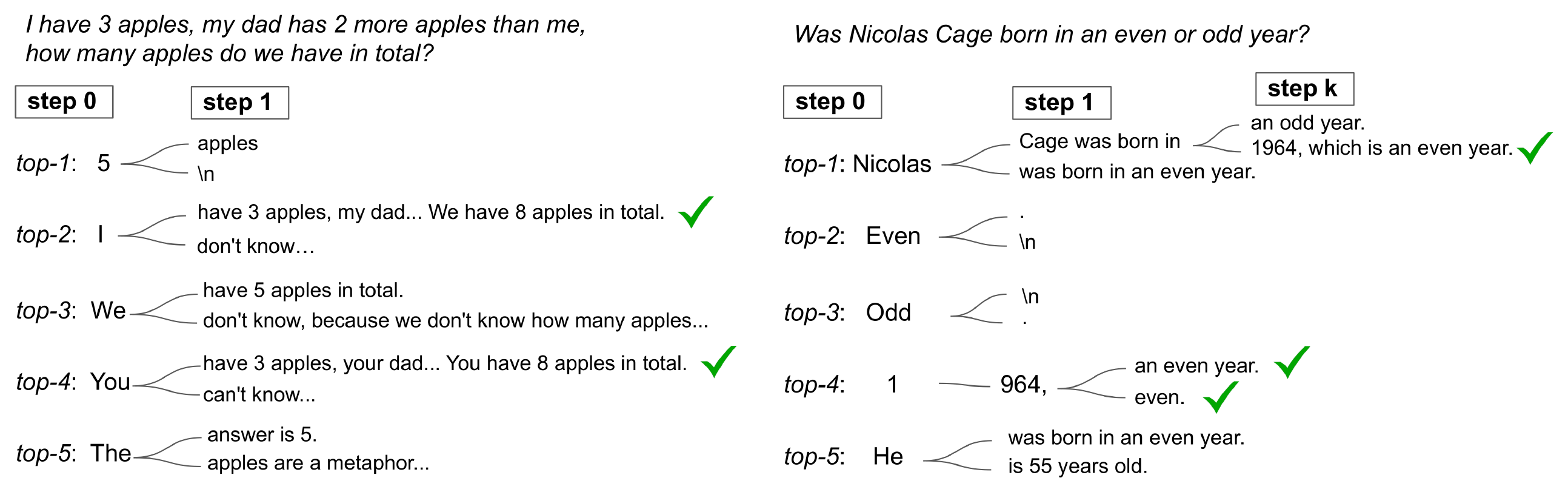
Another natural question is whether branching is viable at later decoding stages, comparing to only branching at the first decoding step. In Figure 2, we highlight the impact of alternative token consideration in subsequent decoding steps. It is evident that early branching, e.g., at the first decoding step, significantly enhances the diversity of potential paths. Conversely, later-stage branching is significantly influenced by previously generated tokens. For instance, initiating with the token "5" greatly decreases the likelihood of rectifying an erroneous path. Nonetheless, the optimal branching point may vary with the task; in the year parity task, for instance, mid-path branching can effectively yield correct CoT paths.
Aggregation of the decoding paths.
Since we already decode the top-$k$ paths, one natural extension is to aggregate the answers over all those paths, similar to self-consistency ([20]) but without the use of prompts. The rationale behind this aggregation is to mitigate sensitivity to small differences in the model's logits, particularly when relying solely on the path with the maximum $\Delta$. The examples in Table 1 show that the majority answer is unlikely to be the correct one. Instead, we propose a weighted aggregation method, i.e., we take the answer that maximizes $\tilde{\Delta}{a} = \sum_k \Delta{k,a}$ where $\Delta_{k,a}$ is the $k$-th decoding path whose answer $=a$. We found that adopting this approach enhances the stability of the results, and further analysis is presented in Section § 3.3.
3. Experiments
Section Summary: The experiments evaluate a new decoding approach called CoT-decoding on several language models, including different sizes of PaLM-2 as well as Mistral-7B and Gemma-7B, using math word problems, a year-parity commonsense task, and other reasoning benchmarks. The method starts by sampling a small set of alternative first tokens and then follows each path greedily, producing large accuracy gains over standard strategies such as greedy decoding, temperature sampling, or beam search. These improvements appear consistently across model scales and families, allow untuned models to approach the performance of their instruction-tuned counterparts, and remain effective even on tasks that do not benefit from simply making the model larger.
Experiment Setup.
For all experiments, the default input to the model is the standard QA format of Q: [question]</span>nA:, where [question] is filled with the actual question depending on the task, and we ask the model to continue the generation given that prefix. During decoding, we use $k=10$ as default for the alternative top-$k$ tokens at the first decoding position, and continue greedy decoding afterwards. We show ablation studies with respect to the different choice of $k$ in Section § 3.1.
Datasets.
For mathematical reasoning, we use the Grade-school math problems (GSM8K; [18]) and the multi-step arithmetic dataset from (MultiArith; [26]). For commonsense reasoning, we investigate the "year parity" task where recent literature finds large language models still struggle with. The task is to query the model with "Was [person] born in an even or odd year?" where "[person]" is filled by a random celebrity name.[^3] Existing work ([27, 19]) shows that even SoTA models like GPT-4 struggle with such tasks, achieving at-chance accuracy ($\sim$50%) when prompted directly. Additionally, we investigate symbolic reasoning tasks from Big-Bench-Hard ([28, 29]).
[^3]: We curate a list of the top 100 celebrity names from ([27]): https://github.com/lukasberglund/reversal_curse/blob/main/data/celebrity_relations/top_celebrities.txt
Models.
We use three public models: (1) PaLM-2 ([2]) with different scales, ranging from X-Small, Small, Medium, and Large; (2) Mistral-7B ([30]), and (3) Gemma-7B ([31]). Our experiments primarily focus on pre-trained models, but we also include experiments with instruction-tuned models (denoted as "inst-tuned" or "IT").
3.1 CoT-Decoding Effectively Elicits Reasoning from Language Models
\begin{tabular}{cc}
\toprule
   {} & GSM8K Acc \\
\midrule
 Top-$k$ sampling ($k=10$) & 4.9\% \\
 Top-$p$ / Nucleus sampling ($p=0.9$) & 6.4\% \\
 Beam search ($b=10$) & 6.7\% \\
 Temperature sampling ($T=0.7$) & 7.5\% \\
 \midrule
 Greedy decoding & 9.9\% \\
 Self-consistency w/o CoT prompt (10 paths) & 12.9\% \\
 CoT-decoding ($k=10$) & \textbf{25.1\%} \\
\bottomrule
\end{tabular}
CoT-decoding is the only decoding strategy that effectively improves language model reasoning.
In Table 4, we present results from popular decoding baselines on the Mistral-7B pre-trained model, including temperature sampling ([32, 33]), top-$k$ sampling ([34, 35, 36]), nucleus sampling ([37]), and beam search. We can see that CoT-decoding is the only decoding strategy that effectively enables language models to reason, while some of the decoding methods even hurt model reasoning compared to greedy decoding.
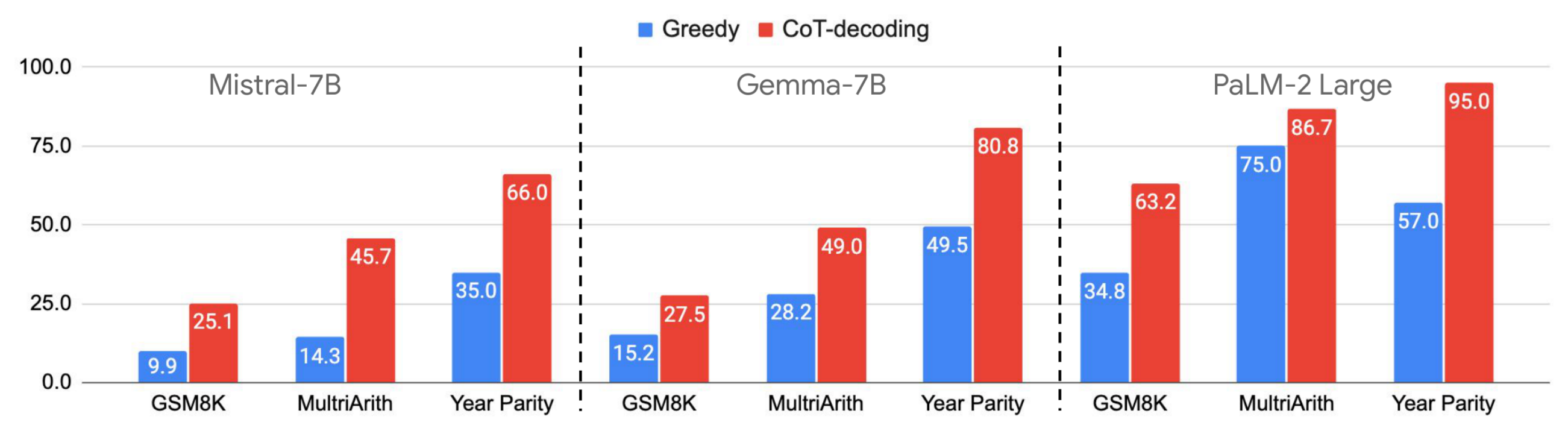
CoT-decoding effectively elicits reasoning across language models.
In Figure 3, we show that across three language model families, PaLM-2, Mistral and Gemma, CoT-decoding effectively elicits model's reasoning, yielding consistent accuracy gains over both math and commonsense reasoning tasks, sometimes doubling or even tripling the performance compared to greedy decoding.
CoT-decoding elicits reasoning across model scales.
In Figure 4, we show that CoT-decoding enhances reasoning across different model scales over the PaLM-2 model family. On GSM8K, CoT-decoding consistently yields +10-30% absolute accuracy gains. On year parity, when using greedy decoding, the model's performance remains flat even after scaling up model sizes, consistent with the findings in ([19]). In contrast, CoT-decoding significantly boosts the performance by recovering the CoT paths, achieving almost perfect accuracy at larger model scales.
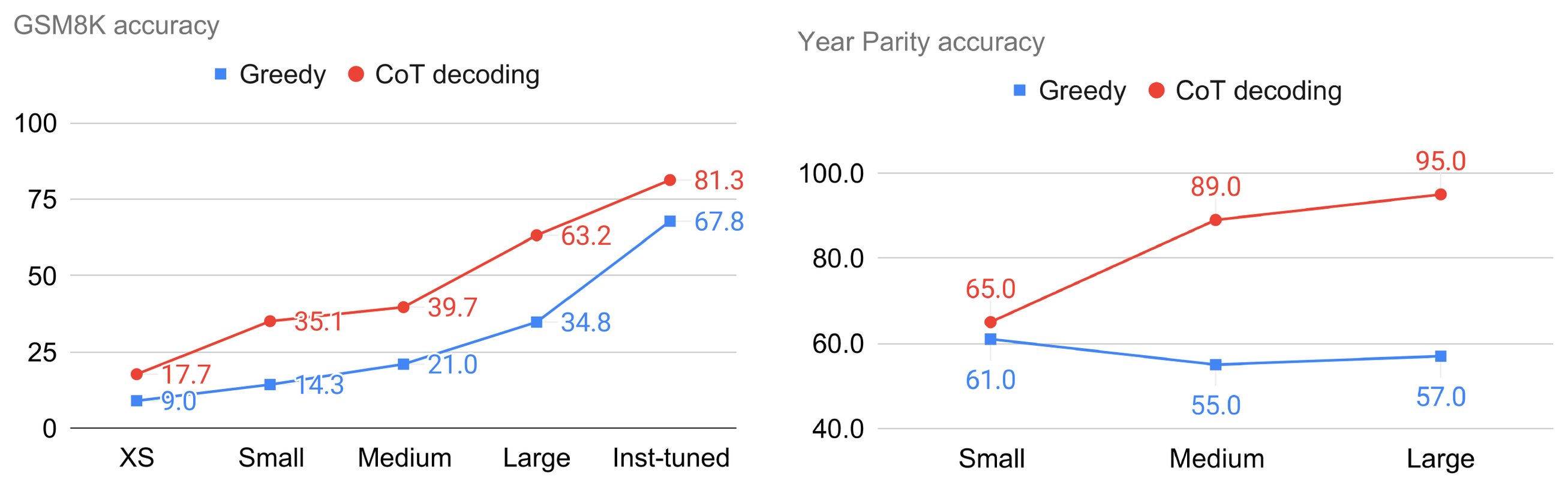
CoT-decoding partially closes the reasoning gap between pre-trained and instruction-tuned models, without using any supervised data.
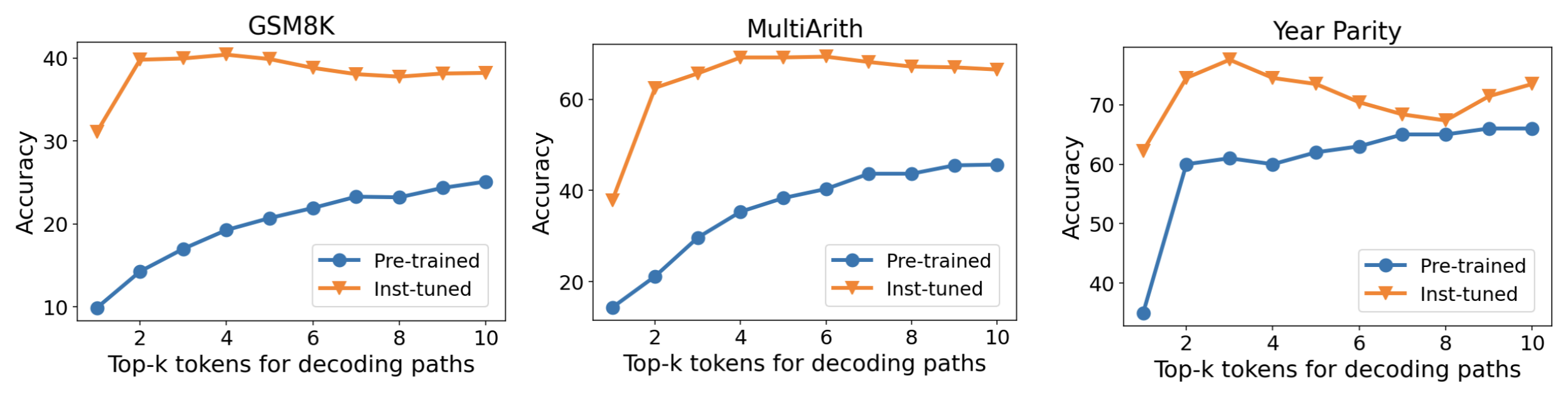
Intriguingly, we observe that CoT-decoding enables a pre-trained model to achieve a similar performance of an instruction-tuned model: in Figure 4 (left), CoT-decoding achieves 63.2% accuracy on the pre-trained PaLM-2 Large model, close to the performance of the instruction-tuned model of the same scale at 67.8%. The results demonstrate that instruction-tuning with sufficient CoT data ([17]) can be partially achieved by modifying the decoding procedure within pre-trained models.
\begin{tabular}{clll}
\toprule
 {} & & Pre-trained & Inst-tuned\\
\midrule
\multirow{2}{*}{GSM8K} & Greedy & 9.9 & 31.2 \\
  {} & CoT-decoding &
 \textbf{25.1} {\scriptsize(+15.2)} & \textbf{38.2} {\scriptsize(+7.0)}\\
 \midrule
\multirow{2}{*}{MultiArith} & Greedy & 14.3 & 37.8\\
   {} & CoT-decoding
   {} & \textbf{45.7} {\scriptsize(+31.4)} & \textbf{66.5} {\scriptsize(+28.7)} \\
  \midrule
\multirow{2}{*}{\makecell{Year \\Parity}} & Greedy & 35.0 & 62.2\\
 {} & CoT-decoding & \textbf{66.0} {\scriptsize(+31.0)} & \textbf{73.5} {\scriptsize(+11.3)}\\
\bottomrule
\end{tabular}
More interestingly, we observe that CoT-decoding can further improve the instruction-tuned model (Figure 4 (left) and Table 5). The instruction-tuning procedure ([17]) has already incorporated abundant CoT annotations during the fine-tuning process. Consequently, the model is expected to inherently generate CoT paths when addressing reasoning tasks. However, upon analyzing specific examples, we found that even after instruction-tuning, the model occasionally persists in attempting to directly address a question. In contrast, CoT-decoding can enhance the exploration of alternative paths by triggering a CoT first, consequently leading to more accurate answers.
Choice of $k$.
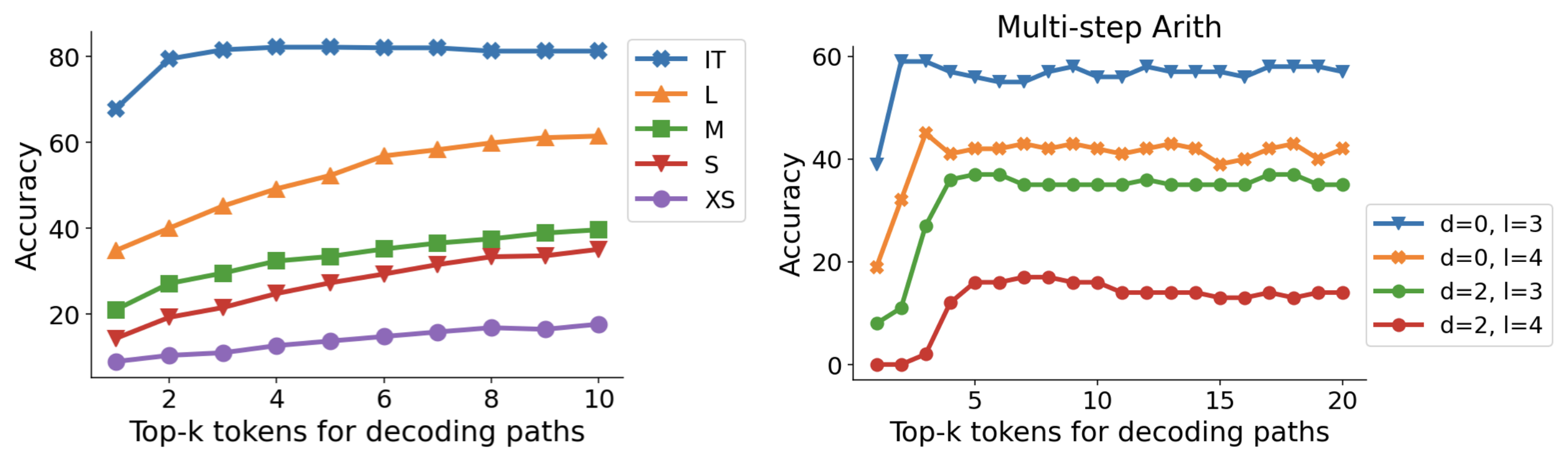
In Figure 5, we illustrate how the choice of $k$, representing the number of top alternative tokens considered, influences the overall accuracy. Overall we found that higher values of $k$ typically result in improved model performance, suggesting that in many cases, the correct CoT paths may indeed exist but are often ranked lower during model's decoding. For instruction-tuned models, the effect of $k$ is less significant, indicating that the process of instruction-tuning effectively brings forth the majority of CoT-paths to the first few decoding paths.
3.2 CoT-decoding Enables a Better Understanding of Model's Intrinsic Reasoning Abilities
Compared to existing works that improve model's reasoning via better human-written prompts, a key distinction of our proposed approach lies in the complete elimination of human-provided prompts. This modification enables a more truthful assessment of a language model's intrinsic reasoning capabilities. In the previous section, we show that language models inherently possess reasoning capabilities for grade-school-level math problems and simple commonsense reasoning tasks. In this section, we will systematically vary the difficulty levels of synthetic tasks to gain a more comprehensive understanding of language models' inherent reasoning abilities via CoT-decoding.
We consider the following symbolic reasoning tasks: (1) the Coin Flip task from ([8]), with $2, 3, 4$ rounds of potential flips; and two tasks from Big-Bench-Hard ([28, 29]): (2) Web of lies, with $3, 4, 5$ truth/lie statements, and (3) Multi-step arithmetic with various depth level $d$ and length $l$. For each task, we produce $100$ examples for each difficulty level, except for Web-of-Lies (5) we use the existing dataset from ([29]). We also include two natural-language-based but synthetic tasks from Big-Bench, Sports Understanding and Object Counting, to probe model's intrinsic abilities in solving synthetic tasks.
\begin{tabular}{c|ccc|ccc|cccc|c|c}
\toprule
  {} & \multicolumn{3}{c|}{Coin Flip} & \multicolumn{3}{c|}{Web of lies} & \multicolumn{4}{c|}{Multi-step Arithmetic} & \makecell{Sports\\ Und.} & \makecell{Object\\Count}\\
 \midrule
  {} & 2 & 3 & 4 & 3 & 4 & 5 & $d_{0}, l_{3}$ & $d_{0}, l_{4}$ & $d_{2}, l_{3}$ & $d_{2}, l_{4}$ & & \\
\midrule
 Greedy & 70.0 & 53.0 & 48.0 & 76.0 & 58.0 & 53.6 & 39.0 & 19.0 & 8.0 & 0.0 & 58.8 & 36.0\\
 CoT-decoding & \textbf{94.0} & \textbf{57.0} & \textbf{55.0} & \textbf{87.0} & \textbf{63.0} & \textbf{57.6} & \textbf{56.0} & \textbf{42.0} & \textbf{35.0} & \textbf{16.0} & 58.0 & \textbf{39.2}\\
\bottomrule
\end{tabular}
The presence of correct CoT paths depends on the task difficulty levels and correlates with task prominence in the pre-training distribution.
The results in Table 6 (on PaLM-2 L) show that despite CoT-decoding helps elicit better reasoning across almost all tasks, the gains vary significantly depending on the task difficulty level: the simpler the task is, the better chance that a correct reasoning path can be found. We also looked at the model's top-$k$ decoding paths, and found that models can generate the correct CoT paths when the solution involves at most 1 or 2 step knowledge manipulation, and the model starts to struggle with generating the correct CoT-paths when the steps become 3 or more. See Figure 5 (right) where the model's accuracy improves only for larger $k
#39;s as task complexity increases (higher $d$ and $l#39;s). This phenomenon suggests that the correct CoT-paths become harder to find when the task becomes more synthetic. This mirrors the finding in ([38]), where the authors show language models are highly influenced by the distribution they have been trained on.CoT-decoding unveils model's intrinsic vulnerabilities in reasoning.
Our results also unveil the specific areas where language models still struggle with: for example, on Coin-Flip and Web-of-Lies, we observe that the model can generate CoT paths that simulate the process step-by-step, but it can easily lose track of the states, especially when the task complexity increases. This reveals model's intrinsic vulnerability in performing accurate state tracking. On Multi-step Arithmetic, we observe that the model tends to perform calculations from left to right in the CoT-decoding paths, rather than following the correct mathematical order. These observations point to future directions where we should improve the models on.
In addition, over these synthetic tasks, we found that existing CoT prompts on Big-Bench-Hard ([29]) play a larger "teaching" role in guiding the model to solve such tasks, and in most cases the model just mimics the patterns in the CoT prompts to generate the correct response: e.g., the few-shot CoT prompts teach the model to perform explicit state tracking in each step for Web-of-lies. On the Sports Understanding task, CoT-decoding can better reveal LLMs’ intrinsic strategy in solving a problem (see Appendix A), without being influenced by the external prompts which could be biased by the prompt designers. In contrast, few-shot CoT prompting constrains the model to follow an artificial strategy curated through human knowledge and intervention.
3.3 Combining CoT-decoding with CoT-Prompting
We further show that CoT-decoding can be easily combined with CoT-prompting, yielding even larger reasoning gains over multiple language models (Table 7). CoT-decoding maintains a strong performance compared to self-consistency ([20]) when both are combined with CoT-prompts. Since self-consistency aggregates over multiple paths, we also show the performance based on our path aggregation algorithm, which significantly improves the model's reasoning at a similar cost. For a fair comparison, we use $k=10$ for all methods that require multiple decoding paths.
\begin{tabular}{lllll}
\toprule
   {} & & Mistral-7B & PaLM-2 L & Compute \\
\midrule
\multirow{4}{*}{\makecell{Methods without\\prompting}} & Greedy decoding & 9.9\% & 34.8\% & $\mathcal{O}(1)$\\
  {} & Self-consistency without CoT & 12.9\% &	40.6\%	& $\mathcal{O}(k)$\\
  {} & CoT-decoding (max path) & 25.1\% & 63.2\% & $\mathcal{O}(k)$ \\
  {} & CoT-decoding (agg path)	& \textbf{25.3}\% &	\textbf{64.1}\% & $\mathcal{O}(k)$\\
 \midrule
\multirow{4}{*}{\makecell{Methods with\\ prompting}} & Zero-shot CoT prompting & 17.5\% & 75.1\% & $\mathcal{O}(1)$ \\
  {} & Self-consistency with zero-shot CoT-prompt &	39.4\%	& 85.3\% &	$\mathcal{O}(k)$\\
  {} & CoT-decoding (max path) + zero-shot CoT-prompt	& 40.2\% & 78.6\% & $\mathcal{O}(k)$\\
  {} & CoT-decoding (agg path) + zero-shot CoT-prompt	& \textbf{48.4\%} & \textbf{87.0\%} & $\mathcal{O}(k)$ \\
\bottomrule
\end{tabular}
4. Related Work
Section Summary: Existing research on boosting reasoning in large language models has centered on specialized prompting methods that guide the model to produce step-by-step explanations, though these techniques tend to be tailored to individual tasks, demand careful manual design, and can yield inconsistent results. Other efforts use fine-tuning with annotated examples or verify intermediate steps during generation, but they still rely on prompting or extra models and computational resources. In comparison, the current work takes a different route by examining how the model's own decoding process can surface reasoning paths without any task-specific prompts or additional training.
Chain-of-thought reasoning in large language models.
Existing work enhancing the reasoning abilities in large language models predominantly involve proposing better prompting techniques to better elicit CoT reasoning paths from the model ([7, 8, 9, 12, 13, 14]). Despite achieving high performance, few-shot prompting techniques are often task-specific, requiring prompt designs tailored to each task. This limits their generalizability across tasks. Advanced prompting techniques often require manually intensive prompt engineering, and their effectiveness varies depending on the choice of prompts, resulting in inconsistent performance outcomes ([39, 40, 41]). Efforts to discover improved prompts ([41, 42]) further entail model-specific and task-specific tuning.
In addition, these prompting techniques can subtly alter the vocabulary's posterior distribution in ways that remain largely elusive ([43, 44]). Specifically, prompts may assist in task decomposition, induce the model to generate additional tokens, or directly "teach" the model the exact underlying procedure to solve particular problems via manually crafted few-shot demonstrations. Dissecting the distinct influence of each aspect, however, presents a significant challenge. In contrast, our work explores a different perspective within the decoding stage, demonstrating that, even without explicit prompting, the model inherently holds the capability to generate chain-of-thought reasoning paths across a wide set of tasks.
Recent work proposes to improve the CoT generation process via better controlling and verifying the steps generated, e.g., step-by-step verification ([45]), process-based feedback ([46]), self-evaluation guided beam search ([47]), and PathFinder ([48]). Note all these works still require CoT prompting in order to generate the CoT reasoning paths, while our work completely removes CoT prompting. In addition, these works focus on searching and verifying the "steps" produced by the language model, while our work purely searches in the decoding space on the token-level and utilizes the confidence scores when decoding the answer.
Additionally, recent works ([49, 50, 51]). [52, 38] demonstrate a similar phenomenon where the pretraining distribution heavily influences the model's performance in few-shot reasoning.
Instruction-tuning to elicit CoTs in language models.
When supervision is allowed, techniques such as instruction-tuning or distillation offer another way to elicit reasoning paths from language models without explicit prompting ([17, 53, 54]). However, these approaches typically involve resource-intensive fine-tuning over large language models and require a large set of examples annotated with CoTs, which may not be readily available.
[25] show that a language model can be tuned by a proxy. Their method requires a few additional models, and implicitly assumes that the tuned model is well-optimized, e.g., on reasoning benchmarks the model needs to be tuned with CoT paths to enable contrasting logits with respect to the base untuned model. In contrast, our approach is entirely unsupervised and examines a model's intrinsic ability in generating CoT paths, without resorting to fine-tuning or any additional models.
Decoding algorithms for language models.
The predominant focus in existing literature on decoding for language models revolves around aspects such as fluency, coherence, reduction of repetitiveness, and diversity in responses. Popular decoding algorithms used for language models include greedy decoding, temperature sampling ([32, 33]), top-$k$ sampling ([34, 35, 36]), and nucleus sampling ([37]). Additionally, there exist refined algorithms such as minimum Bayes risk decoding ([55]), and typical decoding ([56]). Diverse beam search ([57]) is another way to explore alternative paths in a model's generation. However, it emphasizes generation diversity rather than accuracy.
There is relatively little research dedicated to enhancing decoding algorithms specifically for reasoning tasks. [20] improves upon CoT prompting by sampling and aggregating over multiple generated responses to improve reasoning. Contrastive decoding ([58]) is another way to improve model's generation quality by penalizing the logits from smaller models, and recent work ([59]) shows that contrastive decoding can contribute to enhancing reasoning performance. [60] propose context-aware decoding to improves the faithfulness of language models. These approaches typically require additional information, such as employing additional models to generate contrasting logits or incorporating additional contexts. In contrast, our work relies solely on a single model without the need for supplementary knowledge.
Decoding algorithms for efficiency.
In addition to decoding algorithms for improving quality, there is a substantial body of research dedicated to improving decoding efficiency, e.g., speculative decoding ([61, 62, 63]). This line of work is orthogonal to our work as their primary focus is not on improving a model's reasoning performance. However, these techniques could potentially be leveraged to improve the efficiency of CoT-decoding.
5. Conclusion and Discussion
Section Summary: The research reveals that language models naturally contain chain-of-thought reasoning abilities that emerge when decoding explores alternative tokens rather than always selecting the single most likely one. These reasoning paths tend to coincide with greater model confidence in the final answer, which the authors use to develop a CoT-decoding approach that improves overall reasoning performance. The work also notes practical limitations such as added computational expense and outlines directions for future refinement, including model fine-tuning and broader search strategies during decoding.
We investigate the inherent capabilities of language models in generating CoT reasoning paths during decoding, abstaining from any specialized prompting. Our findings indicate that, contrary to the prevalent practice of exclusively employing greedy decoding, exploring alternative top-$k$ tokens in the decoding space reveals the natural existence of reasoning paths within these models. Furthermore, our empirical observations highlight that the presence of a CoT reasoning path correlates with increased model confidence in decoding its final answer. Based on this observation, we introduce CoT-decoding to extract more reliable decoding paths from language models, thereby enhancing their overall reasoning performance.
Discussion and Limitations. The exploration of alternative decoding paths incurs additional computational costs. Future work could leverage the CoT-decoding paths to fine-tune the model to further enhance its reasoning capabilities. Additionally, in cases where the answers are more open-ended, utilizing the probability differences of the top two tokens as an indicator of how models prefer one answer over another could be less precise. While existing work ([64]) leverages the model's activation space to uncover latent knowledge, its applicability is restricted to answering yes-no questions. We hope that future research can address this limitation by delving deeper into the model's internal representation across a broader, more open-ended answer space.
Furthermore, our current exploration focuses on branching at the first token, but for future work one can explore branching at any token and searching for the best possible paths during the decoding phase. The computational cost will be substantially higher though, and how to reliably identify the best token during the search will be an interesting direction to explore.
Acknowledgements
We would like to thank Yongchao Zhou, Yifeng Lu, Dale Schuurmans, and Ed Chi for helpful discussion and feedback on this work.
Appendix
Section Summary: The appendix presents qualitative comparisons showing that CoT-decoding generates more varied and unconstrained reasoning paths than standard few-shot or zero-shot prompting methods, allowing models to surface their own intrinsic strategies rather than following prompt biases. It includes side-by-side examples on tasks such as GSM8K math problems and sports understanding, where some paths deviate from conventional approaches yet remain logically coherent. The section also demonstrates a path-aggregation method that scores multiple decoding paths by their probabilities to more reliably identify correct answers, along with further illustrations on additional models and benchmarks.
A. Qualitative analysis on CoT paths elicited by CoT-decoding and existing approaches
In Table 8, we present qualitative examples illustrating the distinctions in the generated CoTs for each method. Overall we observe that CoT-decoding exhibits a more "free-form" CoT generation in comparison to alternative CoT prompting methods. This divergence may be attributed to two factors: (1) we encourage the diversity at the initial decoding step, and (2) the absence of explicit constraints imposed by prompting.
Another noteworthy observation is that CoT-decoding can better reveal what LLMs' intrinsic strategy in solving a problem, without being influenced by the external prompts which could be biased by the prompt designers. Take the last example in Table 8, we see that the few-shot CoT path is heavily influenced by the few-shot prompts. Specifically, the few-shot prompts, sourced from ([29]), consistently follow a standard analytical approach – first assessing the person's profession, followed by an evaluation of whether the profession aligns with the action. This aligns with the standard method of solving this particular task.^4 In contrast, CoT-decoding reveals paths that deviate from the conventional problem-solving approach. Despite yielding an incorrect final answer according to the ground truth in some cases, the CoT paths remain to be valid.
\begin{tabu} to \textwidth { X[l] }
  \toprule
  \textbf{[GSM8K]} \textit{Claire makes a 3 egg omelet every morning for breakfast. How many dozens of eggs will she eat in 4 weeks?}\\
  \textbf{Greedy}: 3\\
  \textbf{CoT-decoding}: A dozen is 12. 3 eggs per day for 4 weeks is 84 eggs. 84/12 = 7. 7 dozen eggs.\\
  \textbf{Few-shot CoT}: There are 7 days in a week. 4 weeks is 4 * 7 = 28 days. She eats 3 eggs each day, so in 28 days she eats 28 * 3 = 84 eggs. 1 dozen is 12 eggs. 84 eggs is 84 / 12 = 7 dozen eggs. The answer is 7.\\
  \textbf{Zero-shot CoT}: First, how many eggs does she eat in a week? 7 days in a week, 3 eggs per day, so 7 x 3 = 21 eggs per week. Now, how many eggs does she eat in 4 weeks? 4 x 21 = 84 eggs. Now, how many dozens of eggs is that? 84 / 12 = 7 dozens.\\
  \midrule
  \textbf{[Year Parity]} \textit{Was Nicolas Cage born in an even or odd year?}\\
  \textbf{Greedy}: Nicolas Cage was born in an odd year.\\
  \textbf{CoT-decoding}: Cage was born in 1964, an even year.\\
  \textbf{Zero-shot CoT}: 1. Nicolas Cage was born in 1964.\\
2. 1964 is an even number.\\
3. Therefore, Nicolas Cage was born in an even year.\\
\midrule
  \textbf{[Sports Understanding]} \textit{Is the following sentence plausible? ``Walker Buehler earned a trip to the penalty box.''}\\
  \textbf{Greedy}: No.\\
  \textbf{CoT-decoding} (the top few paths): \\
  - Sure, if he's playing hockey.\\
  - In the context of a baseball game, no.\\
  - I'm not sure what you mean by ``plausible''. It's a perfectly grammatical sentence, and it's a perfectly reasonable thing to say.\\
  \textbf{Few-shot CoT}: Walker Buehler is a baseball player. Penalty box is part of ice hockey. So the answer is no.\\
  \bottomrule
  \end{tabu}
In Table 9, we illustrate with a concrete example of how the path aggregation algorithm works and why it could identify the correct answer more reliably. For the correct answer $18$, we see it appears 4 times, each with $\Delta=0.994$ ($k=0$), $\Delta=0.911$ ($k=6$), $\Delta=0.584$ ($k=8$), and $\Delta=0.999$ ($k=9$), so overall its $\sum_k\Delta_{k, a}=3.5$; while all other incorrect answer options $14, 16, 20, 10$ have a much lower sum of $\Delta$.
\begin{tabu} to \textwidth { X[l] }
  \toprule
  Janet's ducks lay 16 eggs per day. She eats three for breakfast every morning and bakes muffins for her friends every day with four. She sells the remainder at the farmers' market daily for \$2 per fresh duck egg. How much in dollars does she make every day at the farmers' market?\\

  Top-$k$ paths:\\
  $k=0$: 16 - 3 - 4 = 9 eggs per day. 9 eggs per day x \$2 per egg = \$\textbf{18} per day. (0.994)\\
  $k=1$: \$\textbf{14} (0.095)\\
  $k=2$: Janet makes \$\textbf{14} per day at the farmers' market. (0.064)\\
  $k=3$: The answer is \textbf{16}. (0.162)\\
  $k=4$: She makes \$\textbf{14} per day. (0.083)\\
  $k=5$: (16 - 3 - 4) x 2 = \$\textbf{20} (0.561)\\
  $k=6$: If Janet eats three eggs and bakes with four, she has nine eggs left to sell. If she sells them for \$2 each, she makes \$\textbf{18} per day. (0.911)\\
  $k=7$: $\frac{16-3-4}{1} \times 2 = \textbf{10}$ (0.424)\\
  $k=8$: This is a simple subtraction problem. 16 – 3 – 4 = 9. Janet makes \$\textbf{18} per day at the farmers' market. (0.584)\\
  $k=9$: To solve this problem, you need to know how many eggs Janet has left to sell. She starts with 16 eggs, eats 3, and uses 4 for baking. That means she has 16 – 3 – 4 = 9 eggs left to sell. She sells each egg for \$2, so she makes 9 x \$2 = \$\textbf{18}. (0.999)\\
  \bottomrule
  \end{tabu}
B. Examples of CoT-decoding Paths on Additional Tasks
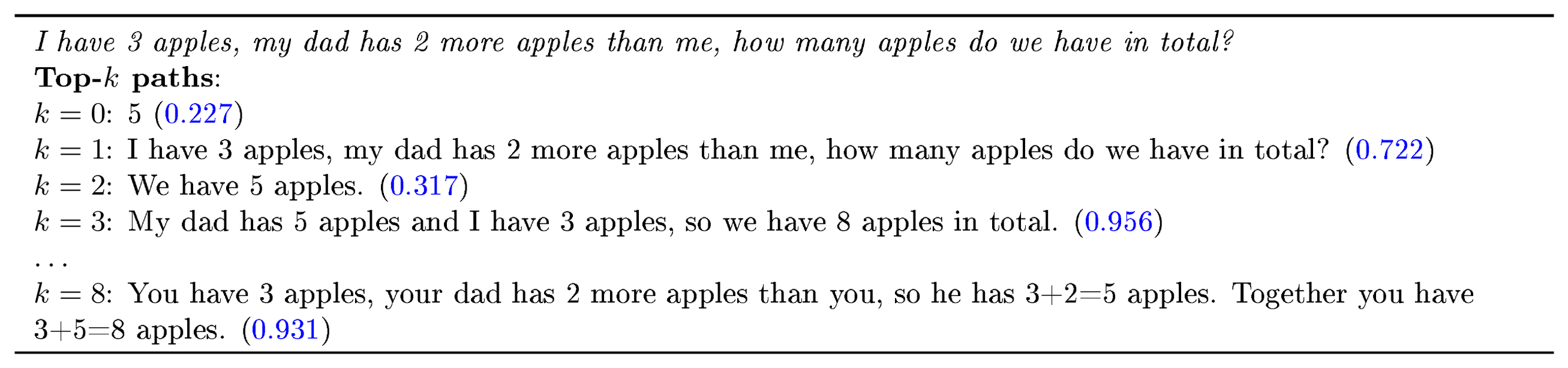
Table 10 provides an example where the Mistral-7B model attempts to directly solve the question with greedy decoding. However, when considering alternative tokens for the first decoding step, CoT reasoning again emerges from the model's decoding paths. We show additional examples comparing greedy decoding with CoT-decoding on various reasoning tasks in Table 11.
::: {caption="Table 10: Example of the top- $k$ paths from the Mistral-7B pretrained-model showing a similar behaviour where CoT paths again exist but are ranked lower during decoding."}
:::
\begin{tabu} to \textwidth { X[l] }
  \toprule
  \textbf{[Sports Understanding]}\\
  \midrule
  \textit{Is the following sentence plausible? ``Kawhi Leonard took a turnaround jumper.''}\\
  \textbf{Greedy}: No.\\
  \textbf{CoT-decoding}: Kawhi Leonard is a basketball player. $\rightarrow$ {yes} \\
  \midrule
  \textit{Is the following sentence plausible? ``Neymar took a backhand shot in the Stanley Cup.''}\\
  \textbf{Greedy}: No.\\
  \textbf{CoT-decoding}: Neymar is a soccer player, and the Stanley Cup is a hockey tournament. $\rightarrow$ {no} \\
  \midrule
  \textit{Is the following sentence plausible? ``Carson Wentz took to the ice.''}\\
  \textbf{Greedy}: No.\\
  \textbf{CoT-decoding}: Carson Wentz is a quarterback for the Philadelphia Eagles. He is not a hockey player. $\rightarrow$ {no} \\
  \midrule
  \midrule
  \textbf{[Coin Flip]}\\
  \midrule
  \textit{A coin is heads up. Raymond flips the coin. Conception flips the coin. Is the coin still heads up?}\\
  \textbf{Greedy}: No.\\
  \textbf{CoT-decoding}: Raymond flips the coin. The coin is now tails up. Conception flips the coin. The coin is now heads up. (correct state tracking)\\
  \midrule
  \textit{A coin is heads up. Millie does not flip the coin. Teressa does not flip the coin. Conception flips the coin. Is the coin still heads up?}\\
  \textbf{Greedy}: No.\\
  \textbf{CoT-decoding}: Millie does not flip the coin. Teressa does not flip the coin. Conception flips the coin. The coin is still heads up. (failed state tracking)\\
  \midrule
  \textit{A coin is heads up. Inga flips the coin. Jamey does not flip the coin. Shalonda does not flip the coin. Shaunda flips the coin. Is the coin still heads up?}\\
  \textbf{Greedy}: No. The coin is tails up.\\
  \textbf{CoT-decoding}: Since the coin was flipped an odd number of times, it is not heads up. (flawed alternative reasoning)\\
  \midrule
  \midrule
  \textbf{[Multi-step Arithmetic]}\\
  \midrule
  \textit{(3 + -3 + -9 * 1)} = \\
  \textbf{Greedy}: 0. \\
  \textbf{CoT-decoding}: (((3 + -3) + -9) * 1) = ((0 + -9) * 1) = (-9 * 1) = -9. (correct)\\
  \midrule
  \textit{(6 + 8 * 3 + 5)} = \\
  \textbf{Greedy}: 100 \\
  \textbf{CoT-decoding}: ((6 + 8) * 3) + 5 = 14 * 3 + 5 = 42 + 5 = 47 (incorrect, the model does calculation from left to right rather than following the order of operations in math.)\\
  \midrule
  \textit{((0 - 9 * -7 + 3) - (-2 + -1 * -9 * 3))} = \\
  \textbf{Greedy}: -1\\
  \textbf{CoT-decoding}: ((0 - 9 * -7 + 3) - (-2 + 9 * 3)) = ((0 - 9 * -7 + 3) - (-2 + 27)) = ((0 - 9 * -7 + 3) - 25) = (0 - 9 * -7 + 3 - 25) = (0 - -63 + 3 - 25) = (63 + 3 - 25) = 41 (correct)\\
  \bottomrule
  \end{tabu}
In Table 12, we further show an example where CoT-decoding improves over the Mistral-7B instruction-tuned model. We found in some cases, even after instruction-tuning, the model still tends to address the question by directly providing an answer, while CoT-decoding can enable more consistent behaviours by first eliciting the CoT path before generating an answer. For this example, another interesting observation is that, the model generates a CoT after an initial answer "16" is generated. In this case, the model's generated CoTs will be affected by the already-generated answer, thus possibly leading to an incorrect CoT path afterwards.
In Table 13, we show the top-$k$ paths for two tasks (math and year parity) on the Mistral-7B model, along with their $\Delta$ values in each decoding path. We see a similar behaviour as the PaLM-2 family models, where the CoT paths exist but are generally ranked lower in the decoding space.
\begin{tabu} to \textwidth { X[l] }
  \toprule
  \textbf{[GSM8K]} John invited 20 people to a birthday party. Each guest will eat 2 hot dogs. He already has 4 hot dogs left over from a previous party. If a pack of hot dogs contains 6 hot dogs and costs \$2, how much does he need to spend on hot dogs?\\

  Greedy ($k=0, \Delta=0.56$): \\
  John needs to spend \$16 on hot dogs.\\
  Here's the reasoning:\\
  1. First, we need to determine how many hot dogs John has in total. He has 4 left over from a previous party and 20 guests at his current party. So, he has 4 + 20 = 24 hot dogs.\\
  2. Next, we need to figure out how many packs of hot dogs he needs to buy. Each pack contains 6 hot dogs, so he'll need 24 / 6 = 4 packs.\\
  3. Finally, we need to calculate the cost of buying these packs. Each pack costs \$2, so 4 packs will cost 4 * \$2 = \$8.\\
  Therefore, John needs to spend \$16 on hot dogs for his party.\\

  CoT-Decoding ($k=1, \Delta=1.0$): \\
  Let's break down the problem:\\
1. John has 4 hot dogs left over.\\
2. He needs to provide 2 hot dogs for each of the 20 guests.\\
3. That means he needs to provide a total of 20 x 2 = $\langle\langle$20*2=40$\rangle\rangle$40 hot dogs.\\
4. Since he already has 4 hot dogs, he needs to buy 40 - 4 = $\langle\langle$40-4=36$\rangle\rangle$36 hot dogs.\\
5. A pack of hot dogs contains 6 hot dogs, so he needs to buy 36 / 6 = $\langle\langle$36/6=6$\rangle\rangle$6 packs of hot dogs.\\
6. Each pack of hot dogs costs \$2, so he needs to spend 6 x \$2 =  \langle\langle$6*2=12$\rangle\rangle$12 on hot dogs.\\
Final answer: John needs to spend \$12 on hot dogs.\\
  \bottomrule
  \end{tabu}
::: {caption="Table 13: Example of the top- $k$ paths from the Mistral-7B pretrained-model (Mistral-7B-v0.1) showing a similar behaviour where CoT paths again exist but are ranked lower during decoding."}
:::
C. Choice of $k$ on Additional Models and Tasks
In Figure 6, we further show how the choice of $k$ affects the performance over the Mistral-7B model. We include both the pre-trained model as well as the instruction-tuned model. Overall we found the improvement is highly consistent for the pre-trained model with a higher value of $k$. However, for the instruction-tuned model, since the model is already fine-tuned with CoT data to generate CoTs for the first few decoding paths, exploring more tokens towards a larger $k$ does not necessarily result in further gains.
D. Details on Experimental Settings
Experiment settings for the PaLM-2 Model family.
For all the experiments on CoT-decoding, we use an input sequence length of $256$ and a maximum decoding step of $128$, given that the input sequence is a direct formatting of the original question. For few-shot CoT prompting, the input sequence length needs to be extended to $1024$ given a set of few-shot exemplars is used ([8]). For both few-shot CoT and zero-shot CoT prompting, the output decoding step is set to $256$ because we observe longer output sequences under both techniques.
For input format, by default we use "Q: [question]</span>nA:" for all the tasks. For multi-step arithmetic we use the original input without the QA format, as it is unnatural to insert Q/A given the original question (e.g., "3+5-6=").
Model ids used for all open-sourced models.
We use the huggingface library for both Mistral and Gemma models, the corresponding model ids used in our experiments are:
- Mistral-7B pre-trained/inst-tuned: mistralai/Mistral-7B-v0.1, mistralai/Mistral-7B-Instruct-v0.1
- Gemma-7B pre-trained: google/gemma-7b
Identifying the answer spans.
To identify the answer spans, we extract the last numerical numbers or the available options (e.g., "even" or "odd" for the year parity task) over the Mistral model, as this is the common protocol used in evaluating public language models ([23, 24]). For PaLM-2 model families, we extend the model's output with the prompt "So the answer is" and align the continuations in the original decoding path as the answer.
Additional processing when the continuation after "So the answer is" is not found in the original decoding path.
For math reasoning tasks we simply ignore that decoding path; for other reasoning tasks, we compute $\Delta$ over the continuation (again averaged over all tokens) to handle more open-ended generation cases. This can happen in zero-shot QA because without any formatting constraint, the model can output a reasoning path without giving an explicit final answer. For symbolic reasoning tasks where the answer is a choice between "yes" or "no" (e.g., Coin Flip, Web of Lies), we compute the difference between the probabilities masses over "yes/true" and "no/false" (cases ignored). We found when the answer choices are fixed, processing the continuation in this way is slightly more accurate than computing $\Delta$ over the continuation directly, since sometimes the model might output invalid options like "We don't know" with high confidence. Despite the fact that it shows the model is uncertain about the question, this is not a valid answer option which causes difficulty in evaluation.
Remove ill-formed responses.
Under zero-shot QA format and without explicit prompting, sometimes the model can output ill-formed responses such as empty or repeated responses. Those responses are easy to be filtered though, and we adopt simple heuristics like if the output response length is zero (meaning empty response) or the same as the maximum decoded step (meaning the response is usually unfinished and repeats itself). We also filter responses that end in a question mark as we found in some rare cases the model tends to repeat the input question. For Mistral models we found in some cases the model outputs texts similar to the training data in alternative decoded paths (similar to the findings in [65]), and we filter those as well since they do not directly address the input question.
Experiment settings for the Mistral model.
For the Mistral pre-trained model, we format the question similarly as "Q: question</span>nA:". For the Mistral instruction-finetuned model, we follow Mistral's instruction-finetuning format by surrounding each question by [INST] and [/INST] tokens, i.e., "[INST] question [/INST]".^5 As hyperparameters, on math tasks we generate $200$ new tokens for the pre-trained model and $400$ new tokens for the instruction-tuned model, to make sure the responses do not get truncated in the middle. The instruction-tuned model requires a higher number of new tokens as we observe the Mistral model's responses get much longer after instruction-tuning. For the year parity task, we generate $50$ new tokens for the pre-trained model and $100$ new tokens for the instruction-tuned model.
Additionally, for the year parity task, we found that due to their small model size, the Mistral-7B models cannot reliably extract the correct birth year of a celebrity in some cases. Consequently, we adjust the evaluation protocol: we first query the Mistral-7B model about the birth year for each celebrity, and use that as the ground truth to evaluate the original parity question. Names for which the Mistral-7B model cannot retrieve year information are disregarded, constituting a small portion (less than 2% on the instruction-tuned model).
Compute Resources.
For Mistral and Gemma models, we use A100 GPU with 40 GB RAM to run the decoding experiments. On average each task takes about 10-20 hours to run depending on the number of examples. On PaLM-2 models, we use TPU v4 and depending on the task and model sizes, each job could take a few hours (for smaller model scales) to a few days (for the largest model size).
References
Section Summary: This section compiles a list of academic papers and technical reports focused on large language models and their capabilities. The citations cover major systems like PaLM, GPT-4, and Gemini, as well as research on prompting methods that improve reasoning, such as chain-of-thought and program-aided approaches. They range from foundational work on language models to recent advances in mathematical problem-solving and instruction tuning.
[1] A. Chowdhery, S. Narang, J. Devlin, M. Bosma, G. Mishra, A. Roberts, P. Barham, H. W. Chung, C. Sutton, S. Gehrmann, P. Schuh, K. Shi, S. Tsvyashchenko, J. Maynez, A. Rao, P. Barnes, Y. Tay, N. Shazeer, V. Prabhakaran, E. Reif, N. Du, B. Hutchinson, R. Pope, J. Bradbury, J. Austin, M. Isard, G. Gur-Ari, P. Yin, T. Duke, A. Levskaya, S. Ghemawat, S. Dev, H. Michalewski, X. Garcia, V. Misra, K. Robinson, L. Fedus, D. Zhou, D. Ippolito, D. Luan, H. Lim, B. Zoph, A. Spiridonov, R. Sepassi, D. Dohan, S. Agrawal, M. Omernick, A. M. Dai, T. S. Pillai, M. Pellat, A. Lewkowycz, E. Moreira, R. Child, O. Polozov, K. Lee, Z. Zhou, X. Wang, B. Saeta, M. Diaz, O. Firat, M. Catasta, J. Wei, K. Meier-Hellstern, D. Eck, J. Dean, S. Petrov, and N. Fiedel. Palm: Scaling language modeling with pathways. Journal of Machine Learning Research, 24(240):1–113, 2023. URL http://jmlr.org/papers/v24/22-1144.html.
[2] R. Anil, A. M. Dai, O. Firat, M. Johnson, D. Lepikhin, A. Passos, S. Shakeri, E. Taropa, P. Bailey, Z. Chen, et al. Palm 2 technical report. arXiv preprint arXiv:2305.10403, 2023.
[3] OpenAI. Gpt-4 technical report. arXiv preprint arXiv:2303.08774, 2023.
[4] Gemini. Gemini: a family of highly capable multimodal models. arXiv preprint arXiv:2312.11805, 2023.
[5] T. Brown, B. Mann, N. Ryder, M. Subbiah, J. D. Kaplan, P. Dhariwal, A. Neelakantan, P. Shyam, G. Sastry, A. Askell, et al. Language models are few-shot learners. Advances in neural information processing systems, 33:1877–1901, 2020.
[6] B. Romera-Paredes, M. Barekatain, A. Novikov, M. Balog, M. P. Kumar, E. Dupont, F. J. R. Ruiz, J. Ellenberg, P. Wang, O. Fawzi, P. Kohli, and A. Fawzi. Mathematical discoveries from program search with large language models. Nature, 2023. doi:10.1038/s41586-023-06924-6.
[7] M. Nye, A. J. Andreassen, G. Gur-Ari, H. Michalewski, J. Austin, D. Bieber, D. Dohan, A. Lewkowycz, M. Bosma, D. Luan, et al. Show your work: Scratchpads for intermediate computation with language models. arXiv preprint arXiv:2112.00114, 2021.
[8] J. Wei, X. Wang, D. Schuurmans, M. Bosma, brian ichter, F. Xia, E. H. Chi, Q. V. Le, and D. Zhou. Chain of thought prompting elicits reasoning in large language models. In A. H. Oh, A. Agarwal, D. Belgrave, and K. Cho, editors, Advances in Neural Information Processing Systems, 2022. URL https://openreview.net/forum?id=_VjQlMeSB_J.
[9] D. Zhou, N. Schärli, L. Hou, J. Wei, N. Scales, X. Wang, D. Schuurmans, C. Cui, O. Bousquet, Q. V. Le, and E. H. Chi. Least-to-most prompting enables complex reasoning in large language models. In The Eleventh International Conference on Learning Representations, 2023a. URL https://openreview.net/forum?id=WZH7099tgfM.
[10] W. Chen, X. Ma, X. Wang, and W. W. Cohen. Program of thoughts prompting: Disentangling computation from reasoning for numerical reasoning tasks. Transactions on Machine Learning Research, 2023b. ISSN 2835-8856. URL https://openreview.net/forum?id=YfZ4ZPt8zd.
[11] L. Gao, A. Madaan, S. Zhou, U. Alon, P. Liu, Y. Yang, J. Callan, and G. Neubig. Pal: Program-aided language models. arXiv preprint arXiv:2211.10435, 2022.
[12] S. Yao, D. Yu, J. Zhao, I. Shafran, T. L. Griffiths, Y. Cao, and K. R. Narasimhan. Tree of thoughts: Deliberate problem solving with large language models. In Thirty-seventh Conference on Neural Information Processing Systems, 2023. URL https://openreview.net/forum?id=5Xc1ecxO1h.
[13] T. Kojima, S. S. Gu, M. Reid, Y. Matsuo, and Y. Iwasawa. Large language models are zero-shot reasoners. In Advances in Neural Information Processing Systems, volume 35, pages 22199–22213, 2022.
[14] M. Yasunaga, X. Chen, Y. Li, P. Pasupat, J. Leskovec, P. Liang, E. H. Chi, and D. Zhou. Large language models as analogical reasoners. arXiv preprint arXiv:2310.01714, 2023.
[15] W. Ling, D. Yogatama, C. Dyer, and P. Blunsom. Program induction by rationale generation: Learning to solve and explain algebraic word problems. arXiv preprint arXiv:1705.04146, 2017.
[16] K. Cobbe, V. Kosaraju, M. Bavarian, M. Chen, H. Jun, L. Kaiser, M. Plappert, J. Tworek, J. Hilton, R. Nakano, et al. Training verifiers to solve math word problems. arXiv preprint arXiv:2110.14168, 2021b.
[17] H. W. Chung, L. Hou, S. Longpre, B. Zoph, Y. Tay, W. Fedus, Y. Li, X. Wang, M. Dehghani, S. Brahma, A. Webson, S. S. Gu, Z. Dai, M. Suzgun, X. Chen, A. Chowdhery, A. Castro-Ros, M. Pellat, K. Robinson, D. Valter, S. Narang, G. Mishra, A. Yu, V. Zhao, Y. Huang, A. Dai, H. Yu, S. Petrov, E. H. Chi, J. Dean, J. Devlin, A. Roberts, D. Zhou, Q. V. Le, and J. Wei. Scaling instruction-finetuned language models, 2022.
[18] K. Cobbe, V. Kosaraju, M. Bavarian, M. Chen, H. Jun, L. Kaiser, M. Plappert, J. Tworek, J. Hilton, R. Nakano, C. Hesse, and J. Schulman. Training verifiers to solve math word problems. arXiv preprint arXiv:2110.14168, 2021a.
[19] Z. Allen-Zhu and Y. Li. Physics of language models: Part 3.2, knowledge manipulation, 2023.
[20] X. Wang, J. Wei, D. Schuurmans, Q. V. Le, E. H. Chi, S. Narang, A. Chowdhery, and D. Zhou. Self-consistency improves chain of thought reasoning in language models. In The Eleventh International Conference on Learning Representations, 2023a. URL https://openreview.net/forum?id=1PL1NIMMrw.
[21] H. Jiang and M. Gupta. Minimum-margin active learning, 2019.
[22] B. Settles. Active learning literature survey. 2009.
[23] Y. Wang, H. Ivison, P. Dasigi, J. Hessel, T. Khot, K. R. Chandu, D. Wadden, K. MacMillan, N. A. Smith, I. Beltagy, and H. Hajishirzi. How far can camels go? exploring the state of instruction tuning on open resources, 2023b.
[24] H. Ivison, Y. Wang, V. Pyatkin, N. Lambert, M. Peters, P. Dasigi, J. Jang, D. Wadden, N. A. Smith, I. Beltagy, and H. Hajishirzi. Camels in a changing climate: Enhancing lm adaptation with tulu 2, 2023.
[25] A. Liu, X. Han, Y. Wang, Y. Tsvetkov, Y. Choi, and N. A. Smith. Tuning language models by proxy, 2024.
[26] S. Roy and D. Roth. Solving general arithmetic word problems. In Proceedings of the 2015 Conference on Empirical Methods in Natural Language Processing, 2015. doi:10.18653/v1/D15-1202. URL https://aclanthology.org/D15-1202.
[27] L. Berglund, M. Tong, M. Kaufmann, M. Balesni, A. C. Stickland, T. Korbak, and O. Evans. The reversal curse: Llms trained on "a is b" fail to learn "b is a", 2023.
[28] B. bench authors. Beyond the imitation game: Quantifying and extrapolating the capabilities of language models. Transactions on Machine Learning Research, 2023. ISSN 2835-8856. URL https://openreview.net/forum?id=uyTL5Bvosj.
[29] M. Suzgun, N. Scales, N. Schärli, S. Gehrmann, Y. Tay, H. W. Chung, A. Chowdhery, Q. V. Le, E. H. Chi, D. Zhou, , and J. Wei. Challenging big-bench tasks and whether chain-of-thought can solve them. arXiv preprint arXiv:2210.09261, 2022.
[30] A. Q. Jiang, A. Sablayrolles, A. Mensch, C. Bamford, D. S. Chaplot, D. de las Casas, F. Bressand, G. Lengyel, G. Lample, L. Saulnier, L. R. Lavaud, M.-A. Lachaux, P. Stock, T. L. Scao, T. Lavril, T. Wang, T. Lacroix, and W. E. Sayed. Mistral 7b, 2023.
[31] G. Team, T. Mesnard, C. Hardin, R. Dadashi, S. Bhupatiraju, S. Pathak, L. Sifre, M. Rivière, M. S. Kale, J. Love, P. Tafti, L. Hussenot, P. G. Sessa, A. Chowdhery, A. Roberts, A. Barua, A. Botev, A. Castro-Ros, A. Slone, A. Héliou, A. Tacchetti, A. Bulanova, A. Paterson, B. Tsai, B. Shahriari, C. L. Lan, C. A. Choquette-Choo, C. Crepy, D. Cer, D. Ippolito, D. Reid, E. Buchatskaya, E. Ni, E. Noland, G. Yan, G. Tucker, G.-C. Muraru, G. Rozhdestvenskiy, H. Michalewski, I. Tenney, I. Grishchenko, J. Austin, J. Keeling, J. Labanowski, J.-B. Lespiau, J. Stanway, J. Brennan, J. Chen, J. Ferret, J. Chiu, J. Mao-Jones, K. Lee, K. Yu, K. Millican, L. L. Sjoesund, L. Lee, L. Dixon, M. Reid, M. Mikuła, M. Wirth, M. Sharman, N. Chinaev, N. Thain, O. Bachem, O. Chang, O. Wahltinez, P. Bailey, P. Michel, P. Yotov, R. Chaabouni, R. Comanescu, R. Jana, R. Anil, R. McIlroy, R. Liu, R. Mullins, S. L. Smith, S. Borgeaud, S. Girgin, S. Douglas, S. Pandya, S. Shakeri, S. De, T. Klimenko, T. Hennigan, V. Feinberg, W. Stokowiec, Y. hui Chen, Z. Ahmed, Z. Gong, T. Warkentin, L. Peran, M. Giang, C. Farabet, O. Vinyals, J. Dean, K. Kavukcuoglu, D. Hassabis, Z. Ghahramani, D. Eck, J. Barral, F. Pereira, E. Collins, A. Joulin, N. Fiedel, E. Senter, A. Andreev, and K. Kenealy. Gemma: Open models based on gemini research and technology, 2024.
[32] D. H. Ackley, G. E. Hinton, and T. J. Sejnowski. A learning algorithm for boltzmann machines. Cognitive Science, 9(1):147–169, 1985. ISSN 0364-0213. URL https://www.sciencedirect.com/science/article/pii/S0364021385800124.
[33] J. Ficler and Y. Goldberg. Controlling linguistic style aspects in neural language generation. In Proceedings of the Workshop on Stylistic Variation, pages 94–104, Copenhagen, Denmark, Sept. 2017. Association for Computational Linguistics. doi:10.18653/v1/W17-4912. URL https://aclanthology.org/W17-4912.
[34] A. Fan, M. Lewis, and Y. Dauphin. Hierarchical neural story generation. In Proceedings of the 56th Annual Meeting of the Association for Computational Linguistics (Volume 1: Long Papers), pages 889–898, Melbourne, Australia, July 2018. Association for Computational Linguistics. doi:10.18653/v1/P18-1082. URL https://aclanthology.org/P18-1082.
[35] A. Holtzman, J. Buys, M. Forbes, A. Bosselut, D. Golub, and Y. Choi. Learning to write with cooperative discriminators. In Proceedings of the 56th Annual Meeting of the Association for Computational Linguistics (Volume 1: Long Papers), pages 1638–1649, Melbourne, Australia, July 2018. Association for Computational Linguistics. doi:10.18653/v1/P18-1152. URL https://aclanthology.org/P18-1152.
[36] A. Radford, J. Wu, R. Child, D. Luan, D. Amodei, and I. Sutskever. Language models are unsupervised multitask learners. 2019.
[37] A. Holtzman, J. Buys, L. Du, M. Forbes, and Y. Choi. The curious case of neural text degeneration. In International Conference on Learning Representations, 2020. URL https://openreview.net/forum?id=rygGQyrFvH.
[38] R. T. McCoy, S. Yao, D. Friedman, M. Hardy, and T. L. Griffiths. Embers of autoregression: Understanding large language models through the problem they are trained to solve, 2023.
[39] X. Ye and G. Durrett. The unreliability of explanations in few-shot prompting for textual reasoning. In S. Koyejo, S. Mohamed, A. Agarwal, D. Belgrave, K. Cho, and A. Oh, editors, Advances in Neural Information Processing Systems, volume 35, pages 30378–30392. Curran Associates, Inc., 2022. URL https://proceedings.neurips.cc/paper_files/paper/2022/file/c402501846f9fe03e2cac015b3f0e6b1-Paper-Conference.pdf.
[40] X. Wang, J. Wei, D. Schuurmans, Q. Le, E. Chi, and D. Zhou. Rationale-augmented ensembles in language models, 2022.
[41] Y. Zhou, A. I. Muresanu, Z. Han, K. Paster, S. Pitis, H. Chan, and J. Ba. Large language models are human-level prompt engineers. In The Eleventh International Conference on Learning Representations, 2023b. URL https://openreview.net/forum?id=92gvk82DE-.
[42] C. Yang, X. Wang, Y. Lu, H. Liu, Q. V. Le, D. Zhou, and X. Chen. Large language models as optimizers. In The Twelfth International Conference on Learning Representations, 2024. URL https://openreview.net/forum?id=Bb4VGOWELI.
[43] A. Webson and E. Pavlick. Do prompt-based models really understand the meaning of their prompts? In M. Carpuat, M.-C. de Marneffe, and I. V. Meza Ruiz, editors, Proceedings of the 2022 Conference of the North American Chapter of the Association for Computational Linguistics: Human Language Technologies, pages 2300–2344, Seattle, United States, July 2022. Association for Computational Linguistics. doi:10.18653/v1/2022.naacl-main.167. URL https://aclanthology.org/2022.naacl-main.167.
[44] S. Min, X. Lyu, A. Holtzman, M. Artetxe, M. Lewis, H. Hajishirzi, and L. Zettlemoyer. Rethinking the role of demonstrations: What makes in-context learning work? In EMNLP, 2022.
[45] H. Lightman, V. Kosaraju, Y. Burda, H. Edwards, B. Baker, T. Lee, J. Leike, J. Schulman, I. Sutskever, and K. Cobbe. Let's verify step by step, 2023.
[46] J. Uesato, N. Kushman, R. Kumar, F. Song, N. Siegel, L. Wang, A. Creswell, G. Irving, and I. Higgins. Solving math word problems with process- and outcome-based feedback, 2022.
[47] Y. Xie, K. Kawaguchi, Y. Zhao, X. Zhao, M.-Y. Kan, J. He, and Q. Xie. Self-evaluation guided beam search for reasoning. In Thirty-seventh Conference on Neural Information Processing Systems, 2023. URL https://openreview.net/forum?id=Bw82hwg5Q3.
[48] O. Golovneva, S. O'Brien, R. Pasunuru, T. Wang, L. Zettlemoyer, M. Fazel-Zarandi, and A. Celikyilmaz. Pathfinder: Guided search over multi-step reasoning paths, 2023.
[49] G. Feng, B. Zhang, Y. Gu, H. Ye, D. He, and L. Wang. Towards revealing the mystery behind chain of thought: A theoretical perspective. In Thirty-seventh Conference on Neural Information Processing Systems, 2023. URL https://openreview.net/forum?id=qHrADgAdYu.
[50] Y. Li, K. Sreenivasan, A. Giannou, D. Papailiopoulos, and S. Oymak. Dissecting chain-of-thought: Compositionality through in-context filtering and learning. In Thirty-seventh Conference on Neural Information Processing Systems, 2023b. URL https://openreview.net/forum?id=xEhKwsqxMa.
[51] B. Prystawski, M. Y. Li, and N. Goodman. Why think step by step? reasoning emerges from the locality of experience. In Thirty-seventh Conference on Neural Information Processing Systems, 2023. URL https://openreview.net/forum?id=rcXXNFVlEn.
[52] Y. Razeghi, R. L. Logan IV, M. Gardner, and S. Singh. Impact of pretraining term frequencies on few-shot numerical reasoning. In Y. Goldberg, Z. Kozareva, and Y. Zhang, editors, Findings of the Association for Computational Linguistics: EMNLP 2022, pages 840–854, Abu Dhabi, United Arab Emirates, Dec. 2022. Association for Computational Linguistics. doi:10.18653/v1/2022.findings-emnlp.59. URL https://aclanthology.org/2022.findings-emnlp.59.
[53] J. Huang, S. Gu, L. Hou, Y. Wu, X. Wang, H. Yu, and J. Han. Large language models can self-improve. In H. Bouamor, J. Pino, and K. Bali, editors, Proceedings of the 2023 Conference on Empirical Methods in Natural Language Processing, pages 1051–1068, Singapore, Dec. 2023. Association for Computational Linguistics. URL https://aclanthology.org/2023.emnlp-main.67.
[54] L. C. Magister, J. Mallinson, J. Adamek, E. Malmi, and A. Severyn. Teaching small language models to reason, 2023.
[55] B. Eikema and W. Aziz. Is MAP decoding all you need? the inadequacy of the mode in neural machine translation. In Proceedings of the 28th International Conference on Computational Linguistics, pages 4506–4520, Barcelona, Spain (Online), Dec. 2020. International Committee on Computational Linguistics. URL https://aclanthology.org/2020.coling-main.398.
[56] C. Meister, T. Pimentel, G. Wiher, and R. Cotterell. Typical decoding for natural language generation. arXiv preprint arXiv:2202.00666, 2022.
[57] A. K. Vijayakumar, M. Cogswell, R. R. Selvaraju, Q. Sun, S. Lee, D. J. Crandall, and D. Batra. Diverse beam search for improved description of complex scenes. In S. A. McIlraith and K. Q. Weinberger, editors, Proceedings of the Thirty-Second AAAI Conference on Artificial Intelligence, (AAAI-18), the 30th innovative Applications of Artificial Intelligence (IAAI-18), and the 8th AAAI Symposium on Educational Advances in Artificial Intelligence (EAAI-18), New Orleans, Louisiana, USA, February 2-7, 2018, pages 7371–7379. AAAI Press, 2018. doi:10.1609/AAAI.V32I1.12340. URL https://doi.org/10.1609/aaai.v32i1.12340.
[58] X. L. Li, A. Holtzman, D. Fried, P. Liang, J. Eisner, T. Hashimoto, L. Zettlemoyer, and M. Lewis. Contrastive decoding: Open-ended text generation as optimization. In A. Rogers, J. Boyd-Graber, and N. Okazaki, editors, Proceedings of the 61st Annual Meeting of the Association for Computational Linguistics (Volume 1: Long Papers), pages 12286–12312, Toronto, Canada, July 2023a. Association for Computational Linguistics. doi:10.18653/v1/2023.acl-long.687. URL https://aclanthology.org/2023.acl-long.687.
[59] S. O'Brien and M. Lewis. Contrastive decoding improves reasoning in large language models, 2023.
[60] W. Shi, X. Han, M. Lewis, Y. Tsvetkov, L. Zettlemoyer, and S. W. tau Yih. Trusting your evidence: Hallucinate less with context-aware decoding, 2023.
[61] Y. Leviathan, M. Kalman, and Y. Matias. Fast inference from transformers via speculative decoding. In International Conference on Machine Learning, 2022. URL https://api.semanticscholar.org/CorpusID:254096365.
[62] C. Chen, S. Borgeaud, G. Irving, J.-B. Lespiau, L. Sifre, and J. M. Jumper. Accelerating large language model decoding with speculative sampling. ArXiv, abs/2302.01318, 2023a. URL https://api.semanticscholar.org/CorpusID:256503945.
[63] Y. Zhou, K. Lyu, A. S. Rawat, A. K. Menon, A. Rostamizadeh, S. Kumar, J.-F. Kagy, and R. Agarwal. Distillspec: Improving speculative decoding via knowledge distillation. In The Twelfth International Conference on Learning Representations, 2024. URL https://openreview.net/forum?id=rsY6J3ZaTF.
[64] C. Burns, H. Ye, D. Klein, and J. Steinhardt. Discovering latent knowledge in language models without supervision. In The Eleventh International Conference on Learning Representations, 2023. URL https://openreview.net/forum?id=ETKGuby0hcs.
[65] M. Nasr, N. Carlini, J. Hayase, M. Jagielski, A. F. Cooper, D. Ippolito, C. A. Choquette-Choo, E. Wallace, F. Tramèr, and K. Lee. Scalable extraction of training data from (production) language models, 2023.